Buyer Fit Snapshot
| Best fit | Review biodegradable mailer pack branding options now projects where brand print, material claims, artwork control, MOQ, and repeat-order consistency need to be specified before quoting. |
|---|---|
| Quote inputs | Share finished size, material target, print colors, finish, packing count, annual reorder estimate, ship-to region, and any compliance wording. |
| Proofing check | Approve dieline scale, logo placement, barcode or warning zones, color tolerance, closure strength, and carton packing before bulk production. |
| Main risk | Vague material claims, crowded artwork, missing packing details, or unclear freight terms can make a low unit price expensive after revisions. |
Fast answer: Review biodegradable mailer pack branding options now should be specified like a repeatable production item. The safest quote records material, print method, finish, artwork proof, packing count, and reorder notes in one written spec.
Production checks before approval
Compare the actual filled-product size with the drawing, then confirm tolerance on folds, seals, hang holes, label areas, and retail display edges. Reserve space for logos, QR codes, warning copy, and material claims before decorative graphics fill the panel.
Quote comparison points
Review material grade, print process, finish, sampling route, tooling charges, carton quantity, and freight assumptions side by side. A quote is only useful when the supplier can repeat the same color, closure quality, and packing count on the next order.
Review Biodegradable Mailer pack branding starts out looking tidy on a flat proof, then the real test begins the moment the mailer is folded, sealed, stacked, and pushed into a busy shipping lane. Surface texture, crease memory, moisture behavior, and print stability all show up fast once the pack leaves the studio and goes into daily handling. A layout that feels polished on screen can still stumble if the fold line cuts through the logo or if the surface picks up scuffs before the parcel even gets out the door.
Quick Answer: review biodegradable mailer pack branding
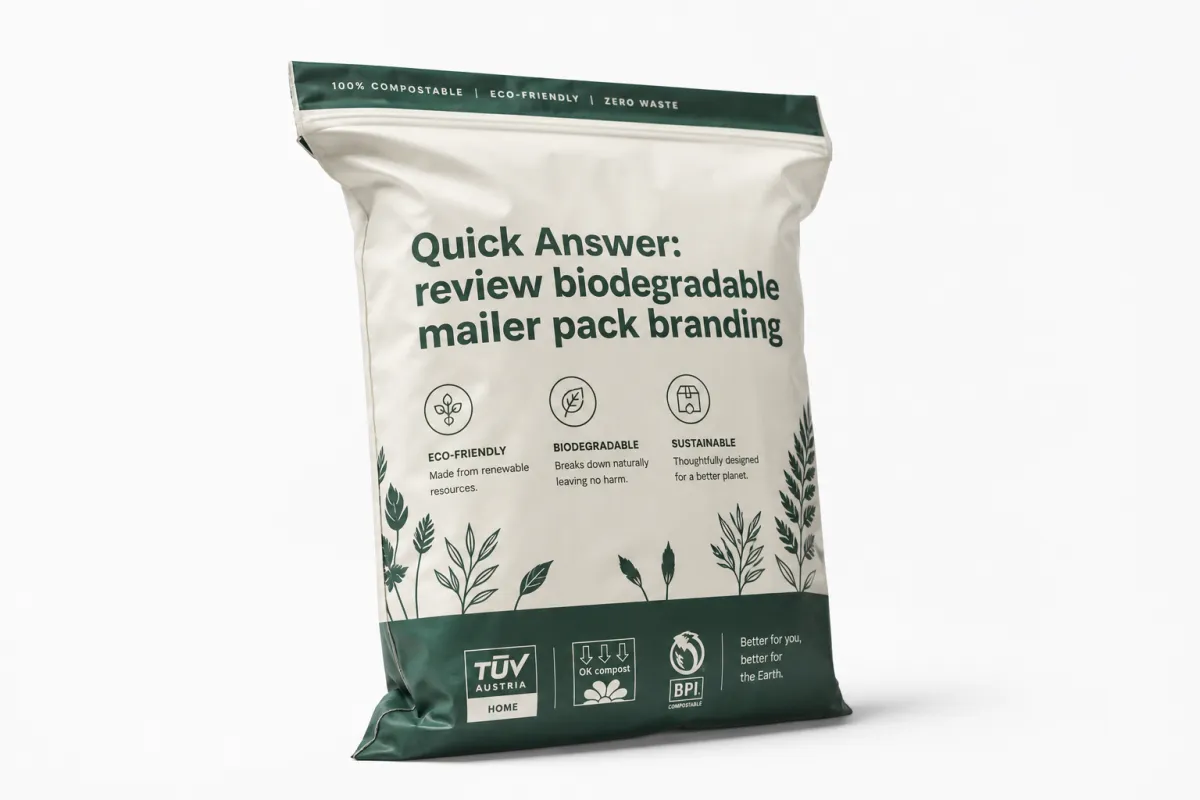
If I had to give the short, honest verdict on review biodegradable mailer pack branding, it would be this: the best choice is usually not the flashiest art direction and not the lowest quote. The right answer is the option that keeps folds clean, handles moisture well, and stays readable after a rough ride through the warehouse and carrier network.
From a packaging buyer's point of view, review biodegradable mailer pack branding should be measured against five things: visual impact, durability, sustainability claims, shipping performance, and the premium feel a customer notices the second the parcel lands on the doorstep. That last piece carries more weight than many teams expect. The mailer is not just a shipping sleeve; it is part of the brand system and shapes the first physical impression before the product is even visible.
A mailer can look beautiful in a mockup and still lose its value if the logo cracks at the fold or the color turns muddy after the first hard handoff.
The practical answer is pretty straightforward: for strong brand presentation, review biodegradable mailer pack branding usually favors materials and print methods that balance clean folding, stable color, and a surface that does not blotch under warehouse light or damp shipping conditions. That difference is what separates a pack that feels intentional from one that feels temporary.
- Best for premium feel: smoother kraft or film-based mailers with restrained graphics and tight registration.
- Best for simple branding: one-color marks, label-style branding, or a short, bold message on a clean front panel.
- Best for real shipping: materials that pass a basic drop, crush, and rub test before launch.
- Best for sustainability messaging: a format with documented material claims, not just eco-looking artwork.
That is the lens I use throughout review biodegradable mailer pack branding: not whether the design looks good on a computer screen, but whether it still looks good after the fold, the seal, the truck ride, and the unboxing moment. That is the whole ballgame, kinda.
Top Options Compared for review biodegradable mailer pack branding
Four material families show up most often in review biodegradable mailer pack branding: kraft-based mailers, compostable film mailers, recycled-content poly mailers, and padded mailers for lighter fragile goods. Each one sends a different signal, and each one behaves differently once ink, adhesive, and shipping stress enter the picture.
Kraft-based mailers give a natural, earthy look that works well for organic brands, wellness labels, and any line that wants a calmer visual language. Compostable film mailers usually feel cleaner and more modern, with smoother print surfaces and better moisture behavior. Recycled-content poly mailers remain a useful benchmark in review biodegradable mailer pack branding because they often produce the sharpest print and the most consistent color, even if they are not the final sustainability choice for every brand. Padded options help when the pack itself has to absorb more abuse, though they add bulk and can reduce the visual simplicity of the design.
The biggest trade-off is print fidelity versus material character. A rough kraft face can make a brand look honest and understated, but small logos and fine type can lose clarity. A smooth film can hold detail better, yet if the art direction gets crowded, the result can feel generic. In review biodegradable mailer pack branding, I usually recommend a design that respects the surface instead of fighting it.
| Option | Visual effect | Print behavior | Shipping durability | Typical 5,000-unit range |
|---|---|---|---|---|
| Kraft-based mailer | Natural, warm, handmade feel | Good for one to two colors; fine detail can soften | Fair to good, depending on basis weight and seam strength | $0.24-$0.48 each |
| Compostable film mailer | Cleaner, more modern, more uniform | Strong for tighter graphics and small type | Good moisture behavior, good fold consistency | $0.28-$0.62 each |
| Recycled-content poly mailer | Bright, crisp, highly legible | Very strong print clarity and color consistency | Very good tear resistance | $0.18-$0.40 each |
| Padded mailer | Substantial, more protective, less minimal | Print area can be interrupted by padding structure | Best for fragile, small, or premium inserts | $0.38-$0.85 each |
What does the customer see first? Usually the front panel, the logo, and the closure line. What communicates fastest? A clean, confident mark and a material that looks deliberate instead of disposable. In review biodegradable mailer pack branding, the strongest choice is the one that keeps the presentation consistent from shelf to door, and from the pack photo to the real parcel in hand.
That is why some brands also compare the mailer against other branded packaging formats like Custom Poly Mailers and even Case Studies that show how package branding affects perception across different product packaging styles. A mailer is only one part of the larger retail packaging story, but it is often the one customers touch first.
Detailed Reviews of review biodegradable mailer pack branding styles
Here is where review biodegradable mailer pack branding becomes more useful than a simple material list. The surface finish, print method, and closure structure all change the result in the hand. A good mockup can hide those issues, but a real production sample will not.
Kraft-based mailers
Kraft-based mailers are the easiest place to start if the brand wants a natural, credible look. In review biodegradable mailer pack branding, kraft often performs best with one-color or two-color graphics, especially when the logo is bold and the negative space is respected. The texture can add character, but it also makes tiny type less reliable. If the brand mark depends on thin strokes or subtle gradients, kraft can flatten the design very quickly.
I like kraft for apparel, small accessories, and subscription kits that need an honest, tactile unboxing experience. It feels grounded and familiar. The downside is that moisture, scuffing, and crease memory can show up sooner than teams expect, so the artwork should avoid critical details near seams and flap edges.
Compostable film mailers
Compostable films often give the cleanest look in review biodegradable mailer pack branding because the print surface is smoother and more uniform. That helps linework, small logos, and solid color blocks hold up better. The surface usually reads more contemporary than kraft, which is useful for beauty, lifestyle, and premium direct-to-consumer brands that want a minimal but polished package branding style.
The caution is that not every "eco" film is the same, and not every claim belongs on the outside of the pack without support. If the film is certified compostable, the claim language should match the certification and market. I also tell buyers to check whether the closing adhesive behaves cleanly in heat or humidity, because some films hold the print well but lose a bit of confidence at the seal line.
Recycled-content poly mailers
Even though this is not the final sustainability answer for every buyer, recycled-content poly mailers are a useful benchmark in review biodegradable mailer pack branding because they show what high clarity looks like. If a design looks weak on recycled-content poly, it usually means the art is underdeveloped, not that the material is the problem. The material can carry fine detail, strong contrast, and a brighter color range than rougher substrates.
The trade-off is perception. Some customers immediately read poly as less premium or less eco-forward, even if the recycled content is meaningful. That makes print strategy more important. A restrained layout, a well-placed logo, and a disciplined color palette can help the pack look modern rather than generic.
Padded mailers
Padded mailers deserve a separate note because protection changes branding behavior. In review biodegradable mailer pack branding, the padding structure can distort a logo, break a continuous background, and make a flat graphic look uneven once the product is inside. For fragile beauty sets, low-weight electronics, or accessory kits with hard edges, the extra protection can be worth it, but the design should avoid relying on perfect flatness.
Honestly, padded mailers work best when the design is intentionally simple. A bold mark, a clear message, and a limited palette look better than a complex full-coverage render. If the brand wants a more editorial look, custom printed boxes may be the better choice because rigid packaging gives the artwork more control and keeps the panel geometry stable.
Finishing choices matter too. Matte tends to read more premium on this kind of pack, while gloss can look louder but also more vulnerable to fingerprints and rub marks. Spot color often gives a cleaner result than a crowded full-color build, especially if the print area is broken by the flap or seal. Embossing and debossing are far less common on flexible mailers than on cartons, so I would not plan a branding strategy around them unless the format is unusually heavy or laminated. In review biodegradable mailer pack branding, simplicity often survives shipping better than ornament.
A quick reality check helps here: if the logo still reads cleanly after folding, sealing, rub testing, and transit stress, the design is probably strong. If it only looks good in a design file, the production version may disappoint. That is the heart of review biodegradable mailer pack branding, and it is where experience on the packaging floor really matters.
Cost and pricing: what review biodegradable mailer pack branding really costs
The unit price is only one line on the quote, and it is not even the most useful one in review biodegradable mailer pack branding. Buyers need to look at the full stack: setup charges, prepress, sample runs, print plates or screens, material choice, coatings, freight, palletizing, and any special cartons or overpacks needed to protect the shipment.
For smaller runs, the setup cost can dominate the total. A simple branded label on a stock mailer may land far below a fully custom print job, and that difference can matter a lot if the SKU is still changing. For larger runs, the unit price usually improves, but the total commitment rises fast, which is why I like to compare landed cost instead of factory-only pricing. In review biodegradable mailer pack branding, a quote that looks cheap on paper can become expensive once shipping and customs are added.
| Cost item | What drives it | Buyer note |
|---|---|---|
| Artwork and prepress | File cleanup, trapping, color separations | Ask whether vector setup and proof rounds are included |
| Printing method | Flexographic, digital, screen, or label application | More colors usually mean more cost and more setup |
| Material choice | FSC paper, compostable film, recycled content, padding | Surface quality and certification affect price quickly |
| MOQ | Supplier minimums and press economics | Lower MOQ often means a higher unit price |
| Freight and packing | Pallet count, carton strength, route, and destination | Do not ignore shipping; it changes the landed number a lot |
Typical budget ranges I see for review biodegradable mailer pack branding are broad for a reason. A simple one-color run on a clean mailer may sit around $0.18-$0.38 per unit at moderate volume, while a more premium full-coverage build can move into the $0.35-$0.75 range or higher depending on substrate and finish. If the supplier quotes well below that, ask what is missing. It may be freight, sample approval, or the very print quality you need most.
Minimum order quantities usually start around 1,000 to 3,000 units for custom jobs, though some suppliers can go lower with digital methods or label-based branding. That is why I often suggest a staged rollout: first a test batch, then a larger run once the design and material prove themselves. A launch does not need to commit to the largest possible order on day one. In review biodegradable mailer pack branding, a controlled first order can save real money by catching weaknesses before the main spend lands.
If the brand is still deciding between mailers and other formats, a hybrid path can help. For example, a launch might use Custom Labels & Tags on a stock mailer for the first drop, then move to a fully printed run once the visual system is locked. That is often smarter than rushing into a large custom order before the artwork, claims, and fulfillment flow are stable.
Process, timeline, and lead time for review biodegradable mailer pack branding
The cleanest review biodegradable mailer pack branding jobs follow a predictable path, and the delays usually happen when one of the early steps gets rushed. The more precise the file handoff, the easier the rest of the production flow becomes.
- Design review: confirm dimensions, bleed, safe zones, closure area, and where the logo should avoid folds.
- File prep: build vector artwork, separate colors properly, and make sure sustainability claims are accurate and approved.
- Proofing: review digital or physical proofs under normal warehouse light, not only on a bright screen.
- Sampling: test a real sample with product inside, because fill weight changes how the pack sits and closes.
- Production approval: lock the final version only after the sample behaves the way you need.
- Printing and finishing: run the job, check color, and confirm the folds and seals stay consistent.
- Packing and shipment: protect cartons and pallets so the printed surface does not arrive scuffed before use.
In practice, repeat jobs can move in about 10 to 15 business days after proof approval if the material is in stock and the artwork is already dialed in. New custom jobs often need 12 to 20 business days, and special materials or heavy print coverage can push that longer. If the order has to cross borders, transit time can matter as much as factory time. That is why review biodegradable mailer pack branding should always be tied to a realistic launch calendar, not just a promised print date.
Buyers should ask a few direct questions before approving any order: Does the lead time include production only, or production plus shipping? Are samples available before mass production? Is the supplier quoting air freight, sea freight, or ex-works? And how many proof rounds are included? Those answers save time, especially when packaging design changes late in the process.
For transit expectations, I like to think in terms of package integrity rather than just delivery date. The broader logic behind ISTA methods is useful here because it reminds buyers to test drops, vibration, compression, and handling, not just print appearance. For broader material and waste context, the public guidance at EPA is a good reminder that sustainability claims should be grounded in real material behavior, not just green language.
That approach keeps review biodegradable mailer pack branding practical. It turns the process into a controlled sequence instead of a rush to press, and it gives the team room to catch issues like fold cracking, adhesive squeeze-out, or color drift before the first customer sees the pack.
How to choose the right review biodegradable mailer pack branding
The easiest way to choose in review biodegradable mailer pack branding is to ask three blunt questions: what must the pack protect, what should the customer feel, and what must the brand communicate in five seconds or less? If those answers are clear, the material choice becomes much easier.
For light apparel and soft goods, a cleaner mailer with simple branding often works better than an overdesigned one. For beauty, subscription kits, and influencer send-outs, the unboxing experience usually matters more, so surface quality and color stability deserve more attention. For items that need stronger protection, the format may need padding or a tougher closure, even if that means a slightly less minimal look. In review biodegradable mailer pack branding, the right choice is the one that fits the product journey, not the one that looks best in isolation.
I also advise teams to score options on a simple matrix:
- Product weight: light, medium, or fragile.
- Shipping route: local, regional, cross-country, or export.
- Visual goal: natural, premium, technical, or low-key.
- Sustainability claim: recyclable, compostable, recycled content, or FSC paper.
- Brand identity: loud, restrained, playful, or editorial.
That scoring model keeps review biodegradable mailer pack branding grounded. It stops the team from choosing a surface just because it looks nice in a render. It also makes it easier to defend the final choice internally, especially if finance, operations, and marketing all want different outcomes.
Claim language deserves real care. A mailer that says biodegradable, compostable, or recyclable should be backed by the right standard and by the actual structure of the pack. For paper components, FSC chain-of-custody can matter. For compostable structures, the relevant testing and claim language should match the market and substrate. ASTM references like D6400 or D6868 may come up depending on the construction, but the exact fit depends on the material itself. In other words, not every green claim belongs on every pack, and review biodegradable mailer pack branding should treat claims as part of the design, not as a decorative afterthought.
If you need a broader packaging reference point, the right call can change once the mailer is compared to custom printed boxes or other retail packaging. Mailers are excellent for speed and efficiency; cartons are better when the brand wants more structure and a larger surface for storytelling. There is no single winner, only the right fit for the shipping job and the brand message.
Before approval, run a real-world checklist:
- Inspect the sample under warehouse light and natural light.
- Fill it with the actual product weight.
- Seal it and flex the fold line.
- Shake it, stack it, and carry it like a worker would.
- Ship it once and inspect the branding after delivery.
That test sounds simple, but it exposes problems fast. Logos creep. Ink rubs. Flaps curl. Corners whiten. In review biodegradable mailer pack branding, that one real shipment often tells you more than a week of internal debate.
For brands that want a more documented comparison set, the strongest route is to test a mailer against a second option and look at the customer reaction, not just the spec sheet. That is why many teams review Case Studies before locking the final format: they want to see what happens to brand perception once the parcel leaves the studio and enters the fulfillment stream.
Our Recommendation: next steps for review biodegradable mailer pack branding
If you want the shortest honest recommendation from review biodegradable mailer pack branding, here it is: choose a smoother, more stable surface for premium presentation, choose a simpler layout if the pack has to survive rough shipping, and choose the material that matches the claim you are willing to stand behind.
For premium feel, I would lean toward a compostable film or a clean kraft option with restrained one- or two-color branding. For budget control, a stock mailer with a strong label or tag system can bridge the gap while the product line is still moving. For the best balance of durability and sustainability positioning, a well-made certified compostable or FSC-based option with disciplined artwork often gives the most credible result. That is the path I would put in front of a buyer who wants review biodegradable mailer pack branding to hold up in real life rather than only in a sales deck.
Next, ask suppliers for three things: printed samples, an itemized spec sheet with MOQ and unit cost, and a timeline that separates proofing from production and shipping. Then run a side-by-side test using the same logo, the same fill weight, and the same packing workflow. That comparison is far more useful than comparing pictures, because it shows how the branding behaves in the same operating conditions. For teams comparing flexible formats, Custom Poly Mailers can be a helpful benchmark even if the final choice is a biodegradable structure.
My rollout advice is simple. Start with a test batch. Inspect returns and customer photos. Check whether the logo is still crisp after transit. Then scale only after the pack proves that the branding survives the real shipping path. That is the discipline that separates attractive packaging design from dependable product packaging, and it is the approach that keeps package branding aligned with actual operations.
In my own sample reviews, the packs that win are usually not the loudest ones. They are the ones that stay clean after being handled by tired warehouse hands, sorted into cartons, and opened at a kitchen table with one quick tear. That is the standard I keep coming back to, and it is the one I would trust for review biodegradable mailer pack branding.
The final takeaway is simple: pick the material and print system that still looks credible after real shipment stress, then approve the artwork only after a live sample proves the claim, the finish, and the fold all work together.
Frequently Asked Questions
How do I review biodegradable mailer pack branding samples?
Check the logo edge quality, color consistency, and whether the surface shows scuffs after folding and sealing. Then fill the mailer with an actual product and inspect how review biodegradable mailer pack branding holds up after handling, taping, and a basic transit stress test. I also like to compare the sample under both natural light and warehouse light, because some finishes shift more than expected indoors.
What is the best print method for biodegradable mailer pack branding?
The best print method depends on the material. Smooth films can carry finer graphics, while rougher kraft surfaces often look better with simple one-color or two-color branding. In review biodegradable mailer pack branding, I always ask for the smallest readable text size on a proof before approving production, because tiny type is where many jobs fall apart.
How much does biodegradable mailer pack branding usually cost?
Price depends on material, print coverage, MOQ, setup charges, and freight, so the unit price alone does not tell the full story. Smaller runs usually cost more per pack, while larger runs reduce the unit cost but increase total commitment. That is why review biodegradable mailer pack branding should always include an itemized quote, not just a single factory number.
What lead time should I expect for biodegradable mailer pack branding?
Lead time usually includes artwork approval, sampling, production, and shipping, so clarify which part the supplier is quoting. Straightforward repeat jobs move faster than new custom artwork or jobs that require extra proofing for color or claims. For review biodegradable mailer pack branding, I would build buffer time into every launch, especially if the packs must arrive before a campaign or product release.
How do I choose the right biodegradable mailer pack branding for my product?
Start with product weight, shipping distance, and how much protection the pack needs during transit. Then compare brand goals: natural look, premium feel, bold shelf presence, or low-key functional branding. The best results usually come from testing two or three options in real packing conditions before locking the final format, because review biodegradable mailer pack branding only becomes clear once the pack has been sealed, shipped, and opened by a real customer.


