Buyer Fit Snapshot
| Best fit | biodegradable mailer sleeve graphics buyer review for packaging buyers comparing material specs, print proof, MOQ, unit cost, freight, and repeat-order risk where brand print, material, artwork control, and repeat-order consistency matter. |
|---|---|
| Quote inputs | Share finished size, material target, print colors, finish, packing count, annual reorder estimate, and delivery region. |
| Proofing check | Approve dieline scale, logo placement, barcode or warning zones, color tolerance, and any recyclable or compostable wording before bulk production. |
| Main risk | Vague material claims, crowded artwork, or missing packing details can create delays even when the unit price looks attractive. |
Fast answer: Biodegradable Mailer Sleeve Graphics Buyer Review: Film, Closure, Print, and Fulfillment should be specified like a repeatable production item. The safest quote includes material, print method, finish, artwork proof, carton packing, and reorder notes in one written spec.
What to confirm before approving the packaging proof
Check the product dimensions against the actual filled item, not only the sales mockup. Ask for tolerance on folds, seals, hang holes, label areas, and retail display edges. If the package carries a logo, QR code, warning copy, or legal claim, reserve that space before decorative graphics fill the panel.
How to compare quotes without losing quality
Compare board or film grade, print process, finish, sampling route, tooling charges, carton quantity, and freight assumptions side by side. A lower quote is only useful if the supplier can repeat the same color, closure quality, and packing count on the next order.
If you need to Review biodegradable mailer sleeve graphics with a buyer’s eye instead of a design-only eye, start with a simple truth from production: a sleeve can look polished on screen and still lose its footing once it is folded, stacked, rubbed, and carried through a real shipping flow. I have seen beautiful mockups go sideways the moment the paper hit a crease, and I have also seen modest artwork come through looking sharper than expected because the stock, ink, and fold behavior were all working together. That is why the best review biodegradable mailer sleeve graphics decisions come from samples, not renderings, and from checking how the print behaves on the actual substrate rather than trusting the brightness of a digital proof.
From a packaging buyer’s point of view, the right sleeve is the one that holds together print clarity, fold durability, and material compatibility without forcing the artwork to carry the whole package on its back. A sleeve should also fit the wider system, especially if the outer shipper needs to feel visually connected. In many programs, it helps to compare the sleeve against matching Custom Poly Mailers so the branding reads like one deliberate set rather than a few disconnected pieces. That is the lens I use here: sample-based, practical, and grounded in how review biodegradable mailer sleeve graphics choices behave in hand, in transit, and at first touch.
“A good biodegradable sleeve does not just look eco-minded; it has to print cleanly, survive rubbing, and still make sense after the box has been opened and refolded.”
The purpose here is straightforward: help you compare finishes, read the pricing signals, and avoid choosing the prettiest artwork over the most dependable production spec. If the packaging has to survive warehouse handling, shelf display, and postal wear, then review biodegradable mailer sleeve graphics becomes a packaging decision rooted in use, not style alone.
Quick Answer: Review Biodegradable Mailer Sleeve Graphics at a Glance
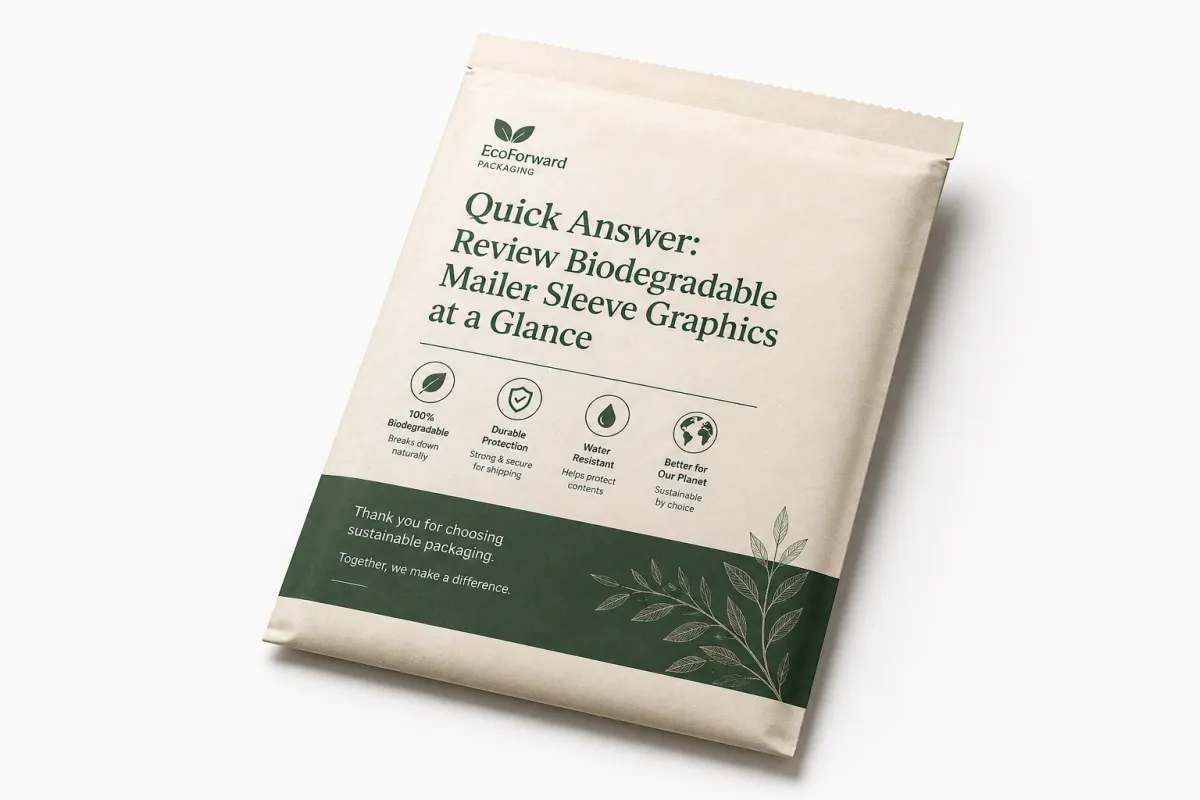
The short version I give buyers who need to review biodegradable mailer sleeve graphics without getting buried in design talk is simple: the best sleeves stay readable after folding, stacking, and transit abrasion. Almost any layout can look sharp on a monitor. The real test comes later, where scuffing at the fold, weak contrast on kraft, or a hairline logo stroke that disappears on textured stock can make the whole package feel less finished than it should.
The strongest review biodegradable mailer sleeve graphics choices hold three things in balance at once: print clarity, fold durability, and substrate fit. Bright artwork alone does not make the sleeve better. A restrained one-color design on a natural paper stock often performs better than a dense full-bleed concept because it stays legible, keeps the eco story believable, and avoids the muddy look that shows up when heavy ink loads sit on uncoated fiber.
What follows is a practical comparison of graphic styles, finish behavior, cost drivers, and the sample results that deserve your trust. I am looking at how the sleeve appears in the hand, how it survives rough shipping routes, and how honestly the printed message matches the material. That is the real standard behind review biodegradable mailer sleeve graphics.
For Brands That Ship often, I would rather see a design with confident contrast and a little restraint than a sleeve that tries to do too much at once. The most attractive review biodegradable mailer sleeve graphics sample is not always the most colorful one; it is the one that still looks deliberate after the first crease and the second touch.
For teams comparing several mockups, keep one question in front of you: does the sleeve still communicate the brand after the package has gone through a normal shipping life? If the answer is yes, the design is probably on the right track. If the answer depends on perfect lighting and an untouched desk sample, then review biodegradable mailer sleeve graphics should continue before production gets locked.
Top Options Compared for Review Biodegradable Mailer Sleeve Graphics
When I review biodegradable mailer sleeve graphics options, I usually narrow the field to four practical directions: minimal one-color branding, full-coverage illustration, earthy kraft-style design, and a more premium matte or soft-touch look. Each path can work well, but each one solves a different business problem. The right answer depends on whether the sleeve is supporting mass shipping, boutique retail pickup, subscriptions, or a gift-like unboxing moment.
Minimal layouts are usually the safest choice for volume. A single strong logo, a short line of copy, and clean contrast can survive a wider range of print conditions. Full-coverage graphics create more impact, especially for direct-to-consumer brands, but they also raise ink cost and can flatten the natural fiber character that often makes biodegradable packaging feel believable. If you want to review biodegradable mailer sleeve graphics honestly, you have to decide whether the brand needs visual energy or material honesty more.
Kraft-style graphics often work well for eco-oriented brands because they let the substrate speak. The texture, the subtle color variation, and the uncoated feel all reinforce the message, as long as the typography is bold enough to hold its shape. Premium matte or soft-touch looks can also be effective, but only if the finish does not make the sleeve feel like it is pretending to be plastic. That tension matters every time I review biodegradable mailer sleeve graphics for a buyer who wants polish without losing the natural look.
White ink can be a strong tool on darker or brown stocks, but it needs careful testing because opacity and registration vary across equipment. Fine line work, small QR codes, and delicate icons need extra tolerance on textured surfaces. If your graphics depend on micro text or thin rules, the sample has to prove those details are still readable under normal handling. That is one of the first things I check when I review biodegradable mailer sleeve graphics.
| Graphic Approach | Best Use | Typical Unit Cost Impact | Durability Notes | Reviewer Verdict |
|---|---|---|---|---|
| Minimal one-color branding | High-volume shipping, clean brand systems | Lowest to moderate | Usually strongest for fold wear and abrasion | Best all-around choice for most buyers |
| Full-coverage illustration | DTC unboxing, seasonal campaigns | Moderate to higher | Can show rub marks more clearly on dense coverage | High impact, but test the real sample first |
| Kraft-style natural design | Eco brands, craft goods, gifting | Moderate | Very credible visually, but fine detail may soften | Strong if contrast is managed well |
| Matte or soft-touch premium look | Boutique retail, subscription packaging | Moderate to highest | Can feel premium, yet may not suit every biodegradable message | Use only when finish and story match |
My practical read is simple: the top option is the one that still looks intentional after folding, stacking, and transit abrasion. That is the difference between a sample that photographs well and a sleeve that actually earns its keep. If you want to review biodegradable mailer sleeve graphics the right way, compare at least two graphic directions side by side and rough them up a bit. The winner should stay clear without looking overdesigned.
Think about the customer touchpoint as well. A shipping sleeve that lives inside a branded box can be more restrained because the rest of the package is carrying some of the visual load. A sleeve visible on a shelf or handed over at pickup needs stronger presence. That is why I do not treat review biodegradable mailer sleeve graphics as a style preference exercise; I treat it as a use-case decision.
Detailed Review of Biodegradable Mailer Sleeve Graphics Materials
The substrate changes everything, and that is where a lot of buyers get surprised when they review biodegradable mailer sleeve graphics for the first time. Kraft paper, compostable paper blends, coated paperboard-style sleeves, and other biodegradable formats all accept ink differently. Some give you a warm, honest look with visible texture. Others hold sharper detail but give up some of the earthy character people expect from sustainable packaging.
Kraft stocks usually bring the most authenticity. They work well when the brand story depends on visible fiber, muted tone, and a natural hand feel. The tradeoff is color shift: muted blues can dull, pale colors can disappear, and thin typography can break apart. A more refined paper blend may hold registration better, but it can also reduce the raw look that many buyers want. That is why I always say you need to review biodegradable mailer sleeve graphics in the actual stock, not just in a digital proof.
Surface texture affects design more than people expect. Rougher surfaces soften gradients, blur delicate line art, and make tiny type harder to read. They also add a bit of friction against neighboring cartons, which means you should watch for rub-off at the edges and folds. If the sleeve wraps over more than one panel, the graphics need enough margin so the fold does not cut through an essential word or icon. When I review biodegradable mailer sleeve graphics, I look at the fold line first and the hero art second.
Durability is not only about whether the sleeve tears. It is also about whether the printed message survives handling without looking tired. Better sleeves resist edge wear and do not crack sharply at the crease. The print should not peel or streak where the material is compressed. In a typical shipping environment, I want to see the graphics remain clear after being opened, refolded, and carried by hand. That practical check sits at the center of every serious review biodegradable mailer sleeve graphics decision.
Brand perception matters too. Natural fibers and low-gloss finishes usually read as more credible for eco-focused packaging because they match the biodegradable story. A sleeve that is too slick or too glossy can create a mismatch: the printed message says sustainable, but the visual feel says coated promo piece. That does not mean a premium finish is wrong. It means the finish has to fit the material and the message, which is exactly what I look for when I review biodegradable mailer sleeve graphics.
For buyers who need a stronger reference point, it is sensible to check packaging claims against recognized standards and certifications rather than marketing language alone. FSC certification can support responsible paper sourcing, while transit testing such as ISTA-style evaluation helps show whether the pack can endure real handling. You can start with the organizations themselves at FSC and ISTA. For material claims involving compostability, local rules and accepted standards such as ASTM D6400 or EN 13432 may matter, but the right claim depends on the actual substrate and the end-of-life pathway. I say that plainly because a package can look sustainable and still fail the claim if the material spec does not support it.
I also like to inspect the sample under two kinds of light. Warehouse lighting reveals weak contrast quickly. Natural light makes the texture and finish easier to judge. That dual check shows whether the sleeve still reads as premium and honest, or whether the graphics are carrying the material farther than the material can go. In practice, that often separates a clean review biodegradable mailer sleeve graphics result from a disappointing one.
If you are building a packaging system, pair the sleeve with the outer mailer or carton before making the final call. A good sleeve should complement the outer shipper, not compete with it. Matching tone, paper feel, and print density often create a stronger brand impression than any single component can create alone. A well-balanced set usually outperforms a louder sleeve, especially once the full shipment is assembled and handled.
People often underestimate how much the substrate controls the final design outcome. Artwork may be excellent, but if the stock is too rough for the line weight or too absorbent for the color target, the result will always look compromised. The best way to review biodegradable mailer sleeve graphics is to judge the image, the paper, and the folding behavior as one system.
Process and Timeline: From Proof to Production
A normal production flow starts with artwork handoff, dieline check, digital proof, color approval, production scheduling, printing, finishing, die cutting, and final packing. That sounds tidy on paper, but every one of those steps can change the schedule if the files are not ready. When a team tries to review biodegradable mailer sleeve graphics late in the process, delays usually come from avoidable mistakes: missing bleeds, fonts not outlined, unclear sustainability claims, or a dieline that does not match the physical spec.
Color approval is where many projects slow down. Kraft stock, white ink, and layered graphics all behave differently from coated art paper, so a digital proof is useful mainly as a direction. If color fidelity matters, ask for a hard proof or sample run. That matters especially when the brand depends on a specific green, a soft neutral, or a bright logo color that has to stay readable on a textured surface. A serious review biodegradable mailer sleeve graphics process includes a proof that reflects real production conditions.
The quickest way to shorten turnaround is to keep the copy final, send vector artwork, confirm Pantone targets early, and avoid late-stage changes to claims or layout. Every revision invites another check on registration, bleed, and print fit. If the sleeve needs to work with other packaging components, lock those dimensions early so the system stays aligned. That discipline matters more than most teams expect when they review biodegradable mailer sleeve graphics against a fixed launch date.
I also recommend thinking about quantity from the start. Small runs are useful for validation, but they take a larger amount of setup time per unit. Larger runs often move more efficiently once the press is dialed in, but only if the artwork is ready and the proof has been signed off cleanly. In other words, the schedule is driven less by press speed and more by how complete the file package is when you begin the review biodegradable mailer sleeve graphics process.
Here is the practical sequence I prefer:
- Confirm the substrate and sleeve dimensions.
- Check the artwork against the dieline before proofing.
- Approve the digital proof, then request a material sample if the finish is critical.
- Validate readability, fold behavior, and rub resistance.
- Lock production only after the sample matches the brand expectation.
That sequence sounds basic, but it prevents most expensive surprises. If the sleeve will be shown at retail, sent through parcel networks, or stacked in bulk before fulfillment, the sample should be treated as a real test, not a formality. That mindset keeps review biodegradable mailer sleeve graphics grounded in actual use instead of presentation slides.
Cost and Pricing: MOQ, Quote, and Unit Cost Factors
Price is where the conversation usually gets real, and it should. When buyers review biodegradable mailer sleeve graphics, the quote often changes faster than expected because several variables stack together: quantity, sheet size, ink coverage, color count, finish, die work, and any assembly or packing step that adds labor. If the sleeve uses a specialty paper or a more elaborate print method, the unit cost can climb quickly even when the artwork itself looks simple.
MOQ matters because setup costs need somewhere to land. Plate charges, press calibration, and proofing effort are spread across the run, so small orders often carry a noticeably higher per-unit price. That does not make small runs a bad choice. It just means buyers should use them for testing or limited launches rather than expecting the same economics as a larger production order. I would rather see a client review biodegradable mailer sleeve graphics with a controlled test run than commit to a large quantity before the print behavior is proven.
Full-bleed artwork, white ink on kraft, custom coatings, and repeated proof rounds are the common pricing traps. They do not always double the quote, but they can shift the number enough to affect margin. The best quote request spells out substrate, finish, quantity tiers, and whether artwork changes are included. If a supplier has to guess, the estimate usually comes back wider than it needs to be. Good review biodegradable mailer sleeve graphics planning keeps the quote clean and the scope specific.
Here is a practical pricing snapshot I would use as a starting point for conversations, assuming a standard sleeve format and typical production conditions. These are not promises; they are the kinds of ranges that help buyers understand where the money goes.
| Option | Typical Order Size | Approx. Unit Price Range | Main Cost Driver | Best Fit |
|---|---|---|---|---|
| Simple one-color kraft sleeve | 5,000 pieces | $0.18-$0.28 | Setup spread across quantity | Volume shipping, clean branding |
| Two- to three-color branded sleeve | 5,000 pieces | $0.24-$0.38 | Ink coverage and registration | Retail-friendly presentation |
| Full-coverage illustrated sleeve | 5,000 pieces | $0.30-$0.55 | Heavy print area and press time | DTC unboxing and seasonal launches |
| Premium finish or specialty stock | 5,000 pieces | $0.42-$0.78 | Material upgrade and extra finishing | Boutique retail or gift packaging |
The cheapest sleeve is not always the best value. A sleeve that scuffs, tears, or loses readability can cost more in customer perception than it saves on the order line. I have seen buyers save a few cents and then lose the premium look they were trying to create. That is why I always tell clients to evaluate review biodegradable mailer sleeve graphics using both unit cost and the long-term impression the packaging creates.
For a clean quote, ask for pricing at two or three quantities, define the finish clearly, and separate design revision costs from production costs. If a quote bundles everything together without explanation, it becomes harder to compare vendors. A useful request might look like this: same artwork, same substrate, same finish, different quantities. That makes the economics easier to read and helps review biodegradable mailer sleeve graphics on an apples-to-apples basis.
If you are already comparing outer packaging, it may help to pair the sleeve estimate with a second quote for matching mailers or shipping components. Our Custom Poly Mailers page is a good place to start if you need the outer shipper to stay visually aligned with the sleeve system. That kind of cross-check is often where a packaging program gets smarter, because the numbers and the branding are reviewed together instead of separately.
How to Choose the Right Biodegradable Mailer Sleeve Graphics
If you want to review biodegradable mailer sleeve graphics with a clear decision rule, start with brand fit. A fast-moving ecommerce brand usually needs bold contrast, simple hierarchy, and graphics that stay readable in a warehouse. A boutique or gift-driven brand may want more warmth, more texture, and a quieter layout that feels tactile and considered. The wrong design style can make the packaging feel disconnected from the product, even if the print quality is high.
Readability should be checked before anything else. The logo, brand name, and primary message need to stay legible at arm’s length, under warehouse light, and when the sleeve is partly folded. If the eye has to work too hard, the packaging loses its job. That is especially true on kraft or other textured stocks, where thin fonts and low-contrast color systems can blur faster than expected. A disciplined review biodegradable mailer sleeve graphics process always starts with legibility.
Then comes the sustainability story. I am not impressed by green graphics that merely look eco-friendly. The material, ink load, and finish need to support the claim honestly. FSC-certified paper can help support responsible sourcing, and a lower-gloss or uncoated finish often fits the biodegradable message better than a high-gloss treatment. If the package is meant to communicate compostability or recyclability, the printed claims need to match the actual material and the regional recovery pathway. Otherwise, the graphics may look right while the story falls apart. That is one reason I review biodegradable mailer sleeve graphics with a skeptical eye when the marketing copy sounds too polished.
Sample testing is the final filter, and it should be more than a quick glance. Compare two or three versions side by side, then fold them, stack them, and move them around a little. Look for rub marks, color shift, and whether the sleeve still looks premium after handling. The best sample is not the one that stays perfect forever; it is the one that still feels trustworthy after normal use. That is the most useful way to review biodegradable mailer sleeve graphics before placing a larger order.
Here are the decision rules I use most often:
- Choose bolder graphics for retail display or high-visibility shipping moments.
- Choose quieter graphics when the brand is built on natural materials and restraint.
- Choose a more utilitarian layout if speed, cost, and readability matter most.
- Choose higher-contrast typography whenever the sleeve must survive rough handling.
- Choose the finish that supports the material instead of fighting it.
One thing people often miss is that the best-looking design in a presentation can be the weakest in the warehouse. I have seen delicate graphics disappear once the sleeve gets folded, and I have seen beautiful natural stocks lose their appeal under a coating that made them feel too slick. That is why I keep coming back to the same point: review biodegradable mailer sleeve graphics against the real use case, not against the mood board.
For brands that want a practical answer, I usually recommend a clear, high-contrast layout on a natural substrate with enough ink coverage to feel branded but not overworked. It is the safest path for most programs because it protects readability, supports the eco story, and keeps the print cost from drifting too far upward. In many cases, that is the right middle ground when you review biodegradable mailer sleeve graphics with both design and operations in mind.
Our Recommendation and Next Steps
My recommendation is direct: for most brands, the strongest choice is a clear layout on a natural biodegradable stock with strong contrast, modest ink coverage, and a finish that does not fight the substrate. That combination tends to survive shipping better, photograph cleanly, and feel believable to the customer. If you need to review biodegradable mailer sleeve graphics one last time before approval, compare the sample after folding, tapping, stacking, and moving it through a few handling steps. The design that still looks sharp is the one worth producing.
The shortlist method I like is simple. Narrow the options to two finishes, request printed samples, and compare them in real light after they have been handled a little. Then check whether the fold line cuts any essential information, whether the ink stays put, and whether the package still feels premium once the sample has lost its showroom polish. That last check matters because the customer will not see a perfect prototype; they will see packaging that has already lived a little. This part of the process turns review biodegradable mailer sleeve graphics into a practical quality control exercise.
From there, lock the artwork, confirm the quantity, verify the quote, and schedule the run only after the sample proves the graphics still look sharp under real conditions. If the sleeve is part of a larger mailer system, keep the outer packaging aligned so the whole brand story feels consistent. A sleeve and shipper that share the same visual discipline usually create a stronger package than either one can create alone. In that sense, review biodegradable mailer sleeve graphics is not only about sleeves; it is about the entire presentation the customer receives.
One final thought: do not let the sustainability message outrun the material reality. Buyers are more trusting now, and they can spot packaging that talks bigger than it performs. If the sleeve is honest, printable, durable enough for transit, and priced within the margin you need, it has done its job. The actionable move is simple: choose the sample that stays readable after a real handling pass, confirm the claim against the actual substrate, and approve production only once the sleeve still feels credible in warehouse light. That is the standard I use whenever I review biodegradable mailer sleeve graphics.
What should I check first when I review biodegradable mailer sleeve graphics samples?
Check whether the ink rubs off at the folds, seams, and corners after handling. Make sure small text, logos, and any QR or barcode remain readable on the actual substrate. Compare the sample in natural light and warehouse light so color shifts do not surprise you later.
Which finish usually looks best for biodegradable mailer sleeve graphics?
A matte or lightly coated finish often gives the cleanest premium look without hiding the material character. Uncoated kraft can feel the most natural, but it needs stronger contrast to keep graphics legible. Avoid choosing a finish only for appearance; test how it survives handling and transit wear first.
How many proof rounds should I expect before production starts?
Most projects need at least one digital proof round and sometimes a second round for color or dieline adjustments. If your sleeve uses white ink, tight registration, or special claims, expect more review before sign-off. Lock the artwork early so design changes do not push the production schedule.
What affects the quote for biodegradable mailer sleeve graphics the most?
Quantity is usually the biggest driver because setup costs spread across the order size. Ink coverage, special finishes, and custom dielines can raise the unit cost quickly. Ask for pricing at multiple quantities so you can see where the best value lands.
Can I order a small test run before a full production order?
Yes, and it is often the smartest move if the graphics need to perform in real shipping conditions. Use the test run to check scuffing, folding behavior, and customer-facing appearance. A small run can reveal whether the design supports the brand before you commit to a larger MOQ.

