Buyer Fit Snapshot
| Best fit | corrugated paper void fill options compared for packaging buyers comparing material specs, print proof, MOQ, unit cost, freight, and repeat-order risk where brand print, material, artwork control, and repeat-order consistency matter. |
|---|---|
| Quote inputs | Share finished size, material target, print colors, finish, packing count, annual reorder estimate, and delivery region. |
| Proofing check | Approve dieline scale, logo placement, barcode or warning zones, color tolerance, and any recyclable or compostable wording before bulk production. |
| Main risk | Vague material claims, crowded artwork, or missing packing details can create delays even when the unit price looks attractive. |
Fast answer: Corrugated Paper Void Fill Options Compared: Material, Print, MOQ, and Cost should be specified like a repeatable production item. The safest quote includes material, print method, finish, artwork proof, carton packing, and reorder notes in one written spec.
What to confirm before approving the packaging proof
Check the product dimensions against the actual filled item, not only the sales mockup. Ask for tolerance on folds, seals, hang holes, label areas, and retail display edges. If the package carries a logo, QR code, warning copy, or legal claim, reserve that space before decorative graphics fill the panel.
How to compare quotes without losing quality
Compare board or film grade, print process, finish, sampling route, tooling charges, carton quantity, and freight assumptions side by side. A lower quote is only useful if the supplier can repeat the same color, closure quality, and packing count on the next order.
Review Corrugated Paper Void Fill: Best Options Compared
A carton can look packed properly and still fail the minute it hits a conveyor, gets stacked a little too hard, or takes one rough corner in transit. The product shifts, rides upward, leans into a side panel, and the box ends up bruised in places nobody expected. That is why review corrugated Paper Void Fill matters: it gives you paper-based stabilization that actually holds product in place instead of just making a box feel full.
My short answer is simple. Review corrugated paper void fill works best as a movement-control tool. It closes dead space, keeps items from sliding, and creates a tighter pack than loose kraft or loosely wadded paper in a lot of shipping setups. It is not the cheapest option on every line, and it is not the right answer for every fragile item, but it solves a real packing problem that cheap filler often misses. If damage reduction, cleaner presentation, and a recyclable material story matter to your team, this category deserves a close look.
Review Corrugated Paper Void Fill: Quick Answer
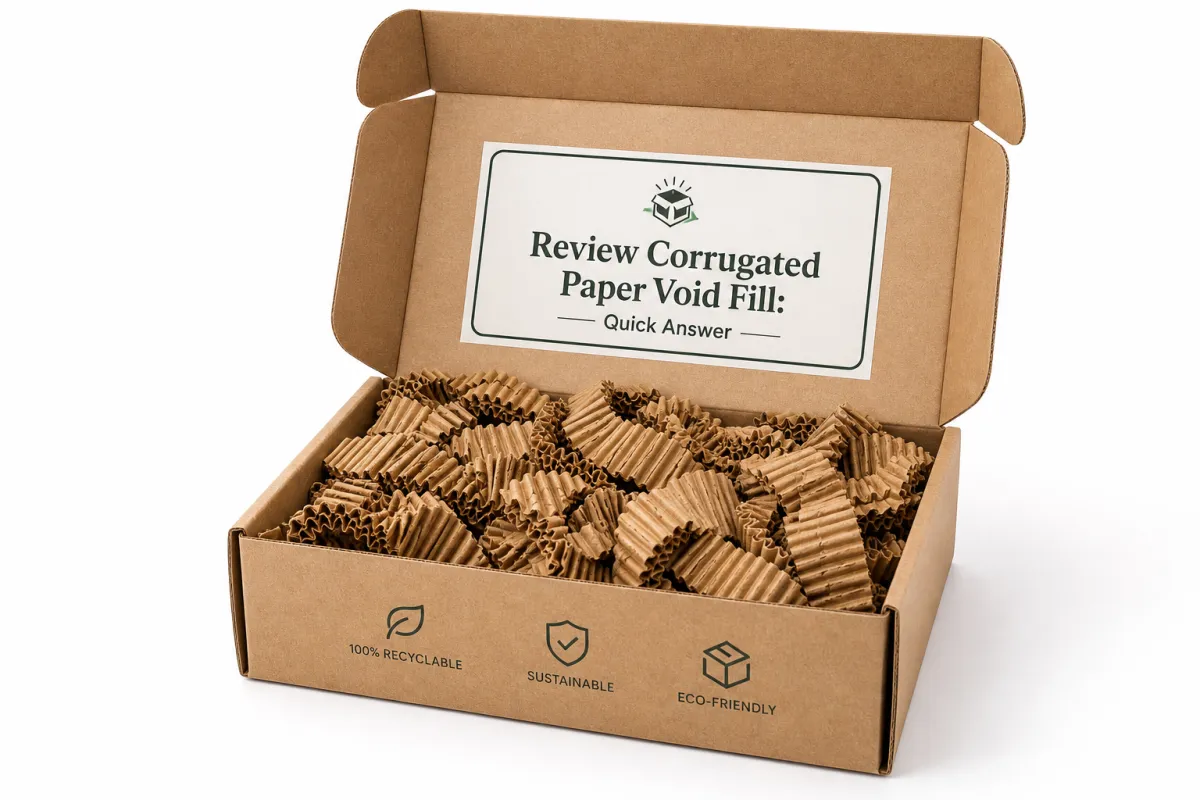
Review corrugated paper void fill from a packaging buyer’s point of view and the pattern shows up fast: it performs best when the problem is empty space, shifting product, and carton crush caused by internal movement. A box that rattles is already losing. Corrugated paper void fill gives you a denser, more structured way to brace the item in place than loose kraft paper or a soft paper pillow that collapses the second the carton gets handled roughly.
The real advantage comes from the fluted structure. Corrugated paper behaves more like a spring than a wad of paper, so it keeps some firmness after the box is closed and moved around. In practice, that means better load retention, less settling, and a pack that still feels snug after the first jolt in transit. For books, boxed kits, bottle multipacks, cosmetics, small appliances, and mixed-SKU orders, review corrugated paper void fill often looks smarter than plastic-based void fill because it fits the paper recycling story many brands want to present.
The tradeoff is just as straightforward. Review corrugated paper void fill is not the least expensive material on every order, and it is not a cure-all for ultra-fragile glass, high-value ceramics, or parcels where the product needs suspension-style cushioning. If the item needs true shock absorption, molded pulp, inserts, or a different protective system may be the better fit. If the item only needs to stop moving, this material is often right on target.
"If the box still sounds hollow when you shake it, the fill is not doing its job. The goal is not to look full. The goal is to stop movement."
Here are the review criteria I use for review corrugated paper void fill:
- Protection: does it stop product shift, top load, and carton bounce?
- Line speed: can packers keep moving without waiting on the filler?
- Waste: how much excess paper ends up in the bin or recycling stream?
- Recyclability: is the system clean, paper-based, and realistic for curbside recovery?
- Operator effort: does it train easily, or does it turn into a daily argument at the pack station?
- Total cost per carton: material, labor, downtime, and storage space all count.
If your shipments are lower-value and the biggest headache is random movement, review corrugated paper void fill usually beats loose kraft stuffed by hand. Fragile products that fail from drop energy need a different conversation. Not every paper fill performs the same way, and the best choice depends on carton size, product weight, and how much empty room needs to be controlled.
Top Corrugated Paper Void Fill Options Compared
There are three main ways to use review corrugated paper void fill in a real packing operation: preformed paper pads, automated paper void-fill machines, and simple manual dispensing systems. They are not equal, and that is the point. A small brand packing 40 orders a day should not buy the same setup as a warehouse sending 2,000 parcels during the afternoon rush. That would be expensive in all the wrong ways.
Preformed paper pads are the easiest to explain. They arrive ready to use, so the packer pulls a pad, places it, and moves on. They are a strong fit for low-volume teams, pop-up packing stations, and anyone who wants predictable performance without training staff on a machine. The downside is speed. Once order volume climbs, the cost per carton rises because someone still has to grab, shape, and place the fill by hand. For review corrugated paper void fill, pads are a low-friction starting point, not the final answer for a high-volume line.
Automated paper void-fill machines are the workhorse option. Feed paper, press a button or foot pedal, and the machine forms long, dense runs of paper that can be stuffed into voids quickly. When the paper density stays consistent, the output is excellent. When the feed gets inconsistent, the station becomes irritating fast. A machine can pack beautifully for weeks and then turn into a jam-prone headache if nobody cleans the feed path after lunch. That part rarely shows up in a sales demo.
Manual dispensing systems sit in the middle. They cost less than full automation, but they still keep the paper organized better than tearing sheets by hand. For a growing ecommerce brand, this is often the sweet spot. You get enough speed to protect line throughput, and you avoid the sticker shock that comes with a bigger machine. For review corrugated paper void fill, manual systems make sense when your boxes vary, your order volume is steady but not huge, and your team needs flexibility more than raw speed.
Here is the blunt version:
- Preformed pads: best for low volume and simple packing; slow but easy.
- Manual dispensers: best for growing teams; balanced cost and control.
- Automated machines: best for throughput; fastest, but more dependent on training and maintenance.
Sustainability claims also vary by system. A plain paper void fill can support recycled-content messaging, and many buyers like that the material is easier to explain than plastic air fill. Still, not every paper-based claim means the same thing. Check recycled content, whether the product is FSC-certified, and whether the supplier makes curbside-recyclable claims that actually match local programs. The FSC site is useful for understanding forest stewardship claims, and the EPA recycling guidance page is a practical reference for basic recycling behavior, even if local rules still vary.
| Option | Best For | Typical Setup Cost | Typical Speed | Verdict |
|---|---|---|---|---|
| Preformed paper pads | Low-volume shippers, sample boxes, simple kits | $0-$300 for basic holders; pads priced per bundle | Slow to moderate | Easy start, but labor adds up |
| Manual dispenser | Growing ecommerce brands, flexible pack stations | $150-$900 | Moderate | Best balance for many teams |
| Semi-automated machine | Mid-volume operations and multi-SKU lines | $1,500-$4,000 or lease pricing | Fast | Worth testing if packing is steady |
| High-throughput automated system | Fulfillment centers and busy dispatch lines | $6,000-$20,000+ | Very fast | Strong output, but only if trained well |
For buyers comparing review corrugated paper void fill to loose kraft paper or air pillows, the main difference is structure. Loose kraft can be cheap, but it often compresses too easily. Air pillows are light and fast, but they do not always hold the product firmly enough in overpacked cartons. Corrugated paper fill gives a firmer, more controlled pack. That is why many brands test it after they get tired of hearing customers complain about items arriving sideways.
Detailed Reviews of the Best Corrugated Paper Void Fill Systems
Review corrugated paper void fill properly and you have to judge it by real packing behavior, not brochure language. The paper can look great in a stack and still disappoint in a box. I care about three things first: how quickly it forms, how well it stays put, and whether the operator fights it after hour two. That tells you more than any marketing sheet ever will.
1) Preformed paper pads
These are the easiest system to adopt. Setup is almost nothing, and staff usually understand them in five minutes. They work well for apparel, flat-pack items, small kits, and accessory orders where you just need a little bracing at the top or sides of the carton. The output quality is decent, though not always uniform. In larger cartons, pads can settle a bit if the product is heavy or if the box has a lot of headspace. For review corrugated paper void fill, I would call pads the safe starter choice, not the strongest long-term option.
Verdict: buy if you value simplicity over speed. Skip if your order volume is climbing fast.
2) Manual roll dispensers
This is the middle ground many brands should have started with from the beginning. The paper stays organized, the station looks cleaner, and the packer can tear off the right amount without improvising. That matters more than people admit. A tidy station usually means fewer overfilled boxes and fewer odd packing habits. On bottle packs and parts kits, manual dispensers perform better than loose kraft because the output is more consistent. For review corrugated paper void fill, that consistency is what keeps product from drifting after the first mile.
Verdict: strong pick for growing businesses that want control without a huge equipment bill.
3) Semi-automated bench machines
This is where performance starts to get serious. A good machine can turn dense paper quickly and keep up with a pack station that handles mixed cart sizes all day. The best systems are easy to trigger, simple to reload, and predictable enough that packers stop thinking about them. That is the goal. The machine should disappear into the workflow. Weak systems do the opposite. They jam, misfeed, and waste time right when the team gets busy. In my view, review corrugated paper void fill at this level is mostly about reliability. Speed only matters if the feed stays clean.
Verdict: buy if you have regular volume and a real need to reduce labor per carton.
4) High-throughput automated systems
These are for serious volume. They can keep pace with faster pick-and-pack lines, and they make sense where every second counts. There is a catch, and it is a big one: they punish sloppy setup. Bad roll loading, poor paper spec selection, or lazy operator training can kill performance fast. I have seen teams blame the machine when the problem was actually basic process control. For review corrugated paper void fill, high-throughput systems are excellent only if the operation is stable enough to support them.
Verdict: excellent for scale, unnecessary for small teams, and not cheap to ignore.
Product fit matters as much as machine type. Here is the practical pattern:
- Books and printed sets: use tighter paper placement near the corners and top panel.
- Bottle packs: use denser fill and test for side shift, not just vertical movement.
- Parts kits: use enough structure to stop items from migrating into voids.
- Apparel: use lighter stabilization; do not overpack and crush the presentation.
- Mixed-SKU orders: use layered placement so one item does not hammer another in transit.
Maintenance is not glamorous, but it separates a smart purchase from a regretful one. The best review corrugated paper void fill setups still need roll checks, feed-path cleaning, and occasional operator retraining. If your team dislikes maintenance, choose the simplest system that gets the job done. Fancy gear without discipline is just expensive paper decoration.
For packaging validation, many teams should also look at transport testing. The ISTA standards are useful for parcel testing because they help you check whether the pack survives real handling, vibration, and drops instead of just surviving a shelf-side demo. If a supplier cannot explain how their void fill behaves under a reasonable test plan, that is a red flag. Plain and simple.
Review Corrugated Paper Void Fill Pricing: Costs, Rolls, and Output
Review corrugated paper void fill on price and you quickly learn why the cheapest-looking option is often the one that costs more once labor and damage are counted. Material price is only one line on the spreadsheet. The full picture includes machine cost, roll or pad price, operator time, storage space, and the cost of a return or damaged parcel. Ignore those and you are only reviewing half the system.
For low-volume users, the economics usually look like this: manual pads or a small dispenser may cost very little to install, but labor per carton stays higher. That works if you ship a few dozen orders a day. It stops working if you are trying to push several hundred parcels through one station. In that case, review corrugated paper void fill starts to look better once you compare total cost per protected order instead of raw paper cost.
Here are practical pricing bands that I see as realistic starting points, not gospel:
- Low volume: $0.08-$0.22 per packed order in material cost, plus more labor
- Mid volume: $0.05-$0.16 per packed order with a better dispenser or semi-automated unit
- High volume: $0.03-$0.12 per packed order when output is tuned and line speed is steady
Those numbers move around quickly. Heavier fill, denser paper, and larger cartons push cost up. Smaller, tighter cartons can bring it down. The important thing is that review corrugated paper void fill tends to reward good fit. If your box size matches your product better, you need less filler and less labor. That is not a fancy insight. It is just packaging arithmetic.
| Cost Element | What It Covers | Typical Impact | Buyer Takeaway |
|---|---|---|---|
| Paper rolls or pads | Primary material | Moderate to high | Compare basis weight and recycled content, not just price per bundle |
| Machine or dispenser | Equipment purchase or lease | Low to very high | Only matters if it matches order volume |
| Labor | Loading, feeding, packing, training | High | This is where bad workflow quietly burns money |
| Downtime | Jams, feed issues, maintenance pauses | Variable | One bad machine can erase the paper savings |
| Returns and damage | Replacement shipments, customer service, lost trust | Very high if packing is weak | Often the hidden reason to upgrade fill |
It also helps to compare review corrugated paper void fill against other dunnage options using total cost per shipment rather than unit price. Air pillows may look cheap until you factor in the space they take, the line behavior they create, and the fact that they can underperform in wide cartons. Loose kraft paper may cost less on paper alone, but the labor to stuff it often cancels the savings. Molded paper inserts can outperform both, but they usually belong in a different conversation entirely because they are part protection, part product structure.
Hidden costs matter too. A bulky roll storage area steals floor space. A machine that needs a better-trained operator adds training time. A dispenser that forces packers to twist, tear, and shove paper in a bad posture slows packing and adds fatigue. That last one sounds minor until you watch a team lose tempo by mid-shift. Review corrugated paper void fill is as much about human ergonomics as it is about material science. Packaging people hate admitting that, but the box does not care about our feelings.
How to Choose Corrugated Paper Void Fill for Your Products
The right review corrugated paper void fill setup starts with product risk, not with the prettiest machine photo. Ask four blunt questions: how heavy is the item, how fragile is it, how much empty space is in the carton, and how bad is the damage if it shifts? Those four answers usually tell you more than any sales demo.
Weight and fragility matter first. A 2 lb apparel order is not the same as a 14 lb bottle set. A polished cosmetic box is not the same as a bundled parts kit with sharp edges. The more mass the product has, the more likely it is to keep moving once the carton takes a shock. That is where review corrugated paper void fill earns its keep. It creates friction and pressure so the item has less room to build momentum.
Box size comes next. Large cartons with lots of void space are harder to stabilize than tight-fit boxes. If your box is oversized by 20-30 percent in any direction, the fill has to work harder. For weaker cartons, especially single-wall boxes with decent but not heroic burst performance, the internal fill becomes part of the structure. In practice, review corrugated paper void fill is more effective when the carton and the insert strategy are designed together rather than treated as separate problems.
Surface finish matters too. Glossy cartons, coated packaging, and slippery inner wraps can let the product slide more easily. A paper fill that grips well may solve a problem that softer, springy dunnage cannot. That is why I like testing against real product surfaces, not test cubes. A product with a slick finish behaves differently from a matte, textured item. Packaging is rude that way. It ignores assumptions.
Use a simple test matrix before you commit:
- Pick one representative product.
- Test three box sizes.
- Run two fill amounts in each box.
- Rock the carton gently side to side.
- Drop-test the final pack under your normal validation method.
- Ship a small live batch and watch for damage patterns.
If you are shipping through parcel networks, validate against a sensible test plan such as ASTM-style handling checks or parcel protocols aligned with ISTA. The paper does not need to be fancy; the test does. That is where review corrugated paper void fill becomes real instead of theoretical.
There are cases where I would not choose it. Extremely delicate glass may need a better suspension or molded insert solution. Very small parcels may not have enough volume to justify the fill structure. And if your only goal is the absolute lowest packaging cost, paper-based stabilization may not win. Sometimes the answer is cheaper kraft, sometimes it is a redesigned carton, and sometimes it is simply a smaller box. Good packaging is often the packaging you do not need to add in the first place.
Custom Shipping Boxes can also change the math. A better box size reduces voids, which reduces fill demand, which lowers material and labor. That is one of the least glamorous ways to improve packing performance, and one of the most effective. A right-sized carton can make review corrugated paper void fill look better without changing the fill at all.
custom mailers are another good fit for lightweight orders that only need a little control, not a mountain of cushioning. For apparel, printed materials, and flat accessories, a mailer plus light stabilization often beats overboxing every time. That is cleaner, cheaper, and less annoying for the customer to open.
Process and Timeline: Setting Up Corrugated Paper Void Fill
Setting up review corrugated paper void fill should not feel like building a factory line from scratch. If it does, the system is too complicated for the job. The rollout is usually straightforward: sample, test, train, pilot, then decide. That is the whole sequence. The tricky part is not skipping the awkward middle stage where you confirm whether the paper behaves the same way on real boxes as it did in the demo.
Here is a realistic timeline for most teams:
- Vendor demo and sample review: 2-5 business days
- Carton and product testing: 3-7 business days
- Operator training: 1-2 shifts for a simple system, longer for automated gear
- Pilot run: 1-2 weeks of live orders
- Final rollout: often 1-3 weeks total if approvals are quick
That is a normal pace. A same-day change is possible only when you are swapping a simple manual setup into a familiar pack station. Once you move to a machine, a better box spec, or a new packing workflow, the calendar stretches. Nothing dramatic. Just normal operations reality.
Machine footprint matters more than people expect. A compact dispenser can fit into a tight station, while a larger automated unit may need room for loading, access, and paper storage. Power needs are usually modest for bench units, but you still need to check before someone promises a plug-and-play miracle. The operator should be able to reload paper without fighting the machine or leaving the station. If reloads are clumsy, review corrugated paper void fill loses its advantage fast.
Training is where good ideas go to die if you rush it. The best fill system still fails when packers overfill one order, underfill the next, or ignore box-specific instructions. Put the instructions at the station. Keep them short. Use photos if necessary. Show the correct fill amount by box size. Then verify it during the pilot instead of assuming people will remember every detail after one five-minute walkthrough.
Measure success with a few numbers that actually matter:
- Damaged parcel rate: compare before and after launch
- Pack speed: boxes per hour or orders per labor hour
- Paper use per order: average grams or feet per shipment
- Customer complaints: look for movement-related issues
- Operator friction: note jams, rework, and annoying workarounds
If the carton stays stable, pack speed holds steady, and complaints fall, review corrugated paper void fill is probably doing its job. If damage falls but labor explodes, the system has not really improved. The cost has simply moved from returns to the pack line. That is not a win. That is accounting with a different haircut.
Our Recommendation and Next Steps for Corrugated Paper Void Fill
My recommendation is simple. For a small brand, start with manual or preformed paper systems unless you already know volume will climb. For a growing ecommerce operation, a good dispenser or semi-automated unit is usually the best balance of speed and control. For a high-volume warehouse, automate only if order flow, training, and maintenance discipline are already in place. Review corrugated paper void fill is one of those categories where buying more machine than you need creates more noise than value.
For brands that want a paper-based presentation and a tighter pack feel, review corrugated paper void fill is often the best first test after loose kraft paper disappoints. For teams that only need the cheapest possible dunnage, I would not force it. That is how people spend money trying to make a material do a job it was never meant to do. Use the right tool, not the shiny one.
Here is the short decision rule I would use:
- Choose it if the product moves too much in transit.
- Choose it if the carton needs better internal stabilization.
- Choose it if you want a paper-based story that still has practical performance.
- Skip it if the item needs true suspension cushioning.
- Skip it if your team cannot support the workflow change.
Next steps should be very practical:
- Request samples from two or three suppliers.
- Test three box sizes with the same product.
- Run a simple shake test and a controlled drop test.
- Track paper use, labor time, and damage rate for one packing shift.
- Compare the result against your current filler, not against a fantasy version of the current filler.
Keep the sustainability discussion honest, too. If the material is clean, paper-based, and accepted locally, recyclability is a real selling point. If the claim depends on a special coating, mixed material, or a recycling stream that most customers do not actually have, tone it down. Packaging buyers notice exaggerated claims immediately. So do customers. The strongest review corrugated paper void fill pitch is not hype. It is measurable stability, manageable labor, and a carton that arrives looking as if someone respected it in transit.
If you verify carton fit, operator training, and damage performance before rollout, review corrugated paper void fill can be a smart upgrade rather than another packaging experiment that eats time. That is the real standard here: does it reduce movement, keep labor manageable, and fit your sustainability goal without pretending to be something it is not?
One final takeaway: choose the simplest corrugated paper setup that passes your drop tests, holds product still, and does not bog down the pack line. If two options protect equally well, pick the one your team can run cleanly on a busy Tuesday afternoon. That is usually the right answer, and it saves a lot of going in circles later.
Is corrugated paper void fill better than air pillows?
Usually, yes, if the main problem is product movement in mixed-size cartons. Air pillows can be lighter and faster to dispense, but they often lose stability in overfilled boxes or reused cartons. Review corrugated paper void fill tends to win when you want a tighter pack feel and a paper-based protection system that holds its shape better under rough handling.
How much corrugated paper void fill do I need per box?
Start by filling the gaps until the product no longer shifts when the carton is gently rocked. Heavy items and large cartons need more dense fill than small apparel orders or light accessory kits. Do not guess by box label alone. For review corrugated paper void fill, the right amount depends on carton size, product weight, and how much headspace is left after the item is loaded.
Does corrugated paper void fill slow down packing lines?
It can, if operators have to tear, stuff, and repeat by hand all day. Manual paper systems are usually slower than automated or semi-automated setups, but good feed controls and a clean station can keep the line moving. Most slowdowns come from poor training or bad station layout, not from the material itself. That is the honest answer for review corrugated paper void fill.
What does corrugated paper void fill cost per shipment?
Cost depends on paper spec, output volume, machine cost, and how much fill each carton needs. Small-volume users usually pay more per shipment because labor is a bigger share of the total. Mid- and high-volume operations can get the per-order cost down if the fill process is consistent. The useful comparison is total cost per protected shipment, not just the roll price. That is the only way review corrugated paper void fill makes financial sense.
Is corrugated paper void fill recyclable?
Often yes, if it is clean and accepted by local recycling programs. Recycled content, coatings, adhesives, and contamination all affect the answer, so you need to check the exact product and the local rules. Supplier claims matter, but local recycling behavior matters more. If you want to use the sustainability angle, verify it before you say it out loud. That is a good habit for review corrugated paper void fill and for packaging claims in general.