Buyer Fit Snapshot
| Best fit | Review Custom Foil Accents on Rigid Boxes projects where brand print, material claims, artwork control, MOQ, and repeat-order consistency need to be specified before quoting. |
|---|---|
| Quote inputs | Share finished size, material target, print colors, finish, packing count, annual reorder estimate, ship-to region, and any compliance wording. |
| Proofing check | Approve dieline scale, logo placement, barcode or warning zones, color tolerance, closure strength, and carton packing before bulk production. |
| Main risk | Vague material claims, crowded artwork, missing packing details, or unclear freight terms can make a low unit price expensive after revisions. |
Fast answer: Review Custom Foil Accents on Rigid Boxes: Material, Print, Proofing, and Reorder Risk should be specified like a repeatable production item. The safest quote records material, print method, finish, artwork proof, packing count, and reorder notes in one written spec.
Production checks before approval
Compare the actual filled-product size with the drawing, then confirm tolerance on folds, seals, hang holes, label areas, and retail display edges. Reserve space for logos, QR codes, warning copy, and material claims before decorative graphics fill the panel.
Quote comparison points
Review material grade, print process, finish, sampling route, tooling charges, carton quantity, and freight assumptions side by side. A quote is only useful when the supplier can repeat the same color, closure quality, and packing count on the next order.
From six feet away, a small foil hit can turn a rigid box from forgettable into expensive-looking. I review custom foil accents on rigid boxes with a production brain, not a mood board, because the mockup is never the whole story. The real test is not whether the finish looks good on screen. The real test is whether it still looks sharp after wrapping, handling, shipping, and a few ugly minutes under retail lighting.
That is the lens here. I am looking at custom foil accents the way a packaging buyer, brand manager, or production lead would: which choices photograph well, which ones survive transit, which ones feel premium in hand, and which ones quietly drain budget without doing much for shelf presence. If you are comparing branded packaging for a launch, a gift program, or a higher-end product line, this review custom foil accents on rigid boxes guide should help you make a cleaner call and avoid the usual expensive surprises.
For custom logo work, the smart move is rarely "add more." It is usually "put the foil where it earns the space." A clean logo, a slim border, an interior lid mark, or a single accent band can do more for package branding than a full metallic flood that looks great on screen and gets scuffed in real life. Fancy is not the same thing as effective. People mix that up all the time.
Quick Answer: Review Custom Foil Accents on Rigid Boxes
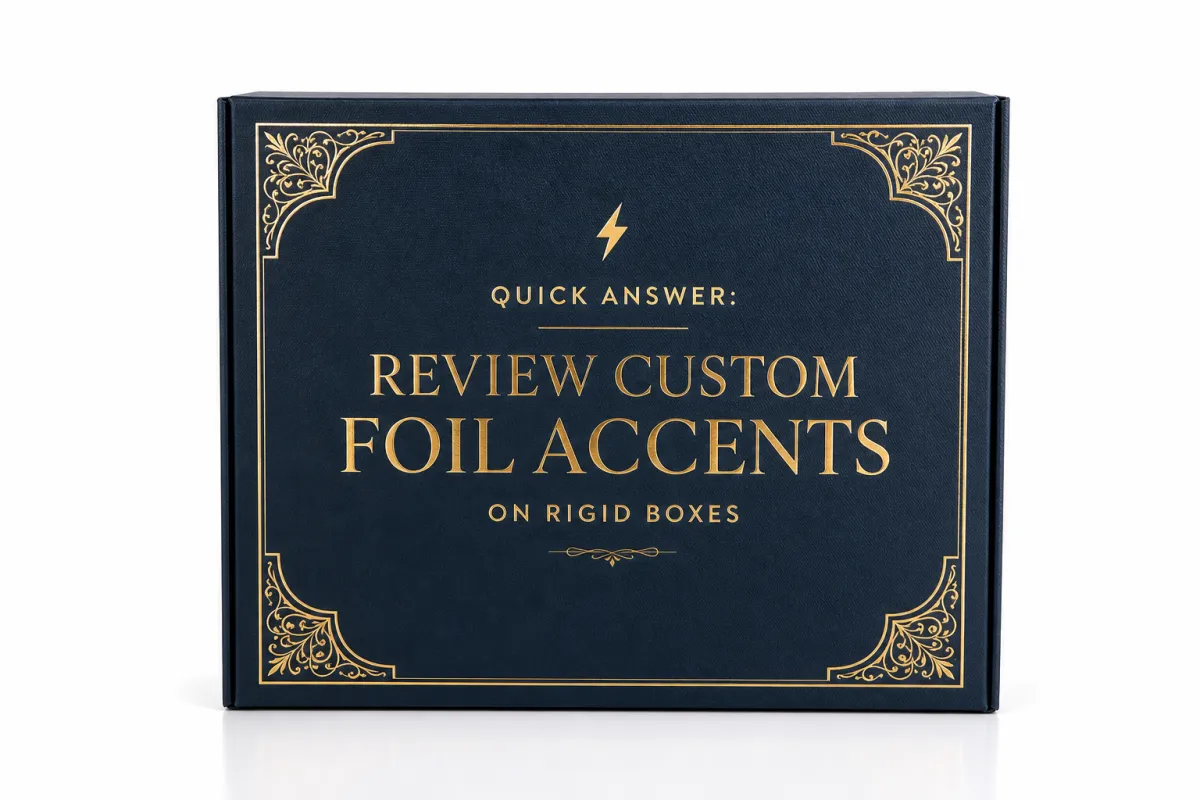
If I had to compress my review custom foil accents on rigid boxes opinion into one line, it would be this: a well-placed foil detail on a rigid box usually looks more expensive than spending the same money on more coverage. That is the part people miss. Foil works best with contrast, clean artwork, and enough restraint to let the material do some of the talking.
The strongest versions are not always the loudest. Gold on matte black can read as luxury from across a room. Silver on white feels crisp and modern, which fits cosmetics and tech nicely. Black foil on a dark wrap can look quietly expensive, but it needs good light to show up. Holographic accents grab attention fast, though they can tip from premium to playful if the artwork gets busy.
My short list is simple: visual impact, durability, cost, lead time, and production risk. Review custom foil accents on rigid boxes through those five filters and most first-round mistakes disappear early. Skip them, and you often end up with a box that looked flawless in the mockup and then lost its edge after folding, wrapping, or shipping. I have seen that movie enough times to know how it ends.
- Visual impact: Does the foil read from arm's length and up close?
- Durability: Will corners, folds, and lid edges stay clean after handling?
- Cost: Is the added spend tied to real brand value?
- Lead time: Can the project handle plate setup, sampling, and approval rounds?
- Production risk: Will the chosen wrap, coating, and artwork register cleanly?
That is why the same review custom foil accents on rigid boxes conversation can lead to very different answers. A subscription brand shipping 2,000 units through parcel networks needs different choices than a luxury gift set sitting in a retail display. Same structure. Different reality. Packaging ignores that at its own expense.
A rigid box with one clean foil accent usually feels richer than a box covered in three competing effects. Most brands do not need more shine. They need better placement.
If you want to compare related builds while you sort out the finish, our Custom Packaging Products page is a useful starting point for rigid boxes, inserts, and other Custom Printed Boxes. The best packaging decisions happen when structure, print, and finishing are all considered together, not in separate little silos.
Top Options Compared for Review Custom Foil Accents on Rigid Boxes
When I review custom foil accents on rigid boxes, I start with the standard finishes because those are still the ones that hold up in real production. Gold is the obvious premium signal. Silver feels cleaner and more contemporary. Black foil on a dark wrap is a quiet move that can look expensive if registration is tight. Holographic and specialty metallic foils bring more energy, but they need discipline or they take over the whole package.
The wrap color matters just as much as the foil color. Matte black, deep navy, and charcoal make metallics pop harder. White can make silver feel minimal and sharp. Kraft wraps are harder to manage because the texture and warmth of the paper can dull the shine. Soft-touch lamination usually pushes the whole thing further into luxury territory, but a heavy texture can soften fine lines and thin typography. That is where a lot of custom foil accents on rigid boxes lose their bite.
Artwork style matters just as much. Thin linework can look elegant on a screen and disappear on a textured wrap. Big flooded areas can look dramatic, then reveal every tiny scuff, pressure shift, or foil inconsistency. Simple logos, clean borders, and repeated pattern hits are usually safer. If the package is already busy, foil should clarify the read, not pile on another layer of noise. Otherwise it starts looking kinda try-hard, which is not the flex anyone thinks it is.
| Foil Option | Best Use | Visual Character | Typical Added Cost | Production Notes |
|---|---|---|---|---|
| Classic gold hot foil | Luxury gifting, beauty, premium retail packaging | Warm, rich, and highly visible | $0.15-$0.60/unit plus tooling | Best with matte or soft-touch wraps |
| Silver foil | Fragrance, tech, minimalist branded packaging | Clean, cool, and polished | $0.14-$0.55/unit plus tooling | Shows registration errors more clearly on white |
| Black foil | Understated premium boxes, dark wrap presentations | Subtle sheen, low contrast, refined | $0.16-$0.65/unit plus tooling | Needs strong lighting to show up well |
| Holographic foil | Launch kits, youth-focused product packaging, limited editions | Bright, shifting, attention-seeking | $0.20-$0.85/unit plus tooling | Best kept to smaller accents |
| Emboss + foil | High-end presentation boxes, VIP sets, collector packaging | Tactile, dimensional, premium | $0.30-$1.20/unit plus tooling | Highest tooling and press-control demands |
For most Custom Printed Boxes, the safest premium choice is still a single foil location with a clean logo and enough negative space around it. That keeps the box readable at a distance, protects budget, and usually gives the best shelf presence for the money. If the brand wants something more dramatic, black foil on black wrap, gold on navy, or silver on soft-touch white can all work. They just need to be sampled under real light instead of judged by render alone. Renders are gonna lie to you a little. That is their job.
Register tolerance changes the result more than most people expect. On rigid stock, foil placement can wander a little if the wrap is textured or if the artwork sits too close to a fold. On small boxes, that tiny shift stands out. On larger presentation boxes, the error may hide better, but only if the artwork gives the printer room to breathe. This is one of the most common reasons review custom foil accents on rigid boxes projects stall: the design asks for more precision than the build can comfortably deliver.
The cleanest foil jobs happen when the paper, coating, artwork, and stamping plan all agree before production starts. Split those decisions, and the box starts arguing with itself.
Detailed Reviews of the Most Useful Foil Accent Builds
Hot foil stamping
Hot foil stamping is still the benchmark for custom foil accents on rigid boxes. The edges come out sharp, and the tactile impression is stronger when the setup is right. The die heats the foil and presses it into the wrap, so the result usually feels more integrated than a flat printed effect. If the logo is simple, the lines are clean, and the pressure is consistent, hot foil is hard to beat for premium presentation.
The catch is simple: hot foil punishes weak artwork. Tiny type, hairline rules, and cramped copy can fill in or break apart, especially on textured paper wraps. A 6 pt serif logo might look fine on a screen and then look tired in production. I usually push brands toward practical stroke widths and away from ornate details stuffed into a tiny stamp area. Review custom foil accents on rigid boxes with press behavior in mind, not just graphic taste. The press does not care how attached you are to the design.
Hot foil also gives the best payoff when the brand wants a crisp edge and a clear reflection point. I have watched the same logo look flat in digital foil and suddenly feel premium once the die bites a little deeper. That difference sounds minor until you hold the box. Then it is not minor at all.
Digital foil
Digital foil earns its place when the run is short, the timeline is ugly, or the artwork needs more flexibility. For many review custom foil accents on rigid boxes projects, it is the only realistic option for limited drops or test launches. It handles variable artwork and smaller quantities without the full cost of traditional plate tooling, which makes it a good fit for custom logo work that needs market feedback before a bigger rollout.
The tradeoff shows up in hand. Digital foil often feels less deeply pressed than hot foil, and that difference is easy to notice if someone actually picks up the box. On a shelf, most people will never care. Under a fingertip, some do. If the goal is a crisp luxury unboxing moment, the deeper impression from hot foil can justify the extra setup. If the goal is speed and controlled spend, digital foil is a practical choice that still looks polished.
I would not pretend digital foil is the same thing as a fully tooled stamp. It is not. But for short runs and fast validation, it can be the better decision even when the old-school purist in the room grumbles about it.
Foil plus emboss or deboss
This is where the finish starts to feel genuinely premium. Pairing foil with emboss or deboss gives the box depth, and depth sells a lot of luxury packaging. A logo that lifts slightly off the surface catches light differently than a flat hit, so the eye finds it faster and the hand wants to follow it. For high-end retail packaging, that tactile shift matters more than a lot of people admit out loud.
I would not recommend emboss plus foil for every order. The tooling cost is higher, the artwork needs more discipline, and the approval cycle usually takes longer. But if a brand wants a presentation box that feels special the second it leaves the sleeve, the combination can be worth it. Review custom foil accents on rigid boxes with this build and the pattern is usually the same: less artwork, stronger result. One mark done well beats three marks that all fight for attention.
Interior foil accents
Interior lid foil is one of the smartest branding moves in the category. The outside box stays clean and restrained, which helps the shelf presentation, while the inside gives the customer a surprise when they open it. That can be a hidden logo, a short message, a simple border, or a small pattern on the inner lid. It is a strong choice for branded packaging because it rewards the unboxing without shouting at the shelf.
Interior accents are also easier to control than large exterior foil fields because the inner surface gets less abuse in transit. There is still a scuff risk if the box is packed too tightly or if inserts rub against the lid, but the wear profile is usually kinder than it is on external corners. For premium gifting and product packaging, I like this approach a lot. It feels deliberate without looking desperate.
Large-area foil treatments
Big foil panels look dramatic in a mockup. On press, they are less forgiving. Any slight pressure inconsistency, dust issue, or wrap flaw shows up faster when the foil covers a large field. That does not mean large-area foil is a bad idea. It means it needs to be treated like a demanding finish, not a decorative afterthought.
Large foil areas work best on controlled builds with smooth wraps and careful handling. If the box is going to ship through parcel networks, stack in a back room, or get opened repeatedly, the shine may wear unevenly at the edges. That is why I usually recommend these builds only when the brand has both the budget and the patience for sample rounds.
Before approving any of these builds, I ask the same question every time: does the finish still feel premium if I rotate the box under a window, hold it at arm's length, and inspect the corners? That simple habit catches weak decisions early. Review custom foil accents on rigid boxes with real light, and a lot of "perfect" samples suddenly reveal where the process still needs work.
Price Comparison for Custom Foil Accents on Rigid Boxes
Pricing is where review custom foil accents on rigid boxes gets misunderstood most often. Buyers sometimes stare at the foil decoration and forget the rigid box itself has a cost base made up of greyboard, wrap paper, insert material, lamination, and assembly. The foil is an add-on. It is not the whole bill. Separate structural cost from finish cost and the comparison gets much easier.
For a typical two-piece rigid box with a standard wrap, the structural cost might sit around $2.20-$5.50 per unit depending on size, board thickness, insert complexity, and order volume. A single-location foil hit may add another $0.15-$0.60 per unit at scale, but on shorter runs the setup and tooling fees matter much more. A 500-piece order can look expensive even when the foil area is tiny because the fixed costs have not had enough units to spread across.
The fastest way to compare quotes is to ask for the same artwork in three forms: no foil, one small foil location, and foil with emboss or a broader coverage area. That gives you a clean picture of what the finish is actually buying. You are not just comparing unit prices. You are comparing visual gain per dollar. That is the correct way to review custom foil accents on rigid boxes from a budget standpoint.
Here is the practical breakdown I usually share with buyers:
- Setup and tooling: commonly $60-$250 for simple foil plates or dies, more for complex emboss tooling.
- Unit price impact on small runs: often $0.35-$1.25 extra per unit depending on coverage and locations.
- Unit price impact on larger runs: often $0.12-$0.45 extra per unit once setup is spread out.
- Sample rounds: budget for at least one physical proof, and two if the wrap is textured or the artwork is tight.
- Rush costs: expect premiums if artwork approval is late or if the foil die must move through production fast.
There are hidden costs too, and those are usually the ones that bite. A new foil plate, a recut emboss die, a change in wrap paper, or a second sample round can all shift the final number. If a buyer changes the art after proof approval, that can force new setup as well. The first quote often looks tidy. The final bill usually tells a messier story once the production path is locked.
For brands on tighter budgets, the smartest move is usually limited foil coverage. A front-panel logo, a top-lid border, or a small interior mark can still create a premium feel without committing to a huge decorated surface. That matters especially for subscription brands and launch kits, where the first impression matters but the box still needs to stay inside a sane Product Packaging Cost.
| Project Type | Typical Quantity | Foil Strategy | Estimated Added Cost | Budget Takeaway |
|---|---|---|---|---|
| Test launch | 300-800 units | Single small logo | $0.40-$1.25/unit | Best for proof of concept |
| Standard retail run | 1,000-3,000 units | Logo plus thin border | $0.18-$0.55/unit | Good balance of cost and shelf impact |
| Luxury gifting | 1,000-5,000 units | Foil plus emboss | $0.30-$1.20/unit | Highest perceived value, more tooling risk |
| Short-run premium box | 250-600 units | Digital foil accent | $0.45-$1.50/unit | Useful when speed matters more than press depth |
If you are comparing boxes for a broader line, browse our rigid box packaging options and compare them against your foil budget rather than treating decoration as a separate decision. That is how experienced buyers keep cost, construction, and package branding aligned.
Process and Timeline for Review Custom Foil Accents on Rigid Boxes
The process looks simple on paper and gets messy at the handoff points. When I review custom foil accents on rigid boxes, I map the job from dieline to artwork, from sample to press setup, and from final assembly to pack-out. The weak spots are usually not the foil itself. They are the gaps between artwork, material selection, and approval. Every extra handoff gives a tiny mistake another chance to become a delay.
A realistic schedule usually looks like this: artwork and dieline review in a few business days, sample setup in about 5-8 business days, physical proof review in 1-3 days depending on the buyer, then production and assembly in roughly 12-18 business days after approval. If the project needs a new die, a different wrap paper, or a second proof, the calendar moves fast. That is why review custom foil accents on rigid boxes should start earlier than most teams expect.
Delays tend to show up in the same places over and over. One is foil registration. If the art sits too close to a fold or edge, the press team may need to shift placement. Another is wrap choice. A heavily textured paper or a coated stock can change how the foil transfers, which means the first sample may not be the final answer. The third is approval discipline. If color, gloss, and foil brightness are not signed off together, revisions can loop longer than planned.
Sampling is where good calls get made. I like to see the sample under three conditions: bright overhead light, softer daylight, and a quick hand test at the corners and lid edges. That mix shows whether the finish looks premium only in perfect lighting or whether it actually holds up as a real presentation piece. For retail packaging, the difference is huge.
If the box will ship rather than be handed over in person, transport testing belongs in the conversation. ISTA methods are the right reference point for parcel-heavy programs, because foil edges and corner wear tend to show up first during vibration and drop events. Their testing resources are available at ISTA. If the project also needs certified paper sourcing, FSC guidance at FSC is a sensible place to verify chain-of-custody requirements for paper-based components.
For teams running a launch with a hard date, I usually recommend one supplier handling both the rigid structure and the foil work. Separate vendors can work, but the coordination risk is real. Once the wrap, board, foil, and assembly plan live in one production line, the odds of a timing slip drop. That does not erase issues. It just makes them easier to fix before the boxes are already on a truck.
One more practical point: if the box uses soft-touch lamination, ask for a test on the exact material blend before locking the artwork. Soft-touch looks beautiful, but it changes friction and can affect how foil edges behave near folds. A textured wrap can be even trickier. Review custom foil accents on rigid boxes with those materials only after physical confirmation, not just digital approval. The sample is the truth, and the sample is usually less flattering than the render.
When launch timing is tight, the safest plan is to keep the foil accent simple and leave room for one physical proof. That usually beats a fancier design that needs multiple cycles. Revision time costs more than a modest design simplification, especially when the calendar is already tight.
How Do You Review Custom Foil Accents on Rigid Boxes?
You review custom foil accents on rigid boxes by checking three things in this order: how the finish looks, how it holds up, and how much production risk it adds. Start with a physical sample, not a render. Then inspect the box under real lighting, because foil is painfully honest about the environment it lives in. A finish that looks rich in a studio can look flat in a retail aisle. A finish that looks crisp in a PDF can break apart the second it meets a textured wrap.
Next, check placement. Corners, folds, lid edges, and any area close to a structural bend deserve extra scrutiny. If the foil sits too close to a movement point, wear shows up fast. Then check the artwork itself. Clean logos, bold shapes, and simple borders usually survive production better than tiny type or dense pattern work. Review custom foil accents on rigid boxes with the same logic you would use for a storefront sign: if people cannot read it quickly, it is working too hard.
Finally, compare the cost against the result. Some foil choices add a lot of shine and very little brand value. Others do the opposite and make the box feel deliberate with a modest spend. That is why the best review custom foil accents on rigid boxes process is not about picking the prettiest sample. It is about picking the sample that still looks good after handling, shipping, and a few seconds of actual use.
How to Choose the Right Foil Accent Strategy
The right foil strategy starts with the brand goal, not a decoration preference. If you need loud shelf impact, gold on a dark wrap or a bolder metallic field may be right. If you want understated luxury, a small logo in black foil or muted silver may be enough. If the box sits inside a larger branded packaging system, the foil should reinforce that system, not fight it. That is how review custom foil accents on rigid boxes becomes a strategic decision instead of a cosmetic one.
Audience matters too. A premium beauty buyer may respond well to a refined logo and careful spacing. A corporate gifting program may want more visual ceremony. A subscription audience may care more about the unboxing surprise than the outside face. A retail buyer will care about how the box sits under store lighting and whether the shine still reads when the box is stacked beside other product packaging.
Box size and structure change the answer as well. Larger rigid boxes can support broader foil fields or secondary accents on the lid and side panel. Smaller boxes usually need restraint. There is less room for error, and too much foil can make the box feel crowded. On very small formats, I tend to favor one crisp logo or a minimal border. It is cleaner, cheaper, and easier to keep register true.
Durability needs to be part of the scorecard before art gets approved. If the box will be mailed, stacked, or opened often, the corners and lid edges need extra attention. A heavy foil flood can wear faster on those touch points. If the box is a one-time presentation piece, you have more freedom. That is why there is no single review custom foil accents on rigid boxes answer that fits every use case.
Here is a scoring method that keeps the decision honest:
- Visual read: does the foil add clarity at arm's length?
- Tactile value: does it feel better in hand or only look better on screen?
- Production risk: does the artwork demand fine registration or special handling?
- Budget fit: does the added cost align with the value of the product inside?
- Timeline fit: does the sample and approval path fit your launch window?
I also recommend a materials check before final sign-off. Soft-touch lamination can make gold feel richer, but too much sheen can flatten the effect. Matte coatings can keep silver from feeling flat, while high-contrast color pairs can help a black foil logo stand out. Textured wraps may need slightly bolder artwork or simpler shapes so the foil does not break visually across the grain. That detail matters more than most teams expect.
For brands comparing several constructions at once, our Custom Packaging Products page can help you line up the box build against the finishing budget. That is the practical way to review custom foil accents on rigid boxes without losing sight of the full packaging design picture.
My rule is blunt: if the foil does not improve the box from across the room and in the hand, it probably does not deserve the spend. A nice render is not enough. A physical prototype has to earn the decision.
Our Recommendation After You Review Custom Foil Accents on Rigid Boxes
After plenty of sample checks and enough real production drama to keep me humble, my recommendation is simple: use foil sparingly, but use it with intent. If you review custom foil accents on rigid boxes honestly, the strongest result is usually one clean, well-placed accent instead of a decorated surface packed with metallic detail. The box feels more confident that way. It also tends to print and assemble more reliably.
For budget-sensitive projects, a single hot foil logo is usually the best starting point. It gives a premium signal without forcing the art team to manage too many variables. For luxury gifting, foil plus emboss or deboss can be worth the extra tool cost, especially on a soft-touch wrap or a deep matte finish. For short-run launches, digital foil is often the most practical path because it keeps the timeline manageable while still delivering a refined look.
If I had to rank the choices by practical value, I would put them like this: hot foil for the best all-around clarity, digital foil for speed and flexibility, and emboss plus foil for maximum premium feel. The best choice depends on the product, the audience, and the amount of production risk the team can tolerate. That is why I never treat review custom foil accents on rigid boxes as a style-only exercise.
Here is the short checklist I would use before placing an order:
- Confirm the exact wrap stock and finish, including soft-touch or textured treatment.
- Approve a physical sample under the same lighting the box will see in real use.
- Check foil placement at corners, lid edges, and folds for wear risk.
- Verify whether the artwork needs one plate, one die, or multiple setup points.
- Lock the timeline with room for at least one revision if the sample needs adjustment.
That checklist looks plain, but it catches the mistakes that cost time and money. The most expensive foil accent is not always the one with the highest quote. It is the one that needs to be redone because it looked better in the mockup than it did on the finished box. Packaging has a mean streak like that.
So if your goal is a premium look with controlled risk, choose a restrained design, a compatible wrap, and a finish that fits the handling profile. If your goal is a dramatic unboxing moment, build in enough time for a real sample and do not rush the approval. Either way, review custom foil accents on rigid boxes with a physical prototype in hand, because that is where the truth shows up.
If you are ready to compare a few versions side by side, check the box construction first, then the foil, then the total landed cost. That order saves a lot of frustration. And if you want my plain answer after all the checking, it is this: the best custom foil accents on rigid boxes look expensive without trying too hard, and that is still the smartest way to review custom foil accents on rigid boxes for a real launch.
Frequently Asked Questions
How should I review custom foil accents on rigid boxes before approving production?
Ask for a physical sample, not just a render, because foil changes a lot under real light and on real wrap material. Check the box from arm's length and close up so you can judge both shelf impact and registration quality. If you are reviewing custom foil accents on rigid boxes on a textured or soft-touch wrap, test the exact material combination before you sign off, and inspect folds, corners, and lid edges for cracking, lifting, or dull spots.
Do custom foil accents on rigid boxes add a lot to the price?
They usually add more through setup and tooling than through material alone, especially on small runs. The widest foil areas, multiple placement locations, and foil plus emboss combinations push pricing up fastest. Limited foil coverage can still create a premium look without the cost of a full-panel effect, which is why many brands review custom foil accents on rigid boxes by comparing unit cost, setup fee, and sample cost separately.
Which foil finish looks most premium on rigid boxes?
Classic gold usually reads as the most obviously premium choice, especially on dark matte wraps. Silver can look cleaner and more modern, which works well for fragrance, tech, and minimalist brands. The premium effect depends on contrast, placement, and surface finish, not just the foil color itself. A small, sharply placed logo often looks more expensive than a large, overly shiny foil field.
How long does it take to produce custom foil accents on rigid boxes?
Timeline depends on artwork approval, sampling, foil setup, and final box assembly. Expect extra time if you need a new die, a special wrap, or multiple sample rounds. Projects move faster when foil and rigid construction are managed together by one supplier. Plan backward from your launch date and leave room for at least one physical proof review, especially if you need to review custom foil accents on rigid boxes under real production conditions.
Can custom foil accents on rigid boxes work with soft-touch or textured wraps?
Yes, but the texture can affect how sharply the foil transfers and how well fine details hold. Soft-touch usually gives a very upscale feel, while deeper textures may soften tiny type or thin lines. Always test the exact material combination before production, because some wraps need adjusted pressure or simplified artwork. Use bolder shapes and cleaner typography if the surface has heavy texture or a soft film finish.


