Buyer Fit Snapshot
| Best fit | of insulated mailer boxes compared for packaging buyers comparing material specs, print proof, MOQ, unit cost, freight, and repeat-order risk where brand print, material, artwork control, and repeat-order consistency matter. |
|---|---|
| Quote inputs | Share finished size, material target, print colors, finish, packing count, annual reorder estimate, and delivery region. |
| Proofing check | Approve dieline scale, logo placement, barcode or warning zones, color tolerance, and any recyclable or compostable wording before bulk production. |
| Main risk | Vague material claims, crowded artwork, or missing packing details can create delays even when the unit price looks attractive. |
Fast answer: Of Insulated Mailer Boxes Compared: Film, Closure, Print, and Fulfillment should be specified like a repeatable production item. The safest quote includes material, print method, finish, artwork proof, carton packing, and reorder notes in one written spec.
What to confirm before approving the packaging proof
Check the product dimensions against the actual filled item, not only the sales mockup. Ask for tolerance on folds, seals, hang holes, label areas, and retail display edges. If the package carries a logo, QR code, warning copy, or legal claim, reserve that space before decorative graphics fill the panel.
How to compare quotes without losing quality
Compare board or film grade, print process, finish, sampling route, tooling charges, carton quantity, and freight assumptions side by side. A lower quote is only useful if the supplier can repeat the same color, closure quality, and packing count on the next order.
A solid review of insulated mailer boxes starts with a question that sounds simple and usually gets ignored: will the box survive the route you actually ship, or just the tidy little route in the sales deck? For Custom Logo Things, that matters more than people want to admit. A carton can look expensive, print beautifully, and still fail if the liner shifts, the closure pops, or the pack-out leaves a pocket of air around the product. The cheap option sometimes wins. Not because it is glamorous. Because it fits better and wastes less space.
This review of insulated mailer boxes focuses on the stuff operations teams feel immediately: temperature hold time, crush resistance, pack-out speed, moisture control, and the way the parcel looks when it lands on the customer’s doorstep. A meal kit, a chocolate shipment, a cosmetic sample, and a pharma order do not fail for the same reason. Pretending they do is how brands end up paying for the wrong box twice. I have watched that happen more than once, and the invoice always shows up later than the regret.
For a packing team, the real decision is not abstract. It is whether the box can keep the product within range for the longest realistic dwell time, whether it can be assembled quickly without tearing the liner, and whether the design carries the brand without adding unnecessary freight weight. That is the lens I use throughout this review of insulated mailer boxes. If a spec cannot pass those three checks, it is not ready. Period.
Quick Answer: Review of Insulated Mailer Boxes
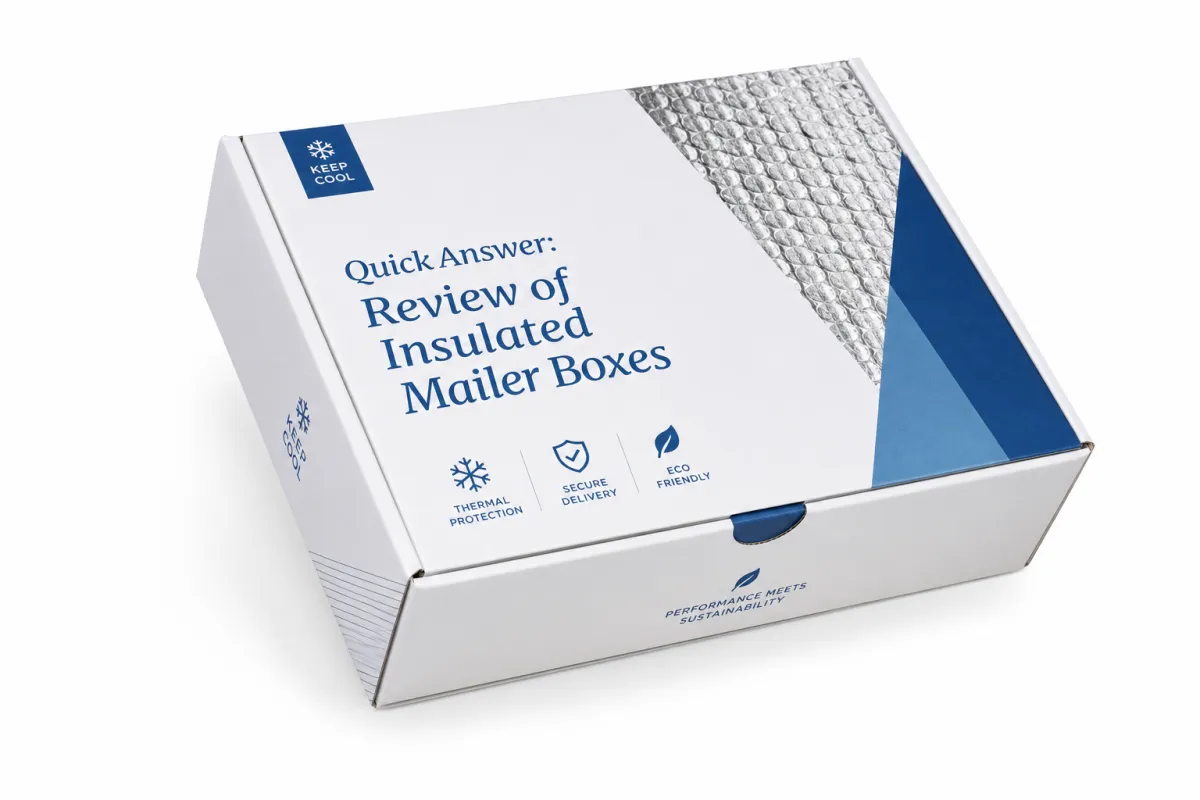
The short version of this review of insulated mailer boxes is blunt: start with the route, then choose the structure. A chilled parcel that moves through one regional hub is not the same animal as a frozen parcel that sits on a dock before final delivery. If the box does not match the shipping reality, the insulation claim is just marketing with better packaging.
Thickness gets too much attention. People love to compare liner depth and call it research. It is not. A slightly lighter hybrid build often performs better because the closure is cleaner, the headspace is smaller, and the product shifts less in transit. That is where buyers misread the review of insulated mailer boxes: they compare material thickness and ignore fit. Fit is the part that decides whether the box actually works.
Here is the fastest practical test I recommend for a review of insulated mailer boxes:
- Measure temperature hold time with the actual product load and gel pack arrangement.
- Time the pack-out speed for a trained operator, not a designer holding a sample for the first time.
- Check crush resistance in a stacked pallet or mixed freight scenario.
- Inspect headspace; if the product can shift more than a few millimeters, thermal performance usually drops.
- Look at the parcel after delivery and ask whether it still feels customer-ready.
My first-pass pick for a lot of brands is a hybrid construction. It usually balances thermal performance, brand presentation, and freight weight better than a bulky foam cooler. If the line ships premium food, small-batch cosmetics, or temperature-sensitive wellness products, a hybrid often gives the strongest overall result in a review of insulated mailer boxes. It is not magic. It is just a better compromise for a lot of real-world programs.
"It looked fine on the spec sheet, then the first delayed route exposed every weak point." That is the pattern I hear most often when buyers talk about insulated packaging after the first real test.
My quick verdict: if you need maximum thermal protection for the harshest lanes, foam still has a place. If you care about retail feel, lower freight weight, and cleaner unboxing, hybrid and fiber-faced systems often perform better. The smartest review of insulated mailer boxes is the one that matches construction to the actual shipment, not to the sales pitch. Otherwise you are kinda just buying confidence in cardboard form.
Top Options Compared: Fiber, Foam, and Hybrid Builds
This review of insulated mailer boxes breaks the market into four common structures: molded fiber-lined mailers, corrugated shippers with reflective liners, foam-based boxes, and hybrid insulated systems. Each one wins for a different reason, and each one has a weak point that can hurt a commercial roll-out if buyers overlook it.
The comparison should not stop at "which one stays cold the longest." I also want to know how it packs, how it stacks, how it disposes, and whether the box feels expensive or disposable on arrival. A structured review of insulated mailer boxes needs all five of those factors, because logistics and brand perception rarely stay separate for long.
| Build Type | Thermal Performance | Pack Speed | Presentation | Disposal / Recycling | Typical Unit Price |
|---|---|---|---|---|---|
| Molded fiber-lined mailer | Good for short to moderate chilled routes | Fast once the insert is trained in production | Clean, premium, less "industrial" than foam | Often easier to recycle when kept mono-material | $1.10-$1.80 at 2,500 units |
| Corrugated with reflective liner | Moderate, depends on pack-out and liner quality | Very fast if the insert is simple | Good branding surface, solid outer print area | Can be recycling-friendly if the liner is removable | $0.85-$1.25 at 2,500 units |
| Foam cooler box | Strongest hold time in difficult lanes | Medium; the bulk slows pack-out | Functional more than premium | Disposal concerns are common with many buyers | $1.20-$2.10 at 2,500 units |
| Hybrid insulated system | Strong balance of hold time and fit | Fast to medium, depending on insert design | Usually the best all-around appearance | Can be designed for cleaner material separation | $0.95-$1.55 at 2,500 units |
Foam wins when thermal margin is everything. Longer dwell times, rough handoffs, and routes where the parcel may sit in uncontrolled temperatures all push a buyer toward foam. The trade-off is hard to miss: more bulk, more storage space, and a less refined look. In a review of insulated mailer boxes, foam usually ranks first for protection and last for presentation. That is not an insult. It is just the job description.
Fiber-lined options sit on the other end of the spectrum. They often look better, are easier to explain to retailers and consumers, and can fit a cleaner sustainability story when the board structure stays simple. The weak point is the liner and the closure. In a review of insulated mailer boxes, a tidy fiber build can beat a thicker-looking box if the seal holds and the product stays centered. I have seen that enough times to stop trusting bulk alone.
Hybrid systems deserve extra attention because they often give the best logistics fit. The outer corrugated shell protects the load, the liner improves temperature retention, and the structure usually stacks better than soft foam. For many brands, that is the point where a review of insulated mailer boxes stops being theoretical and starts looking like a workable operating spec.
Use this simple decision matrix:
- Short chilled route, high presentation value: fiber-lined or hybrid.
- Moderate route, mixed freight, tighter budget: corrugated reflective liner.
- Maximum thermal margin, long dwell time, frozen goods: foam or a heavy hybrid.
- Brand wants cleaner disposal and lower freight weight: hybrid with minimal mixed-material content.
One practical note from a real review of insulated mailer boxes: the structure that looks least impressive on paper can still be the better commercial choice if it lowers damage claims and speeds packing. That is why I never stop at materials alone. I look at the entire system, because the route does not care how elegant the spec sheet reads.
Detailed Review of Insulated Mailer Boxes
The strongest review of insulated mailer boxes is not a generic list of "good" and "better" products. It is a category-by-category read on where each one wins, where it slows operations, and what kind of shipments expose its weakness. That means testing the same variables every time: insulation thickness, closure security, condensation behavior, stacking strength, and how much room the product has to move.
Molded Fiber-Lined Mailers
Molded fiber-lined mailers appeal to buyers who want a polished feel without jumping all the way into premium cold-chain packaging. In a review of insulated mailer boxes, these often score well on presentation because the finished parcel looks organized and deliberate. The board shell also holds graphics nicely, which matters for customer-facing meal kits, sweets, or wellness samples.
The weak point is pretty straightforward: if the insert fit is loose, the thermal benefit drops fast. I have seen fiber-lined systems do very well on a short regional route and then struggle when a parcel picks up even a few hours of dwell time. For that reason, a review of insulated mailer boxes should always include a real route test rather than a bench-only check. Otherwise the box is basically passing a test nobody ships by.
Best for: premium chilled products, shorter transit windows, and brands that care about presentation as much as insulation.
Corrugated Shippers With Reflective Liners
Corrugated shippers with reflective liners are the workhorse option. They are often the easiest to scale because the outer shell is familiar to packers, the print area is useful, and the cost usually stays lower than a dense foam system. In a review of insulated mailer boxes, these are the units that make sense when a brand needs decent insulation without giving up speed or shipping efficiency.
Consistency is the catch. If the liner wrinkles, tears, or is applied poorly, performance can swing more than buyers expect. The box may still look fine in a photograph, but the temperature curve tells a different story. That is why this review of insulated mailer boxes keeps coming back to assembly quality; a simple structure can fail if production discipline is weak. No one is gonna care that the outer print is gorgeous if the liner lifts halfway through transit.
Best for: short to medium chilled routes, price-sensitive programs, and operations that need fast pack-out.
Foam-Based Boxes
Foam remains the benchmark when the shipment is unforgiving. For frozen goods, long dwell times, or lanes with unpredictable handoffs, foam can deliver the strongest thermal protection. In a review of insulated mailer boxes, that matters because the measured hold time often beats lighter alternatives by a wide margin, especially when the packer cannot control the full route.
Foam is not painless. It takes more storage space, can look less premium, and may create disposal questions for buyers who want a cleaner sustainability story. I also find that some teams underestimate pack-out time. A dense foam format can be slower to assemble, and that slows the whole line. A careful review of insulated mailer boxes has to price that labor, not just the carton. A strong thermal result with bad labor economics is still a problem.
Best for: frozen products, extended transit, and shipments where temperature failure is costly enough to justify higher bulk.
Hybrid Insulated Systems
Hybrid systems are the category I come back to most often. They usually combine a corrugated outer with a more controlled liner or insert, and that gives a strong balance between hold time, branding, and freight weight. In a review of insulated mailer boxes, hybrids often end up being the best practical answer because they do several things well instead of one thing extremely well.
The risk is overengineering. Add too many parts, and pack-out slows. Add too much material, and the sustainability case gets muddy. The best hybrid designs keep the structure intuitive and easy to train. When that happens, a review of insulated mailer boxes usually shows fewer rejects, fewer crushed corners, and less product movement on arrival. That is the kind of boring success operations teams love.
Best for: most commercial chilled programs, premium presentation, and brands that want a middle path between thermal performance and operating cost.
For standards and sourcing, the practical route is to test against recognized shipping methods instead of trusting internal guesswork. The ISTA test family is useful for abuse simulation, and sourcing gets easier to defend when the board side is clear too. If recycled or responsibly sourced paperboard matters to the brand, look for FSC-certified paperboard where it fits the spec.
My honest take after comparing these options: the highest-rated design in a review of insulated mailer boxes is not always the thickest or the prettiest. It is the one that arrives stable, packs quickly, and causes the fewest headaches in the first 500 shipments. That is the part that matters after the excitement wears off.
Price Comparison for Review of Insulated Mailer Boxes
Price is where many buyers get tripped up. A review of insulated mailer boxes should compare unit price, freight weight, minimum order quantity, and the cost of inserts or gel packs. Sticker price alone can hide a more expensive landed cost, especially when the heavier box raises parcel charges or the assembly process creates scrap.
For a 2,500-unit order, the spread is usually wide enough to change the buying decision. A box that looks cheaper by fifteen or twenty cents can become the costly choice once packing labor, damage rates, and replacement shipments are included. That is why a review of insulated mailer boxes should always include total cost per successful shipment, not just the quoted carton price. The finance team will eventually ask for that number anyway, so you might as well get there first.
| Option | Typical Box Price | Extra Materials | Approx. Freight Impact | Operational Note |
|---|---|---|---|---|
| Molded fiber-lined mailer | $1.10-$1.80 | May need gel packs | Moderate | Good balance if pack-out is clean |
| Corrugated reflective liner | $0.85-$1.25 | Often requires gels or pads | Low to moderate | Lowest entry cost for many programs |
| Foam cooler box | $1.20-$2.10 | Sometimes fewer inserts needed | Higher due to bulk | Best when damage cost is extreme |
| Hybrid insulated system | $0.95-$1.55 | Usually some insert or liner cost | Moderate | Strong all-around landed cost profile |
Customization Changes the Quote fast. Print coverage, special die cuts, thicker insulation, and modified closure panels can move the cost more than buyers expect. For a review of insulated mailer boxes, I like to break the quote into layers: base carton, insulation, print, accessories, and freight. That is the only way to compare one supplier to another without missing hidden costs.
There is another quiet expense: scrap. If a box takes too long to fold, tears during assembly, or forces a packer to rework the lid three times, labor cost rises even if the material quote looks attractive. A disciplined review of insulated mailer boxes should measure both the box price and the percentage of packs that go out cleanly on the first attempt. That percentage is worth money, even if it never appears on the carton spec.
For a realistic budget conversation, I would expect something like this at volume: corrugated reflective systems around $0.85-$1.25 per unit, hybrid systems around $0.95-$1.55, fiber-lined builds around $1.10-$1.80, and foam between $1.20-$2.10 depending on thickness and order size. Those numbers move with print, MOQ, and seasonality, but they give a fair starting point for a review of insulated mailer boxes.
If your line ships a lot of orders with low damage tolerance, the cheapest box can still be the most expensive mistake. That is the part of a review of insulated mailer boxes that gets overlooked most often: failure cost usually dwarfs carton savings, and the numbers get ugly fast once refunds and reships enter the picture.
How to Choose the Right Insulated Mailer Box
The right choice starts with temperature window. Chilled, cool, frozen, and ambient-protected shipments are not interchangeable. In a review of insulated mailer boxes, this is the first filter because it determines whether you need a light thermal buffer or serious hold time. A product that must stay in a narrow range for twelve hours needs a very different structure than a cosmetic sample that only needs to avoid summer heat spikes.
Route length matters next. A parcel that stays in a regional lane for one day behaves differently from one that moves through multiple hubs with a long dock wait. If you are doing a review of insulated mailer boxes for a national DTC program, do not assume the same spec will work in every zone. The longest lane should set the spec, not the easiest one.
Product shape and moisture risk deserve a separate look. Round jars, soft packs, and items that sweat or shift need a tighter fit than flat cartons or rigid trays. Here, the best review of insulated mailer boxes asks a practical question: does the product stay centered when the outer carton is tilted, stacked, and dropped? If the answer is no, the design needs more restraint or better dunnage.
Sustainability and compliance belong in the same conversation, not separate meetings. If the brand wants recyclable materials, look at mono-material or easier-to-separate constructions. If food contact or wellness regulations apply, review the material declarations carefully. A serious review of insulated mailer boxes should also check whether the board source is credible and whether the package aligns with the brand promise. That is where Custom Packaging Products can help a buyer compare structures across the broader packaging line, not just one insulated format.
For brands with lighter SKUs or less demanding temperature control, the package decision may shift toward a different format entirely. Sometimes a chilled-ready mailer is overkill. Sometimes the better fit is a branded outer plus a lighter protective shipper, such as Custom Poly Mailers, when the product and route allow it. A disciplined review of insulated mailer boxes should be honest enough to say when the insulated route is not the best route.
Pack-out speed has to count too. A box that saves two cents but adds twenty seconds of labor can destroy the margin on a busy line. That is why a credible review of insulated mailer boxes includes timing the pack-out with the actual team that will use it, not a sample lab in a quiet room. Real packers, real rhythm, real mistakes. That is the only version that tells the truth.
Process and Timeline: From Sample to Shipment
The best review of insulated mailer boxes is also a process map, because plenty of packaging mistakes happen before the first production order is even placed. Start with a sample request and a fit check. Measure the product, the gel pack, any insert, and the lid clearance. If the spec is loose at this stage, it usually gets worse once production starts.
Next comes thermal validation. That means using a temperature logger or a timed cold pack test with the actual product load and the real route assumption. A solid review of insulated mailer boxes should not accept claims without proof. I like to see at least one real transit trial, especially when the lane includes weekend risk, long dwell times, or mixed climate conditions. If you can only test one lane, test the worst one.
Then comes artwork and structural approval. A custom insulated mailer may be simple in appearance, but changing a die line, print panel, or closure tab late in the process can add days to the schedule. In a review of insulated mailer boxes, the timeline often looks like this:
- Sample request: 3-7 business days, depending on structure.
- Fit and assembly test: 1-2 days once the sample arrives.
- Thermal route trial: 1-3 days plus transit time.
- Artwork and dieline approval: varies, but the cleanest approvals happen in one revision cycle.
- Production: often 12-18 business days after approval for many custom runs, though this depends on material and order size.
That schedule is not a promise; it is a realistic planning frame. A buyer who orders too late usually ends up paying more for rushed freight or accepting a compromise spec. In a review of insulated mailer boxes, the brands that avoid trouble are the ones that build in safety stock and validate the next reorder before the shelf goes empty. Late ordering is how people end up making expensive decisions with no good options left.
Lead time planning matters even more for seasonal runs or product launches. If the pack needs custom print, special insulation thickness, or a new insert, start earlier than you think. A careful review of insulated mailer boxes should include a pilot rollout before full deployment, because the first 100 or 500 units often reveal assembly issues that sample photos never show. The sample might pass. The line might not.
Quality checkpoint: ask whether the team can pack the box in under a fixed time, whether the lid closes without forcing, and whether the final parcel survives a standard drop or compression test. A review of insulated mailer boxes that skips those checks is not really a review; it is a brochure recap.
Our Recommendation and Next Steps
If I had to narrow the field, I would make one recommendation by use case. For premium presentation with decent thermal control, hybrid is usually the safest choice. For the harshest lanes and frozen goods, foam still earns its place. For shorter chilled routes with a cleaner brand feel, fiber-lined or corrugated reflective systems can be the smartest commercial decision. That is the practical conclusion of a review of insulated mailer boxes once cost, performance, and labor are all in the same frame.
My second recommendation is to test two suppliers under identical conditions. Same product load. Same gel pack count. Same route. Same packer. That is the only fair comparison in a review of insulated mailer boxes. Anything else can be distorted by better training, better packing discipline, or a route that happened to be kinder on the day of the test.
Then do the simple math: landed cost, damage rate, replacement rate, and the time it takes to pack one unit. If the cheaper box raises re-ship expense or slows the line, it is not cheaper. A serious review of insulated mailer boxes always lands on total cost per successful shipment, because that is what the finance team feels and what customers remember.
Here is the action list I would use before ordering in volume:
- Request two or three samples with the exact product dimensions.
- Run one real route with a temperature logger or timed ice pack test.
- Measure pack-out time for the actual warehouse team.
- Check crush, seal integrity, and customer-facing appearance on arrival.
- Lock the reorder spec only after the data matches the shipping reality.
For Custom Logo Things, that is the cleanest path forward. A review of insulated mailer boxes should not leave you with more questions than answers. It should tell you which structure protects the product, which one protects the margin, and which one does both well enough to scale.
One final thought: the strongest review of insulated mailer boxes treats packaging as an operating system, not just a container. If the box is easy to pack, holds temperature for the right window, and arrives looking deliberate, it is doing its job. If not, the spec needs another round of testing before the next order goes out. That is the actionable takeaway: choose the design that survives your longest lane, prove it with a live trial, and only then place the volume order.
FAQ
What should I look for in a review of insulated mailer boxes?
Focus on real transit performance, not just material claims or polished product photos. A useful review of insulated mailer boxes checks insulation, closure strength, fit around the load, and whether the test includes dwell time, compression, and pack-out speed. If those pieces are missing, the comparison is incomplete. Pretty graphics do not keep chocolate cold.
Are insulated mailer boxes better than foam coolers for shipping?
Foam coolers usually win on maximum thermal performance, especially for frozen or long-dwell shipments. Insulated mailer boxes often win on branding, handling, and lower freight weight. A good review of insulated mailer boxes should say the better choice depends on route length, temperature risk, and how premium the parcel needs to look when it arrives. Different tools. Different jobs.
How do I test insulated mailer boxes before ordering in bulk?
Run a sample through the exact route your orders will take, then log the temperature or use timed ice pack testing with the real product load. Track damage, assembly time, and customer-ready appearance after delivery. In a practical review of insulated mailer boxes, those are the numbers that matter more than a material claim on a spec sheet. If the route is ugly, test the ugly route.
What is the most common mistake buyers make with insulated mailer boxes?
They compare unit price instead of total landed cost, and they ignore how long parcels sit before final delivery. Another common error is choosing a box that looks strong but is too slow or awkward to pack. A careful review of insulated mailer boxes should catch both problems before the first bulk order is placed. Cheap on paper can get expensive in a hurry.
How long should insulated mailer boxes keep products cold?
There is no universal number, because performance depends on insulation, filler, route conditions, and the product itself. For many commercial shipments, the target should match the longest realistic dwell time plus a safety margin. The only reliable answer comes from a real route test, which is why the best review of insulated mailer boxes always includes live validation. If the spec cannot survive the longest lane, it is not the right spec.