Buyer Fit Snapshot
| Best fit | of tamper evident mailers and costs for packaging buyers comparing material specs, print proof, MOQ, unit cost, freight, and repeat-order risk where brand print, material, artwork control, and repeat-order consistency matter. |
|---|---|
| Quote inputs | Share finished size, material target, print colors, finish, packing count, annual reorder estimate, and delivery region. |
| Proofing check | Approve dieline scale, logo placement, barcode or warning zones, color tolerance, and any recyclable or compostable wording before bulk production. |
| Main risk | Vague material claims, crowded artwork, or missing packing details can create delays even when the unit price looks attractive. |
Fast answer: Of Tamper Evident Mailers and Costs: Cost, MOQ, Proof, and Reorder Checks should be specified like a repeatable production item. The safest quote includes material, print method, finish, artwork proof, carton packing, and reorder notes in one written spec.
What to confirm before approving the packaging proof
Check the product dimensions against the actual filled item, not only the sales mockup. Ask for tolerance on folds, seals, hang holes, label areas, and retail display edges. If the package carries a logo, QR code, warning copy, or legal claim, reserve that space before decorative graphics fill the panel.
How to compare quotes without losing quality
Compare board or film grade, print process, finish, sampling route, tooling charges, carton quantity, and freight assumptions side by side. A lower quote is only useful if the supplier can repeat the same color, closure quality, and packing count on the next order.
Quick Answer: Review of Tamper Evident Mailers
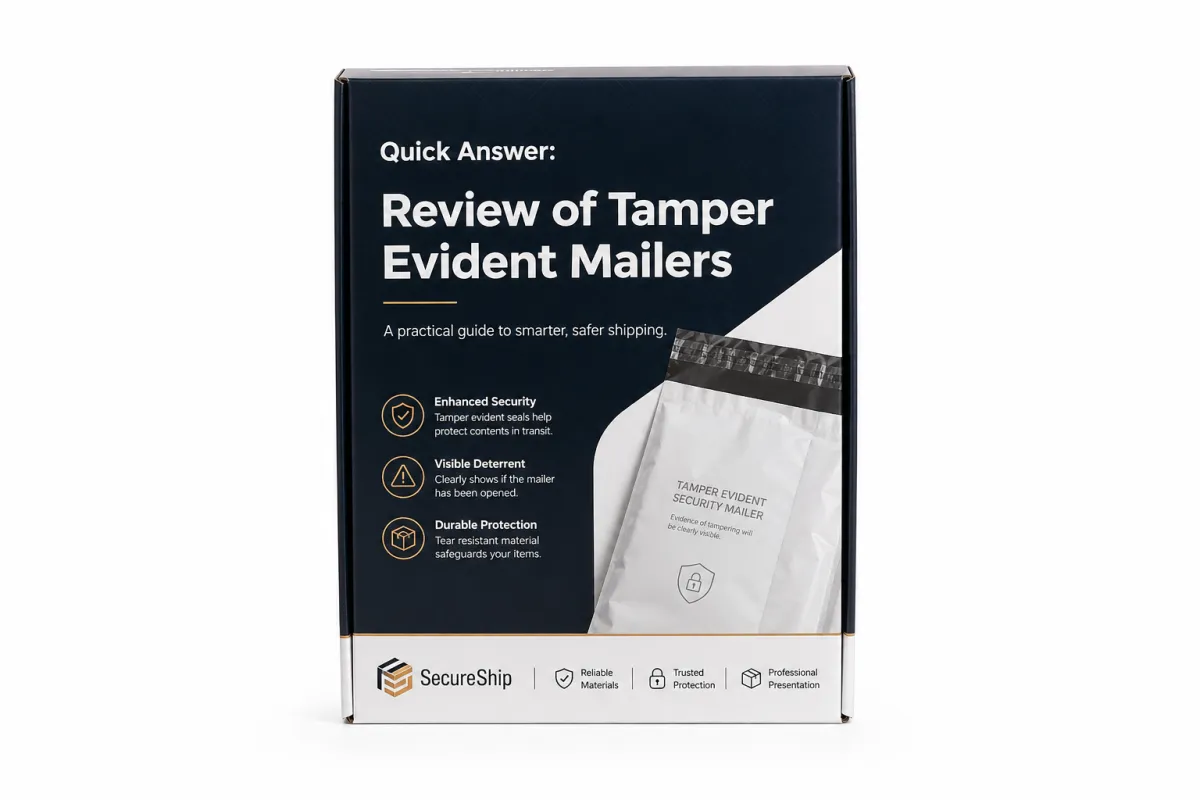
The first time I was asked to write a review of tamper evident mailers, I was standing beside a packing line in Dongguan, Guangdong, where a plain poly bag had already caused one theft complaint too many. The team had been shipping apparel in standard mailers for 11 months, mostly because nobody wanted to untangle another supplier comparison spreadsheet. Then one missing order turned into an angry customer, a $42 refund, and a very awkward conversation about "acceptable loss" in front of a supervisor who had already counted 1,200 parcels that shift. Security was no longer a nice-to-have. It was a line item with consequences. That is why a review of tamper evident mailers matters: not because the packaging looks clever in a catalog, but because inventory, margin, and brand trust are sitting inside the bag. That is the real value of tamper-evident packaging.
The short answer is straightforward. A useful review of tamper evident mailers always comes back to three things: adhesive strength measured in real packing conditions, visible seal damage after tampering, and film thickness that survives conveyor abuse without splitting at the fold. If the bag opens cleanly for the customer yet clearly shows interference when it is forced open, that is a good sign. If it feels secure on paper but peels apart during packing at minute seven of a rushed shift, it is not security packaging. It is expensive disappointment with a glossy finish and a procurement approval attached to it. A practical review of tamper evident mailers should also account for seal consistency, because one weak strip can undo an entire carton of good ones.
I have seen brands use these mailers for apparel, accessories, documents, cosmetics, returns, and sample kits that should never arrive pre-opened. A review of tamper evident mailers is especially useful for e-commerce teams shipping items that move quickly but still carry enough value to make a stolen parcel hurt. Think $28 lipstick sets, $90 sunglasses, $115 pharmacy refill kits, medical paperwork, or a replacement part a customer needed three days ago. In other words: not glamorous, just costly enough to make people lose sleep at 2:00 a.m. when the tracking page stops updating. In that sense, a review of tamper evident mailers is really a review of risk.
The tradeoff is plain. Better security usually means a higher unit price and a little less forgiveness on the packing line. A cheaper bag might save two cents. A better one might save a $68 replacement, a chargeback, and a chain of customer service emails that nobody wants to read before lunch on a Monday. I have negotiated enough packaging quotes to know where the false savings hide, and they are usually buried in weak adhesive, thin 45-micron film, and a closure that feels flimsy before it even leaves the carton. Honestly, I distrust any "budget" option that seems too proud of itself. In a serious review of tamper evident mailers, that is usually the first warning sign.
This review of tamper evident mailers focuses on the practical side: the major types, real pricing, and the features that actually matter once a warehouse starts moving 300, 900, or 2,500 orders a day. If you also need branded secondary packaging, see Custom Packaging Products and our Custom Poly Mailers page. If the same order includes an insert card, a 350gsm C1S artboard sheet printed in Shenzhen can carry the return policy without making the mailer itself heavier than it needs to be. The mailer still has to match the brand, but it also has to survive the trip. A pretty bag that fails in transit is just stationery with attitude. A review of tamper evident mailers only works if it keeps one eye on presentation and the other on damage control.
Top Tamper Evident Mailers Compared
My review of tamper evident mailers usually starts by sorting them into four groups: permanent-seal security mailers, tear-strip styles, dual-adhesive return mailers, and printed warning mailers. Suppliers like to blur those categories together because it shortens a sales deck from 14 slides to 9. It also makes the buying decision messier, which is convenient for them and mildly irritating for the rest of us who have to reconcile the freight invoice. A clearer review of tamper evident mailers makes the tradeoffs visible before the order is placed.
The permanent-seal version is the most direct. You close it once, and if someone tries to open it, the bag shows it. That makes it a strong fit for documents, invoices, and items that are not expected to come back through a returns center in Melbourne or Memphis. Tear-strip styles add a defined opening line, which helps the customer see where the package was meant to be opened. Dual-adhesive return mailers are the practical choice for apparel and e-commerce returns because the bag can be reused without tape, knives, or a minor argument with the packaging. Printed warning mailers use bold text, security patterns, or void-style graphics to make tampering obvious before anyone even touches the closure. I like that last category more than I probably should, partly because it does the psychological work before the physical work even starts. In a review of tamper evident mailers, that deterrent effect is not cosmetic; it is functional.
I once ran a small review of tamper evident mailers for a cosmetics client in Ningbo and packed 200 units across four samples on a rushed bench in under 18 minutes. The best adhesive grabbed fast, which matters when a picker is pushing 400 orders before lunch and the scanner keeps beeping like it has personal grievances. The weakest sample curled at the flap and cost time because the worker had to press, re-press, and then inspect the seal like it had personally offended them. That is not a small issue. Packing speed is labor, and labor is not free. Also, nobody enjoys watching a brand-new mailer behave like a stubborn envelope from 2009. A real review of tamper evident mailers should treat that extra handling time as a cost, not a footnote.
A quick filter helps. Documents and invoices usually favor permanent-seal mailers. Lightweight apparel does well with tear-strip or dual-adhesive formats. Subscription kits often work best with printed security mailers because they read as deliberate, not fearful. The best value option is usually a plain security poly mailer with a strong tamper-evident closure and a 60-micron film. The premium option is the dual-adhesive return mailer with custom print, especially if the brand expects repeat business and cares about the unboxing moment. That distinction matters more than the marketing copy suggests, especially for teams shipping 5,000 units a month or more. It also keeps a review of tamper evident mailers grounded in how the bags are actually used.
For buyers who want a standards-based check, I like comparing sample performance against an abuse sequence that resembles ISTA handling. The ISTA framework matters because it reminds you that shipping is not a tabletop fantasy. If a supplier cannot explain how the mailer handles vibration, corner drop, and rough transit from Shenzhen to Chicago, I do not care how polished the catalog looks. Pretty samples fail just as hard as ugly ones once they enter a real dispatch center. I have seen both, and neither gets a trophy. A review of tamper evident mailers that ignores handling stress is just a brochure with numbers.
Here is a practical comparison drawn from real buying conversations and pack tests:
| Type | Best For | Typical Price at 5,000 Units | What I Like | What Fails First |
|---|---|---|---|---|
| Permanent-seal security poly mailer | Documents, invoices, small accessories | $0.09 to $0.14 each | Low cost, obvious seal evidence, fast packing | Weak adhesive on humid days |
| Tear-strip security mailer | Light apparel, retail goods, samples | $0.12 to $0.18 each | Clean opening line, visible tamper point | Thin film around the tear strip |
| Dual-adhesive return mailer | Returns, apparel, subscription kits | $0.16 to $0.26 each | Outbound and return use, customer-friendly | Secondary seal alignment if the bag is overfilled |
| Printed warning security mailer | High-theft goods, branded shipments | $0.14 to $0.24 each | Strong visual deterrent, polished look | Print quality drops if the supplier is sloppy |
That table is the reason a review of tamper evident mailers has to be practical instead of theoretical. A bag that costs two cents less but slows packing by eight seconds is not cheaper. It only looks cheaper until the labor line gets involved. I have watched finance teams in Austin and Rotterdam discover that fact with the kind of expression normally reserved for bad weather and surprise freight invoices. A fair review of tamper evident mailers should compare the landed cost and the labor cost together.
Detailed Review of Tamper Evident Mailers by Type
This section of the review of tamper evident mailers is where the differences stop hiding. On paper, every supplier says "tamper resistant" or "security closure" and acts as if the label settles the matter. It does not. I have opened enough samples on warehouse tables in Dongguan, Hai Phong, and southern Poland to know the weak point is usually the adhesive backing, the seam, or the film gauge. Sometimes all three. Packaging defects have a habit of traveling together, like they booked the same bad hotel and shared the same tiny breakfast buffet. A detailed review of tamper evident mailers makes those weak points visible early.
Standard security poly mailers
In a review of tamper evident mailers, standard security poly mailers are the workhorses. A standard security mailer uses an adhesive closure that leaves obvious damage if someone peels it open. The better versions use a pressure-sensitive strip that grabs in under two seconds and does not let go unless someone is actively trying to destroy it. That matters. If the seal is too weak, it is a joke. If it is too aggressive, the packer wastes time and the customer gets a package that feels hostile. There is a very narrow sweet spot, and I wish more sales reps admitted that instead of pretending every closure is perfect. On a 1,000-piece order, the difference between a 45-second pack cycle and a 53-second pack cycle adds up to real labor by the end of the week. That is exactly the sort of detail a review of tamper evident mailers should catch.
On one factory visit in Dongguan, I watched a line switch from generic bags to security mailers after a cosmetics client reported theft on a 9,000-unit monthly program. The difference showed up immediately. Orders looked cleaner, packaging complaints dropped, and the team stopped taping random corners because the bag itself was finally doing the work. The supplier tried to upsell a premium version for an extra $0.05 per unit. I said yes. Five cents was still cheaper than replacing three missing orders every week. That is where a review of tamper evident mailers becomes a margin conversation instead of a packaging conversation. The math is unromantic, but it is very persuasive.
Returnable tamper evident mailers
In a review of tamper evident mailers, returnable versions are the smarter choice when reverse logistics matter. The second adhesive strip lets the customer send the item back without scissors, loose tape, or a small emotional crisis at the kitchen table. I like these for clothing, fit-sensitive accessories, and DTC brands with higher return rates in the 18% to 28% range. The customer experience is better, and the warehouse receives a return that is easier to process. That is the rare packaging choice that actually makes life easier on both sides of the transaction.
There is one catch. Overfilling ruins the design. If the pack bulges at the seam, the second strip may not line up, and the whole point of the format falls apart. I learned that during a client meeting where a retailer in Chicago insisted sweater boxes would fit the same mailer as flat tees. They did not. We had to re-spec the bag by adding 20mm to the width, moving from 260mm x 340mm to 280mm x 340mm, and paying an extra $0.03 per unit. That was a cheap mistake, which is another way of saying it was still expensive enough to remember. I still remember the silence in the room when the sample popped open at the wrong seam. Not great. A review of tamper evident mailers should always include this fit check.
Heavy-duty security mailers
In a review of tamper evident mailers, heavy-duty mailers are where thickness starts to matter. For rough distribution routes, I prefer a film that feels closer to 60 to 80 microns than the flimsy stuff that wrinkles if you look at it too long. A heavier film does more than resist punctures. It also holds the seal shape better when the bag gets crushed on a conveyor in Los Angeles, loaded into a tote in Birmingham, or jammed into a van at 6:10 p.m. That extra body can be the difference between a package that looks professional and one that arrives looking like it lost a fight with gravity. In a review of tamper evident mailers, this is often the point where gauge and transit risk start to matter more than print.
That said, not every brand needs the thickest option. Honest answer: overbuying gauge is a classic packaging error. If the item is light and the route is gentle, you may be paying for a bag that adds cost without adding real protection. A better review of tamper evident mailers separates actual abuse risk from warehouse anxiety. Those are not the same thing, even if someone in operations insists they are. I have heard that argument more times than I can count, and it rarely gets better the third time around. A 50-micron film is often enough for a flat document kit shipped from Ningbo to Seoul, while a 75-micron bag makes more sense for bulky knitwear.
Printed security mailers
In a review of tamper evident mailers, printed versions are the brand-forward option. They can carry warning text, void patterns, or a branded exterior that tells the customer the package is serious without looking like a prison envelope. I like them for cosmetics, supplements, and premium retail because they make the mailer feel deliberate instead of generic. Print also works as deterrence. A thief wants easy. Loud packaging is not easy. If a package says "security seal" in 18-point black type across a matte white film, it is already doing part of the job before the customer touches it. A review of tamper evident mailers that includes printed warning graphics usually reveals whether the brand wants visibility or just a stronger closure.
Print quality matters more than people expect. Poor registration, muddy ink, and weak contrast make the security message look cheap. A printed warning that is half invisible is just decoration. If you are paying for print, it needs to read clearly from two feet away and still hold under a 1,000-piece run. I have seen suppliers quote beautiful artwork and then deliver bags where the warning text looked like it had been whispered by the press. That is not security. That is typography with excuses. It is also exactly why I ask whether the printer is running flexographic or gravure lines in Shenzhen or Wenzhou before I approve a proof. A review of tamper evident mailers without print checks is only half a review.
What usually breaks first
Across the samples I have tested, the first failure is usually a weak adhesive strip, followed by sloppy gussets and inconsistent film thickness. Once those problems show up, the bag fails security and slows the pack line. That second part rarely gets mentioned in brochures, which is one more reason a serious review of tamper evident mailers has to call it out plainly. Marketing wants a hero shot. Operations wants a bag that closes correctly the first time. Guess which one I trust when 800 labels are waiting at the edge of the conveyor. A review of tamper evident mailers should answer that question with evidence, not adjectives.
For a brand shipping 1,500 to 3,000 orders a week, even a tiny failure rate becomes real money. Ten bad bags in one shift can mean ten reprints, ten relabels, and one tired supervisor deciding the sample was "close enough." At a labor rate of $18 an hour, those extra minutes are not theoretical. They become a daily tax on the line. That is how a preventable defect turns into a warehouse habit. I have watched it happen more than once, and once was already too many. In a review of tamper evident mailers, the math usually tells the truth faster than the sales deck does.
Tamper Evident Mailers Price Comparison
Pricing is where a review of tamper evident mailers gets real very quickly. Buyers love the low unit number until freight, print, and minimum order quantities walk into the room and rewrite the math. I once compared three quotes for a client in Denver and the cheapest one looked excellent at first glance: $0.11 per unit. Then freight added $0.04, artwork added $120, and the low-order fee added another $85. The supposedly cheap bag was not cheap anymore. It was just optimistic, and optimism is not a procurement strategy. A review of tamper evident mailers should always include landed cost, not just list price.
Here is the pricing pattern I see most often:
- Sample packs: $18 to $45 for 10 to 20 units, depending on print and size.
- Small-batch orders: $0.18 to $0.32 per unit when ordering 1,000 to 3,000 pieces.
- Higher-volume orders: $0.09 to $0.22 per unit when ordering 5,000 to 20,000 pieces.
- Custom print and branding: usually adds $0.02 to $0.08 per unit, plus setup.
That spread is normal. What is not normal is pretending every quote means the same thing because the words "security mailer" appear in all of them. They do not mean the same thing. A plain stock mailer from a large distributor like Uline may look fine on screen, but the landed cost can shift fast once freight and rush handling enter the picture. I care less about the sticker and more about what arrives in the building, because the invoice does not pack the orders. For a 5,000-piece run, I have seen a landed price of $0.15 per unit stay competitive only after freight was consolidated with a separate carton order from Ningbo to Seattle. A review of tamper evident mailers that ignores that freight swing is incomplete.
A better way to think about a review of tamper evident mailers is total landed cost per shipped order. If a mailer costs $0.17 more than your current bag but prevents one lost $75 order in every 400 shipments, that is not a bad trade. It is a reasonable one. If the security feature does nothing for your product category, then spend the money elsewhere. Packaging is not a charity event, and no amount of cheerful sales language changes that. A $0.14 mailer that reduces complaints by even 3% can pay for itself faster than a $0.09 option that forces you to rework 20 bags a day. A good review of tamper evident mailers should compare those outcomes directly.
For buyers who want a sourcing frame, I like to cross-check claims against packaging education resources and sustainability standards. The Packaging Industry Alliance offers useful context on material choices, and FSC certification matters if you are shifting part of the pack-out toward paper-based or mixed-material systems. That does not make a mailer secure by magic, but it does keep sourcing conversations grounded. It also keeps everyone from pretending a single brochure can answer every operational question. If the supplier also offers printed cartons or inserts, ask for substrate specifics like 350gsm C1S artboard, not just "premium paper." The difference shows up in hand feel, bend resistance, and whether the insert survives a 14-day ocean voyage without curling. A review of tamper evident mailers should sit alongside those material choices, not outside them.
One client in personal care insisted on the lowest-cost option until we modeled the replacement rate. At $0.13 per bag, they were saving roughly $780 a month compared with the security version. Then we compared that to one lost cart of premium kits and two customer complaints a week, and the "savings" disappeared into bad math. This is why a review of tamper evident mailers has to include the cost of failure, not just the cost of the bag. If the numbers ignore complaints, replacements, and 14-minute service calls, the numbers are lying.
My budget rule is simple. If the package protects revenue or trust, pay the extra few cents. If it protects neither, remove it. That sounds blunt because it is. Packaging budgets are full of polite nonsense, and honest numbers clear that away fast. I have never once seen a vague feeling close a gap in shrink loss, and I have seen finance teams in Singapore, Manchester, and Dallas all learn that lesson the hard way. In a review of tamper evident mailers, price only matters after performance is proven.
How do you choose the right tamper evident mailers?
The easiest way to Choose the Right mailer is to stop shopping by description and start shopping by job. A review of tamper evident mailers should begin with product weight, shape, and route risk. A flat document pouch does not need the same construction as a bulky apparel order moving through two hubs and a last-mile carrier that treats cartons like they are made of paper. That is not cynicism. That is experience, and a little exhaustion after 600 parcels that all looked similar until they did not.
First, match the mailer to the product. If your item is under 8 ounces and flat, a lighter security bag may be enough. If the package has corners, seams, zippers, or strange geometry, you want thicker film and a stronger closure. Overstuffing causes seal failure, which is a memorable way to make a secure bag look suspicious before it leaves the dock. I have seen people pack a mailer until it looked like a gym sock full of batteries. Predictably, that did not end well, especially on a 240mm x 320mm bag that should have been used for something flatter. A review of tamper evident mailers should always check fit with real SKUs, not assumptions.
Second, decide how fast your packing operation moves. Fast lines need adhesive that grabs instantly. Slower teams can work with a seal that allows a half-second of adjustment. That sounds tiny. It is not. On a 300-order shift, a two-second delay on each bag adds real labor. I have timed it with a clipboard, a scale, and a coffee that went cold twice while a picker in Phoenix worked through a rush. Small delays become expensive almost insultingly fast. That is one reason a review of tamper evident mailers should include pack-cycle timing.
Third, be clear about the message you want the customer to see. Some brands want a bold tamper warning because the product is high-value or regulated. Others want a cleaner look with security built into the closure. Both can work. The bad version is when a brand buys the loudest bag in the catalog and then realizes it looks like evidence packaging from a crime drama. That usually gets a nervous laugh in the meeting, followed by someone asking if there is a softer version. There usually is, thankfully, and the difference between loud and readable often comes down to 1-color black on white instead of a crowded 4-color design. A review of tamper evident mailers should weigh visual deterrence against brand tone.
Fourth, check whether returns matter. If they do, choose a dual-seal or return-friendly format. If they do not, do not pay for it. Packaging buyers sometimes keep every feature on the wish list because nobody wants to disappoint marketing. I understand that pressure. I have sat through those meetings in London and Kuala Lumpur. Still, adding features your process never uses is how quotes get ridiculous. It is also how good projects become bloated ones, which is a less dramatic but equally annoying outcome. In a review of tamper evident mailers, extra features only make sense when they reduce friction later.
To keep the decision tight, I use this filter in a Review of Tamper Evident Mailers:
- Security level: Does the closure clearly show tampering?
- Brand presentation: Does the bag look professional, not paranoid?
- Order volume: Does the price still make sense at your real monthly usage?
- Ship speed: Can your team pack it without fighting the material?
If a mailer fails two of those four, I move on. There are too many options to keep arguing with a bag that has already told you no. That sounds harsh, but sometimes the bag is the one being honest first, and a $0.12 sample can save a company from a $12,000 mistake. A disciplined review of tamper evident mailers keeps that mistake off the PO.
Process and Timeline for Testing Tamper Evident Mailers
Testing is the part people skip because it sounds slow. Then they buy 10,000 units and spend the next month discovering that the seal peels in humid weather or the film cracks at the fold. A serious review of tamper evident mailers starts with samples. Not one sample. Three to five. Different suppliers. Real products. Real pack-out. Real hands. I cannot stress that enough, although apparently I must, because every warehouse has at least one person who wants to skip straight to the purchase order and call it a strategy. A review of tamper evident mailers without a test plan is just hope in a spreadsheet.
My usual process is plain enough. Order samples, pack your actual SKUs, and then test four things: seal grab, tear evidence, handling speed, and transit durability. If you want a realistic check, run a fill test, shake test, drop test, and opening test. That does not require a fancy lab. It requires a warehouse table, a scale accurate to 1 gram, and someone willing to write down what happened instead of saying "looks fine" because they are busy. "Looks fine" is how packaging problems get promoted. A review of tamper evident mailers should never stop at visual inspection alone.
Here is the timeline I tell clients to expect:
- Sample request: 2 to 5 business days if the supplier is responsive.
- Internal testing: 1 to 3 days for a basic trial, longer if you have multiple SKUs.
- Artwork proof: 1 to 4 days, depending on how many people need to approve it.
- Production: 12 to 15 business days from proof approval for stock formats, 18 to 25 for custom print.
- Freight: 3 to 12 business days, depending on lane and season.
Those are normal ranges, not promises. Custom sizes and custom printing stretch the clock. Peak-season backlogs stretch it more. I have seen a quote that looked like a two-week job turn into a five-week wait because the factory in Zhejiang had a plate issue and the freight window slipped by four days. The buyer was furious, which made sense. The supplier looked surprised, which did not. That is why you ask for the full timeline in writing. Paper does not fix delays, but it does make them harder to pretend away. In a review of tamper evident mailers, timing belongs right next to price.
One practical way to reduce risk is to run a pilot batch before a full rollout. Use one SKU, one ship lane, and one warehouse shift. That gives you a clear read on pack speed, seal consistency, and customer feedback. A review of tamper evident mailers is useful, but your own pilot is better. It tells you how the bag behaves in your process, not in a polished sample photo with perfect lighting and no urgency. Real life is messier than the brochure, and frankly, that is why it is worth checking. I usually recommend a pilot of 250 to 500 units, which is enough to expose weak closures without blowing the budget. A review of tamper evident mailers becomes far more useful after that pilot data comes back.
If you want a more formal benchmark, compare sample performance against common shipping expectations from your carrier and product category. You do not need a lab report for every decision, but you do need a system. The brands that get this right do not buy once and hope. They test, document, and reorder with far less drama. In packaging, drama is usually a sign that someone skipped a step, and those skipped steps tend to show up as claims from Brisbane to Boston. A review of tamper evident mailers should make those steps visible before launch.
Our Recommendation: Best Next Steps
After enough factory visits, supplier calls, and too many cups of bitter coffee, here is my honest review of tamper evident mailers: the best option is the one that protects the order, fits your packing speed, and does not make your brand look cheap. That sounds simple because it is. The complication is that suppliers love to dress up every bag like it will solve theft, returns, and brand perception at once. It will not. It is a bag. A good one helps. A bad one costs you money and then asks for a reorder, which is rude in a very expensive way. A review of tamper evident mailers should cut through that noise.
If you want the cleanest path, choose three options: one security mailer for everyday use, one premium version for higher-value orders, and one return-friendly format if reverse logistics matter. Then order samples. Then test them with real products. Then ask for pricing at your actual volume. That sequence saves time and keeps the final quote from drifting into brochure fantasy. I know that sounds almost too tidy, but it works because it forces the issue early. A 5,000-piece quote from Shenzhen can look very different from a 500-piece trial once freight, print, and carton counts are all visible. In a review of tamper evident mailers, this sequence is where the decision usually becomes obvious.
What should you measure before buying? Seal integrity. Tear visibility. Packing speed. Customer experience. Landed cost per shipped order. Those five numbers tell you more than a glossy sales page ever will. I also want to know whether the supplier can keep color consistency and adhesive quality across a full run, because a sample that behaves and a production lot that misbehaves are not the same product. Funny how that works. Funny, in the same way a leaky carton is funny, which is to say not funny at all. If the supplier can provide a spec sheet with film thickness, adhesive type, and print method, ask for it in writing. A review of tamper evident mailers should treat documentation as part of the product.
My closing rule is the same one I use with clients standing in a packing room with a deadline breathing down their necks: if the mailer protects revenue or brand trust, pay for the better option. If it protects neither, remove it from the list and stop romanticizing packaging. That is the practical side of a review of tamper evident mailers, and it is the part that saves the most money. The rest is just decoration with a procurement label on it, no matter how neatly it is stacked on a pallet in Shanghai or Singapore.
The takeaway is simple: match the mailer to the product, test it with your actual pack-out, and choose the version that proves tamper evidence without slowing the line to a crawl. If you are torn between two options, pick the one that fails visibly in a test instead of silently in transit. That kind of failure is easier to fix, and it saves you from learning the hard lesson the expensive way.
If you are ready to source, start with Custom Packaging Products for broader packaging options, then narrow down to the right format for your operation. If your shipping program already relies on poly film, the Custom Poly Mailers page is a good place to compare structure and branding choices. Either way, do not buy on faith. Buy on evidence. That is the point of a review of tamper evident mailers, and it is the part that keeps everyone from learning an expensive lesson twice. A final review of tamper evident mailers should leave you with a shortlist, not a hunch.
What makes tamper-evident mailers different from regular poly mailers?
They use a seal or adhesive system that shows obvious damage if someone opens the package. Regular poly mailers are mainly about protection and speed, not tamper evidence. Choose tamper-evident versions when package integrity matters more than the lowest possible cost. I have had clients save money with standard mailers, but only in categories where nobody cared if the bag had been opened, such as low-value socks or sample giveaways under $12 each. That is a very specific situation. A review of tamper evident mailers helps separate those cases from shipments where the seal itself is the product benefit.
Are tamper-evident mailers worth the extra cost for small shops?
Yes, if you ship higher-value items, branded goods, or customer paperwork that should not be opened in transit. The added cost is usually small compared with the cost of a lost order, replacement, or complaint. If your items are low-value and low-risk, standard mailers may be enough. I would not pay for security theater, but I would absolutely pay for real protection, especially if a $0.15 mailer can prevent a $60 replacement and 20 minutes of service work. A practical review of tamper evident mailers makes that tradeoff easy to see.
How do I test tamper-evident mailers before buying in bulk?
Order samples from at least 3 suppliers and pack your actual products into each one. Test seal strength, tear visibility, and how the mailer holds up after a shake and drop test. Check whether your team can pack them quickly without fighting the adhesive. If a sample makes your packers mutter under their breath, that is feedback too. I would also test a 100-unit pilot on one shift, then compare the failure rate after 48 hours and after 7 days in storage. A review of tamper evident mailers is only useful if it reflects your real process.
What is the usual lead time for custom tamper-evident mailers?
Sample approval is often fast, but custom printing and production usually take longer than plain stock mailers. Build in time for proofing, production, and freight, especially if your order is tied to a launch date. In practice, I usually see 12 to 15 business days from proof approval for stock-style runs, and 18 to 25 business days for custom print from factories in Dongguan, Ningbo, or Guangzhou. Always ask for the full timeline in writing before you commit. Production schedules have a talent for becoming mysterious right when you need clarity. A review of tamper evident mailers should force that schedule into the open.
Which tamper-evident mailers are best for returns?
Look for dual-seal or reclosable options that let the customer return the item without using tape and tearing the whole bag apart. The best return mailers stay secure on the outbound trip and remain usable on the way back. If returns are common, this feature can save time, shipping materials, and customer frustration. It also saves your team from answering the same "how do I reseal this?" message twenty times a week, usually before 10:00 a.m. on a Monday. A review of tamper evident mailers will usually point you toward dual-adhesive designs for that reason.


