Buyer Fit Snapshot
| Best fit | Rigid Gift Boxes Bulk Pricing projects where brand print, material claims, artwork control, MOQ, and repeat-order consistency need to be specified before quoting. |
|---|---|
| Quote inputs | Share finished size, material target, print colors, finish, packing count, annual reorder estimate, ship-to region, and any compliance wording. |
| Proofing check | Approve dieline scale, logo placement, barcode or warning zones, color tolerance, closure strength, and carton packing before bulk production. |
| Main risk | Vague material claims, crowded artwork, missing packing details, or unclear freight terms can make a low unit price expensive after revisions. |
Fast answer: Rigid Gift Boxes Bulk Pricing: Specs, MOQ & Ordering should be specified like a repeatable production item. The safest quote records material, print method, finish, artwork proof, packing count, and reorder notes in one written spec.
Production checks before approval
Compare the actual filled-product size with the drawing, then confirm tolerance on folds, seals, hang holes, label areas, and retail display edges. Reserve space for logos, QR codes, warning copy, and material claims before decorative graphics fill the panel.
Quote comparison points
Review material grade, print process, finish, sampling route, tooling charges, carton quantity, and freight assumptions side by side. A quote is only useful when the supplier can repeat the same color, closure quality, and packing count on the next order.
Rigid Gift Boxes bulk pricing is where packaging decisions stop being abstract and start showing up as real line items. The first production run usually carries the heaviest per-piece cost because setup, print prep, cutting, wrapping, and hand assembly are all being absorbed by a smaller quantity. That is not a gimmick, and it is not a supplier trying to be difficult; it is simply how a rigid box is built.
For brands in cosmetics, candles, apparel, gifts, and premium accessories, the box is carrying a lot more than the product. It protects the item in transit, shapes the first impression on shelf or in unboxing, and can reduce avoidable damage claims if the board, wrap, and insert are matched to the product the right way. In practical sourcing work, Rigid Gift Boxes bulk pricing becomes a planning tool. The earlier the buyer locks quantity, board thickness, wrap stock, insert type, print method, and finish, the cleaner the quote usually is, and the easier it is to predict landed cost without a bunch of surprises showing up later.
It also helps to think beyond the headline unit price. A low quote can turn into the expensive choice if it hides setup charges, tooling, weak board, or rework after proof approval. I have seen teams save a few cents per box and then spend far more correcting fit issues or replacing damaged shipments. That is a pretty bad trade, honestly. The better move is to compare the full package, not just the number sitting at the top of the sheet.
What rigid gift boxes bulk pricing really buys you
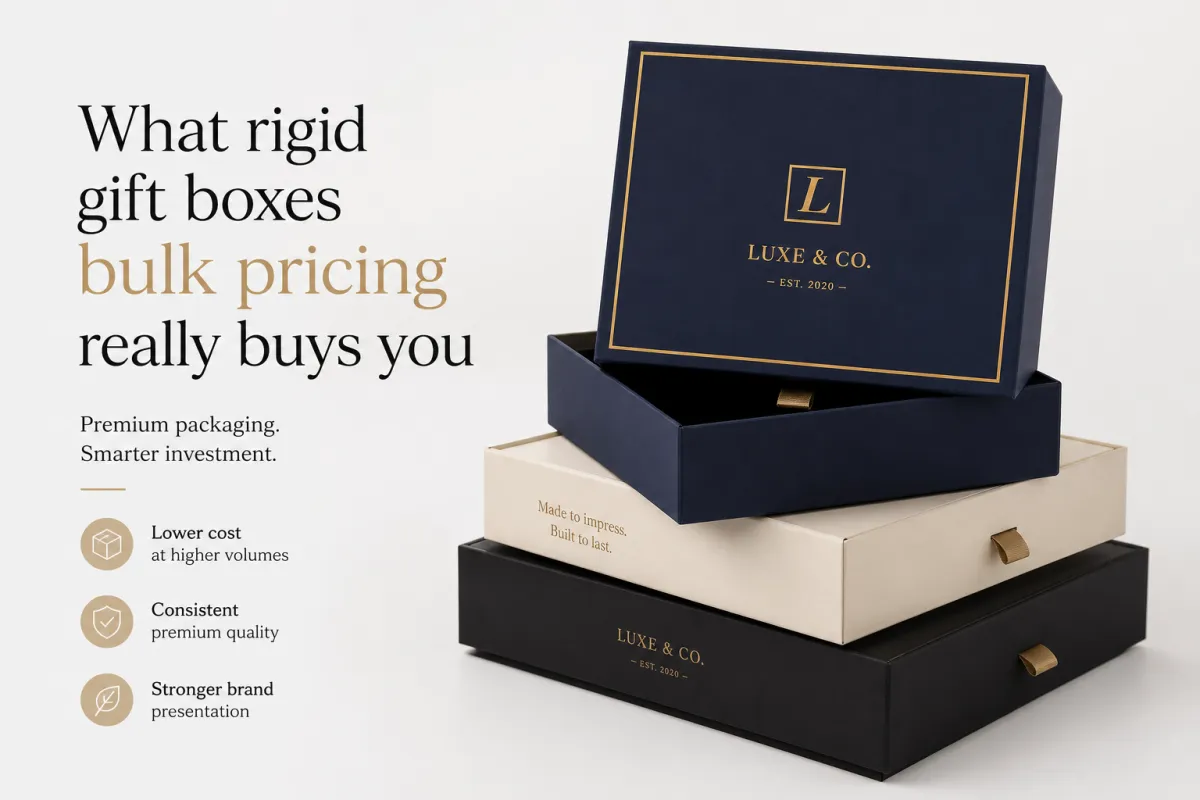
Rigid gift boxes bulk pricing buys consistency first. Once the spec is approved, every box in the run should look and perform the same, which matters a lot if the order is going into retail, fulfillment, or an event program where presentation is part of the product itself. Compared with folding cartons or lightweight mailers, rigid packaging uses thick greyboard, wrapped surfaces, and more manual assembly, so the economics are different from the start.
The tradeoff is pretty straightforward. Rigid boxes begin with a higher unit cost because they use heavier board, more wrap material, and more labor at the bench. The return can still be strong. A well-made rigid box supports premium positioning more easily than a thin mailer because it feels intentional in the hand, protects the product better, and tells the customer the brand cared about the experience before the box even opens.
Damage reduction alone can justify rigid gift boxes bulk pricing. If a fragile candle, bottle, or accessory arrives broken, the replacement cost rarely stops at the item itself. Shipping, customer service time, reshipments, and the hit to trust all travel with that mistake. A stronger spec can reduce those losses, especially in long-distance distribution where parcels get handled more than once and often not very gently.
From a buyer’s standpoint, rigid gift boxes bulk pricing should be weighed against category, channel, and order frequency. A cosmetics launch may need a more polished exterior than an internal corporate gift set. A subscription program may need crush resistance and inserts more than an elaborate opening sequence. The best box supports the commercial goal without paying for features the product does not actually need.
Most teams get better results by treating rigid gift boxes bulk pricing as a forecastable input instead of a one-off purchase. If a line will replenish, the first run should not be designed only around the opening shipment. Locking the spec early reduces reprints, keeps color and fit consistent, and cuts waste when the second and third orders show up. That matters even more for brands managing several SKUs or rolling seasonal promotions.
“The cleanest packaging quotes start with exact specs. Once the board, wrap, insert, and finish are defined, rigid gift boxes bulk pricing becomes a planning exercise instead of a guessing game.”
Supplier comparison gets a lot easier when you stop looking at unit price in isolation. A quote that reads lower may still cost more if it includes narrow tolerances, weak adhesive, or a slower schedule that creates stockouts. Better buyers compare the same dimensions, same structure, same insert, and same finish before deciding what the bulk pricing actually means.
If the program is still being shaped, start with a wider packaging view through Custom Packaging Products and then narrow the inquiry to the format that fits the item. For recurring orders across stores, marketplaces, or seasonal drops, a structured replenishment plan can also be mapped through Wholesale Programs.
Materials and environmental context matter too. The FSC chain-of-custody framework is useful when paper sourcing is part of the brand story, while the EPA recycling guidance helps brands think clearly about recovery, labeling, and end-of-life expectations. Those references do not set rigid gift boxes bulk pricing by themselves, but they often shape the spec that gets approved.
Rigid gift box formats that change your bulk quote
Rigid gift boxes bulk pricing shifts quickly with structure. Two boxes can share the same outside dimensions and still land at very different cost points because the assembly path is not the same. A two-piece lid-and-base box is usually more direct than a magnetic closure box with hidden board magnets and tighter alignment tolerances, and that difference shows up in labor before it shows up anywhere else.
Buyers commonly compare set-up boxes, magnetic closure boxes, drawer-style boxes, book-style boxes, and two-piece lid-and-base boxes. Each has a place, but each changes material load and labor in a different way. The box style should fit the product, not the mood board. That line saves a lot of money, and a lot of regret.
Two-piece lid-and-base boxes usually sit near the simpler end of rigid gift boxes bulk pricing. They show up often for retail gift sets, apparel accessories, and seasonal bundles because the structure is familiar, easy to pack, and visually clean. The cost rises if the lid needs a deep wrap, print coverage on both surfaces, or a custom insert.
Magnetic closure boxes often sit higher in the quote because they need precise folding, magnet placement, and a cleaner assembly workflow. The hidden hardware is not expensive by itself, but the labor required to build it well adds up. These boxes work especially well for luxury launches, high-end cosmetics, and corporate gifting where the opening moment matters as much as the item inside.
Drawer-style boxes create a premium feel and are popular for jewelry, small tech accessories, and curated kits. They usually need an inner tray, a pull ribbon, or a tighter sleeve fit, so rigid gift boxes bulk pricing rises with the extra handling steps. They can be worth it when the brand wants repeat use or a more collectible presentation, but they are not a free upgrade. There is always a cost somewhere.
Book-style boxes give a strong canvas for branding and are often chosen for press kits, presentation sets, and influencer mailers. The opening motion is part of the appeal, but the structure can push labor and precision higher than a simple setup box. If the artwork has to align across panels, the proofing stage matters more than many buyers expect.
The comparison below shows how formats usually affect pricing and function:
| Format | Typical cost impact | Best use case | Buyer watch-out |
|---|---|---|---|
| Two-piece lid-and-base | Lowest to moderate | Retail gifts, apparel, candles | Lid fit and board thickness |
| Magnetic closure | Moderate to high | Luxury launches, premium kits | Magnet alignment and closure strength |
| Drawer-style | Moderate to high | Jewelry, small accessories, PR boxes | Tray fit and pull durability |
| Book-style | High | Presentation sets, influencer mailers | Panel alignment and wrap consistency |
| Set-up box with insert | Moderate | Cosmetics, bundles, sample kits | Insert complexity and interior finish |
Structure affects labor as much as materials. A magnetic closure box may look simple from the outside, but its hidden assembly steps can make rigid gift boxes bulk pricing climb faster than a basic lid-and-base box. That is why two quotes can appear similar at first glance and then split apart once labor is fully counted. The box is kinda doing two jobs at once: looking premium and surviving real handling.
Insert choice Changes the Quote as well. EVA foam is usually more protective and more expensive than paperboard dividers. Molded pulp can be a smart middle ground if the brand wants a more recyclable look and secure product separation. Velvet trays push the experience further into luxury territory, though they also raise material and assembly time. Some programs do not need an insert at all, and that can save more than buyers expect.
Many packaging teams overspend here. A sample that looks dramatic under studio lights can tempt a brand into choosing the most premium structure available, even when the SKU does not need it. If the product is lightweight and stable, a simpler format can preserve the brand feel while keeping rigid gift boxes bulk pricing under control. That is the kind of decision that looks boring on paper and smart on a freight invoice.
Specifications that move cost: board, wrap, inserts, and finish
Specifications are where rigid gift boxes bulk pricing is won or lost. Board thickness, wrap stock, interior paper, corner reinforcement, adhesive quality, and print coverage all affect both the quote and the long-term performance of the box. Buyers who define these details early usually avoid the unpleasant kind of surprise later, the kind that shows up after approval and somehow always costs more.
The core structure starts with greyboard, often in the range of 800gsm to 1800gsm depending on size and strength target. Smaller presentation boxes can use thinner board, while larger or heavier products need more wall strength to avoid bowing. That choice changes material use immediately, and it also affects freight because thicker board adds weight and volume. A wider box can look harmless on a spreadsheet, then quietly move the shipping line in the wrong direction.
Wrap stock matters just as much. Standard art paper wrap is usually more economical than specialty paper, textured stock, or metallic finishes. Soft-touch lamination adds a premium hand feel, but it also adds a process step and can increase rigid gift boxes bulk pricing noticeably. Full-color wrap coverage costs more than a single-color exterior because of print setup, color control, and the extra time needed to keep the run consistent.
Finishing choices move the quote quickly. Foil stamping, embossing, debossing, spot UV, matte lamination, and textured coatings all change labor and setup. Some are worth it because they reinforce the brand story. Others are selected because a sample was made to catch the eye under bright lights, which is not always the same thing as selling power. A finish should earn its keep, not just look pretty in a mockup.
Dimension changes are another quiet cost driver. Even a small increase in width or depth can alter board consumption, reduce carton packing efficiency, and raise freight costs. A box that seems only slightly larger on screen can require a different sheet layout or a less efficient nesting pattern. That is why rigid gift boxes bulk pricing often shifts when the dieline changes, even if the print art stays the same.
Function specs also deserve attention, even when they do not jump out in a rendered image. Fragrance resistance matters for scented products. Scratch resistance matters for glossy surfaces and retail handling. Food contact requirements matter for edible gifts or items with direct exposure. Warehouse durability matters when boxes are stored, stacked, and moved several times before they reach the end customer.
For programs that must pass testing, asking about ISTA procedures and transport stress expectations is reasonable. Packaging durability is not just a marketing idea; it can be measured. Industry references such as ISTA help buyers think beyond appearance and into drop, vibration, and handling performance. That matters because rigid gift boxes bulk pricing should reflect real distribution conditions, not only a polished sample sitting on a desk.
Spec sheet discipline saves money. The more exact the dieline, artwork, insert dimensions, finish notes, and pack-out instructions, the easier it is to compare apples-to-apples quotes. If one supplier is pricing a 1.5mm board with matte paper and another is quoting 2.0mm board with soft-touch lamination, the difference in rigid gift boxes bulk pricing is not mysterious. It is a spec gap, plain and simple.
These items tend to move cost most often:
- Board thickness: thicker greyboard raises material use and can increase shipping weight.
- Wrap stock: specialty paper, textures, and metallic effects usually cost more than standard art paper.
- Insert complexity: custom trays and foam inserts add cutting and assembly steps.
- Finish type: foil, embossing, and spot UV add setup charges and production time.
- Box size: larger dimensions often increase both material consumption and freight.
If your team is comparing rigid gift boxes bulk pricing across vendors, ask each supplier to quote the same structure and include the same hidden details. That includes whether corner reinforcement is used, whether the inside is wrapped or left raw, and whether the insert is glued in or packed separately. Small differences can distort the quote enough to make a weak decision look attractive.
Rigid gift boxes bulk pricing: how MOQ and quantity tiers work
MOQ is one of the least glamorous parts of rigid gift boxes bulk pricing, but it is one of the most important. Minimum order quantity exists because setup, cutting, wrapping, and assembly cost about the same whether the run is short or long. A small order still needs the same die setup, the same print alignment, and the same quality checks. The math does not really care that the run is small.
That is why the steepest savings usually appear between the smallest run and the next volume tier. A run of 500 rigid boxes can land at a much higher unit cost than 1,000 or 2,000 pieces because the fixed costs are spread more efficiently. The price curve often flattens after that, but the first drop is usually the most dramatic, and it can be the difference between a budget that works and one that gets kicked back by finance.
In practical terms, rigid gift boxes bulk pricing might look something like this for a mid-spec retail box with a printed wrap and paperboard insert:
| Quantity | Indicative unit cost | What is driving the price | Best for |
|---|---|---|---|
| 500 pcs | $2.40-$3.60 | Setup charges and labor spread across fewer units | Pilot launches, test runs |
| 1,000 pcs | $1.70-$2.60 | Better distribution of tooling fees and assembly time | First retail rollout |
| 3,000 pcs | $1.10-$1.90 | Improved material buying and line efficiency | Seasonal programs, repeat SKUs |
| 5,000+ pcs | $0.85-$1.50 | Higher production efficiency and lower per-piece handling | Established replenishment programs |
Those ranges are examples, not a promise. Rigid gift boxes bulk pricing shifts with print coverage, insert type, finish, and destination. A heavily printed magnetic box with a custom foam insert can sit well above those numbers, while a simpler two-piece box may sit lower. The pattern matters more than the exact figures: quantity changes the shape of the quote more than most buyers expect.
When asking for a quote, request the separate line items. Unit price, setup fee, tooling fee, sample cost, carton count, freight estimate, and any rush surcharge should be shown in writing. If the supplier will not break out those items, comparing rigid gift boxes bulk pricing fairly becomes much harder, and landed cost starts drifting into guesswork.
Hidden cost traps show up often. Split shipments can add freight and handling. Artwork revisions after approval can trigger new setup charges. Special inserts may require separate molds or cutting tools. Mixed-SKU orders can reduce production efficiency if each box needs a different wrap or insert. The quote may still look reasonable until the real landed cost is tallied.
A simple decision rule helps. If the packaging program will repeat, it is often worth ordering a little above the immediate need. That can reduce average unit cost, protect against stockouts, and make replenishment easier. The buyer is not paying extra for boxes so much as buying stability in rigid gift boxes bulk pricing across the next cycle. That kind of stability is easy to ignore until a replenishment rush hits and every day costs money.
Most manufacturers also price by tier, which means 2,000 pieces might be materially better than 1,500 even though the gap seems small. That jump can be enough to improve carton efficiency or reduce a press changeover. It is a clear example of how rigid gift boxes bulk pricing rewards planning over urgency.
From approved dieline to delivery: the bulk order timeline
Once a quote is approved, rigid gift boxes bulk pricing turns into an operations story. The order moves through quote confirmation, dieline approval, artwork proofing, sample or mockup review, production, quality check, packing, and freight booking. Each step carries its own timing risk, and the weakest point is usually approval speed rather than manufacturing itself.
Late artwork changes create the most common delay. A buyer may approve a concept and then ask for a logo shift, a new barcode location, or a different foil color after proofing. Those changes sound small, but they can force new plates, new wrapping layouts, or a fresh review of insert fit. That is how a simple rigid gift boxes bulk pricing plan stretches into a longer schedule.
Material availability matters as well. Specialty paper can take longer to source than standard wrap stock. A custom insert may need its own cutting tool or mold. During busy periods, even good suppliers can get squeezed on production windows. If the box needs color-critical printing or a high-gloss finish, allow extra buffer for inspection and rework, because production that looks smooth on a calendar can still wobble in the final stage.
Lead time depends on complexity. A straightforward rigid box can move from approved proof to shipment faster than a premium book-style box with nested inserts and decorative finishes. A simple order may land in 12-15 business days after proof approval, while more complex programs need a longer runway. The exact answer depends on artwork readiness, material stock, and the production queue.
Pre-production samples are worth the time. They catch fit problems, color shifts, and closure issues before the full run is committed. A sample can also reveal whether the insert grips the product too tightly or leaves too much movement in transit. That is particularly useful for delicate items such as glass, fragrance, and cosmetics, where a half-millimeter mistake can be the difference between a clean unbox and a broken product.
Logistics can change the schedule after production is done. Ocean freight adds transit time and can face port congestion. Domestic trucking can be affected by warehouse receiving windows. Peak-season congestion can slow booking even when the boxes are complete. A clean production plan is only half of rigid gift boxes bulk pricing; delivery timing is the other half.
From a compliance standpoint, some buyers also ask about ASTM test references or shipping validation, depending on the product type. That is not overkill for fragile items. It is a practical way to confirm that the box chosen through rigid gift boxes bulk pricing will hold up once it leaves the production floor and enters the real supply chain.
The order timeline is easiest to manage when the buyer treats packaging like a production asset rather than a last-minute purchase. If the packaging arrives late, the product launch slips. If the spec changes, the quote changes. If the approval process drags, even the best rigid gift boxes bulk pricing will not fix the schedule. That part is on the process, not the box.
Why choose us for rigid gift boxes bulk pricing
Buyers do not need hype. They need stable pricing, repeatable quality, and a supplier who can explain exactly why a quote changed. That is the practical value of working with a packaging partner who understands rigid gift boxes bulk pricing from both the design side and the production side.
In-house design support matters because it shortens the back-and-forth. If a dieline needs adjustment to fit a specific insert or if the logo placement needs to shift to protect a fold line, the fix happens faster when the team understands how the structure is built. That kind of packaging engineering can reduce costly revisions and keep the unit cost under control.
Manufacturing oversight matters too. When there are fewer handoffs, there is usually less confusion about board stock, wrap stock, and finishing tolerances. Direct manufacturing also tends to improve accountability. If there is a defect, the question is not who passed the file along. The question is what should be corrected before the next run of rigid gift boxes bulk pricing goes out.
That clarity matters even more on recurring orders. A good supplier should help forecast reorders, preserve the approved spec, and avoid overbuying on the first run. The right partner will also be direct about where the quote sits because of real production costs and where the box can be simplified without hurting the brand. That honesty saves time, and it tends to save money too.
The commercial case is simple. Buyers who know the difference between setup charges and material cost can choose better specs. Buyers who understand MOQ can avoid ordering too little and paying too much per piece. Buyers who compare landed cost instead of headline unit price usually get more value from rigid gift boxes bulk pricing. None of that is flashy, but it is how smart packaging programs stay on budget.
Trust still matters. Quality checks, sample validation, consistent board sourcing, and clear carton packing instructions reduce surprises. A box that looks great but arrives crushed or inconsistent is not premium packaging. It is a problem wearing a nice finish.
If you are comparing suppliers now, ask for a quote that reflects the same board thickness, same wrap, same insert, same finish, and same destination. That is the only fair way to compare rigid gift boxes bulk pricing. Everything else is a guess dressed up as a number.
How to request a quote and compare next steps
The fastest way to get a useful quote is to prepare the right inputs. Start with box dimensions, target quantity, closure style, insert type, print coverage, finish, and destination ZIP or port. If you know the product weight and how the item sits inside the box, include that too. Rigid gift boxes bulk pricing becomes far more accurate when the supplier is not guessing at fit.
It also helps to request two or three comparable scenarios. Ask for a value build, a mid-tier spec, and a premium version. That makes the budget trade-offs visible. In many cases, the mid-tier option delivers the best mix of appearance, protection, and unit cost. The premium version may be the right answer for a launch kit, but not for routine replenishment.
Ask for sample photos, a dieline, and a line-item quote before approval. Those three items help confirm what is included and what is optional. If tooling fees, setup charges, or freight are not clearly shown, the landed cost can be misleading. A clear quote protects both the brand and the production schedule.
Use a short internal checklist before signing off:
- Budget: does the quote fit the target spend per kit or per unit?
- Lead time: is there enough time for proofing, sample review, and freight?
- Brand priority: is premium finish worth the added rigid gift boxes bulk pricing?
- Reorder plan: will this spec be repeated, or is it a one-time campaign?
- Logistics: is the delivery window realistic for the warehouse or fulfillment center?
If the order is for a repeat program, think one step ahead. A slightly larger initial purchase can lower average cost, smooth replenishment, and protect against stockouts. That is especially true for seasonal retail, corporate gifting, and launch programs where missing inventory costs more than the extra boxes. Rigid gift boxes bulk pricing works best when the buyer sees beyond the first shipment.
For brands still refining their packaging lineup, it can help to map rigid gift boxes bulk pricing against the rest of the packaging stack. Maybe the outer carton is doing too much work. Maybe the insert can be simplified. Maybe the print finish can be reduced while keeping the same shelf impact. Small changes often deliver the cleanest savings, and they are usually the first place I would look before making the spec more expensive.
The most practical move is simple: gather the exact specs, compare landed cost on the same build, and choose the structure that fits the product and the replenishment schedule. That is the cleanest way to treat rigid gift boxes bulk pricing as a buying decision instead of a guessing exercise. Done well, rigid gift boxes bulk pricing gives you a better box, a clearer budget, and fewer surprises on the receiving dock.
What drives rigid gift boxes bulk pricing the most?
The biggest drivers are quantity, box structure, board thickness, wrap material, and finishing choices such as foil or embossing. Insert complexity and custom sizing also matter because they add labor and material usage. Freight, sample charges, and rush production can change the landed cost even when the unit price looks stable.
How low can MOQ be for rigid gift boxes bulk orders?
MOQ varies by structure and customization level, but the smallest runs usually carry a higher unit price because setup costs are spread across fewer boxes. Standard shapes and fewer finishing steps tend to allow lower MOQs than highly customized premium builds. If a buyer needs a small pilot order, ask for the minimum viable spec rather than a full luxury build.
Do inserts change rigid gift boxes bulk pricing a lot?
Yes, inserts can move price materially because they affect material use, cutting, and assembly time. Paperboard dividers are usually more economical than molded foam or custom trays, especially at lower volumes. The right insert should fit the product securely without paying for more structure than the item actually needs.
How long does a bulk rigid gift box order usually take?
Timelines depend on approval speed, artwork readiness, material availability, and the complexity of the box structure. A simple order moves faster than a premium box with custom inserts, special finishes, or color-critical printing. Build in time for proofs and a sample review if the order must fit products exactly.
How do I compare two rigid gift box quotes fairly?
Compare the same dimensions, materials, insert type, print coverage, and finish so the pricing reflects identical specs. Check whether tooling, samples, freight, and carton packing are included or billed separately. The best quote is the one that matches the spec, timeline, and landed cost you actually need.


