Buyer Fit Snapshot
| Best fit | Rigid Gift Boxes with Foil Logo projects where brand print, material claims, artwork control, MOQ, and repeat-order consistency need to be specified before quoting. |
|---|---|
| Quote inputs | Share finished size, material target, print colors, finish, packing count, annual reorder estimate, ship-to region, and any compliance wording. |
| Proofing check | Approve dieline scale, logo placement, barcode or warning zones, color tolerance, closure strength, and carton packing before bulk production. |
| Main risk | Vague material claims, crowded artwork, missing packing details, or unclear freight terms can make a low unit price expensive after revisions. |
Fast answer: Rigid Gift Boxes with Foil Logo: Brand Impact Explained should be specified like a repeatable production item. The safest quote records material, print method, finish, artwork proof, packing count, and reorder notes in one written spec.
Production checks before approval
Compare the actual filled-product size with the drawing, then confirm tolerance on folds, seals, hang holes, label areas, and retail display edges. Reserve space for logos, QR codes, warning copy, and material claims before decorative graphics fill the panel.
Quote comparison points
Review material grade, print process, finish, sampling route, tooling charges, carton quantity, and freight assumptions side by side. A quote is only useful when the supplier can repeat the same color, closure quality, and packing count on the next order.
Rigid Gift Boxes with Foil Logo: Brand Impact Explained
Put two gift boxes on a table with the same footprint, the same insert, and the same product inside, and the one built as Rigid Gift Boxes with foil logo almost always grabs attention first. The reason is simple: a solid structure changes how the eye reads the package, and a metallic logo gives that structure a clear point of focus. The result feels deliberate, not like something that got printed in a rush and sent out the door.
That effect shows up across cosmetics, jewelry, hospitality gifts, seasonal retail, and corporate presentation sets. In all of those categories, the box is doing more than holding an item. It is setting expectations before the lid even opens, and that first read has a real impact on how the product is judged.
The appeal is visual, but it is also physical. A rigid box starts with dense chipboard, so the walls stay square, the lid has weight, and the whole package gives a stronger hand-feel than a folding carton. Add a foil-stamped logo and the package starts to communicate care, restraint, and quality in a single glance. That is why Rigid Gift Boxes with foil logo keep showing up in premium packaging briefs.
There is also a practical side that buyers sometimes underestimate. The structure needs to protect the product, the wrap paper has to handle the stamping cleanly, and the foil has to fit the logo without crowding the lid. If any of those pieces are off, the box may still work, but the premium effect drops fast. A fancy finish cannot rescue weak construction. It just can’t.
Why rigid gift boxes with foil logo feel premium at a glance
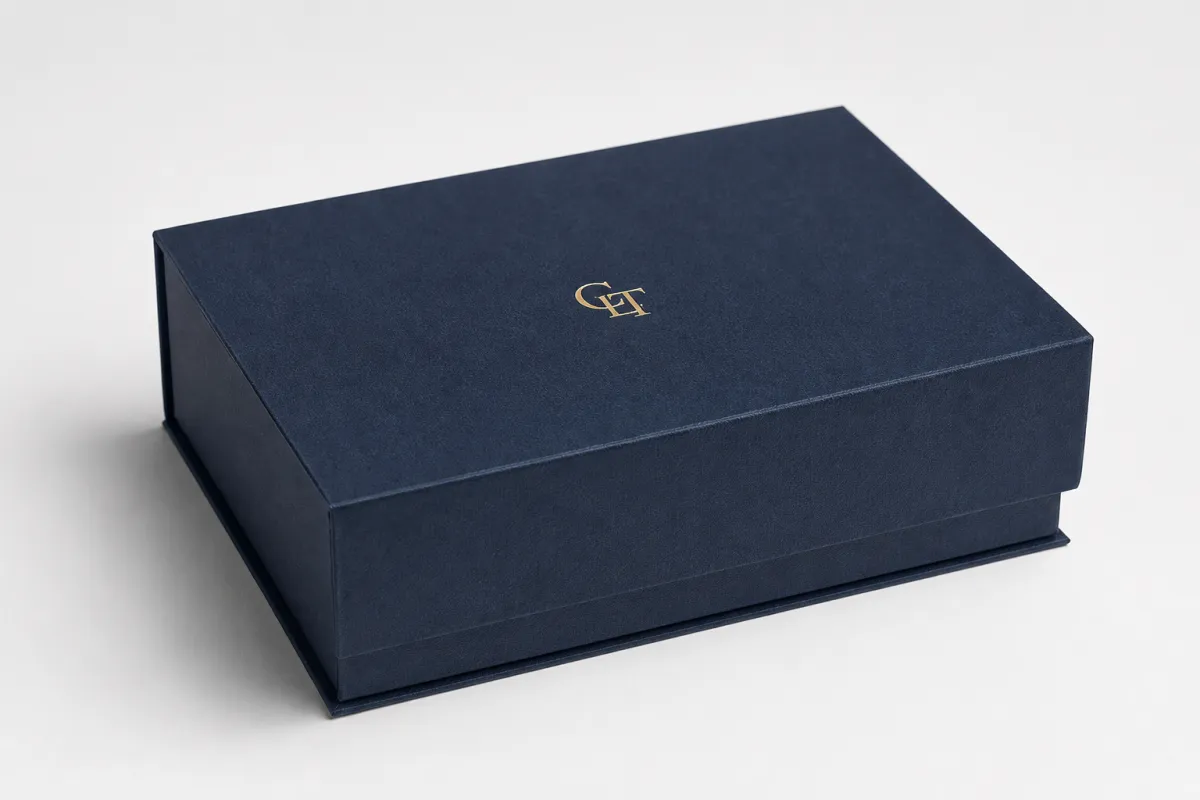
Premium packaging often gets treated like decoration, but the stronger formats do the opposite. They begin with structure, then use finish to sharpen the message. A rigid box has enough thickness to feel substantial in the hand, and a foil logo adds a signal that tells the customer someone paid attention to the details. That combination is why rigid gift Boxes with Foil logo feel more finished than many other presentation formats.
Contrast does a lot of the work. Matte wrap paper paired with gold, silver, or black foil reflects light differently than standard ink, so the logo stands apart from the surface instead of blending into it. That difference creates hierarchy. The eye knows exactly where to land, and the brand gets to decide what gets the spotlight.
Minimal layouts often perform especially well here. A small centered mark, a restrained corner placement, or a clean top-panel logo can feel more confident than a crowded lid full of type and icons. In packaging reviews I’ve been part of, the projects that age best are usually the ones that resist doing too much. A little breathing room goes a long way.
The unboxing moment matters too. A rigid lid opens with more presence than a folding flap, and that subtle resistance builds anticipation. When the foil is placed carefully on the lid or sleeve, the package tells a story before the product is even visible. That kind of reveal can feel kind of cinematic without trying too hard.
A foil logo does not hide poor structure; it makes structure easier to judge. If the board bows, the edges crush, or the wrap paper is poorly matched, the shine draws attention to the weak spots instead of masking them.
That is one reason this format keeps appearing in premium retail, launch kits, and gift programs. The box becomes part of the product experience, not just the shell around it. For brands comparing other packaging constructions, our Custom Packaging Products page shows how different formats support different presentation goals.
How rigid gift boxes with foil logo are constructed and foiled
A rigid box usually begins with dense chipboard, often around 1.5 mm to 3 mm thick, depending on box size, product weight, and the amount of stiffness the brand wants to feel in the hand. The board is cut into panels, wrapped with paper, and assembled so the package keeps its form. That construction is one of the main reasons rigid gift boxes with foil logo feel more refined the moment someone picks them up.
Wrap paper choice matters more than many teams expect. A smooth coated wrap usually gives the crispest foil edge and the sharpest type detail, while textured paper can add warmth and depth but may soften very fine lines. Foil stamping itself uses heat, pressure, and a die to transfer metallic or pigment foil onto the surface. It is not printed in the usual sense; it is pressed, which is why temperature, registration, artwork scale, and paper selection all matter.
Gold, silver, rose gold, black, and holographic foils are common choices, but they do not all behave the same way on every wrap. Matte foil is often a strong option for brands that want a quieter finish rather than high shine. Embossing and debossing can be combined with foil for extra dimension, although those steps add tooling complexity and can affect both cost and lead time. In practice, the best finish is usually the one that matches the brand voice, not the one that looks loudest on a screen.
Design limits that matter on press
Artwork that looks beautiful on a monitor can become fussy on a physical box. Hairline strokes, tiny serif details, and tightly packed letters can fill in during stamping, especially on textured wrap paper. The logo needs enough thickness to survive production, and it needs enough open space around it so the foil sits cleanly on the surface. Those choices help rigid gift boxes with foil logo stay readable from a distance and elegant up close.
Placement matters just as much as finish. A centered lid logo works for many brands, while a smaller mark near the top edge can feel more editorial. Some teams place the logo on a sleeve so it stays visible on shelf. Others repeat the logo on both lid and base, though that usually pushes cost up and can make the layout feel crowded. Most of the time, one clear surface does the job better than three competing ones.
For a quick comparison, here is a practical view of how structure and finish shape the result:
| Option | Typical Look | Best For | Relative Cost |
|---|---|---|---|
| Rigid box with one foil logo | Clean, premium, restrained | Luxury gifts, PR kits, jewelry, cosmetics | Moderate to higher depending on quantity |
| Rigid box with foil plus embossing | More tactile and dimensional | High-end branding, limited editions | Higher |
| Printed rigid box without foil | More graphic, less reflective | Brand campaigns, colorful retail sets | Moderate |
| Folding carton with foil accent | Lighter structure, lower presence | Retail shelves, lighter products | Lower |
That comparison matters because rigid gift boxes with foil logo are not the right fit for every brief. A lightweight product, a short seasonal run, or a tight budget may be better served by a well-designed folding carton. Still, when the brief calls for a stronger first impression, rigid construction and foil stamping usually return more perceived value per square inch.
Key factors that shape the look, durability, and brand fit
The first question I ask about rigid gift boxes with foil logo is basic: what has to happen in the real world? A box for a retail shelf has different demands than a box used only for a presentation at an event. If the packaging will ship across the country, it needs enough crush resistance to survive transit vibration, stacking, and repeated handling. If it mainly sits on a counter or rides home in a gift bag, the design can lean harder into visual impact and opening experience.
Board thickness is one of the first decisions that shapes the outcome. Thicker board gives a firmer feel and cleaner edges, but it also raises cost and can make very small boxes harder to assemble neatly. Wrap material matters just as much. A soft-touch laminated wrap feels rich, though it can show scuffs in certain light. A specialty paper adds texture and depth, yet that same texture may reduce foil sharpness. Those tradeoffs are exactly why samples matter so much for rigid gift boxes with foil logo.
The logo should match the brand language instead of chasing every possible finish. A wellness brand may look stronger with a simple gold foil mark on uncoated paper, while a tech gift set may need silver foil on a dark matte surface. Black foil is useful when the goal is subtle contrast instead of sparkle. If the logo is oversized, it can crowd the lid; if it is too small, the foil effect gets lost. Balance usually wins over spectacle.
Practical performance details matter too. A magnetic closure changes the way the box opens and closes, which can make the unboxing feel smoother and more refined, but the magnets add cost and need to be aligned carefully. Ribbon pulls help with removing inserts or trays, though they can complicate packing. A custom insert, whether paperboard, EVA foam, molded pulp, or velvet-lined card, should hold the item securely rather than just filling empty space. That matters even more for rigid gift boxes with foil logo carrying glass, perfume, or fragile accessories.
Consistency is another detail that separates a clean production run from a frustrating one. Foil registration needs to stay tight across batches. Wrap color tolerance should be managed so one lot does not drift visibly from the next. If the packaging has to align with a broader brand system, compare it with labels, printed cartons, tissue, or inserts early rather than after final approval. The strongest packaging programs treat rigid gift boxes with foil logo as part of the whole set, not as a standalone object.
One useful way to judge fit is to ask whether the box feels like a natural extension of the brand or just a premium shell borrowed from somewhere else. That question may sound soft, but it saves real money. A box that does not match the brand personality often gets redesigned later, which means extra proof cycles and avoidable delays. A better brief up front usually leads to better rigid gift boxes with foil logo the first time around.
For buyers shaping a broader packaging system, it helps to compare a few formats together and look at closure style, insert options, and surface finish before sending a request. That approach is faster than asking for one sample after another without a clear direction, and it keeps the project grounded in actual use rather than mockup appeal. If you need a place to begin, our Custom Packaging Products page shows how different constructions support different products and budgets.
Production process and timeline for rigid gift boxes with foil logo
The usual workflow for rigid gift boxes with foil logo starts with a brief, not with artwork. A useful brief includes dimensions, product weight, box style, target quantity, closure preference, foil color, insert needs, and the date the boxes must arrive. Once that is set, the supplier prepares a dieline and checks the structure against the product. That early step saves a lot of expensive back-and-forth later.
After the dieline is approved, the artwork gets cleaned up for production. This is where line thickness, logo spacing, and foil placement are checked against real manufacturing limits. Then comes the proof or sample stage. A visual sample shows how the box should look, while a production sample is closer to the actual run and helps confirm whether the structure, paper choice, and foil treatment can hold up at scale. For rigid gift boxes with foil logo, that distinction matters because a nice mockup is not enough if the lid warps or the foil cracks at the corner.
Once the sample is approved, the foil plate or die is made and the production run begins. The box is wrapped, stamped, folded, assembled, inspected, and packed. If the design uses embossing, multiple foil colors, or a custom insert, the process takes longer and becomes more delicate. Complex structures also add time because each extra surface or closure point creates another place where alignment can drift. That is why rigid gift boxes with foil logo often need more lead time than simple printed cartons.
Typical timelines can range from about 12 to 18 business days after final proof approval for straightforward projects, but that figure is only a rough benchmark. If the order uses custom inserts, specialty paper, or several foil locations, it can stretch to 20 business days or more, especially if artwork revisions happen late. Freight needs its own schedule. Air shipping saves time but adds cost; sea freight lowers landed cost but requires more buffer time.
Plan backward from the real deadline. If the gift launch is tied to a retail season, event date, or influencer shipping window, leave room for sample changes, production queue time, and possible freight delays. That buffer is one of the cheapest forms of insurance in packaging. It is far easier to approve a box a week early than to try to rescue a launch with a rushed run of rigid gift boxes with foil logo.
There are also standards worth keeping in mind if the boxes will travel far or pass through channels with strict handling expectations. Distribution testing often follows ISTA methods, and many brands look at general packaging guidance from sources like ISTA when they evaluate shipping durability. If sustainability is part of the brief, paper sourcing and board selection may also be checked against FSC certification requirements. Those references do not solve every packaging problem, but they give the project a more disciplined frame.
Rigid gift boxes with foil logo cost, pricing, and MOQ
Pricing for rigid gift boxes with foil logo comes from several layers, and a quote only makes sense when those layers are visible. Size is the first driver because larger boxes use more board, more wrap paper, and more labor. Board grade follows, then the wrap material. A standard art paper wrap costs less than a specialty textured stock, and a soft-touch laminate or complex printed wrap usually increases both material and handling cost.
Foil stamping is another cost bucket, and it changes with the number of foil colors, the total area covered, and whether the logo needs embossing or debossing. Inserts can be inexpensive when they are simple paperboard pieces, but they become more expensive when they are custom-cut EVA foam, molded trays, or lined presentations. Manual assembly can also be significant because rigid packaging takes more labor than folding carton work. That is why rigid gift boxes with foil logo are rarely priced from one feature alone.
MOQ matters because setup costs are front-loaded. Once the dies, plates, proofing, and production setup are in motion, the per-unit cost falls as quantity rises. A small order can carry a high unit price simply because the setup is spread across too few boxes. At higher volumes, the same structure becomes much more efficient. Buyers sometimes focus only on the sticker price, but the smarter question is what quantity gives the best mix of quality and cost for rigid gift boxes with foil logo.
To make the tradeoffs easier to read, here is a practical pricing view based on common production choices. These are indicative ranges rather than fixed quotes, but they help frame the conversation:
| Build Option | Typical Features | Approx. Unit Cost at Mid Volume | Notes |
|---|---|---|---|
| Standard rigid box, one foil logo | 1.5-2 mm board, paper wrap, single foil hit | $1.80-$3.20 | Good for simple premium presentation |
| Rigid box with insert and premium wrap | Thicker board, custom insert, specialty paper, one foil logo | $2.80-$5.00 | Common for gifts, cosmetics, and accessories |
| Rigid box with foil and embossing | Foil logo plus raised detail, tighter tooling control | $3.50-$6.50 | Stronger tactile feel, more setup time |
| Luxury presentation set | Magnetic closure, premium wrap, insert, multiple finishes | $5.00-$10.00+ | Best for high-value retail or gift programs |
Those numbers can move up or down based on quantity, shipping method, and how much hand assembly is required. A small run of rigid gift boxes with foil logo may cost much more per unit than a larger run, even when the design looks identical. That is not a supplier trick; it is simply how setup-heavy packaging works. The good news is that once a format is proven, repeat orders often become easier to price and faster to produce.
If you need a better quote, send the supplier the box dimensions, product weight, artwork files, foil color, finish expectations, insert needs, and target quantity. If the box has to fit inside a shipper, a display tray, or a retail set, say that up front. Every constraint shared early improves the estimate. That is especially true for rigid gift boxes with foil logo, because the structure and finish are more tightly linked than they are in many other package types.
One useful buying habit is to ask for two or three build options instead of one. Compare a standard foil logo against a foil-plus-emboss version, or compare a premium wrap against a more cost-controlled paper. That turns the decision into a real tradeoff conversation rather than a single quote that may or may not fit the budget. It is often the fastest path to a balanced choice, and it keeps rigid gift boxes with foil logo aligned with both brand and margin goals.
Common mistakes that weaken foil and box performance
The most common mistake is asking the logo to do too much. Fine lines, tiny letters, crowded icons, and narrow spacing can look elegant in a vector file but fail once they are stamped onto a wrapped surface. Foil needs room. If the artwork is too intricate, the edges can blur or fill in, and the brand mark loses clarity. For rigid gift boxes with foil logo, simple usually beats ornate when the goal is a clean premium read.
Weak contrast causes another problem. A pale foil on a pale wrap, or a highly reflective foil on a busy texture, can disappear visually. The goal is not to make the box loud. The goal is to make the logo readable and intentional. A darker wrap with gold or silver foil often gives stronger hierarchy, while matte foil on a soft-touch surface can create a quieter, more modern look. If the contrast is wrong, even well-made rigid gift boxes with foil logo can feel flat.
Teams also forget how the box behaves after real handling. A rigid box can look perfect on a mockup table and still disappoint once it gets stacked, shipped, opened, and closed several times. Corners can scuff, lids can shift, and inserts can loosen if the fit is too generous. For a presentation box, those problems show up fast. Product weight, closure style, and shipping method should be part of the conversation from the start. Packaging that only survives the photo shoot is not enough for rigid gift boxes with foil logo.
Late approvals create another kind of trouble. When artwork moves through without a physical sample, the first production run becomes the test, and that is a risky place to discover problems. Time spent reviewing alignment, paper color, foil shine, and lid fit before volume production is far cheaper than fixing mistakes afterward. A good sample can reveal whether the logo sits too close to the edge, whether the foil breaks on the fold, or whether the lid feels too loose. Small corrections at that stage protect the full run of rigid gift boxes with foil logo.
- Keep logo artwork simple enough for stamping.
- Match foil color to wrap color with real contrast in mind.
- Test the box with the actual product weight.
- Approve a physical sample before mass production.
- Check shipping, stacking, and insert fit, not just appearance.
One more mistake appears often: treating the rigid box as a separate project from the rest of the packaging system. The box, tissue, insert, label, and outer shipper all need to speak the same visual language. When they do, the presentation feels cohesive and expensive in a way that is hard to fake. When they do not, even attractive rigid gift boxes with foil logo can feel disconnected from the brand.
Expert tips and next steps for stronger packaging briefs
Start with the unboxing moment. Decide exactly what the customer sees first, where the logo should land, and what should feel tactile when the lid comes off. That exercise clears up a surprising number of design decisions. If the brand wants a slower, more ceremonial reveal, a magnetic rigid box with a centered foil logo can work beautifully. If the goal is quick elegance, a sleeve-style presentation may fit better. The experience should drive the structure, especially for rigid gift boxes with foil logo.
Ask for material combinations, not just one quote. A good supplier should be able to show a few directions, such as gold foil on smooth paper, black foil on soft-touch wrap, or silver foil on a textured specialty stock. Comparing samples side by side helps buyers judge sheen, contrast, hand-feel, and brand fit in a way renderings rarely can. That is one reason I encourage teams to request more than one build option when they are serious about rigid gift boxes with foil logo.
When the brief is ready, keep it tight and practical. Include dimensions, product weight, quantity, target delivery date, insert requirements, shipping constraints, and any retail display concerns. If the boxes must fit a master carton or be packed in a specific way for fulfillment, mention that too. The more concrete the brief, the more accurate the recommendation. It also reduces revision cycles, which saves time and often money on rigid gift boxes with foil logo.
I also recommend thinking one step beyond the immediate purchase. Ask what the box says when it is photographed, stacked, shipped, and reused. A strong premium box does not only look good in a studio shot; it keeps its shape, protects the product, and still feels special when the customer opens it at home. That durability of impression is where smart packaging pays back. A lot of buyers feel that effect with rigid gift boxes with foil logo because the structure stays present even after the foil has done its first job.
If you are building a broader packaging program, keep an eye on repeatability. The best results happen when the supplier understands the brand's preferred foil finish, board feel, and lid tolerance well enough to reproduce them reliably. That consistency matters for subscription gifts, seasonal programs, and repeat retail SKUs. It is also why many teams keep their packaging partners informed about new runs instead of rebuilding the spec each time. For a better starting point, review our Custom Packaging Products and compare structure options before you lock the brief.
My practical closing advice is simple: gather the artwork, confirm the box style, request a sample, compare cost against finish quality, and make sure the final package matches the brand promise from first glance to final unboxing. Done well, rigid gift boxes with foil logo do more than hold a product. They shape how that product is perceived, how it is remembered, and how confidently a customer passes it along to someone else. That is a lot of work for one box, but it is exactly why rigid gift boxes with foil logo remain such a strong choice for premium packaging.
FAQ
Are rigid gift boxes with foil logo better than printed boxes for luxury gifts?
Rigid boxes usually feel more premium because the board is thicker, the lid opens with more presence, and the package keeps its shape instead of collapsing like a folding carton. Foil stamping adds a reflective detail that printed ink cannot fully match, especially when the brand wants a restrained look. For gifts where presentation affects perceived value, rigid gift boxes with foil logo are often the stronger choice.
What affects the price of custom rigid gift boxes with foil logo most?
Size, board grade, wrap paper, foil complexity, and inserts are the biggest cost drivers because they affect both materials and labor. Order quantity matters too, since setup costs are spread across more boxes at higher volumes. If you want a more accurate quote for rigid gift boxes with foil logo, send dimensions, artwork, quantity, and the exact finish you want.
How long does production usually take for foil-stamped rigid gift boxes?
The timeline depends on artwork approval, sample making, foil plate setup, and how many finishing steps the box needs. Simple projects can move faster, but custom structures, special papers, or multiple foil locations usually add time before shipping. For rigid gift boxes with foil logo, it is safer to plan backward from the real launch date and leave room for proof revisions.
Which foil colors work best on rigid gift boxes for branding?
Gold and silver are classic choices, but matte black, rose gold, and holographic foil can be stronger if they match the brand personality. The best option is the one that contrasts clearly with the wrap paper and keeps the logo readable at a glance. That contrast is a major reason rigid gift boxes with foil logo work so well for premium presentations.
What details should I send a supplier for an accurate quote?
Provide the box dimensions, product weight, artwork file, foil color, quantity, target delivery date, and whether you need inserts or special closures. If you already know the use case, include shipping or retail requirements so the quote reflects the real packaging conditions. The more complete the brief, the easier it is to price rigid gift boxes with foil logo accurately the first time.


