Buyer Fit Snapshot
| Best fit | Shipping Bags Wholesale projects where brand print, material claims, artwork control, MOQ, and repeat-order consistency need to be specified before quoting. |
|---|---|
| Quote inputs | Share finished size, material target, print colors, finish, packing count, annual reorder estimate, ship-to region, and any compliance wording. |
| Proofing check | Approve dieline scale, logo placement, barcode or warning zones, color tolerance, closure strength, and carton packing before bulk production. |
| Main risk | Vague material claims, crowded artwork, missing packing details, or unclear freight terms can make a low unit price expensive after revisions. |
Fast answer: Shipping Bags Wholesale: Materials, Pricing, and Orders should be specified like a repeatable production item. The safest quote records material, print method, finish, artwork proof, packing count, and reorder notes in one written spec.
Production checks before approval
Compare the actual filled-product size with the drawing, then confirm tolerance on folds, seals, hang holes, label areas, and retail display edges. Reserve space for logos, QR codes, warning copy, and material claims before decorative graphics fill the panel.
Quote comparison points
Review material grade, print process, finish, sampling route, tooling charges, carton quantity, and freight assumptions side by side. A quote is only useful when the supplier can repeat the same color, closure quality, and packing count on the next order.
Shipping Bags Wholesale: Materials, Pricing, and Orders
Comparing shipping bags wholesale options for an ecommerce operation often starts with a spreadsheet battle and ends with a freight bill. The middle layer is where the real leverage—or the hidden cost cliff—usually lives. If the packaging footprint is off by even a small amount, you pay for that gap in dimensional weight, extra void fill, and handling time. A well-sized mailer does the opposite: it cuts slack in the pack, shortens station touches, and usually lands at the customer as a package that looks intentional instead of improvised.
For teams building a repeatable supply plan, Custom Poly Mailers are often the first form to evaluate, and wider sourcing can flow through our Wholesale Programs or the full Custom Packaging Products catalog. The shipping bags wholesale conversation is not really about getting the lowest unit cost; it is about locking in repeatable behavior. Packaging spec reliability, lead-time stability, and fit to warehouse motion can be worth more than a few cents per bag.
In two different operations I reviewed last year, a 4 mm increase in average mailer length produced opposite outcomes: one team added padding and still had scuffs, while another kept a cleaner footprint and reduced repacking. Same category, different fit, different process discipline. That contrast is why this topic matters for anyone serious about margin and fulfillment consistency.
Shipping Bags Wholesale: Why the Right Bag Lowers Returns
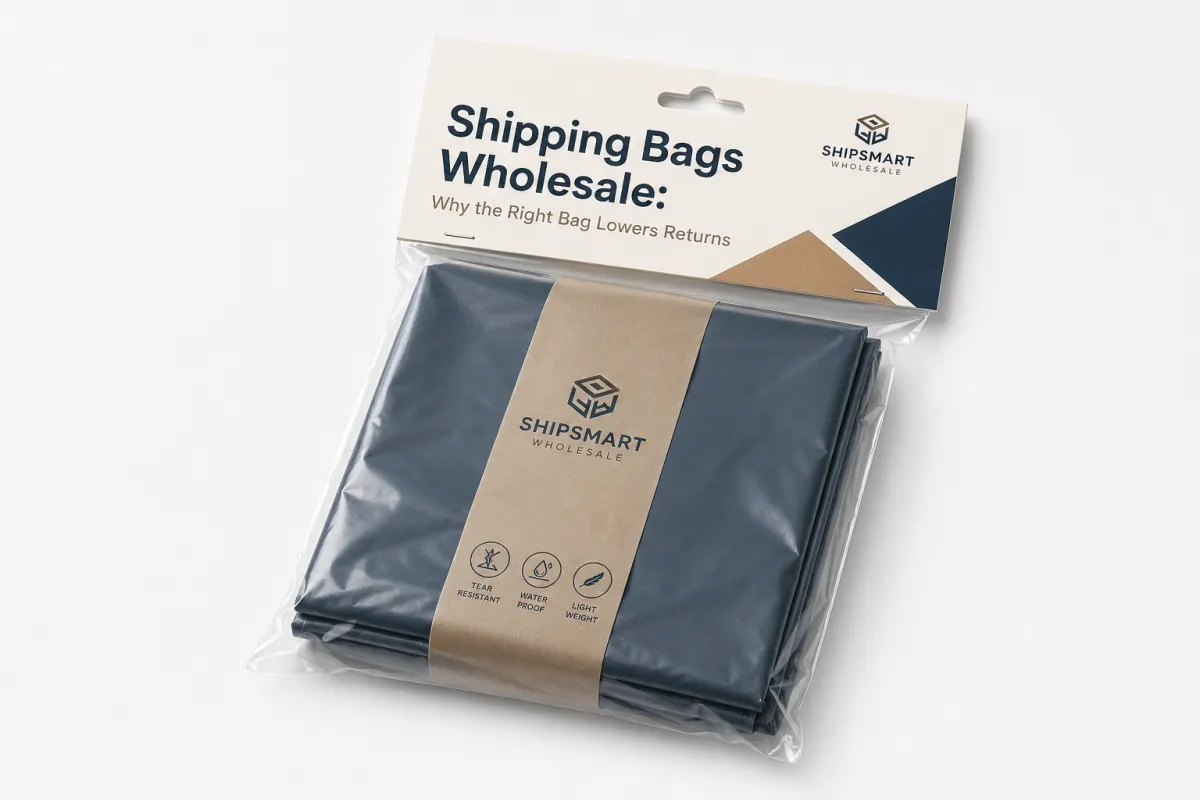
A packing floor reveals weak packaging decisions fast. I have watched soft goods slip from a bag that should have sealed fine on paper, then pass through every station and arrive with a scuff at the corner because the closure was under-spec'd. A soft accessory, folded tee, or stack of inserts does not need heavy crush protection, but it does need a reliable film, stable seal behavior, and abrasion resistance through conveyors and sortation. That is why shipping bags wholesale should be treated as an operating decision, not a commodity line.
Dimensional weight is usually the first measurable place savings appear. A small item in oversized packaging is billed for volume it never used, not for value it adds. A mailer matched to actual dimensions shrinks dead space and can improve ecommerce shipping economics without sacrificing the customer experience. A small improvement at packaging speed compounds quickly: a one-second reduction in pack touches across 5,000 parcels is roughly 1.4 additional labor hours per month depending on shift structure. Over quarters, that changes the cost curve.
Standardization is another lever teams underrate. Once fulfillment settles on a narrow set of shipping bags wholesale sizes and closure types, training time drops and operator confidence rises. New team members hit target speed faster, and the number of “let me check with shipping” interruptions decreases. I have seen teams lose more effort re-sorting 30+ bag variants than they gained from small per-bag price reductions on oddball sizes that never matched actual demand.
A good bag disappears into the process. It gets opened fast, sealed once, travels clean, and lets the line keep moving.
That is the true performance test. A bargain bag that tears at the flange or adds 2–3 seconds per package becomes expensive the moment it enters real fulfillment. Buyers should evaluate shipping bags wholesale using four real metrics: pack speed, field damage rate, presentation quality, and corrective actions required after initial pack-out.
Procurement also has a habit of optimizing the visible line while neglecting the nonvisible one. If packaging causes operators to switch to a larger outer shipper, or reach for extra tape during odd loads, the true cost has already started. The better method is practical: define product geometry, shipping method, handling risk, and storage conditions first, then map the best mailer profile to that reality.
In return-heavy categories, this matters even more. Wrong film or closure behavior often leads to “soft damage” complaints that are annoying but not always reported as hard claims. Customers can still accept the product and still mark it as poor experience. That is quietly expensive and far harder to catch in monthly dashboards unless the team tracks it as a separate metric.
How Do You Choose Shipping Bags Wholesale?
The first checkpoint is always the product. A T-shirt, silk scarf, flat promo insert, and rigid accessory may share a similar weight range and still require different packaging behavior. So for shipping bags wholesale selection, start with shape, then handling risk, then brand requirements. That sequencing prevents overbuilt packaging for one SKU and underbuilt for another.
The second checkpoint is the warehouse workflow. A fast, repetitive line needs a bag that loads cleanly, seals reliably, and stacks under pressure. A volatile seasonal operation with rotating labor needs a bag that is intuitive to handle. If complexity grows faster than training, the bag becomes a bottleneck before it becomes a cost center in a procurement report.
It helps to ask concrete route questions early: Is the shipment likely to pass through multiple parcel scans? Is the line often exposed to moisture? Is the product sensitive to friction, scuffing, or crushing? That short questionnaire tells you whether a poly mailer, reinforced mailer, or an alternative ecommerce packaging format is the safer bet. The right option is usually the one that removes failure points while keeping labor friction low.
Decision rule of thumb from field experience: use a mailer when the item can tolerate flex but not harsh edge pressure; use cartons when it can be dented, bent, or deformed under normal handling. That distinction sounds obvious, but it still gets debated in meetings over aesthetics and ignored in actual shipping tests.
For certain accessories, teams start with a mailer and move a % of SKU volume to rigid packs after a short pilot, because they discover one line in the catalog has a high return rate from fold-over stress. You are gonna have better outcomes if you pilot by SKU family, not by supplier preference. It sounds slower, but it usually catches expensive mistakes before volume goes live.
Another practical check is return workflow. If your reverse logistics team reports cracked or damaged returns on flexible goods, that is a sign the outbound protection is probably too optimistic. If return rates are low and complaints are mostly cosmetic, you might be over-investing in heavy materials for outbound and can shift to a lighter spec while improving closure or protective inserts.
Shipping Bags Wholesale Product Details: Sizes, Closures, and Use Cases
Most shipping bags wholesale programs for non-fragile products revolve around poly mailers, flat mailers, gusseted options, and similar flexible formats. They are common in apparel, accessory, and print-based ecommerce where speed and moisture resistance often beat heavy crush protection. The point is not simply “mailer vs carton,” but whether the package is aligned to the item and the fulfillment motion.
Size selection is frequently treated as a minor line item when it actually drives major outcomes. Too small, and seams are stressed, seams get pulled unevenly, and seal defects climb. Too large, and the look looks untidy, filling material rises, and shipping efficiency drops. For shipping bags wholesale, the target is simple: enough room for controlled insertion and a stable seal, without excess internal volume.
Closures are part of operational design, not styling. Self-seal adhesives are a natural fit for repetitive line speed, especially if teams must process high volume every hour. Tamper-evident options can improve trust for certain categories, while return-ready mechanisms reduce support load when a product is likely to come back. Those choices should be tied to SKU behavior, return history, and customer profile, not default brand preference.
Soft goods usually perform best in mailers when protected from sharp-pointed stress points. Socks, tees, scarves, and lightweight kits generally move well in the right mailer depth. Flat inserts and promotional cards also ship efficiently in this format. Some boxed items can still use mailers if the outer parcel shape remains secure and the item is not crush-sensitive. In other words, outer carton usage and inner content strength both matter.
Poly mailers often outwork Cartons for Parcels that need a compact profile and weather handling. That is especially true in wet seasons and long-haul regional lanes where moisture and repeated sortation can change a package’s quality quickly. But if the product has point-load vulnerability, a stronger carton may still be the better control point. This is not a “mailer is always cheaper” debate; it is a “mailer fits this use case” decision.
Environment inside the facility is not cosmetic. A cool dock, hot storage room, or long palletized dwell period can alter film performance by lowering flexibility and changing how adhesive behaves on aging stock. I have seen a lot of teams approve a sample on a display roll, then get field failures after a full pallet sits overnight in a dock with humidity swings. That is a production issue, not a surprise defect.
Shipping Bags Wholesale Specifications: Materials, Thickness, and Print
The dominant material in most shipping bags wholesale programs is polyethylene film. Its appeal is simple: lightweight, adaptable, and easy to pair with many closure systems. But film choice is not binary. Teams usually choose a profile that balances flexibility, puncture resistance, seal consistency, and printability against expected handling conditions.
Thickness is usually discussed in mils, but the number alone tells you little unless you connect it to load, shape, and motion. A lighter film can work for soft, low-risk items with low edge stress. A thicker option is usually the better match for heavier bundles, irregular geometry, or products with hard edges. In general, match thickness to puncture risk and seam stress. Thickness for appearance alone usually becomes a cost trap.
Film construction changes daily behavior on the line too. A glossy film might feel fast to open but slide differently through manual folding. A matte film can be easier on grip and sometimes more predictable in high-volume sealing zones. Opacity also affects brand presentation: clear films are practical but can expose contents; opaque tones hide variation and can be easier to present. Buyers evaluating shipping bags wholesale should ask for material stack details, not visual assumptions.
Print introduces another layer of process design. A single-color application is usually easiest to execute and often enough for brand recognition. Multi-color and larger coverage increase visual impact but may raise setup complexity, reject rates, and approval cycles. I have found that teams who lock print design after sample testing get fewer surprises than teams who sign off on a screen mockup only.
Before locking a purchase, confirm these inputs so quotes match reality:
- Finished width and length including seam allowance
- Gusset depth and profile required for volume tolerance
- Adhesive style and strip dimension for the seal method used
- Thickness or gauge for puncture and handling risk
- Color, opacity, and finish such as clear, white, matte, or printed
- Print method and artwork constraints including color count
- Load and compatibility based on product shape and sortation path
Every selection creates a tradeoff. A light spec saves on resin and usually inbound freight, but may fail under real abuse or sharp edges. A heavier spec improves confidence and protection, but adds cost per unit and often a broader material footprint. If the team is serious about shipping bags wholesale, they should evaluate that tradeoff against handling evidence, not the first headline price.
For sustainability-conscious programs, this step is more important than many realize. If your brand uses recycled content or paper alternatives, confirm how the chosen film supports downstream guidance and facility-side recycling realities. The EPA packaging and recycling guidance is a useful anchor, especially when a buyer has to justify material transitions to internal stakeholders. For protection claims, the ISTA methods are practical when a team wants formal handling validation, though not every program needs full lab testing to make good decisions.
Trustworthiness note: carrier acceptance policies, regional recycling rules, and recycled-content claims can change by lane and over time. Confirm current requirements before locking long-run orders; what is valid in one quarter can shift with supplier updates or shipping channel mix.
Shipping Bags Wholesale Pricing, MOQ, and Cost Drivers
Pricing for shipping bags wholesale moves with several variables at once: size, gauge, closure type, print complexity, quantity, and whether the order is stocked or custom. Two offers can differ little in unit price while producing wildly different total cost once freight, picking friction, and repack losses are included. A lower price on paper can become a higher all-in cost by month-end.
MOQ behavior depends on process design. Stock unprinted bags usually accept smaller runs because pre-existing tooling and broad production cycles lower setup friction. Custom print, custom color, and odd die-cut profiles raise minimums to keep cost efficient. Ask for MOQ early so comparison conversations stay in the same volume envelope and do not force unrealistic assumptions later.
Unit economics should always be separated from operating economics. Your true landed cost includes inbound freight, pallet handling, storage, and the labor cost of a package that fails a seal check every few minutes. If a line runs 10 to 15 percent faster because the mailer is easy to load and seal, that speed can exceed small unit savings in a single quarter.
Teams often use this reference matrix as a starting point during sourcing. Use it as directional guidance only; regional material markets, ink systems, and order timing still move the final quote.
| Option | Common Use | Typical Thickness | Planning Price at 5,000 Units | Notes |
|---|---|---|---|---|
| Stock unprinted poly mailers | Apparel, accessories, flat soft goods | 2.5-3 mil | $0.08-$0.16 each | Lower MOQ, faster sourcing, limited branding options |
| Custom printed poly mailers | Branded ecommerce shipping | 2.5-3 mil | $0.18-$0.32 each | Artwork complexity, color count, and print coverage affect cost |
| Heavy-duty tamper-evident mailers | High handling risk, premium presentation | 3-4 mil | $0.22-$0.40 each | Higher resistance, greater resin usage and stricter handling spec |
| Gusseted mailers | Bulky soft goods or compact boxed items | 3-4 mil | $0.25-$0.45 each | Better fit for volume, more material, better shape control |
Cheapest is not always best. If a bag tears at the flap, adhesive migrates, or branding appears fuzzy after the first pallet, fulfillment disruptions start quickly. The most profitable shipping bags wholesale programs are those that stay stable: low variability, low claim pressure, and predictable workflow behavior.
Safety stock planning protects against avoidable line downtime. A steady business with predictable throughput usually needs a reorder point with enough cover for demand spikes and supplier lead time variation. In one case, a brand operating a 12 to 15 business-day production window and one-week freight cycle had nearly zero emergency buys after switching from reactive ordering to forward buffer planning by weekly usage trend.
For apples-to-apples comparison, request quotes against exact dimensions, exact quantity, and exact print specs you intend to run. If the inquiry says “similar” or “closest available,” you are not buying from the same baseline and can’t make a fair decision.
Shipping Bags Wholesale Process and Timeline: Quote to Delivery
The process for shipping bags wholesale is clean when inputs are complete. You normally move from spec confirmation to quote, then artwork proof (if printed), then production, inspection, and freight handoff. The workflow gets messy when one key variable is unresolved in the early stage and each delay bubbles into production and lead time.
Before asking for a quote, prepare target dimensions, material target, monthly quantity range, shipping destination, artwork files, and delivery requirements. If your products are soft but bulky, state that clearly. If operators fold inserts or use a specific packing method, include it as part of the spec. These details reduce assumptions and reduce back-and-forth with production.
Sample approval remains one of the highest-value steps available in this category. A physical sample shows closure behavior, film memory, opacity, and real handling quality in ways a PDF cannot. It also catches small but costly defects like short flaps, awkward seal placement, or handling slip after temperature changes. Even one short sample run can save substantial rework in custom formats.
Lead times split by type. Stock bags often move quickly because the inventory exists before order entry. Custom bags usually need more steps: proofing, setup, printing/lamination, manufacturing, quality checks, then freight scheduling. Teams often forget freight as a separate variable and then wonder why packaging arrives after expected date.
These are the delay drivers I see most often:
- Missing or incomplete artwork and vector files
- Spec changes after proof approval
- Unclear size, gauge, or closure definitions
- Quantity revisions that force production reslots
- Late destination changes that alter freight lanes and rates
For customers testing against a known channel profile, you can add a lightweight stress check. Compare your expected handling sequence—stacking, transfer, drop points, and exposure conditions—against chosen samples and then against known parcel stress patterns. The ISTA framework gives structure for teams that want that rigor, though not every order needs a formal report.
A practical timeline template for shipping bags wholesale typically looks like:
1-3 days for specification and quote confirmation, plus 1-7 days for artwork or sample approval, plus 7-14 days for production depending on run size and complexity, plus freight transit by lane and mode. Planning against that full path keeps reorder cycles predictable and avoids the “we'll fix it on arrival” style of execution.
For stable operations, this timeline discipline belongs to supply chain planning, not just procurement admin. A packaging gap at the end of a month can choke outbound flow just as severely as a printer failure or labor gap.
Why Choose Us for Shipping Bags Wholesale
Custom Logo Things approaches shipping bags wholesale from an operational lens first, then a branding lens second. That order is intentional. A bag that looks good but fails at the line rarely saves money. A bag that seals cleanly, performs consistently in handling, and prints as expected reduces the number of exceptions your team has to manage.
Our teams review practical variables every step of the way: how mailers feed on the packing station, how they stack into cartons, how the seal responds to real-world pressure, and how print holds after typical transit stress. That is the difference between packaging as decoration and packaging as execution infrastructure.
Quality checks are focused where teams feel impact. Adhesive consistency, seam quality, film uniformity, print registration, and repeatability from batch to batch are critical. First-pallet quality is not enough if the fifth pallet drifts and creates rework. Good suppliers track that drift and correct quickly.
We also push back on over-specification. A very thick bag might look “safe,” but if the item does not need it, you are paying for unnecessary mass and resin every day. Likewise, under-printing can look cheap and inconsistent, but overprinting can add cost without practical value in some categories. The objective is always fit: product needs, channel demands, and line pace.
The strongest wholesale mailer is the one that sustains pack speed, protects the shipment, and creates no hidden labor after the parcel leaves the floor.
For buyers new to shipping bags wholesale, the steepest learning curve is usually closure logic and thickness selection. Start from operational reality, not supplier catalog categories. If the product portfolio includes fragile components, Custom Shipping Boxes can still be the right tool, but for soft goods and high-volume mailer-suitable SKUs, mailers remain one of the cleaner choices.
Our role is to help teams avoid cost surprises that show up as late-night overtime, rushed reorder fees, and avoidable packaging substitutions. That is why this process usually begins with specs and ends with a measured workflow outcome.
Next Steps for Shipping Bags Wholesale Buyers
If you are evaluating shipping bags wholesale, begin with the line you already have. Measure actual used size by product family, confirm current damage and returns by packaging type, and document where overpack or underpack currently happens. If operators are adding tape or swapping pack sizes, that is usually where your spec is off.
Before requesting your first quote, line up three baseline fields: dimensions, quantity forecast, and stock versus custom print requirement. Add product type, fold behavior, and packing method if possible. A clear use case usually gives you a clearer offer and prevents late changes that disrupt timelines.
Request samples and run them on an actual shift, not just a one-off inspection table. Use one team to evaluate seal security, insertion speed, and in-motion appearance. If a sample performs well off-line but struggles in production, it is not too late to revise—just revise before your main run goes out.
Plan reorder timing around velocity and seasonality. A steady fulfillment pattern might only need a shorter buffer, while promotions can double weekly usage in a short window. Build reorder points around confirmed lead times so a delayed bag lot does not force emergency procurement and manual substitutions at fulfillment.
Then finalize the decision in three passes: compare all options with the same spec, test the top two on an actual lane, and request a formal quote tied to those tested specs only. That process keeps shipping bags wholesale purchasing from becoming a guessing game. The actionable takeaway is simple: choose the mailer that protects first-touch fulfillment flow, then optimize cost inside that operating truth.
What is the typical MOQ for shipping bags wholesale?
MOQ varies by production type. Stock bags usually support smaller orders because they are already in production flow, while custom printed runs often need higher volumes to absorb setup and artwork costs. Size, finish, and print complexity are key variables, so ask for a quote using your exact spec and expected frequency before finalizing.
How do I choose the right thickness for shipping bags wholesale orders?
Start with product shape, weight, and handling stress profile, then choose thickness based on puncture risk and seam stress tolerance. Lightweight apparel and folded soft goods often work with lighter film, while heavier, irregular, or edge-prone items usually need stronger gauge to avoid tears and seal strain.
Can shipping bags wholesale be custom printed with a logo?
Yes. Most custom mailer programs support logo and brand mark printing, including limited color palettes and full-color setups depending on the line and film compatibility. Provide vector files, final artwork dimensions, print area, and a clear proof approval plan before starting production.
How long does a shipping bags wholesale order usually take?
Stock bags are typically faster because they do not require full custom setup, while printed or specialized formats usually need a longer schedule for proofing, production, inspection, and freight. Best practice is to plan for both production lead time and transport time, then add a practical buffer for destination variability.
What should I prepare before requesting a quote for shipping bags wholesale?
Have final bag dimensions, preferred material or thickness, expected monthly quantity, print requirements, destination profile, and desired delivery window ready. If possible, include sample product geometry and packing method details to ensure the proposed bag performs in your actual workflow.


