Buyer Fit Snapshot
| Best fit | Shipping Box Price for Custom Sizes projects where brand print, material claims, artwork control, MOQ, and repeat-order consistency need to be specified before quoting. |
|---|---|
| Quote inputs | Share finished size, material target, print colors, finish, packing count, annual reorder estimate, ship-to region, and any compliance wording. |
| Proofing check | Approve dieline scale, logo placement, barcode or warning zones, color tolerance, closure strength, and carton packing before bulk production. |
| Main risk | Vague material claims, crowded artwork, missing packing details, or unclear freight terms can make a low unit price expensive after revisions. |
Fast answer: Shipping Box Price for Custom Sizes: Board, Finish, Dieline, and Unit Cost should be specified like a repeatable production item. The safest quote records material, print method, finish, artwork proof, packing count, and reorder notes in one written spec.
Production checks before approval
Compare the actual filled-product size with the drawing, then confirm tolerance on folds, seals, hang holes, label areas, and retail display edges. Reserve space for logos, QR codes, warning copy, and material claims before decorative graphics fill the panel.
Quote comparison points
Review material grade, print process, finish, sampling route, tooling charges, carton quantity, and freight assumptions side by side. A quote is only useful when the supplier can repeat the same color, closure quality, and packing count on the next order.
Shipping box Price for Custom sizes is never just a number on a quote. One inch can change how the product fits, how many cartons stack on a pallet, how much filler gets stuffed inside, and whether a carrier decides your parcel now weighs more than it should. Smart buyers know the carton price is only one slice of the bill, and sometimes it is not even the biggest slice. Freight and labor love to sneak in through the side door.
Custom sizing is a control point, not decoration. A box that is too large wastes corrugated and invites void fill, rattling, and dimensional weight pain. A box that is too tight causes crushed corners, rushed packing, and expensive rework once the warehouse starts fixing mistakes. The best shipping box price for custom sizes is the one that protects the product, keeps production predictable, and avoids stupid surprises later.
Catalog pricing can make custom packaging look worse than it is. Stock cartons have neat published prices, which is comforting right up until the product starts sliding around inside them. Custom cartons have more moving parts: board grade, flute, print, tolerances, tooling, quantity, freight terms, and shipping destination. That is why shipping box price for custom sizes can swing fast. The right comparison is not box price versus box price. It is total landed cost versus total landed cost.
Shipping Box Price for Custom Sizes: Why Quotes Shift Fast
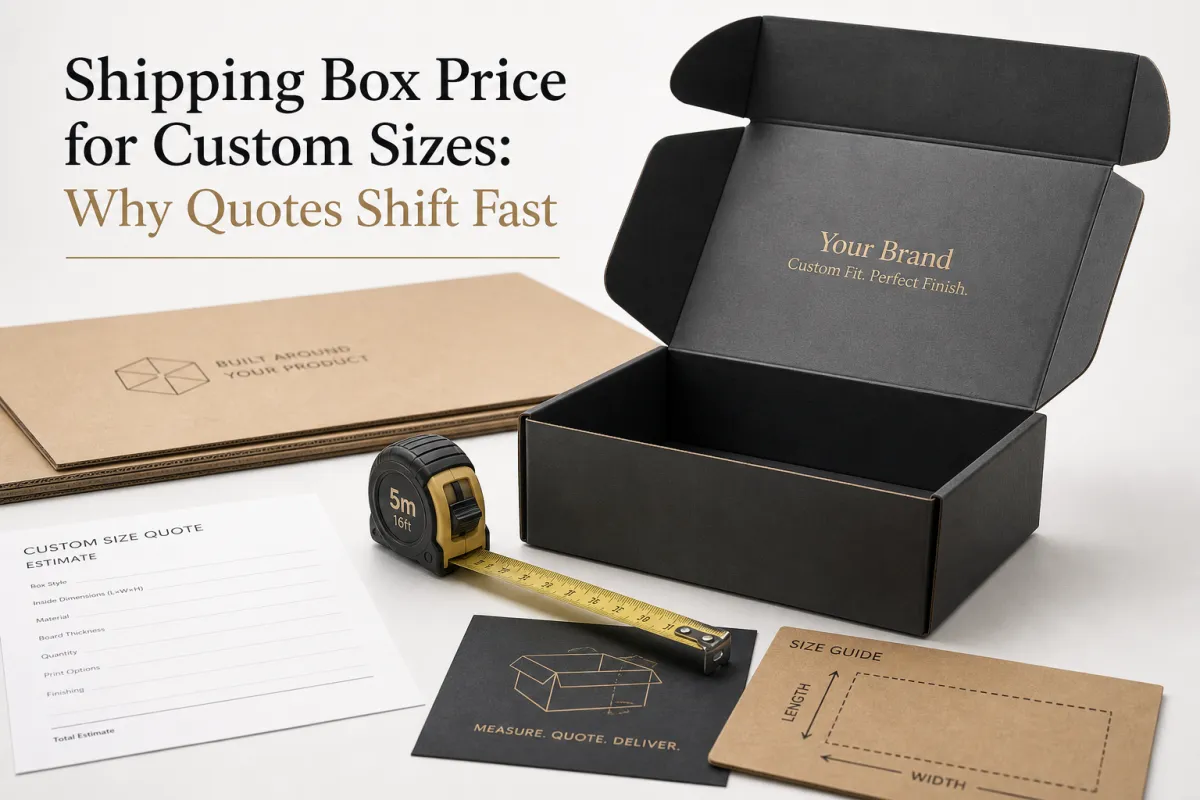
Shipping box price for custom sizes changes fast because the box itself changes the math. It is a shape problem, a material problem, and a shipping problem all at once. Add an inch to the length, width, or height and you can reduce sheet yield, increase trim waste, and change how the cartons fit on a pallet. Then the carrier gets involved, because of course it does.
Vendor assumptions also drive the spread. One supplier may quote a 32 ECT single-wall RSC, flat-packed, no print, and basic tolerances. Another may build in a heavier board, tighter sizing, and a die-cut structure with more labor. Both are custom boxes. They are not the same product, so the shipping box price for custom sizes will not match unless the structure, board, and order conditions match too.
Custom does not automatically mean expensive. A better fit can cut packing time, reduce filler, and improve cube efficiency. That matters when you ship enough volume for small savings to stack up into actual money. A few cents more on the carton can be cheaper if it removes a packing step or prevents a dimensional-weight penalty. Judging shipping box price for custom sizes by the unit price alone is how teams end up overpaying in other places.
I have seen teams chase the cheapest carton, then spend the rest of the quarter buying more bubble wrap and paying for damage claims. That is not a win. It is just a nicer invoice in one place and a mess everywhere else.
"A cheap box that arrives crushed is not cheap. It is just underpriced."
For teams comparing Custom Shipping Boxes against stock options, the question is not whether custom sizes cost more per unit. The real question is whether they cost less per shipped order. If the answer is yes, the shipping box price for custom sizes is doing its job.
Value Proposition: When Custom Sizes Lower Total Shipping Cost
Stock cartons work fine when the product is standard and the order profile barely changes. Plenty of businesses do not ship standard products. They ship kits, fragile goods, awkward shapes, display sets, or mixed-SKU orders that make generic boxes look lazy. In those cases, a custom carton can reduce wasted volume and improve the way the product lands. That is where shipping box price for custom sizes starts to look better than a stock box that only fits after a pile of filler gets crammed in.
The math is usually not subtle. A stock box might run $0.12 to $0.18 per unit, but add kraft liners, oversized void fill, and slower packing and the true cost climbs fast. A custom size might run $0.22 to $0.35 per unit, then shave 20% off packing time and cut filler use in half. For repeat orders, that trade is easy to defend. Shipping box price for custom sizes becomes a throughput cost, not just a purchasing cost.
Fragile products often benefit first. Glassware, cosmetics sets, subscription kits, small electronics, and retail packs all hate movement. Less movement means fewer claims. Fewer claims mean fewer replacements, fewer support tickets, and fewer people in operations muttering at the packing table. The same logic applies to ecommerce shipping, where dimensional weight punishes bulky cartons. A tighter custom box can pay back through carrier savings and fewer breakage headaches.
Labor is part of the picture too. Packing teams lose time when they have to keep adjusting filler around a box that is obviously too big. A custom size cuts the guesswork. The packer drops in the product, closes the flaps, and moves on. That sounds minor, but when a line is pushing 1,000 orders a day, it is not kinda minor. Saving 8 to 10 seconds per order adds up fast. Seen that way, shipping box price for custom sizes is also a labor-efficiency decision.
Not every carton in a program needs to be custom. Many buyers mix stock and custom formats, then support the cases that truly need tight fit, stronger branding, or better presentation with Custom Packaging Products. That blend usually wins because the shipping box price for custom sizes is reserved for the boxes that earn their keep.
Product Details: Box Styles, Materials, and Print Options
Box style has a direct effect on shipping box price for custom sizes. A regular slotted carton, or RSC, is usually the cheapest route because it is simple to cut, fold, and ship flat. A die-cut mailer costs more because the tooling is more specific, but it may save labor and look better for ecommerce or retail packaging. Specialty shippers with tabs, locks, or inserts usually land at the higher end because they need more design work and more precise cutting.
Material choice matters just as much. Single-wall corrugated is often enough for lighter products, especially apparel, documents, or low-risk goods. Double-wall makes more sense for heavier shipments, stacked storage, or products that need more crush resistance in transit. Board ratings such as 32 ECT, 44 ECT, and 200# test are not marketing confetti. They translate into real load performance. If a carton sits in a warehouse stack or takes a rough ride through the carrier network, the right rating matters more than a glossy print.
Print is another cost lever. A one-color logo usually adds a modest amount. Full coverage graphics, inside print, flood coats, and spot finishes raise the shipping box price for custom sizes because they add ink, setup time, and machine complexity. That does not make branded packaging a bad idea. It just means the spend should be intentional. Some products need a quiet exterior and a strong fit. Others need the box to sell the product before anyone even opens it, especially at delivery or on a retail shelf.
Think in layers. The outer carton should protect the product and keep the shipping flow efficient. If presentation matters more, build it through packaging design, inserts, or a printed sleeve instead of pushing every corrugated spec upward by default. That keeps shipping box price for custom sizes under control while still letting the package look like it belongs in the same century as the rest of the brand.
One more detail people forget: closure style changes the experience too. Glued seams, tabs, dust flaps, and locking bottoms all affect assembly speed and box rigidity. A box that saves three seconds to fold can easily beat a prettier box that needs two extra hands and a prayer.
For buyers comparing formats, here is a practical view of how structure affects price and use case.
| Box Type | Typical Use | Relative Cost | Comments |
|---|---|---|---|
| RSC single-wall | General shipping, lighter goods | Low | Good for standard protection and efficient production |
| Die-cut mailer | Ecommerce shipping, presentation-heavy orders | Moderate | Cleaner presentation, often faster pack-out |
| Double-wall shipper | Heavier or fragile items | Moderate to high | Better stacking and transit protection |
| Custom insert kit | Multi-piece kits, retail sets | High | Better fit, more tooling, more assembly complexity |
If the goal is margin, start with function and work outward. That is how shipping box price for custom sizes stays disciplined instead of drifting upward every time someone asks for a nicer finish.
Shipping Box Price for Custom Sizes: Specifications That Set the Quote
The fastest way to get a credible shipping box price for custom sizes is to send a complete spec sheet. Start with inside dimensions, then add product weight, target shipping method, and quantity. If those basics are fuzzy, the quote is going to wander because the vendor has to guess at board usage and production yield. Guessing is not a strategy. It is a bill with extra steps.
Small dimension changes can affect more than blank size. They can change die-line setup, print registration, material yield, pallet count, and how well the cartons nest in transit. A box that is 1/8 inch tighter may fit the product better and reduce movement. A box that is 1/4 inch larger may require more board, more filler, and a different packing pattern. That is why shipping box price for custom sizes is so sensitive to tolerances. A box is a system, not a rectangle with confidence issues.
Special requirements should go in the brief from the start. If the carton needs moisture resistance, say so. If it will live in humid storage, ask about coatings or upgraded board performance. If a certification or test basis matters, call it out. Standards such as ISTA test methods matter when shipment survivability is the goal, while FSC chain-of-custody claims matter when sustainability is part of the packaging program. The more specific the brief, the more accurate the shipping box price for custom sizes.
A vague request produces a vague quote. A clear request produces something usable. List dimensions, artwork expectations, insert requirements, stacking needs, and the destination zip or region. If the carton has to survive pallet stacking, say that. If it only needs parcel performance, say that too. Those details shift board selection and the final shipping box price for custom sizes more than most buyers expect.
Order volume matters just as much as product size. A run of 200 units once a year will carry tooling and setup costs differently than 20,000 units spread across multiple orders. Shipping box price for custom sizes improves when the production run is large enough to spread the fixed costs. If the spec feels messy, ask for a dieline review before you approve the job. That one check can stop a correction cycle before it starts.
Pricing & MOQ: How to Read the Numbers Without Surprises
Most pricing confusion comes from mixing setup cost with unit cost. Shipping box price for custom sizes usually includes tooling or dieline setup, board consumption, print charges, and the per-unit manufacturing cost. On a small order, setup can dominate the quote. On a larger order, the unit price usually drops because the fixed costs get spread across more cartons. That is why MOQ exists. It is not a random supplier mood. It is how production economics work.
A buyer should always ask for a quote ladder. Here is a common pattern for a simple Custom Corrugated Box with light branding:
| Quantity | Indicative Unit Price | What Usually Changes |
|---|---|---|
| 250 units | $0.65-$1.10 | Setup cost is spread thin, so the unit price looks high |
| 500 units | $0.45-$0.85 | Better balance between setup and manufacturing efficiency |
| 1,000 units | $0.28-$0.60 | More efficient board usage and lower per-box overhead |
| 5,000 units | $0.18-$0.38 | Best unit economics, assuming size and print stay stable |
Those ranges are not universal, and anyone pretending otherwise is selling you a fantasy with a spreadsheet. Board grade, flute, print coverage, and insert complexity move the numbers quickly. A plain brown shipper does not price like a full-color mailer. A single-wall carton does not price like a double-wall box built for stacking. Even so, the bands give buyers a practical way to judge whether the shipping box price for custom sizes makes sense.
Read the quote line by line. Does it include freight? Are plates or tooling included? Is print priced as one color or full coverage? Is the box shipped flat or assembled? Are there hidden minimums? If the answers are fuzzy, the shipping box price for custom sizes is not transparent yet.
A slightly more expensive box can still be the cheaper option if it reduces relabeling, repacking, and damage. That matters even more in order fulfillment environments where labor is tight and every mistake costs time. If the carton supports the packing line better, the quote should be judged on throughput, not paper cost.
For brands also buying mailers, dividers, or protective packaging, it can help to compare the carton program against Custom Poly Mailers. Not every product needs corrugated, and not every shipment should be stuffed into it just because it feels familiar. The point is to keep shipping box price for custom sizes aligned with the product and the shipping method.
Process & Timeline: From Quote Request to Delivery
The process is simple enough, but delays show up when the brief is thin. Send the product dimensions, weight, quantity, print needs, and shipping destination first. Then the vendor prepares a quote and often a dieline. If the job is more complicated, expect a sample, a digital proof, or a physical prototype before production starts. That flow is normal. It is also the place where shipping box price for custom sizes can move if the design changes after the first review.
Lead times depend on complexity. A plain unprinted custom carton usually moves faster than a printed die-cut mailer with inserts. Once artwork approval enters the chain, add proofing time. If a sample is required, add another step. In many packaging programs, the total cycle runs from one to several weeks depending on tooling and quantity. Buyers who plan inventory ahead tend to avoid rush charges and get a steadier shipping box price for custom sizes.
Most delays come from preventable mistakes. Measurements get rounded loosely. Artwork changes late. Someone measures the product without accounting for closures or inserts. Or the buyer approves a quote before confirming the carrier method. Each of those mistakes can trigger a revision. That revision affects both production time and shipping box price for custom sizes because a corrected spec usually means fresh setup or extra material waste.
There is a clean way to reduce the risk. Confirm internal dimensions, product weight, and stacking requirements first. Approve the structure next. Finalize print and finish only after that. Buyers who follow that order usually avoid the endless "one more revision" cycle that burns time and money. Boring? Sure. Effective? Also yes.
Strong quotes usually come from teams that understand their shipment profile. A carton for subscription kits is not the same as a carton for bulk replenishment. A box used in retail packaging is not the same as a box used for direct-to-consumer shipping. The clearer those use cases are, the more accurate the shipping box price for custom sizes becomes.
I have also seen teams shave days off a program just by sending one good sketch with dimensions marked clearly. Not pretty, not fancy, just readable. Packaging people are weirdly grateful for that. We will take legible over polished every time.
Why Choose Us: What a Reliable Packaging Partner Delivers
A reliable packaging partner should do more than send a number and disappear. They should help translate a product into a workable spec. That means asking real questions about fit, strength, print, and handling. It also means showing where shipping box price for custom sizes can be improved without weakening the box or inflating the order for no good reason.
Transparency matters. A strong partner explains the quote structure clearly: setup, tooling, board grade, print, and freight. If the job needs a design adjustment, they say so early. If a simpler structure can meet the same protection target, they should recommend it. That kind of guidance keeps the shipping box price for custom sizes from drifting upward through unnecessary upgrades or hidden fees.
Consistency matters too. Reorders should match the original spec closely. If you approved a 32 ECT single-wall carton with a specific print layout, the next run should not show up with a different feel, a different shade, or a different fold style. For brands that rely on branded packaging, repeatability is part of trust. It shapes how the product is perceived, especially when the box is part of the unboxing experience.
A good partner also knows where standards fit. If the shipper needs performance validation, ask about test paths based on ISTA or relevant ASTM references. If environmental claims matter, ask about sourced material and FSC documentation. If the team is trying to balance sustainability with cost, the vendor should be able to discuss material reduction without sliding into vague marketing fluff. Data beats slogans. Every time.
For buyers comparing options, the best partner is the one who can show the tradeoff clearly: lower unit cost versus lower damage rate, higher print impact versus better production efficiency, simpler design versus stronger presentation. That is the difference between quoting a box and quoting a packaging system.
And yes, a good partner should be willing to say no to a bad spec. That is annoying in the moment. It saves money later. The useful vendors are the ones who protect the program, not the ones who nod at everything and send a pretty invoice.
Next Steps: Build a Quote-Ready Box Spec Sheet
If you want a better shipping box price for custom sizes, start with better inputs. Gather inside dimensions, product weight, quantity, shipping method, print needs, and any handling concerns. If the product is fragile, add photos. If it is irregular, add a sketch. If it needs inserts, say how many and where they sit. Those details cut down the back-and-forth and produce a quote you can actually use.
It also helps to review the pain points before requesting a new quote. Are damage claims rising? Is the team using too much filler? Are boxes failing in transit or under pallet stack? Are oversized cartons pushing dimensional weight into ugly territory? Those are the real reasons many teams move to custom sizes. A good spec should describe the problem being solved, not just the outer measurements of the item.
Before approving production, ask for sample photos, a dieline, and a side-by-side comparison if more than one structure is possible. That comparison often exposes a better balance between cost and protection. Sometimes a slightly different flute or a slightly different depth gives a better result without changing the product fit. That is one of the quiet advantages of working with packaging people who understand the difference between looking good and working well.
If you are rebuilding a packaging program, do not treat shipping box price for custom sizes as a one-line decision. Treat it as a design choice, a logistics choice, and a cost-control choice. The better the spec sheet, the faster the quote. The clearer the quote, the fewer revisions. And the right box, priced correctly, can improve product packaging, reduce waste, and make order fulfillment less annoying for everyone involved.
The practical takeaway is simple: compare custom box options on landed cost, packing speed, and damage risk together, not one at a time. A carton that fits better, ships cleaner, and reduces touch points is usually the one that wins, even if the sticker price looks a little higher. That is where shipping box price for custom sizes starts making sense instead of just looking tidy on paper.
FAQ
What affects shipping box price for custom sizes the most?
Inside dimensions usually matter most because they change material usage and how many blanks fit on a sheet or pallet. Board grade, print coverage, and quantity also move the number quickly. Freight, coatings, and special finishes can add cost, but they may reduce damage or rework enough to justify the spend. In short, shipping box price for custom sizes is driven by both structure and scale.
Is there usually a minimum order for custom shipping boxes?
Yes, most manufacturers set an MOQ to cover tooling, setup, and production efficiency. The exact minimum depends on the box style, print complexity, and board type. If volume is lower, ask for a simpler structure or fewer print colors so the order stays practical. That often keeps shipping box price for custom sizes within a workable range.
How fast can I get a custom size shipping box quote?
A complete spec sheet can speed things up because it cuts down on back-and-forth about dimensions and materials. Quotes take longer if the vendor needs a dieline check, sample approval, or packaging test. For faster turnaround, include product weight, inside dimensions, quantity, and destination in the first request. That is the quickest path to a realistic shipping box price for custom sizes.
Can I reduce the shipping box price for custom sizes without changing the fit?
Yes. Cost often drops when print is simplified, board grade is adjusted, or a different structure uses less material. Larger order quantities also reduce unit price because setup costs are spread out. The trick is to compare versions that still protect the product and support your shipping method. That keeps shipping box price for custom sizes efficient without sacrificing fit.
What details do you need to quote a custom shipping box accurately?
You need inside dimensions, product weight, quantity, print requirements, and the type of shipping or stacking the box must survive. It also helps to know whether the box needs inserts, coatings, or a specific corrugated strength rating. If the item is fragile or irregular, share photos or a drawing so the quote reflects the real packaging challenge. The more complete the brief, the more accurate the shipping box price for custom sizes will be.
Is the cheapest quote always the best one?
No. The cheapest quote can still be the most expensive choice if it drives damage, slower packing, or higher freight bills. I would rather see a quote that explains the tradeoffs clearly than one that looks great and falls apart in the warehouse. Packaging has a nasty habit of punishing shortcuts later.
If you are serious about controlling packaging cost, start with the spec, not the guess. That is how shipping box price for custom sizes becomes predictable, defensible, and tied to real shipping performance instead of a loose catalog number. For most buyers, that is where the margin gets won.

