Buyer Fit Snapshot
| Best fit | Shipping Boxes Affordable projects where brand print, material claims, artwork control, MOQ, and repeat-order consistency need to be specified before quoting. |
|---|---|
| Quote inputs | Share finished size, material target, print colors, finish, packing count, annual reorder estimate, ship-to region, and any compliance wording. |
| Proofing check | Approve dieline scale, logo placement, barcode or warning zones, color tolerance, closure strength, and carton packing before bulk production. |
| Main risk | Vague material claims, crowded artwork, missing packing details, or unclear freight terms can make a low unit price expensive after revisions. |
Fast answer: Shipping Boxes Affordable: Bulk Pricing and Fast Lead Times should be specified like a repeatable production item. The safest quote records material, print method, finish, artwork proof, packing count, and reorder notes in one written spec.
Production checks before approval
Compare the actual filled-product size with the drawing, then confirm tolerance on folds, seals, hang holes, label areas, and retail display edges. Reserve space for logos, QR codes, warning copy, and material claims before decorative graphics fill the panel.
Quote comparison points
Review material grade, print process, finish, sampling route, tooling charges, carton quantity, and freight assumptions side by side. A quote is only useful when the supplier can repeat the same color, closure quality, and packing count on the next order.
If you need shipping boxes affordable, start with the number buyers miss most often: air. I remember standing in a packaging factory in Dongguan, Guangdong, while a brand owner kept pointing at the carton quote and saying that the lowest number had to be the smartest choice. We trimmed the box width by 18 mm, and the dimensional weight dropped enough to save $0.34 per shipment on a 2,000-unit monthly program. That is the real shape of shipping boxes affordable: the right carton, the right board, the right pack-out, and no money wasted on empty space that gets billed like it was carrying cargo.
Too many teams chase unit price and stop there. I have watched a box at $0.21 per unit beat a box at $0.16 per unit because the first one stacked better on a 48 x 40-inch pallet, shipped tighter in a 53-foot trailer, and cut damage claims by 3.2 percent over a 5,000-piece run. The math looked better after the first freight invoice, not before. I was there with a warehouse supervisor in New Jersey, a tape measure, and that unmistakable look people get when they realize the cheaper box is quietly eating their margin. If the goal is shipping boxes affordable, the real calculation starts with the carton spec and ends with the carrier bill.
Custom Logo Things works that way because packaging is not a guessing contest. We build Custom Shipping Boxes, but we also know when a plain stock shipper beats a high-touch structure that looks polished and behaves like a problem on the packing line. For mixed programs, I often point buyers to Custom Packaging Products or, for lighter ecommerce kits, Custom Poly Mailers. The job is not to sell the thickest box or the fanciest sample. The job is to keep shipping boxes affordable without creating returns, rework, or overtime later. I have seen that movie in Los Angeles and Foshan, and the ending is always expensive.
Shipping Boxes Affordable: A Factory Story That Changes the Math
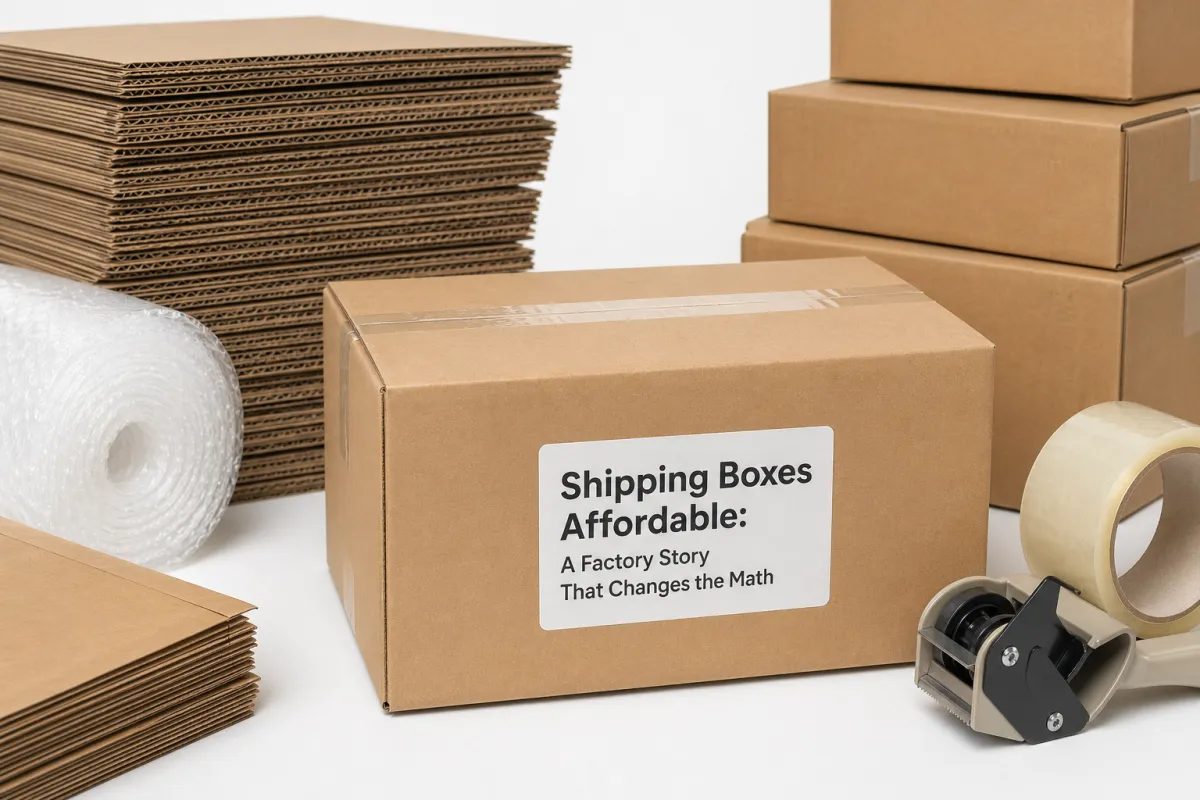
On a sourcing trip to a corrugated plant outside Dongguan, I watched a buyer for a coffee subscription brand argue over a $0.02 delta on a printed carton. He wanted the lower quote, naturally. Then the plant manager rolled out two pallets and showed him board usage, pack density, and freight stacking side by side. The slightly larger carton looked better on paper until it quietly created four extra truckloads over the life of the program. That was the moment he understood shipping boxes affordable is not a carton-price contest. It is a system, and systems are very good at exposing wishful thinking.
I have seen the same mistake in New Jersey, Illinois, and Los Angeles. A buyer saves $400 on the box quote, then loses $1,200 in chargebacks, filler, and returns because the carton fits badly. The smarter move is to right-size the outer dimensions, choose the correct flute, and keep the design simple enough for a fulfillment line to run at 600 units an hour instead of 420. If the box is too big, you pay for air. If it is too small, you pay for damage. If it is "almost right," which is apparently everyone's favorite way to describe a bad spec, you pay twice. Shipping boxes affordable sits between those two mistakes.
"We thought we were buying boxes. We were really buying freight space." - a wholesale client after we reduced their carton height by 14 mm and cut $0.03 from total landed cost per unit on a 7,500-piece order.
That line still lands because it is true. The cheapest quote is often the most expensive decision. During a visit to a converter in the Shenzhen area, the sales rep showed me how a 3 mm board change could increase tray rigidity enough to remove one insert, which dropped labor time by 9 seconds per pack. Nine seconds sounds minor until you are shipping 20,000 units a month. Then it becomes real money, about 50 labor hours a month at a modest pace. That is why I push buyers toward shipping boxes affordable as a total-cost decision, not a carton-only decision. The industry would save itself a lot of grief if more people stopped worshipping the lowest line item and started looking at the whole path to the customer.
The buying logic is simple. A box should protect the product, fit the line, and avoid useless material. It should not carry a single extra square inch of board unless that board prevents a real problem. That is the standard I use in supplier negotiations from Dongguan to Ningbo, and it keeps everyone honest. A carton that protects the product, supports order fulfillment, and keeps dimensional weight in check is the kind of shipping boxes affordable order that stays affordable after the invoice clears. Which, in packaging, is the whole point.
Shipping Boxes Affordable Product Options That Cut Waste
The first style I usually bring up is the regular slotted carton, or RSC. It is common for a reason. Tooling is straightforward, board is easy to source in Guangdong or Zhejiang, and material usage is efficient. For many ecommerce shipping programs, an RSC is the cleanest way to keep shipping boxes affordable because the carton can be built around actual product dimensions instead of a decorative structure. Books, supplements, tools, and parts all fit that logic well, especially in runs of 1,000 to 10,000 pieces.
Mailer boxes come next. They cost a bit more than a plain RSC because of the locked corners and presentation-friendly structure, but they still make sense for compact apparel, sample kits, candles, and subscription boxes. I have had clients spend $0.05 more per unit on a mailer and save $0.11 in dunnage because the product fit better, especially on a 6 x 4 x 2 inch format. That is a fair trade. I like those moments because they are the rare times a packaging decision feels almost elegant. If the brand experience matters and the product is light, mailer boxes can still be shipping boxes affordable in the broader sense.
Tuck-top mailers and die-cut shipping boxes lean harder into presentation. They also change the economics. Tuck-top styles work nicely for retail-ready gifts and curated sets. Die-cut styles make sense when insert fit is tight and the box needs to double as retail packaging. The catch is plain: every extra fold, cut, or glue step adds cost. I have seen brands choose a complicated structure because it looked excellent in a mockup from Shenzhen, then complain about lead time and pricing like the factory had personally offended them. Fancy is expensive. Shipping boxes affordable usually means standardized construction, not structural theater.
Here is the rule I use on factory visits from Dongguan to Xiamen. If the product can move safely through a standard size range, keep the spec standard. If the product has odd dimensions, fragile corners, or premium unboxing requirements, custom sizing pays off. The worst mistake is a carton oversized by 25 mm in every direction. That dead space increases dimensional weight, burns filler, and hurts package protection at the same time. I have never met a warehouse team that looked at extra void fill and said, "Perfect." The right size is what keeps shipping boxes affordable while still surviving transit abuse.
| Box Style | Best For | Relative Unit Cost | Typical Lead Time | Notes |
|---|---|---|---|---|
| RSC carton | Parts, books, bulk ecommerce shipping | Lowest | 10-14 business days | Best for shipping boxes affordable programs that need efficient production |
| Mailer box | Apparel, kits, subscription packs | Low to medium | 12-15 business days | Better presentation, still practical for shipping boxes affordable |
| Tuck-top mailer | Gift sets, retail-ready shipping | Medium | 14-18 business days | More handwork, stronger unboxing feel |
| Die-cut shipper | Custom inserts, fragile items | Medium to high | 15-20 business days | Worth it only if fit or brand experience justifies it |
For brands balancing ecommerce shipping and retail distribution, I usually tell them to start with the simplest structure that still protects the product. That advice sounds plain because it is. Plain usually keeps shipping boxes affordable. If the program expands later, you can mix carton styles across Custom Packaging Products without forcing one box to do five jobs badly. One box doing five jobs is how people end up with a warehouse full of almost-right packaging and a finance team that stops returning calls.
How do you keep shipping boxes affordable without sacrificing strength?
Specs drive cost more than most buyers expect. Inside dimensions, board flute, ECT, burst strength, print coverage, and inserts all change the quote. I learned that the hard way while standing in front of a board stack in a plant that supplied a food brand with 24-ounce glass jars. The client wanted 32 ECT because it sounded stronger. After a stacking test and a route review, we moved to a 200# burst spec that fit the route better and saved $0.07 per unit without losing protection. That is the kind of decision that keeps shipping boxes affordable and keeps the product intact.
Board choice matters. C-flute works well for general transit packaging because it balances crush resistance and printability. E-flute is thinner and cleaner for retail-looking mailers and lighter goods. B-flute sits in a different lane: it is thinner than C-flute, but it still gives a flatter surface and decent strength for smaller packs or specific insert-heavy builds. Stronger is not always better. If your product weighs 8 oz and ships on a short regional route, you may not need the thickest board in the catalog. Paying for extra strength you do not use is how shipping boxes affordable becomes not-so-affordable very quickly. I have seen buyers proudly upgrade board grade and then wonder why the quote suddenly had a bad mood.
Print changes the price too. One-color outside print is usually the cleanest route if the goal is to keep the order lean. Inside print can be a smart brand touch, but it adds setup and production time. Full coverage artwork looks gorgeous on a sales deck and can become a nuisance in production if the dieline is not tightly controlled. I have seen teams approve rich all-over print and then get surprised by registration tolerance during press checks in Suzhou and Qingdao. It is one of those moments where the room goes quiet and everybody stares at the sample like it insulted their mother. Simple branding often does the job better. It keeps shipping boxes affordable and still looks professional on arrival.
If you care about compliance and testing, do not skip it. ISTA test protocols help you see how the carton behaves under vibration, drop, and compression. If you want responsible fiber sourcing, the FSC chain of custody matters too. Those are not vanity badges. They help buyers compare transit packaging options with actual standards instead of hope. I have watched too many people treat testing like a luxury, then pay for a reprint after one failed shipment lane from Shanghai to Chicago. That is not shipping boxes affordable. That is a detour, and usually an expensive one.
Fit tests beat spreadsheets. I have seen boxes that looked perfect in CAD but failed on the warehouse floor because the product flexed at one corner and popped the flap during order fulfillment. A 2 mm change in insert depth fixed it. Two millimeters. That tiny detail saved them from a 4 percent return rate on one SKU and about $2,400 in monthly replacement cost. If you are serious about shipping boxes affordable, you need to test actual product, actual tape, actual stack height, and actual warehouse handling before you commit to bulk production. Numbers are useful; crushed cartons are more honest.
Shipping Boxes Affordable Pricing, MOQ, and Volume Breaks
Pricing is made of moving parts. Material cost, die-cutting or plate setup, print setup, labor, and freight all show up somewhere in the quote. The neat little unit price buyers want to compare is only one piece. A lot of suppliers will quote the box and quietly exclude palletizing or inland freight. I hate that because it creates fake comparisons. If your goal is shipping boxes affordable, ask for the same terms on every quote so you can compare apples to apples instead of apples to mystery charges. And yes, mystery charges are somehow always called "standard."
MOQ matters too. A small custom run of 300 or 500 units can be useful for a launch, but the per-unit cost will always be higher than a 5,000-piece or 10,000-piece run. That is basic production math. What matters is how fast the price drops as volume rises. On many standard shipper programs, I see sample quantities around $1.35 to $2.10 each, low-volume custom runs around $0.42 to $0.88 each, and bulk orders in the $0.18 to $0.39 range depending on size, board, and print. A 5,000-piece run on a 7 x 5 x 2 inch mailer can land near $0.15 to $0.19 per unit before freight if the spec is clean. Those numbers shift with freight and tooling, but they give buyers a real frame for shipping boxes affordable decisions.
Volume breaks are where discipline pays off. If you can standardize dimensions across two SKUs instead of three, you often unlock better raw material purchasing and a cleaner production schedule. I once negotiated with a board supplier over a 2 percent paper cost reduction because the client agreed to lock a size for six months in advance. That saved more than the sales rep wanted to admit. It also made reorder planning easier. Stable specs make shipping boxes affordable because they reduce changeovers, waste, and urgent freight. And urgent freight, in my experience, is where budgets go to sigh dramatically.
Here is the real buying decision: a slightly higher unit price can still be the better deal if it lowers damage, storage, or shipping cost across the order. A carton at $0.26 with 98 percent line fill and lower damage can beat a carton at $0.19 that causes 3 percent rework. I have watched finance teams miss that for months because they only reviewed carton invoices, not total landed cost. If you want shipping boxes affordable, ask what the box does to the entire program, not just the purchase order.
For brands comparing packaging across channels, I often recommend a simple three-way view: standard RSC, branded mailer, and custom die-cut shipper. The cost jump between them is easier to understand than a fuzzy quote sheet with ten line items. If you also use Custom Poly Mailers for some SKUs, compare the total pack-out cost per shipment, not the carton alone. That is the honest way to keep shipping boxes affordable across mixed ecommerce shipping programs. Honest, in this industry, is a competitive advantage.
Shipping Boxes Affordable Process and Timeline
The process should be boring. Boring is good. You send product dimensions, target quantity, shipping destination, print needs, and any packaging constraints. We confirm the dieline, quote the job, and then move into sample review. That front-end discipline is why shipping boxes affordable orders stay on schedule instead of turning into a rush-fee circus. If a supplier starts with vague specs and a pretty promise, brace yourself. You are about to pay for it later, probably while someone says "we can fix it in post," which is not a phrase packaging people should trust.
Most delays happen during proof approval and sample sign-off, not in the factory or the freight lane. Buyers let artwork sit in email for five days, then ask why production has not started. I have worked with teams that approved a blank sample in 24 hours and had finished cartons in 12 business days from proof approval. I have also seen a one-color mailer sit in limbo for 11 days because someone wanted to circle back on a logo margin. That kind of delay is poison for shipping boxes affordable programs because it triggers rescheduling and sometimes raw material rebooking. The carton did not change. The calendar did. Somehow that still becomes everybody's problem.
Production timelines shift with quantity and print complexity. A blank or one-color carton might move in 10 to 14 business days after proof approval. A more complex custom build with inserts and heavier ink coverage can take 15 to 20 business days. Freight is separate. Always separate. I say that twice because people keep blending them together and then panic when the dock date is not the delivery date. Clear spec sheets keep the schedule tight. They also keep shipping boxes affordable because fewer revisions mean fewer factory interruptions in places like Dongguan, Ningbo, and Xiamen.
Logistics details matter more than people think. Palletizing, carton pack counts, and freight booking can shift your landed cost by hundreds of dollars on a mid-size order. If the outer shipper packs 25 units per master carton instead of 20, the pallet count changes. If the pallet height runs 6 inches over a carrier threshold, you pay more. I learned that from a freight forwarder in Los Angeles who could quote the difference down to the dollar. It was not glamorous. It was effective. And effective is what keeps shipping boxes affordable.
A clean process also protects order fulfillment. When the warehouse knows the exact carton count per pallet and the exact outer dimensions, they can slot inventory faster and avoid surprise storage fees. A sloppy packaging handoff creates labor churn. A precise handoff creates smoother receiving, smoother put-away, and fewer mistakes at the packing station. That is why I always push for a written pack plan. It feels tedious, but tedious is cheaper than a reprint. That is fact, not branding, and I say that as someone who has had to explain a reprint to a very unhappy client while holding a sample that should have been caught two days earlier.
Why We Win on Shipping Boxes Affordable Orders
I do not sell fairy dust. I sell direct factory sourcing, tighter spec control, and fewer handoffs. Those three things usually beat the middleman model because every extra handoff adds room for error and margin markups. I spent enough time in factories in Guangdong and Fujian to know where money leaks out. It leaks at the board source, at the converter, at freight booking, and at the proof stage. We push hard on all four. That is how shipping boxes affordable stays honest.
Negotiation matters too. A serious buyer can get better pricing by locking board specs, agreeing to stable artwork, and planning freight in advance. I have negotiated with corrugated suppliers who would drop a few cents per unit once the schedule was clean and the design stopped changing. They are not doing charity. They are pricing certainty. That is fair. If you want shipping boxes affordable, give the factory a clean run and you will usually get a cleaner number back. Make the job easy to quote and harder to mess up. That is the sweet spot.
Pre-production checks are another place where cheap mistakes become expensive. I have seen a box leave a plant with the wrong flap score by 4 mm because nobody checked the final sample against the master spec. The job had to be remade. Nobody likes that day. It is the packaging version of stepping on a rake: surprising, loud, and somehow your fault. That is why sample validation, dieline review, and documentation matter more than a pretty quote sheet. Cheap boxes are expensive when they arrive wrong. There is no medal for saving $200 and losing a shipment week.
Communication is the quiet advantage. When buyers know exactly what they are getting, they do not get surprise charges, rushed reprints, or last-minute freight upgrades. I have walked clients through the difference between EXW, FOB, and delivered pricing more times than I can count because it changes the real number on the purchase order. If your vendor cannot explain the chain from board mill to dock, be careful. A transparent process is how shipping boxes affordable orders stay predictable. Predictable may not sound glamorous, but it is the reason finance teams sleep at night.
I still like simple packaging. Not because it is boring, but because it works. A clean carton, a correct insert, and a stable pallet plan will beat a flashy package that costs more and ships worse. If your team is comparing programs across multiple categories, keep the box spec aligned with the product, not with ego. That is how real packaging buyers think. That is also why shipping boxes affordable is one of the few phrases in Packaging That Actually means something measurable. It either saves money, or it does not.
Next Steps to Lock In Shipping Boxes Affordable
Before you request a quote, gather the basics: product dimensions, target quantity, gross weight, branding needs, and delivery destination. If you can, add the inner pack count and the maximum stack height your warehouse allows. Those five details save time immediately. They also make shipping boxes affordable easier to quote because the supplier is not guessing at the structure. Guessing is expensive. Clear specs are cheaper, and they make everyone sound more competent than they probably feel on a Monday morning.
Then compare landed cost, not just carton price. Include freight, handling, storage, and any filler or inserts you might need to make the package safe. A box that looks cheap in isolation can become expensive once it is on a pallet and moving across the country. I have seen this with fragile cosmetics, hardware kits, and apparel bundles. The invoice for the carton is only the first line. The final line is where shipping boxes affordable gets proven or fails.
If you need speed, the fastest route is usually this: request a dieline, approve a sample, confirm the pallet plan, and lock the production slot before peak demand. That sequence cuts back-and-forth and gets the job moving. For many brands, it is also the best way to protect launch dates and replenishment windows. A clean approval path keeps shipping boxes affordable because it avoids rush fees, rework, and lost time. I have seen a launch nearly implode because a logo moved 3 mm to the left and three people suddenly had opinions. The box did not care. The timeline did.
Here is my honest advice after years on factory floors and in supplier meetings: do not chase the lowest quote unless the spec is already right. A $0.03 savings on the carton means very little if you lose $0.12 in freight and labor. Spend the extra five minutes on dimensions, board grade, and test samples. That is where the real money sits. If you want shipping boxes affordable and you want it to stay that way, confirm size, volume, and freight method before the order is released.
At Custom Logo Things, that is the standard I would use on my own money. Tight specs. Honest pricing. No fluff. If your next run needs shipping boxes affordable, start with the product dimensions, Choose the Box style that fits the route, and build from there. That is how you get the lowest landed cost without buying a headache. And if you avoid one miserable reprint along the way, I would call that a win.
FAQ
How do I get shipping boxes affordable without sacrificing strength?
Match the board grade to the actual shipping route and product weight instead of defaulting to the thickest board available. Right-size the carton so you are not paying for extra material, extra freight space, or filler. Keep print and finishing simple if the job is price-sensitive. That is usually the fastest way to keep shipping boxes affordable and still protect the product. I would also test the actual packed box before ordering a full run, because "it should be fine" is not a test method.
What box style is usually cheapest for shipping boxes affordable orders?
Standard RSC cartons are often the lowest-cost option because they use efficient tooling and common board formats. Mailer-style boxes can be affordable for lighter ecommerce items when presentation matters and the product stays compact. Die-cut styles cost more when the design gets complex, so they are best when the fit or brand experience justifies it. For pure cost control, shipping boxes affordable usually starts with the simplest structure. Simple wins more often than people like to admit.
What is the typical MOQ for custom shipping boxes affordable runs?
MOQ depends on style, print method, and board size, but small custom runs usually cost more per unit than bulk orders. The best price breaks usually appear when you commit to a larger quantity and standardize dimensions. Ask for tiered pricing so you can compare a test run against a production run before you commit. That way you can see where shipping boxes affordable really begins to improve. If a supplier hides the break points, I get suspicious immediately.
How long does production take after proof approval?
Lead time depends on volume, print complexity, and current factory load, but proof approval usually starts the production clock. Simple blank or one-color jobs move faster than full-color custom builds with inserts or special finishes. Freight time is separate from production time, so factor both into your launch or replenishment plan. If you need shipping boxes affordable on a schedule, approval speed matters more than people think. One slow email thread can cost more than a board upgrade.
Can packaging design make shipping boxes affordable in the long run?
Yes. Smaller outer dimensions can reduce carrier charges and improve pallet efficiency. A cleaner insert plan can reduce void fill, labor, and damage claims. Consistent box specs make reorders easier and often lower total cost over multiple shipments. Good design is one of the few ways shipping boxes affordable gets better every time you reorder. I have watched the same SKU go from annoying to profitable just because the box stopped wasting space.


