Buyer Fit Snapshot
| Best fit | Shipping Carton Dividers Price projects where brand print, material claims, artwork control, MOQ, and repeat-order consistency need to be specified before quoting. |
|---|---|
| Quote inputs | Share finished size, material target, print colors, finish, packing count, annual reorder estimate, ship-to region, and any compliance wording. |
| Proofing check | Approve dieline scale, logo placement, barcode or warning zones, color tolerance, closure strength, and carton packing before bulk production. |
| Main risk | Vague material claims, crowded artwork, missing packing details, or unclear freight terms can make a low unit price expensive after revisions. |
Fast answer: Shipping Carton Dividers Price: Board, Finish, Dieline, and Unit Cost should be specified like a repeatable production item. The safest quote records material, print method, finish, artwork proof, packing count, and reorder notes in one written spec.
Production checks before approval
Compare the actual filled-product size with the drawing, then confirm tolerance on folds, seals, hang holes, label areas, and retail display edges. Reserve space for logos, QR codes, warning copy, and material claims before decorative graphics fill the panel.
Quote comparison points
Review material grade, print process, finish, sampling route, tooling charges, carton quantity, and freight assumptions side by side. A quote is only useful when the supplier can repeat the same color, closure quality, and packing count on the next order.
Shipping Carton Dividers Price: The Small Part That Protects the Whole Shipment
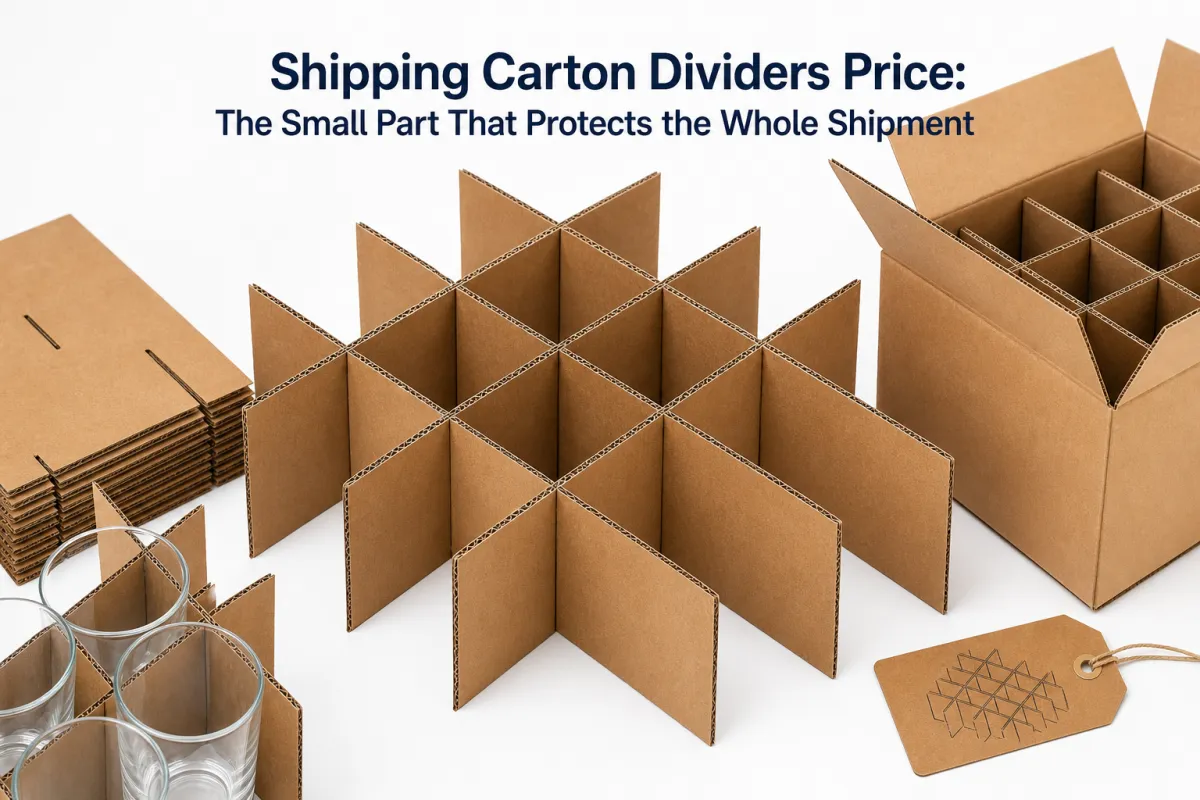
shipping carton dividers price can look tiny on a quote sheet and still have a large effect on the real cost of a shipment. A divider set may account for only a sliver of the packaging budget, yet it often decides whether glass arrives intact, whether bottles stay upright, or whether small electronics survive the trip without scuffing and shifting. Once a carton starts failing in transit, the low unit price on the divider stops mattering very quickly. That is why experienced buyers measure the shipping carton dividers price against the protection it actually delivers.
Those inserts pull more weight than they first appear to. They separate bottle necks in beverage packs, keep cosmetic items from rubbing against each other, and hold chargers, tools, or compact devices in place while freight moves through the network. They also help packing teams build cases more consistently, which matters in high-volume fulfillment where speed, repeatability, and lower rework all pull in the same direction. A divider that fits the product well can reduce breakage, save labor, and improve cube use inside the shipper.
Cheap is not the same thing as economical. A divider that looks inexpensive may allow enough movement to cause dents, cracks, or leaks, and the claims that follow can erase the savings from a long run of clean shipments. One damaged SKU can wipe out the margin from many good orders. A better way to think about the purchase is to start with protection, move to the material choice, then compare the shipping carton dividers price with a clear view of the risk being reduced.
I have seen divider specs that looked fine on paper and then started slipping once vibration testing or rougher lane conditions came into play. That kind of gap is usually not dramatic in a sample photo, which is why the field matters so much. A slightly stronger structure may raise the shipping carton dividers price a bit, but if it cuts damage and repack labor, the landed cost improves anyway. That is the real comparison: the cost of a protected shipment versus the cost of a damaged one.
The most useful question is simple: what failure are we trying to stop, and how expensive is that failure if it happens? Once that answer is clear, the rest of the buying decision gets easier to sort through. The shipping carton dividers price is not only a materials number. It sits at the center of breakage prevention, labor control, freight efficiency, and customer experience.
Shipping Carton Dividers Price by Material and Board Grade
The main driver behind shipping carton dividers price is the construction of the material itself. Corrugated board, chipboard, heavier partitions, and moisture-resistant grades each solve a different shipping problem. A divider that performs well on a dry domestic route may behave very differently in humid export transit, and that shift shows up in the quote.
Corrugated partitions are often the most balanced choice for everyday shipping protection. Single-wall corrugated with the right flute can give a useful mix of strength and cost, especially when the product is not extremely fragile. Chipboard can work well for lighter goods and tighter pack geometry, though it usually offers less edge protection. Heavier partitions, double-wall builds, or reinforced board grades make sense when the product is heavier, taller, or more likely to shift under vibration. Each step up in strength tends to increase the shipping carton dividers price, yet that increase is often easier to justify when product risk is high.
Flute type carries more weight in the decision than many buyers expect. A larger flute can improve cushioning and edge resistance, while a smaller flute may improve fit and reduce bulk. Caliper, recycled fiber content, and moisture resistance all affect the final cost too. If the spec calls for FSC-certified board, the shipping carton dividers price can move again, not because certification is decorative, but because the buyer is sourcing traceable fiber and documented chain of custody. For responsible fiber sourcing information, see the FSC site.
Freight also changes the math. A lighter divider can reduce weight, which matters when carriers use dimensional weight and actual weight side by side. That reality shows up often in ecommerce shipping, where a box can feel light in hand and still be billed at a higher rate because of its dimensions. A lighter board may trim materials expense and outbound freight, while a heavier board may improve package protection. That tradeoff is worth testing with real samples instead of guessing from a spec line.
One thing I always push buyers to do is compare the board grade against the actual lane, not just the product description. A pack that moves smoothly through a local route may need a different build for regional consolidation, cross-country freight, or export. The same divider layout can land at very different shipping carton dividers price points depending on board grade, flute structure, and performance expectations. Matching the grade to the lane, the product, and the tolerance for damage is where the value sits.
| Material / Grade | Typical Use | Indicative Unit Range | Cost Behavior |
|---|---|---|---|
| Light chipboard | Low-weight products, short hauls, simple cell layouts | $0.08-$0.18 per set | Lower material cost, less edge protection |
| Single-wall corrugated | General shipping, bottles, cosmetics, small electronics | $0.12-$0.28 per set | Best balance of cost and protection for many programs |
| Heavier or moisture-resistant board | Fragile goods, humid lanes, heavier load-bearing cartons | $0.20-$0.48 per set | Higher unit cost, stronger performance in transit packaging |
Those ranges are directional rather than fixed. The final shipping carton dividers price still depends on dimensions, quantity, print, and the tolerance window the plant has to hold. Even so, they give buyers a solid starting point before the first quote arrives.
Product Details: Divider Styles, Cell Counts, and Fit
The divider structure affects both performance and shipping carton dividers price. A basic slotted partition set is usually easier to make than a complex die-cut insert, so the quote is often lower. Style alone does not decide the value, though. Fit, pack speed, and how the product behaves inside the carton matter just as much.
Slotted partitions are common because they are efficient to manufacture and straightforward for packing teams to assemble. Interlocking grids work well where a carton needs several cells and steady vertical separation. Die-cut inserts make sense for unusual product shapes, cartons that need precise retention, or brands that want a cleaner presentation at opening. Custom-fit cell structures are the most controlled option, yet they can raise the shipping carton dividers price because they need tighter die work and more careful production control.
Cell count changes the quote in a very direct way. A 4-cell divider and a 12-cell divider may use the same board grade, but the 12-cell version needs more cuts, more fold points, and more labor during assembly. Cell size matters just as much. If the cells are too loose, the product moves. If they are too tight, packing slows down and operators may force items into place. The right geometry lowers labor and keeps the product stable. That is how a divider becomes part of a faster order fulfillment process rather than a source of friction.
From the buyer's side, the best divider is the one that balances product fit, pack speed, and material use. A divider that saves two seconds per carton on a high-volume line can turn into real labor savings over the course of a month. That labor savings belongs in the same conversation as the shipping carton dividers price. Buyers who only compare the insert cost often miss the larger operational picture.
Stock sizing and custom sizing should also be separated clearly. Stock or near-stock sizes can reduce setup cost and shorten lead time, which can improve the effective shipping carton dividers price for lower-volume users. Custom sizing gives better control over movement and stack height, yet tooling and setup costs usually rise. If the shipment is fragile or expensive, that extra spend can still be the right move.
"A divider that fits is rarely the most expensive part of the package. A divider that fails is."
That line describes the real cost well. If the divider keeps products stable, it protects the customer relationship as much as the carton itself. Reorders matter too. A program that ships the same SKU every week needs the next run to behave like the first sample did. Stable dimensions, repeatable cell counts, and consistent stack height all help keep the shipping carton dividers price predictable over time.
Pricing, MOQ, and Quote Inputs You Need Up Front
Any request for shipping carton dividers price is only as accurate as the information behind it. Board grade, finished dimensions, cell count, tooling, print, finishing, and order volume all shape the final number. Leave one of those out, and the quote can change after the spec review.
MOQ carries real weight. Smaller runs usually cost more per unit because setup, material waste, and machine time are spread across fewer pieces. Larger runs usually lower the unit price, though they also increase inventory exposure. The right MOQ is not the smallest possible number; it is the one that fits demand without creating dead stock. That matters especially in ecommerce shipping, where SKU counts grow fast and pack configurations can change from season to season.
Buyers should send a clean spec pack from the beginning. The fastest way to get a reliable shipping carton dividers price is to provide carton inside dimensions, product dimensions, product weight, target quantity, destination, and the required protection level. If the product has fragile surfaces, liquid content, or an unusual center of gravity, that should be called out as well. Those details can change the recommended board grade and the cell geometry.
It also helps to explain whether the divider is part of a broader shipping materials program. If the same carton will use inserts, void fill, or a printed shipper, the supplier can optimize the whole structure. A divider designed to work with a slightly smaller box can reduce dimensional weight and lower freight more than a cheaper insert would. That is the point where transit packaging decisions and freight costs meet.
Below is a practical way to compare options before choosing the lowest number. The cheapest shipping carton dividers price is not always the strongest value once protection and throughput are included.
| Option | Indicative Price | MOQ Behavior | Best For |
|---|---|---|---|
| Stock-style corrugated divider | Lower | Often friendlier at moderate volumes | Standard cartons, repeat shipments, simpler products |
| Custom slotted partition set | Mid-range | Setup cost matters more at low volume | Bottle packs, cosmetics, light industrial items |
| Die-cut or reinforced custom insert | Higher | Best at higher volumes or fragile SKUs | Premium goods, tight fit requirements, high breakage risk |
To compare quotes fairly, ask every supplier to use the same spec sheet, the same packing configuration, and the same freight assumption. A low shipping carton dividers price can look attractive until it turns out the quote assumes looser tolerances, a different board grade, or a shipment plan that does not match your lane.
For buyers who want related packaging options, it can also help to review broader packaging formats such as Custom Packaging Products, Custom Shipping Boxes, and Custom Poly Mailers. The divider is the focus here, but the full package system shapes the total cost.
Process, Timeline, and Lead Time from Brief to Delivery
Lead time connects directly to shipping carton dividers price. Faster schedules can mean tighter production windows, more handholding, or expedited freight. Rush orders are possible, yet the buyer should understand where the schedule gets compressed and where the cost rises as a result.
The process usually follows a clear sequence. First comes the inquiry and spec review. Then the supplier checks dimensions, board grade, and layout feasibility. If the design is custom, the team may prepare a sample or dieline review. Once the buyer approves the sample, production starts, followed by quality check and shipment. Straightforward layouts move faster. Complex inserts or tight tolerance requests take longer, and the shipping carton dividers price can reflect that extra control.
Delays tend to show up in the same places. Missing carton dimensions create avoidable back-and-forth. Unclear pack counts, late artwork changes, and slow PO approval also push the schedule out. Sample revision creep is another common issue. A buyer asks for one adjustment, then another, then another, and each change resets part of the timeline while nudging the final shipping carton dividers price. The simplest fix is to lock the spec before production begins.
Seasonality matters too. During peak shipping periods, production slots tighten and freight space can become expensive. Domestic freight is usually easier to manage than international movement, though even local lanes can slow down if the program depends on a specific truck date. If the divider is part of a launch or a holiday order, the specification should be finalized early. That single decision can save both time and money.
For businesses that pay close attention to package protection standards, sample testing should line up with recognized methods. Many teams use ISTA testing practices to check whether a carton and divider combination can handle vibration, compression, and drop exposure. A lab report is not required for every order, but a repeatable standard helps on the products that matter most.
A practical planning rule keeps the project grounded: the cleaner the brief, the better the shipping carton dividers price and the easier the lead time becomes. Final dimensions, final quantity, and final packing instructions should all be approved before the order is released. That is how a program moves from quote to delivery without unnecessary friction.
Why Choose Us for Carton Divider Programs
A good divider supplier should do more than send a number. Real value shows up in engineering support, clear pricing, consistent dimensions, and repeatable quality across reorders. Buyers feel that difference most once shipment volume rises and the stakes get higher.
At Custom Logo Things, the goal is not to overspec every job. It is to recommend the right board grade and divider style for the shipment, then keep the shipping carton dividers price aligned with the real risk. Overbuilt packaging can quietly drain margin. Underbuilt packaging can trigger claims. The right partner helps buyers avoid both problems by matching the divider to the product, the route, and the pack-out method.
Stable production matters a great deal when a company ships the same SKU every week. The same fit, the same stack height, and the same assembly behavior reduce labor variation. That matters in fulfillment centers where operators need packing speed they can trust. It also matters for quality control, because a divider that fits on the first run should fit on the tenth. Consistency lowers hidden costs, and those hidden costs often matter more than the headline shipping carton dividers price.
There is another benefit buyers sometimes underestimate: fewer surprises. A divider program should not require constant troubleshooting. When the specs are clear and the production process is controlled, reorders become easier to manage. The result is lower damage rates, less repacking labor, and a shipping line that stays predictable as volume shifts. That is the practical value of a well-run divider program.
Honestly, the best packaging relationships feel boring in the right way. No surprise charges. No fit problems on reorder. No guessing about what changed between samples and production. Just dependable shipping materials that do the job. That is what buyers should expect when comparing shipping carton dividers price across vendors.
Next Steps to Lock In Your Shipping Carton Dividers Price
If you want a reliable shipping carton dividers price, start with the basics. Gather the carton inside size, product size, product weight, pack count, annual volume, and shipping destination. Add any special handling requirements, such as humidity exposure, fragile surfaces, or glass contact. Those details let the quote reflect the actual shipping environment instead of a generic assumption.
Next, request two or three material options. Side by side, the value becomes much easier to see. A lighter board can help on freight, a stronger board can help on package protection, and a custom-fit design can improve pack-out speed. The buyer sees more than the shipping carton dividers price; the buyer sees performance, labor, and freight together.
Samples are the safest move before volume. Ask for a white sample, dummy sample, or pre-production sample depending on the stage of the project. Then check product movement, carton stability, and how long it takes to pack a full case. A divider that takes too long to assemble can erase savings even if the unit cost looks attractive. Testing also helps confirm whether the final design works with your current shipping boxes and transit packaging workflow.
- Confirm the MOQ before approving the design.
- Approve the final spec sheet, not a rough sketch.
- Lock the timeline before you schedule launch inventory.
- Plan the reorder trigger now, not after stock gets tight.
That sequence keeps the project under control. It also gives you a cleaner basis for comparing the shipping carton dividers price across options, since every quote is measured against the same requirements. The most useful lesson is simple: the right divider protects the shipment at the lowest total cost, not the one with the smallest sticker price. That is how buyers turn shipping carton dividers price into a smart purchasing decision instead of a guessing game.
What affects shipping carton dividers price the most?
Material grade, divider size, cell count, and total order volume usually have the biggest impact on shipping carton dividers price. Tooling, print, special coatings, and tight tolerances can also raise cost. Freight and packaging configuration matter because they change how many finished sets fit per shipment.
How does MOQ change shipping carton dividers price per unit?
Lower MOQ orders usually cost more per unit because setup and waste are spread across fewer pieces. Higher volumes often reduce the unit price, but they also increase the cash tied up in inventory. The best MOQ is the one that matches demand without creating excess stock, and that keeps the shipping carton dividers price easier to manage.
Which material gives the best value for shipping carton dividers price?
The best value depends on how fragile the product is and how much movement the carton must control. Corrugated board is often the most balanced option for general shipping protection. Heavier or moisture-resistant materials make sense when damage risk is higher than material savings, even if the shipping carton dividers price is a little higher.
How long does a custom divider order usually take?
Lead time depends on approval speed, material availability, and whether samples are required. Standard layouts move faster than fully custom sizes or complex cell patterns. Final dimensions and artwork approvals are the quickest way to shorten the schedule, and they also help stabilize the shipping carton dividers price.
Can I get samples before placing a bulk order?
Yes, and it is the safest way to confirm fit before a full production run. Ask for a white sample, dummy sample, or pre-production sample depending on the project stage. Check product movement, pack-out speed, and carton stability before approving volume so the final shipping carton dividers price reflects a design That Actually Works.


