Buyer Fit Snapshot
| Best fit | shipping cartons manufacturer choose fit for packaging buyers comparing material specs, print proof, MOQ, unit cost, freight, and repeat-order risk where brand print, material, artwork control, and repeat-order consistency matter. |
|---|---|
| Quote inputs | Share finished size, material target, print colors, finish, packing count, annual reorder estimate, and delivery region. |
| Proofing check | Approve dieline scale, logo placement, barcode or warning zones, color tolerance, and any recyclable or compostable wording before bulk production. |
| Main risk | Vague material claims, crowded artwork, or missing packing details can create delays even when the unit price looks attractive. |
Fast answer: Shipping Cartons Manufacturer Choose Fit: MOQ, Samples, Lead Time, and Quote Checks should be specified like a repeatable production item. The safest quote includes material, print method, finish, artwork proof, carton packing, and reorder notes in one written spec.
What to confirm before approving the packaging proof
Check the product dimensions against the actual filled item, not only the sales mockup. Ask for tolerance on folds, seals, hang holes, label areas, and retail display edges. If the package carries a logo, QR code, warning copy, or legal claim, reserve that space before decorative graphics fill the panel.
How to compare quotes without losing quality
Compare board or film grade, print process, finish, sampling route, tooling charges, carton quantity, and freight assumptions side by side. A lower quote is only useful if the supplier can repeat the same color, closure quality, and packing count on the next order.
Shipping Cartons Manufacturer: How to Choose the Best Fit
Picking a shipping cartons manufacturer is not a hunt for the cheapest cardboard quote. It is a decision about product protection, warehouse speed, freight cost, and how many headaches you want to buy later. A carton can look fine on paper and still fail the first time it hits a conveyor, gets stacked too high, or rides through a delivery network that treats boxes like they owe it money.
A strong shipping cartons manufacturer looks at the whole route, not just the box dimensions. Product size matters. So do pallet patterns, storage conditions, carrier rules, and the way your team actually packs orders on a busy Tuesday. If you sell through ecommerce shipping, move mixed SKUs, or run replenishment on tight schedules, the carton spec is part packaging and part operations. Skip that part and the problem usually shows up in damage claims, not in the quote.
The bargain carton is often the expensive one. Save a few cents on the box, then pay for damage, rework, filler, and freight penalties. That math is pretty rude, but it is real.
Custom Logo Things works with brands that want packaging to do more than hold product and disappear. If your project needs broader packaging support, the team at About Custom Logo Things can help align artwork, structure, and delivery goals, while Custom Packaging Products gives buyers a practical way to compare carton and mailer options in one place. That matters more than people think, especially when one packaging choice quietly affects three others.
I have watched buyers chase a lighter box and then pay for the mistake in returns and repacks. I have also seen the opposite: a slightly stronger carton that cut damage enough to justify the higher unit cost. Packaging is annoying like that. The right answer is rarely the flashy one.
What a Shipping Cartons Manufacturer Really Does
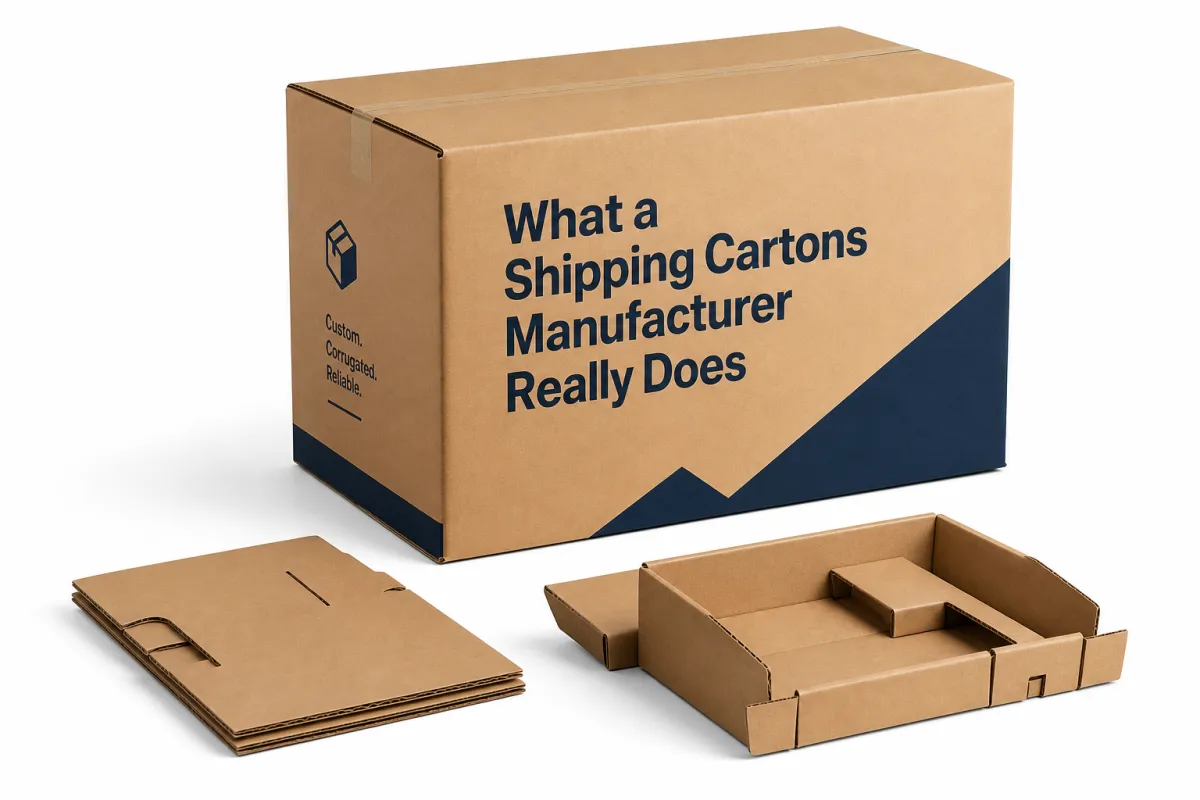
A shipping cartons manufacturer makes corrugated packaging that can be plain stock or built for a specific product, pallet layout, or sales channel. The job starts with board selection, then moves into box style, scoring, die-cutting, print, and finishing. The carton is supposed to solve a shipping problem. Looking nice is fine, but it is not the mission.
Many buyers miss the real job. A shipping cartons manufacturer is not selling cardboard by the pound. They are balancing package protection, cost, speed, and handling efficiency. A regular slotted carton may be enough for a simple replenishment program. A custom design makes more sense when the product is heavy, oddly shaped, fragile, or expensive enough that one failure wipes out the savings. That is not a glamorous answer, but it is the correct one.
Stock cartons are the quick route. They come in standard sizes and usually ship fast, which helps when you need cartons for a short run or a launch that got moved up because someone in marketing got enthusiastic. Custom cartons take more planning, but they let a shipping cartons manufacturer right-size the box to the product, trim wasted void space, and improve dimensional weight performance for parcel shipping. That matters a lot in ecommerce shipping, where an inch can push a package into a worse rate tier.
The board itself does most of the heavy lifting, so ignoring it is a bad habit. Corrugated cartons use linerboard and fluting. Single-wall board handles everyday shipments. Double-wall board adds stiffness for heavier loads, rougher routes, or longer storage. Flute profiles like A flute, B flute, C flute, E flute, and combinations like BC flute change crush resistance, print quality, and stacking behavior. A shipping cartons manufacturer chooses those layers based on the shipment, not because one option happened to be sitting around.
Recycled content, liner quality, and board grade matter too. A 32 ECT board may be enough for standard cartons, while 44 ECT or burst-rated board can be a better call for heavier products or stacks that sit longer than planned. The right spec is the one that survives real handling without paying for strength you do not need. That is the part a shipping cartons manufacturer earns.
Cartons do not work alone. Void fill, pallet wrap, warehouse process, and even the way a box is loaded all change the outcome. Mismatch those pieces and a strong carton still disappoints. Line them up and the same box can travel farther, stack cleaner, and land with fewer headaches.
One honest disclaimer: there is no single “best” carton spec that works everywhere. A box that performs beautifully on a short parcel route might be overbuilt for local delivery and underbuilt for export or long-term storage. Anyone who sells you a universal answer is probably skipping the messy part of the job.
How a Shipping Cartons Manufacturer Turns Specs Into Boxes
The process usually starts with intake. A shipping cartons manufacturer asks for product dimensions, unit weight, packing method, shipping route, quantity per carton, print needs, and the target delivery date. Clear input makes the spec work cleaner. Vague input turns into guesswork, and guesswork is how packaging budgets get chewed up.
After that, the manufacturer converts the brief into structural choices. A light consumer item may do fine in a single-wall carton with a common flute profile. A dense product may need stronger board, a tighter fit, or internal support. A shipping cartons manufacturer may also suggest a different closure method, a crash-lock bottom, or a style that speeds assembly on the packing line. Those small changes can shave seconds off each pack-out, which turns into real labor savings once volume climbs.
Samples save people from expensive mistakes. Prototypes or mockups let the buyer check fit, closure, stacking, and pallet use before a full run starts. For anything serious, the sample should be tested with the real product, not just measured with optimism and a tape. If the carton is meant for fragile goods, test it both fully packed and slightly underpacked so the team can see what happens when the shipment is less than perfect. Real life is not always neat. Packaging needs to survive the sloppy version too.
A realistic schedule usually runs like this: one to three business days for intake and quoting, several days for engineering and proofing, a few more days for samples if the build is custom, then make-ready, production, packing, and freight booking. Stock carton runs can move fast. A shipping cartons manufacturer handling print, specialty board, or tooling may need 12 to 18 business days after approval, sometimes longer if artwork keeps changing. If someone promises a custom carton overnight, ask what corner they are planning to cut.
Buyers who want tighter transport validation should ask whether the carton can be evaluated against recognized testing methods like ISTA transport testing standards or compression guidance from ASTM methods. That does not mean every carton needs a full lab program. It does mean the conversation gets more technical, and more useful. A shipping cartons manufacturer that talks in terms of test loads, stacking height, and distribution hazards is usually easier to work with than one that only quotes dimensions.
One more thing matters here. A shipping cartons manufacturer should be honest about where timing slips happen. Artwork changes, approval delays, special coatings, and multi-location freight can all add time. If the team names those risks up front, buyers can plan around them instead of chasing a ship date that was never realistic in the first place.
Key Factors That Shape Carton Performance
Product weight is the first filter. A carton that carries a lightweight apparel accessory is a different animal from one that holds metal parts, bottled goods, or an appliance component. A shipping cartons manufacturer will look at center of gravity, load distribution, and whether the contents can shift inside the pack. If the weight sits high or off to one side, the carton may need a more stable geometry or internal blocking.
Shipping method comes next. Parcel cartons take different abuse than palletized freight cartons. Parcel units see more drops, impacts, and conveyor handling. Palletized loads spend more time under compression. A shipping cartons manufacturer serving ecommerce shipping may focus on dimensional weight, tear resistance, and tape performance, while a manufacturer working on warehouse replenishment may care more about stacking strength and load retention.
Environment can quietly wreck a decent spec. Humidity softens corrugated board, and temperature swings can change how adhesives and coatings behave. If cartons will sit in a dock area, a non-climate-controlled warehouse, or long-term storage, the board spec needs to reflect that. A shipping cartons manufacturer that ignores storage conditions is asking for crushed corners and bowed panels later. I have seen that happen in July, and the results were not charming.
Print expectations also affect performance. Heavy ink coverage, tight registration, special coatings, and multi-color graphics can change cost and sometimes add complexity to the board selection. If the carton is part of a brand experience, the print surface matters. If it is strictly a transit package, a cleaner unprinted build may be smarter. Good buyers do not confuse visual finish with structural strength. They make sure both fit the job.
Sustainability goals belong in the conversation, but they should not show up as a slogan with no math behind it. Right-sizing cartons cuts wasted air, which helps with freight cube and material use. Recycled content can support sourcing goals. FSC certification matters if your procurement team tracks chain of custody. The best shipping cartons manufacturer will explain where recycled content helps, where it does not, and how to balance that against protection needs. If you want a broader industry reference for resource reduction and packaging waste, the EPA's sustainable materials guidance is a good place to see the bigger picture.
Standards help separate opinion from performance. A shipping cartons manufacturer may talk about ECT, burst strength, or test protocols, but the buyer should ask how those numbers map to the real product and the real route. ASTM D642 compression testing and ISTA distribution testing are useful because they connect the carton spec to the stress it will actually face. That beats picking a box because it feels thick. Thickness is not a strategy.
Here is the part people skip: the carton itself can be fine and still fail the system if the pallet pattern is sloppy or the warehouse team overpacks it. Carton performance is a chain. Break one link and the whole thing gets weird.
Shipping Cartons Manufacturer Pricing: What Drives Cost
Pricing starts with board grade and construction. A shipping cartons manufacturer has to decide whether the product can ride safely in single-wall board or whether double-wall is the better answer. Heavier products, taller stacks, and harsher routes usually need more board, and more board costs more. Flute profile matters too, because stronger board and better stacking behavior often show up immediately in the quote.
Size has a real effect. A larger carton uses more material, more die space, and usually more freight cube. If the dimensions are off even a little, the project can end up pricier than it should be. A custom fit can still save money overall because it cuts void fill, lowers damage risk, and improves pallet efficiency. A shipping cartons manufacturer that understands dimensional weight will look at landed cost, not just the per-unit carton price.
Volume is one of the biggest levers. Small runs usually carry a higher unit cost because setup, tooling, and make-ready are spread across fewer boxes. Larger orders spread those fixed costs out, so the unit number drops. A buyer who only looks at the per-box quote and ignores the run economics may miss the best opening. That is why a shipping cartons manufacturer should quote at least two or three volume breaks whenever possible.
Print complexity changes the price too. One-color print on a brown liner is usually less expensive than full-coverage graphics, and a plain shipper is cheaper still. Coatings, special finishes, inserts, and artwork changes all add to the bill. Rush orders do the same thing. If the art file is not final, or if the box needs a late structural change, the extra labor can eat the savings fast.
| Carton Type | Typical Unit Range | Best Fit | Notes |
|---|---|---|---|
| Stock corrugated shipper | $0.20-$0.60 | Fast replenishment, simple products | Lowest setup, limited sizing flexibility, often best for short lead times |
| Custom unprinted single-wall carton | $0.35-$0.95 | Right-sized ecommerce shipping, moderate protection | Usually a strong value when dimensional weight and fit matter |
| Custom printed one-color carton | $0.55-$1.40 | Brand presentation plus transit packaging | Print adds setup and press time, but can improve unboxing consistency |
| Heavy-duty double-wall carton | $0.90-$2.50 | Heavier products, long storage, stacked freight | More board and better compression strength, often used by a shipping cartons manufacturer for demanding loads |
Those ranges are examples, not promises. Board availability, order quantity, carton size, and freight all swing the final number. Still, they give buyers a fair way to compare options. The smartest comparison is not the cheapest quote. It is the quote that shows the same board grade, the same print method, the same quantity, and the same delivery assumptions. A shipping cartons manufacturer should be willing to explain every line instead of hiding behind a single number.
Freight is another trap. A carton that is cheap per unit but expensive to ship from the plant can erase the savings quickly. Split deliveries, special pallet counts, and remote destinations all change the landed cost. That is why a shipping cartons manufacturer should price not just the box, but also the cost of getting the box where it needs to go.
If you are comparing two quotes that look close, ask for the assumptions behind them. The board might not be the same. The print coverage might not be the same. The freight terms might absolutely not be the same. That little detail can wreck an otherwise clean comparison.
Step-by-Step Process and Timeline for Ordering Cartons
Start with a clean brief. A good carton project needs internal product dimensions, product weight, pack-out count, shipping method, target order quantity, print expectations, and the delivery window. If the item is fragile, irregular, or temperature sensitive, say so. A shipping cartons manufacturer can only spec the right box if the basic facts are on the table from the start.
- Gather the product and shipping data.
- Confirm the box style and board target.
- Request a quote from the shipping cartons manufacturer.
- Review the proof and sample.
- Approve production after fit and strength checks pass.
- Schedule fabrication, packing, and freight.
The quote stage should do more than spit out a price. It should confirm whether the carton is meant for parcel, pallet, or mixed distribution, whether it needs print, and whether the board recommendation is based on compression, burst, or a testing method like ISTA. A shipping cartons manufacturer that can explain those details in plain language usually makes the rest of the project easier, because the buyer knows what is being purchased and why.
Samples deserve real attention. Even a simple carton can act differently once it is full of product. Fit should be checked with the actual item, not a sketch and wishful thinking. Closure method should be tested too, especially if tape, glue, or locking tabs are part of the build. In a warehouse, a carton that takes three extra seconds to assemble can become a labor problem across thousands of units. A shipping cartons manufacturer should be asked how the box performs on a real packing line, not just on paper.
Production usually moves through make-ready, press setup if printed, corrugator or converting work, quality checks, bundling, and freight booking. A straightforward run can move quickly once the proof is approved, but custom artwork, new tooling, or special board can stretch the schedule. If the run supports a launch or seasonal replenishment cycle, build in buffer time. A shipping cartons manufacturer can hit a window more reliably if the buyer leaves room for one surprise, because packaging projects almost always have one.
Communication is the quiet part that keeps the job moving. The buyer should know when sign-off is needed, what happens if artwork changes, and who confirms the delivery appointment. That matters even more in order fulfillment programs that run every week or every month. A shipping cartons manufacturer is much easier to work with when expectations are clear and the approval trail is short.
If your project uses more than one format, such as cartons for bulky goods and Custom Poly Mailers for lightweight shipments, it is worth aligning the whole packaging system at once. One program usually affects the other. A shipping cartons manufacturer often sees those savings more clearly than a buyer who only looks at one item in isolation.
One practical tip: keep the approval chain short. If five people need to bless a sample, the schedule will wobble. If one owner can gather feedback and make the call, the project moves. Simple stuff, but it saves a lot of pointless back-and-forth.
Common Mistakes When Buying Shipping Cartons
The first mistake is treating internal dimensions as the only number that matters. Fit matters. Compression strength matters too. A carton that fits perfectly can still fail if the board is too light for the stack or if the product is heavy enough to bow the bottom panel. A shipping cartons manufacturer should help the buyer look at fit and strength together, because one without the other gives a false sense of security.
The second mistake is ignoring pallet behavior. A carton that looks fine in singles may act badly in a full pallet pattern. Corner crush, overhang, and uneven load distribution all create trouble during storage and transit packaging. If the pallet stack is tall or mixed, the carton spec should reflect that. A shipping cartons manufacturer can usually spot these issues early if the buyer shares the pallet plan, not just the product size.
The third mistake is skipping samples. That gets risky fast with fragile products, irregular shapes, or anything expensive enough that one damaged case hurts. A prototype can reveal a dozen small problems: too much headspace, weak closure, awkward hand holes, or a print area that gets in the way of glue. A shipping cartons manufacturer that pushes for testing is usually trying to save the buyer from a much bigger mistake later.
The fourth mistake is chasing the lowest line item and forgetting the rest of the quote. Board grade, print method, lead time, testing, inserts, and freight assumptions can change the real value of the deal. A buyer may save a few cents per carton and then lose money through damage claims, extra void fill, or a rushed second order. A shipping cartons manufacturer should be evaluated on the full package, not just the number at the bottom.
The fifth mistake is poor timing around approvals. Artwork delays, late revisions, and unanswered questions can push a shipment right past the date you actually need it. That creates stress for purchasing, production, and the warehouse. If the project supports a launch or replenishment window, the shipping cartons manufacturer needs fast feedback and one point of contact. That is often the difference between a clean run and a costly scramble.
Do not forget sustainability goals or documentation either. If your company wants recyclable packaging, a certain recycled content level, or FSC sourcing, ask for it early. Changing those requirements after the quote is issued slows everything down. A shipping cartons manufacturer can usually support those goals, but only if the request is part of the brief instead of a late surprise.
And yes, sometimes a carton that looks good in a spec sheet simply does not like your product. That is not a moral failure. It is a signal to adjust the board, the closure, or the box style before the warehouse finds the problem for you.
Expert Tips and Next Steps for Your Carton Project
Build a one-page carton brief before you request quotes. Keep it simple: product dimensions, weight, quantity, shipping method, stack height, print needs, and target date. That single sheet helps a shipping cartons manufacturer compare your project against the right materials instead of guessing at the spec. It also makes quote comparison easier, because every supplier is working from the same input.
Ask for performance language, not just a price. If a supplier says a box is 32 ECT, ask what that means for your product. If they recommend 44 ECT or double-wall board, ask why. A shipping cartons manufacturer that can connect ECT, burst strength, board grade, and flute choice to your actual load is giving you useful guidance, not a random SKU with confidence attached.
Test the carton in the environment it will actually face. Stack it in the warehouse. Let it sit for a while. Move it through the pack line. Check how it behaves under normal handling. If the carton is for a rough lane, test it under rough conditions. A shipping cartons manufacturer can design for theory, but your route decides the final result.
Think in total landed cost. A box that costs a little more can still win if it cuts damage, reduces dimensional weight, speeds assembly, or eliminates filler. I have seen buyers save on the carton and lose on labor, freight, or returns. I have also seen the opposite. The right shipping cartons manufacturer will help you see the whole picture instead of pushing the cheapest sheet of corrugated on the market.
If the project involves several packaging formats, keep them aligned. Cartons, mailers, inserts, and exterior branding should feel like one system, not four unrelated purchases. That matters even more for brands balancing ecommerce shipping with retail replenishment or mixed order fulfillment. A shipping cartons manufacturer that can coordinate with your broader packaging plan often saves time and prevents mismatched specs.
From there, the next steps are pretty direct: gather your specs, request a sample, compare a few detailed quotes, and choose the shipping cartons manufacturer that balances protection, cost, and timeline in a way that fits the business. If your packaging program is still taking shape, it also helps to review Custom Packaging Products alongside your carton needs so the whole shipping system is built with the same logic.
For companies that want a cleaner sourcing story, FSC sourcing and recycled content can be part of that final decision. For companies focused on damage reduction, stack strength and route testing may matter more. The goal is not to force every project into the same box. The goal is to choose a shipping cartons manufacturer who asks the right questions, tells you what the carton can and cannot do, and then builds the right answer.
My blunt takeaway: do not buy a carton, buy a shipping outcome. If the spec protects the product, fits the process, and lands at a sane total cost, you are in good shape. If any one of those three is missing, the quote is not done yet.
How do I choose a shipping cartons manufacturer for heavy products?
Ask for board and strength recommendations based on product weight, stacking height, and shipping method. Request sample cartons or prototypes so you can check fit, closure, and crush resistance before ordering at scale. Confirm whether the shipping cartons manufacturer can explain ECT, burst strength, and flute choices in plain language.
What information should I send to a shipping cartons manufacturer for an accurate quote?
Provide internal product dimensions, unit weight, quantity per carton, and whether the carton ships on pallets or by parcel. Include print requirements, finish expectations, and any special handling or storage conditions. Share your target delivery date so the shipping cartons manufacturer can build a realistic timeline.
How long does it usually take a shipping cartons manufacturer to deliver custom cartons?
Simple runs may move faster, but custom sizing, artwork, and testing add time. Expect the timeline to include quoting, proofing, sampling, production, and freight scheduling. The earlier you approve specs and artwork, the easier it is for a shipping cartons manufacturer to keep the project on schedule.
What affects shipping carton price the most?
Board grade, carton size, order quantity, and print complexity usually have the biggest impact. Rush timing, tooling, inserts, and freight can also change the final cost. A slightly stronger box from a shipping cartons manufacturer can sometimes reduce damage costs enough to pay for itself.
Can a shipping cartons manufacturer help reduce shipping costs?
Yes, by right-sizing cartons so you move less empty space and use less void fill. Better carton design can improve pallet efficiency and reduce freight cube. A shipping cartons manufacturer can also suggest lighter but still strong board options when the product allows it, which helps control total cost while still protecting the shipment.


