Buyer Fit Snapshot
| Best fit | Shipping Cartons Price List projects where brand print, material claims, artwork control, MOQ, and repeat-order consistency need to be specified before quoting. |
|---|---|
| Quote inputs | Share finished size, material target, print colors, finish, packing count, annual reorder estimate, ship-to region, and any compliance wording. |
| Proofing check | Approve dieline scale, logo placement, barcode or warning zones, color tolerance, closure strength, and carton packing before bulk production. |
| Main risk | Vague material claims, crowded artwork, missing packing details, or unclear freight terms can make a low unit price expensive after revisions. |
Fast answer: Shipping Cartons Price List: Prices, MOQ, and Specs should be specified like a repeatable production item. The safest quote records material, print method, finish, artwork proof, packing count, and reorder notes in one written spec.
Production checks before approval
Compare the actual filled-product size with the drawing, then confirm tolerance on folds, seals, hang holes, label areas, and retail display edges. Reserve space for logos, QR codes, warning copy, and material claims before decorative graphics fill the panel.
Quote comparison points
Review material grade, print process, finish, sampling route, tooling charges, carton quantity, and freight assumptions side by side. A quote is only useful when the supplier can repeat the same color, closure quality, and packing count on the next order.
Shipping Cartons Price List: Prices, MOQ, and Specs
If you are comparing a shipping cartons price list for Custom Logo Things, the first mistake is treating every carton quote like it is the same product with a different number on the page. It is not. Two cartons can share the same outside size and still produce very different landed costs once board grade, print setup, freight terms, and dimensional weight enter the picture. A shipping cartons price list only earns its keep when the spec sits beside it, not after the purchase order is already moving.
I have watched buyers chase the lowest line item and then wonder why the warehouse started seeing crushed corners, slow packing, and a spike in customer complaints. It usually starts small. A box is a little too light, a little too large, or a little too flimsy, and then the whole system pays for it later. That kind of mistake is easy to make because the quote looks tidy on a screen. Real shipping is messier than that, and honestly, it is gonna punish shortcuts.
In practice, the lowest headline quote often belongs to the carton that costs you more later. Maybe it crushes under stack load. Maybe it forces extra void fill. Maybe it nudges your parcel into a higher carrier band because the box is larger than the product really needs. I have seen buyers chase a cheap shipping cartons price list, then pay for the mistake in damage claims, repacks, and frustrated customer emails. That is not savings. That is a slow leak in the budget.
This is a buyer's guide, not a quote collector's daydream. The goal is simple: read a shipping cartons price list like someone who has to ship product every day, not like someone who only wants the lowest number in a spreadsheet. That means looking at carton size, flute profile, burst strength, print coverage, MOQ, freight, lead time, and whether the carton actually fits your order fulfillment flow.
Shipping Cartons Price List: Why the Cheapest Quote Misleads
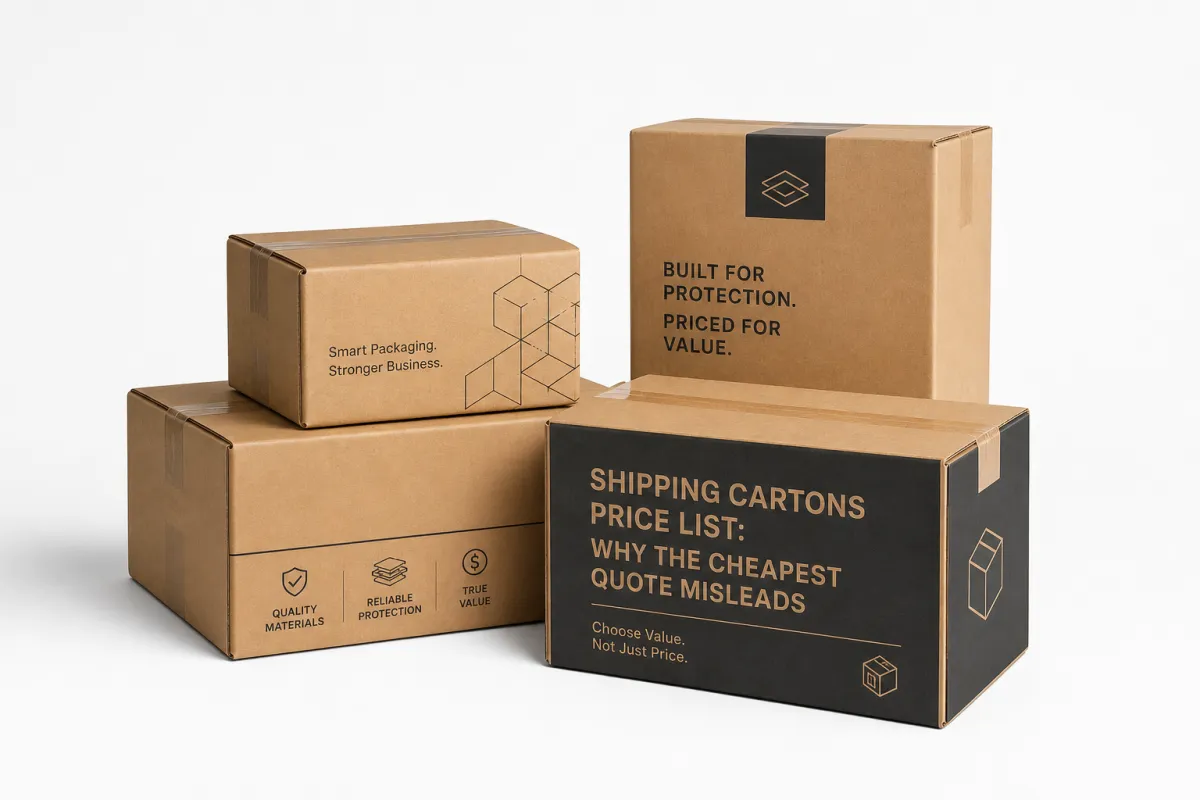
The cheapest quote usually leaves something out. Freight gets omitted. Tooling gets tucked away. Board grade gets downgraded. A useful shipping cartons price list tells you whether the carton is single-wall or double-wall, whether delivery is included, and whether the unit cost changes once you hit a different MOQ. When those pieces are missing, the quote is not apples-to-apples. It is bait dressed as a bargain.
One thing that trips people up is that packaging costs do not always show up in the same place as packaging defects. A carton that looks fine on paper can still create labor waste if the closure is awkward, the bundle count is inconvenient, or the internal size makes packers fight the product into place. Those are quiet costs. They do not arrive as one dramatic invoice. They show up as extra minutes at the bench, and then as overtime, and then as a team asking why the line feels slower than it did last quarter.
Here is a common scenario. An ecommerce shipper starts with a lightweight mailer-style box because it looks tidy and keeps the unit price low. Damage stays tolerable for a while, or at least unnoticed. Then the return rate starts climbing. The brand moves to a heavier double-wall carton, and the unit price rises. On paper, the shipping cartons price list looks worse. In the warehouse and the customer inbox, though, package protection improves, transit damage drops, and the service team stops spending half the day apologizing for crushed goods. That trade makes sense even when the first line item looks larger.
A carton that survives transit is cheaper than a carton that needs replacement. Buyers love low unit price until they see the cost of rework, reshipment, and claims.
What most buyers miss in a shipping cartons price list is the hidden cost of bad fit. Oversized cartons waste board and shipping materials, raise dimensional weight, and force more void fill. Undersized cartons can damage the product or make packing slow and awkward. Both problems are expensive. For irregular SKUs, the right box shape can cut labor time as much as it cuts freight.
Print coverage changes the picture too. A plain brown carton and a fully printed branded box are not the same thing. Even one-color branding can add plate or setup charges, and a full outside print changes the run economics again. The same goes for inside print, varnish, or a specialty coating. A useful shipping cartons price list should separate those costs clearly so you can decide whether branding is worth the spend for the channel you are serving.
Bundling and pack count deserve attention as well. Ten cartons per bundle, twenty-five per bundle, or flat-packed on a pallet all affect handling and freight efficiency. A supplier can quote a clean number on the carton and then hide the real cost in the packing method. If the carton arrives in awkward counts, your warehouse pays for it in order fulfillment time. That is a real cost even if it never appears in the unit line.
For buyers managing ecommerce shipping at scale, the better question is not “Who is cheapest?” It is “Which shipping cartons price list gives me the best total cost per shipped order?” That is a different calculation, and it is the one that matters when the orders start stacking up.
Product Details That Shape a Shipping Cartons Price List
Carton format comes first. Regular slotted cartons, die-cut cartons, heavy-duty shippers, single-wall cartons, double-wall cartons, and export cartons all sit in different cost bands because they use different amounts of board and different manufacturing steps. A regular slotted carton is usually the baseline. A die-cut carton may give you a cleaner fit, yet it often needs tooling and tighter production control. A heavy-duty shipper brings more board and more performance, which is exactly why the shipping cartons price list climbs with strength.
Standard carton formats
For day-to-day ecommerce shipping, single-wall cartons work well for lightweight products, accessories, books, cosmetics, and non-fragile items. For heavier goods, stacked parcels, or anything that rides rough in transit packaging, double-wall usually makes more sense. Export cartons sit in a different category because they have to survive longer freight lanes, more handling, and storage conditions that are often less forgiving. If the spec sheet does not say which format you are buying, the shipping cartons price list is incomplete.
Size has a direct impact on price. A carton that is 200 x 150 x 100 mm uses less board than one that is 450 x 300 x 250 mm. That sounds obvious, yet buyers still compare quotes by box count instead of board consumption. The better way to read a shipping cartons price list is through sheet yield and finished dimensions, because those two details tell you how much material is actually becoming a usable carton.
Construction details matter more than people expect. Glued joints are common and efficient. Stitched joints can improve strength in some heavy-duty applications, though they can add cost and processing time. Tuck flaps, reinforced edges, crash-lock bottoms, and auto-bottom styles all change the production method. That means the same carton footprint can land in different sections of a shipping cartons price list depending on how the box opens, closes, and carries weight.
Print is another major driver. A plain kraft shipper is usually the lowest-cost path. One-color branding adds setup and run time, but it can still be practical if the carton is visible to the customer or used as outer packaging in ecommerce shipping. Full outside print looks sharper and gives more room for brand storytelling, but it will not be the low-cost line in any honest shipping cartons price list. Inside print, coatings, and special finishes add more cost again. Useful? Sometimes. Free? Never.
Stock versus custom is the last big split. Stock cartons win on speed and often on short-run price because they come from existing inventory. Custom cartons are better when fit matters, when brand presentation matters, or when the product creates a lot of wasted space in a stock box. If your boxes stay consistent across SKUs, custom can lower damage and packaging waste. If your products change every month, stock may be the smarter move. That decision shows up immediately in a shipping cartons price list.
If your packaging mix includes more than one outer format, compare cartons against other shipping materials too. Some teams use cartons for most orders and lighter formats for accessories. Our Custom Packaging Products range is helpful when you need to line up outer cartons, inserts, and related transit packaging without forcing every SKU into the same spec.
Size can change your channel economics in a way that surprises new buyers. A carton that looks close enough on paper can still push a parcel into a larger dimensional weight bracket. A few millimeters can cost real money once the carrier bill lands. A smart shipping cartons price list should help you avoid that trap before it reaches the shipping invoice.
Shipping Cartons Price List: Specs, Materials, and Strength
Read the spec line before you read the price. Every useful shipping cartons price list should show the internal dimensions, flute profile, board caliper, burst strength or edge crush test, and maximum load guidance. Without those details, the number on the page is just a guess wearing a suit. Buyers who know what they are looking at can spot a cheap carton that will fail long before it reaches the customer.
The most useful specs are simple enough to compare quickly. Internal dimensions tell you whether the carton actually fits the product and any insert or void fill. Flute type shows how much cushioning and compression resistance the board has. E-flute is thinner and cleaner looking. B-flute and C-flute offer more cushion and better stacking behavior. Double-wall constructions, like BC or EB combinations, are common in heavier transit packaging where package protection matters more than shaving a few cents off the unit cost.
Board strength is where buyers either save money or create problems for themselves. Burst strength measures resistance to puncture and rupture. ECT measures how well the carton resists crushing under stack load. Neither metric is perfect on its own, but both belong on a serious shipping cartons price list. If you are stacking cartons in a warehouse, loading them on pallets, or shipping them long distance, ECT often matters more than a glossy print finish.
Material choice changes the economics too. Kraft board usually gives a cleaner look and strong performance. Recycled content can reduce cost and support sustainability goals, though performance still needs to match the load. Premium board grades are better for heavier goods, long-haul lanes, or cartons that need to survive repeated handling. For buyers seeking FSC-certified paper sources, the certification chain matters more than vague sustainability claims. If you need a reference point, see the Forest Stewardship Council at fsc.org.
Climate and transport conditions are not optional details. Humid routes, cold storage, long warehouse dwell time, and rough carrier networks all push you toward stronger board or double-wall construction. A carton that performs well in a dry local delivery lane may fail in a humid export lane. That is why a shipping cartons price list should never be read without the destination and transit environment attached to it. Same box. Different result.
Carrier rules are another filter. Parcel services care about dimensions and dimensional weight. Palletized freight cares more about stacking and compression. If your carton is designed for ecommerce shipping, make sure it still fits the carrier network you actually use. The wrong spec can quietly add cost every time it moves through the channel.
One practical way to judge a carton is to ask whether it has been designed against recognized test methods. In many buying cases, people reference standards such as ISTA procedures for transport testing, alongside ASTM-based strength measurements. That does not mean every carton needs lab testing for every order. It does mean the supplier should be able to explain how the carton was selected, tested, or matched to the shipment profile instead of waving at the price and hoping nobody asks harder questions.
If the carton spec cannot survive a normal stacking, drop, and transit conversation, the shipping cartons price list is not ready for procurement.
For high-volume shippers, I usually recommend keeping a short spec checklist on hand: dimensions, flute, ECT or burst target, weight class, finish, and delivery method. That checklist keeps every shipping cartons price list honest and saves time during reorders. It also helps your team avoid comparing a light-duty stock box against a heavy-duty custom shipper just because the supplier wrote both prices on one page.
There is one more detail that gets ignored too often: humidity during storage. Corrugated board can lose some compression strength if it sits in a damp warehouse or near a loading dock with temperature swings. It is not dramatic in every case, but it can be enough to matter for stacked pallets and export lanes. If your cartons are going into a tougher environment, ask for the board grade that matches that reality instead of assuming the cheapest kraft sheet will behave the same way.
Shipping Cartons Pricing, MOQ, and Unit Cost
This is the part buyers care about most, and for good reason. A shipping cartons price list only becomes useful once you understand how pricing is built. Material cost is the obvious piece. Tooling or die charges come next. Then print setup, labor, packing method, palletization, and freight. If a supplier quotes only the per-unit box price and leaves everything else hanging in the air, the quote will grow teeth later.
MOQ changes the unit price more than most people expect. Small runs carry a higher per-carton cost because setup is spread over fewer pieces. Larger runs usually bring the unit cost down because the production line runs more efficiently and the board purchase becomes more favorable. That is the tradeoff. A low MOQ is useful for testing a new size, but it is rarely the lowest cost per carton. A better shipping cartons price list shows that relationship instead of hiding it.
Here is a practical comparison. These numbers are broad market ranges, not promises. They vary by region, carton size, print coverage, and freight distance. Still, they are useful for budget planning.
| Carton Type | Typical MOQ | Unit Price Range | Typical Lead Time | Best For |
|---|---|---|---|---|
| Plain single-wall stock-style carton | 100-500 pcs | $0.45-$1.10 | 3-7 business days | Fast replenishment, light products, test orders |
| Custom single-wall printed carton | 500-2,000 pcs | $0.70-$1.80 | 10-15 business days | Branded ecommerce shipping, moderate protection |
| Heavy-duty double-wall carton | 300-1,000 pcs | $1.25-$3.50 | 10-18 business days | Fragile goods, stacking, export transit packaging |
| Large custom export carton with print | 1,000+ pcs | $2.50-$6.00+ | 15-25 business days | High-load shipments, industrial items, long haul freight |
Those ranges show the shape of a shipping cartons price list better than any vague marketing line ever will. A plain carton can look cheap until you add delivery. A printed carton can look expensive until it cuts repacking, improves brand presentation, or reduces damage. A double-wall carton can look like overkill until you run the numbers on returns and claims. Unit cost alone is not the whole bill.
Ask for pricing in a way that makes comparison possible. You want per-carton price, MOQ, sample fee, tooling or die charge, freight terms, tax treatment, and rush surcharge if applicable. You also want to know whether the price assumes flat-packed cartons, bundled cartons, or pallet delivery. Those details change the economics quickly. A careful shipping cartons price list should make the total spend visible before you place an order.
There is also a useful split between stock cartons and custom cartons. Stock is usually faster and can help if you need a temporary fix. Custom is better if the product is stable and the box is part of the cost structure. A custom fit can reduce filler, improve package protection, and lower shipping waste. That can make the custom carton cheaper over time, even if the initial quote is higher. If you are also using lighter formats for some SKUs, pairing cartons with Custom Poly Mailers can reduce your overall packaging spend where a full box is unnecessary.
One more thing: do not compare a plain carton quote to a printed carton quote without adjusting for scope. I still see buyers do this, then complain that suppliers are expensive. The comparison was sloppy, not the pricing. A fair shipping cartons price list compares matched specs, matched print, matched board, and matched freight terms. Anything else is noise.
If you need a broader packaging mix for multiple SKUs, compare your carton options against our Custom Shipping Boxes range as well. Some customers do better with one standardized outer box size and a few internal inserts. Others need several carton sizes because the product line is too varied. The right answer is usually operational, not emotional.
Shipping Cartons Process and Lead Time From Quote to Delivery
A clean process matters because packaging delays spread into order fulfillment fast. The standard path is simple enough: inquiry, spec review, quote, artwork check, proof or sample, production, packing, and dispatch. A good shipping cartons price list should sit inside that process, not outside it like a random flyer. If the process is sloppy, the price usually gets worse too.
Most delays happen for boring reasons. The dimensions are not clear. The product weight is missing. Artwork files are low resolution or not print-ready. The customer changes the carton spec after approval because someone in operations noticed a pallet issue three days too late. None of that is dramatic. All of it costs time. A well-prepared shipping cartons price list reduces that mess by forcing the right questions early.
Lead time depends on the carton type. Stock cartons can ship quickly if inventory is on hand. Custom cartons with simple one-color print often need around 10 to 15 business days after proof approval. Heavy-duty cartons, large runs, or new tooling can stretch into the 15 to 25 business day range. If the order also needs samples, revised artwork, or special freight arrangements, build in more buffer. The honest answer is that a realistic shipping cartons price list should include timeline assumptions, not just cost.
The fastest way to shorten turnaround is to send complete information on day one. Include internal dimensions, product weight, load requirements, print needs, delivery postcode, and preferred quantity. If the carton is going into ecommerce shipping, note whether it has to survive parcel sorting, pallet stacking, or both. If the box will sit in a warehouse for weeks before use, say that too. Those details affect the board spec. A supplier cannot quote smartly against a fuzzy brief.
Sample policy also matters. For a new size, I usually recommend a pre-production sample or at least a proof if print is involved. It costs a little more up front, but it is cheap compared with discovering a fit problem after 5,000 cartons land on your floor. A strong shipping cartons price list should make sample costs clear so you can decide whether the extra step is worth it.
Delivery terms deserve their own line. Some suppliers quote ex-works. Others include freight. Some split delivery charges by pallet count or by region. If the price does not specify delivery, you are not done. A quote becomes a procurement headache the moment that detail gets ignored. If the supplier can save your team time by packing in a warehouse-friendly way, that has value too. Cartons are part of shipping materials, yes, but they are also part of labor planning.
From a practical standpoint, the more fragile the product, the more important it is to ask about transit packaging before signing off. A carton that performs in a local courier lane may fail in a longer route with more handling. Experienced buyers treat the shipping cartons price list as one step in a packaging qualification process, not a final answer carved into stone.
Lead time can also change with seasonality. The weeks before holidays, large sales events, or end-of-quarter inventory pushes are where quote promises get tight fast. If your business runs on peaks, build a little slack into the schedule. That small bit of planning keeps the supply chain from turning into a fire drill, which is something nobody wants to deal with twice.
Why Choose Us for Shipping Cartons and Repeat Orders
Repeat buyers want consistency more than poetry. They want a shipping cartons price list that does not jump around without reason, cartons that match the approved spec, and reorders that do not require a fresh scavenger hunt through email threads. That is the real value. Not hype. Not vague claims. Just a packaging supplier that understands how annoying variation gets when you are trying to keep inventory moving.
At Custom Logo Things, the practical value is in stability. Stable specs mean your team can reorder without rechecking every dimension from scratch. Stable print quality means branded cartons do not look different from one run to the next. Stable pricing means the quote makes sense when you compare it to the last purchase order. Those three things save time and reduce friction in order fulfillment. A good shipping cartons price list should support that kind of consistency.
Buyers also care about control. Material sourcing should match the spec. Production checks should catch carton size drift and print issues before shipment. Packing discipline should keep shortages, damage, and mixed lots out of the warehouse. None of that is glamorous. It is just how you keep transit packaging from becoming a recurring problem. If the supplier cannot explain how they control those steps, the shipping cartons price list is probably too optimistic.
Support matters on repeat work. A buyer should be able to re-quote quickly, update a quantity, and reorder from saved specs without rebuilding the whole job. If your carton program spans multiple SKUs, that matters even more. Some products may use cartons, others may move better in lighter formats, and others may need inserts or outer protection. That is why it helps to have a packaging partner who can keep the system organized instead of making every purchase feel like a new project.
There is also a very practical point about account support: if demand shifts, your carton spec may need to shift too. Maybe a product gets heavier. Maybe the shipping route changes. Maybe the warehouse wants fewer carton sizes on the floor. A supplier who understands those changes can help you standardize intelligently. That is better than chasing the lowest price and then discovering the spec no longer fits reality. A smart shipping cartons price list should stay useful across reorder cycles, not just on the first order.
For brands that need multiple packaging formats, it helps to compare cartons with other outer-packaging choices early. A heavier carton might be right for some products, but not for all. The right spec mix can save freight, reduce waste, and simplify warehouse picking. That is the kind of decision that pays off quietly, which is usually how good packaging works.
We also keep an eye on the unglamorous details that save headaches later: consistent bundle counts, readable carton markings, and packaging that stacks the way the warehouse expects. Those are small things, but they matter when you are receiving pallets at 7 a.m. and trying to keep the line moving without drama.
Next Steps to Request a Better Shipping Cartons Price List
If you want a usable shipping cartons price list, send complete information first. Start with internal dimensions, product weight, board preference, print requirements, quantity, and destination postcode. If the carton will be used for ecommerce shipping, say whether the shipment is single-item, case-packed, or palletized. Those details let the supplier quote the right spec instead of guessing and padding the price later.
Ask for two or three options instead of one. A sensible quote set might include economy, standard, and heavy-duty cartons so you can compare cost against protection. That makes decision-making easier and usually prevents the awkward second round of quoting after someone realizes the first option was too light. A better shipping cartons price list should give you room to choose, not trap you in one spec.
If the carton size is new, ask about samples early. A pre-production sample or proof is often the cheapest insurance in packaging. It catches fit issues, closure problems, and branding mistakes before they become pallet-sized losses. For custom print, send artwork in final form as soon as possible. The cleaner the file, the faster the quote and the smoother the production path. That is not glamorous advice, but it is the advice that saves money.
Use a simple checklist before you compare suppliers:
- Confirm internal dimensions and product weight.
- Choose the board grade and flute type.
- Decide whether you need plain, one-color, or full print.
- Lock the quantity and the MOQ you can actually support.
- Ask whether freight, tax, tooling, and samples are included.
- Check the lead time from proof approval, not just from inquiry.
That checklist keeps the shipping cartons price list grounded in reality. It also makes it easier to compare suppliers fairly, which is half the battle. The other half is resisting the urge to buy the cheapest number without checking the spec behind it. That move has cost more than one buyer a stack of avoidable headaches.
Here is the blunt version: a carton quote is only good if it fits the product, survives the lane, and lands inside your operating budget. If you need help narrowing the options, ask for matched specs and matched delivery terms. That is the cleanest way to compare a shipping cartons price list and make a decision you will not regret three weeks later.
The practical takeaway is simple. Match the carton to the product, the route, and the carrier rules before you compare prices, and the quote will start making sense in a way the cheapest number never will. If your current list does not show dimensions, board strength, MOQ, and delivery terms on the same line, it is not really a price list yet.
What details do I need for an accurate shipping cartons price list?
Send internal dimensions, product weight, board strength, print requirements, quantity, and delivery postcode. If any of those are missing, the quote is only a rough estimate. For custom cartons, add artwork files and whether you need a sample before production.
Why do shipping cartons price lists vary so much between suppliers?
Suppliers may quote different board grades, flute types, print methods, and freight terms. Some quotes include tooling or delivery while others hide those costs until later. A cheap-looking quote can become expensive once you compare the same spec line by line.
Is a lower MOQ always the better choice for shipping cartons?
Not always, because low MOQ usually raises unit cost. It can be smart for testing a new size or sales channel. For steady demand, a larger MOQ usually gives a better price per carton and fewer reorder headaches.
How long does production usually take after approval?
Stock cartons can move quickly if they are already in inventory. Custom cartons need more time for tooling, print setup, and quality checks. The safest timeline depends on spec complexity, quantity, and whether artwork is approved on the first pass.
Can I get a custom shipping cartons price list for printed cartons?
Yes, but the quote needs exact dimensions, print colors, and quantity. Printed cartons often have setup costs that make small runs less efficient. The best comparison is between matched specs, not between a plain carton and a printed one.