Buyer Fit Snapshot
| Best fit | Poly Mailers Cost Per Unit projects where brand print, material claims, artwork control, MOQ, and repeat-order consistency need to be specified before quoting. |
|---|---|
| Quote inputs | Share finished size, material target, print colors, finish, packing count, annual reorder estimate, ship-to region, and any compliance wording. |
| Proofing check | Approve dieline scale, logo placement, barcode or warning zones, color tolerance, closure strength, and carton packing before bulk production. |
| Main risk | Vague material claims, crowded artwork, missing packing details, or unclear freight terms can make a low unit price expensive after revisions. |
Fast answer: Poly Mailers Cost Per Unit: Pricing, MOQ, and Specs should be specified like a repeatable production item. The safest quote records material, print method, finish, artwork proof, packing count, and reorder notes in one written spec.
Production checks before approval
Compare the actual filled-product size with the drawing, then confirm tolerance on folds, seals, hang holes, label areas, and retail display edges. Reserve space for logos, QR codes, warning copy, and material claims before decorative graphics fill the panel.
Quote comparison points
Review material grade, print process, finish, sampling route, tooling charges, carton quantity, and freight assumptions side by side. A quote is only useful when the supplier can repeat the same color, closure quality, and packing count on the next order.
Poly Mailers Cost Per Unit: Pricing, MOQ, and Specs
If you are comparing poly mailers cost per unit by looking at one quoted line and calling it settled, the number is probably fooling you a little. The bag price matters, sure, but freight, setup charges, damage rates, and replacement shipments can turn a low quote into a costly mistake. From a packaging buyer’s point of view, poly mailers cost per unit only tells the truth when the full landed cost and the bag’s actual performance in transit sit in the same conversation.
That is the catch. A mailer that saves a fraction of a cent can split at the seam, scuff a product, or fail at the adhesive closure, and then the true poly mailers cost per unit is no longer the approved quote. It becomes the quote plus service time, claim handling, replacement inventory, and wasted freight. A sturdier bag that costs a bit more often protects margin better than the bargain option that keeps coming back with problems. I have seen buyers chase the cheaper number and end up paying for it three different ways, which is a pretty frustrating lesson to learn twice.
This page centers on the buying question that actually matters: what drives poly mailers cost per unit, which specs deserve attention, and how do you compare quotes without getting fooled by a sticker price? The aim is plain enough. Buy the right bag for the product, the ship method, and the order volume. Not the loudest discount.
Poly Mailers Cost Per Unit: The Real Price Trap
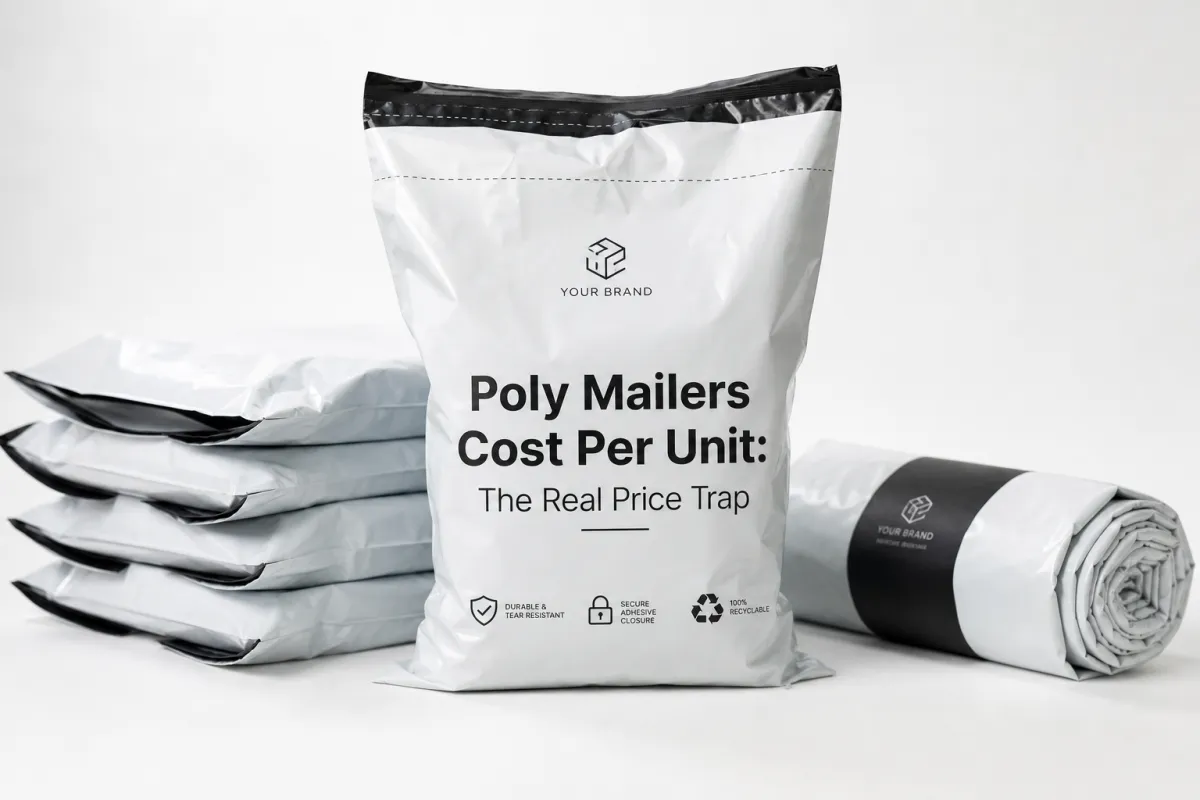
The lowest quote is not always the lowest shipment cost. Buyers still get burned by that every week because poly mailers cost per unit looks neat on paper while the bag’s real work only shows up after it has moved through sorting belts, carrier handling, and a few hard corners in the parcel network. If a mailer fails, the damage usually costs more than the savings ever did.
Picture a thin mailer saving a small amount per piece, then tearing on a shelf edge or at a weak seal. The seller pays twice: once for the broken bag and again for the replacement shipment. Add service labor, customer frustration, and the occasional refund, and poly mailers cost per unit on the cheap option becomes a false economy. That mistake shows up most often when buyers compare only unit price and never look at failure rate.
A better way to think about the number is to treat poly mailers cost per unit as a full landed cost question. Start with the bag price, then add freight, tooling fees, setup charges, and the expected cost of damage or returns. If the current mailer creates even a small percentage of replacements, the actual cost per piece is higher than the quote suggests. A sturdier bag with better puncture resistance, stronger adhesive, or the right thickness can lower total spend even if the invoice looks a little higher.
What most buyers get wrong: they assume mailers of the same size perform the same. They do not. A 10 x 13 inch bag in 2.5 mil film is a different piece of packaging from a 10 x 13 inch bag in 3.5 mil film, even before print coverage enters the picture. That is why poly mailers cost per unit should always be read beside the spec sheet, not alone.
Freight can twist the math too. A lightweight bag may look attractive until the customer needs a second shipment because the first one arrived damaged. Then the “savings” vanish. The right move is less flashy and more profitable: choose the bag that protects the product, fits the item cleanly, and keeps the shipping lane quiet. That is the version of poly mailers cost per unit that actually helps the business.
The lowest quote is not the lowest cost if it creates claims, reships, or bad customer reviews. Cheap packaging has a way of collecting interest.
Poly Mailer Product Details That Change Cost Per Unit
Several product details move poly mailers cost per unit faster than most buyers expect. Film type, thickness, size, closure style, print coverage, and any special finish do most of the work. Miss one of those and the quote changes. Miss two and the quote may no longer be useful.
Film type is usually the first cost fork. Standard polyethylene is the baseline because it is flexible, light, and easy to produce. Recycled-content film often costs a bit more, although the gap depends on resin availability and the percentage of post-consumer or post-industrial content. Co-extruded film, which uses multiple layers, can improve toughness and opacity, but it usually increases poly mailers cost per unit compared with a simple single-layer bag. Opaque black and metallic films also sit in higher price bands because they use more pigment or a more specialized structure.
Thickness matters just as much. Most buyers compare 2.5 mil, 3 mil, and 4 mil options. Lighter film reduces poly mailers cost per unit, but the bag may not hold up well for heavier apparel, boxed items, or products with sharp edges. Thicker film improves puncture resistance and gives a more premium hand feel. In practice, 3 mil is often the middle ground for general e-commerce use, while 4 mil makes sense for heavier or irregular items that need more abuse resistance.
Size changes more than surface area. It affects resin use, seal length, packing efficiency, and freight density. An oversized mailer wastes film. An undersized one creates stuffing problems and can stress the seam. A correct size is usually the best way to keep poly mailers cost per unit honest because it reduces material waste and improves packing speed. That part sounds simple, but it is where a lot of avoidable spending hides.
Closure style also shifts pricing. A single adhesive strip is the basic option. Dual adhesive strips, tear strips, tamper evidence, and return-friendly closures all add value, but they also add cost. If you are shipping apparel with a high return rate, a second adhesive strip may be worth the money. If you are shipping low-return accessories, you may not need the extra feature. That is how a buyer keeps poly mailers cost per unit aligned with real business use instead of paying for convenience that never gets used.
Print coverage can change the quote quickly. Plain bags are the cheapest. One-color print is usually the next step up. Full-coverage prints, metallic effects, and multi-color artwork raise production time and color cost. Plates, ink coverage, and registration complexity all add to poly mailers cost per unit. If branding matters, that extra spend can still pay for itself by reducing outer packaging and creating a cleaner first impression.
Here is a simple way to think about the price bands:
- Plain stock mailers: lowest cost, fastest to source, best for commodity shipping.
- Custom printed mailers: higher poly mailers cost per unit, but better for branding and unboxing.
- Specialty films: recycled, opaque, or metallic options usually cost more, especially at lower quantities.
- Feature-heavy bags: tear strips, dual seals, and tamper evidence raise unit cost but can reduce support costs.
For buyers comparing Custom Poly Mailers, the useful question is not “what is the lowest number?” A better question is “what spec gives me the lowest failure rate at the best landed cost?” That is the only version of poly mailers cost per unit that matters when product protection is part of the job.
If your packaging mix includes other components, it helps to compare the mailer quote against the rest of the kit as well. A lower-cost mailer may not beat a smarter overall packaging system. That is why many buyers cross-check options through Custom Packaging Products instead of treating the mailer line as a standalone decision. It keeps the math a little more honest, which is not a bad thing.
Specifications Buyers Should Lock Before Quoting
A quote is only as accurate as the specs behind it. If the spec is vague, poly mailers cost per unit is just a guess. That is where buyers waste time. A supplier cannot price a bag correctly if the size, thickness, print area, and seal style are still floating around in someone’s inbox.
Before you ask for pricing, lock these items:
- Width and length: exact finished dimensions, not “about” or “roughly.”
- Gusset, if any: side gusset or bottom gusset changes usable volume and film use.
- Thickness: 2.5 mil, 3 mil, 3.5 mil, or 4 mil are common decision points.
- Seal type: single adhesive, dual adhesive, tear strip, or tamper-evident closure.
- Print area: front only, front and back, or full coverage.
- Color and opacity: clear, white, black, metallic, recycled-content tint, or custom opaque film.
Why does this matter so much? Because vague sizing creates bad pricing. If a bag is too small, product gets forced in and the seam works harder than it should. If it is too large, you are paying for extra film and more freight per shipped unit. That is not smart poly mailers cost per unit; that is avoidable waste.
Thickness deserves a plain-English breakdown. Lighter film keeps poly mailers cost per unit down, but the bag may feel flimsy and puncture more easily. Thicker film costs more, but it often reduces loss in transit and gives a better customer impression. For apparel, lightweight soft goods, or non-fragile goods, a moderate spec may be enough. For boxed items, sharp accessories, or irregular shapes, it is usually worth spending a little more on film strength.
Printing specs deserve their own attention. Suppliers need to know how many colors, whether there is bleed, whether the artwork wraps, and whether you are using spot colors or process color. More colors usually mean more setup and more handling. That is why the same mailer can show very different poly mailers cost per unit depending on the artwork file and print method.
Packaging specs also affect production efficiency. Ask about carton count, carton dimensions, pallet pattern, and whether there are retail-ready packing requirements. A bag may be inexpensive to make but costly to pack if the carton configuration is awkward. In bulk orders, that changes the real poly mailers cost per unit more than many buyers expect.
For buyers who want a more formal performance check, carrier transit testing and distribution simulation matter. The ISTA standards are widely used for package testing, and they are useful when you want to know whether a mailer can survive real handling, not just a desk inspection. That is a practical filter, not a luxury. If the bag fails distribution testing, the unit price was never the real problem.
The same mindset applies to sustainability claims. If recycled content or material responsibility is part of the brief, the EPA’s plastics guidance is a useful reference point for understanding material management and recycling realities. No packaging label should be treated like magic. Buyers need proof, spec detail, and a clear supply chain statement if they want the claim to hold up.
One more thing: do not let “close enough” specs slip into the quote stage. A quote based on the wrong thickness or print area is not a real comparison. It is a trap dressed up as convenience. That is how buyers end up arguing with a supplier over poly mailers cost per unit after the order is already moving.
Poly Mailers Cost Per Unit: Pricing, MOQ, and Volume Breaks
MOQ is where the economics start to make sense. Higher volume usually lowers poly mailers cost per unit because setup, labor, and overhead are spread across more pieces. But higher MOQ only works if you can actually move the stock. Buying too many bags just to shave a few cents can create storage costs, cash flow pressure, and stale inventory. That is not savings. That is a spreadsheet illusion.
Here is the general buying pattern I would expect:
| Order Tier | Typical Use | Typical Poly Mailers Cost Per Unit | What Usually Changes |
|---|---|---|---|
| Sample or test run | Proofing size, seal, and print before committing | $0.45-$1.20+ | High handling, small quantity, setup spread over very few bags |
| Small production run | New brand launch or limited SKU test | $0.22-$0.55 | MOQ is still low, tooling fees and setup charges matter a lot |
| Mid-volume run | Steady e-commerce volume | $0.12-$0.32 | Better spread on production costs, more room for print efficiency |
| Bulk order | Repeat replenishment or multi-month usage | $0.06-$0.22 | Best chance to reduce unit cost if specs are stable |
Those ranges are not fantasy. They are the kind of numbers buyers use to frame negotiations, even though the final price still depends on size, film type, print coverage, and freight. If you want a plain bag in a standard size, poly mailers cost per unit can get very lean at volume. If you want custom print, recycled content, or feature upgrades, the range climbs fast. That is normal.
There are also hidden cost buckets that belong in the quote comparison. Too many buyers skip them, then wonder why the invoice lands higher than expected. Watch for:
- Tooling fees: usually for print plates, dies, or other production setup requirements.
- Setup charges: art prep, line setup, color alignment, and proof generation.
- Freight: especially important on lightweight products where shipping can distort the unit price.
- Import duties: depends on origin, classification, and destination country rules.
- Packing changes: carton count or pallet configuration can shift landed cost.
That last point matters. A quote can look inexpensive until the buyer notices the bags are packed in a way that creates more warehouse handling. A few extra minutes on the dock across thousands of units is real money. Good buyers compare poly mailers cost per unit on a landed basis, not just ex-factory pricing.
For printed bags, the price break usually improves as quantity rises because fixed costs get diluted. A one-color design may carry a modest setup cost, while a multi-color design may need additional plates or more complex press adjustments. If branding is important, the best route is usually to keep the artwork sharp but not overcomplicated. Simpler artwork often gives a better poly mailers cost per unit result without making the bag look cheap.
One practical buying rule: do not chase the lowest MOQ unless you actually need it. A lower minimum is attractive for testing, but the real win is the lowest landed cost that still matches your consumption rate. That is how experienced buyers manage poly mailers cost per unit without tying up cash in a room full of boxes they do not need yet.
From Quote to Dock: Process and Timeline
A clean process keeps poly mailers cost per unit from drifting after the quote. The fewer surprises in the approval stage, the fewer surprises in production. That sounds basic because it is basic. Most delays come from incomplete specs, bad art files, or last-minute changes that should have been caught before pricing was locked.
The workflow should look like this:
- Send the exact size, thickness, print colors, quantity, and delivery address.
- Confirm whether you need plain stock, custom printed, or a specialty film.
- Review artwork and approve a digital proof or physical sample.
- Lock production after all specs are confirmed.
- Allow packing, freight booking, and transit time to finish the job.
Simple stock orders usually move faster. Custom printed mailers take more time because the supplier has to handle setup, press work, proofing, and production scheduling. A plain order might move in roughly 7 to 10 business days after final approval, while a custom printed order often needs 12 to 18 business days or more depending on quantity and artwork complexity. Transit time is separate. Buyers who need a hard dock date should leave buffer room for shipping, customs if applicable, and last-mile delivery. Otherwise poly mailers cost per unit turns into the least of your problems because the bags are late.
Where do delays usually happen? The same place every time: missing measurements, fuzzy artwork files, and spec changes after pricing is already calculated. If your vendor quoted a 3 mil bag and then the team decides they want 4 mil after approval, the quote has to be reworked. If the print file is not supplied in a proper editable format, setup takes longer. If the size is vague, everyone wastes time reconciling the dimensions. That delay does not just slow the schedule. It can also move poly mailers cost per unit if the supplier has to redo calculations or change material usage.
Checklist for a smoother order:
- Use exact dimensions, not estimates.
- Send artwork in a clean vector format when possible.
- Confirm the print count and ink colors before proofing.
- Ask for the quote to separate bag cost, setup charges, and freight.
- Approve the sample quickly if the spec is correct.
That last item is underrated. A fast approval can hold your pricing steady. A slow one may push production into another scheduling window, which can affect lead time and sometimes the available material cost. That is one more reason to treat poly mailers cost per unit as a process issue, not just a price issue.
If the supplier cannot explain the production steps in plain language, the quote is probably not as clean as it looks.
Buyers should also think about transit standards if the product is fragile, heavy, or shipped through rough channels. A mailer that looks fine in a photo is not automatically fit for parcel abuse. That is why testing, sampling, and shipping simulation matter before bulk release. A few samples are cheap insurance compared with a pallet of bags that fail in real use and blow up poly mailers cost per unit through claims.
Why Choose Us for Poly Mailers
Good packaging suppliers are easy to describe. They give straight answers, stable specs, and repeatable quality. For poly mailers cost per unit, that matters more than fancy promises. A supplier who can hold thickness, print consistency, and seal performance across repeats is worth more than a cheaper quote that shifts every time you reorder.
At Custom Logo Things, the value is in keeping the process clear. Buyers should get transparent pricing, real spec review, and a quote that separates the main cost buckets instead of hiding them together. If a bag needs tooling fees or setup charges, say so. If the print coverage is what Drives the Price, show it. If a lighter spec would work just as well, that should be on the table too. That is how you keep poly mailers cost per unit honest.
Direct manufacturing also helps. Fewer middle layers usually means cleaner pricing, faster clarification, and less confusion when a spec needs to be adjusted. It also makes repeat orders easier. Once the size, print, and seal style are documented, the buyer does not have to rebuild the whole quote every time. That improves unit cost control and reduces ordering friction.
What should a buyer look for in a supplier? I would keep it simple:
- Consistent film quality so the bag feels and performs the same from order to order.
- Repeatable printing so logo placement and ink density do not wander.
- Reliable seals so the adhesive does its job in real shipping conditions.
- Clear communication so the quote matches the product shipped.
- Fast sample support so issues are found before bulk production.
If you are building a broader packaging program, it helps to think beyond one SKU. Some buyers need mailers, cartons, labels, and inserts to work together. In that case, browsing Custom Packaging Products can make it easier to compare the packaging stack as a whole instead of treating mailers as a standalone line item. That is often the smarter way to manage poly mailers cost per unit because it keeps the brand and the shipping process aligned.
One honest note: not every order needs premium features. If the product is light and the shipping lane is gentle, plain stock may be enough. If the product is heavy or the brand presentation matters, printed mailers may earn their keep. A good supplier should help you Choose the Right spec, not the most expensive one. That is how you protect margin and keep poly mailers cost per unit in a range that actually makes sense.
For buyers who want to compare options visually, start with our Custom Poly Mailers page and match the product type to the shipping need. That saves time, lowers guesswork, and makes the quote stage much cleaner. It is a small step, but it is usually where the better poly mailers cost per unit decisions start.
What to Send Before You Order Poly Mailers
If you want an accurate quote fast, send a complete spec pack. Half-baked requests lead to half-accurate pricing, and that is how poly mailers cost per unit gets distorted before the first sample is even made. A clear request saves time for everyone and usually gives you a better number the first time around.
Here is the order checklist I would use:
- Size: finished width and length, plus gusset if applicable.
- Thickness: target mil or micron equivalent.
- Print: number of colors, front/back coverage, and artwork file.
- Quantity: target MOQ and any repeat order forecast.
- Shipping destination: full address or at least country and postal code.
- Delivery date: the date the bags need to arrive, not the date you want the quote.
- Priority: lowest unit cost, fastest lead time, premium look, or stronger puncture resistance.
That last point matters more than people think. If you do not say what matters most, the supplier will guess. And the guess may be wrong for your business. A buyer focused on shelf presentation might accept a higher poly mailers cost per unit for better print quality. A buyer shipping commodity product might want the lowest landed cost with no extras. Both are valid. The spec needs to reflect the goal.
I also recommend asking for two or three quote options, not just one. Compare plain stock against printed, compare 2.5 mil against 3 mil, compare lower MOQ against bulk pricing. That gives you a real performance-versus-cost view. It also makes it obvious which feature is pushing poly mailers cost per unit up and whether that feature is actually worth it.
If the order is sensitive to budget, ask the supplier to show the line items separately: bag cost, tooling fees, setup charges, freight, and any extra packing requirement. That way the quote is not hiding the real driver. Buyers who do this tend to make better decisions, and their poly mailers cost per unit comparisons are cleaner because they are comparing the same spec across vendors.
Final rule: send one complete spec to every supplier, ask for landed cost, and keep the requirements identical across quotes. If the spec changes between vendors, the comparison is meaningless. Plain and simple. That is the only way to judge poly mailers cost per unit without fooling yourself.
FAQ
What affects poly mailers cost per unit the most?
Size, thickness, print coverage, and order volume usually move poly mailers cost per unit the most. Custom printing, special finishes, and extra features like dual adhesive strips add cost, and freight or setup charges can matter just as much as the bag price on small orders. In practice, the cheapest-looking quote is often missing one of those pieces.
How low can poly mailers cost per unit go on bulk orders?
The lowest poly mailers cost per unit depends on size, film type, and whether the bag is plain or printed. Plain stock mailers in large volume are usually the cheapest option. Custom printed or specialty film bags cost more, but the right unit price only matters if the bag still protects the product in transit. Cheap and broken is still expensive, which is kind of the whole trap.
Does higher MOQ always mean better poly mailers cost per unit?
Usually yes, because setup and production overhead are spread across more bags, which lowers poly mailers cost per unit. But not always. Overbuying creates storage costs and cash tied up in inventory. The right MOQ is the lowest volume that still gives you a workable landed cost and a realistic usage plan.
Are printed poly mailers much more expensive per unit?
Yes, printed bags usually cost more than plain bags because of setup, artwork, and production steps, so poly mailers cost per unit rises. The gap narrows as quantity increases. If branding matters, printed mailers often justify the added cost through better presentation and fewer outer boxes. That is real value, not just decoration.
What should I send to get an accurate quote fast?
Send the size, thickness, quantity, print colors, artwork file, and delivery address. Include whether you need plain stock, custom printed, or a specific film type. The faster the spec is complete, the faster the quote will be accurate, and the less likely poly mailers cost per unit will change after the first estimate.
If you want the shortest possible answer, here it is: compare poly mailers cost per unit as landed cost, not as a sticker price, lock the specs before quoting, and choose the bag that protects the product without paying for features you do not need. Start with a tight spec sheet, ask suppliers to separate bag price from freight and setup, and then pick the option that balances failure rate, lead time, and budget. That is how buyers keep poly mailers cost per unit under control and still get a mailer that does the job.

