Buyer Fit Snapshot
| Best fit | Shipping Insert Cards with Logo projects where brand print, material claims, artwork control, MOQ, and repeat-order consistency need to be specified before quoting. |
|---|---|
| Quote inputs | Share finished size, material target, print colors, finish, packing count, annual reorder estimate, ship-to region, and any compliance wording. |
| Proofing check | Approve dieline scale, logo placement, barcode or warning zones, color tolerance, closure strength, and carton packing before bulk production. |
| Main risk | Vague material claims, crowded artwork, missing packing details, or unclear freight terms can make a low unit price expensive after revisions. |
Fast answer: Shipping Insert Cards with Logo: Design, Cost, and Turnaround should be specified like a repeatable production item. The safest quote records material, print method, finish, artwork proof, packing count, and reorder notes in one written spec.
Production checks before approval
Compare the actual filled-product size with the drawing, then confirm tolerance on folds, seals, hang holes, label areas, and retail display edges. Reserve space for logos, QR codes, warning copy, and material claims before decorative graphics fill the panel.
Quote comparison points
Review material grade, print process, finish, sampling route, tooling charges, carton quantity, and freight assumptions side by side. A quote is only useful when the supplier can repeat the same color, closure quality, and packing count on the next order.
Shipping Insert Cards with Logo: Design, Cost, and Turnaround
Shipping insert cards with logo do a lot more than fill a small gap inside a box. A plain carton says the order arrived; a branded insert adds structure, warmth, and a sense that someone actually thought through the shipment from first touch to final reveal. That little sheet of paper or board is often the first branded piece a buyer handles, which makes it one of the simplest ways to shape the opening moment, reinforce trust, and give the package a more finished feel.
For packaging buyers, the appeal is practical as much as visual. Shipping insert cards with logo can explain care steps, point the customer toward a reorder page, offer a referral code, or answer the one question that might otherwise become a support email. They are easy to print, easy to store flat, and easy to slot into a packout process across ecommerce orders, subscription shipments, replacement parts, and wholesale sample kits. Used well, they make the shipment feel more deliberate without adding much friction to fulfillment.
I've seen teams make the mistake of treating the insert like an afterthought, and that usually shows up fast in the box. A good card should earn its place. If it needs a long speech to justify itself, the design is probably solving the wrong problem.
For Custom Logo Things, shipping insert cards with logo work best when they are treated as part of the shipping system rather than as a separate marketing add-on. The card has to fit the box, fit the workflow, and fit the message. That sounds simple, but this is where projects either move cleanly or get weird and slow. The sections below cover how these cards function, what drives pricing, how turnaround usually moves, and what to check before placing an order.
Shipping insert cards with logo: why a tiny card changes the whole box
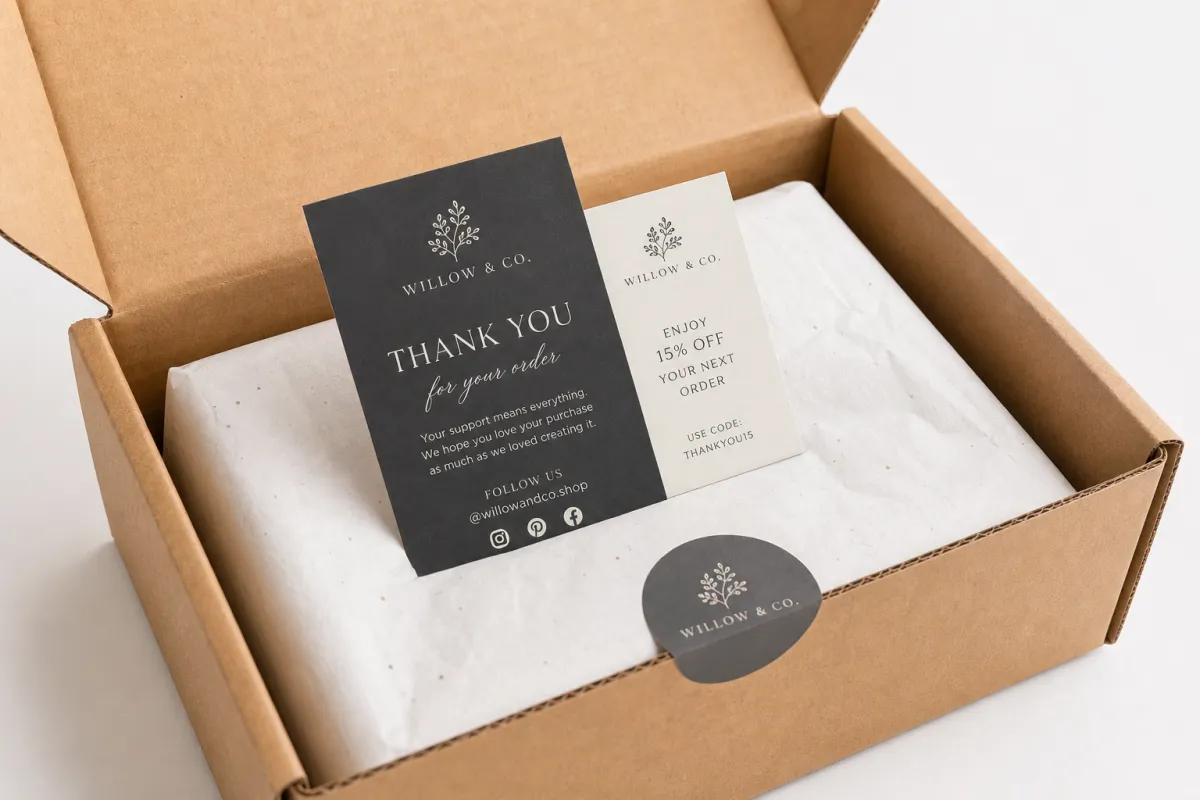
There is a noticeable difference between a shipment that feels assembled and one that feels branded. Shipping insert cards with logo help close that gap. In a plain kraft box, the customer may see a product, a packing slip, and some protective fill. Add a well-made insert, and the first touchpoint starts carrying the brand story before the product is even out of the carton. That matters because packaging is not only about containment; it also shapes the order in which the customer discovers information.
Shipping insert cards with logo are not just decoration. They are printed cards, folded pieces, or tags placed inside a shipment to communicate something specific. A card might say thank you, outline care instructions, include a QR code for activation, remind the customer to register a warranty, or point toward a reorder page. In many operations, the card becomes the place where brand voice can live without crowding the exterior packaging. It is compact, but it can carry useful information with very little effort from the customer.
That flexibility is part of the reason teams use them for ecommerce shipping and direct-to-consumer launches. A customer opening a subscription shipment may need a different message than someone receiving a one-time replacement part. Shipping insert cards with logo can shift by order type, season, or customer segment without changing the carton, mailer, or outer label. In practice, that keeps the packaging system stable while giving the message room to change.
The strongest cards also reduce confusion. A short note that says what the item is, how to use it, and where to go next can lower support volume. For a brand with repeat orders, shipping insert cards with logo can keep the reorder path easy to remember. For a new product, they can provide setup guidance so the buyer is less likely to set the item aside unfinished. For a wholesale sample, they can explain what is included, how to compare options, and who to contact for pricing.
From an operations standpoint, that is what makes shipping insert cards with logo so practical. They are low-complexity branding tools. They do not require a new carton style, and they usually do not change the dimensional weight of the shipment. They can be printed in moderate quantities, packed flat, and staged with the rest of the shipping materials. If you are building a broader packaging system, they also pair naturally with Custom Packaging Products, Custom Shipping Boxes, and Custom Poly Mailers.
One common mistake is asking the card to do too much. Shipping insert cards with logo work best when the job stays focused. One card can thank the customer, point to a care page, and reinforce the logo. It should not try to be a brochure, a return policy, a product manual, and a coupon sheet all at once. When the message is clear, the card feels useful. When it is crowded, it feels like clutter.
How shipping insert cards with logo work in the unboxing flow
Shipping insert cards with logo only earn their keep if they fit the unboxing flow. That means looking beyond the artwork on screen and thinking through the route from file prep to finished packout. The card has to be printed, cut, counted, stored, and inserted in a way that works for the warehouse team or 3PL handling the order. A beautiful card that slows the line is not a smart packaging choice.
Placement inside the box changes what the customer notices first. Some teams place the card on top of tissue so it is visible right away. Others tuck it beside the product so it feels like part of the reveal. A packing slip may sit underneath if the shipment needs order details kept separate from the brand message. Shipping insert cards with logo perform best when the placement matches the story. A welcome card should be seen quickly. A setup card should be easy to pull out and keep nearby.
These cards can handle a handful of practical jobs. They can welcome a first-time buyer, give short care instructions, point to a reorder page, or explain how to assemble, activate, or return the item. In shipping and logistics, those small details matter because customers judge the experience from the first few seconds. A well-placed insert can answer a question before the customer searches the website or opens a support ticket. That is not flashy work, but it saves time.
Shipping insert cards with logo can also shift by order type. A repeat customer may respond well to a loyalty message or referral prompt. A first order may need reassurance: how to use the product, what to expect, and where to get help. A wholesale sample kit may need product specs and a contact line for order fulfillment questions. The card is not there to impress by itself; it is there to make the shipment easier to understand.
In a well-run warehouse, the strongest insert is the one that disappears into the process. It should be easy to count in batches of 25, 50, or 100. It should stack flat without curling. It should fit the chosen carton or mailer without folding or trimming. That matters in high-volume ecommerce shipping, where a small issue repeats hundreds or thousands of times a week. Cleaner insert workflow means fewer delays, fewer rework moments, and less of that annoying "wait, which version goes here?" conversation.
Packaging people often talk about package protection as if it only means cushioning the product. That leaves out an important part of the picture. Protection also includes clarity. If the card explains fragile handling, activation steps, or a return path, it can prevent misuse and reduce avoidable damage claims. Shipping insert cards with logo are one of the few shipping materials that can protect both the product and the customer relationship at the same time.
For brands that care about transport performance, it helps to keep the broader system in view. If the shipment also needs protective testing, transport packaging checks from ISTA can help validate the packout, especially when the card is part of a kit with inserts, void fill, or fragile components. The insert itself is simple; the full system still deserves discipline.
Cost and pricing for shipping insert cards with logo
Pricing for shipping insert cards with logo becomes easier to read once you break it into parts. The main cost drivers are finished size, stock choice, print sides, number of colors, coatings, folding, die cutting, variable data, and any specialty finish that changes the feel of the piece. A simple one-color card on a standard stock is not the same as a folded card with soft-touch lamination, a QR code, and a custom shape. The latter costs more because it asks more from the press and the finishing line.
In real buying scenarios, unit cost drops as quantity rises. That pattern is normal. Higher quantity only makes sense if the message will stay current long enough to justify the inventory. If your insert supports a seasonal campaign or a short-term promotion, a smaller run is often the better move than printing six months of cards and hoping the offer still applies. Shipping insert cards with logo should support the message, not trap the brand in old copy.
Minimum order quantities vary by supplier and setup, but short runs can make sense for launches, testing, and limited-time offers. Larger runs usually fit evergreen messages such as thank-you notes, care instructions, or a branded QR code that leads to a stable landing page. The decision is not only about savings. It also comes down to how often the artwork will change and how much warehouse space you want to give to shipping materials that may age out quickly.
Here is a practical way to think about the cost structure. A buyer may pay a little more for a heavy board stock and get a more premium hand feel plus better scuff resistance. A buyer may choose a plain uncoated card for a softer, more natural look and save a few cents per unit. That tradeoff is normal. Shipping insert cards with logo sit at the point where brand image meets order fulfillment, so the right choice depends on how the package feels in the hand and how it functions in the box.
| Option | Typical use | Indicative unit cost | Notes |
|---|---|---|---|
| Simple uncoated card | Thank-you note, basic brand message | $0.12-$0.24 at 5,000 pcs | Good for a natural feel and clean writing space |
| Coated printed card | QR code, product care, promo message | $0.18-$0.32 at 5,000 pcs | Sharper color and better image reproduction |
| Folded insert | Multi-step instructions or richer brand story | $0.28-$0.60 at 5,000 pcs | More content space, more finishing steps |
| Custom shape or specialty finish | Premium campaigns, retail kits, seasonal drops | $0.35-$0.85 at 5,000 pcs | Die cutting or lamination adds setup and handling cost |
Those figures are broad ranges, not promises. Exact pricing depends on artwork coverage, production method, and shipping destination. Even so, they show where the money goes. An item that seems expensive at first may make sense once you account for folding, trimming, insertion labor, and the cost of unclear messaging. A lower headline price is not always the better deal if it creates confusion in transit packaging or requires extra handling at the warehouse.
Labor is another detail that gets missed. If a fulfillment partner inserts the card by hand, that step takes time. If the card is bundled in counts for a packout line, there is staging time, inventory control, and occasional rework if the wrong version gets pulled. Those costs do not always appear on the print quote, but they are part of the real total.
That is why itemized quotes matter. Ask what is included. Is proofing covered? Are revisions included? Is cutting or folding included? Are cartons or master packs included? Is the price quoted delivered, or do you need to add freight? With shipping insert cards with logo, the most honest quote is the one that lets you compare the same specs side by side instead of comparing a stripped-down estimate with a finished product.
Process and turnaround for shipping insert cards with logo
The production path for shipping insert cards with logo is straightforward, but every step affects the schedule. It usually starts with artwork prep. The file should be built at the correct size, with bleed, safe area, and the final logo treatment in place. Then comes prepress review, where the printer checks image quality, fonts, QR codes, and any legal or regulatory text. After that, a proof is approved, the job goes to print, and finishing begins.
Turnaround often depends less on the press and more on approval speed. A shipment can sit idle for days because one logo placement needs a revision, a QR code points to the wrong landing page, or a promotional line still needs marketing approval. Shipping insert cards with logo move quickly once the file is locked, but they can stall just as fast if the team is still debating copy. The cleanest timeline is the one where decisions happen before production starts.
The main timeline variables are easy to predict after a few runs. Stock availability matters. Standard paperboard moves faster than a specialty sheet. Finishing complexity matters. Matte coating is simpler than soft-touch lamination or foil. Order quantity matters. A small run may print quickly, but a large run can add time to drying, cutting, packing, and freight. Custom shapes add tooling and often extend the schedule. Simple rectangles are usually the fastest route.
Rush production can help when a launch slips or a replenishment order drops lower than expected. Even so, it is rarely the best fit for every project. Rush jobs may limit material choices, and sometimes the finish options narrow as well. If color consistency matters, a more relaxed schedule often gives a better result. Shipping insert cards with logo are not usually a bottleneck if the plan is made early. The bottleneck is often the approval chain, not the printing itself.
A practical sequence saves time: confirm the message first, lock dimensions second, approve the proof third, and only then coordinate delivery or insertion with the fulfillment team. That order keeps the warehouse from receiving cartons of the wrong version, which is a headache nobody wants. If your insert will be hand-packed, let the team know the counts, carton weight, and storage plan before the shipment arrives. If it will be inserted by a 3PL, send the approved art file and count instructions together.
For brands that also depend on protective outer packaging, the same timing logic applies to the rest of the shipping materials in the kit. A carton, mailer, insert, and label should all be approved within the same window so the packout moves as one system. If you are coordinating a launch, it helps to line up Custom Packaging Products alongside the insert project so no one is waiting on a missing component while orders are already moving.
From an industry standards point of view, shipping insert cards with logo may be simple, but the surrounding package still deserves a documented process. The strongest fulfillment teams keep a clean spec sheet, a proof approval trail, and a version control log. That habit is not glamorous, but it saves mistakes later. In packaging, the fastest order is usually the one that was prepared carefully before it entered the schedule.
Materials, size, and design factors that affect performance
Material choice sets the tone immediately. A simple uncoated stock feels softer and more natural in the hand, which works well for brands that want an understated presentation. A coated stock gives sharper color and stronger image reproduction, which helps when the insert carries photography, a QR code, or fine logo detail. Heavier board adds stiffness and a more premium feel. Shipping insert cards with logo often use stocks in the 14pt to 16pt range, though lighter or heavier options can make sense depending on the packout and the desired feel.
Size matters for more than appearance. The card needs to be readable fast, fit in the box or mailer without folding, and move through the line without slowing anyone down. A 3.5 x 5 inch card may be enough for a short thank-you note and QR code. A larger 4 x 6 or postcard-style piece may be better when the card needs care steps or a return explanation. If the box is small, oversized shipping insert cards with logo can create clutter. If the card is too small, the message feels squeezed and easy to miss.
The design basics are simple, yet they carry real weight. Logo placement should be obvious without taking over the whole card. Contrast needs to stay strong enough to read under warehouse lighting, apartment lighting, or the less forgiving light of a kitchen counter. Font size should remain practical; elegant tiny type looks fine on a screen and fails in the box. White space is not wasted space. It gives the customer room to breathe and makes the message feel intentional. One clear call to action usually beats three competing ones.
QR codes deserve special attention. They should be large enough to scan quickly, surrounded by quiet space, and linked to a page that works well on mobile. If a customer has to zoom in or hunt for the right link, the insert loses value fast. Shipping insert cards with logo are strongest when the print piece and the digital landing page match cleanly. A well-built card is a bridge, not a dead end.
Finishes shape both the look and the handling performance. Matte gives a calmer, more refined appearance and reduces glare. Gloss can make color pop, but it also reflects light and shows fingerprints more easily. Soft-touch feels more premium in the hand, though it is not always the best choice if the card will rub against other items in transit packaging. Aqueous coating is often a practical middle ground because it improves scuff resistance without making the card feel overly coated. Each finish changes how shipping insert cards with logo hold up in the box.
If the message needs to feel especially upscale, an FSC-certified substrate may be a sensible choice, provided the supplier can document chain of custody. The FSC system is a useful reference point for teams that want to align the insert with broader sustainability goals. That does not answer every packaging question, but it is a sensible place to start if recycled content or responsible sourcing is part of the brief.
There is also a design hierarchy worth following. The logo should be seen first. The main message should be understood second. The call to action should be obvious third. If a card tries to explain everything at once, the customer may read none of it. Shipping insert cards with logo perform better when the message can be grasped in a few seconds, because the unboxing moment is short and attention is split.
For brands comparing different packaging materials, the insert should be treated like part of the whole system rather than a separate marketing piece. The card needs to work with the box, the mailer, the product, and the fill material. That is why a shipping insert can look perfect in isolation and still fail in the box if it clashes with the rest of the unboxing flow. Practical design always beats decorative design that ignores the packout.
Common mistakes when ordering shipping insert cards with logo
The most common mistake is overloading the card. Shipping insert cards with logo can carry a surprising amount of information, but that does not mean they should. One insert that tries to thank the buyer, promote three offers, explain a policy, and push five social channels ends up feeling noisy. If the message is crowded, customers skim it or toss it immediately. A better approach is to choose one job and make that job obvious.
Low contrast is another frequent problem. A logo that looks crisp on a monitor can disappear in a real box if the paper tone, ink color, and lighting are working against it. Thin type is especially risky. It may look elegant in the proof stage and then blur at press size or become hard to read in the hand. Shipping insert cards with logo should be designed for the warehouse, the delivery route, and the customer's actual environment, not just the mockup.
Fit issues create trouble too. If the card does not match the packout method, workers may need to fold it, trim it, or skip it. That breaks consistency. A card that is too large can snag on other contents. One that is too small may slide under void fill or get lost in the box. The best shipping insert cards with logo are sized with the real carton, real mailer, and real packout sequence in mind. That saves time and protects the look of the shipment.
Vague goals lead to weak results. A team may ask for a branded insert because everyone wants one, but no one agrees on what it should achieve. That usually produces a generic piece that looks fine and performs poorly. A stronger brief is simple: reduce customer service questions, drive repeat purchases, or explain how to use the product. Once the objective is clear, the design choices become easier. Shipping insert cards with logo do not need to satisfy every department to be effective.
Proofing mistakes are expensive in a different way. Typos, outdated URLs, expired offers, and incorrect QR destinations can make the insert useless. The same goes for missing scannability checks. If the code works on one phone in one room but fails in a real box under real lighting, the card is not finished. A final proof should verify the text, the links, the spacing, the color breaks, and the cut lines. That extra review is far cheaper than reprinting a bad run.
There is also a warehouse risk that gets overlooked. If multiple versions of shipping insert cards with logo are stored together, version control has to be clear. The wrong card in the wrong carton can confuse the customer and create a mismatch between the shipment and the campaign. That kind of mistake is easy to avoid with labeled cartons, date codes, and a simple approval log. Small process discipline goes a long way in order fulfillment.
Finally, do not ignore dimensional weight and packout bulk. An insert may be flat, but if the card is oversized, folded, or bundled with extra materials, it can affect storage and handling. It rarely changes parcel charges by itself, but it can change the way the whole kit is packed. In transit packaging, a little added thickness can create surprising friction. That is why shipping insert cards with logo should be chosen with the full shipment in mind, not as an isolated print item.
Expert tips and next steps for shipping insert cards with logo
Start with one clear objective. If the job is to say thank you, keep it warm and direct. If the job is to reduce service questions, include the exact next step and the support path. If the job is to drive a repeat purchase, keep the offer simple and the deadline honest. Shipping insert cards with logo tend to perform best when the message is focused enough to read in a few seconds and specific enough to be useful later.
Build a short spec sheet before asking for quotes. Include the dimensions, stock, print sides, finish, insertion method, quantity, and final copy. If there is a QR code, include the destination URL and ask for a scannability check. If the card will be paired with a carton or mailer, note that too. A clean brief makes it easier to compare prices fairly, and it helps keep shipping insert cards with logo aligned with the rest of the package system.
A small test batch is often the smartest first move. Print one version, pack it into a modest shipment run, and review it in the real box. Check readability, insertion speed, customer feedback, and whether the card feels appropriate for the product. A card that looks strong in a sample pack can still fail once it meets the pace of an actual warehouse. Testing lets you catch that early.
Coordination with fulfillment matters more than most teams expect. The best insert in the world will not help if the warehouse does not know where to store it, how to count it, or which version belongs in which order. If the packout is managed by an outside partner, send the spec sheet and approval file together. If the card will be used across multiple SKUs, label the versions clearly. Shipping insert cards with logo are simple pieces, but the handling process still needs to be deliberate.
For brands building a broader packaging line, I usually recommend reviewing the insert alongside the outer shipper and any mailer choice. That is where the practical savings and the presentation gains really show up. A good insert in a weak box feels unfinished. A good insert in a well-matched carton feels intentional. If the shipment uses lighter secondary packaging, it can also help to review whether a branded outer layer is worthwhile alongside the insert and the protective fill.
One more point on sourcing: if sustainability claims matter, ask for documentation instead of assuming. Certified board, recycled content, and chain-of-custody records are all manageable, but only if you ask early. The same is true for performance questions. If the insert needs to support a product with fragile handling requirements, make sure the wider system is tested and documented. Shipping insert cards with logo are one piece of the picture, not the whole picture.
The cleanest buying sequence is simple: compare one sample, one quote, and one packout plan. Then choose the version of shipping insert cards with logo that fits your box, your budget, and your timeline. Do that, and you are much more likely to end up with a card that looks good, runs cleanly in fulfillment, and gives the customer a reason to remember the brand. Keep the message tight, keep the workflow honest, and the insert will do its job without turning into extra noise.
Frequently Asked Questions
What size should shipping insert cards with logo be?
The best size is the one that fits your box and your packout method without folding or trimming. A smaller card works well for a short thank-you note, while a larger format helps when you need setup instructions, QR codes, or care details. Shipping insert cards with logo should be sized around the actual shipment, not just the design comp.
Are shipping insert cards with logo better than packing slips for branding?
Packing slips are usually transactional, while insert cards are the better place for brand messaging, instructions, or promotions. Many teams use both: the packing slip handles order details and the insert card handles the customer experience. Shipping insert cards with logo are especially useful when you want the brand message to feel separate from the invoice-style paperwork.
How much do shipping insert cards with logo usually cost?
Pricing depends on size, stock, quantity, print sides, finishing, and whether the card needs cutting or folding. The unit price usually drops as quantity rises, so ask for itemized quotes to compare true like-for-like options. For many projects, shipping insert cards with logo land somewhere from a few cents to well under a dollar per unit, depending on the specs.
What should I print on shipping insert cards with logo?
Keep the message focused: logo, one main benefit, one clear next step, and any required instructions or QR code. Avoid crowding the card with too many offers or policies, because simpler cards are easier to read and easier to pack. Shipping insert cards with logo work best when the customer understands the point almost immediately.
How long does it take to produce shipping insert cards with logo?
Turnaround depends on proof approval speed, material availability, finishing complexity, and order quantity. If you need a rush order, expect fewer material and finish choices, so it helps to lock the artwork early. Once the file is approved, shipping insert cards with logo usually move faster than people expect, provided the production slot is clear and the warehouse plan is already set.


