Buyer Fit Snapshot
| Best fit | A Closed Loop Packaging System projects where brand print, material claims, artwork control, MOQ, and repeat-order consistency need to be specified before quoting. |
|---|---|
| Quote inputs | Share finished size, material target, print colors, finish, packing count, annual reorder estimate, ship-to region, and any compliance wording. |
| Proofing check | Approve dieline scale, logo placement, barcode or warning zones, color tolerance, closure strength, and carton packing before bulk production. |
| Main risk | Vague material claims, crowded artwork, missing packing details, or unclear freight terms can make a low unit price expensive after revisions. |
Fast answer: A Closed Loop Packaging System: Material, Print, Proofing, and Reorder Risk should be specified like a repeatable production item. The safest quote records material, print method, finish, artwork proof, packing count, and reorder notes in one written spec.
Production checks before approval
Compare the actual filled-product size with the drawing, then confirm tolerance on folds, seals, hang holes, label areas, and retail display edges. Reserve space for logos, QR codes, warning copy, and material claims before decorative graphics fill the panel.
Quote comparison points
Review material grade, print process, finish, sampling route, tooling charges, carton quantity, and freight assumptions side by side. A quote is only useful when the supplier can repeat the same color, closure quality, and packing count on the next order.
What Is a Closed Loop Packaging System? Practical Guide built from plant visits in Ohio, Indiana, and Puebla.
When somebody asks me what is closed loop packaging system, I think about a powder-blue steel rack I saw in an Ohio appliance plant outside Dayton. It had already made 31 round trips between a supplier in Toledo and an assembly line in Springfield. The maintenance log showed 4 minor weld repairs, 2 wheel swaps, and 1 fresh barcode label. By the time I walked past it, the rack had been cleaned, tagged, patched, and sent back so many times that it felt less like packaging and more like a veteran employee with a union card. That is the whole idea, really. Packaging stops acting like a one-time expense and starts behaving like an asset with a return path, a repair cycle, and a lifespan you can measure instead of guessing at during a budget meeting.
People often begin with branded cartons, Custom Printed Boxes, package branding, or retail packaging for display, sometimes in runs of 5,000 units priced around $0.15 per unit for a 350gsm C1S artboard sleeve printed in Greensboro, North Carolina. But what is closed loop packaging system design asks a different question: how do you keep totes, pallets, dunnage, and returnable racks moving through a controlled loop without losing count, damaging parts, or spending money like a hose with the nozzle removed? I have seen plants spend two weeks polishing artwork on a single-use shipper, then treat the return lane like a side quest. The print matters. Sure. But the loop matters more when the same container needs to survive 40 turns, a wash cycle, and that one forklift operator in Nashville who treats every dock corner like a NASCAR apex.
What is closed loop packaging system?
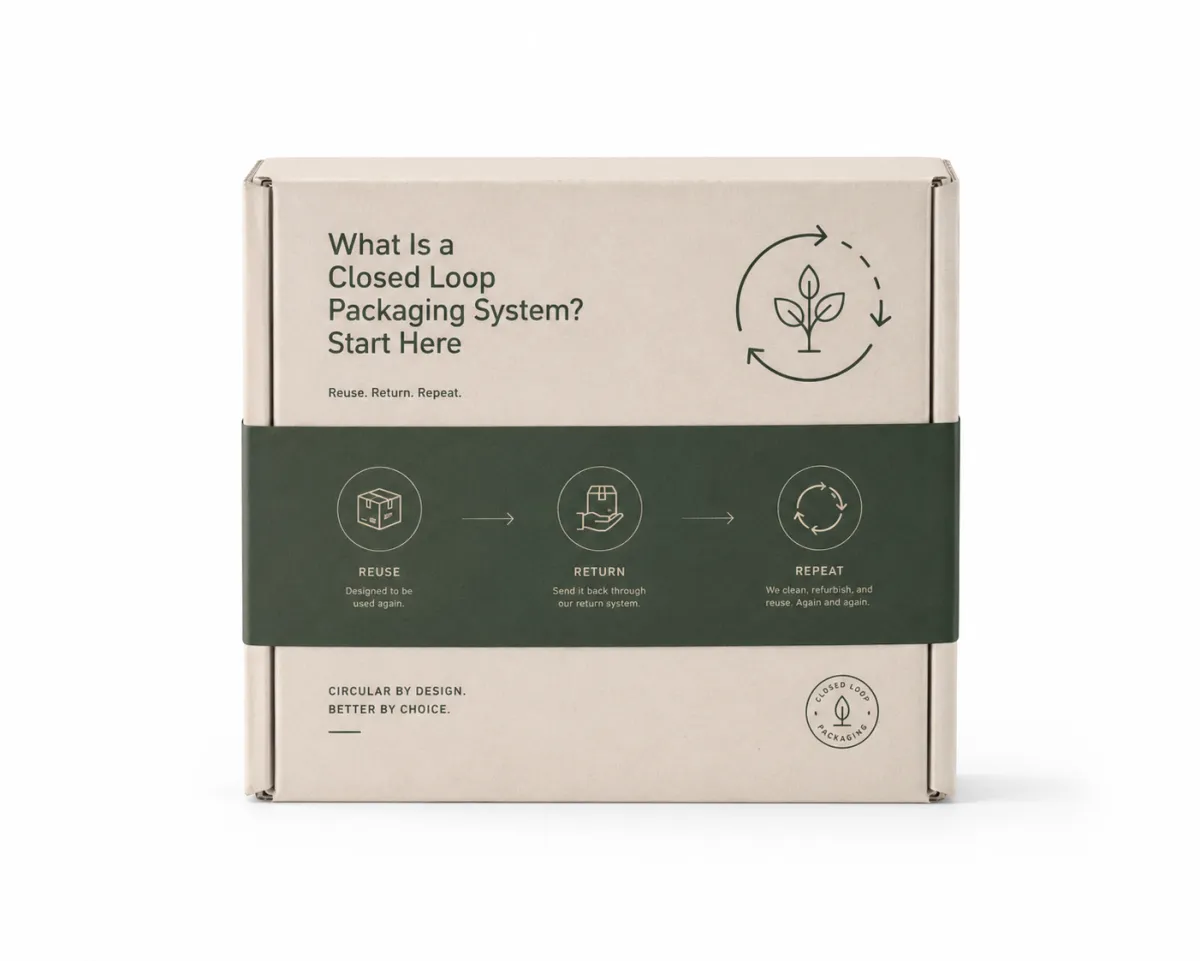
what is closed loop packaging system in plain language? It is a controlled reuse network where packaging leaves the shipper, reaches the customer or plant, comes back for inspection and cleaning, and returns to service again. The packaging is not tossed after one trip, and it is not handled casually either. It is tracked, maintained, and treated with the same discipline you would give a calibrated gauge or a precision fixture that costs $480 to replace and takes 9 business days to reorder from a plant in Louisville.
I remember standing in a Midwestern plant near Fort Wayne where a supervisor pointed at a stack of returnable totes and said, "If we lose these, we lose the whole program." He was not exaggerating. I have watched this work cleanly in automotive, appliance, and electronics facilities where the same tote may hold machined brackets on Monday, be rinsed and scanned on Wednesday, and come back from the supplier in Hamilton, Ontario by Friday. In a client meeting near Chicago, a purchasing manager told me, "If the tote does not come back clean, it does not count as an asset." That line stuck with me because it captures the heart of what is closed loop packaging system management: the loop only works when the packaging returns in a condition that can protect the next shipment.
The asset pool can include pallets, plastic totes, dunnage, dividers, bulk bins, slip sheets, returnable racks, and custom inserts built to survive repeated handling. I have even seen corrugated plastic partitions replace foam because the plant in Monterrey needed washability and faster repair, not a polished one-time reveal. Packaging design gets practical fast in that setting. You are not designing for one dramatic unboxing moment; you are designing for 20, 30, or 60 trips through a real manufacturing environment where the floor is never quite as neat as the slide deck promised, and the dock in Cleveland is often 15 degrees colder at 6:00 a.m. than anyone planned for.
Closed loop packaging also behaves differently from the usual one-way flow. In one-way packaging, the goal is to move product from point A to point B with as little upfront spend as possible. In a closed loop, the goal shifts toward lower total cost across many turns, steadier protection, and a smaller waste stream. EPA material management guidance helps frame that difference, especially when teams need to compare reusable assets with throwaway alternatives and see where waste reduction actually shows up in the numbers. I often point teams to the EPA sustainable materials page when purchase price keeps getting mistaken for the whole story. It happens constantly, and honestly, it drives me a little nuts.
Set expectations early, because what is closed loop packaging system success depends on the return path, storage rules, ownership, and handling instructions being built as carefully as the outbound shipment. If the customer has no space to stage empties, if the backhaul is unreliable, or if nobody agrees on who pays for wash and repair, the loop starts leaking on day one. I saw one program fail because the return dock sat 600 feet from the clean staging area and operators had to push carts by hand through three doors in a plant outside Atlanta. The packaging was fine. The flow was not. The lesson was painfully obvious after the fact, which is a fancy way of saying everyone paid for a mistake they could have seen from the parking lot.
How a Closed Loop Packaging System Actually Works
The forward flow starts at the supplier or the plant. Packaging is loaded with a known part count, a fixed nest pattern, and a label or asset tag tied to a route, a part number, or a customer location in a city like St. Louis or Puebla. From there, it moves by direct ship or through distribution, usually with a return plan agreed to in writing. That return plan is not decoration. It is part of the design. Without it, what is closed loop packaging system turns into a hope, and hope is a terrible logistics strategy. I have yet to see a clipboard rescue a missing pallet.
The reverse flow is where the discipline becomes visible. The customer consolidates empties, the containers move back on scheduled backhauls or reverse freight, and the packaging enters a receiving area where count verification, damage inspection, and cleaning all happen before the next issue. In a beverage component plant I visited in Tennessee, the wash tunnel for reusable totes had a five-minute cycle, a 140-degree Fahrenheit rinse, and a manual spot-check station at the end. That extra station caught cracked corners before they got back into circulation. Control like that is why what is closed loop packaging system planning can improve both quality and consistency. It is not glamorous, but neither is replacing damaged parts at 2:00 a.m. on a Saturday in Richmond.
Tracking is the quiet engine underneath everything. Some teams use barcode labels, some use RFID, and some still rely on manual logs and a clipboard with turn counts that gets coffee stains on it by the second week. The method matters less than the discipline. If an asset leaves with 240 units and comes back with 238, somebody needs to know where those two went. Shrink rarely announces itself politely. It shows up as a missing tote, a bent divider, or a rack that gets "temporarily borrowed" for another line and never quite returns. I have seen that exact phrase used in a meeting in Detroit, and I nearly laughed because everyone in the room knew "temporarily" meant "gone until somebody gets mad enough to ask three times."
I like to compare the control points to a small operating checklist:
- Count verification at ship and receipt
- Inspection for cracks, bent wire, torn hinges, or contamination
- Cleaning or wash-down based on the material and industry
- Minor repair for clips, fasteners, labels, or welds
- Quarantine for packaging that no longer meets spec
Standards matter here too. I have used ISTA test methods to validate shipping abuse, and I have leaned on ASTM references when a customer in Milwaukee wanted a formal plan for drop, vibration, or compression. If a package is going to be reused 50 times, the first-trip design is only half the story. The other half is what it looks like after the 15th bump on a dock plate and the 22nd time somebody stacks it too high in a trailer because "it looked like it would fit." We both know how that ends.
One practical truth tends to survive every industry. A closed loop packaging system does not care whether the product is a machined housing, a molded fitting, or a finished metal component. It cares whether the part, the container, and the route stay in sync. I have seen thermoformed dunnage for precision machined parts in Ohio, corrugated plastic bins for food components in California, and steel racks for painted goods in Quebec. Each solved a different damage problem, but the operating logic stayed the same. what is closed loop packaging system work succeeds when the loop is real and the rules are followed.
Key Factors That Make a Closed Loop Packaging System Work
Material choice is the foundation. HDPE, PP, corrugated plastic, steel, wood, and hybrid builds all behave differently in wash cycles, impact resistance, and repairability. A tote that looks perfect on a sample table in Chicago may crack after repeated freezing and thawing in a Minneapolis warehouse. A steel rack may last 100 trips, but if it is too heavy for the lane, freight cost can erase the savings. That is why what is closed loop packaging system is never just a packaging question; it is a material, logistics, and process question all at once. I think that is the part people underestimate. They see a container. I see a container, a route, a repair bill, a forklift path, and one very tired warehouse manager in Indianapolis.
Geometry matters nearly as much as material. A custom insert that protects a precision component on a 40-mile route can become a cost burden if it is too bulky to stack, too awkward to return, or too specialized to repurpose later. I once sat through a supplier negotiation in Shenzhen where the buyer wanted one more cavity per tray because it lowered the per-part packaging cost by a few cents. The tray was already pushing trailer cube and the return freight rate was higher than the part margin. We backed off the nesting depth and saved more in logistics than the extra cavity could ever deliver. That is the kind of tradeoff what is closed loop packaging system teams need to model early, not after the tooling is paid for and everyone is pretending the spreadsheet will fix itself.
Reverse logistics is another make-or-break factor. If the return lane is fragile, the loop falls apart even when the container is excellent. For some plants, the right answer is a dedicated backhaul on a regular route. For others, it is a consolidated return pickup every two weeks. The best setup depends on distance, trailer utilization, and whether the customer site has room to stage empties without blocking outbound freight. "We will figure it out later" is one of the most expensive sentences in reverse logistics. I have heard it in conference rooms in Dallas and Guadalajara, and I can almost hear the budget groaning before anyone opens the spreadsheet.
Tracking and accountability deserve their own budget line. Without turn counts, loss rates, and damage data, the program becomes guesswork. I have seen teams argue for hours about whether they needed 800 or 1,200 totes when the real issue was that 17 percent were sitting in the wrong warehouse. A simple asset dashboard, even a spreadsheet at first, can answer the basic questions quickly:
- How many assets are in circulation?
- How many turns per asset are we getting each month?
- What percentage comes back damaged or missing?
- How long does cleaning or repair take?
Partner alignment is the final piece. Suppliers, 3PLs, plant logistics teams, wash vendors, and repair shops need the same handling rules and the same definition of acceptable condition. If one partner thinks a cracked corner is fine and another treats it as scrap, the asset pool gets messy fast. That is why I like one-page handling standards with photos, dimensions, and yes/no examples, usually printed on a 350gsm C1S artboard sheet or laminated card for a site in Ohio or Mexico. It sounds old-fashioned, but on a busy dock, simple instructions beat elegant theory every time. Fancy wording will not stop a container from getting smashed by a rushed driver on a Friday afternoon.
What Is a Closed Loop Packaging System Costing You?
People ask about price first, and that makes sense. The honest answer is that what is closed loop packaging system costing you depends on upfront design, sample work, tooling, returns, cleaning, repair, and the number of turns you can actually achieve. A reusable asset may look expensive when you compare it to a disposable shipper on a purchase order, but the lifecycle picture usually tells a different story. I have seen a $28 HDPE tote outlast six rounds of cheaper cartons from a plant in Kentucky, and I have also seen a "cheap" tote become the most expensive option in the room because nobody accounted for loss and wash labor. That second one still annoys me, frankly, because the problem was visible from day one.
Here is a practical way to think about the economics. The upfront investment often includes design work, samples, molds or tooling for custom parts, and the first buy of the reusable packaging itself. A custom printed carton sleeve can ship from Milwaukee in 12-15 business days from proof approval, while a returnable rack built in Michigan may need 4 to 6 weeks before first article sign-off. After that come the operating costs: return freight, storage space, washing, sanitizing, inspection labor, repair parts, and asset tracking tags or software. If you want to understand what is closed loop packaging system worth, compare total cost of ownership, not just the purchase Price Per Unit. Otherwise you end up celebrating a low quote while paying for ten small problems nobody wanted to admit in the kickoff meeting.
| Packaging option | Typical upfront cost | Typical reuse cycle | Best fit | Lifecycle view |
|---|---|---|---|---|
| Disposable corrugated shipper | $1.10 to $2.80 each | 1 to 2 trips | Low-return lanes, short-run launches | Low purchase price, higher recurring spend |
| HDPE tote with lid | $18 to $32 each | 40 to 100 turns | Repeat-shipped parts, cleanable loops | Higher upfront cost, strong turn economics |
| Corrugated plastic dunnage insert | $6 to $18 each | 25 to 60 turns | Nested protection for repeat parts | Moderate cost, easy to clean and replace |
| Steel returnable rack | $220 to $650 each | 80 to 200 turns | Painted, finished, or heavy goods | High capital cost, excellent long-run durability |
Those numbers are not universal, and I would never pretend they are. A lane moving 500 units a week from Austin to San Antonio can justify different tooling than a lane moving 40 units a month from Dublin, Ohio to Montreal. Still, the savings drivers stay consistent: fewer purchases over time, less product damage, better cube utilization, and less labor spent chasing one-time packaging. I have watched a plant save more money from a 12 percent reduction in damage than from the packaging purchase price itself. That is why what is closed loop packaging system planning is often more about reducing chaos than shaving pennies. Chaos is expensive. Chaos also tends to show up right before lunch, which is rude.
There is also a pricing reality check that teams appreciate once they see the numbers in one place. A container that costs $9 and breaks after 8 turns can be worse than a container that costs $24 and lasts 60 turns. Add in one lost carton of finished product, one extra hour of repacking, and one urgent freight charge from Atlanta to Birmingham, and the "cheap" option stops looking cheap fast. Packaging economics reward patience, especially when you are building a reusable program that has to survive real dock behavior in Chicago, Columbus, or Monterrey.
If you are still comparing formats, our Custom Packaging Products page is a useful place to review reusable inserts, returnable trays, and material options before you lock in a pilot. I often send teams there after the first round of numbers, because a closed loop decision gets much easier when the material and structure choices are laid out plainly. It is also a fast way to compare printed parts like a 350gsm C1S artboard retail sleeve against a reusable HDPE tray when the budget meeting turns specific at 3:00 p.m.
Step-by-Step: Building a Closed Loop Packaging System
Start by mapping the current flow. Before you buy anything, document where the packaging begins, where it lands, how it comes back, where it is stored, and who touches it at every handoff. I have seen teams discover they already had a backhaul opportunity on Tuesday and Thursday trailers from Louisville and Cincinnati, but nobody had drawn the lane on paper. Once you can see the lane, what is closed loop packaging system planning becomes much easier to manage. That sounds obvious, but so does "check the back dock" and people still forget.
Identify the best candidates for reuse next. High-value parts, repeat shipments, consistent geometry, and a history of damage are strong signals. So are lanes with predictable return routes and customers that already stage empties in a controlled area. A one-off promotional item is a poor candidate. A steady flow of machined subassemblies shipped three times a week from Grand Rapids to Columbus is usually a much better fit.
Prototype on the actual line, not just in a lab. I have watched a design that looked excellent in CAD fail because the operator had to twist his wrist at an awkward angle to load the part. Another design had a beautiful nest pattern, but the stack height caused trailer instability in a 53-foot dry van leaving El Paso. That is why what is closed loop packaging system design should be tested under real lighting, with real gloves, on real shift timing. Packaging that takes 20 extra seconds to load will eventually get ignored or misused, and then everyone acts surprised like the laws of gravity just appeared.
Build the return process with the same care. That includes collection rules, count reconciliation, cleaning standards, damage thresholds, and escalation paths for lost or damaged assets. A good return process answers simple questions: who stages empties, who signs off the count, who pays when a tote goes missing, and where do quarantined items sit until they are repaired or scrapped? If the answers are vague, the loop will feel vague. If the answers are sharp, the program feels almost calm, which is a nice change from normal logistics life in a plant outside Louisville.
Set a realistic timeline. A simple pilot lane can take 2 to 4 weeks from audit to launch if the part, packaging, and return route are straightforward. A multi-site network can take 8 to 16 weeks because each location has its own dock rhythm, storage constraints, and approval chain. I have seen programs stall for six weeks because no one wanted to decide whether the cleaning spec should be "visually clean" or "wash and dry to no residue." That small sentence can reshape the whole launch plan, which is absurd until you realize the whole operation depends on someone writing down one useful rule instead of three fuzzy ones.
Review the pilot against clear KPIs. Useful measures include turns per asset, return rate, damage rate, cleaning turnaround time, and labor per cycle. If you need a simple scorecard, start there. If the pilot beats disposable packaging on total cost, lowers damage, and is easy for operators to follow, then it deserves scale. If it only works when one hero on second shift babysits the process, it is not ready yet. That is the practical test for what is closed loop packaging system success.
I also recommend bringing your packaging supplier, warehouse team, and logistics partner into the same conversation before the pilot starts. A program can look perfect on a slide and still fail because the wash vendor wants a different label format or the 3PL has no dedicated location for empties in a facility near Charlotte. The more you design the loop as a working network, the less you will pay later in expedites and confusion. For teams comparing build types, the right Custom Packaging Products option usually becomes obvious once the reverse flow is mapped with real volume and real handling time.
Common Mistakes When Designing a Closed Loop Packaging System
The biggest mistake I see is designing the packaging first and the reverse flow later. That sequence is backwards. If the return process is not built into the system from day one, the loop leaks in ways that are hard to fix later. When someone asks what is closed loop packaging system success built on, the answer is almost always the same: it is built on planning the return path with the same care you give the outbound lane, whether that lane runs from Detroit to Toledo or from Dallas to Fort Worth.
Over-customizing is another trap. A container that fits one part number perfectly may be too rigid for future product changes, especially in factories where engineering revisions happen every quarter. I once reviewed a custom tray program that needed a new insert every time the part changed by 4 millimeters. The tray was beautiful, but the maintenance cost was punishing. A slightly more flexible design would have held up better across the product family, and it would have saved everyone from pretending a tiny change was "no big deal" while the packaging team quietly lost sleep.
Ignoring cleaning and contamination needs causes quality issues, especially in food, medical, and precision manufacturing environments. A loop that moves machined castings can tolerate a different cleanliness standard than one that touches components for a medical device. That is why what is closed loop packaging system design must reflect the actual product risk. If there is residue, dust, coolant, or oil on the asset, the cleaning step is not optional. It is part of the spec, and on a line in Rochester or Juarez, the quality team will notice the difference by the second shift.
Skipping tracking and shrink control turns the asset pool into a mystery. A lot of teams start with good intentions and then lose visibility after the first 90 days. Asset tags, barcodes, RFID, or even disciplined manual logs can keep the system honest. Without them, nobody knows whether 50 totes were lost, borrowed, damaged, or sitting in a corner behind a pallet of obsolete parts. That uncertainty is where budget creep begins, and budget creep is just a polite phrase for money disappearing while everyone shrugs.
Launching at full scale before a pilot is proven is the final mistake that costs time and freight. The better move is to prove one lane, one customer, or one part family first. Then you can scale with actual data instead of assumptions. I have seen more than one plant burn money on a full rollout only to discover that the return trailer could not be loaded because the racks were 2 inches too wide for the dock door in Savannah. Small dimensions matter. So does patience. Annoyingly, the universe does not care that the drawings looked clean.
What To Do Next After You Define the Closed Loop Packaging System
Start with one high-volume lane and audit it carefully. Count how many containers move each week, how often they return, how many get damaged, and where the losses happen. I like to stand on the dock for an hour and watch the actual motion, because paperwork rarely tells the whole story. When you can see the flow, what is closed loop packaging system decision-making becomes much sharper. You can hear the difference between a process and a guess, especially in a plant where forklifts run every 90 seconds.
Pull real numbers on packaging spend, freight, labor, and product damage next. Do not rely on estimates if you can avoid it. Even a rough twelve-month history is enough to compare disposable and reusable options on total cost. If you know that damaged parts cost $1,800 a month and expedited replacement freight costs another $650 from Newark to Harrisburg, the business case suddenly becomes much easier to explain to finance. Numbers calm the room better than optimism does.
Choose one product family or one customer route for the pilot. A focused launch is easier to control, easier to train, and easier to troubleshoot. In my experience, the best pilots are the ones with a steady shipment cadence and a predictable return window, because they expose system weaknesses without overwhelming the team. That makes it simpler to see whether what is closed loop packaging system design is actually working or just looking good in a presentation that everybody claps for and nobody trusts.
Set a short list of KPIs and review them on a fixed schedule. I usually recommend:
- Turns per asset
- Return rate
- Damage rate
- Cleaning turnaround time
- Loss or shrink rate
Bring the supplier, the warehouse team, and the logistics partner into the same room before launch. That one meeting can prevent a dozen small problems later. If the goal is a packaging network that survives daily operations, the people handling the assets need to be part of the design conversation. It is the same principle I use for product packaging and retail packaging projects: the best-looking concept in the world still has to survive the floor, the dock, and the truck from Indianapolis to St. Paul.
The smartest teams treat what is closed loop packaging system work as a controlled operational program, not a one-time packaging purchase. They test, measure, repair, and improve. That is how a tote becomes an asset instead of a headache. And if you have ever spent half a shift hunting down five missing containers, you already know why that matters. In practice, the winning move is simple: map one lane, prove the return loop, and scale only after the turns, damage rate, and cleaning cycle all make sense. Anything else is basically wishful thinking with a barcode on it.
FAQ
What materials work best in a closed loop packaging system?
The best material depends on how many trips the packaging must survive, whether it will be washed, and how much impact the product sees in transit. Common choices include HDPE and PP totes, corrugated plastic dunnage, steel racks, and durable wood or hybrid pallets for heavier loads. I usually start with the product risk and the return lane, because what is closed loop packaging system success depends on both. A beautiful material choice that cannot survive the dock in Kansas City or Toronto is just expensive disappointment.
How do you measure whether a closed loop packaging system is working?
Track turns per asset, return rate, loss rate, damage rate, cleaning turnaround time, and labor spent handling the packaging. If those numbers improve while product damage and replacement spend drop, the loop is doing its job. I also like to compare the pilot to a disposable baseline so the finance team can see the difference in total cost, ideally over 90 days or 1,000 shipments. If the spreadsheet makes people stop talking for a second, that is usually a good sign.
Is a closed loop packaging system cheaper than disposable packaging?
Usually yes over time, but only when shipment volume is steady enough to keep the assets moving and returning on schedule. Compare total cost of ownership, not just purchase price, because cleaning, freight, repair, and loss control change the real economics. In many lanes, what is closed loop packaging system value shows up after the third or fourth turn, not on day one. Before that, it can look expensive enough to make everyone nervous, which is normal in a plant budget review.
How long does it take to launch a closed loop packaging system?
A simple single-lane pilot can be set up in 2 to 4 weeks if the part, packaging, and return route are straightforward. A multi-site or highly regulated program often takes 8 to 16 weeks because testing, approvals, and reverse logistics planning take longer. The biggest timing variable is usually not the container itself; it is getting every partner to agree on the handling rules. That agreement can take longer than the prototype, which feels backward until you have lived through it in Chicago or Monterrey.
What products are best suited for a closed loop packaging system?
High-value, repeat-shipped parts with consistent dimensions are strong candidates, especially when damage rates are expensive or frequent. It also works well when the supply chain already has a predictable return path, such as direct-to-plant, regional distribution, or dedicated customer lanes. If the loop is visible, measurable, and disciplined, what is closed loop packaging system planning can deliver a cleaner flow than most one-way packaging setups ever will. That is not hype; it is just the arithmetic finally behaving itself in places like Ohio, Tennessee, and southern Ontario.


