Buyer Fit Snapshot
| Best fit | Single Wall Corrugated Cartons Cost projects where brand print, material claims, artwork control, MOQ, and repeat-order consistency need to be specified before quoting. |
|---|---|
| Quote inputs | Share finished size, material target, print colors, finish, packing count, annual reorder estimate, ship-to region, and any compliance wording. |
| Proofing check | Approve dieline scale, logo placement, barcode or warning zones, color tolerance, closure strength, and carton packing before bulk production. |
| Main risk | Vague material claims, crowded artwork, missing packing details, or unclear freight terms can make a low unit price expensive after revisions. |
Fast answer: Single Wall Corrugated Cartons Cost: What Drives It should be specified like a repeatable production item. The safest quote records material, print method, finish, artwork proof, packing count, and reorder notes in one written spec.
Production checks before approval
Compare the actual filled-product size with the drawing, then confirm tolerance on folds, seals, hang holes, label areas, and retail display edges. Reserve space for logos, QR codes, warning copy, and material claims before decorative graphics fill the panel.
Quote comparison points
Review material grade, print process, finish, sampling route, tooling charges, carton quantity, and freight assumptions side by side. A quote is only useful when the supplier can repeat the same color, closure quality, and packing count on the next order.
Single Wall Corrugated cartons cost is often lower than buyers expect until the spec starts drifting. A carton that is a little too large, a little heavier than needed, or built with the wrong board grade can push the quote up faster than most teams plan for. The price usually does not jump because of one dramatic factor. It creeps up through a series of small choices that add material, labor, and freight exposure.
I have seen this happen more than once: two boxes look almost identical on paper, then one detail changes the whole economics of the job. A half-inch in each direction, a different flute, or a closure style that takes longer to pack can be enough to move the quote in a way that feels out of proportion to the change. Packaging buyers run into this a lot, and it is kinda frustrating when the first quote looks clean but the landed cost tells a different story.
Two quotes can look close and still point to very different cartons. One supplier may be pricing a tighter fit, a lighter flute, and a simpler closure. Another may be quoting extra headroom, a stronger liner, and a heavier structure that sounds safe but costs more to move. If the outer dimensions are not identical, the flute is not the same, and the closure style shifts, the comparison is not clean. It is like comparing two boxes that only share a name.
For packaging buyers, the right way to think about single wall corrugated cartons cost is plain enough: buy enough strength to protect the product, then stop. A carton should hold its shape, stack well, and ship at a sensible landed cost. Anything beyond that belongs in the nice-to-have pile, and that pile grows expensive in a hurry.
Practical rule: a carton that is larger than needed does not just cost more board money. It also carries extra air, extra freight, and extra risk once pallets start moving through the supply chain.
Single Wall Corrugated Cartons Cost: The Surprising Part Most Buyers Miss
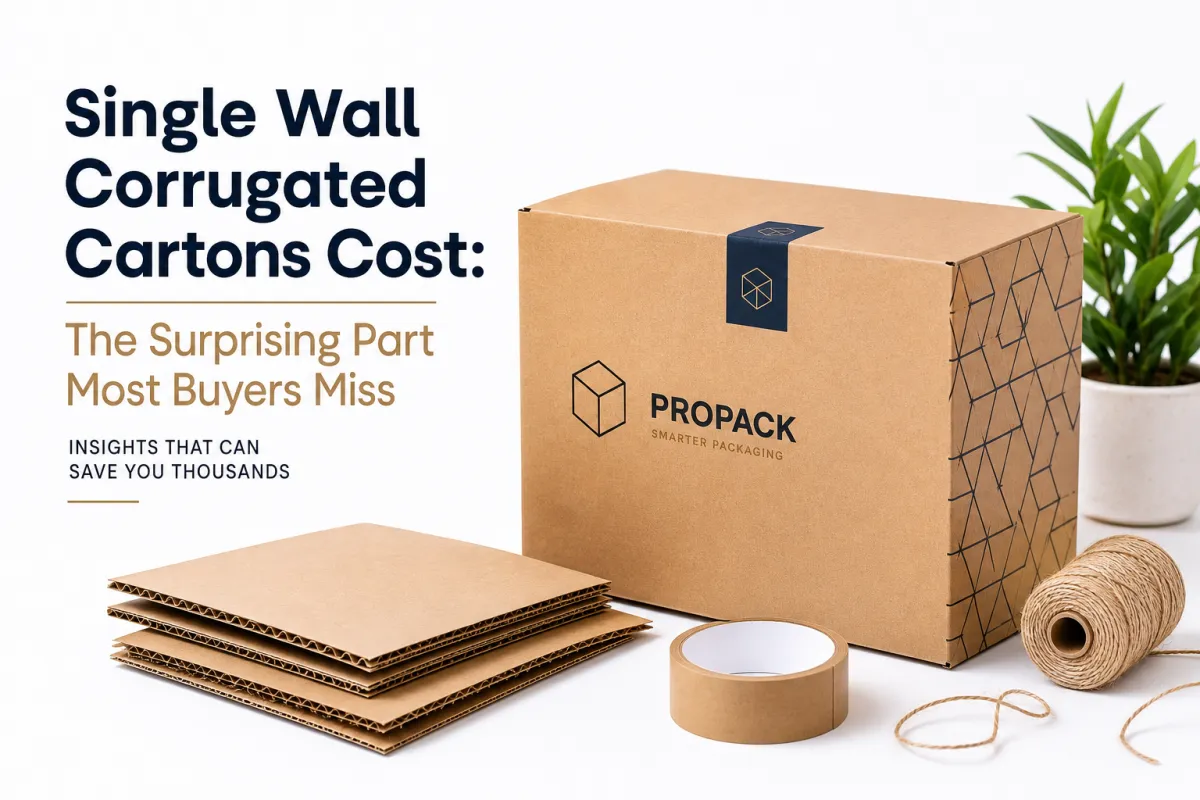
The part many buyers miss is simple: single wall corrugated cartons cost is shaped by geometry before graphics ever enter the discussion. Print gets attention because it is visible and easy to compare. Size gets overlooked because it feels routine. The board manufacturer does not share that bias. Every extra inch changes surface area, material usage, and the amount of fiber needed to make the carton.
Take a product that fits neatly in a 12 x 10 x 8 inch box. Increase the carton to 13 x 11 x 9 inches and every panel grows. That extra area does not stay hidden in the background. It raises board consumption, can increase pallet cube, and may push shipping into a less favorable dimensional weight bracket. On a small run, the jump can be enough to turn an acceptable quote into one that makes procurement pause for a second look.
Freight plays the same quiet trick. A carton only slightly larger than necessary can still increase shipping cost if it changes pallet count or fills a trailer less efficiently. Landed cost tells the full story better than unit price does. The cheapest carton on the quote sheet may be the most expensive carton once it lands in the warehouse and starts moving downstream.
Like-for-like comparison matters just as much. Two suppliers can both label a box as single wall, yet one may be quoting a thin E flute with plain kraft liners while the other is pricing a stronger C flute with heavier board. The boxes do not perform the same way, and they do not cost the same for good reason. A price gap without a matching spec gap tells you very little.
Some buyers swing too far the other direction and ask for heavier board just to be safe. That instinct sounds cautious, then turns into unnecessary spend. In many programs, the better answer is a carton that fits properly, carries the product without slack, and uses the lightest board that still survives the route. A box with less empty space usually protects better than a box that is simply thicker.
If the package needs a different structure altogether, it can be worth reviewing Custom Shipping Boxes at the same time as the carton brief. Sometimes the carton itself is not the real problem. The internal pack layout is the thing driving cost, damage, and wasted filler.
That is the core formula behind single wall corrugated cartons cost: board area, flute selection, freight footprint, and how tightly the spec matches the product. The idea is simple, and it is easy to miss when the quote only shows a neat number in a table.
What Single Wall Corrugated Cartons Are, and Where They Save Money
Single wall corrugated cartons use one fluted medium between two linerboards. That structure gives the carton enough rigidity for everyday shipping, storage, and fulfillment without paying for a double wall build that many products never need. It is the standard workhorse format for a wide range of corrugated packaging because it balances cost and performance in a practical way.
For e-commerce, subscription kits, light industrial parts, literature packs, and many consumer goods, single wall usually makes sense. It is lighter than more complex board options, easier to handle on the line, and often cheaper to print and pack. That is one reason single wall corrugated cartons cost stays attractive for brands that need to protect margin without giving up basic durability.
The savings show up most clearly when the carton is sized correctly. A tighter fit reduces filler, lowers the chance of product movement, and keeps freight cube under control. Plenty of buyers think the cheapest choice is simply the thinnest carton available. That approach usually misses the bigger picture. The smarter choice is the lightest carton that still survives the trip without crushing corners, flexing at the seams, or collapsing under stack pressure.
Compared with double wall or triple wall construction, single wall typically uses less material and moves faster through handling and conversion. Double wall has a place in heavy-duty distribution, palletized industrial work, and rough transit routes. For many products, though, that extra board adds cost without creating enough added value to justify it. If the product does not need the extra compression strength, the box is paying rent it does not owe.
That balance becomes even more visible in bulk purchasing. At low quantities, the penalty for overbuilding is obvious. At high quantities, the excess often hides inside a few cents per carton and gets dismissed as harmless. Spread those cents across thousands of units and the budget starts to feel the difference. That is how single wall corrugated cartons cost becomes either a controlled line item or a slow leak.
Most savings come from three things working together: the right box size, the right board grade, and print that supports the job instead of turning the carton into a billboard. A one-color logo on kraft board can look sharp, ship cleanly, and keep the job simple. Full coverage artwork may look impressive, but it also adds setup time, production complexity, and extra cost that some programs never recover.
The main point stays straightforward. single wall corrugated cartons cost is not about choosing the cheapest structure on instinct. It is about matching the carton to the product so the packaging does its work without wasting material, freight budget, or warehouse time.
Single Wall Corrugated Cartons Cost: Materials, Specs, and What Changes the Price
The material spec is the place where the quote starts moving. Single wall corrugated cartons cost changes with carton dimensions, board grade, flute profile, liner quality, print coverage, coatings, die-cut complexity, and order quantity. None of that is a sales gimmick. Corrugated pricing follows the material and conversion work the job actually requires.
Board grade is usually the first checkpoint. Common everyday specs include 32 ECT and 200# test, but those are starting points rather than universal answers. A heavier product, taller stack, or rough shipping lane may call for stronger board or a different flute choice. Under-spec a carton and the savings disappear the first time a product gets crushed or returned.
Flute selection changes the performance picture too. B flute often gives a solid balance between stacking strength and print quality. C flute is common where cushioning and compression matter more. E flute is thinner and fits tighter dimensions well, especially for lighter products and retail-ready packaging. None of those is automatically better. The right answer depends on the product, the fill method, and the route the carton will travel. That is why single wall corrugated cartons cost should be checked against the use case, not just a line on a board spec.
Print coverage can shift pricing more quickly than many buyers expect. A simple one-color logo on one panel usually costs less than full-coverage artwork, multiple print stations, or tight registration requirements. If the carton spends most of its life in transit, there is no reason to pay for a design treatment that never gets seen.
Die-cut complexity is another quiet cost driver. Standard regular slotted cartons are generally simpler to produce. Custom die-cuts, hand holes, special tuck features, and inserts can improve usability, yet they may also add setup charges and tooling fees. If a feature does not improve packing speed, product protection, or warehouse handling, it usually belongs in the extra spend category.
Coatings and specialty finishes also change the number. Water-resistant treatments, anti-scuff surfaces, and premium finishes can add practical value, but they should be specified with a clear reason. The same is true of closures. A self-locking style may save assembly time. A reinforced closure may reduce returns. Both affect single wall corrugated cartons cost, and they do it in different ways.
The carton itself is only part of the full package economics. A slightly stronger liner may remove the need for an insert. A better-fit box may reduce void fill and cut packing labor. In those cases, a carton with a higher unit price can still lower the overall spend. Unit price matters, but only after damage rates, handling time, and freight efficiency are in the conversation.
| Option | Typical Use | Indicative Unit Cost at 1,000 | Indicative Unit Cost at 5,000 | Indicative Unit Cost at 10,000 | Notes |
|---|---|---|---|---|---|
| Plain kraft, standard RSC | Basic shipping, storage, e-commerce | $0.68-$0.98 | $0.34-$0.56 | $0.24-$0.39 | Lowest decoration cost; often the simplest route for keeping single wall corrugated cartons cost under control. |
| One-color branded carton | Retail presentation, branded fulfillment | $0.82-$1.18 | $0.42-$0.69 | $0.30-$0.48 | Print setup adds expense, yet the carton can stay efficient if the structure is not overbuilt. |
| Heavier board, print, and inserts | Fragile goods, higher compression needs | $1.05-$1.55 | $0.55-$0.88 | $0.40-$0.66 | Protection improves, while the carton price and single wall corrugated cartons cost both move up quickly. |
Those ranges are illustrative, not a promise. A smaller carton with simple specs may sit below them. A larger carton with heavier board may sit above them. The pattern stays consistent, though: larger dimensions, stronger board, and more print all raise single wall corrugated cartons cost.
Quotes get clearer when suppliers separate board spec, print method, and any one-time charges. That breakdown shows whether the money is going into material, labor, setup, or some vague claim of premium quality that does not mean much on its own.
Buying note: if a supplier cannot tell you whether a charge is setup, tooling, or recurring unit price, the quote is not clear enough to approve.
Pricing, MOQ, Quote, and Unit Cost for Single Wall Corrugated Cartons
Single wall corrugated cartons cost is usually built from five parts: raw board, conversion, print setup, any tooling, and freight. Some suppliers bundle those items into one number. Others break them out. The second version is easier to read because it shows where the money goes and gives procurement something real to negotiate.
MOQ changes the math because it spreads fixed charges across the order. If setup costs are divided over 500 cartons, the unit price feels high. Put the same setup across 5,000 cartons and the price per piece drops in a way nobody needs a spreadsheet to see. A low MOQ is useful for testing, pilot launches, or short runs. It usually does not deliver the sharpest bulk price.
A solid quote starts with exact dimensions, product weight, quantity, board preference, print requirements, and destination. Leave out any of those details and the supplier has to guess. Guessing is how teams compare the wrong quote against the right one and then spend half a day sorting out why the numbers do not line up.
The most useful question is rarely “What is your best price?” A better one is “Please quote three volume levels.” That shows where the unit cost drops, where it settles, and whether the MOQ is helping or hurting the buying plan. You may discover that 1,000 units is too expensive, 5,000 is the real sweet spot, and 10,000 offers only a small additional saving. That is the kind of information that helps manage single wall corrugated cartons cost with intent instead of guessing after the order is placed.
It also helps to ask whether the job is standard or custom. Standard sizes usually move faster and can cost less because the production path is simpler. Custom dimensions, custom print, and nonstandard closures ask for more prep work. If the carton is die-cut, ask directly about tooling. If it is a printed RSC, ask whether the setup charge is one-time or recurring. Those distinctions matter more than a polished quote sheet would suggest.
For buyers balancing budget and presentation, the basic choices usually look like this:
- Plain carton: lowest price, fastest approval, best for transit packaging.
- Printed carton: higher unit cost, stronger brand presentation, better unboxing experience.
- Heavier spec carton: higher cost per piece, lower damage risk, better for rough handling or heavier products.
None of those options wins by default. The right choice is the one that protects the product at the lowest landed cost. That is the standard worth using when reviewing single wall corrugated cartons cost. Not cheapest. Not strongest. Best fit for the job.
ISTA test methods are useful because they keep the focus on real transit conditions, not just a tidy office discussion. If a carton is gonna ride through parcel networks, pallet distribution, or rough warehouse handling, a little testing costs far less than a wave of claims later.
For sustainable sourcing, the EPA source reduction guidance is worth a look. Smaller, lighter, correctly specified cartons usually reduce material use and waste. That is not flashy advice, but it does tend to show up clearly on the purchase order.
Printed cartons are a common question point. Sometimes the extra spend is worthwhile. A clean logo can improve recognition, reduce label clutter, and make the box feel intentional rather than generic. If the carton lives inside a larger shipper or disappears in transit, the premium may never pay for itself. In that case, focus on single wall corrugated cartons cost first and presentation second.
Process, Timeline, and Lead Time for Production
The production path is predictable once the spec is settled. Spec confirmation comes first, followed by artwork review. Sample approval comes next if the job needs it. Material planning, production, packing, and shipment follow after that. The order of operations does not change much, though the timing does. A clean brief can shave days off the schedule and keep single wall corrugated cartons cost from drifting because of preventable delays.
Standard cartons move faster because fewer variables need checking. Custom sizes and printed jobs ask for more back-and-forth, especially when the artwork is still changing or the structure has not been approved. One revised dieline can stall a run. One missing dimension can do the same. The front end of the process is where most of the money is won or lost. Packaging is built from small decisions, and each one has a price.
Many custom corrugated jobs land in the 10 to 15 business day range after proof approval, though the real timing depends on quantity, board availability, print complexity, and whether samples are required. Rush work is possible in some cases, but it usually tightens the schedule and raises the cost. That tradeoff makes sense. Faster production means more pressure on scheduling, conversion, and quality checks.
Lead time also depends on the order type. A plain unprinted carton may move faster than a branded carton with several colors. A straightforward RSC often moves faster than a die-cut style with special features. If specialty board or an unusual finish has to be sourced, the timeline stretches again. Buyers managing single wall corrugated cartons cost and launch dates should ask about timing at the quote stage, not after approval is already in motion.
Sample approval deserves real attention. Even a well-written spec can miss by a few millimeters or place the print too tight to a fold. A sample catches that before production starts. That small step costs far less than reworking thousands of cartons after the fact.
Use the process to your advantage. Have exact dimensions ready. Send artwork in the format the supplier requests. Confirm whether the quote includes bundling or palletizing. If the order needs delivery to multiple sites, say so early. Every missing detail creates room for error, and error is a very expensive design feature.
Once the spec is locked, a supplier should be able to explain how the order will move and where the risks sit. Clear answers matter more than polished language. If the team can explain what affects single wall corrugated cartons cost and what affects lead time, you are working with people who understand production as well as sales.
Why Choose Us for Single Wall Corrugated Cartons
We keep the buying process practical. No drama, no inflated spec sheets, and no pretending every carton needs to be built like a shipping bunker. If you want single wall corrugated cartons cost that makes sense, the first step is honest guidance on the structure, board, and print level that actually fit the product.
Too many packaging quotes are written to impress rather than perform. A carton can be oversized, overprinted, or overengineered simply because nobody challenged the brief. We challenge it. If the product can ship safely in a lighter carton, that is what we say. If the box needs stronger board or a different flute, we say that too. Buyers do not need flattery. They need a carton that arrives intact and a number they can stand behind.
Consistency carries real weight in the warehouse. Accurate dimensions, dependable production, clean print registration, and carton-to-carton uniformity make life easier for line operators and receiving teams. If a box is 2 mm off, the line notices. If a print panel shifts, the brand notices. If the board spec changes from shipment to shipment, the customer notices. Single wall corrugated cartons cost should never be separated from quality control, because quality issues turn cheap cartons into expensive ones very quickly.
Responsiveness matters too. A buyer may need a second quote for a lower MOQ, a different board grade, or a revised carton size after freight feedback. That kind of revision is normal. Good suppliers do not act put out by it. Real packaging work often needs one more pass because products, shipping lanes, and storage conditions rarely stay neat long enough for a first draft to hold forever.
For a packaging buyer, the best supplier saves time by cutting down back-and-forth. Clear specs, quick revisions, and grounded recommendations are part of the job. If that also keeps single wall corrugated cartons cost in a useful range, even better. There is no prize for buying a box that sounds clever and ships badly.
We also understand where recycled and certified fiber can matter. If your program needs FSC-certified board, we can account for that early so the quote reflects the real requirement instead of adding surprise cost later. For many brands, that early clarity is the difference between a clean approval process and another round of procurement questions. If you are comparing options, it helps to look at sustainability targets and the actual landed cost side by side.
Custom Shipping Boxes can be a useful comparison point when a plain transit carton is not the best fit. Some products do better in a different structure, and that can change both protection and pricing. The point is to Choose the Right packaging for the job instead of forcing every product into the same format.
The value is not in claiming to be the cheapest. Plenty of suppliers can put a number on a quote. The value is in putting forward a number that still holds up once the product moves through production, freight, and the warehouse floor. That is the difference between a price and a plan.
Next Steps to Lock in an Accurate Single Wall Corrugated Cartons Cost
If you want a quote that actually helps, start with exact dimensions, product weight, quantity, artwork files, and shipping destination. That sounds basic because it is basic. Yet vague requests remain one of the biggest reasons quotes come back useless. A vague brief produces a vague number, and vague numbers do not help anyone approve a purchase.
Next, decide whether the carton should be plain kraft, printed, or built for heavier duty use. That one decision changes single wall corrugated cartons cost more than many buyers expect. A plain shipping carton and a branded carton can sit in completely different cost brackets once setup charges, print prep, and finishing are included.
Then ask for pricing at multiple quantities. You want to see how MOQ affects the unit cost and where bulk pricing starts to improve. A quote for 500 pieces may not help if the real program needs 5,000. A quote for 10,000 may look attractive but tie up cash in inventory you do not want to carry. Smart buyers compare the breakpoints before they commit.
If the carton needs special features such as hand holes, inserts, or nonstandard closures, call those out now. Do not hide the detail and hope the quote stays low. It will not. The price only climbs later when the shop has to revise the job. Clear specs protect both the schedule and the budget, and that is how you keep single wall corrugated cartons cost honest.
Finally, ask for a sample if fit matters. A sample can save a very expensive mistake. It can also show whether the board grade feels right, whether the print reads cleanly, and whether the carton closes the way the pack line needs it to. One clean approval costs less than one bad production run.
My practical advice: request the quote, check the spec against the product, review the MOQ, and confirm the lead time before you approve anything. If the box is right, the rest of the program becomes easier. If the box is wrong, the cheapest quote in the room can still cost more than it saved. That is the hard truth behind single wall corrugated cartons cost, and it is usually the truth that matters most.
What affects single wall corrugated cartons cost the most?
Carton dimensions usually matter first because larger boxes use more board. Board grade, flute type, and print coverage are the next big pricing factors. Higher quantities usually reduce the unit cost because setup gets spread over more cartons.
How does MOQ change the unit cost of single wall corrugated cartons?
A low MOQ usually means a higher unit cost because setup and prep are divided across fewer cartons. As volume rises, the price per carton usually drops until the savings start to flatten out. Ask for pricing at several quantities so the breakpoints are easy to see.
Are printed single wall corrugated cartons more expensive than plain cartons?
Yes, printed cartons usually cost more because they add artwork setup, press time, and color control. Simple one-color print is usually far cheaper than full-coverage graphics or multiple print areas. If branding matters, compare the print cost against the value of cleaner presentation and better shelf impact.
What details do I need for an accurate quote on single wall corrugated cartons?
Provide exact internal or external dimensions, product weight, quantity, and shipping location. Add print requirements, board preference, and any special features such as hand holes or inserts. If you want a reliable quote, send artwork files and confirm whether samples are needed first.
How long does it take to produce single wall corrugated cartons?
Standard jobs are faster than custom sizes because they need less setup and approval time. Artwork changes, sample requests, and material availability can all extend lead time. If the order is urgent, ask early; rush production can change both timing and price.
How can I keep single wall corrugated cartons cost under control without hurting performance?
Start with a carton that fits the product closely, then choose the lightest board that still passes handling and transit needs. Avoid extra print and special features unless they solve a real problem. A short round of testing usually saves more money than the guesswork it replaces.
Actionable takeaway: lock the carton dimensions first, then choose the lightest board and simplest print that still protect the product on its route. If a quote is built on that sequence, single wall corrugated cartons cost stays tied to actual performance instead of drifting upward through extras that do not earn their keep.