Soap makers Kraft Paper Bags MOQ is not just a pricing question. It often decides whether a soap line looks finished on shelf or gets held back by weak board, poor fit, or packaging that marks up before it reaches retail.
For buyers, the best order of operations is straightforward: define the bar size, choose the paper weight, check the print method, then decide the MOQ that matches launch volume. Decoration matters, but it should come after structure, grease resistance, and pack-out.
Why Soap Bags Fail Before The Product Does
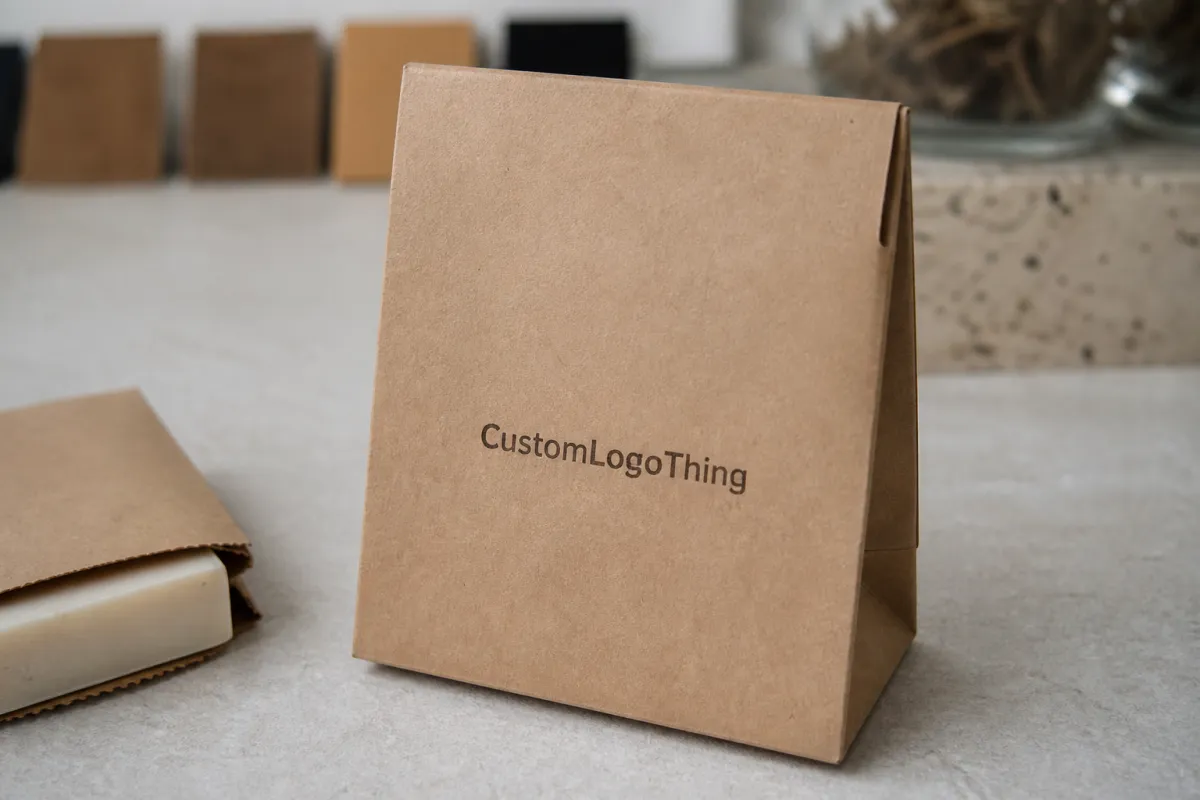
Soap is small, but its packaging still has to survive handling, transit, and shelf display. A kraft bag that looks fine in a sample photo can bruise corners, buckle at the seams, or show oil marks once a real bar goes in.
The failure points are familiar: thin seams split, shallow bases lean, and oversized bags let the soap shift so the front panel wrinkles. Hand-cut or irregular bars make the problem worse because the actual finished size can differ from the mold size used for quoting.
The cheapest bag is not always the lowest-cost option. If it triggers repacking, damage, or returns, the real cost shows up later.
Good soap packaging keeps the bar stable, keeps the paper clean, and keeps the presentation consistent from sample to shipment. When the bag has to work too hard to hold the product, the buyer usually pays for that weakness somewhere else.
Board Weight, Grease Resistance, and Print That Lasts
Kraft paper comes in a wider range than many first-time buyers expect. A midweight paper around 120-150 gsm is often enough for a wrapped single bar or sample pack. For gift sets, two-bar bundles, or packs with inserts, 180-250 gsm usually gives better stiffness and corner recovery.
Grease resistance is the hidden spec that matters when soap carries fragrance oil, shea residue, or soft inner wraps. A light aqueous coating, barrier treatment, or liner can reduce marking without making the bag feel plastic-heavy. If sustainability claims matter, ask exactly what the treatment is and whether it affects recyclability or compostability.
Print method changes both appearance and cost. One-color flexo keeps the natural kraft look and is usually the most efficient choice for larger runs. Digital printing works better for shorter runs, fine text, and multiple SKUs. Foil, white ink, and heavy solids can work, but they add cost and often change the feel of the bag.
Handle style and finish also affect the quote. Twisted paper handles add labor, while die-cut handles keep the bag flatter and often suit lighter packs. Matte finishes generally look more premium on kraft than gloss. For buyers who need documentation, request paper grade, recycled content percentage, and any FSC paperwork before approval, not after production starts.
Sizing, Gussets, and Fit Checks for Soap Bars
Fit is where a lot of packaging projects go wrong. Buyers often send only the soap size and forget the wrap, tissue, insert card, or inner sleeve that changes the usable footprint. A bar measured at 90 x 60 x 25 mm may need a very different bag once those extras are added.
Gusset depth is the key variable. A shallow gusset gives a cleaner front panel, but it can squeeze the product and leave stress marks. A deeper gusset gives more volume, though too much space lets the soap slide and makes the pack feel unfinished. For most retail soap packs, the goal is enough room for a neat top fold with modest headspace.
Bottom style matters as well. Flat-bottom bags are better for display and help heavier bars sit square. Square-bottom bags are usually better for bundle packs and gift sets. If the soap ships with an insert or divider, add that allowance to the dieline so the pieces do not rub during transit.
- Send finished bar dimensions, not only mold size.
- Include wrap thickness, tissue, insert cards, and inner sleeves.
- State the number of bars per bag and whether it must stand upright.
- Request a physical sample if the soap is oily, textured, or irregularly cut.
Check the pack-out by hand before approving the dieline. Soap edges are less forgiving than they look on screen. If the bar has squared corners, allow more clearance than you would for rounded edges. If it is hand-cut, ask for a tolerance range instead of a single perfect dimension.
Soap Makers Kraft Paper Bags MOQ and Unit Cost Breakpoints
MOQ is rarely a single rule. Stock sizes, printed stock sizes, and fully custom bags follow different production logic. The more variables you add, the higher the minimum usually climbs, especially once the supplier needs a new cutter, plate, or setup.
The lowest quote is not always the best one. Some suppliers hide setup charges inside unit cost, while others keep the piece price low and add plate fees, proof fees, or freight later. Ask for tiered pricing at 1,000, 3,000, and 5,000 units so you can see the real breakpoint and whether a larger first order saves enough to justify the inventory.
| Option | Typical MOQ | Unit Cost Range | Best For | Notes |
|---|---|---|---|---|
| Stock kraft bag, no print | 500-1,000 | $0.12-$0.24 | Fast launches and test markets | Lowest setup burden; limited branding control |
| Stock size with 1-color print | 1,000-3,000 | $0.18-$0.36 | Retail soap lines and repeat SKUs | Good balance of branding and unit cost |
| Fully custom size and print | 3,000-10,000 | $0.28-$0.65 | Premium gift sets and signature collections | Highest setup cost, strongest shelf presence |
Those numbers move with paper weight, size, print count, handle style, coating, carton pack-out, and shipping zone. A heavier board or special finish can shift the number much faster than buyers expect. On shorter runs, setup fees matter almost as much as the paper itself. On larger runs, freight and packing efficiency start to shape landed cost.
Paper yield also affects price. A size that nests well on the sheet may cost less than a smaller bag that wastes trim. Two bags with similar surface area can still price differently because the supplier is buying machine efficiency, not just material.
Production Steps, Lead Time, and Sample Approval
The cleanest orders move in a simple sequence: brief, dieline, proof, sample, approval, production, shipment. One missing detail can slow the whole job, so a supplier cannot quote accurately if the artwork is just a logo screenshot and the size is described as “roughly medium.”
For stock-based orders, proof approval may take 2-4 business days and production 5-10 business days. Fully custom bags usually need more time. A realistic window is 3-7 business days for artwork correction and dieline signoff, then another 7-15 business days for sampling and production, depending on print method and finish. Transit time should be built into the plan early because sea and air freight change both cost and launch timing.
A digital proof only shows layout. A physical sample shows how the paper behaves, how the print sits on kraft, and whether the fold lines land where they should. If fragrance or oils are part of the product, ask for a rub check on the printed area. Some inks look fine until handling starts.
If the bags will ship inside corrugated cartons, ask how many units fit per carton and whether the pack-out leaves room for corner compression. Packaging that is too loose can damage edges even when the bags themselves are well made. For higher-risk shipping routes, using ISTA references as a practical benchmark helps set expectations for drop and vibration.
Supplier Checks That Matter on Repeat Orders
Repeat orders expos

