The tea brand kraft Paper Bags Material guide is about performance first. Buyers need to know whether a bag will protect tea after printing, filling, stacking, shipping, and shelf handling. Kraft gives a natural look and good hand feel, but the real decision usually comes down to the liner, seal, closure, and print spec.
Tea is sensitive to oxygen, moisture, light, and outside odors. A pouch that looks strong in a sample photo can still fail in storage if the barrier layer is weak or the seal is poorly designed. The right structure is the one that matches shelf life, channel, and handling conditions, not just the design brief.
Tea Brand Kraft Paper Bags Material Guide: What Buyers Miss
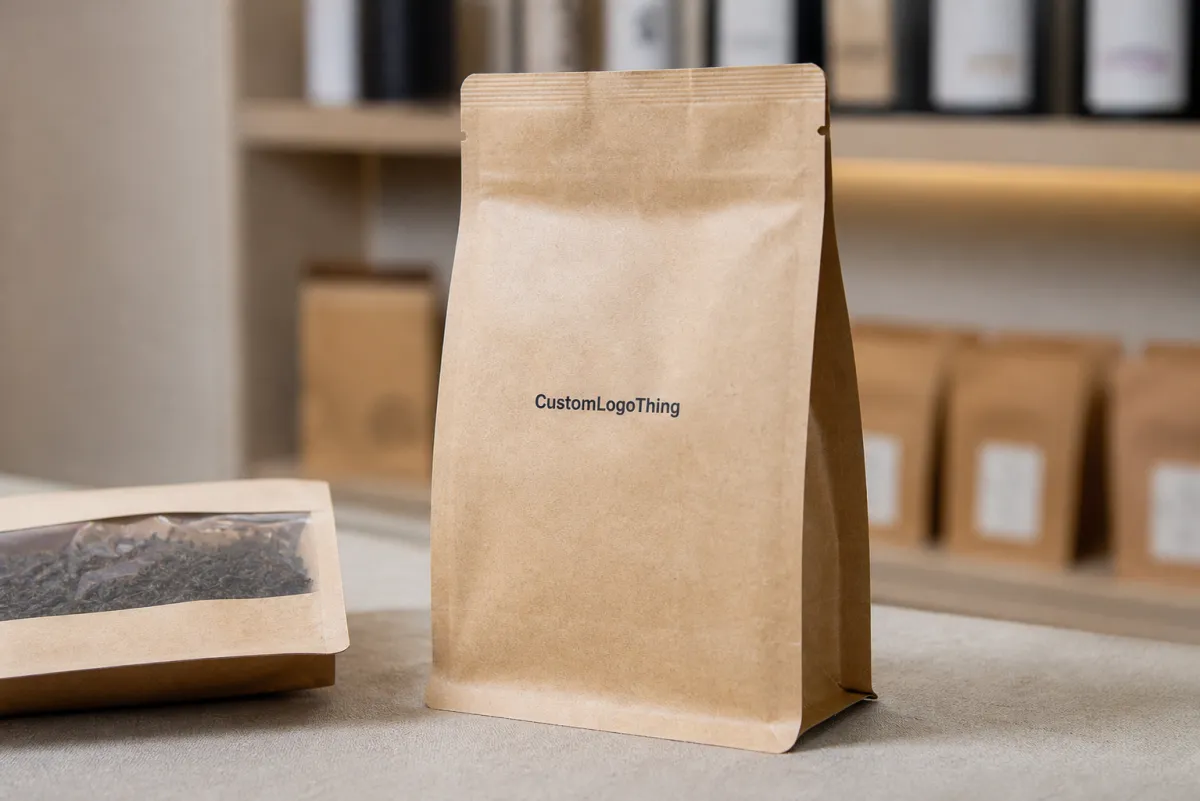
Kraft paper adds structure and a more natural brand impression, but it does not protect tea on its own. The outer face may be kraft, yet the protective work is usually done by the inner film, coating, and seal area. Buyers who focus only on paper weight often miss the part that actually preserves freshness.
Appearance can also hide weak specs. A pouch may look premium in a showroom and still curl, scuff, or soften in humid storage. Natural kraft shows wear quickly, which is useful because it exposes material problems early. If the sheet is too light, the bag feels flimsy; if it is too heavy, it can become stiff without adding much protection.
Different tea products need different structures. Fast-moving black tea can often use a simpler build than a delicate herbal blend held longer in inventory. Gift packs, ecommerce refills, and retail shelf bags all have different demands, so one structure rarely works equally well for every channel.
The practical question is not whether kraft looks good. It is whether the full structure protects aroma, holds shape, and stays within budget. That is where material choice becomes a buyer decision instead of a design preference.
How Kraft Paper Bags Work for Tea Protection
A tea pouch built with kraft paper is really a layered system. The outer kraft gives shelf presence and print surface. Under it may be PE, CPP, EVOH, metallized film, or another barrier layer that slows oxygen and moisture transfer. Zippers, tin ties, tear notches, and heat seals all change cost and performance.
Paper porosity matters more than many briefs acknowledge. A denser kraft face usually prints cleaner and resists abrasion better, while a more open sheet can look rustic but show more variation. If the brand wants that natural finish, the inner laminate still has to carry the freshness burden.
Seal design is one of the most important details. Weak seams cause many packaging failures, even when the outside looks fine. If the seal band is too narrow, contaminated, or mismatched to the film structure, the bag can open during transit. For tea, that can mean stale aroma long before any visible damage appears.
A bag can feel rigid in hand and still be a weak tea package if the barrier layer is light or the seal zone is underdesigned.
Tea also picks up odors easily. Coffee, spices, cleaning products, and even surrounding cartons can affect flavor if the barrier is poor. Many buyers therefore need a complete protection chain: a suitable liner, a reliable seal, and a closure that works with the filling line. For shipping validation, ISTA-style checks help reveal vibration, compression, and drop issues that simple desk samples miss. The ISTA methods are not tea-specific, but they are useful for testing the package as it will actually move through the supply chain.
After filling, the bag still has to stand, stack, and travel well. Some pouches look fine empty but collapse when filled. Others buckle in cartons or lose print quality after handling. The best spec is the one that survives the whole chain, not just the mockup stage.
Cost and MOQ Drivers for Custom Tea Bags
Price is driven more by structure than by print alone. The outer kraft is only one part of the quote. Barrier grade, zipper or tin tie hardware, window cutouts, coatings, color count, and approval rounds all affect unit cost. MOQ usually rises as the structure becomes more complex because setup time, material waste, and line changeovers increase.
A printed kraft pouch with a standard heat-seal liner usually sits at the lower end of the market. A stand-up pouch with a zipper and stronger barrier costs more, and enhanced barrier or specialty finishing increases the number again. For planning purposes, a 5,000-piece run may land around $0.18-$0.30 for a basic build, $0.26-$0.45 for a more protective stand-up structure, and $0.30-$0.55 or more for stronger barrier or demanding finishing. These are directional ranges only; size, freight, and artwork can move them.
| Build | What It Gives You | Typical MOQ | Planning Unit Cost | Watch-Outs |
|---|---|---|---|---|
| Printed kraft pouch with heat-seal liner | Natural look, straightforward production, moderate protection | 5,000-10,000 | $0.18-$0.30 | Barrier may be too light for slower-moving tea |
| Laminated kraft stand-up pouch with zipper | Stronger shelf presence, better reclose value, improved shipping resistance | 5,000-10,000 | $0.26-$0.45 | Higher setup cost and more components to confirm |
| FSC certified kraft with enhanced barrier | Stronger sourcing story and better freshness control | 8,000-15,000 | $0.30-$0.55 | More documentation and a longer proofing cycle |
The easiest savings usually come from simplifying the spec, not from trimming paper weight. Standardize bag sizes across SKUs when possible. Keep print coverage lean. Avoid decorative features that do not improve selling power or protection. In many projects, reducing structure variation saves more than shaving a few cents from the material itself.
Freight can also change the economics quickly. A low unit price can look attractive until cartons, palletization, and shipping are added. Secondary packaging matters too. If the master carton is weak, a good pouch can still arrive bent or scuffed.
Production Process and Timeline From Spec to Shipment
Strong projects start with complete product information. Tea format, fill weight, storage conditions, shelf-life target, closure preference, and sales channel all affect the material choice. A 50g retail pouch is not the same as a 250g ecommerce refill, so a vague brief usually creates unnecessary revisions.
A typical process is spec gathering, material recommendation, artwork review, proof approval, sample or mockup, production, inspection, and shipment. Straightforward runs can move from proof to production in roughly 12-15 business days. More complex jobs, especially those with special finishes or multiple revisions, take longer. Build in extra time if the launch date is fixed.
Delays often happen before production starts. Missing barcode details, late copy changes, or uncertainty about matte versus gloss can stall the schedule. Once production begins, changes are slower and more expensive. The most efficient projects lock the spec early and limit late-stage edits.
Samples should be tested with the actual tea, not just reviewed empty. A bag can look right on the table and still behave badly when filled, sealed, stacked, and shipped. That is why a useful packaging guide ties materials to the product instead of to the artwork alone.
Key Material Specs to Compare Before You Order
Start with the outer kraft weight. A mid-weight sheet usually gives a practical balance of structure and cost. Too light and the pouch wrinkles or feels weak; too heavy and it becomes bulky without improving freshness. The right weight depends on fill size and handling conditions.
Next compare the barrier layer. PE is common for basic heat sealing. EVOH improves oxygen resistance. Metallized film gives stronger barrier performance, though it may affect recyclability goals and the visual tone of the pack. Aluminum-based structures provide very high protection but can cost more than the tea needs.
Seal strength should be documented, not assumed. Ask how the supplier checks temperature, dwell, and seal quality, and whether leak checks are part of release. A clean seam matters more than a decorative finish. For premium tea, stale aroma is often the first sign of failure.
Food-contact suitability is another essential filter. Tea is not a high-risk food, but the packaging still needs the right compliance trail. If the structure includes recycled content or a coating inside the pack, ask about odor transfer, consistency, and contact safety. Claims are simple; the material stack usually is not.
FSC certification can support sourcing claims, but it does not replace a working barrier. Recycled kraft has a place too, especially for brands that want a lower-impact look and feel, but it should still be evaluated for print behavior and odor control. A surface that carries off-notes is the wrong trade.
Useful spec checklist:
- Outer kraft weight and surface finish
- Barrier liner type and sealability
- Print method and color count
- Closure style: zipper, tin tie, or heat seal
- Food-contact documentation and odor transfer checks
Step-by-Step Guide to Specifying Tea Packaging
Specify the package from the product outward. Start with the tea, then decide what the bag must do in storage, retail, and shipping.
- Define the tea format and fill weight, whether loose-leaf, sachets, or a gift set.
- Set the shelf-life target and storage conditions, including humidity and transport distance.
- Choose the structure, then decide on zipper, tin tie, tear notch, or window.
- Request mockups with actual tea inside so shape, seal behavior, and display can be checked.
- Lock artwork, proofing, and freight timing before production starts.
That order matters because each choice affects the next one. A shallow pouch may not stand properly. A window can reduce barrier performance. A zipper can improve convenience but raise cost and complicate filling. If the team skips sample testing, the first problems often appear after approval, when fixes are most expensive.
Compare at least two structures before committing. One should lean toward presentation and the other toward protection or economics. That makes the tradeoff visible early and usually prevents second-guessing later. For many tea brands, the most workable answer is a natural kraft face paired with a serious inner barrier.
Think channel as well as product. A pouch for boutique retail may need less crush resistance than one shipped by parcel. Subscription packs need tighter dimensional control. Export orders often need more barrier confidence. The same material can serve multiple channels, but only if the spec accounts for the hardest one.
Common Mistakes That Cause Weak Tea Packaging
The first mistake is choosing kraft for the look and then forgetting what the tea needs. The second is under-specifying the package for warm, humid, or slow-moving markets. Tea that sits in a warehouse or crosses climate zones needs more protection than tea sold quickly from a local shelf.
Another common problem is treating recycled content as automatically better without checking odor, consistency, and barrier behavior. Recycled kraft can work well, but the blend still has to be controlled. The same caution applies to biodegradable packaging claims. Buyers should ask what part of the structure is biodegradable, under what conditions, and whether the barrier layer changes the claim.
If the tea tastes flat or smells dull by the time it reaches the customer, the package failed, no matter how attractive the artwork looked on screen.
Skipping sample testing creates avoidable damage. Print contrast can soften on natural kraft. Seals can crease. Filled pouches can lean or collapse. Shipping vibration can expose weak corners and closures. Good buyers test the bag and the tea together because the package is judged as a system.
Overbuilding is the last common mistake. Extra coatings, too many finishes, and decorative features that do not improve protection can push cost up quickly. Simple often works better than flashy if the structure is sound.
Expert Tips and Next Steps for Better Orders
Ask for the material data sheet early. Request barrier details, seal recommendations, and food-contact documentation before you approve a full run. If the tea is sensitive, ask for odor transfer notes too. A supplier should be able to explain why a specific liner was selected and what level of protection it is meant to support.
Test under real conditions whenever possible. Use the actual fill weight. Stack the cartons. Simulate shipping vibration. Leave a few samples in the environment where the tea will be sold or stored. If the pack is headed through long distribution routes, an ISTA-based transit check is one of the fastest ways to catch weaknesses before they become returns.
Compare two build options before signing off: one stronger on presentation, one stronger on protection or cost. That exercise usually produces a cleaner decision than debating a single concept for weeks. For tea, the best structure is rarely the most expensive one. It is the one that preserves aroma, holds shape, fits the filling line, and stays within margin.
Use recycled materials where they fit the brand and route to market. If the tea is delicate or the shipping lane is long, performance stays in charge. If sustainability claims are part of the brief, make sure the liner, coating, and closure all support the same story.
Final approval should follow a simple chain: confirm the tea spec, shortlist the structure, Request a Quote, review samples, then approve production. That is the cleanest way to use a tea packaging material guide without turning it into guesswork.
What kraft paper weight works best for tea brand bags?
A mid-weight outer kraft is usually the best starting point because it balances structure and cost. The right weight still depends on fill size, shelf display, and how the bag will be handled. If freshness matters, pair the outer layer with a barrier liner or inner pouch.
Do tea brand kraft paper bags protect aroma on their own?
Plain kraft paper usually does not protect aroma well enough by itself. Most tea packs need an inner barrier layer, a heat-sealed structure, or another functional closure to slow moisture and odor transfer. Seal quality matters as much as the paper because a weak seam can undo a good material spec.
Are recycled kraft materials safe for tea packaging?
They can be, provided the material is food-contact appropriate and checked for odor transfer, consistency, and print behavior. Ask for documentation on the kraft blend, liner, and any coating inside the pack. If the tea is delicate, sample testing becomes even more important.
How long does production usually take for custom tea kraft bags?
Simple builds often move through proofing and production faster, while custom sizes, special finishes, and revision-heavy artwork extend the schedule. A typical run may need time for spec approval, sampling, manufacturing, inspection, and freight. Build extra time into the launch plan so shipping does not squeeze the release date.
How can I lower the unit cost of tea brand kraft paper bags?
Use a standard size when possible, keep print coverage simple, and avoid special finishes unless they clearly help sell the tea or protect it better. Consolidating SKUs into one structure can also improve pricing and make replenishment easier. That is usually a better savings path than trimming material quality.


