Buyer Fit Snapshot
| Best fit | packaging buyers who need clearer specs, stronger internal paths, and repeatable quote decisions where brand print, material, artwork control, and repeat-order consistency matter. |
|---|---|
| Quote inputs | Share finished size, material target, print colors, finish, packing count, annual reorder estimate, and delivery region. |
| Proofing check | Approve dieline scale, logo placement, barcode or warning zones, color tolerance, and any recyclable or compostable wording before bulk production. |
| Main risk | Vague material claims, crowded artwork, or missing packing details can create delays even when the unit price looks attractive. |
Fast answer: Soy Ink Printed Labels: What They Are and How They Work should be specified like a repeatable production item. The safest quote includes material, print method, finish, artwork proof, carton packing, and reorder notes in one written spec.
What to confirm before approving the packaging proof
Check the product dimensions against the actual filled item, not only the sales mockup. Ask for tolerance on folds, seals, hang holes, label areas, and retail display edges. If the package carries a logo, QR code, warning copy, or legal claim, reserve that space before decorative graphics fill the panel.
How to compare quotes without losing quality
Compare board or film grade, print process, finish, sampling route, tooling charges, carton quantity, and freight assumptions side by side. A lower quote is only useful if the supplier can repeat the same color, closure quality, and packing count on the next order.
Soy ink printed labels are not a cure-all, and that is exactly why they deserve a clear-eyed look. The soy component can improve the story around a label, but it does not erase the impact of the face stock, adhesive, liner, trim waste, or freight. Buyers who focus only on the ink end up paying for a pleasing claim and a label that may still misbehave on the shelf.
The better starting point is less romantic and more useful. Soy ink printed labels can be a strong fit for food jars, beverage bottles, cosmetics, wellness products, supplements, and shipping applications, but only when the full construction suits the package. A label is a tiny engineered system. It has to survive printing, application, storage, handling, abrasion, condensation, and the last rough mile before a customer notices it.
Used well, soy ink printed labels offer three things buyers actually want: clean color, readable type, and a more responsible print story. Add the right substrate stack and the result can be both practical and credible. Skip that discipline, and the environmental language starts to sound like decoration. Packaging has a way of exposing wishful thinking faster than a sales deck does.
I have seen this play out more than once in packaging reviews: a brand gets excited about a greener ink claim, then discovers the label stock is the real bottleneck. The print may be fine. The peel test may not be. That gap is where the useful work starts.
What Soy Ink Printed Labels Actually Are
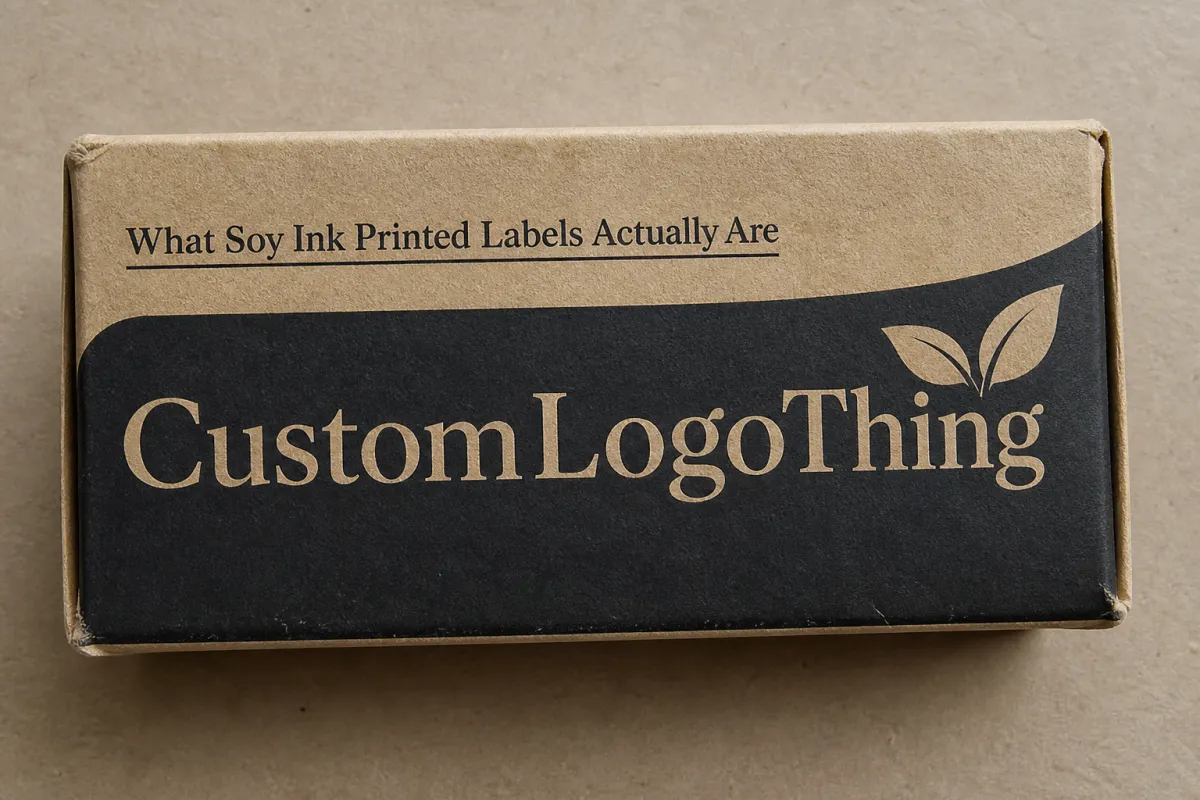
Soy ink printed labels use an ink system that replaces part of the petroleum-based vehicle with soybean oil or another vegetable-oil blend. The pigment still creates the color. The oil base changes how the ink flows, transfers, and bonds during printing. In plain terms, soy ink printed labels are not a different species of label; they are labels printed with a different ink formulation.
That distinction matters more than people expect. Soy ink printed labels do not become recyclable, compostable, or low-impact by default just because the ink contains plant-derived content. The face stock still matters. The liner still matters. The adhesive still matters. Even the scrap rate matters. If the press setup wastes material because the job was poorly planned, the environmental story weakens no matter how elegant the finished sheet looks.
One nuance that gets lost in marketing copy: many “soy” inks are actually vegetable-oil blends, and the soy portion can vary by supplier and region. The label buyer should ask for the ink specification rather than assuming every soy ink formula is identical. That is the difference between a meaningful material choice and a slogan.
Where do soy ink printed labels make the most sense? Usually on products that care about shelf appeal and brand narrative at the same time. Food brands want crisp ingredient copy and trustworthy presentation. Beverage brands want color strength and moisture resistance. Cosmetics and wellness brands often want a more natural-feeling package without drifting into homemade territory. Shipping labels can also benefit when a company wants a cleaner materials story across the package stack.
Soy ink printed labels are only one piece of sustainability math. Put soy ink on a thick vinyl face stock with a heavy adhesive and a nonrecyclable liner, and the result is not a miracle. It is still a label with one better-sounding feature. Serious buyers ask for the full spec because the full spec is where the real performance lives.
That is why experienced buyers ask about the paper or film type, the adhesive chemistry, the liner, the finish, and how the label will behave on the actual container. Soy ink printed labels can be a smart decision, but only when the entire structure is designed like a system. Otherwise, the project is just expensive decoration with a greener adjective.
How Soy Ink Printed Labels Are Made: Process and Timeline
The production flow for soy ink printed labels is straightforward on paper and messy in real life if the details are off. Artwork prep comes first. Then proofing. Then file setup or plate setup, depending on the print method. After that come press setup, color matching, finishing, inspection, slitting or die-cutting, and packing. Every one of those steps can add time when the job is not ready.
Simple soy ink printed labels orders can often move in about 5-10 business days after artwork approval. That is the fast lane, and it usually means standard materials, clean files, and a basic shape. If the job needs a custom die, special coating, foil, tough color matching, or multiple proof rounds, the timeline can stretch to 2-4 weeks or longer. Printing does not accelerate just because the launch date feels close.
Most delays are predictable. Missing dielines waste time. Late copy changes waste time. Pantone matching can slow things down if the brand expects a deep red or a specific green to land perfectly without a proof. Specialty substrates can add sourcing time. Finishing choices like lamination or varnish may need their own setup. A quote that looks simple at first can turn into a mini project once all those moving parts appear.
For larger runs, flexographic or offset printing often works very well for soy ink printed labels because those methods support repeatable color and efficient throughput. Digital printing still makes sense for shorter runs or variable data, but the ink system depends on the supplier and the press platform. Buyers should ask how the labels are actually being produced instead of assuming every label shop works the same way. They do not.
Speed improves when the buyer removes guesswork. Finalize the copy before proofing. Approve samples quickly. Stay with a standard shape if a custom shape is not essential. Choose a common stock rather than a specialty stock that has to be sourced. Soy ink printed labels move faster when the project stops changing shape halfway through.
If you are working on a launch with a hard date, the timeline deserves the same scrutiny as the design. In practical terms, a label project rarely misses because the printer cannot print. It misses because the approval loop was left vague for too long.
Cost, Pricing, and MOQ for Soy Ink Printed Labels
The price of soy ink printed labels is usually shaped by quantity, size, substrate, adhesive, finish, die complexity, and color coverage. The ink itself is rarely the expensive part. That is the piece many buyers miss. Setup fees, make-ready time, and small-run inefficiency usually cost more than the soy ink upgrade. A cleaner story on the invoice does not mean the printer is giving away labor.
MOQ, or minimum order quantity, matters because setup costs get spread over fewer units on short runs. That is why 1,000 labels often cost much more per unit than 10,000. On longer runs, unit price drops because the setup is amortized across more pieces. Buyers who compare quotes without checking quantity are often comparing two different math problems and pretending they are the same one.
| Label Stack | Typical Use | Ballpark Unit Price at 5,000 Pieces | What Usually Changes the Cost |
|---|---|---|---|
| Paper face stock + soy ink | Dry goods, jars, cartons, retail packs | $0.05-$0.09 | Color coverage, die-cut shape, and adhesive type |
| FSC paper + soy ink | Brands that want a fiber-sourcing story | $0.06-$0.11 | Certified paper cost and finish selection |
| BOPP or film stock + soy ink-compatible system | Bottles, cold-chain products, moisture-prone packaging | $0.07-$0.14 | Film cost, adhesive performance, and durability needs |
| Specialty stock + coating or lamination | Premium cosmetics, gifting, high-touch retail | $0.10-$0.22 | Texture, coating pass, and lower press efficiency |
Those figures are practical ranges for a common label size, not a promise. A 2 x 3 inch label with moderate ink coverage behaves differently from a full-bleed label with dense solids, fine type, or compliance copy. If a supplier gives you a quote without asking about coverage or usage, the quote is not a plan. It is a guess with a logo on it.
“A green claim is cheap. A reprint is not.”
If budget matters, simplify the stock or finish before chasing the lowest ink claim. That is the smarter buying move. A buyer can often save more by switching from a premium textured face stock to a clean FSC paper than by obsessing over a tiny ink premium. The same logic applies to die shape. Simple rectangular labels cost less than awkward contours that chew up conversion time and create more waste at trim.
To compare quotes properly, ask suppliers to use the same artwork, same quantity, same material, and same finish. If one supplier is quoting soy ink printed labels on plain paper stock and another is quoting a coated film with special varnish, you are not comparing price. You are comparing two different product specs and pretending they are siblings.
If you need a starting point for product formats, the Custom Labels & Tags page is a practical place to review common options before you request matched quotes.
Key Factors That Decide Print Quality and Sustainability in Soy Ink Printed Labels
Substrate choice is the first serious decision. Soy ink printed labels can look sharp on paper, but recycled paper, FSC paper, film, and compostable stocks all behave differently under press and in the field. Paper usually gives a softer, more natural look. Film gives better moisture resistance. Recycled materials can support the sustainability story, but only if the performance still matches the package.
Adhesive is the second decision, and buyers underestimate it constantly. Cold-chain labels need a different adhesive than dry-shelf cartons. Moisture-prone bottles need a different adhesive than paper mailers. Premium glass bottles may need a more aggressive tack or a cleaner removable behavior, depending on whether the label must stay put or come off later. If the adhesive fails, nobody cares how elegant the soy ink printed labels looked on the proof.
Finish changes both appearance and durability. Gloss makes colors pop. Matte softens the look. Soft-touch gives a premium feel but can pick up scuffs if the handling is rough. A varnish can protect the print, while lamination can improve durability even more. Each choice changes the final presentation, and each choice nudges the end-of-life story too. There is no free lunch in packaging, just different bills.
The end-of-life story deserves scrutiny. If a brand claims recyclable packaging, the label system should not quietly sabotage recovery. Liners, coatings, and adhesive residue can all get in the way. For a baseline on packaging claims and disposal language, the EPA recycling guidance is useful because it keeps the discussion grounded in actual materials behavior rather than marketing polish.
Durability matters as well. Soy ink printed labels used on refrigerated bottles, bathroom products, or shipping cartons need testing under real conditions. Condensation, abrasion, contact with oils or sanitizer, and handling over time all change the outcome. For transport and distribution, ISTA test protocols are a smart reference point because they simulate the bruising a package gets before a customer ever touches it. You can review the standards at ISTA.
Compliance is the part nobody wants to talk about until the labels are printed wrong. Food, supplement, and cosmetic products often need readable ingredient copy, batch codes, warnings, and barcodes that scan cleanly. Soy ink printed labels can support that, but the font size, contrast, and placement need care. A pretty label that fails legal requirements is not premium. It is a reorder.
There is also a practical benefit to thinking through compliance early: it makes the art better. Clear space for a barcode, a readable lot code, and a sensible hierarchy usually improves the design instead of hurting it. Good packaging rarely happens by accident.
Step-by-Step Guide to Ordering Soy Ink Printed Labels
Step 1: define the use case first. Before talking about soy ink printed labels, decide where the label will live. Dry shelf? Refrigerated bottle? Oil-prone jar? Shipping carton that gets tossed around? The environment says more than the marketing brief. A label that survives on a candle box may fail on a cold beverage bottle within a day.
Step 2: pick the material stack. Choose face stock, adhesive, and finish together. Do not treat the ink choice like the only variable. For many soy ink printed labels jobs, a simple paper stock with the right adhesive beats a fancy finish that photographs well and performs badly. If the container is glossy glass, test adhesion on that exact surface, not a substitute.
Step 3: prepare the artwork properly. Finalize the dieline, bleed, safety margins, barcode size, and legal copy before proofing starts. Missing one of those pieces can add several days. A supplier can print soy ink printed labels with excellent color, but if the text is cut off by a bad dieline, the job is still wrong. Clean color does not rescue bad geometry.
Step 4: request a proof or sample run. Check color, adhesion, readability, and finish on the real container. A screen mockup helps with layout, but it cannot tell you how a matte finish catches light or how a label behaves after a cold soak. If the product will live in a fridge for two weeks, test it for two weeks. That saves expensive embarrassment later.
Step 5: lock the order details. Confirm quantity, MOQ, shipping window, carton requirements, and inspection expectations before production starts. Soy ink printed labels orders go sideways when the buyer assumes the supplier already knows the launch deadline, pallet spec, and receiving dock details. Write it down. Everyone sleeps better when the rules are explicit.
Step 6: approve a real-world test. Put the sample through storage, handling, and application conditions that mirror the final use. If the label rubs, peels, or smears, fix it before the full order. A short test is far cheaper than discovering the failure after 20,000 labels have already been packed and shipped. That lesson is memorable for all the wrong reasons.
For buyers still comparing formats, start by shortlisting two or three printers that can show actual soy ink printed labels samples on similar stock. Then ask for a quote that uses the same spec across all suppliers. That gives you a fair comparison. Without matched specs, price shopping turns into noise.
If the supplier pushes back on sample testing, treat that as a signal. Good converters expect questions about application, storage, and end use because those details drive the print spec. The right partner welcomes that conversation.
Common Mistakes People Make With Soy Ink Printed Labels
Mistake 1: assuming soy ink means fully sustainable. It does not. Soy ink printed labels can reduce some petroleum content, but the face stock, adhesive, liner, waste, and shipping footprint still matter. If the label system blocks recyclability or creates a pile of waste on press, the ink choice is only part of the story.
Mistake 2: choosing on price alone. The cheapest quote often hides thin materials, limited finish options, or a tiny MOQ that makes the unit cost look friendly only on paper. I have seen buyers celebrate a low quote and then pay for a reprint because the labels peeled in refrigeration. That is a memorable way to lose margin, if by memorable we mean irritating.
Mistake 3: approving color from a screen only. Monitors are not press conditions. A deep green on your laptop can turn into a dull olive on the substrate if the proofing process is sloppy. Soy ink printed labels need the same discipline as any other color-critical packaging. Check the proof under neutral light, and compare it against the actual container.
Mistake 4: ignoring lead time. People get impatient, then surprised. The delay is usually not the press run. It is the missing dieline, the late copy change, or the request for a specialty stock that has to be sourced. If a launch date is fixed, build in approval time early. Soy ink printed labels can move quickly, but only when the buyer stops making the project stumble.
Mistake 5: skipping durability tests. Refrigeration, abrasion, condensation, and shipping vibration expose weak specs fast. If the labels have to sit on bottles in a cooler or survive a few hundred miles in transit, test them before you commit. Standards such as ISTA are useful because they push the package through conditions closer to reality than a clean desk ever will.
Mistake 6: forgetting the application method. Some labels are hand-applied, some are machine-applied, and some have a little too much faith in human consistency. Soy ink printed labels need to match the application method. A label that is fine on a flat carton may wrinkle on a curved bottle if the dimensions are off by even a few millimeters. Tiny geometry, big annoyance.
Mistake 7: treating the label as an isolated purchase. The label lives inside a packaging system. Carton design, bottle shape, storage conditions, and distribution all affect how soy ink printed labels perform. If the package is being reworked, the label spec should be reviewed too. Otherwise, you can end up with a beautiful label that is simply wrong for the next version of the product.
Expert Tips and Practical Next Steps for Buyers
Ask for the whole system spec, not just the ink story. A serious quote for soy ink printed labels should tell you the stock, adhesive, liner, finish, expected application surface, and any performance notes. If a supplier cannot describe the stack clearly, they are probably not set up to solve the real problem. Nice wording does not seal bottles.
Request two samples if possible: one soy ink printed labels option and one conventional option. Put them side by side under real light, on the real container, with the real product inside if you can. Then look at texture, edge quality, color depth, and durability after a few hours or a cold cycle. The difference is often small in theory and obvious in hand.
Use soy ink where it supports the brand story and the end use makes sense. Do not pay extra for sustainability theater on a label that sits in a dry carton and never sees the customer. On the other hand, do not cheap out on a shelf-facing package where color quality and material signal matter. Smart buying sits between those extremes, not in them.
Plan around the real schedule. If the launch is tight, build in proofing time and keep a backup stock in mind. A minor material delay should not turn into a missed launch because nobody allowed for variation in sourcing. Soy ink printed labels are a packaging decision, not a wish.
If you are reviewing current packaging, start with a short audit:
- Check whether the current label stock matches the container and storage conditions.
- Confirm whether the adhesive survives moisture, refrigeration, or oils.
- Review whether the finish improves durability or just inflates cost.
- Compare at least two matched quotes for the same soy ink printed labels spec.
- Test one sample on the real package before you approve the full run.
That is the practical path. It is not glamorous, but it works. The best soy ink printed labels are the ones that look good, hold up in use, and make sense on the cost sheet without pretending the ink alone solved packaging sustainability.
The clearest next move is usually simple: gather the full spec, test it on the real container, and compare apples to apples before ordering at scale. That one habit prevents most label mistakes.
Frequently Asked Questions
Are soy ink printed labels actually more eco-friendly?
Usually, yes, but only when the rest of the label system is considered too. Soy ink printed labels reduce some petroleum content, yet the stock, adhesive, liner, waste rate, and shipping still shape the total impact. Ask for the full material spec before treating any sustainability claim as meaningful.
Do soy ink printed labels cost more than standard labels?
Not always. The ink itself is rarely the biggest cost driver. Setup, quantity, substrate, finish, and MOQ usually move the price more than the ink choice, and larger runs often narrow the gap because setup costs are spread across more labels.
How long do soy ink printed labels take to produce?
Simple jobs can move in roughly 5-10 business days after artwork approval. Custom materials, finishes, or tight color matching can push the timeline into 2-4 weeks or longer. In most cases, the biggest delay is approval time, not the press run itself.
Will soy ink printed labels hold up in cold storage or on bottles?
Yes, if the adhesive and face stock are chosen for that use case. Cold, moisture, condensation, and abrasion need to be tested on the actual container. Always sample before you place a full order for refrigerated or high-touch packaging.
What files do I need for soy ink printed labels?
Provide final artwork with a proper dieline, bleed, and safe margins. Use vector files when possible, and include Pantone or spot color references if color matters. Make sure barcodes, legal text, and usage claims are final before proofing starts.
Should I switch to soy ink printed labels now?
If your current label spec is already close, yes, it is worth testing. Start with matched samples, compare a few quotes, and make sure the substrate, adhesive, and finish fit the package Before You Order at scale. That is the practical way to buy soy ink printed labels, and it usually leads to fewer surprises later.


