Stationery shop hang tags Bulk: Order Custom tags fast. That is often the cleanest way to tighten up a mixed stationery display without tearing apart every box, pouch, sleeve, or insert. If your shelf is carrying notebooks, pens, sticker sheets, planner bundles, and gift sets that all need to hold attention at once, stationery shop hang tags bulk gives you brand control, clearer pricing, and a more polished retail face without forcing a full packaging overhaul.
From a packaging buyer's point of view, the job is practical rather than dramatic. A hang tag needs to identify the item, carry the right details, and make the product look like it belongs in the same line as everything else you sell. That is why stationery shop hang tags bulk makes so much sense: one consistent format can pull a scattered product range into order quickly. The cheapest-looking tag usually ends up being the most expensive choice over time, because it leads to reprints, awkward shelf presence, and avoidable complaints.
If you are comparing stationery shop hang tags bulk options for a launch or a restock, the questions that matter are plain and useful. Which stock holds its shape? Which size fits the product without crowding it? Which finish still reads clearly under store lighting? What MOQ starts making the price feel sensible? Those are the decisions that keep the order clean and the margin intact.
Why stationery shop hang tags bulk are the cheapest upgrade
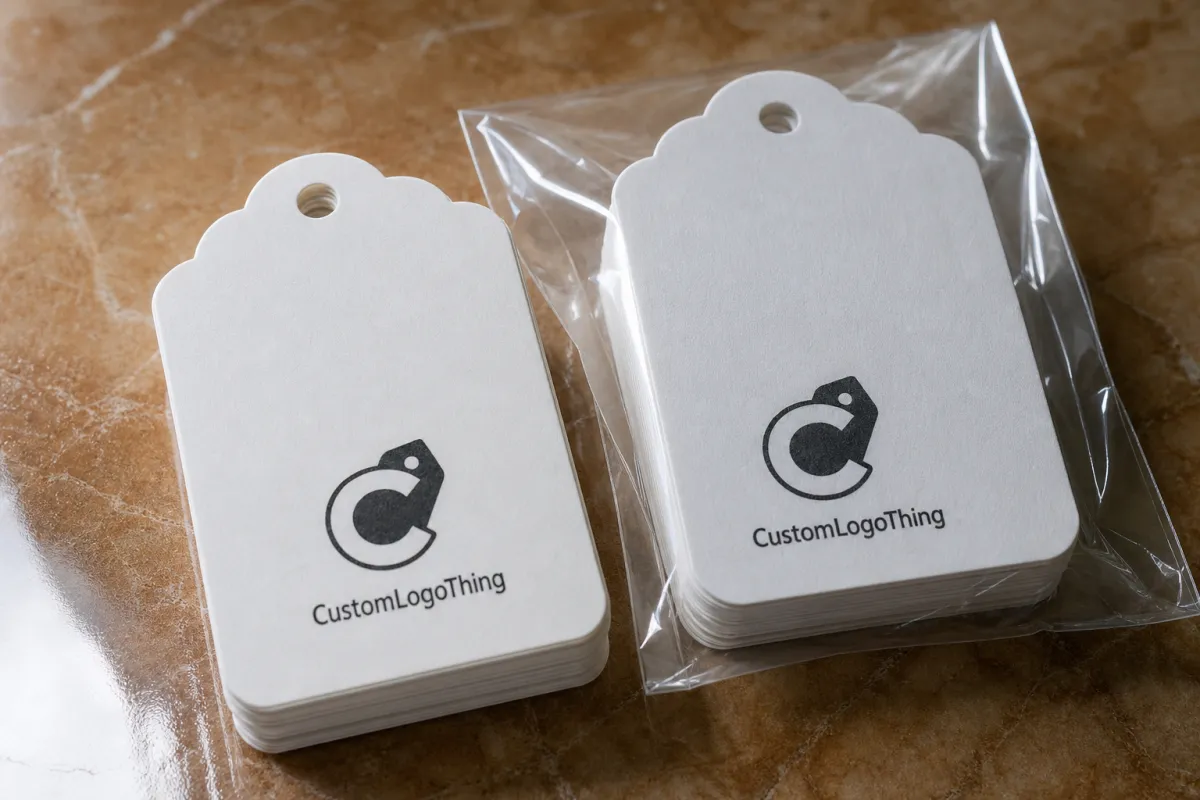
A hang tag is usually the first thing a shopper reads on a peg wall, so it needs to do its work fast without swallowing the product. That is why stationery shop hang tags bulk is such a practical move. You are not paying to rebuild packaging from the ground up; you are paying for a small piece of printed space that carries a surprising amount of weight. A good tag can hold a logo, product name, SKU, price, barcode, and a short brand cue in one neat piece.
For stationery retailers, that matters more than people tend to admit. Mixed product lines can look busy in the wrong way. One notebook carries a different label style. The pen pack uses tiny type. The sticker sheets have no clear branding at all. Bulk tags fix that mismatch with one repeatable system. Stationery shop hang tags bulk turns assorted items into a family, and a family of products usually sells better than a wall of visual noise.
There is a real cost advantage too. A custom box or a fully printed sleeve can be too much for lower-value stationery items, especially when SKUs change often. By contrast, stationery shop hang tags bulk lets you refresh a line, test a seasonal run, or standardize a bestseller without filling your storage with packaging you may not use again. That flexibility is one reason buyers keep coming back to tags.
What gets overlooked most often is that the tag is not just decoration. It can do three jobs at once: identify the product, carry the commercial data, and reinforce the brand. If one of those jobs gets ignored, the whole setup feels unfinished. The strongest stationery shop hang tags bulk orders strip away anything that does not help the shopper and leave the essentials in a clear, readable format.
- Identify the item clearly on a crowded peg wall.
- Support sales with price, product name, and a small brand mark.
- Reduce clutter across notebooks, pens, planners, and accessory packs.
- Keep consistency across mixed SKUs without redesigning each package.
That is the cheap upgrade. Not cheap in quality. Cheap in the smart sense: one setup, one print specification, and one visual system that keeps paying back every time the line is restocked. If you are buying stationery shop hang tags bulk, the real value is not the tag by itself. It is the cleaner retail presentation that comes from repeating one controlled format across the range.
In jobs I've handled, the easiest way to spot a weak tag order is to look for a shelf that feels a little tired even when the products are good. Usually the issue is not the artwork. It is the absence of a consistent tag system. Once that gets fixed, the whole wall relaxes, and the product line starts looking like it belongs together. Kinda simple, but it works.
Product details: what your hang tags can include
Begin with the front side and keep it restrained. A typical stationery shop hang tags bulk layout puts the logo, product name, and a short model or collection code on the front. If the shelf decision depends on price, include it. If the pack needs to scan, add a barcode or QR code, but keep the layout from turning into a crowded corner of tiny elements. Small retail tags fail when they try to do too much at once.
The back side is where useful detail belongs. That can mean product notes, bundle contents, care instructions, country of origin, website, or retail barcode information. For a planner bundle or notebook set, the back of a stationery shop hang tags bulk tag can also hold ruled page count, size, paper weight, or a short brand message. Keep it factual. Shoppers do not need a speech. They need the right information quickly.
Shape matters more than many buyers expect. A straight-cut rectangle remains the workhorse because it prints efficiently and stacks neatly. Rounded corners feel softer and resist edge wear a little better. A circle can suit a simple brand, though it gives up space once you need more text. Custom die-cut shapes can look distinctive, but they also raise cost and slow proofing. For many stationery shop hang tags bulk orders, the smartest shape is the plain one that performs without fuss.
Attachment hardware deserves as much attention as the design. A punched hole works well for lighter items and simple stringing. Eyelets add strength and reduce tearing on heavier bundles. Elastic loops are useful for notebooks, journals, and gift sets where production speed matters. String is fine too, as long as it matches the product weight and the way the item hangs in store. If a tag falls off on the shop floor, the design never had a chance to do its job.
For stationery buyers, there is another small detail that matters: where the tag sits after the item is hung. A tag can be technically correct and still look wrong if it flips under the product or hides key artwork. I always tell teams to mock up at least one physical sample before they lock the run. Paper on screen is one thing; a tag hanging on an actual hook is another.
- Front side: logo, product name, series name, or price.
- Back side: SKU, barcode, QR code, notes, or care details.
- Shape: rectangle, rounded corner, circle, or custom die-cut.
- Attachment: punched hole, eyelet, string, or elastic loop.
- Finish: matte, gloss, soft-touch, or uncoated if it must be writable.
Readability is the quiet advantage. A well-planned stationery shop hang tags bulk design can be read at arm's length under store lighting. That sounds basic because it is basic. Basic is what makes the tag useful. If the type is too small, the contrast is weak, or the layout feels crowded, the tag stops helping the sale and starts looking like packaging filler.
Specifications that keep stationery tags readable and durable
Most stationery shop hang tags bulk jobs work best on 300-400 gsm cardstock or 14-16pt cover stock. That range gives the tag enough stiffness to hang straight and enough body to survive handling without curling into something flimsy. Go thinner than that and you invite bending, edge fray, and a less professional shelf presence. Go much heavier without a clear reason and the piece can feel overbuilt without bringing any real benefit.
Standard sizes cover more use cases than buyers often expect. A 2 x 3.5 in tag suits compact accessories and narrow packaging. A 2 x 4 in format gives more room for pricing and product data. Slim vertical tags work well for notebooks, pens, and bundled sets because they keep the layout readable while hanging neatly beside the item. For stationery shop hang tags bulk, size should follow the product, not the mood board.
Printing choice is usually straightforward. Use CMYK for most full-color artwork, because it keeps the order flexible and the cost under control. Use Pantone only when the brand color must match exactly across product families or across repeat runs. That extra precision can be worth it for a signature brand shade, but it is never a free upgrade. It adds setup complexity, and setup complexity always shows up somewhere in the quote.
Hole placement deserves more attention than it gets. If the hole sits too close to the edge, the tag tears. If it sits too low, the tag hangs awkwardly and can cover part of the product. If a barcode or QR code ends up near the punch, scanners and operators both start fighting the layout. A clean stationery shop hang tags bulk file should include bleed, safe zones, and final hole position before production begins. That is not extra caution. That is simply careful work.
If the tag must be written on by staff, choose a finish that accepts pen, marker, or a small label. Heavy gloss can look attractive, but it is not always the right choice for retail teams that need to write prices, batch notes, or promotions by hand. For a writable surface, uncoated or lightly coated stock usually performs better. Stationery shop hang tags bulk often starts with function first, because a beautiful tag that cannot be marked properly still creates a headache.
For sustainability-minded buyers, ask for FSC-certified board where possible. The FSC standard is widely recognized and gives you a straightforward sourcing story without inventing one. For transit durability on larger mixed orders, ISTA testing practices are worth understanding, especially if the tags travel inside packed retail sets rather than hanging alone. Those standards do not replace common sense. They support it.
One honest disclaimer: paper and board names vary a little by supplier and region. A "14pt" sheet in one plant may behave slightly differently from a board with the same label somewhere else, so I always ask for an actual sample or a printed proof before approving the full run. That tiny step saves a lot of guessing later.
- Best stock range: 300-400 gsm or 14-16pt cover stock.
- Common sizes: 2 x 3.5 in, 2 x 4 in, or slim vertical cuts.
- Color method: CMYK for most orders, Pantone for strict color control.
- Safe setup: bleed, margin, and hole placement checked before proof approval.
- Writable option: uncoated or lightly coated stock if staff need to mark it by hand.
Cost, MOQ, and pricing for stationery shop hang tags bulk
This is the part where people start guessing, and guessing tends to be expensive. The price for stationery shop hang tags bulk depends on size, paper weight, print sides, finish, shape, and assembly details like eyelets or string. A simple rectangular tag with one-sided CMYK print is one thing. A custom die-cut tag with soft-touch lamination, front and back print, and eyelets is a different piece of work. The quote should show that difference clearly.
MOQ ties directly to production setup. Stock shapes and straightforward print runs can start lower because they need less tooling. Custom shapes, specialty finishes, and manual assembly push the minimum higher because they take more press time and more handling. For many buyers, a realistic planning range is 250-500 pieces for easier setups and 500+ for custom finish work. With stationery shop hang tags bulk, the lower end helps with testing, and the higher end helps with margin.
Unit cost falls as quantity rises, but not in a perfectly even line. The first jump from 250 to 500 pieces can Save More Per unit than the move from 1,000 to 2,000 pieces. That is why smart buyers compare pricing at the break points before they lock the order. Do not ask for a vague quote and hope it behaves. Ask for pricing by specification. Otherwise, the number looks friendly until it gets hit with a finish, a hole, or a reprint fee.
| Option | Common spec | Typical MOQ | Approx. unit price at 500 pcs | Best use |
|---|---|---|---|---|
| Stock rectangle | 2 x 3.5 in, 14pt, CMYK one side | 250 | $0.12-$0.20 | Simple notebook, pen, and label refresh orders |
| Standard custom tag | 2 x 4 in, 16pt, front and back print | 500 | $0.18-$0.30 | Retail-ready stationery lines with pricing and SKU data |
| Premium finish | Soft-touch or gloss, eyelet, string included | 500-1,000 | $0.28-$0.45 | Gift sets, planner bundles, premium notebooks |
| Custom die-cut | Special shape, full-color, optional foil or spot UV | 1,000+ | $0.35-$0.60 | Brand-led launches or higher-margin stationery collections |
Those numbers are not a promise. They are a sensible working range. Artwork complexity, print coverage, and finishing choices can nudge the quote upward or downward. The pattern still holds. Stationery shop hang tags bulk gets cheaper per unit as the run grows, but only if the spec stays disciplined. Add too many special touches and you can spend more than a simpler, cleaner tag would have cost in the first place.
The lowest quote is rarely the best order. Thin stock may save a few cents, but it often looks flimsy on the shelf. A weak finish may cut setup cost, but it can dull the artwork or make the tag less writable. A bad hole placement can force a reprint, and the savings disappear. For stationery shop hang tags bulk, the real price is the one that gets you a usable tag on time, not the one that only looks cheap on paper.
One practical way to compare offers is to ask for the same spec at 250, 500, and 1,000 pieces. That shows the break points, the unit drop, and the amount of inventory you will hold. If the 1,000-piece price is only a little higher than 500, that may be the stronger buy. If your SKU changes often, 250 or 500 may be the safer move. Stationery shop hang tags bulk should fit your sales pace, not just your ambition.
Pricing also depends on how much handwork the order needs. If the tags arrive flat and loose, packing is easy. If you want them strung, bagged, or sorted by SKU, labor goes up. That is normal, and it should show up in the estimate instead of being hidden inside a vague all-in number. Honest pricing is easier to manage, even if it is a little less shiny.
Process, timeline, and turnaround for bulk hang tags
The usual process is simple enough: quote, file review, proof, approval, production, quality check, packing, and shipping. That is the clean path for stationery shop hang tags bulk, and the fastest orders are usually the ones where the buyer sends complete information from the start. Final quantity, size, artwork files, finish preference, attachment type, and target delivery date should all be in the first message if you want the schedule to stay tight.
Simple runs can move quickly after proof approval. Custom shapes, spot colors, eyelets, and specialty finishes add days because each one introduces another step. That is not a delay problem. That is production reality. A rectangular tag with standard stock and CMYK print may be ready much sooner than a die-cut tag with lamination and stringing. Buyers planning stationery shop hang tags bulk around a fixed event date should build in a buffer instead of assuming the press will bend around the calendar.
Most delays come from mistakes people could have caught early. Low-resolution logos turn into muddy edges. Fuzzy barcodes scan badly. Missing bleed creates border issues. Tiny text gets lost because nobody checked it at full size. If the proof is weak, the production run will be weak. That is why the proof stage is not a formality. It is the last chance to catch problems that cost money later.
If the tag cannot be understood in three seconds, it is asking for too much of the shopper.
That applies doubly to stationery shop hang tags bulk. You are not building a brochure. You are building a quick retail signal. Good timelines come from simple choices: stock size, standard finish, clean file setup, and a proof response that is Fast and Clear. If the deadline is tight, do not add special effects late in the process. Keep the spec compact and the order becomes much easier to manage.
For buyers who need repeat orders, consistency is the real advantage. Once the layout, hole position, and stock are locked, reordering gets much easier. You can keep one master file, one SKU system, and one approved finish. That means fewer surprises and fewer small problems to chase later. In practice, the best stationery shop hang tags bulk workflow is the one that feels almost boring after the first order. Boring is efficient. Efficient is profitable.
In my experience, the orders that turn out best are the ones where someone on the buyer's side takes five minutes to check the tag at full size before giving the green light. That one small habit catches the weird stuff: text that looks fine in a design file but shrinks too far in print, or a barcode that wanders into the punch area. Not glamorous, but it saves headaches.
Why choose us for stationery shop hang tags bulk orders
We understand small-item retail, which sounds obvious until you see how many tag orders ignore it. A stationery tag has to carry brand, price, and product detail without turning into a crowded mess. That balance is the point of stationery shop hang tags bulk, and it is exactly where production experience matters. The wrong stock or the wrong layout makes the item feel cheap. The right setup makes even a basic notebook look like it belongs in a well-run store.
Our production setup is built for consistent color, clean cutting, and readable small text on compact tags. That matters because the most common failures are tiny ones. A barcode that prints too soft. A logo that drifts slightly from batch to batch. A punched hole that lands too close to a line of text. For stationery shop hang tags bulk, those small misses are not small. They decide whether a batch is usable or disappointing.
We also help buyers avoid the obvious traps: weak stock, awkward hole placement, overdesigned layouts, and barcode problems. If a design tries to fit a full brochure onto a 2 x 3.5 inch tag, I will say it plainly: it is too much. Strip it back. Make the important information legible. A cleaner order usually prints better and sells better. That is the part people pay for even if they do not always say it out loud.
For multi-SKU stationery lines, consistency matters more than gimmicks. One off-spec tag can make a whole batch look sloppy. That is why many buyers pair stationery shop hang tags bulk with other standardized printed pieces through our Custom Labels & Tags options. If the line is expanding, our Wholesale Programs can also make repeat orders easier to plan and easier to price.
We also care about practical file support. If you send final dimensions, quantity tiers, and artwork in the right format, the process moves faster. If you need help with layout checks, we can spot the issues that most buyers miss: type too close to the edge, low contrast, barcode placement that fights the hole, or a finish that will not suit handwriting. That is the kind of support that makes stationery shop hang tags bulk feel manageable instead of annoying.
And yes, the order should still look good. Function first does not mean dull. It means the design has to earn its space. A sharp matte tag with clean typography and controlled spacing will beat a flashy one that nobody can read. Every time. That is why I like straightforward stationery shop hang tags bulk projects: they reward discipline, not noise.
We do not promise miracle turnaround times or pretend every spec can ship yesterday. If the order needs specialty finishing, there is real production time behind it. Saying that out loud keeps the process honest, and honest timing is usually better than optimistic timing that slips three times before it lands.
- Retail fit: tags sized and finished for actual shelf use, not just mockups.
- File support: practical checks for bleed, margins, barcode clarity, and hole placement.
- Run consistency: stable color and cutting across the batch.
- Buyer help: quantity planning, proof review, and shipping coordination.
- Repeatability: easier reorders for seasonal or permanent stationery lines.
Next steps for stationery shop hang tags bulk
Start with the strongest SKUs first. Do not try to solve the whole catalog in one pass. For stationery shop hang tags bulk, it is smarter to begin with the products that need the clearest shelf presence: best-selling notebooks, pen sets, sticker packs, planners, and gift bundles. Once those pieces are standardized, the rest of the line becomes much easier to manage.
Gather the useful inputs before requesting a quote. You will want logo files, dimensions, quantity tiers, finish preference, attachment style, barcode or QR requirements, and any retail notes that affect the layout. If you have a deadline, say it early. If the tag needs to support handwriting, say that too. Stationery shop hang tags bulk moves faster when the brief is complete instead of vaguely optimistic.
Ask for a digital mockup or proof that shows front, back, hole placement, and small text at readable size. That is where most preventable mistakes show up. Compare the cost at 250, 500, and 1,000 pieces so you can choose the break point that matches your margin and replenishment needs. For many buyers, that price comparison is the difference between a sensible stock plan and a pile of leftovers.
There is also a simple operational habit that helps a lot: assign one person to approve the proof and one person to check the receiving count. When too many people touch a tag order, small details get blurred. A single owner keeps the decisions clean and cuts down on last-minute changes that were never part of the plan.
- Choose the SKU group that needs the clearest shelf presentation.
- Lock the size, stock, finish, and attachment method before quoting.
- Approve the proof only after checking barcode, text size, and hole placement.
- Confirm the quantity and pack count so shipping matches your receiving plan.
- Move the approved stationery shop hang tags bulk order into production without adding late changes.
Once the proof is clean, approve it and move. That is the simplest route to a fast order. If you keep adding special effects after the proof stage, the schedule slips and the quote creeps. If you keep the spec disciplined, stationery shop hang tags bulk can be a quick, practical upgrade that makes your stationery line look more polished without turning the project into a circus.
Frequently Asked Questions
What size works best for stationery shop hang tags bulk orders?
2 x 3.5 in and 2 x 4 in cover most notebooks, pens, and small accessory packs. Smaller items usually need a tighter format, while taller tags help when you need price, SKU, and branding on one side without crowding the layout. For stationery shop hang tags bulk, leave enough safe space so the hole, string, and barcode do not crowd the edge.
What MOQ should I expect for stationery shop hang tags bulk?
Simple stock shapes and digital print runs can start lower, while custom die-cuts usually need a higher minimum. A practical planning range is 250-500 pieces for easier setups and 500+ for custom finishing. With stationery shop hang tags bulk, the right MOQ is the one that matches your reorder rhythm, not the one that sounds impressive.
Which stock is best for stationery shop hang tags bulk?
Use 300-400 gsm cardstock or 14-16pt cover stock for a sturdy retail feel. Matte works well for a clean stationery look, and uncoated stock is a better choice if the tag needs to be writable. Avoid thin paper that curls or bends, because that makes the product look cheap on the shelf and defeats the point of stationery shop hang tags bulk.
How long does turnaround take for stationery shop hang tags bulk?
Simple runs can often ship a few business days after proof approval. Custom shapes, spot colors, eyelets, or special finishes add extra production time. Shipping time is separate, so build in transit days before you promise a delivery date to a retailer. For stationery shop hang tags bulk, fast usually means clean files and a standard spec.
Can you print logos, QR codes, and prices on both sides?
Yes, front and back printing is standard for most custom hang tag orders. Keep QR codes high contrast and leave enough margin so scanners read them cleanly. Use the back side for product details, pricing notes, or care instructions when the front needs to stay simple. That is one of the reasons stationery shop hang tags bulk works so well for mixed retail lines.
If you want a cleaner retail presentation without overcomplicating the packaging, stationery shop hang tags bulk is still one of the smartest buys on the table. The practical takeaway is simple: lock the size, stock, and attachment first, then proof the layout at full size Before You Order the run. That is the step that keeps a tag from becoming a headache later.


