Two stationery bags can carry the same artwork and still feel completely different in hand. One stands upright, keeps its shape, and carries cleanly. The other softens at the top, leans under load, or shows stress around the handle. That difference usually comes from paper weight, caliper, coating, handle reinforcement, and the actual contents inside the bag.
For buyers, the decision is rarely about the heaviest paper available. It is about matching the bag to the product, the budget, and the production timeline. The right spec protects the contents, keeps print quality consistent, and avoids paying for material strength that does not solve the real weak point. If you are comparing custom logo stationery packaging, the bag has to support the product instead of competing with it.
The most useful order is simple: define the load, choose the paper and finish, check the structure, then compare price, MOQ, and Lead Time. That sequence removes a lot of guesswork before you request samples.
Why thickness changes the first impression fast
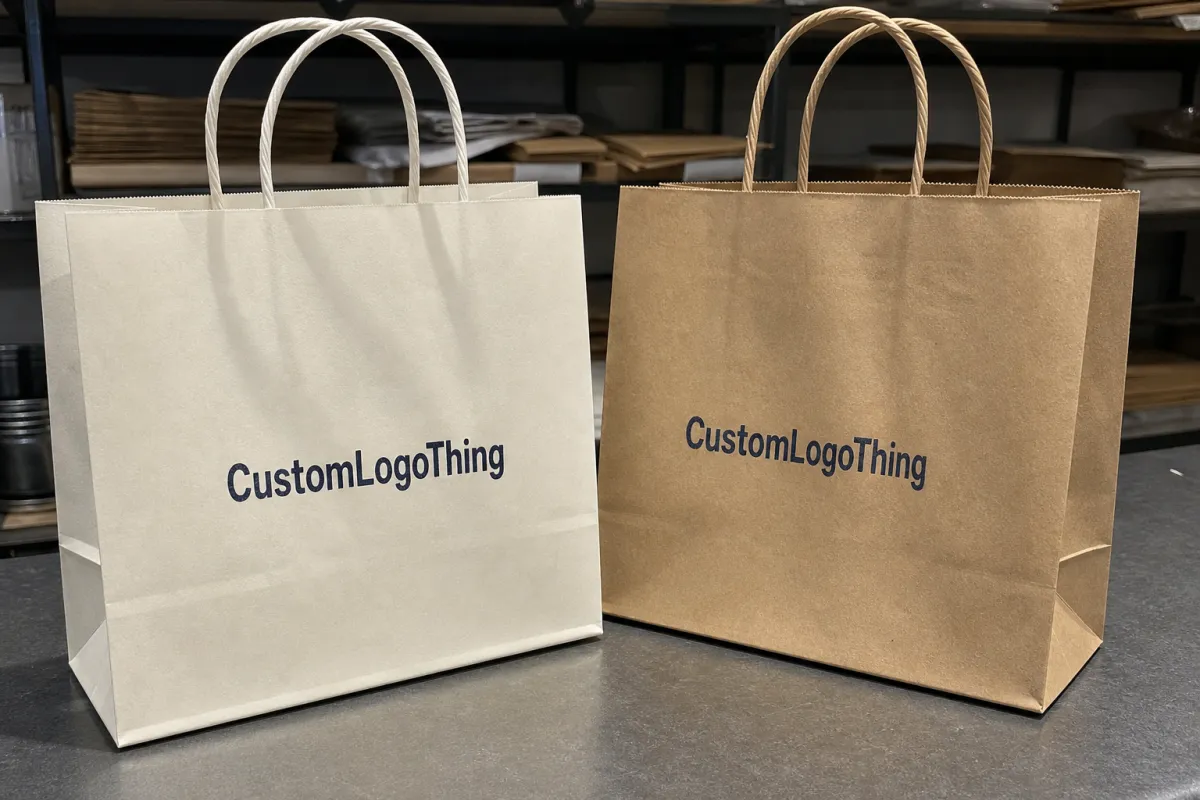
Thickness affects more than durability. It changes how the bag reads the moment someone picks it up. A heavier-feeling bag tends to signal care and permanence. A thin bag can make a premium product feel temporary, even when the print is strong.
GSM tells you paper weight, not the full behavior of the finished bag. Caliper describes thickness, but not how the sheet folds. Coating changes surface drag and stiffness. Reinforcement around the top fold and handle anchors often matters more than the base sheet once the bag is in use.
That is why a stationery twisted Handle Paper Bags material thickness guide should start with the contents, not with a random paper number. A slim notebook set is different from a boxed journal bundle with a pen tray, inserts, or a ribbon closure. Once the load shifts, the bottom seam and handle joints take the strain first.
Use this quick check before comparing samples:
- Contents: What is the real packed weight, and does it shift?
- Finish: Do you want natural kraft, coated paper, or a premium laminated surface?
- Budget: Is the goal the lowest landed cost or the best presentation within a fixed range?
- Timeline: Can the schedule handle special stock, extra reinforcement, or hand assembly?
If a sample feels strong but the handle bond is weak, the paper weight is not solving the problem. That is the main mistake to avoid.
Good bag spec work is quiet. If nobody notices the bag after approval, the material choice was probably close to right.
How twisted handles and bag structure carry weight
Twisted paper handles spread load differently from rope or ribbon handles. The twist adds some stiffness, but the stress concentrates where the handle is glued into the top fold. If that bond area is too small, or the fold is too soft, the handle can fail before the paper sheet does.
Think of the bag as a load path. Weight moves from the contents into the bottom panel, then into the gussets, side walls, top fold, and finally the handle anchor. A bottom board spreads pressure. A wider glue area supports the side seam. A reinforced top edge reduces tear-out near the handle holes or glued insert points.
That is why “go thicker” is not always the best answer. For notebook or journal kits, a 150-170 GSM kraft body with proper top reinforcement, a stiff bottom insert, and a clean handle bond can perform better than a much heavier sheet with weak joints. It can also keep the print cleaner and the cost lower.
Common stationery use cases usually fall into a few buckets:
- Notebooks and journals: Need stable sides and a bottom panel that does not cave in.
- Folders and document sets: Need height control so the contents do not crease at the top edge.
- Event kits: Need dependable handle performance because they are lifted and opened often.
- Retail gift packs: Need a stronger visual body because the bag becomes part of the gift.
If the load is awkward or wide, ask for a carry sample with the actual contents. A bag may survive a few empty lifts and still fail when the weight shifts to one side. Also check the top fold width: a wider fold gives more room for handle bonding and usually improves the feel at the edge.
stationery twisted handle paper bags material thickness guide: paper grades, GSM, and finish choices that change feel
Kraft, coated, and specialty papers do not behave the same way. Kraft usually signals natural strength and a matte, fiber-rich look. Coated stock prints more sharply and often feels more premium in hand. Specialty papers can add texture, but they usually increase cost and can narrow print options.
GSM is the headline number, but two papers with the same GSM can feel different because of fiber mix, caliper, and coating. A stiffer 170 GSM sheet can outperform a softer 180 GSM sheet depending on the construction. That is why sample comparison matters more than the number on the spec sheet.
Most stationery buyers end up in these ranges:
- 120-140 GSM: Light stationery sets, slim folders, handouts, and lower-weight giveaways.
- 150-170 GSM: The practical middle zone for notebooks, journals, mixed stationery packs, and modest retail gift sets.
- 180-200 GSM: Better for premium kits, boxed sets, heavier contents, and bags that need a more confident body.
These ranges are a starting point, not a rule. A tall narrow bag can feel rigid at a lower GSM because the shape supports itself. A wide bag carrying a heavier assortment may need more paper weight, a stronger bottom board, or both.
Finish also changes feel and durability. Lamination improves abrasion resistance and makes colors pop, but it adds cost and changes the hand feel. Spot UV or hot stamping improves logo impact, yet it does not replace proper paper strength. A shiny logo on a weak structure still feels weak. For buyers who care about sourcing, FSC chain-of-custody can matter, and FSC is a useful reference point: fsc.org.
Print coverage matters too. Dark solids, flood coats, and metallic inks can look excellent but may show scuffing at folds and edges. If the bag will move through retail, shipping, or event distribution, a matte kraft or a controlled coated finish may be the better balance of price, appearance, and handling.
Humidity and storage also affect behavior. Recycled fibers can vary more from batch to batch, and a bag that feels ideal in a dry sample room can soften in transit or warehouse storage. That is not always a defect; it is a reason to confirm incoming paper and check consistency before a full run.
Cost, pricing, MOQ, and unit cost tradeoffs
Thicker paper costs more, but the biggest price jumps often come from reinforcement, custom handles, heavier print coverage, or finish work that needs extra setup and labor. A thicker body is only one part of the quote.
MOQ shapes the decision too. Lower quantities raise unit cost because printing, die-cutting, and hand assembly have fixed setup time whether the run is 500 or 5,000 pieces. Special papers and premium finishes often push the minimum order higher because suppliers need enough volume to cover waste and labor.
| Thickness tier | Typical spec | Best use | Indicative unit cost at 5,000 pcs | Notes |
|---|---|---|---|---|
| Light | 120-140 GSM kraft, simple one-color print | Handouts, slim stationery sets, low-weight giveaways | $0.18-$0.28 | Lowest cost, but least forgiving under load |
| Mid | 150-170 GSM kraft or coated stock, reinforced handle area | Notebooks, journals, mixed stationery packs | $0.24-$0.38 | Often the best balance of feel, print quality, and cost |
| Premium | 180-200 GSM stock, laminate or specialty finish, bottom board | Gift kits, boxed sets, retail presentation bags | $0.34-$0.65 | Higher perceived value, but finish and labor move price quickly |
These numbers are ballpark figures. Freight, region, paper availability, and print coverage can move them. Still, they are more useful than asking for “the best price” without defining the build.
A better quote test is to ask for the same size, the same artwork, and three thickness tiers. Compare landed unit cost, not just ex-works price. A bag that is slightly cheaper but fails a carry test is not cheap once the reprint and delay are included.
Also confirm what the quote includes: handle style, glue pattern, bottom board, packing method, and overage allowance. These details change the real cost more than many buyers expect.
Process and lead time: from spec sheet to shipment
Production starts with clear specifications: dimensions, target load, paper choice, print coverage, handle style, and finish. Then comes artwork proofing, material sourcing, sample or pre-production approval, mass production, packing, and shipment. Each step can expose a different problem if the brief is incomplete.
The biggest lead-time bottlenecks are usually paper matching, color approval, and hand assembly. Stock kraft bags can move quickly because the material is easier to source and the build is simpler. Premium bags take longer when they use coating, lamination, reinforced bottoms, or board inserts.
Typical planning ranges are roughly 7-10 business days for stock-based custom printed bags after proof approval, 12-15 business days for mid-complexity builds, and 18-25 business days for fully custom bags with heavier finishing or reinforcement. Those are common bands, not fixed rules.
To reduce back-and-forth, send these items up front:
- Final dimensions: Width, gusset, and height in millimeters or inches.
- Target weight: What the bag must carry without strain.
- Artwork files: Print-ready files with bleed and clear color references.
- Approval criteria: What must match before mass production starts.
- Packing expectations: Carton count, stacking limits, and labeling needs.
It helps to ask how the supplier checks incoming paper. A solid process should verify GSM, caliper, color consistency, and adhesive performance before the run starts. For transit testing and carton handling, ISTA is a useful reference: ista.org.
One practical point: a good bag can still crease if it is packed too tightly or stored under heavy cartons. If the route is rough, storage and carton design matter almost as much as the sheet itself.
Common mistakes when choosing bag thickness
The first mistake is choosing by feel alone. A buyer holds a sample, likes the stiffness, and assumes the bag will handle the final contents. Then the actual stationery set goes in, the load shifts, and the handle area takes the strain. Feel is useful, but it is not enough.
The second mistake is ignoring reinforcement. Many buyers focus almost entirely on GSM and overlook the handle bond, top fold, and bottom seam. That is backwards. A slightly lighter bag with a better glue pattern and a stiff bottom board can outperform a heavier bag with weak joints.
The third mistake is overspecifying paper weight when structure would solve the problem more efficiently. If a notebook box is sliding around, a board insert or a tighter fit may help more than a jump to much heavier stock. If the logo area is scuffing, a smarter coating or print strategy may matter more than extra GSM.
The fourth mistake is forgetting storage and shipping. A bag can look excellent in production and still pick up edge wear, curl, or compression marks in transit. The outer carton matters. Plain corrugated cardboard, packed correctly, helps preserve the profile and reduce top-edge damage before the bags reach retail.
The fifth mistake is ignoring climate. Recycled kraft, virgin kraft, and coated stock can react differently to humidity. That can show up as waviness, curl, or a softer hand feel. A supplier should be able to explain the expected behavior without making it sound unusual.
For repeat handoffs, trade shows, or event distribution, ask for a real-load carry test and a simple drop test. That catches more issues than a render or a flat sample ever will.
What to send before you request quotes and samples
Send a one-page brief if you want quotes that are easy to compare. Include size, target weight, handle style, finish, print coverage, quantity, and budget range. If the supplier has to guess, the quote will be harder to use.
Ask for two sample versions: one flat sample and one assembled sample with the actual contents. The flat sample shows print, finish, and paper behavior. The assembled sample shows whether the handle bond, gusset, and bottom panel work under load. That second sample is often the more important one.
When you review samples, check the same points each time:
- Top fold: Does it stay crisp after a few openings and lifts?
- Handle bond: Is the glue pattern even, centered, and large enough?
- Bottom panel: Does it sit flat under the real load?
- Print and finish: Are edges clean, with no cracking, scuffing, or color drift?
- Carton pack: Do the bags stack without crushing the top edge?
Compare options by cost per use, not just by unit price. A bag that costs a little more but survives handling, keeps the logo clean, and supports a better brand impression can be the better buy for stationery launches, gift sets, and event packs.
The final filter is straightforward: match load, print, and budget before approving production. If the bag carries the contents, holds the artwork well, and fits the commercial target, the spec is doing its job.
What GSM is best for stationery twisted handle paper bags?
Use 120-150 GSM for light stationery sets, handouts, and giveaways. Move to 170-200 GSM for premium kits, boxed notebooks, or heavier assortments. Reinforcement can do part of the work before you jump to very heavy stock.
How thick should twisted handle paper bags be for notebooks and journals?
Base the choice on the packed weight, not the empty bag feel. If the load sits near the top of the range, add a bottom board and stronger top fold reinforcement. Ask for a carry test with real contents before final approval.
Does lamination make paper bags stronger or just shinier?
Lamination improves scuff resistance and can make the bag feel more rigid. It does not replace proper paper thickness or handle anchoring. A thin bag with heavy lamination can still fail if the load is too high.
What MOQ should I expect for custom stationery paper bags?
Simple sizes and single-color prints usually have the lowest MOQ. Thicker papers, custom handles, and special finishes typically raise the minimum. Ask how MOQ changes across three thickness tiers before you compare suppliers.
How do I compare quotes for paper bag thickness fairly?
Compare the same size, same print coverage, same handle style, and same finish. Confirm paper grade, GSM, reinforcement, and packing method before judging price. Use landed unit cost and defect risk together.
What quality checks matter most before production?
Check GSM, caliper, handle bond placement, bottom panel strength, and print registration. Ask for a physical sample under the real load, not a blank shell that only looks right.

