Buyers sourcing streetwear drop OPP Header Bags with a low MOQ usually want the same result: packaging that presents the product cleanly, fits the folded garment correctly, and does not force a large inventory commitment. The decision gets messy when the first sample is too thin, too glossy, or the wrong size. A good header bag solves the basics without adding friction to packing, storage, or retail display.
OPP, or oriented polypropylene, is common because it is clear, fairly rigid, and suitable for printed headers. That makes it useful for streetwear, where the sleeve often has to do some branding before the garment is even opened. The better question is not whether the bag looks premium in a mockup, but whether it protects the product, holds its shape, and stays consistent from sample to repeat order.
Low MOQ matters because it limits risk. A brand testing a new silhouette, colorway, or fold standard does not want to sit on a large box of sleeves that no longer fit the product. Smaller runs cost more per piece, but they are easier to correct if the spec needs a change. The goal is not just a low minimum. The goal is a spec that can be repeated.
Why Header Bags Beat Generic Poly Mailers for Streetwear Drops
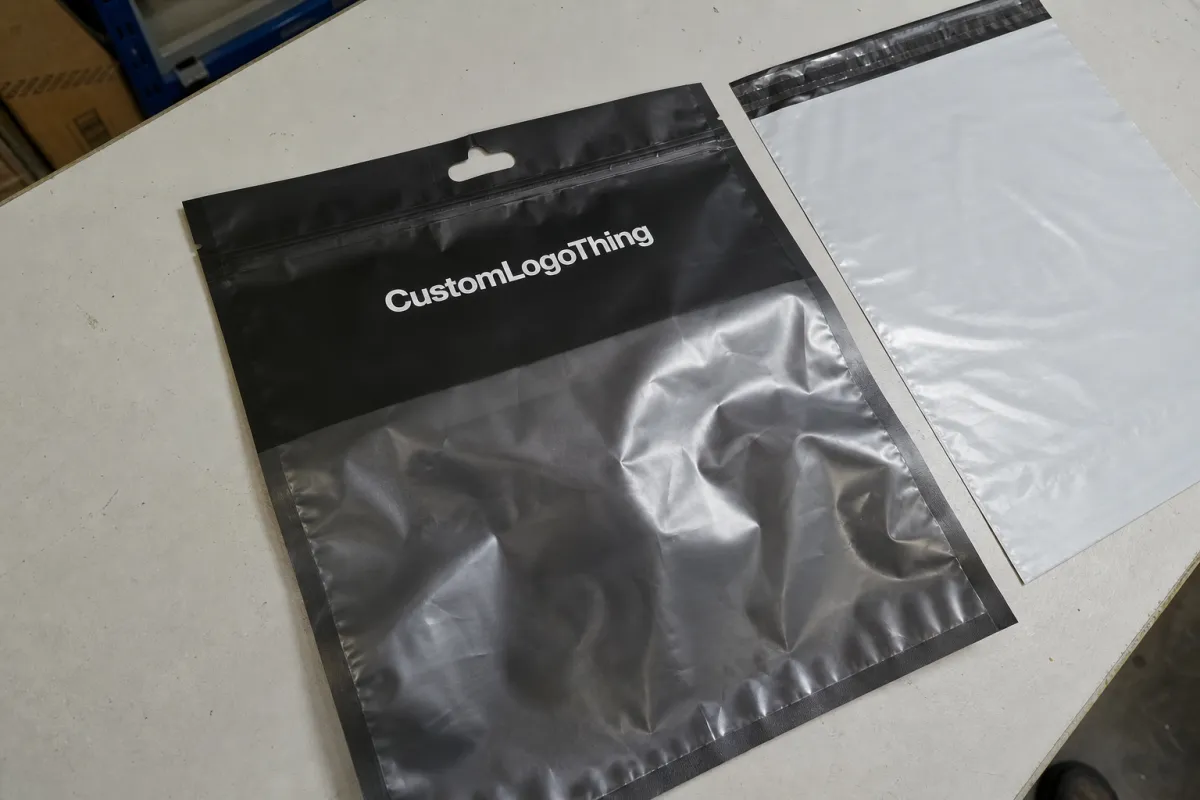
Streetwear sells on presentation as much as on fabric weight. A generic poly mailer ships the item safely, but it hides the garment and makes the drop feel more like freight than merchandise. A clear header bag shows the color, print placement, collar fold, and sometimes the tag arrangement before the pack is opened. That first impression affects how the release is judged.
For DTC orders, limited tees, and collab capsules that may also move into boutiques, header bags create a retail-ready look without requiring a full box package. They also make warehouse work easier because staff can see the product, verify the fold, and catch errors before sealing. If the pack later moves to retail, the same sleeve can hang or display more cleanly than a mailer.
The practical test is simple: if the packaging looks cheaper than the garment, the brand loses value before the customer opens it. A sleeve does not need to be flashy. It needs to be clean, durable, and consistent after folding, shipping, and handling.
If the packaging looks cheaper than the garment, the brand gives up margin before the customer opens the pack.
Bag Structure, Header Style, and Seal Options That Fit Drop Merch
Most decisions come down to three parts: the film body, the header, and the closure. The body holds the garment. The header carries the brand mark and any hanging feature. The closure affects packing speed and how secure the sleeve feels in transit.
For a standard tee, a simple OPP bag with a printed header is usually enough. It is easy to source in low quantities and gives the brand room to test fit before scaling. Once the size is confirmed, buyers can decide whether the pack needs a euro slot, adhesive flap, zip seal, or heat seal.
An euro slot works well for retail hanging and showroom display. Adhesive flaps are faster on fulfillment lines and are often the best choice for DTC orders, though adhesive quality should be checked in warm storage conditions. Zip seals suit premium packaging or multi-piece sets because they can be reopened cleanly. Heat seals look the cleanest, but they usually require a packing setup built for them.
Size and thickness matter more than most first-time buyers expect. Lightweight tees fit standard headers comfortably. Heavy fleece often needs more width, more depth, or a gusset so the fold does not push against the seal. If the bag is too tight, the header curls and the pack starts to look cheap. That is why the bag should be chosen against the actual folded garment, not the size label.
For Low MOQ Orders, a simple construction is usually the safest route. One stable size, one closure style, and one strong brand element is often enough for a drop. Complex constructions can look attractive in a quote but slow the packing table down later. The best structure is the one the warehouse can repeat without guesswork.
Quick structure comparison
| Option | Best for | Typical MOQ | Cost per piece | Tradeoff |
|---|---|---|---|---|
| Stock OPP header bag | Testing a new tee or small capsule | 500-3,000 | $0.05-$0.12 | Fast and cheap, but limited branding |
| Custom printed header bag | Retail-ready tees, preorder runs | 2,000-5,000 | $0.10-$0.22 | Better brand presence, some setup charges |
| Fully custom gusseted bag | Hoodies, thick fleece, boutique packs | 5,000-10,000 | $0.18-$0.35 | Better fit, higher tooling and setup cost |
Those ranges are working estimates, not fixed rules. Film gauge, print method, dimensions, and freight all change the final number. If a quote lands far outside those bands, there is usually a spec issue hidden in the details.
Film Gauge, Print Coverage, and Spec Choices Buyers Should Compare
Film gauge affects durability, hand feel, and how well the sleeve resists scuffs in transit. For lighter garments, 30-40 micron film often works well. For heavier fleece or packs with inserts, 40-50 micron is safer because it helps the bag hold shape. Too-thin film may save money on paper, but it creases quickly and can make the product look tired before it reaches the customer.
Clarity matters just as much. OPP is popular because it stays clearer than many softer films, which helps the garment remain the focus. If the sleeve fogs too much, the product loses impact. If it is overly glossy, it can feel like a commodity pack instead of a branded one. The best spec usually sits in the middle: clear enough to show the garment, stiff enough to hold shape, and smooth enough to pack efficiently.
Print coverage is the other major lever. A full-clear sleeve puts the garment front and center, which works well for graphics and bright colorways. A printed header gives the brand identity without burying the product. Full-coverage printing can look stronger in presentation decks, but it adds cost, increases lead time, and raises the chance of color mismatch on small runs. For many drops, a clean header panel is enough.
Size should be based on the folded garment, not the tag size. A medium tee with a card insert may need more room than expected. Hoodies are less about width than thickness, so depth and gusseting matter. A bag that is too tight creates wrinkles, strains the seal, and makes the pack look rushed.
Before approval, check the details that affect packing and inspection:
- Vent holes for thicker fleece pieces that need air release.
- Tear notches for a cleaner customer opening experience.
- Barcode space if the pack will move through retail handling.
- Hang tabs or euro slots if the garment may be displayed on a rack.
- Header stiffness so the top section stays flat in cartons.
Inspection should match the actual spec, not the mockup. Ask for checks on seal strength, film clarity, print registration, cut accuracy, and bag-to-bag consistency. Pinholes and static are worth checking on the first sample batch, especially if the packaging will be photographed or handled in retail accounts. If the dieline does not fit the folded sample, the quote needs to be corrected before production starts.
Pricing, MOQ, and Unit Cost Levers for Smaller Runs
Low MOQ helps brands test demand without carrying dead inventory, but smaller runs almost always cost more per piece. Setup work does not shrink just because the order is smaller. The main pricing drivers are film thickness, bag size, print coverage, closure type, and whether the order is stock or fully custom.
Extra charges matter more than the base unit price in small runs. Plate fees, cutting fees, artwork revisions, tooling, oversized dimensions, and freight can change the economics quickly. A bag quoted at $0.08 can end up costing more than one quoted at $0.12 if the first quote carries heavier setup costs.
The best way to compare offers is total landed cost, not just the per-piece number. For smaller runs, a simple one-color header and a standard size usually give the best value. Full-coverage printing may look stronger in theory, but it often adds 15-30% to packaging cost on limited quantities and slows production.
A useful buying sequence is straightforward:
- Sample one or two sizes against an actual folded garment.
- Check seal behavior, print clarity, and packing speed.
- Lock the size that fits without stretching the fold.
- Scale quantity only after the structure is stable.
For custom printed header bags, a realistic range is often around $0.10-$0.22 per unit at 2,000-5,000 pieces, depending on structure and print area. Larger quantities usually reduce the unit price, though not always dramatically. The main savings come from keeping the spec simple and repeating it on the next order.
Production Steps and Lead Time From Artwork Approval to Delivery
Packaging sourcing works best when the process is boring: quote, artwork review, dieline confirmation, proof approval, production, packing, freight. If one step is skipped, the delay usually shows up later and becomes more expensive to fix.
Artwork causes many of the delays. Low-resolution logos, loose color instructions, or files that ignore the real bag size create correction rounds. Fit creates the next set of problems if the supplier does not know whether the product is a tee, hoodie, or multi-piece set. Approval churn slows things down too, especially when several people need to sign off on every change.
A typical new custom run often takes 12-20 business days after proof approval, plus freight. Repeat orders can move faster, usually 7-12 business days, because the cutter, film spec, and print setup already exist. Samples or pre-production proofs often take 5-10 business days. Freight should be planned separately because it can add a few days or a few weeks depending on the route.
A few checks reduce risk quickly: confirm whether dimensions are flat size or finished size; verify that the header print is centered on the actual dieline, not just the art file; ask for carton counts and gross weight; and check a physical sample against the folded garment before mass production. The first dozen finished packs should also be checked for cut consistency, seal alignment, adhesive strength, and clarity after folding.
Speed is possible when the inputs are clean. A supplier can move quickly on a repeat spec. A supplier cannot rescue vague artwork, unclear sizing, and three rounds of revision without paying for it somewhere else.
What a Reliable Supplier Should Provide for Repeat Drop Calendars
Reliability is not about polished sales copy. It is about whether the second order matches the first without a long explanation. Streetwear calendars leave little room for inconsistency, so a supplier that changes the fold fit, shifts the print position, or revises the MOQ after the first quote creates real problems.
A strong supplier keeps three things stable: communication, quality, and pricing structure. Clear answers matter because packaging specs can sound similar while behaving very differently. Stable quality matters because a sleeve that works once and curls on the next run is a production issue. Stable pricing matters because a quote that changes every time is not really a quote.
Good vendors also flag small fixes that save money later. They may suggest a slightly taller header for better branding, a wider body for a thicker garment, or a safer logo placement if the artwork is too close to the edge. That kind of input usually comes from repeat production, not from a product page.
For brands that need documentation, ask what records are available for the film and printed components. If a supplier cannot explain the specification in plain language, they may not control the process tightly enough. The best partner is often the one that can repeat the same result without drama.
The best packaging partner is often the one that repeats the same result without drama.
How to Request a Fast Quote and Place the First Order
Fast quotes come from exact inputs. Send the bag size, garment type, artwork file, print colors, quantity, and delivery location. If the launch date matters, include that too. A supplier cannot price around a mood board, and vague notes usually produce vague answers.
The quickest quoting path is simple:
- Measure the garment after folding, not before.
- Choose one primary size and one backup size for comparison.
- Send vector artwork if it exists, or the cleanest source file available.
- Ask for MOQ, setup charges, and unit pricing together.
- Approve the proof only after checking print area, seal style, and hanging feature.
That backup size matters more than many buyers expect. A difference of 10-20 mm can change packing speed, carton density, and wrinkle control. Before placing the first order, measure width after folding, height after folding, and thickness at the thickest point. Those numbers tell the supplier whether a standard header bag is enough or whether the pack needs extra depth.
For a first drop, keep the spec calm: one bag style, one print decision, one approval path. Once the first run is approved, future orders are easier to repeat because the variables have already been locked down.
What size streetwear drop opp header bags should I order for tees and hoodies?
Use the folded garment dimensions, not the flat shirt size, to choose the bag. Tees often fit standard header formats, while hoodies usually need more width, more depth, or a gusset so the fold does not press into the seal. A physical sample is the safest way to confirm fit before bulk ordering.
Can I get streetwear drop opp header bags with a low MOQ?
Yes, but the minimum depends on whether the bag is stock or fully custom, how much of the surface is printed, and whether special tooling is needed. Low MOQ works well for testing new drops or limited colorways. The tradeoff is a higher unit cost than a larger repeat run.
What print option works best for custom header bags with logos?
A simple one- or two-color header print is often the best balance of cost and visibility. It gives the brand presence without covering the garment. Full-coverage print can look stronger in photos, but it raises cost, increases setup time, and reduces flexibility on small runs.
How long is the lead time for streetwear header bag production?
New custom runs often take 12-20 business days after proof approval, plus freight. Repeat orders can move faster because the tooling and spec already exist. Samples usually take 5-10 business days. Freight should be planned separately so the launch date does not depend on production alone.
What do you need from me to quote opp header bags quickly?
Send the target bag size, quantity, artwork file, print colors, delivery location, and garment type. If the product is thick or unusually folded, include a sample measurement or a photo with dimensions. That gives the supplier enough information to check fit, price the job accurately, and avoid a second round of corrections.

