Buyer Fit Snapshot
| Best fit | Sustainable Box Inserts Manufacturer for Brands projects where brand print, material claims, artwork control, MOQ, and repeat-order consistency need to be specified before quoting. |
|---|---|
| Quote inputs | Share finished size, material target, print colors, finish, packing count, annual reorder estimate, ship-to region, and any compliance wording. |
| Proofing check | Approve dieline scale, logo placement, barcode or warning zones, color tolerance, closure strength, and carton packing before bulk production. |
| Main risk | Vague material claims, crowded artwork, missing packing details, or unclear freight terms can make a low unit price expensive after revisions. |
Fast answer: Sustainable Box Inserts Manufacturer for Brands: Board, Finish, Dieline, and Unit Cost should be specified like a repeatable production item. The safest quote records material, print method, finish, artwork proof, packing count, and reorder notes in one written spec.
Production checks before approval
Compare the actual filled-product size with the drawing, then confirm tolerance on folds, seals, hang holes, label areas, and retail display edges. Reserve space for logos, QR codes, warning copy, and material claims before decorative graphics fill the panel.
Quote comparison points
Review material grade, print process, finish, sampling route, tooling charges, carton quantity, and freight assumptions side by side. A quote is only useful when the supplier can repeat the same color, closure quality, and packing count on the next order.
Sustainable Box Inserts Manufacturer Guide for Brands
The insert inside a box often carries more of the protective burden than the carton around it, and a capable sustainable box inserts manufacturer understands how much depends on cavity shape, wall thickness, fiber orientation, and the real weight of the product. A well-made insert keeps an item from sliding, cushions it against impact, and helps the whole package feel considered rather than improvised. That matters in transit, but it matters just as much at the moment of opening, when the customer notices whether the box feels intentional or wasteful.
Anyone who has opened a carton and found a product drifting inside a loose pocket has seen the weakness immediately. A sustainable box inserts manufacturer turns that loose arrangement into a tighter system built from recyclable paperboard, molded fiber, pulp, corrugated structures, or related fiber-based materials that still need to perform under actual shipping conditions. For e-commerce brands, retail kits, subscription boxes, cosmetics, electronics, and fragile goods, the insert is often where presentation and protection either work together or cancel each other out.
Custom Logo Things works with brands that need packaging to do more than sit neatly on a shelf, and the insert usually comes first in that conversation. If you want a broader look at the company behind that kind of work, the About Custom Logo Things page is a good place to start. Here, the focus stays on what a sustainable box inserts manufacturer actually does, how the design process unfolds, what drives cost, and how to choose a structure that protects product quality without overbuilding the pack.
What a Sustainable Box Inserts Manufacturer Does
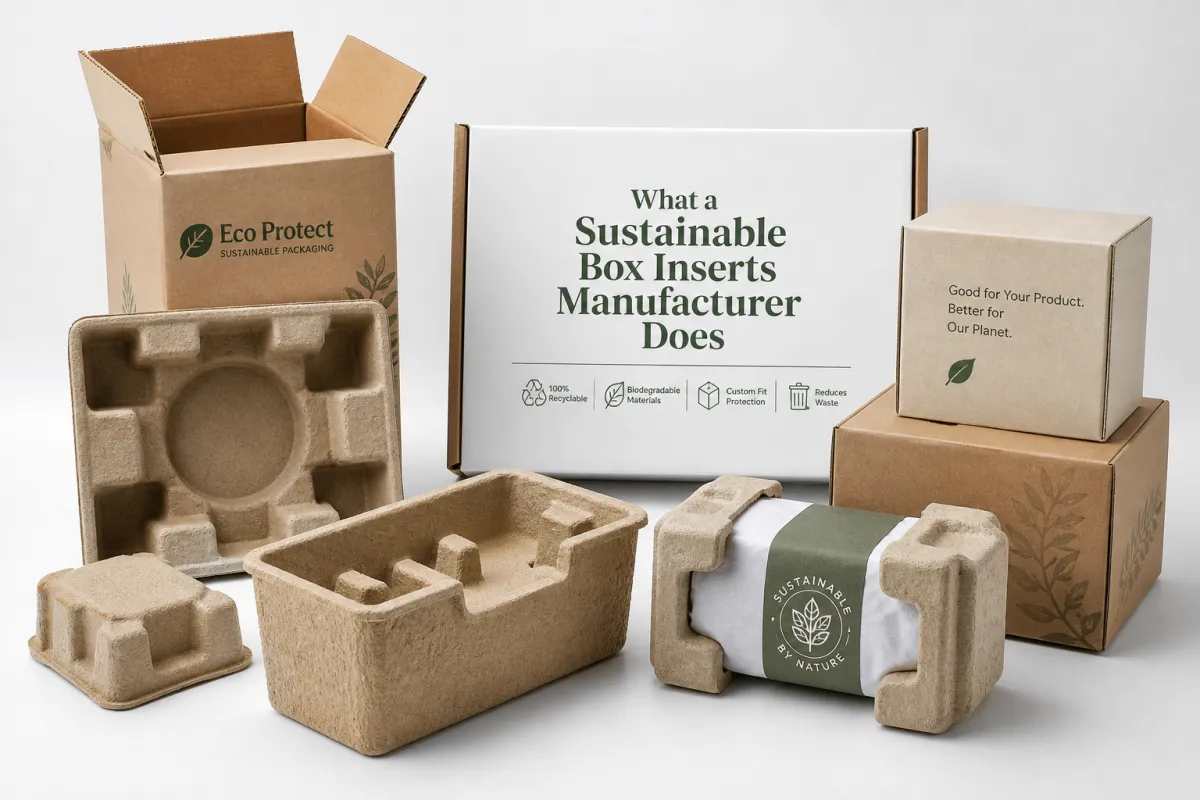
A sustainable box inserts manufacturer does a very practical job: it studies the product, the shipping method, and the box size, then builds an insert that holds the item in place with as little wasted material as possible. That sounds simple, yet the work is more technical than many buyers expect. The fit has to be tight enough to stop movement, gentle enough not to scuff a finish, and efficient enough to avoid using plastic where fiber can do the same job with less impact. The fit has to be right, not kinda right.
That balance matters because the insert often decides whether the package arrives intact. A rigid outer carton can still fail if the product bounces inside it. A sustainable box inserts manufacturer looks at the entire pack-out, not just the outer box, which means thinking about shock, vibration, compression, and presentation as one connected system. When the insert is designed well, the carton can be smaller, void fill can drop, and the finished pack feels more deliberate in the hand.
Here is the part many brands miss: the insert is not filler. It is a structural piece that helps the package survive the trip from warehouse to customer. A reliable sustainable box inserts manufacturer builds that structure from materials such as paperboard for lighter products, molded fiber for formed cushioning, corrugated for added rigidity, and pulp or fiber blends where a custom contour is needed. The right choice depends on product weight, surface finish, and the way the box moves through the supply chain.
That is why inserts matter across so many categories. Cosmetics need a clean, premium presentation and a snug home for bottles, jars, and pumps. Electronics often need cavity control, accessory separation, and protection against corner impacts. Subscription boxes want a neat reveal that still holds up in transit. Fragile products like glassware, ceramics, and specialty food items need controlled movement and a material that can absorb abuse without falling apart before it reaches the customer. A sustainable box inserts manufacturer has to think through all of that before the first sample is cut.
In the shop, the failure mode I see most often is not dramatic damage; it is slow, unglamorous motion inside the box. A part shifts a few millimeters, a finish rubs, a cap scuffs, and the claim shows up later as a return or a complaint. That kind of issue is exactly why a good sustainable box inserts manufacturer spends time on tolerances instead of just chasing a neat drawing.
A good insert does three jobs at once: it protects the product, helps the box pack out faster, and keeps the brand from shipping unnecessary air.
From a buyer's point of view, the best sustainable box inserts manufacturer is the one that can explain not only what the insert is made of, but why that material fits the product and the shipping lane. If the answer is vague, the result usually is too. Clear design logic, clean geometry, and realistic performance expectations are what separate a true packaging partner from someone selling a cut piece of board.
How a Sustainable Box Inserts Manufacturer Designs the Insert
The design workflow usually starts with product dimensions, but the real starting point is fragility. A sustainable box inserts manufacturer will want to know where the product can tolerate pressure, where it cannot, whether surfaces scratch easily, and how much movement is acceptable before damage becomes likely. That information then becomes a CAD layout or structural concept that defines the cavities, folds, cutouts, tabs, and lock features that keep the item stable.
Once the geometry is mapped, the manufacturer chooses the material path. Paperboard works well for lighter goods and a clean presentation, especially when the product has simple lines and the insert does not need heavy cushioning. Molded fiber brings more contour and cushioning, which makes it a strong option for formed protection around bottles, small appliances, and accessories. Corrugated structures add stiffness and can be layered to improve crush resistance for heavier packs. Pulp and fiber blends can shape around irregular items and help reduce the need for plastic trays or foam. A skilled sustainable box inserts manufacturer picks the material after the performance need is clear, not before.
Design for Fit, Not Guesswork
Fit is where much of the value sits. A box that is too large invites movement, while an insert that is too tight can make product removal frustrating and even cause scuffing during opening. The better sustainable box inserts manufacturer designs to the actual product, not to a generic template. That means measuring the real unit, checking the tolerances on caps or lids, and deciding how much clearance is needed for easy packing without letting the item rattle.
Some projects call for tabs or finger cutouts so the customer can lift the product out cleanly. Others use nesting, which helps finished inserts stack more efficiently in production and reduces freight volume. Both choices affect cost, and both shape the experience the customer has the moment the box opens. The best sustainable box inserts manufacturer keeps that balance in view from the beginning.
There is also a quiet manufacturing detail that buyers sometimes overlook: a well-placed fold or score can do more for pack-out consistency than a thicker board ever will. I have watched teams try to solve a fit issue by specifying more material, only to end up with a stiffer insert that is harder to assemble and no better at protecting the product. Usually, the smarter answer is in the geometry, not the bulk.
Test the Structure Before Scaling
Before a full run is approved, strong manufacturers sample and test the insert under realistic conditions. That usually includes fit checks, drop testing, stacking pressure, and pack-out timing. Many teams use methods aligned with ISTA test standards, while others adapt internal tests based on their own products and shipping lanes. The point stays the same: a drawing does not prove itself just because it looks tidy on screen.
For products with sharper edges or painted finishes, the testing phase matters even more. A molded insert may hold the item securely, but if it presses too hard on one edge, the finish can mark during transit. A paperboard design may look elegant, but if the compression strength is too low, the insert can collapse under stacking loads. A reliable sustainable box inserts manufacturer keeps revising the geometry until the design protects the item without creating new problems.
Experienced buyers know the final answer is rarely to use more material. A better answer is often a smarter fold, a different cavity depth, or a change in board caliper. That is where packaging expertise really shows itself. A small adjustment to a shoulder, pocket, or corner radius can do more than doubling thickness in the wrong place. On a busy line, that kind of detail is gonna matter fast.
Key Factors to Compare Before You Choose a Sustainable Box Inserts Manufacturer
Choosing a sustainable box inserts manufacturer gets easier when you compare suppliers against the same set of practical criteria. The first question is always the product itself: how heavy is it, how fragile is it, what is the finish like, and does it ship alone or with accessories? A glass bottle with a metal cap needs a different insert than a light cosmetic set or a multi-component electronics kit. If the product profile is unclear, the quote will be too.
The second question is sustainability, but that should be tested carefully rather than accepted at face value. Ask what percentage of recycled content is in the fiber, whether the structure is curbside recyclable in the target market, whether the material is compostable under a recognized standard, and whether the sourcing carries credible chain-of-custody documentation. If fiber claims matter to your brand, the FSC standards are worth understanding because they help confirm responsible forest management and traceability. A sustainable box inserts manufacturer should be able to explain those claims clearly without hiding behind vague eco language.
Structural performance is the third filter. Compression strength, cushioning response, moisture sensitivity, and edge crush resistance all matter, especially if the product travels through humid warehouses, mixed delivery networks, or repeated handling. Some inserts look impressive in a sample room but weaken in a damp lane. Others look plain and still perform better because the geometry is honest and the fibers are oriented well. A sustainable box inserts manufacturer should be able to discuss those tradeoffs in plain language.
Brand experience belongs in the comparison too. A premium insert can make an ordinary box feel more deliberate, while a rough or dusty insert can cheapen the whole package. Texture, print quality, cut accuracy, and the ease of opening all affect how the customer perceives value. If the insert is visible at the first reveal, it becomes part of the brand story. A thoughtful sustainable box inserts manufacturer will ask about the unboxing sequence, not just the dimensions.
Supplier capability matters just as much as materials. Can the team prototype quickly? Can they hold color or fiber consistency across repeat orders? Do they have quality checks in place for die-cut tolerances, fiber density, or insert height? Can they scale from a pilot run to recurring monthly production without redoing the setup every time? Those questions sound operational, but they protect schedule and budget. A strong sustainable box inserts manufacturer will answer them directly.
| Insert Material | Best For | Typical Unit Cost Range | Protection Profile | Sustainability Notes |
|---|---|---|---|---|
| Paperboard | Light products, retail kits, clean presentation | $0.10-$0.24 | Good for fit and organization, lighter cushioning | Often recyclable, especially with fiber-based builds |
| Molded fiber | Bottles, small appliances, formed product protection | $0.18-$0.42 | Strong contour support and better shock absorption | Usually fiber-based with lower plastic use |
| Corrugated insert | Heavier items, shipping kits, extra rigidity | $0.16-$0.35 | Better crush resistance and stacking performance | High fiber content, widely recycled in many markets |
| Pulp or fiber blend | Irregular items, premium formed protection | $0.20-$0.50 | Custom contouring and steadier hold | Can reduce plastic trays and foam inserts |
That table is not a price promise, because actual quotes move with size, tooling, waste rate, and order volume. Still, it gives a useful starting point. A sustainable box inserts manufacturer should be able to explain why one option sits at the low end of the range and another climbs higher because of mold complexity, print treatment, or assembly labor.
If you are comparing suppliers, build a simple scorecard. Ask each sustainable box inserts manufacturer to rate the design against protection, sustainability claims, unit cost, lead time, and pack-out speed. That keeps the conversation grounded. It also makes it easier to separate real engineering from polished sales language.
Process and Timeline: From Brief to Production
The production path usually moves through a handful of clear steps: discovery brief, structure concept, prototype, revisions, pre-production approval, and then the full run. A good sustainable box inserts manufacturer keeps each step visible, because that is how surprises stay small. If a product or box dimension changes late, the schedule can slide fast, so the earlier the team locks those details, the better.
A complete brief makes a real difference. The most useful inputs are the product sample, the final or near-final outer box size, the target pack count, shipping method, dimensional tolerances, branding needs, and any special handling notes. If the item is temperature-sensitive or has a delicate finish, say so early. If the insert needs to fit alongside cables, manuals, or sample sachets, say that too. A sustainable box inserts manufacturer can design around complexity, but only if the complexity is known.
Typical Timing Signals
Simple structures can move faster, especially if the product dimensions are stable and the material is standard. More complex designs take longer because sample revisions are part of the process. A realistic timeline often stretches when tooling is custom, when the material is specialty fiber, or when the client asks for a sustainability change after the layout is already approved. Those changes are normal, but they cost time.
As a rough planning guide, brands often see concept work and first samples move within several business days, then revisions add another round or two, and production follows after sign-off. The exact schedule depends on the manufacturer's queue, the raw material availability, and how quickly approvals come back. A responsive sustainable box inserts manufacturer should share checkpoints rather than leaving you guessing.
Communication cadence matters more than many teams expect. A checkpoint after the first concept, another after the prototype, and a final sign-off before tooling or full production starts usually keeps the job on track. That matters even more if you are protecting a launch date. A sustainable box inserts manufacturer that surfaces fit problems early can save a brand from expensive rework later.
Packaging buyers sometimes focus only on the sample, but the sample is just one stage. The real test is whether the design can be made the same way, at the same quality, across the entire order. That is why process discipline matters. A sustainable box inserts manufacturer with a clean approval flow usually delivers a more predictable result than one that improvises after the first prototype.
Cost, Pricing, MOQ, and Quote Factors
Pricing from a sustainable box inserts manufacturer usually comes down to five variables: material type, insert size, cavity complexity, finishing requirements, and order volume. That is the short version. The longer version is that each of those variables affects yield, labor, and freight density, which means the lowest-looking quote is not always the lowest-cost result.
MOQ is another key factor. Custom inserts often need setup work, dielines, and tooling, so low quantities can carry a higher per-unit cost because the fixed expense is spread across fewer pieces. A brand ordering 1,000 units will usually pay more per insert than a brand ordering 10,000 units, even if the material is the same. That is normal, and any sustainable box inserts manufacturer worth working with should explain it without confusion.
Hidden costs deserve equal attention. Waste rate during production can push a quote up if the geometry is difficult. Assembly labor matters if the insert requires folding or gluing. Freight density matters because a bulky insert can raise shipping costs even if the raw material itself is inexpensive. Damage reduction matters too, because a slightly better insert can save money through fewer returns, fewer replacements, and less repacking labor.
Here is a simple way to read a quote from a sustainable Box Inserts Manufacturer: if one supplier is a little cheaper but needs more assembly time, more storage space, or more product protection in the field, the apparent savings may disappear. A better insert can reduce total packaging cost, not just line-item unit cost. That is the metric buyers should track.
| Quote Item | What It Usually Means | Why It Changes Cost |
|---|---|---|
| Tooling or die setup | Custom shaping, cutting, or forming preparation | Fixed cost that spreads across the order |
| Sample rounds | Prototype revisions before approval | Extra labor and material before full production |
| Print or finish | Branding, texture, coating, or special treatment | Adds process steps and sometimes slower throughput |
| Freight density | How much space the insert occupies in transit | Larger or less nestable designs raise shipping cost |
| Assembly time | Seconds needed per pack-out | Labor cost rises if the insert is awkward to build |
That is why procurement teams should ask for more than a unit price. Ask for tooling, sample fees, freight assumptions, and whether the sustainable box inserts manufacturer includes design support in the quote or charges separately for it. Sometimes a supplier with a slightly higher price is actually the better value because the team has already solved the fit problem before production starts.
One more practical point: if the insert design reduces damage, the savings can show up far beyond the packaging budget. Fewer breakage claims, fewer reships, and less customer frustration are all real financial outcomes. A sustainable box inserts manufacturer that understands the whole cost picture can help a brand make a much better decision.
Common Mistakes When Sourcing Sustainable Box Inserts
The biggest mistake is choosing a material because the eco language sounds good instead of checking whether it actually protects the product. A paper-based insert can be an excellent choice, but only if the geometry, thickness, and board grade fit the load. A molded fiber tray can look like a strong sustainability win, but if it is too soft for the lane or the product weight, the damage rate will rise. A sustainable box inserts manufacturer should help you test the function before you commit to the story.
Another common problem is poor dimensional planning. Brands sometimes design an insert around the outer box first and the product second, which is backward. If the product shifts, crushes, or sits crooked in the cavity, the finished pack looks improvised and ships poorly. A sustainable box inserts manufacturer will usually ask for the exact item dimensions and tolerances because the insert needs to fit the product, not the marketing mockup.
Skipping sample testing is another expensive habit. A first prototype can look excellent on a desk and still fail in a fulfillment center. Workers may pack differently than expected, products may be loaded at higher speed, and shipping abuse may be harsher than the design assumed. That is why a serious sustainable box inserts manufacturer will push for real-world testing before scale-up.
Assembly time is easy to ignore, but it can erase savings fast. If a sustainable insert takes twice as long to pack as the existing setup, labor cost climbs immediately. On a busy line, even a few extra seconds per unit can matter. The right sustainable box inserts manufacturer will ask how the insert performs in the pack-out room, not just in the design file.
There is also a tendency to over-specify. Some brands jump to the thickest board or the most complex molded shape because it feels safer. Often that is not the smartest move. A lighter structure with better geometry may use less material and perform better. Many packaging programs get bloated for that reason: the package becomes heavier, harder to source, and no more protective than a simpler design from a skilled sustainable box inserts manufacturer.
Another quiet mistake is forgetting the people who will actually build the pack. If an insert needs extra folding steps, awkward hand placement, or fiddly tabs, the line will slow down whether the spec sheet admits it or not. I have seen great-looking concepts get pulled apart by production because the pack-out rhythm just did not fit the design. That part is easy to miss from a sample room, but not from a busy table full of cartons.
- Do not assume "recyclable" means "right for this product."
- Do not approve a design before checking fit with the actual item.
- Do not skip line trials if assembly speed matters.
- Do not treat sample testing as optional if the product is fragile.
- Do not ignore moisture, compression, or shipping lane conditions.
Expert Tips and Next Steps With a Sustainable Box Inserts Manufacturer
The best way to work with a sustainable box inserts manufacturer is to start with the product and the shipping problem, then choose the material and structure second. That order matters. If you start with a material preference first, the design can get forced into a shape that does not truly serve the item. If you start with the item, the insert can be built around the actual load, the actual finish, and the actual way the box will move through the chain.
Ask for samples that include the exact product, the outer box, and the shipping method whenever possible. A good sample on its own is useful, but a sample inside the real carton tells you far more. You can check product removal, box fit, cushioning, and presentation in one pass. That is the kind of practical review a sustainable box inserts manufacturer should welcome.
Use a Simple Decision Sheet
Before choosing a final design, create a comparison sheet with five columns: material, protection level, sustainability claim, lead time, and unit cost. Add a sixth column for assembly time if your pack-out line is busy. That gives every stakeholder a clearer view of what matters and keeps the conversation from drifting into vague preferences. A sustainable box inserts manufacturer can usually help fill in the technical details if you bring the sheet to the discussion.
I also recommend a short internal pack-out trial. Have the warehouse team or fulfillment partner build the pack, close the box, and stack a small sample pallet if that reflects your real process. Watch where the time goes. Watch whether workers fight the insert or trust it. Watch whether the product comes out cleanly. Those small observations often reveal more than a polished presentation ever will.
Do not be shy about asking for honest tradeoffs. A sustainable box inserts manufacturer should tell you if a lighter material is better for one part of the pack and a stiffer material is better for another. In some cases, a hybrid approach makes sense, with a paperboard component for presentation and molded fiber for cushioning. In other cases, a single fiber-based design is enough. The best answer is the one that protects the product, holds the schedule, and keeps waste down.
If your brand is tightening its packaging standards, this is also a good time to review your broader structure choices with the team at About Custom Logo Things. Inserts do not live alone; they work with the box, the print, the fill, the closure, and the shipping lane. A strong sustainable box inserts manufacturer helps you see that whole system clearly.
My practical advice is simple: audit the current damage points, gather product specs, request samples and quotes, and compare no more than two or three serious options side by side. That process keeps the decision grounded. It also makes it much easier to choose a sustainable box inserts manufacturer that can support the next order, not just this one. Start with the actual product, the actual box, and the actual shipping lane; everything else gets a lot clearer after that.
A sustainable box inserts manufacturer is most valuable when the goal is not just to reduce plastic, but to build a packaging system that ships cleanly, protects the product, and feels right for the brand. If you take the time to compare fit, structure, timeline, and total cost, the right sustainable box inserts manufacturer can lower waste, reduce returns, and make the unboxing moment feel more deliberate from the first shipment to the last.
How do I choose a sustainable box inserts manufacturer for fragile products?
Start with fit, cushioning performance, and drop protection before you look at aesthetics. Ask the sustainable box inserts manufacturer for samples with your actual product so you can test movement, compression, and removal, and confirm the material works for your shipping lane rather than only in theory.
What materials are most common for sustainable box inserts?
Paperboard is a strong choice for light products and clean presentation, while molded fiber and pulp are often better for cushioning and formed protection. Corrugated and fiber-based hybrids can add rigidity for heavier or multi-item packs, and a good sustainable box inserts manufacturer will choose the structure based on the product, not just on the material trend.
How long does the process usually take with a custom insert manufacturer?
Simple projects can move fairly quickly if product dimensions and branding are already locked, while complex inserts usually need more time for prototyping and revisions. Lead time also depends on tooling, material availability, and approval speed, so a sustainable box inserts manufacturer should give you checkpoints instead of a single vague promise.
What affects the cost of custom sustainable box inserts most?
Material choice, geometry, and order volume usually drive the biggest price changes. Tooling, sample rounds, print or finish requirements, freight density, and assembly time can also move the quote, which is why the best sustainable box inserts manufacturer will talk about total packaging cost, not just the unit number.
Can a sustainable box inserts manufacturer help reduce packaging waste?
Yes. The right design can use less material, replace plastic components with fiber-based structures, and reduce void fill by tightening the fit around the product. The best results come from matching the insert to the item, the outer box, and the shipping method, and that is exactly where a strong sustainable box inserts manufacturer adds value.


