Buyer Fit Snapshot
| Best fit | Sustainable Kraft Boxes Wholesale for Growing Brands projects where brand print, material claims, artwork control, MOQ, and repeat-order consistency need to be specified before quoting. |
|---|---|
| Quote inputs | Share finished size, material target, print colors, finish, packing count, annual reorder estimate, ship-to region, and any compliance wording. |
| Proofing check | Approve dieline scale, logo placement, barcode or warning zones, color tolerance, closure strength, and carton packing before bulk production. |
| Main risk | Vague material claims, crowded artwork, missing packing details, or unclear freight terms can make a low unit price expensive after revisions. |
Fast answer: Sustainable Kraft Boxes Wholesale for Growing Brands should be specified like a repeatable production item. The safest quote records material, print method, finish, artwork proof, packing count, and reorder notes in one written spec.
Production checks before approval
Compare the actual filled-product size with the drawing, then confirm tolerance on folds, seals, hang holes, label areas, and retail display edges. Reserve space for logos, QR codes, warning copy, and material claims before decorative graphics fill the panel.
Quote comparison points
Review material grade, print process, finish, sampling route, tooling charges, carton quantity, and freight assumptions side by side. A quote is only useful when the supplier can repeat the same color, closure quality, and packing count on the next order.
Sustainable Kraft Boxes Wholesale is not just a packaging line item; it affects shipping performance, product protection, shelf presentation, and the first impression a customer forms before the product is even out of the box. A well-built carton can cut down on filler, reduce transit damage, and make better use of pallet space. A poor fit does the opposite, and the cost of that mistake usually shows up after the shipment has already gone out the door.
Brands return to Sustainable Kraft Boxes wholesale because the numbers are easier to control. If you are sending the same jar, candle, supplement bottle, or apparel set every week, you need a box that behaves the same way every week too. Once volume repeats, packaging stops being a nice extra and starts acting like a real operating expense that needs attention. That matters whether your run is 1,000 pieces or 100,000, and it matters a lot more than people expect.
Kraft has a kind of visual honesty that glossy cartons often miss. It feels grounded, practical, and intentional without trying too hard. Many brands prefer that look in categories where trust matters, especially food, beauty, apparel, candles, and supplements. A clean kraft box can support sustainability claims, but it also supports the basics that keep orders moving: quick packing, clean stacking, and a box that arrives in one piece.
Why Sustainable Kraft Boxes Wholesale Beat Off-the-Shelf Packaging
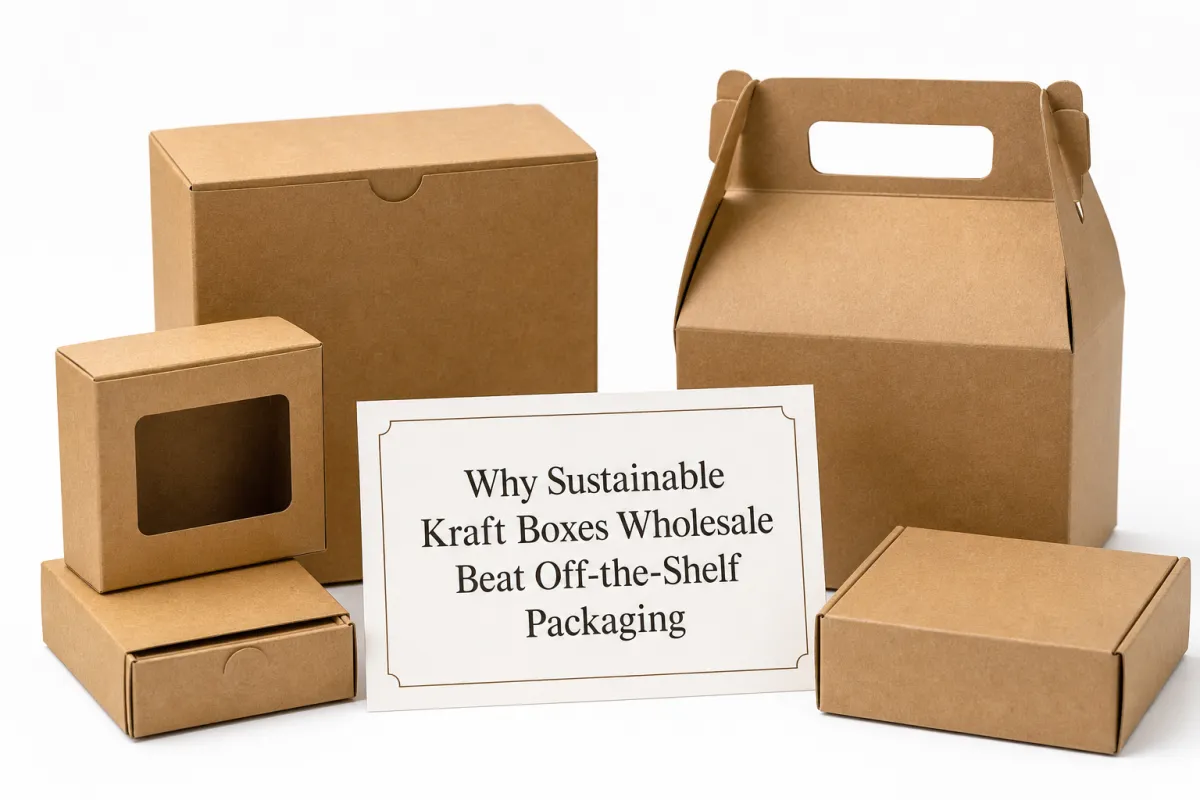
Generic retail cartons are built to fit many products, not your product. That broad approach often leaves too much empty space, adds void fill, and pushes freight higher than it needs to be. Sustainable kraft boxes wholesale gives you a way to build around the item instead of forcing the item into a box that was never meant for it in the first place.
Small sizing mistakes add up fast. A box that is only 1/2 inch too large on each side can demand extra paper stuffing, reduce the number of units that fit on a pallet, and create weak points that show up as corner crush during shipping. I have seen packaging teams spend more time compensating for the wrong size than they would have spent correcting the spec early. With sustainable kraft boxes wholesale, the carton can be built from the product outward rather than from a guess inward, and that difference shows up in packout speed, freight cost, and fewer headaches for the receiving team.
Wholesale ordering matters because consistent brands need consistent numbers. Seasonal SKUs, subscription kits, and recurring e-commerce bundles all benefit from a box structure that can be repeated without surprises. sustainable kraft boxes wholesale supports that kind of stability. It gives the buyer a cleaner path for forecasting packaging spend, which is useful when margins are tight and replenishment windows are narrow.
There is a perception benefit too. Kraft suggests restraint. It tells the customer the brand cares about material use and does not need to hide behind a lot of decorative noise to make a point. That works especially well for food, beauty, apparel, candles, and supplements, where the package should feel trustworthy without sliding into cheap or throwaway. Sustainable kraft boxes wholesale fits that middle ground with little fuss.
If a box saves 20 grams of filler but fails a corner drop, the savings never really happened. The cost just moved to returns, replacements, and customer service time.
Buyers who plan well usually ask a better question than “What does it cost?” They ask what the box removes from the workflow. Less filler, fewer damaged units, less unused air, and fewer packaging variants to manage all carry real value. That is the business case behind sustainable kraft boxes wholesale, and it is often stronger than the unit price alone suggests.
Brands that see the biggest gains tend to share a common need: repeatability. Food companies want a subscription mailer that stays consistent. Beauty brands want retail-ready cartons for sets and PR boxes. Apparel brands need protection for folded garments without adding bulk. Candles and supplements need a structure that protects narrow or fragile items without turning every packout into a balancing act. For each of them, sustainable kraft boxes wholesale is a working tool, not a branding flourish.
Sustainable Kraft Boxes Wholesale: Styles, Uses, and Print Options
No single box style fits every product. The right structure depends on the item, the shipping method, and the kind of unboxing experience the brand wants to create. That is why sustainable kraft boxes wholesale usually starts with shape and function before design embellishment enters the conversation.
Tuck end boxes are a familiar choice for lightweight retail products, sample kits, and presentation pieces. They are economical, easy to assemble, and well suited to a simple logo or a clean one-color design. Mailer boxes are better for direct-to-consumer shipping because they are rigid, stack neatly, and open in a satisfying way. Sleeve boxes create an outer branding layer that works well for gift sets and bundled products. Two-piece boxes often suit premium presentation, especially for launches that need a deliberate reveal. Display boxes and product boxes fit retail shelves, counters, and promotional programs where visibility matters as much as protection.
A useful rule separates shipping packaging from display packaging. If the box spends most of its life in transit, structure should carry the decision. If it spends most of its life in a customer’s hand or on a shelf, the opening experience and visual balance matter more. Sustainable kraft boxes wholesale can serve both roles, but the design brief should not be the same. A courier box needs crush resistance and reliable closure. A merchandising box needs readable graphics, clear hierarchy, and a presentation that works quickly in the hand.
Print choices change the feel of the package more than many teams expect. A single-color logo on kraft can look cleaner than full-coverage artwork because the paper texture stays visible. Spot color suits brands that want a controlled palette without a lot of complexity. Interior printing can create a strong reveal for gift sets or subscription kits. Embossing and debossing add tactile detail, though they bring extra tooling and setup. Window cutouts can show product color or shape, but they should be used thoughtfully if recovery streams matter. Labels are useful for short runs and seasonal SKUs, especially when artwork changes often.
There is a sweet spot many packaging teams settle into: enough customization to feel intentional, not so much that the box becomes costly, slow to produce, or harder to recover. That balance is one of the strongest reasons buyers move toward sustainable kraft boxes wholesale. The natural look of kraft becomes part of the design instead of something the design has to fight against.
For many buyers, a simple starting framework looks like this:
- Shipping-first: mailer box, internal fit, simple logo, minimal ink.
- Retail-first: tuck end or two-piece box, stronger shelf graphics, clearer product messaging.
- Gift or set packaging: sleeve or rigid-style presentation with insert support.
- Subscription packaging: mailer box with repeatable internal fit and sturdy closure.
- Promotional kits: product box with insert, inner print, and controlled unboxing.
Sustainable kraft boxes wholesale should match the customer journey, not just the SKU. That mistake comes up often: a brand chooses a style because it looks good in a mockup, then learns it works poorly in transit or assembly. A pretty mailer that collapses under stack pressure is still a problem. A plain box that ships cleanly and displays neatly usually wins in the long run.
Specifications That Matter: Size, Board, Finish, and Strength
Specification work is where sustainable kraft boxes wholesale either becomes a dependable system or a steady source of complaints. Size, board selection, finish, and structural details all affect cost and performance. Miss one of them, and the box starts leaking money in ways that never show up cleanly on the first quote.
Start with internal dimensions, not outside dimensions. Product clearance needs to account for inserts, closures, nesting, and any protective layer that sits between the item and the board. A bottle with a label may need a little more room than the bare container. A candle jar with a lid may need top clearance plus a paperboard cradle or insert. Sustainable kraft boxes wholesale should be specified with enough tolerance to protect the product, but not so much extra room that the packout shifts around inside the carton.
Board choice should follow the job. Lightweight paperboard fits presentation boxes and retail cartons. Corrugated kraft makes more sense for transit-heavy packaging, especially where compression or stacking pressure becomes part of the equation. Within corrugated, flute profile matters: E-flute can give you a tighter print surface and a cleaner retail appearance, while B-flute or a stronger profile may be a better option when protection matters more. For heavier products or longer distribution chains, a better board can be the cheaper choice once returns and damage are counted. That is one of the less glamorous truths about sustainable kraft boxes wholesale.
Finish should be judged with recovery in mind. Uncoated kraft is the simplest path and is usually the easiest for recycling streams to handle. Water-based coatings can improve scuff resistance without making the package feel overly sealed. Soy inks are often a practical choice for brands that want a lower-impact print approach. Heavy film lamination can improve appearance, but it may complicate recyclability depending on local acceptance rules. A careful buyer asks whether the finish adds real value or only adds shine.
For a wider view of packaging terminology and design discipline, the resources at packaging.org are useful. For transit performance, ISTA test protocols are worth reviewing, especially if you are shipping fragile goods or moving volume through multiple carriers. Those standards are practical tools, not marketing language, and they help define how a first production run of sustainable kraft boxes wholesale should be evaluated before it reaches customers.
Engineering details matter just as much. Dielines need to be clean. Glue areas need to be sized correctly. Tear strips should open in the intended direction. Window film, if you use it, should be selected carefully because mixed-material components can affect recovery and can also introduce variation if the adhesive spec is vague. On a busy line, those are not small issues. They are the difference between a smooth assembly process and a stack of boxes that fights the packer every time.
Quality control should reach beyond a visual check. Compression strength, corner integrity, moisture exposure, and stack stability all matter, especially in warehouses that palletize mixed cartons. Heavy, dense, or humidity-sensitive products need the board grade and structure tested under realistic handling conditions. A kraft box that looks fine on a table can still fail after a few days in a humid loading dock. Strong sustainable kraft boxes wholesale programs are built with testing in mind.
A practical specification checklist helps keep the order accurate:
- Internal dimensions with product clearance and insert allowance.
- Product weight and any fragile areas that need support.
- Board type, flute profile, or paperboard grade.
- Print colors, coverage level, and inside/outside print needs.
- Finish choice, window use, and any special closure features.
- Stacking, shipping, and storage expectations.
The strongest sustainable kraft boxes wholesale programs feel ordinary in the best sense. They assemble cleanly. They stack cleanly. They protect the product without unnecessary drama. That kind of result only happens when specifications are treated as operating requirements rather than an afterthought.
Sustainable Kraft Boxes Wholesale Pricing, MOQ, and Volume Breaks
Price is where many buyers begin, but it should not be the only place they look. Sustainable kraft boxes wholesale pricing depends on style, board, print coverage, special finishes, inserts, tooling, and order size. The quote may look simple. The economics underneath it rarely are.
Blank or stock-style runs usually cost less at the start because the structure already exists and setup work is lighter. Custom dielines add value by fitting the product more closely, but they also bring tooling and prepress steps. More print colors increase press time. Complex finishes add labor and slow throughput. Inserts add material and assembly time. If a buyer wants a low number but also wants a custom structure, metallic ink, a window, a sleeve, and a full-color inner print, the budget tells the truth early.
MOQ should be treated as a planning tool, not a hurdle. Lower volumes work for launches, limited-edition runs, and SKU validation. Higher volumes lower the unit rate because setup costs are spread over more pieces. For sustainable kraft boxes wholesale, the better question is not “What is the cheapest quantity?” It is “At what quantity does this become efficient enough to justify storage and cash flow?” That question tends to lead to better decisions.
Ask for tiered quotes. Two or three quantity breaks show where the unit cost falls and where the savings start to flatten out. That makes it easier to compare a test run against a full production run. It also shows whether carrying extra inventory is worth the discount. Sometimes it is. Sometimes it is not. A buyer who can see the breakpoints is in a better position than one who only sees a single line item for sustainable kraft boxes wholesale.
Landed cost should always be part of the comparison. Freight, palletization, packaging protection during shipment, and storage all belong in the real number. A box that is $0.03 cheaper per unit but ships inefficiently can become the expensive choice quickly. If the cartons are large, heavy, or packed in a way that wastes cube space, freight can erase the savings. That is why solid sustainable kraft boxes wholesale quotes should be read as part of a full system, not as a sticker price.
| Box Type | Typical Use | Common Material | Approx. Unit Cost at 5,000 pcs | Notes |
|---|---|---|---|---|
| Blank tuck end | Light retail items, samples, small kits | Paperboard | $0.16-$0.32 | Lowest setup burden; good for simple branding. |
| Printed mailer box | DTC shipping, subscriptions, bundles | Corrugated kraft | $0.42-$0.88 | Better crush resistance; print coverage affects cost fast. |
| Sleeve with inner tray | Gift sets, seasonal launches, premium kits | Kraft board or corrugated | $0.55-$1.10 | More assembly steps; strong presentation value. |
| Two-piece presentation box | High-end retail, PR boxes, display packs | Rigid-style board or thick paperboard | $0.95-$2.40 | Elevated look, but material and labor are higher. |
| Custom mailer with insert | Fragile products, cosmetics, supplements | Corrugated kraft plus paperboard insert | $0.58-$1.35 | Insert design can reduce damage and improve unboxing. |
Those ranges are directional, not promises. A narrow box with a single-color print is a different job from a large subscription mailer with full coverage and an insert. Even so, the pattern stays the same: sustainable kraft boxes wholesale rewards clarity. The more exact the specs, the easier it is to land a quote that reflects reality rather than guesswork.
Storage is another point that gets missed. A higher volume order can improve unit pricing, but only if the warehouse has room for the finished boxes. Packaging is light, yet it takes space quickly. A pallet that looks manageable on paper can become a storage problem once it reaches your site. Smart sustainable kraft boxes wholesale buying balances cash, space, and reorder timing instead of treating unit price as the only win.
From Quote to Delivery: Process and Timeline
The quickest packaging project is the one that begins with complete information. For sustainable kraft boxes wholesale, the usual workflow is straightforward: send specs, receive a recommendation, approve the dieline and artwork, review a sample, and move into production. Delays usually begin when the project starts with gaps or assumptions.
Clear dimensions matter. Product weight matters too, because shipping and board choice depend on it. If you already know the print count, finish, insert requirements, and destination, the supplier can prepare a quote that sits much closer to reality. If the project includes a second SKU or another size, mention that early. It can reduce revision rounds later. Sustainable kraft boxes wholesale moves faster when the buyer makes the job easy to read from the start.
Samples are not all the same. A digital mockup can show placement, panel balance, and artwork flow, but it does not prove structure or board behavior. A physical sample shows fit, closure, and hand feel. A pre-production sample is the closest dress rehearsal before the full run because it mirrors the final build more closely. If the product is fragile or expensive, ask for that stage. It is far cheaper than learning about a flaw after the pallets have already shipped.
Timeline depends on complexity. A simple one-color run with no insert and a clean dieline can move quickly. Add multi-color print, a window, special finishing, or a custom insert, and the schedule stretches. That is normal. What matters is understanding why. Sustainable kraft boxes wholesale is not slow by nature; it becomes slow when the project brief keeps changing after approval has already started. Keeping the scope stable saves a lot of grief.
Shipping coordination deserves more attention than it usually gets. Production completion is not delivery. Freight booking, customs clearance if relevant, final-mile scheduling, and receiving appointments all need time. Many packaging teams treat the box as “done” once production ends, but the warehouse only cares about when the pallet arrives and whether the labels can be read quickly.
A practical order sequence keeps the project moving:
- Confirm product dimensions, weight, and target quantity.
- Choose the box style and board type.
- Approve the dieline and placement of graphics.
- Review the sample or pre-production proof.
- Lock the production slot and freight window.
- Plan the next reorder before stock gets tight.
Sustainable kraft boxes wholesale works best when the timeline is built around decision speed. One owner or one packaging lead should own approvals. If five people review the dieline, the project slows. If one person signs off with clear instructions, the order moves. That sounds simple because it is, and it usually keeps everyone from chasing the same file around for a week.
For brands shipping into retail or e-commerce programs with stricter validation, transit testing can be worth the time. A carton that passes a distribution simulation is more likely to arrive looking like a product and not like a refund. Testing is not overkill when the product value is high. It is insurance with a measurable purpose.
Why Choose Us for Sustainable Kraft Boxes Wholesale
Custom Logo Things is positioned as a packaging partner, not a catalog reseller. That matters because sustainable kraft boxes wholesale is rarely solved by picking the first box that looks close enough. It is solved by matching structure, board, print, and order planning to the way your product actually moves through the supply chain.
A manufacturing-first approach gives buyers more control over the details that tend to cause delays. Color consistency matters. Cutting accuracy matters. Board sourcing matters. Repeat-order stability matters even more. If a brand is planning a monthly replenishment cadence, the last thing it needs is a different result every time it reorders. Stable sustainable kraft boxes wholesale programs reduce that kind of noise.
Transparent quoting matters too. A quote should show what changes the price instead of hiding it. If a finish raises cost without improving the customer experience, that should be said plainly. If a simpler structure will hold the product just as well, that should be said as well. Honest feedback does not weaken a project. It keeps the packaging budget intact.
That kind of service also reduces handoffs. Fewer intermediaries usually means fewer communication gaps, fewer rounding errors on dimensions, and fewer “we thought you meant” conversations. With sustainable kraft boxes wholesale, a cleaner path from concept to approval can save time in ways that are hard to measure at first and easy to appreciate later.
If you want to see how a repeatable order process is structured, review our Wholesale Programs page. If you are still comparing box types, browsing our Custom Packaging Products can help narrow the format before you request a quote. That usually saves more time than guessing at the wrong structure for another week.
Sustainability credibility should feel practical, not theatrical. Recyclable materials, efficient packout, and designs that reduce filler all help. So does avoiding unnecessary laminations or mixed materials when the brand does not need them. Sustainable kraft boxes wholesale works best when the environmental claim is backed by material choices that make operational sense too. Buyers notice that. Retailers notice it as well.
There is a commercial benefit to working with a supplier that speaks in specifics. If a supplier can discuss board grades, print coverage, lead time, and damage risk in the same conversation, the project usually moves more cleanly. That kind of detail-driven support matters when the packaging has to perform in shipping and still look good on arrival.
Next Steps for Your Sustainable Kraft Boxes Wholesale Order
If you are ready to move, start with the facts. Send the product dimensions, product weight, box style preference, print count, quantity target, and shipping destination. Those six items are enough to build a serious first quote for sustainable kraft boxes wholesale. Add insert requirements, finish preferences, and any retail display constraints if they matter to your line.
The fastest comparison usually comes from two material options and two quantity tiers. That gives you a realistic picture of how structure and volume affect price. It also shows whether a slightly different board or closure style could improve strength without pushing the budget too far. For buyers working through a launch, this is a practical way to approach sustainable kraft boxes wholesale because it turns opinions into numbers.
A solid buyer checklist should include the following:
- Final product dimensions and weight.
- SKU count and reorder frequency.
- Desired print areas and color count.
- Storage room for finished inventory.
- Damage tolerance and shipping method.
- Decision deadline for artwork and sample approval.
Once the sample is approved, lock the production slot and align freight timing. Then set the reorder trigger before the first run is even in transit. That habit sounds cautious, but it is usually what keeps shelves full and campaign launches on schedule. It also keeps sustainable kraft boxes wholesale from turning into a last-minute emergency purchase with a worse unit price.
Here is the part many buyers overlook: the box should earn its place in the program every time it is used. It should protect product, support the brand, and move efficiently through the warehouse. If it does those three things, it is doing real work. If it only looks good in a render, it is not finished yet. Choose sustainable kraft boxes wholesale with that standard in mind, and the packaging will start paying its own way.
Frequently Asked Questions
What is the minimum order for sustainable kraft boxes wholesale?
MOQ depends on box style, dimensions, and print complexity. Blank or stock-style runs can start lower, while custom printed or specialty structures usually need a higher quantity to cover setup efficiently. Ask for tiered quotes so you can compare launch volume against repeat-order pricing for sustainable kraft boxes wholesale.
Are sustainable kraft boxes wholesale recyclable?
Uncoated kraft and paperboard are typically recyclable. Heavy lamination, mixed materials, and certain window films can change local acceptance. Water-based coatings and minimal finishing usually make recovery easier, which is one reason many buyers favor simpler sustainable kraft boxes wholesale builds.
How long do custom sustainable kraft boxes wholesale orders take?
Timeline starts after dieline, artwork, and quantity are approved. Simple orders move faster; printed, windowed, or insert-heavy projects take longer. Build in time for proofing, sample review, production, and freight booking. That schedule keeps sustainable kraft boxes wholesale realistic instead of optimistic.
Can I print full-color branding on sustainable kraft boxes wholesale?
Yes, but coverage and color count affect cost, lead time, and recyclability. One- or two-color designs often look cleaner on kraft and keep the natural paper texture visible. Ask for a print method recommendation before approving artwork so your sustainable kraft boxes wholesale order lands where you want it visually and commercially.
What should I send for an accurate quote?
Final dimensions, product weight, and the box style you want are the starting point. Add quantity, print colors, finish, and any insert or window requirements. Delivery ZIP or port also helps estimate freight and landed cost correctly. The more complete the request, the more precise the sustainable kraft boxes wholesale quote will be.


