Buyer Fit Snapshot
| Best fit | Kitting Cost Optimization projects where brand print, material claims, artwork control, MOQ, and repeat-order consistency need to be specified before quoting. |
|---|---|
| Quote inputs | Share finished size, material target, print colors, finish, packing count, annual reorder estimate, ship-to region, and any compliance wording. |
| Proofing check | Approve dieline scale, logo placement, barcode or warning zones, color tolerance, closure strength, and carton packing before bulk production. |
| Main risk | Vague material claims, crowded artwork, missing packing details, or unclear freight terms can make a low unit price expensive after revisions. |
Fast answer: Kitting Cost Optimization: Material, Print, Proofing, and Reorder Risk should be specified like a repeatable production item. The safest quote records material, print method, finish, artwork proof, packing count, and reorder notes in one written spec.
Production checks before approval
Compare the actual filled-product size with the drawing, then confirm tolerance on folds, seals, hang holes, label areas, and retail display edges. Reserve space for logos, QR codes, warning copy, and material claims before decorative graphics fill the panel.
Quote comparison points
Review material grade, print process, finish, sampling route, tooling charges, carton quantity, and freight assumptions side by side. A quote is only useful when the supplier can repeat the same color, closure quality, and packing count on the next order.
what is kitting cost optimization? It is the discipline of lowering the total cost to build, pack, store, and ship a kit while keeping the product presentation intact and the production line sane. I have watched a five-piece mailer in a Shenzhen packing room look inexpensive on a spreadsheet at $1.18 in material cost, then climb to $1.94 once the team counted the extra hand-fold, the second label pass, and the tiny but real delay from a tray that did not sit square the first time. That is what is kitting cost optimization in plain terms: reduce the landed cost per finished kit by balancing labor, materials, packaging, storage, freight, and rework instead of chasing the cheapest carton on the first line of the quote.
I have spent enough time around packaging lines in Dongguan, Los Angeles, and Chicago to know that a $0.12 savings in one component can disappear fast if it adds two more hand motions and another QC check. A spec change can also go the other way, dropping the unit cost by $0.15 on a 5,000-piece run while making the pack line cleaner and faster, which is the sort of improvement a production manager notices right away. That is what is kitting cost optimization really means on the floor. Not theory. Not presentation math. Real margin control built into the way the kit is assembled and shipped.
Promotional kits, subscription boxes, retail bundles, sample packs, and onboarding kits all hit the same pressure point: every unique touch adds labor, waste, and freight risk. I have seen teams obsess over a product that cost $1.40 and ignore $0.22 of assembly, $0.08 of rebagging, and $0.31 of outbound dimensional weight, and then wonder why the quote feels off before the first master carton leaves the dock. What is kitting cost optimization? It is the habit of making that math visible before production starts, while there is still time to change the spec instead of absorbing the cost after the goods are already wrapped, counted, and palletized.
What Is Kitting Cost Optimization? Start With the Real Margin Leak
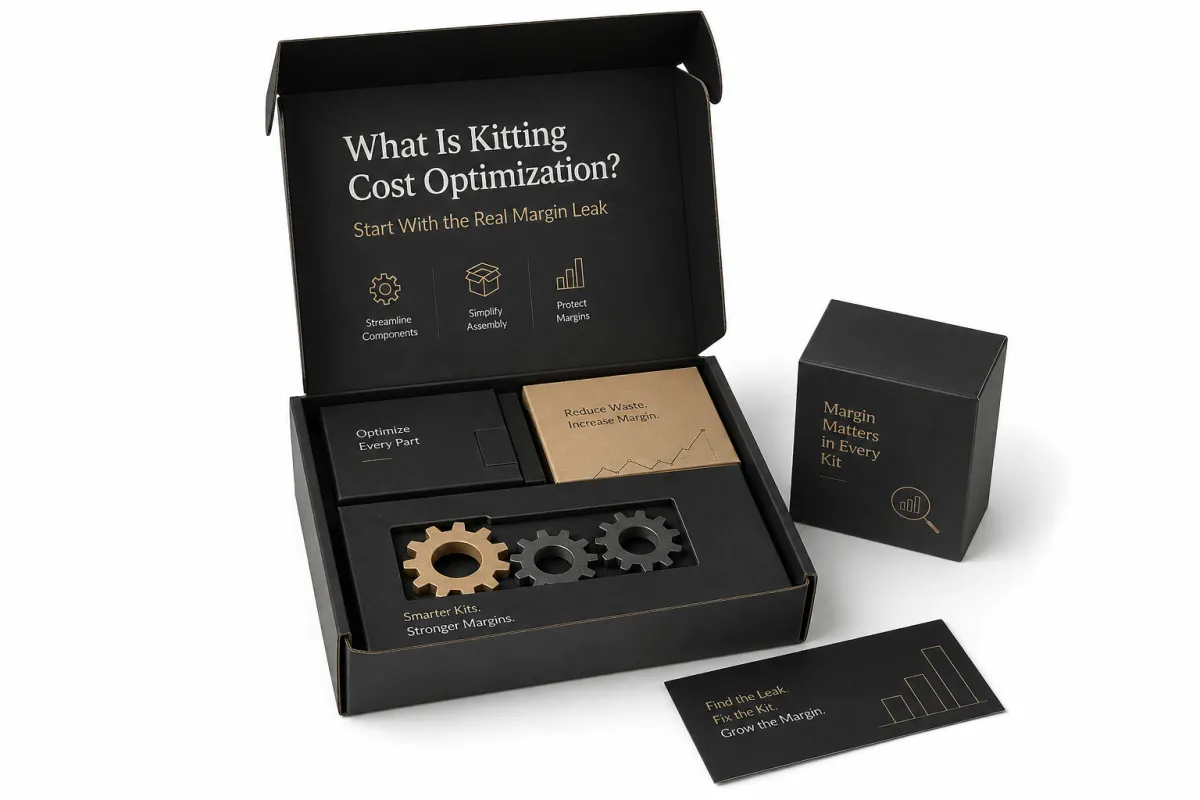
I once stood beside a packing line in our Shenzhen facility and watched a "simple" five-piece kit cost more in labor than the products inside it. The components were not the problem. The process was. Two inserts, one tissue wrap, one sticker, one instruction card, and one final seal sounds harmless on paper. In practice, those six touches became 11 actions because someone had to rotate the box, straighten the card, recheck the label, and re-tape the corner that kept lifting. That is the first lesson in what is kitting cost optimization: the cheapest component is not always the cheapest kit, especially when a 14-second delay repeats 2,000 times in a single shift.
The core idea stays simple. What is kitting cost optimization? It is reducing the total landed cost per kit by balancing four things at once: labor, components, packaging, and shipping. If your carton costs $0.28 less but adds 18 seconds of hand assembly, you may have increased the real cost per piece by $0.19 once overtime and QA checks are counted. I have seen buyers celebrate a low material quote in USD, then stare at the finished invoice in a Guangzhou office wondering why the total still feels heavy. The answer usually sits inside setup charges, touch labor, storage days, and rework. Paper savings are pleasant. Margin savings pay the bills.
This matters across promotional kits, retail bundles, subscription boxes, and sample packs because each category carries a different pain point. Promotional mailers often suffer from oversized packaging and waste that adds $0.14 to $0.40 in freight per carton. Subscription boxes get hurt by SKU chaos and late substitutions that add 1 to 3 business days. Retail bundles get hit by compliance labels and pack-out order, while sample packs get wrecked by tiny components that need hand counting on a table in Miami, Dallas, or Pittsburgh. What is kitting cost optimization? It is the method for cutting those weak spots down to size so fewer errors slip through and the line keeps moving at a predictable rate of 180 to 240 units per hour.
"We cut the labor on a 3,000-piece onboarding kit by $420 just by changing the insert sequence and standardizing the inner tray. Same products. Less drama. The line in our Suzhou shop went from 9.5 minutes per case to 7.8 minutes per case."
That quote came from a client meeting where the buyer expected the cheapest supplier to win. The winning quote separated materials, assembly, and outbound freight into clear line items, which made the tradeoffs obvious instead of fuzzy. What is kitting cost optimization without visibility? Guesswork with a polished cover sheet. I want the Cost Per Unit, the MOQ, the changeover time, and the rework allowance before I sign off on anything. If a supplier cannot show those four numbers, they are not pricing the kit. They are pricing hope, and hope does not keep a warehouse in Savannah or Rotterdam on schedule.
The business value shows up fast. Lower cost per assembled unit. More predictable production. Less scrap. Better control over margin when volumes shift from 1,000 to 10,000. Cleaner replenishment planning. What is kitting cost optimization if not a way to keep the quote honest when a client asks for a rush add-on or a second SKU? I have seen teams lose 12 points of margin on a project simply because the pack-out steps were never priced correctly in the first place, and a missing insert created 3 hours of line downtime on a Friday afternoon. That kind of miss is the sort that makes a finance team go quiet, which is usually the loudest kind of angry.
- Promotional kits: the biggest wins usually come from reducing hand-folding, extra tissue, and custom inserts with too many bends, especially on 250 to 1,000-piece runs.
- Subscription boxes: the strongest savings often come from cutting SKU count from 9 to 5 and tightening replenishment timing by 3 to 5 days, which can reduce receiving labor in a warehouse outside Atlanta or Phoenix.
- Retail bundles: better labeling, fewer special wraps, and one common shipper can trim rework by 15% to 20% and reduce case pack errors by 1 out of every 75 units.
- Sample packs: pre-counted components and a simple pouch format can beat a fancy carton by $0.10 to $0.25 per kit, especially when the goods are assembled in batches of 500 or 1,000.
What is kitting cost optimization also depends on quote structure. I want to see what is included, what triggers extra labor, and what happens if one component is short by 8% or late by 2 business days. A buyer who understands that structure can compare suppliers without guessing which line item hides the pain. The rest of this piece covers the product specs, the packaging details, the MOQ math, the production timing, and the quote format that keeps hidden fees from slipping in through the side door.
How Do You Calculate What Is Kitting Cost Optimization?
The quickest way to answer what is kitting cost optimization is to calculate landed cost per kit with all the real variables included. Start with component cost, then add pack-out labor, secondary packaging, storage, inbound receiving, outbound freight, and a rework allowance. If a carton change saves $0.08 but adds 12 seconds of labor and a second QC scan, the math is not in your favor unless the line speed improves somewhere else.
I usually break the calculation into a simple sequence:
- Materials: count every component, insert, label, wrap, and outer shipper.
- Labor: include assembly time, packing time, QC checks, and any hand-fold or hand-count step.
- Shipping: factor dimensional weight, pallet pattern, and case pack efficiency.
- Risk: add rework, sample revisions, spoilage, and late-art penalties.
Once those pieces are visible, what is kitting cost optimization becomes easier to manage. A supplier can show you whether the biggest savings come from reducing touch labor, simplifying the tray, or shrinking the carton footprint. That is also where the best decisions usually live: in the small changes that reduce handling time and keep the finished kit inside the right freight tier.
On a 3,000-unit program, a $0.05 reduction in materials sounds modest until it removes one packing motion and saves another $0.04 in labor. On a 10,000-unit program, that same change can pay for a better insert, cleaner packing instructions, or a sturdier shipper. The point is not to chase the cheapest single line item. The point is to compare total cost per finished kit and protect margin before production starts.
There is one more piece people forget: quality loss. A kit that ships with a 2% rework rate is not just annoying, it is expensive, because every reopened carton eats labor twice and often pushes a finished pallet into a later freight window. That part does not always show up in the first quote, which is why I like to ask for the rework assumption right away. If a team says "we almost never see issues," I usually ask them how they define almost. That answer tells me more than the price does.
Product Details That Move Kitting Cost Optimization Fast
The product mix is where what is kitting cost optimization either gets easier or turns into a headache. A kit with one box, one card, and one sealed pouch is straightforward. A kit with seven mixed-size items, two fragile components, a ribbon, a hangtag, and a QR insert is not. I have priced both, and the difference can be $0.14 to $0.60 per kit before freight even enters the conversation, especially if the build is happening in a facility in Shenzhen or a contract packer near Chicago. If the product mix changes every week, the line slows down and the labor quote climbs. No supplier magic fixes a bad assortment design, no matter how polished the sample photos look.
Standardizing components is the fastest route to better what is kitting cost optimization. Fewer unique SKUs means less picking time, less inventory confusion, and fewer chances to ship the wrong combination. On one cosmetics project in Dongguan, we reduced the active component count from 11 to 6 and shaved 22 minutes off every 100 kits, which mattered once the run hit 8,000 units and the client had a fixed ship date in 14 business days. A kit with common outer cartons, one insert size, and one seal label is simply cheaper to run than a kit with five one-off pieces and three bag sizes that all need separate handling.
Certain product types raise labor cost on sight. Fragile glass bottles need more handling and more inspection. Odd-shaped components need more orientation. Mixed-size bundles create more sorting and more mis-picks. Kits that require hand-folding or special wrapping add time in the exact place where production gets expensive: the human hand. What is kitting cost optimization in those cases? It is often choosing the packaging format that fits the product instead of forcing the product to fit a brochure idea that looked beautiful in a deck and terrible on the floor of a warehouse in Ontario, California.
Shipping economics matter just as much as assembly. A lighter, denser pack almost always ships better than an oversized kit with empty air inside the carton. I have seen a 14-ounce bundle ship at a lower freight tier than a 9-ounce kit simply because the 9-ounce version had a huge footprint and triggered dimensional-weight pricing on a ground lane to Denver and Minneapolis. That kind of penalty can wreck a smart quote in one stroke. What is kitting cost optimization if not the practice of reducing wasted volume, not just product weight? Nobody gets a bonus for paying to move air around the country in a 24 x 18 x 8-inch shipper.
For influencer mailers, onboarding kits, trade show packs, and subscription inserts, the product details can make or break the margin. An influencer mailer with a 1-inch foam insert and a magnetic closure may look premium, but it can add $0.35 in labor and $0.19 in material cost immediately, and the closure can add one extra inspection pass. A trade show pack with a folded brochure, sample sachet, and welcome card can stay lean if the items are pre-sorted and the pack-out order is fixed. What is kitting cost optimization? It is knowing which category needs premium feel and which one just needs to arrive intact in Nashville, Orlando, or Edmonton.
- Influencer mailers: usually benefit from one outer box, one molded insert, and pre-applied labels to avoid hand-positioning delays and reduce seal errors by 10% to 15%.
- Onboarding kits: work better with a fixed sequence, such as card first, product second, then paperwork, because it cuts mispacks on desks in New York or Austin.
- Trade show packs: are cheaper when literature is folded to the same finished size and packed in case quantities of 25 or 50, which keeps replenishment simple.
- Subscription inserts: save money when the outer mailer stays unchanged for at least 3 to 4 cycles, so setup charges are spread out across more than one production window.
Many buyers overcomplicate the product mix. They add one extra pouch, one extra sticker, and one extra card because it feels branded. Fine. If those additions add 12 seconds to every pack and the run is 6,000 units, you just paid for a small engine and a half day of labor in a contract shop outside Hanoi or Ningbo. What is kitting cost optimization? Sometimes it is the discipline to remove one decorative layer and keep the offer profitable. I have had to tell clients, politely, that a foil belly band is not a personality trait, and a 0.2 mm emboss line does not justify $0.08 of extra handling.
There is also a practical note on color, finish, and coating. A soft-touch lamination on a carton feels premium, but it can scuff differently than a gloss aqueous coat and may need different nesting during assembly. A heavy black flood print can look dramatic and still slow the line because it shows fingerprints. If the goal is cost control, I usually ask whether the finish supports the sale or just supports the mood board. That question sounds blunt, but it saves real money.
Packaging Specifications for Kitting Cost Optimization
If the spec sheet is sloppy, the quote will be sloppy. That is not a philosophy; it is a production fact repeated every week in factories in Shenzhen, Dongguan, and Kuala Lumpur. What is kitting cost optimization without a clear spec sheet? A supplier guessing at dimensions, material thickness, and pack-out order. Before anyone quotes your kit, send the finished dimensions, component weights, material type, print coverage, quantity per kit, insert count, and the exact sequence for packing. A difference of 2 mm in box depth or 0.5 oz in component weight can change the tray layout and the shipping carton selection, and that can alter the unit cost by $0.04 to $0.11.
The tolerance issues are where money disappears quietly. Box fit matters because a tray that is 3 mm too tight slows the line and a tray that is 4 mm too loose creates damage risk. Insert depth matters because the product should sit flush, not float 1/8 inch above the cavity. Adhesive strength matters because a weak seal creates rework on every 40th unit. Barcode placement matters because a label that covers a seam can fail scan checks in a warehouse in Dallas or Louisville. What is kitting cost optimization? It is making these tolerances visible before the first sample leaves the bench, not after someone has already burned through an afternoon with a craft knife and a frustrated look.
I still remember a purchasing call where a buyer said, "The box is the box." No. The box is not just the box. If you are using a 350gsm C1S artboard with soft-touch lamination, the finish changes the folding behavior, the scuff resistance, and the packing speed. If you are printing full coverage on a darker sheet, there may be extra ink cost and a 12 to 18 hour longer dry time. If you need an FSC-certified board, that can change the sourcing pool and the lead time by 2 to 4 business days. You can confirm certification guidance through FSC, and if you are evaluating transport or drop-testing concerns, the ISTA library is worth a serious look for 1A and 3A test references.
Compliance and damage control matter too. Retail-ready labels, lot tracking, moisture protection, and clear handling instructions reduce breakage and rework. If the kit is going into humid storage in Houston or Singapore, I will ask about polybag thickness, desiccant needs, and the warehouse dwell time. If it is headed to a retail shelf, I want the case pack count, the pallet pattern, and the master carton strength. What is kitting cost optimization if not the effort to keep the product from becoming a refund later? I have seen one cheap-looking sleeve turn into a very expensive apology because nobody asked where it would sit for three weeks on a warm dock.
Missing specs create hidden cost in three places: sample revisions, extra approvals, and rework. I have seen a project burn 9 days because the buyer sent a carton size without the insert height and the supplier had to rebuild the prototype twice. That extra cycle cost $180 in sample tooling and another $240 in line delay, plus one missed Tuesday ship window. If your measurements are clear, your quote is easier to compare and your MOQs are more honest. If your measurements are vague, every supplier pads the risk differently, and you lose apples-to-apples pricing. That is classic what is kitting cost optimization failure, and it is avoidable with one careful measurement pass and a tape measure marked in millimeters.
There is a smaller detail that still matters a lot: how the art files are delivered. If the dieline arrives as a clean, locked PDF with bleed, trap, and callouts already marked, the sample desk can move faster. If the file comes in as a screenshot with arrows drawn in email, somebody ends up guessing, and guessing is expensive. I have had more than one project saved simply because the print buyer sent a proper artwork pack instead of a loose folder with half-finished filenames. That kind of discipline pays for itself.
- List the finished size in millimeters, not "small" or "medium."
- State every component weight, even if it is only 0.8 oz or 23 g.
- Specify the pack-out order so nobody improvises at the table or on the conveyor.
- Call out print coverage, lamination, and any FSC or recycling requirements, including a 350gsm C1S artboard if that is the spec.
- Include case pack count, pallet count, and the launch date in business days, such as "ship by the 14th business day after proof approval."
The buyer rule is simple. The clearer the spec sheet, the easier it is to compare quotes from different suppliers without guessing what is included. What is kitting cost optimization at the spec level? It is removing ambiguity before the plant starts spending labor time on your behalf. A clean spec sheet saves money twice: once in the quote, and again on the floor in Shenzhen, Monterrey, or Indianapolis. It also saves a lot of annoyed back-and-forth, which I count as a real business benefit when a project manager is juggling three launches in the same week.
Pricing, MOQ, and What Drives Kitting Cost Optimization
Pricing for what is kitting cost optimization usually falls into four buckets: component cost, labor time, setup or changeover, and fulfillment touches such as storage, pick-and-pack, and outbound freight. Ignore any one of those and the quote is incomplete. A kit with cheap content can still carry a high total cost if the labor is manual and the storage window is long. I have seen a $0.74 component basket turn into a $2.11 finished kit because the assembly needed three people, a second check, and a custom shipper built from 32 E-flute board blanks.
MOQ logic is where many buyers get surprised. Smaller runs almost always cost more per kit because setup time and manual handling are spread across fewer units. A 500-unit run may carry $120 in setup charges and $65 in line balancing that a 5,000-unit run absorbs more comfortably. That is not a scam. That is math. What is kitting cost optimization if not understanding that your per-kit rate improves as the line gets more efficient and the supplier can buy in better bulk pricing on cartons, labels, and tissue sourced from a paper mill in Jiangsu or Wisconsin?
Custom print, sourcing complexity, and special assembly steps push pricing higher even when the pieces look cheap individually. A 1-color label at $0.04 can become a $0.11 line item if the artwork changes late and the supplier has to replate or reproof. A simple ribbon tie can add more labor than the entire card set, especially when the packer must pause to align the knot on 3,000 units. Tooling fees show up when you need a custom insert, a die-cut sleeve, or a mold that did not exist before. Those fees are fine if the volume supports them. They are frustrating if nobody warned you first. That is why what is kitting cost optimization needs line-item transparency, not fuzzy reassurance.
I always ask for a quote that breaks out per-kit assembly, per-component sourcing, inbound receiving, storage, secondary packaging, and shipping. If the supplier gives only one blended number, I know I will spend the next call untangling assumptions. What is kitting cost optimization? It is comparing true line items, not totals with hidden padding. A supplier that is honest about setup charges and rework assumptions is usually easier to work with than a supplier who promises a magic number and then backfills the invoice later. I have a strong opinion here: I would rather see a messy but honest quote than a pretty number that falls apart the moment the first pallet lands in Savannah or Felixstowe.
One more thing that matters is payment of time, not just dollars. If a design change saves $0.07 per unit but adds two extra days of sample approval, the value may still be positive for a long run and still be a poor choice for a launch that cannot slip. I have seen buyers make the right cost decision and the wrong schedule decision, and the schedule mistake cost more. So, yes, the numbers matter. The calendar matters too, and a late box is just an expensive box.
| Kit Type | Typical MOQ | Estimated Unit Cost | Common Setup Charges | Cost Driver |
|---|---|---|---|---|
| Simple mailer with 3 components | 500 to 1,000 units | $1.05 to $1.65 | $75 to $180 | Low touch labor, one carton size, standard labels |
| Retail bundle with insert card and label | 1,000 to 3,000 units | $1.70 to $2.85 | $120 to $260 | Labeling, compliance, case pack control, pallet wrapping |
| Influencer kit with custom insert and premium finish | 2,000 to 5,000 units | $2.90 to $5.40 | $200 to $450 | Custom die-cut, finish work, hand assembly, proof rounds |
| High-SKU sample pack with mixed items | 3,000 to 10,000 units | $1.25 to $3.10 | $95 to $220 | Picking accuracy, inventory sorting, recheck steps, receiving |
That table is not theory. Those ranges mirror the kind of pricing I have negotiated with carton suppliers in Shenzhen, finishing partners in the U.S. Midwest, and a pack-and-ship team in North Carolina. On one job, we shaved $0.15 per unit by changing from a custom two-piece tray to a standard fold-in insert, and the client saved another $310 by reducing the case pack from 20 to 24. That is what is kitting cost optimization looks like in the real world: a few specific changes that move the total by hundreds or thousands of dollars, not magical thinking and not wishful spreadsheets.
Watch out for fake-low bids. If a quote hides labor, warehousing, or rework assumptions, the final cost shows up later in a more annoying way. Usually that means "we did not include receiving," or "we assumed you would supply the labels," or "rush handling is extra after 3 p.m." I prefer a quote that says, "Here is the component cost, here are the setup charges, here is the labor rate, and here is the freight estimate." That kind of honesty makes what is kitting cost optimization measurable instead of mysterious. It also makes a supplier far less annoying to work with, which should count for more than people admit.
Process and Timeline for Kitting Cost Optimization Projects
The normal workflow is not glamorous, but it works. Start with a project brief, move to spec review, confirm sourcing, build a sample, approve the sample, run a pilot, then move into full production. What is kitting cost optimization inside that workflow? It is the discipline of making each step cleaner so the whole project runs with fewer surprises. On a well-managed program, spec review can take 1 to 2 business days, sample building 3 to 5 business days, and a pilot run another 2 to 4 business days depending on the kit complexity and whether the work is happening in Shenzhen, Mexico City, or a plant in the U.S. Midwest.
Timing gets wrecked by predictable delays: late artwork, missing components, unclear pack instructions, and approval loops that stall for 48 hours at a time. I had a client once who sent four artwork versions in 6 days and then asked why the sample moved slowly. Because the production team is not a fortune teller, and the proofing desk in Dongguan cannot guess which dieline is final. Better planning shortens the timeline. Pre-approved materials, stable artwork, and standardized pack-outs reduce sample churn and stop the line from waiting on decisions that should have been made in the first round. That is a hard requirement, not a nice-to-have. That is what is kitting cost optimization in a schedule.
Rush orders can be handled, but they usually cost more because they require overtime, prioritized line time, or simplified sourcing. I have seen a 10-day launch become a 6-day launch by using a standard mailer, pre-existing labels, and one common insert instead of a custom three-part tray. The rush saved the calendar, but it added $0.27 per unit in labor and freight, and the midnight shift in Suzhou still had to do one extra QC sweep. Sometimes that is the right trade. Sometimes it is not. What is kitting cost optimization? It is Choosing the Right trade instead of pretending every deadline should cost the same.
In one supplier negotiation, I pushed a converter to hold the unit price on a 4,000-piece run only if we locked the artwork by Thursday at 3 p.m. and skipped a second proof round. That saved the client $640 and protected the production slot. The boundary was simple: no last-minute edits, no holiday scheduling, no mystery substitutions. Buyers hate that kind of line in the sand until they see the invoice. Then they usually stop arguing. What is kitting cost optimization without a schedule and a boundary? Just stress with a purchase order number, and I have seen enough of that to last a lifetime.
The fastest projects are the ones where the kit is already defined before the supplier has to guess. If you know the finished size, component count, label style, and target ship date, the quote can stay clean and the sample cycle can stay short. I usually tell clients to think in 12- to 15-business-day blocks for a standard build after proof approval, longer if there is custom sourcing or a certification requirement such as FSC paper or a drop test against ISTA standards. What is kitting cost optimization? It is not speed for speed's sake. It is timing that protects margin and avoids rework in the final three days before launch.
- Best-case path: standard materials, 1 sample round, and a locked pack-out order, often finishing in 12 to 13 business days.
- Normal path: 2 sample rounds, 1 pilot batch, and 12 to 15 business days for a clean build with no artwork changes.
- Slow path: custom inserts, late art, and supplier substitutions that add 5 to 7 extra days and $0.08 to $0.22 per unit.
- Rush path: overtime and simplified sourcing, usually with a 10% to 20% cost bump and one fewer revision cycle.
If you want the process to stay efficient, decide early whether the goal is premium presentation, lowest cost, or a balanced middle. You cannot max out all three on a small MOQ and expect miracles. What is kitting cost optimization? It is acknowledging the tradeoffs before they become emergency calls at 8:30 p.m. I would rather have the uncomfortable conversation early than discover the expensive one after production has already started in a facility that is already committed to another run. That kind of honesty tends to save everyone a headache.
Why Choose Us and Your Next Steps
At Custom Logo Things, we keep the pricing honest. No padding, no mystery fees, and no pretending a messy kit can be quoted cleanly without specs. I have sat through enough supplier meetings in Shenzhen, Guangzhou, and San Diego to know the difference between a partner that understands production and one that only knows how to talk. The good ones ask about labor, packing sequence, MOQ, and rework before they talk about the pretty stuff. That is how what is kitting cost optimization stays grounded in real numbers instead of slide-deck optimism.
My own factory-floor experience taught me a blunt lesson: the quote that looks nicest in email is not always the best quote on the line. I have seen one plant save $0.06 on an insert and lose $0.14 in speed because the insert needed a tighter fold. I have also seen a customer save $1,100 on a 5,000-unit run by switching from mixed box heights to one common carton size and a 350gsm C1S artboard outer. That is the sort of practical detail you want from a packaging partner. What is kitting cost optimization without that kind of hands-on judgment? Thin, and usually expensive later.
Buyers care about five things most: clear MOQ, QA checks, sample photos, packing specs, and a quote that separates labor from materials instead of burying both. I care about those things too, because they tell me whether a project is going to run cleanly or fight every step of the way. If a supplier gives you a single lump-sum number with no line items, ask for a breakdown. If they cannot explain setup charges, ask again. If they dodge the question twice, move on. That is not attitude. That is risk control, and it matters on a 2,000-piece launch as much as on a 20,000-piece reprint.
"The line-item quote saved us from a $900 surprise fee on storage and receiving. I wish every vendor priced like this, especially for our 4,500-unit retail kit in Ohio."
Here is the action list I give clients before I quote a kit. Send the contents list, the target volume, the finished dimensions, the artwork files, the launch date, and any special packaging requirements such as FSC board, retail labeling, or drop-test concerns. If you already know the case pack count and pallet pattern, include those too. The more specific you are, the easier it is for us to build a fair estimate and protect the unit cost. What is kitting cost optimization? It starts with giving the supplier enough real information to price the job correctly the first time.
Then ask for a sample pack. Compare the per-kit math. Review whether the quote assumes one labor pass or three. Check whether tooling fees are included for a custom insert or sleeve. Use the sample results to decide whether to launch, revise, or simplify the kit. I have seen clients save more by cutting one decorative element than by haggling over a penny on the box. That is the boring truth, and boring truth is usually profitable. The glamorous version sells better in meetings, but the boring version is the one that keeps margin from leaking out through the floor in warehouses from New Jersey to British Columbia.
What is kitting cost optimization? It is the practice of making a kit cheaper to assemble, easier to ship, and less likely to go wrong, all without pretending margin is optional. If you want a line-item estimate for your kit, send the specs, the MOQ, and the timeline. We will tell you where the cost lives, what can be trimmed, and which parts are worth keeping. Then you can decide with actual numbers instead of guesses, which is a much nicer way to spend a budget than discovering a $0.23 overrun after the pallets are already sealed.
The clearest takeaway is pretty simple: treat kitting as a total-cost problem, not a parts-cost problem. If you can lock the spec, standardize the components, and force the quote to show labor, materials, freight, and rework separately, you will usually find the savings faster than by changing the product itself. That one habit does more for margin than most people expect, and it keeps the whole project a lot less messy.
What is kitting cost optimization in simple terms?
It is the process of lowering the total cost to assemble, package, store, and ship a kit, not just the price of the box or the products inside it. The fastest savings usually come from reducing labor touches, simplifying components, and tightening the spec sheet before production starts. In a 1,000-unit run, even a $0.10 improvement in unit cost can save $100 before freight, and a 5,000-unit run can save $500 without changing the product itself.
How does MOQ affect kitting cost optimization?
Lower MOQ usually means higher per-kit cost because setup, sourcing, and assembly time are spread over fewer units. Bigger, stable orders often unlock better bulk pricing on cartons, inserts, and labels, which brings down the cost per piece. I have seen a 500-unit job carry a $0.29 higher unit cost than a 5,000-unit version with the same materials, especially when the smaller order required more manual receiving and a separate proof round.
Which packaging details matter most for kitting cost optimization?
Finished dimensions, component weights, insert layout, pack-out order, and labeling requirements have the biggest impact on labor and shipping cost. If those details are unclear, the quote usually gets padded or the project gets delayed by sample revisions. A 2 mm change in depth or a 0.4 oz difference in weight can be enough to change the packing method, the carton size, and the freight tier on a shipment headed to Phoenix, Toronto, or London.
How long does a typical kitting project take?
Timing depends on component sourcing, artwork approval, and sample sign-off, but a standard project usually runs from spec review to pilot build before full production. A clean project can move in 12 to 15 business days after proof approval; a custom one with tooling fees or special inserts may need 18 to 22 business days. Projects move faster when materials are standardized and the supplier does not need to chase missing information from three different email threads.
How do I compare quotes for kitting cost optimization?
Compare line items for labor, materials, storage, receiving, and outbound freight instead of looking only at the total number. Ask each supplier what is included, what triggers extra charges, and whether the quote assumes rework, rush handling, or component sourcing. If one quote is $300 lower but excludes storage and receiving, it is not the better deal, especially if a 30-day warehouse hold adds another $120 in hidden charges later.
What should I send first if I want a quote?
Send the contents list, the finished dimensions, the target quantity, the artwork files, and the ship date. If you already know the case pack count, pallet pattern, or any certification requirements, include those too. The more the supplier knows up front, the less they have to guess, and that is usually where the real savings begin.

