Buyer Fit Snapshot
| Best fit | Sustainable Retail Paper Bags Price projects where brand print, material claims, artwork control, MOQ, and repeat-order consistency need to be specified before quoting. |
|---|---|
| Quote inputs | Share finished size, material target, print colors, finish, packing count, annual reorder estimate, ship-to region, and any compliance wording. |
| Proofing check | Approve dieline scale, logo placement, barcode or warning zones, color tolerance, closure strength, and carton packing before bulk production. |
| Main risk | Vague material claims, crowded artwork, missing packing details, or unclear freight terms can make a low unit price expensive after revisions. |
Fast answer: Sustainable Retail Paper Bags Price: Film, Print, MOQ, and Carton Packing should be specified like a repeatable production item. The safest quote records material, print method, finish, artwork proof, packing count, and reorder notes in one written spec.
Production checks before approval
Compare the actual filled-product size with the drawing, then confirm tolerance on folds, seals, hang holes, label areas, and retail display edges. Reserve space for logos, QR codes, warning copy, and material claims before decorative graphics fill the panel.
Quote comparison points
Review material grade, print process, finish, sampling route, tooling charges, carton quantity, and freight assumptions side by side. A quote is only useful when the supplier can repeat the same color, closure quality, and packing count on the next order.
Buyers usually begin with one blunt question: what is the sustainable Retail Paper Bags price? Fair enough. Bags look simple until the quote lands and suddenly the number moves because of a handle swap, a print tweak, or a size change that seemed harmless in email. I have seen a 5,000-piece reorder shift more from artwork and construction details than from the paper grade itself. That is why the sustainable retail paper bags price should be treated as a purchase decision, not a lone number in a spreadsheet.
From a packaging buyer's point of view, the cheapest bag is not always the lowest-cost choice. Freight, setup, minimum order rules, and print coverage can change the landed cost fast. A slightly higher sustainable retail paper bags price may cut damage, reduce waste, and keep a launch on schedule. For retail packaging, that matters more than a quote that looks great for five seconds and becomes a headache for five months.
This article breaks down what moves the sustainable retail paper bags price, which specifications deserve real attention, and how to compare quotes without getting trapped by hidden assumptions. The goal is simple: help you order with confidence, ask sharper questions, and buy the right bag for the brand, the budget, and the shelf.
Why Sustainable Retail Paper Bags Price Is More Than a Unit Cost
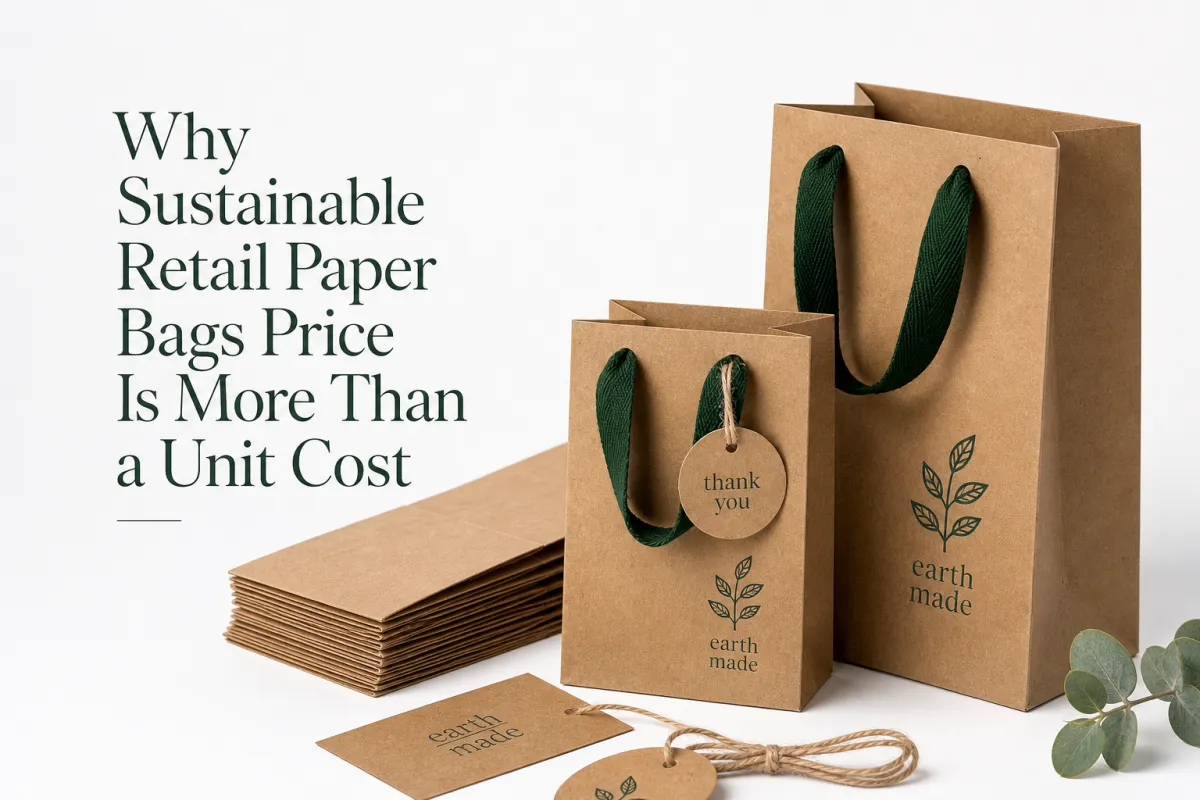
Picture a buyer reordering 5,000 Kraft Paper Bags for a boutique chain. The first quote looks fine. Then the artwork changes from one-color black to two-color spot print, and the price moves more than the stock choice did. That is normal. The sustainable retail paper bags price is shaped by production setup, ink coverage, handle assembly, carton packing, and freight. The paper is only one part of the equation.
Too many quotes get compared as if they were identical. They are not. One supplier may include export packing, another may not. One may quote ex-works, another may include inland transport to a consolidation warehouse. A third may show a low unit price but tuck the real cost into a separate plate charge. If the goal is a fair comparison, the buyer needs the same spec sheet, the same shipping term, and the same assumptions behind the sustainable retail paper bags price.
The market also behaves differently depending on the bag's visible finish. A simple natural kraft bag often sits in one pricing band, while a heavily printed retail bag with coated paper, reinforced top fold, and rope handles lands in another. On paper, they can look similar. In production, they are not. The same-looking bag can have a very different sustainable retail paper bags price because the paper source, trim loss, and assembly time are not the same.
That is why a quote that is 8% higher can still be the better value. If it cuts damage in transit, reduces store complaints, and avoids an emergency reorder, the total cost can be lower. The right way to judge sustainable retail paper bags price is to compare it against risk, not just against a competitor's number.
"The lowest quote is often the one with the least room for error. Once freight, artwork changes, and rework risk show up, the cheapest line item can turn into the most expensive decision."
For a practical benchmark, packaging teams often review cost alongside compliance and performance. The FSC framework helps buyers evaluate responsible fiber sourcing, while the EPA recycling guidance is useful when checking how a bag fits local recovery systems. Those references do not set the sustainable retail paper bags price, but they do shape the spec that is worth paying for.
From a procurement angle, a smarter approach is to separate three questions: what does the bag need to do, what does it need to look like, and what does it need to cost landed at the door? Once those are answered, the sustainable retail paper bags price becomes easier to judge. Without that structure, every quote feels like a guess.
I have had more than one buyer send me two "almost identical" quotes and then discover one omitted freight, one omitted proofing, and neither was actually comparable. That sort of thing happens all the time. Packaging pricing is not mysterious; it is just annoyingly easy to misread.
Sustainable Retail Paper Bags Price: Material, Size, and Print Drivers
Material choice is the first major lever on sustainable retail paper bags price. Natural kraft, recycled-content paper, FSC-certified stock, and heavier board all behave differently in the press and on the converting line. A 120gsm kraft bag with a simple one-color logo will usually price very differently from a 170gsm premium paper bag with full-coverage print and a reinforced base. The difference is not cosmetic; it reflects paper cost, conversion speed, and overall yield.
Size matters just as much. A small bag can be deceptively expensive if it needs an unusually deep gusset or a tall panel that creates more waste during sheet conversion. Larger bags use more fiber, but they also pack differently in cartons and on pallets. That affects freight. In practice, the sustainable retail paper bags price often changes because of carton density and shipping efficiency as much as because of the paper itself.
Handle choice is another major driver. Twisted paper handles are usually one of the most economical sustainable options. Flat handles can work well for utility retail, but they may add labor depending on the construction. Rope handles, while attractive, tend to lift the sustainable retail paper bags price because of component cost and assembly time. Die-cut handles sit in their own band; they can look clean and premium, but they may require stronger board or reinforcement to carry the same load.
Print is where many budgets get quietly stretched. A one-color logo on a kraft bag is straightforward. Add full-bleed coverage, white ink underprint, internal print, or multiple artwork panels, and the job becomes more complex fast. Each color may require extra setup, additional pass time, or tighter drying control. For a buyer comparing sustainable retail paper bags price, print coverage is often the biggest surprise after freight.
There is also a visible tradeoff between sustainability and finish. Soft-touch lamination, foil, heavy coatings, and decorative effects can make a bag look more polished, but they usually push the sustainable retail paper bags price higher and may complicate recyclability. The best value often comes from a restrained design that uses paper texture, a clean logo, and the right handle rather than piling on expensive finish work that customers will notice for two seconds.
Here is a practical comparison buyers can use as a first pass. The numbers are indicative only, but they show how fast the sustainable retail paper bags price changes once material and print choices shift.
| Option | Typical Spec | Indicative MOQ | Indicative Sustainable Retail Paper Bags Price | Main Cost Driver |
|---|---|---|---|---|
| Natural kraft bag | 120gsm kraft, twisted paper handle, one-color print | 3,000-5,000 pcs | $0.18-$0.34 per unit | Paper weight and setup |
| Recycled-content bag | 130-150gsm recycled stock, flat handle, one- or two-color print | 3,000-5,000 pcs | $0.22-$0.42 per unit | Material supply and print coverage |
| FSC retail bag | 150gsm FSC-certified kraft, twisted handle, custom sizing | 5,000 pcs+ | $0.24-$0.48 per unit | Certification, size, and freight |
| Premium printed bag | 170gsm board, rope handles, full-coverage print | 5,000-10,000 pcs | $0.38-$0.85 per unit | Finish, color count, and labor |
The table helps because it forces the right question: what do you actually need the bag to do? If the answer is "carry light apparel for a boutique launch," the highest-spec option may not be the best spend. If the answer is "carry heavier products, survive multiple handoffs, and reinforce brand value," a higher sustainable retail paper bags price may be justified. Price should follow function.
Product Details That Change the Quote Before You Order
Retail use case is the hidden cost driver that many teams miss. Apparel bags need presentation more than strength. Cosmetics bags often need a clean interior and sharp print registration. Gift shops may want a premium unboxing moment. Pharmacies and wellness stores usually care more about repeat use and load stability. Each scenario changes the sustainable retail paper bags price because the bag is solving a different problem.
Construction details matter in ways that are easy to overlook on a quote sheet. A reinforced base helps prevent blowouts. Handle patching improves durability on heavier loads. A tighter fold can make the bag look cleaner at the counter and also improve packing density. Tear resistance is especially important for stores that hand bags to customers quickly, because rushed handling exposes weak seams immediately. If a bag fails on the floor, the sustainable retail paper bags price savings disappear in a second.
Buyers also need to separate sustainability claims that sound similar but are not the same. Recycled content means the bag includes recovered fiber. FSC certification means the paper chain follows a verified sourcing standard. Water-based inks reduce solvent burden. Recyclable construction means the structure can fit local recycling systems, but that depends on coatings, laminations, and labels. Those details can all influence the sustainable retail paper bags price, and they are not interchangeable.
A stronger bag sometimes saves money despite the higher quote. Fewer breakages reduce replacement orders. Better load support lowers the chance of product damage. A cleaner, sturdier bag can also increase perceived value, which matters in premium retail. That is why the best sustainable retail paper bags price is rarely the lowest on a line item; it is the one that matches the actual store journey.
From a buyer's point of view, the best-performing spec is usually the one that avoids overdesign. Many brands do not need heavy lamination or elaborate internal print. A restrained logo, a paper-forward look, and a sensible handle style often deliver the best mix of brand impact and sustainable retail paper bags price. Simple is not cheap in a bad way. Simple is efficient when the product and the market support it.
If you are buying for several store formats, it helps to segment use cases before requesting quotes. A flagship bag and a daily carry bag do not need the same construction. A premium launch bag can justify more spend than a replenishment bag used every week. That segmentation keeps the sustainable retail paper bags price aligned with merchandising priorities instead of forcing every SKU to behave like a hero product.
And yes, sometimes the "prettier" option is the worse business decision. A shiny finish that looks good on a mockup can be a pain in production and can make recycling harder. Fancy is fine if the brand truly needs fancy. Otherwise, it is just extra cost wearing lipstick.
Specifications to Compare in Every Sustainable Retail Paper Bags Price Quote
The fastest way to compare sustainable retail paper bags price quotes fairly is to lock down the spec sheet first. If one supplier quotes a 250 x 120 x 320 mm bag and another quotes 240 x 110 x 310 mm, the unit prices are not directly comparable. Small size changes alter paper consumption, converting speed, and carton packing. The same is true for gsm, handle length, and reinforcement details.
Every quote should clearly state dimensions, paper GSM, print area, handle type, and any reinforcement at the top or base. Without that, the buyer may be comparing two different products with the same name. Tolerance matters too. A 2-3 mm size variance may not seem dramatic, but it can affect shelf presentation, internal fit, or retail display consistency. That is why the sustainable retail paper bags price must be tied to a written spec sheet, not just a sample image.
Dieline approval is another critical checkpoint. A proper dieline confirms the panel layout, fold lines, handle placement, and print-safe zones before production starts. If the dieline is wrong, the project can slip or require rework. Sample approval plays the same role on the physical side. A blank sample confirms dimensions and construction; a printed pre-production sample confirms color, placement, and finish. Both are worth the extra time because they lower the chance that the final sustainable retail paper bags price turns into a correction cost later.
Compliance should also be part of the comparison. For retail packaging, buyers often need to consider recycled-content claims, FSC sourcing, recycling compatibility, and sometimes food-contact requirements if the bag is used near edible goods. Store chains may also request certain board weights or print restrictions. A quote that ignores those points may look attractive, but the sustainable retail paper bags price could rise once the missing requirement is added back in.
Here is the practical rule: compare only matched specs. Same size, same paper, same handle, same print method, same packaging, same freight assumption. If one quote includes carton labeling and another does not, the lower number is not a true lower cost. The most reliable sustainable retail paper bags price is the one built from apples-to-apples assumptions.
Core spec checklist:
- Exact dimensions, including gusset depth and handle drop
- Paper type and GSM
- Handle style and reinforcement
- Print colors, coverage, and finish
- Packaging method and carton count
- Freight term and delivery location
Some buyers also ask for transit testing references, especially if the bag will travel long distances or hold heavier goods. In those cases, ISTA handling methods can be relevant because they help define how packaging should perform in distribution. The point is not to over-engineer the order. The point is to make the sustainable retail paper bags price reflect the actual risk profile of the product.
Pricing, MOQ, and What Your Budget Really Buys
MOQ is where many first-time buyers get surprised. The sustainable retail paper bags price per unit usually falls as quantity rises because setup cost gets spread across more bags. That does not mean the lowest MOQ is the worst choice. It means the buyer must understand the curve. A 1,000-piece order may carry a much higher unit price than a 5,000-piece run, even if the bag looks identical.
For a typical custom retail bag, budget planning often falls into three rough bands. Entry-level runs may sit in the higher per-unit range because labor and setup are heavy relative to volume. Mid-volume runs usually produce the best balance of price and flexibility. Larger runs can unlock meaningful savings, but only if storage, color consistency, and demand forecast support the bigger buy. The smart approach is to ask for tiered quotes so the sustainable retail paper bags price can be compared at 1,000, 3,000, 5,000, and 10,000 units side by side.
Several line items shape the final number. Paper weight changes material cost. Handle type changes both component cost and assembly time. Print colors increase setup complexity. Finishing adds labor. Packaging format affects carton count and freight. If the supplier quotes separately for plates, proofs, or tooling, those charges need to be added into the landed total. A good sustainable retail paper bags price conversation does not stop at the unit rate; it includes every cost required to receive saleable bags at the destination.
Hidden charges are where procurement teams can lose margin without noticing. Proofs may be included or billed separately. Palletization can change freight. Split shipments often increase the landed cost per bag. If the order is going into multiple retail locations, distribution charges can matter as much as the production cost. Buyers should ask whether the sustainable retail paper bags price includes final packing, outer cartons, and any regional delivery surcharge.
Below is a simple way to think about how the budget typically behaves:
- Small run: Highest unit price, best for product testing or limited launches.
- Mid run: Usually the best value zone for stable retail demand.
- Large run: Lower unit price, but greater storage and forecast risk.
The most efficient order is not always the largest one. If a design is still changing, buying too much inventory is a form of waste. If a store program is stable and the bag will be used across a broad rollout, volume can materially improve the sustainable retail paper bags price. The real decision is not "more is cheaper"; it is "how much can be bought without locking cash into obsolete packaging."
A practical buyer should ask for a quote matrix that shows the same spec across several quantities. If the supplier only offers one number, there is not enough information to judge the sustainable retail paper bags price properly. Tiered pricing reveals the breakpoints, and breakpoints are where smart purchasing happens.
In plain English: a cheap unit rate is nice, but useless if the order size is wrong. I would rather see a buyer spend a few minutes on quantity planning than spend a few weeks fixing dead inventory. That is the difference between saving money and just moving it around.
Process and Timeline for Custom Sustainable Retail Paper Bags
The order process is straightforward when the inputs are clear. It usually starts with a quote request, then artwork review, then sample approval, then production, then inspection, then shipment. Each step has its own failure point, and each failure point can affect the sustainable retail paper bags price if it creates rework or delay. A rushed fix is almost always more expensive than a careful approval.
What speeds things up? Final artwork in the correct format. Exact dimensions. A written sustainability requirement list. If the buyer knows whether the bag must be FSC-certified, recycled-content, water-based ink printed, or retail-chain compliant, the supplier can quote more accurately. That accuracy keeps the sustainable retail paper bags price from drifting once production starts.
Where Delays Usually Start
Most delays begin with vague specs. A buyer may say "medium size" instead of giving exact measurements. Or the logo file arrives, but the print area has not been approved. Another common problem is late-stage change requests after the sample has already been made. Every revision can push the schedule and raise the sustainable retail paper bags price if new plates, proofs, or materials are required.
Sample timing deserves special attention. Blank samples usually arrive faster and are useful for checking size, feel, and construction. Printed samples take longer, but they reduce risk by confirming the artwork and finish before the full run. For a launch-driven order, that extra time should be built into the plan. If it is not, the final sustainable retail paper bags price may be irrelevant because the bags will arrive after the store opening.
Lead time also changes with shipping method. Standard production can often fit within a reasonable window after proof approval, but air freight and ocean freight behave very differently. Air can rescue an urgent replenishment, yet it often erodes the savings in the sustainable retail paper bags price. Ocean freight is more economical for larger runs, but it needs more schedule padding and tighter inventory planning.
Quality inspection matters as well. A sensible buyer will ask for photo checks, carton counts, or third-party inspection if the order is large enough. That is not about distrust. It is about protecting the landed cost. One bad batch can do more damage than a modestly higher sustainable retail paper bags price ever would.
From a process standpoint, the strongest orders follow a repeatable sequence:
- Confirm dimensions, material, and handle style.
- Request a landed-cost quote with tiered quantities.
- Approve a dieline and artwork proof.
- Review blank or printed samples.
- Sign off on production and shipping terms.
That sequence may look basic, but it is the difference between a controlled purchase and a reactive one. The tighter the process, the more predictable the sustainable retail paper bags price becomes. Predictability is valuable. In packaging procurement, predictability often saves more money than a small discount ever will.
If you have ever watched a launch slip because one proof was "basically fine," you already know the problem. Basically fine is where budget gets chewed up.
Why Choose Us and Next Steps for Sustainable Retail Paper Bags Price
At Custom Logo Things, the best supplier relationship is one that makes the quote easier to understand, not harder. Buyers do not need a flood of options. They need a clean recommendation based on use case, budget, and brand standard. That is especially true for the sustainable retail paper bags price, where the gap between an efficient spec and an overbuilt spec can be wider than most teams expect.
A useful supplier should help narrow the field. If a bag will carry light apparel, there is little point pushing a heavy construction that drives up cost without improving performance. If a brand needs a premium feel, the supplier should explain which detail actually creates that effect: paper texture, print coverage, handle choice, or reinforcement. The value is in guidance. That guidance keeps the sustainable retail paper bags price aligned with the job, not the ego of the packaging.
The support that matters most is practical. Dieline review. Sample coordination. Print guidance. Realistic lead-time estimates. Clear freight assumptions. Those services reduce surprises and help the buyer compare matching quotes. In a market where a few cents per bag can add up fast at scale, clarity is not a soft benefit. It is part of the economics of the sustainable retail paper bags price.
Recommended next steps:
- Choose the bag size based on the actual product dimensions.
- Confirm the paper grade and handle style before requesting quotes.
- Prepare artwork in final form and note any brand rules.
- Ask for a landed-cost quote at several quantities.
- Approve a sample before full production.
If you want a clean purchase decision, compare two or three quotes that use the same spec sheet. Check whether freight, packaging, and setup are included. Confirm the sample path. Then choose the option that gives the best blend of performance, presentation, and value. That is how the sustainable retail paper bags price stops being a guessing game and becomes a controlled purchase.
One final point: the right bag is not the cheapest bag, and it is not always the most expensive one either. It is the bag that holds up in store, supports the brand, and lands at a fair total cost. That is the standard I would use for any sustainable retail paper bags price decision.
What affects sustainable retail paper bags price the most?
Paper weight, bag size, and handle style usually drive the biggest shifts. Print coverage and color count can raise setup and production costs quickly, and order quantity changes the unit price because setup is spread across more or fewer bags. If you only compare one number, you will miss the real sustainable retail paper bags price drivers.
Is recycled paper always the best value for sustainable retail paper bags price?
Not always. Recycled stock can cost more if supply is tight or if the bag needs extra strength. The best value depends on the look you want, the load the bag must carry, and the volume you need. In some cases, a lower-cost FSC kraft option produces a better sustainable retail paper bags price on a landed basis.
What MOQ should I expect for custom sustainable retail paper bags?
MOQs vary by factory, but custom retail paper bags often start in the low thousands per size or design. Lower MOQs are possible, but the unit price usually rises because setup work is shared across fewer bags. Ask for tiered pricing so you can compare 1,000, 3,000, and 5,000-unit scenarios and judge the sustainable retail paper bags price with context.
Can I get samples before committing to a larger order?
Yes. Blank samples or printed pre-production samples are common, and they are worth the time. Samples confirm size, paper feel, print quality, and handle strength before full production starts. Build sample time into the schedule so approval does not distort the sustainable retail paper bags price through rush freight or rework.
How do I compare sustainable retail paper bags price quotes fairly?
Compare only quotes that use the same dimensions, paper GSM, handle type, print method, and finish. Check whether freight, setup, and packaging are included so you are reviewing landed cost, not just unit cost. Then ask for a written spec sheet and sample approval path. That is the clearest way to protect the sustainable retail paper bags price and end up with the bag you actually need.
The simplest takeaway: lock the spec first, then compare like-for-like landed costs. If the details are not matched, the sustainable retail paper bags price is just noise dressed up as a decision.

