Buyer Fit Snapshot
| Best fit | Sustainable Rigid Box Packaging Wholesale projects where brand print, material claims, artwork control, MOQ, and repeat-order consistency need to be specified before quoting. |
|---|---|
| Quote inputs | Share finished size, material target, print colors, finish, packing count, annual reorder estimate, ship-to region, and any compliance wording. |
| Proofing check | Approve dieline scale, logo placement, barcode or warning zones, color tolerance, closure strength, and carton packing before bulk production. |
| Main risk | Vague material claims, crowded artwork, missing packing details, or unclear freight terms can make a low unit price expensive after revisions. |
Fast answer: Sustainable Rigid Box Packaging Wholesale: Key Facts should be specified like a repeatable production item. The safest quote records material, print method, finish, artwork proof, packing count, and reorder notes in one written spec.
Production checks before approval
Compare the actual filled-product size with the drawing, then confirm tolerance on folds, seals, hang holes, label areas, and retail display edges. Reserve space for logos, QR codes, warning copy, and material claims before decorative graphics fill the panel.
Quote comparison points
Review material grade, print process, finish, sampling route, tooling charges, carton quantity, and freight assumptions side by side. A quote is only useful when the supplier can repeat the same color, closure quality, and packing count on the next order.
Sustainable Rigid Box Packaging Wholesale: Key Facts
Sustainable rigid box packaging wholesale has to do three jobs at once: protect the product, present it cleanly, and survive freight without adding avoidable waste. If the box arrives crushed, scuffed, or oversized, the savings disappear fast. If it is built well, the same structure can support branded packaging, stable shelf presentation, and repeatable reorders with fewer headaches.
That is why buyers usually think about the box as part of the product, not as an afterthought. A rigid box affects the unboxing moment, the retail packaging impression, and the cost of every shipment that leaves the dock. A wholesale program makes those variables easier to control because you can standardize dimensions, reuse proven structures, and avoid paying setup costs over and over again.
Sustainable does not mean fragile, plain, or unfinished. In practical terms, it usually means smarter board selection, tighter sizing, fewer mixed materials, and a finishing plan that supports the product instead of hiding weak structure. For teams comparing custom printed boxes and broader package branding options, the real question is whether the box can look premium, ship cleanly, and stay recyclable or recoverable as much as possible.
One quick reality check: a box is only as sustainable as its full path. Board choice matters. So does the local recycling stream, the amount of adhesive used, and whether you pack air into the shipment for no good reason. That part gets ignored a lot. Not exactly shocking.
A sustainable box is not a weaker box. It is a better planned box, built with enough structure to protect the product and just enough material to do the job properly.
If you are sorting through options for a launch, a refresh, or a repeat order, it helps to compare specs directly instead of chasing vague eco claims. Start with the structure you need, then decide how much print coverage, finishing, and insert complexity the product truly deserves. If you want to see broader packaging formats alongside rigid boxes, browse our Custom Packaging Products or compare ordering structures in our Wholesale Programs.
Why Sustainable Rigid Box Packaging Wholesale Works
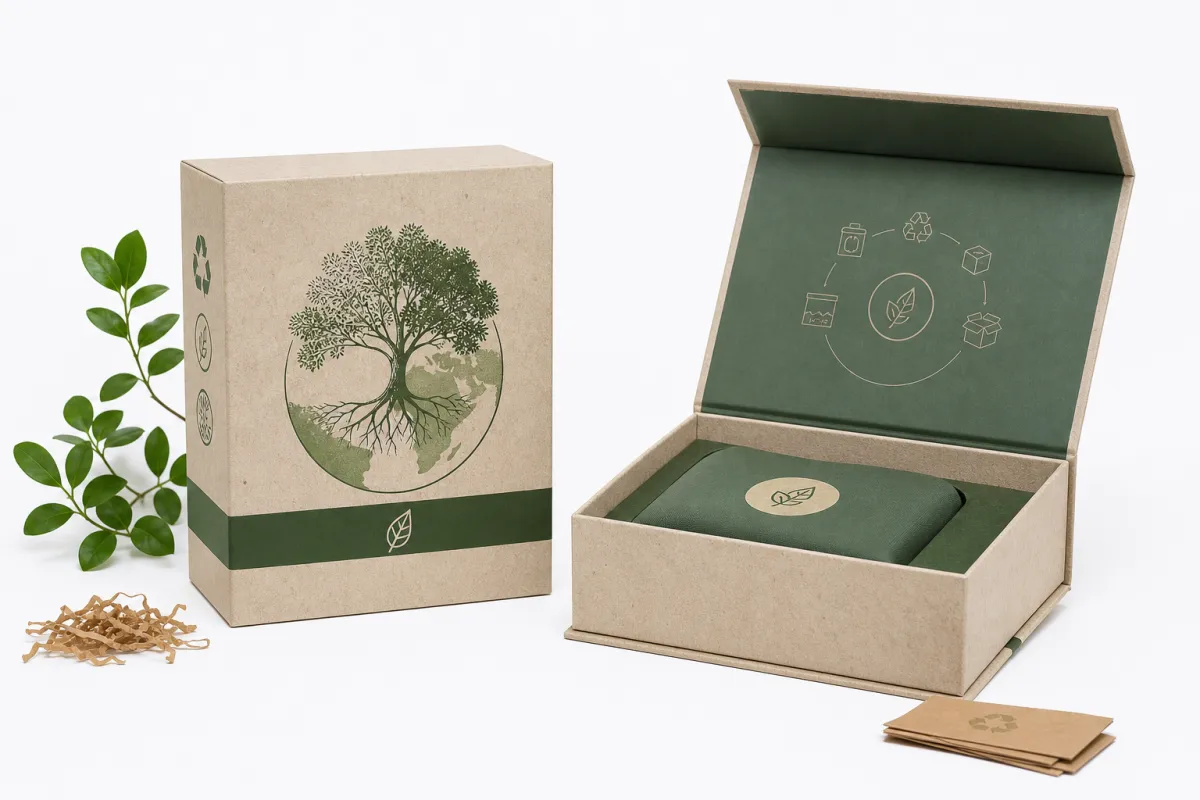
Wholesale ordering works because it turns packaging into a repeatable system. A single well-made rigid box can be adapted across product lines, replenishment cycles, and seasonal sets with only minor changes to artwork or inserts. That reduces waste and keeps package branding consistent from one release to the next. In retail packaging, that consistency matters more than most teams admit.
For a shipping scenario, imagine a premium accessory, candle, cosmetic set, or electronics accessory packed inside a rigid box that has to hold its shape through a warehouse stack, a courier network, and a retail shelf. The box cannot be so heavy that it inflates freight cost, but it also cannot be so thin that corners crush or lids warp. Sustainable rigid box packaging wholesale gives brands a way to dial in that balance and avoid one-off decisions that create expensive problems later.
There is also a practical cost advantage. Wholesale volume allows the board, wrap paper, and inserts to be planned in batches, which is where waste starts to drop. A box that is right-sized can use less chipboard, less wrapping stock, and less void fill. That is one reason sustainable rigid box packaging wholesale is a business decision as much as an environmental one: better planning usually lowers the unit cost while improving consistency.
Honestly, a lot of buyers get tripped up by the word sustainable. They assume it means a box must use the least material possible. That is not always true. A box that is too light may fail in transit, and damaged product is never sustainable. In practice, sustainable rigid box packaging wholesale usually means the right board thickness, the right wrap, the right insert, and the right footprint, all selected to reduce avoidable loss.
A good wholesale partner will talk in concrete terms: board caliper, wrap stock, closure style, and finish. Those details matter because they determine whether the box supports the product or simply looks good in a mockup. For buyers comparing branded packaging options, that technical conversation is the difference between a box that photographs well and a box that actually performs.
One more point that matters once orders start repeating: standardization makes reorders easier to forecast. If a 2 mm board with a paper wrap and paperboard insert is approved once, the next order does not need to relearn the design from scratch. That reduces revision cycles, cuts the chance of dimension drift, and gives the team a cleaner baseline for sustainable rigid box packaging wholesale across future runs.
And yes, the boring part saves money. The glamorous part does not always.
Product Details: What Makes a Rigid Box Sustainable
A rigid box is built from a dense chipboard or paperboard core, usually around 1.5 mm to 3 mm thick, wrapped in printed paper, specialty paper, or another exterior sheet that gives the box its finished look. Unlike folding cartons, rigid boxes hold their shape without being crushed flat first. That structural stability is a big part of the premium feel, and it is also why sustainable rigid box packaging wholesale can be so effective for Product Packaging That needs protection and presentation together.
The sustainability story starts with the board. Many buyers ask for recycled fiber content, FSC-certified board, or both. FSC certification does not automatically make a box perfect, but it gives a credible sourcing framework and helps brands document fiber responsibility. For buyers who want a reference point, the FSC standards at fsc.org are a useful place to start, while transit validation methods from ista.org help teams test whether the finished package can survive the distribution lane it will actually face.
Next comes the wrap. Paper-based wraps, recycled-content papers, and printed kraft-style surfaces are common choices for sustainable rigid box packaging wholesale. Water-based inks and soy-based inks are often preferred because they reduce reliance on heavier solvent systems. A clean printed wrap can still deliver sharp color, clear typography, and strong package branding without leaning on plastic-heavy layers that are harder to separate later.
Inserts deserve the same attention. A rigid box can use folded paperboard, die-cut paperboard, molded fiber, or in some cases molded pulp. Each option has a different balance of cost, protection, and recyclability. Paperboard inserts are usually the most flexible and price-friendly. Molded fiber can be a good match for more protective sustainable rigid box packaging wholesale programs, especially where the cavity has to cradle a product securely without foam. Die-cut pulp has a natural look and a strong environmental story, but it usually needs careful sizing to avoid a sloppy fit.
Here is where sustainability can be lost. Oversized boxes create empty space that requires filler, larger freight cartons, and more material than the product needs. Heavy lamination can improve scuff resistance, but if it adds a plastic film that does not fit the recycling path you want, it can work against the brand story. Mixed materials, decorative magnets, foam inserts, and unnecessary windows may all look premium in the short term, yet they complicate disposal and raise the actual material load of the box.
In my view, sustainable rigid box packaging wholesale works best when the design team asks a simple question: does this feature protect, present, or improve usability? If the answer is no, it usually becomes waste. That is why a restrained packaging design often outperforms a busy one. Clean graphics, exact dimensions, and a well-built interior can look more premium than a box overloaded with effects.
For brands selling cosmetics, apparel accessories, wellness goods, or small electronics, the goal is not to make the box look earthy in a generic way. The goal is to build a structure that matches the product, supports retail packaging expectations, and avoids unnecessary complexity. A well-judged sustainable rigid box packaging wholesale specification can still feel luxury-grade because the strength is in the construction, not in excess material.
Materials and construction also affect how a box photographs. Custom printed boxes with solid registration, crisp folds, and a tight wrap reveal quality immediately. If the corners are clean and the lid sits square, the box communicates reliability before the customer opens it. That is one reason buyer teams often Compare rigid boxes not just by price, but by the visible consistency of the sample run.
Sustainable Rigid Box Packaging Wholesale Specifications
Before asking for a quote, gather the specifications that actually move the price and the performance. Sustainable rigid box packaging wholesale is easiest to price when the supplier knows the finished dimensions, board thickness, wrap material, print coverage, insert type, and closure style. If any of those details are vague, the quote will either come back padded with caution or need several revision rounds to settle on a real number.
The first specification is size. Length, width, and height should be the finished internal dimensions if the product fit matters, or the outside dimensions if the line needs shelf consistency. That distinction matters because a 2 mm board on all sides changes the cavity, and an insert built from paperboard or molded fiber needs its own allowance. Buyers often underestimate how much a few millimeters affect the final fit.
The second specification is structure. Lift-off lid rigid boxes are common for cosmetics, accessories, and gift sets because they are simple, elegant, and straightforward to assemble. Magnetic closures add a refined opening experience and work well for presentation-driven product packaging, but they introduce extra components and usually cost more. Shoulder boxes create a visible step between lid and base and can feel especially premium. Drawer-style boxes support curated sets and can be strong for branded packaging, although they often need more assembly time than a standard two-piece style.
Finishing choices should be selected with a practical lens. Embossing and debossing are excellent for tactile branding when used sparingly. Foil can create a strong focal point, but large foil areas may not suit every sustainability goal. Soft-touch coating feels premium, yet it can add complexity to recycling streams depending on the construction. Matte lamination is popular because it reduces glare and protects the print, but a simple paper wrap with controlled print coverage is often the cleaner route if recyclability is a major priority.
A smart wholesale buyer thinks about surface and structure together. A restrained custom Printed Boxes Design with one or two inks, a clean logo hit, and accurate color can feel more expensive than a box covered with multiple effects. That is especially true in retail packaging, where customers tend to judge quality by fit, symmetry, and clarity more than by how many finishes are stacked on top of one another.
The list below is what should be in your quote request:
- Finished dimensions for the box and, if needed, the insert cavity.
- Board caliper or thickness target, such as 1.5 mm, 2 mm, 2.5 mm, or 3 mm.
- Wrap material, including kraft, art paper, specialty paper, or recycled-content paper.
- Print method, print coverage, and color count.
- Insert type, such as paperboard, molded fiber, or die-cut pulp.
- Closure style, including lift-off lid, magnetic flap, shoulder, or drawer format.
- Finish, such as matte, soft-touch, embossing, debossing, or foil.
- Target quantity and the reorder pattern you expect over the next few cycles.
That level of detail allows a packaging partner to recommend the right structure instead of defaulting to the most expensive option. It also keeps sustainable rigid box packaging wholesale aligned with the actual use case. A subscription product does not need the same closure as a boutique gift set. A travel-size cosmetic box does not need the same board weight as a heavy glass jar. The more exact the brief, the cleaner the result.
If your team is still shaping the line, a helpful way to think about it is this: the outside should support package branding, while the inside should support product protection. Those two goals do not have to fight each other. A well-planned box lets the graphics stay elegant while the interior structure does the heavy lifting.
Pricing and MOQ for Sustainable Rigid Box Packaging Wholesale
Price for sustainable rigid box packaging wholesale is driven by more than box size. The main cost drivers are board thickness, wrap stock, print complexity, insert design, closure hardware, finishing method, and total quantity. Labor matters too, because some rigid box constructions require more hand assembly than others. A simple lift-off lid with a paperboard insert will usually price lower than a magnetic box with multiple compartments and foil accents.
Minimum order quantity, or MOQ, is usually set by setup time, material sourcing, and how much manual assembly the structure requires. Small custom runs can absolutely be done, but the per-unit cost rises because the setup is spread across fewer pieces. That is why sustainable rigid box packaging wholesale often feels expensive at 300 or 500 units, then much more efficient at 1,000, 3,000, or 5,000 units. The production line itself is not punishing small buyers; it is simply math.
The table below gives a realistic planning view for a standard rectangular rigid box with a printed paper wrap, basic insert, and ordinary finishing. These are working ranges, not fixed prices, because the exact numbers depend on dimensions, artwork coverage, and how many components go into the build.
| Order Volume | Typical Unit Price | Common Setup or Sample Cost | What Usually Drives the Price |
|---|---|---|---|
| 500 units | $2.40 - $4.80 | $120 - $350 | Higher hand labor, smaller material buy, and any specialty finishing |
| 1,000 units | $1.70 - $3.40 | $90 - $250 | Board thickness, insert style, and print coverage |
| 3,000 units | $1.15 - $2.50 | $60 - $180 | Closure style, coatings, and whether the box needs extra assembly steps |
| 5,000+ units | $0.85 - $1.95 | Spread across the run | Freight assumptions, carton packing method, and finishing complexity |
That table shows why buyers should never look only at unit price. One quote may seem lower until you discover it excludes inserts, sample charges, or freight. Another may look higher but actually includes the exact cavity size you need, better board quality, and cleaner print registration. For sustainable rigid box packaging wholesale, the smarter comparison is total landed cost, not just the number printed beside the unit price.
There are practical ways to save money without weakening the box. Simplify the print surface by using fewer ink colors. Reduce specialty finishes to a single focal point. Standardize dimensions across multiple SKUs. Choose a paperboard insert instead of a more complex molded component if the product does not need deep cradling. Often, a well-executed simpler box looks more intentional than a heavy design packed with effects.
The most useful quote request is one that asks for pricing at multiple volumes. Ask for 500, 1,000, 3,000, and 5,000 units if your business may scale. That shows where the break point sits and helps you plan replenishment. It also lets you compare how sustainable rigid box packaging wholesale behaves as your program grows, rather than guessing whether a reorder will still fit the budget.
Another useful habit is to separate recurring costs from one-time costs. Tooling, sampling, and die setup may appear only once, while board, wrap, print, assembly, and freight repeat every run. If you know which charges are fixed and which charges scale, you can judge whether a project is actually affordable or only looks affordable in the first quote.
For buyers managing branded packaging across a portfolio, this distinction is critical. A box with a slightly higher board cost may still be the better choice if it reduces damage rates and keeps the product inside from shifting. A less expensive structure that fails the lane can cost more after returns, replacements, and customer complaints are counted.
Process and Timeline for Sustainable Rigid Box Packaging Wholesale
The order flow for sustainable rigid box packaging wholesale is usually straightforward, but the schedule depends on how prepared the brief is. A clean project starts with a quote request, moves to dieline or spec confirmation, then proceeds through artwork prep, prototype or sample approval, production, finishing, packing, and shipping. Each step is manageable on its own. Delays appear when one of them is incomplete.
In a normal project, the supplier reviews the dimensions, structure, and artwork requirements, then returns pricing and a rough lead time. If the dimensions are unclear, the insertion style is not defined, or the print coverage changes midstream, the timeline stretches quickly. That is especially true for sustainable rigid box packaging wholesale orders that include custom printed boxes, because even a small change to print layout can affect the die line and the production proof.
Sampling is where many schedules get tested. A first sample may take about 5 to 10 business days after the brief is finalized, depending on complexity and current workload. If the structure needs multiple revisions, that window gets longer. A buyer who approves a sample quickly can often move into production without much delay. A buyer who keeps adjusting cavity size, finish, or artwork placement can easily add another week or two before the run is released.
Production lead time commonly lands in the 12 to 25 business day range after approval, again depending on order size and finish complexity. Simple sustainable rigid box packaging wholesale runs can stay near the lower end of that range. Orders with magnets, foil, molded inserts, or heavy hand assembly move more slowly. Transit time is separate, so the final delivery window should always include shipping, customs if applicable, and local receiving time.
There are a few places where projects usually stall:
- Incomplete dimensions that force a second round of engineering.
- Artwork that is not print-ready and needs layout correction.
- Sample revisions that change the structure after the quote is already approved.
- Finish changes made late in the process, such as adding foil or soft-touch coating.
- Unclear freight terms that leave the delivery schedule uncertain.
From a practical buying point of view, the fastest path is the one that starts with complete information. Send the product dimensions, target quantity, insert needs, closure style, finish preference, and delivery window in the first message. If you already know whether you need a retail-ready look or a shipping-first design, say so. That one step usually shortens the back-and-forth and keeps the sustainable rigid box packaging wholesale order moving.
A good production partner should also tell you what does not need to be expensive. Sometimes the box can look premium without soft-touch coating. Sometimes the insert can be paperboard instead of molded pulp. Sometimes the closure can remain a standard lid rather than a magnetic upgrade. Those tradeoffs are not compromises if they are made on purpose. They are how a project stays on schedule and on budget.
Where transit is a major concern, testing matters. Many teams rely on distribution standards such as ISTA protocols to evaluate whether the packaging can handle compression, vibration, and drop exposure. That kind of testing is especially useful for sustainable rigid box packaging wholesale because it proves the structure is doing its real job instead of relying on appearance alone.
Why Choose Us for Sustainable Rigid Box Packaging Wholesale
For wholesale buyers, the value of a packaging partner shows up in consistency. You want the same board quality, the same lid fit, the same color behavior, and the same assembly standard every time the order repeats. That is what keeps branded packaging from drifting over time. A strong supplier should be able to reproduce a rigid box with stable results, whether the run is 500 units or 5,000.
That repeatability matters because sustainable rigid box packaging wholesale is rarely a one-time event. Most buyers come back for replenishment, seasonal versions, or new SKUs that need the same base structure. If the original box was engineered well, the next version can stay close to the approved design and still move quickly through production. That is a real business advantage, not a marketing claim.
Technical guidance also protects the buyer from avoidable mistakes. Oversized cavities make products shift. Weak closures can pop open in transit. Decorative finishes can look appealing but interfere with recycling or add cost without adding value. A packaging partner who understands construction can help you avoid those problems before they reach production, which is especially useful for custom printed boxes built for retail packaging and gift presentation.
We also pay attention to the details that shape package branding in the final hand feel. Clean folding, tight wrap application, accurate color matching, and an insert that actually supports the product are not extras. They are the difference between a box that looks premium in the photo and one That Feels Premium in the hand. Buyers notice that difference immediately, even if they do not name the construction details out loud.
If you are comparing suppliers, ask for more than a quote. Ask for clear specs, sample support, realistic lead times, and a repeat-order path that will not force you to rebuild the project every time you restock. That is where sustainable rigid box packaging wholesale becomes easier to manage. The best partner will make the structure predictable, the pricing transparent, and the reorder process calm.
Our Wholesale Programs are designed for that kind of repeatability, and our Custom Packaging Products give you a broader view of related formats if your line needs more than one box style. For buyers who are balancing product presentation, freight realities, and sustainability goals, that combination of guidance and consistency is often more useful than a flashy sample that cannot be reproduced cleanly at scale.
Sustainable rigid box packaging wholesale should feel controlled, not complicated. The box needs to fit the product, hold up in real transit, and look intentional on the shelf. If a supplier can keep those three outcomes aligned, the buying decision gets a lot easier.
Next Steps for Sustainable Rigid Box Packaging Wholesale
Before you request a quote, assemble the core details in one place. Sustainable rigid box packaging wholesale moves faster when the buyer can send product dimensions, target quantity, closure style, finish preference, insert needs, and target delivery window together. That one packet of information usually saves more time than a long email chain full of partial answers.
Your comparison should go beyond the lowest unit price. Check board thickness, wrap material, print method, insert construction, and freight assumptions. A quote that looks slightly higher may actually be more realistic if it includes the proper insert, better board, or a more protective finish. A quote that looks cheap can become expensive if the finished box does not support the product well enough for shipping or retail display.
If the box will be reused across product lines or retail channels, start with one approved prototype and lock the structure before scaling. That is especially helpful for sustainable rigid box packaging wholesale because it gives your team a stable baseline for future graphics and reorder planning. A single good prototype can prevent a long series of corrections later.
It also helps to think about where the box lives. A premium gift presentation may justify a shoulder box or magnetic closure. A shipping-first presentation may work better with a cleaner lift-off lid and a paperboard insert. A curated set may need a drawer style. The right answer depends on the product, the handling environment, and the cost target, not on the most elaborate option in the catalog.
My practical rule is simple: build the box around the product, then trim the extras until every feature earns its keep. That is usually where the best sustainable rigid box packaging wholesale projects land. Not flashy. Not wasteful. Just right.
For brands that want premium presentation with practical material choices, sustainable rigid box packaging wholesale can deliver both. The next move is to send a complete brief, ask for landed pricing at a few volumes, and approve the structure before you start decorating it with finish choices. That sequence keeps the project honest and keeps the final box from pretending to be more complicated than it needs to be.
FAQ
What counts as sustainable rigid box packaging wholesale?
Look for recycled or FSC-certified board, paper wraps, and inks or coatings that reduce environmental impact without weakening the box. The strongest sustainable rigid box packaging wholesale options also reduce mixed materials, because simpler construction is easier to sort, reuse, or recycle. Right-sizing matters just as much as material choice, since excess board and empty space increase waste and freight cost.
What is a practical MOQ for eco-friendly rigid box wholesale orders?
MOQ usually depends on size, print setup, and insert complexity, so small custom runs cost more per unit than larger repeat orders. Many sustainable rigid box packaging wholesale projects start in the low hundreds, but the exact minimum should be tied to your structural design and finishing choices. If you expect repeat reorders, ask for pricing at multiple volumes so you can see where the best break point sits.
Can sustainable rigid box packaging wholesale still look premium?
Yes. Premium usually comes from precise construction, clean printing, and a strong fit, not from adding the heaviest or most complex finish. A restrained design with sharp typography, accurate color, and a well-built insert often looks more expensive than a box overloaded with effects. Material quality and assembly consistency are visible immediately, which is why premium presentation and sustainability can work together in sustainable rigid box packaging wholesale.
How long does sustainable rigid box packaging wholesale production take?
Timing depends on whether artwork and dimensions are ready, because sample approval and dieline checks often decide the schedule. After approval, production usually takes several weeks, with shipping added on top based on destination and freight method. Faster turnaround is easier when the buyer submits final specs upfront and limits revision cycles during sampling.
Which finishes work best for sustainable rigid box packaging wholesale?
Paper-based wraps with matte or uncoated looks are often easier to keep recyclable than heavily laminated or multi-material finishes. Embossing, debossing, and selective foil can still work when used sparingly, but they should support the design rather than dominate it. If the box will be handled heavily, choose finishes that resist scuffing without adding unnecessary layers or plastic-heavy coatings.


