Buyer Fit Snapshot
| Best fit | Sustainable Shipping Cartons Supplier projects where brand print, material claims, artwork control, MOQ, and repeat-order consistency need to be specified before quoting. |
|---|---|
| Quote inputs | Share finished size, material target, print colors, finish, packing count, annual reorder estimate, ship-to region, and any compliance wording. |
| Proofing check | Approve dieline scale, logo placement, barcode or warning zones, color tolerance, closure strength, and carton packing before bulk production. |
| Main risk | Vague material claims, crowded artwork, missing packing details, or unclear freight terms can make a low unit price expensive after revisions. |
Fast answer: Sustainable Shipping Cartons Supplier: Board, Finish, Dieline, and Unit Cost should be specified like a repeatable production item. The safest quote records material, print method, finish, artwork proof, packing count, and reorder notes in one written spec.
Production checks before approval
Compare the actual filled-product size with the drawing, then confirm tolerance on folds, seals, hang holes, label areas, and retail display edges. Reserve space for logos, QR codes, warning copy, and material claims before decorative graphics fill the panel.
Quote comparison points
Review material grade, print process, finish, sampling route, tooling charges, carton quantity, and freight assumptions side by side. A quote is only useful when the supplier can repeat the same color, closure quality, and packing count on the next order.
A Sustainable Shipping Cartons supplier does a lot more than move brown boxes from one dock to another. The better version of that partner helps you reduce wasted fiber, protect products through transit, and keep freight costs from creeping up because a carton was a little too generous with its dimensions. In ecommerce shipping and order fulfillment, that extra inch or two can quietly trigger higher dimensional weight charges, more void fill, more storage strain, and more handling time. A capable sustainable shipping cartons supplier looks at the full path from packout to pallet to final delivery, then recommends the smallest carton that still protects the product properly.
The tradeoffs are where the real work lives. A Sustainable Shipping Cartons supplier has to balance recycled content, strength, print requirements, recyclability, and the practical limits of your packaging budget. The lightest board is not always the wisest choice. I have seen cartons that looked nice on a spec sheet but failed the first time a pallet sat in warm storage for a few days. I have also seen slightly heavier boards save money because they cut down on damage, returns, and replacement shipments. Sustainability is partly about material use, sure, but it is also about choosing a package that holds up without wasting more downstream resources.
For teams comparing packaging options for Custom Packaging Products, the carton itself is only one part of the conversation. A good supplier should help you think through protection, transit packaging, and storage efficiency together, whether you ship a few hundred units a month or run a high-volume ecommerce program that depends on predictable supply and consistent sizing.
What a Sustainable Shipping Cartons Supplier Does
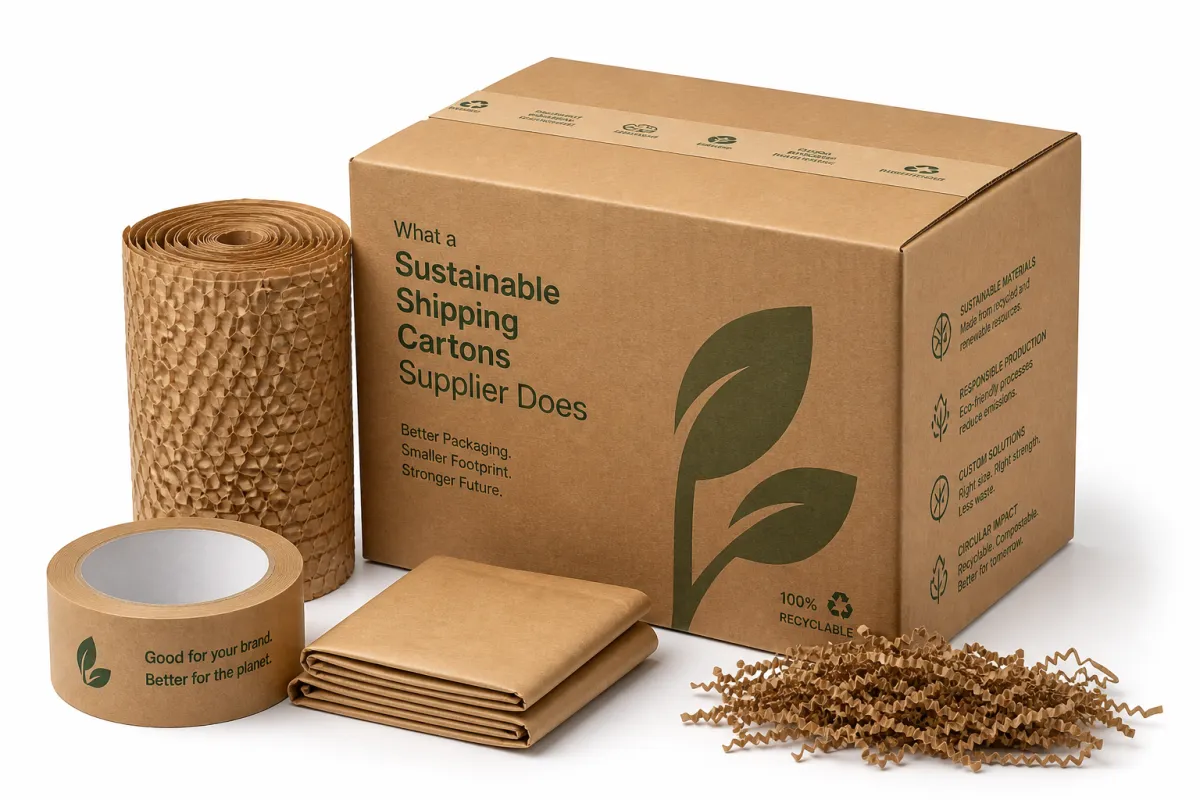
A sustainable shipping cartons supplier starts with a packaging problem, not a product page. The first question usually sounds simple: does the item need a stock shipping box, a custom size, or a structure that removes excess headspace without weakening the shipment? That question matters because every extra inch of carton space can increase corrugate use, invite more void fill, and raise dimensional weight. In carrier networks where cube matters almost as much as actual weight, the wrong box can quietly drive up total landed cost.
Sustainability is not a single checkbox. It is a chain of material and structural decisions that either support one another or fight each other. A sustainable shipping cartons supplier may recommend recycled-fiber content, responsible sourcing, recyclable construction, and right-sizing support, but those choices still have to work in the real world. A carton that looks environmentally clean but crushes during stacking is not a win. A heavy-duty box that protects well but uses far more material than the shipment needs is not much better. The stronger suppliers keep all three goals in view: the right material, the right size, and the right performance.
Generic packaging vendors often stop at the SKU description. A true sustainable shipping cartons supplier asks about item dimensions, weight, fragility, shipping distance, pallet pattern, and storage conditions. That context makes it possible to design packaging around actual use instead of brochure assumptions. The result is usually a carton that uses less fiber, moves through shipping more efficiently, and still performs through handling, sorting, vibration, and delivery.
The word “sustainable” deserves more than a marketing gloss. The best carton is usually the smallest carton that can protect the product through the whole shipping journey. For one item that may mean a single-wall corrugated box; for another, a double-wall structure may be the better fit because the shipment is heavier or needs more stacking performance. A skilled sustainable shipping cartons supplier should be able to explain why a specific build makes sense rather than defaulting to the thickest board available. If they cannot explain it clearly, that is usually a clue that the recommendation is generic.
Practical rule: if you can remove empty space, reduce board weight, or simplify the print without hurting package protection, you are usually moving in the right direction.
For buyers comparing Custom Shipping Boxes, the value sits in the consultation. The supplier should help you identify where the carton can be lighter, narrower, or less decorated while still meeting the protection target. That combination of technical guidance and material discipline is what separates a useful partner from a simple box seller.
Recyclability matters at the end of the package life too. The EPA’s recycling guidance at EPA recycling resources is a useful reminder that the material should stay easy for consumers and recovery systems to handle. Corrugated cartons usually fit that expectation well when they remain single-stream friendly, use minimal coatings, and avoid unnecessary mixed materials that complicate recovery.
How a Sustainable Shipping Cartons Supplier Builds Cartons
The build process usually starts with the board. A sustainable shipping cartons supplier may work with single-wall corrugated board for lighter products, or double-wall board for heavier goods and tougher distribution conditions. Recycled liners and recycled medium are common within those board structures, yet recycled content should never be judged in isolation. The carton still has to survive shipping stress, so flute selection, board grade, and compression strength all matter.
Flute choice affects much more than thickness. Smaller flutes can improve print quality and surface smoothness, while larger flutes can add cushioning and stacking resistance. A sustainable shipping cartons supplier will match flute and board grade to the item’s weight, fragility, and shipping route. A lightweight apparel box does not need the same build as a carton carrying glassware or dense hardware. That sounds obvious, though many buyers still order one box for every SKU and end up paying for excess material and higher damage rates at the same time.
Material selection also shapes sustainability. Kraft liners are common because they are strong and highly recyclable. White top liners can help branding, but they should be used only where they add real value. A thoughtful sustainable shipping cartons supplier will ask whether a white surface is necessary or whether a kraft surface with minimal ink coverage makes more sense. Less coating, fewer heavy finishes, and simpler graphics often keep cartons easier to recycle and less resource-intensive to produce. That part is not glamorous, but it matters more than a fancy print finish ever will.
Structure matters just as much as material. Cartons designed around product dimensions can reduce filler, reduce damage, and reduce replacement shipments. That matters in order fulfillment because every broken shipment doubles the material and transport burden. A well-engineered carton specified by a sustainable shipping cartons supplier can lower total fiber use even if the board is slightly stronger, simply because it avoids overpacking and repeated handling mistakes.
Testing should be part of the build, not something added later. A serious sustainable shipping cartons supplier may refer to tests aligned with ISTA procedures or compression methods based on ASTM practices. For a deeper look at shipment testing standards, the International Safe Transit Association at ISTA is a useful authority. Those tests matter because a carton that survives a perfect warehouse environment may still fail after vibration, stacking, humidity, and conveyor handling. I have reviewed packaging setups that passed visual inspection and still split open during transit because nobody checked corner crush or real stack exposure.
Where sustainability and structure meet
One of the most common mistakes is assuming that “eco-friendly” and “strong” sit on opposite sides of the equation. They do not. Better carton design often uses less material overall because it fits the product properly and resists the actual failure modes your shipment faces. A sustainable shipping cartons supplier should be able to explain how board grade, flute profile, and carton geometry interact so the packaging is efficient instead of merely light.
A tighter fit can reduce movement inside the box and let you cut back on void fill. A stronger score line can improve packout consistency and reduce corner crush during fulfillment. A cleaner fold design can also speed up packing, which matters when a team is moving hundreds of units each shift. Sustainability, in that sense, includes material recovery and operational discipline at the same time. It is a bit boring, honestly, but that is usually where the savings live.
Key Factors When Choosing a Sustainable Shipping Cartons Supplier
The first factor is material content and documentation. Ask whether the sustainable shipping cartons supplier can specify recycled content, fiber sourcing, and any chain-of-custody documentation that supports your sustainability claims. If you need FSC-certified materials, verify that the supplier can provide the correct paperwork. If certification is not required, ask for a plain explanation of the board composition so your team knows what is actually being purchased instead of relying on broad green language.
The second factor is performance. A carton that looks responsible on paper still has to protect the product. The supplier should ask about product weight, stack load, shipping distance, temperature swings, and seasonal humidity. Those details affect board strength and the chance of compression failure. A sustainable shipping cartons supplier that skips those questions is probably moving too quickly for a package that actually needs engineering attention.
The third factor is branding and print discipline. Printing can support brand presentation, but more ink, more coverage, and more finishing usually mean more cost and more complexity. Water-based inks and restrained graphics are often a smart choice if you want the carton to stay recyclable and keep production simple. A good sustainable shipping cartons supplier will help you place logos efficiently and avoid designs that require heavy coatings or decorative add-ons that do not improve the shipping outcome.
The fourth factor is operational fit. Your supplier needs to work with your order volume, SKU count, lead times, and replenishment rhythm. A brand with five carton sizes has different needs than a catalog operation with fifty. In some cases, the best partner is one that can supply standard sizes quickly and also produce custom runs for flagship products. If you already manage multiple packaging categories, you may want the supplier to coordinate with related programs such as Custom Poly Mailers for lighter items that do not need a box at all.
The fifth factor is end-of-life recovery. The carton should stay easy to recycle in typical curbside systems, which means avoiding mixed materials that complicate recovery. Simple corrugated construction is usually a better environmental choice than decorated packaging with layers that cannot be separated. The more straightforward the carton, the easier it is for a customer to flatten, recycle, and move on. That is not exciting, but it is practical.
A practical supplier checklist
- Can the sustainable shipping cartons supplier document recycled content and sourcing claims?
- Will they recommend carton strength based on actual product weight and shipping conditions?
- Can they show how the proposed carton reduces dimensional weight or void fill?
- Do they offer samples, prototypes, and feedback before full production?
- Can they support both standard stock and custom dimensions without delaying fulfillment?
For teams comparing options quickly, a simple test helps: if the supplier cannot explain why a specific carton is the right balance of protection and material reduction, keep looking. A credible sustainable shipping cartons supplier should be comfortable discussing tradeoffs in plain language, not hiding behind polished phrases.
Sustainable Shipping Cartons Supplier Process and Timeline
The process usually starts with a product brief. A sustainable shipping cartons supplier will want basic dimensions, weight, fragility, shipping method, and whether the product ships as a single unit or in multipacks. If the item is part of a larger ecommerce shipping program, the supplier may also ask about fulfillment flow, pallet density, and whether the carton has to survive multiple touches or just one parcel journey. Those details shape the design before any cutting die is made.
Sample development comes next. Good suppliers often create prototype cartons so you can check fit, closure, stacking behavior, and loading efficiency. This is the stage where hidden problems start to surface. A carton can look right on a spec sheet and still be too tight for the packer, too loose for the product, or too weak at the corners once it is taped and lifted. A thoughtful sustainable shipping cartons supplier will encourage packout trials with real staff because that is where practical issues show themselves.
Testing should not feel like a formality. Compression checks, drop tests, and transit trials help predict whether the carton will hold up in the field. If the packaging is for fragile goods, the supplier may suggest more rigorous validation, especially if you are replacing an existing design that has caused claims or returns. In some cases, the right answer is not a stronger carton, but a slightly different size or a revised internal insert that improves package protection without adding much material.
Timelines vary, but standard stock cartons can move quickly once size and board are confirmed. Custom structures, printed runs, and certification checks usually take longer. As a rough planning guide, a simple project may move from brief to first shipment in around 10-15 business days, while a custom printed carton often needs 15-25 business days or more, depending on proof cycles and production load. A sustainable shipping cartons supplier should be direct about this rather than promising speed that the production floor cannot support.
Delays usually show up in a few familiar places. Artwork approval is common, especially when the design needs last-minute edits. Structural revision is another, especially if the first prototype reveals a fit problem. Certification verification can also slow things down if you need documentation for FSC or other sourcing claims. Peak seasons create queues just like any manufacturing schedule, so planning ahead matters because carton supply should never become the bottleneck that slows order fulfillment.
A small buffer in your forecast helps more than most teams expect. If your operation consumes cartons weekly, do not wait until you are down to a few pallets before reordering. A reliable sustainable shipping cartons supplier can help you set a reorder point based on lead time, storage space, and demand variability so replenishment stays predictable. That kind of planning keeps the warehouse calmer, which is kind of the whole point.
Sustainable Shipping Cartons Supplier Pricing Factors
Carton pricing depends on more than board thickness. A sustainable shipping cartons supplier will usually quote based on board grade, recycled content, flute selection, dimensions, print coverage, order volume, and freight. The more custom the structure, the more setup cost tends to matter. Two cartons with similar dimensions can still have very different prices if one needs dies, special print, or a tighter material specification.
Buyers often ask for the lowest unit price and stop there. That creates risk. The cheapest carton can become the most expensive total option if the box causes damage, needs extra void fill, or triggers dimensional weight charges on every shipment. A better comparison looks at cost per shipped unit, not just cost per carton. A sustainable shipping cartons supplier should be comfortable helping you calculate that number, because it captures the real expense of the package in transit packaging terms.
Minimum order quantities affect the picture as well, especially for smaller brands or companies with a large SKU mix. Standard-stock cartons often carry lower setup costs and can be cost-effective for repeat programs. Custom-engineered cartons may cost more at the start because tooling and production setup are involved, but they can save money over time if they sharply reduce waste or breakage. That is where a supplier with practical experience earns trust, because they can tell you the difference between a nice idea and a package that truly pays for itself.
Here is a simple way to compare options side by side:
| Option | Best For | Typical Cost Drivers | Operational Tradeoff |
|---|---|---|---|
| Stock corrugated carton | Common SKU sizes and fast replenishment | Board grade, quantity, freight | Lower setup cost, less exact fit |
| Custom-sized corrugated carton | Products with tight fit requirements | Die cutting, tooling, board spec, quantity | Better right-sizing, more upfront planning |
| Printed custom carton | Brand-sensitive ecommerce and retail programs | Ink coverage, proofing, setup, quantity | Stronger presentation, potential extra print cost |
| Heavy-duty double-wall carton | Heavier items and long-distance shipping | Board strength, flute choice, quantity | More protection, more fiber per unit |
In many cases, the most economical answer is not the cheapest carton but the one that reduces total waste. A sustainable shipping cartons supplier can often save more money by trimming half an inch of excess cube than by shaving a few cents off board cost. That improvement also helps if your operation is sensitive to dimensional weight, because a smaller carton can lower billed shipping charges across thousands of parcels.
Freight to your facility matters as well. A lower carton price can disappear once inbound shipping is added. If you are comparing suppliers, ask for pricing on a landed basis whenever possible. The best sustainable shipping cartons supplier will help you see the full picture rather than hide costs in the transport line.
How to compare quotes intelligently
- Compare cost per shipped unit, not just cost per carton.
- Check the board spec, not only the outer dimensions.
- Ask whether the quoted price includes print, samples, and freight.
- Review lead time against your actual replenishment cycle.
- Estimate savings from reduced void fill, damage, and dimensional weight.
That final step matters more than most teams expect. A carton that costs a few cents more can still deliver a better bottom line if it lowers claims and speeds packout. That is the kind of practical math a seasoned sustainable shipping cartons supplier should be ready to discuss without dressing it up.
Common Mistakes When Working With a Sustainable Shipping Cartons Supplier
The first mistake is choosing recycled content without checking strength. Recycled fiber is a smart sustainability choice, but recycled board still has to meet the load demands of your shipment. If the carton is too weak for the product or the route, you may save a little material and then spend much more replacing damaged goods. A better sustainable shipping cartons supplier will help you balance recycled content with performance requirements so the carton does not fail in the field.
The second mistake is ordering oversized cartons. This shows up everywhere, especially in ecommerce shipping programs where teams keep a few generic box sizes on hand and hope they fit most products. Oversized cartons waste fiber, encourage more void fill, and create a less polished unboxing experience. They also make pallet patterns less efficient. From a sustainability and cost standpoint, the waste adds up quickly, and it adds up quietly.
The third mistake is ignoring humidity and stacking pressure. Corrugated board is strong, but it is still paper-based material, which means moisture can affect performance. If cartons are stored in a damp warehouse or shipped through humid climates, a marginal board choice may underperform. A sustainable shipping cartons supplier should ask about storage and transit conditions because those variables change the real-world result more than many buyers realize.
The fourth mistake is over-specifying print and finishes. Heavy ink coverage, glossy coatings, and decorative layers may look appealing, but they can add cost and reduce recyclability without improving package protection. A simple logo and a clean, well-sized carton often do more for the brand than a crowded design ever will. If your packaging program needs stronger shelf appeal, that conversation may belong somewhere else, not in the shipping carton spec.
The fifth mistake is skipping samples. A carton that sounds correct on paper may still feel awkward on the pack line or unstable in transit. Real products vary a little. Real workers move quickly. Real shipping routes are rougher than most people expect. A competent sustainable shipping cartons supplier will encourage testing before scale-up because a sample session often reveals the small but expensive details that specs miss.
There is also a planning mistake that has nothing to do with the carton itself. Some teams make the change, approve the new box, and then forget to build inventory into the launch calendar. The result is rushed reorders, last-minute substitutions, and unnecessary pressure on fulfillment. A supplier can help, but your internal plan still has to support the change.
In one sentence: sustainability works only when the box, the process, and the shipping environment line up. That mindset separates a decent sustainable shipping cartons supplier from one that truly supports your operation.
Expert Tips and Next Steps for Choosing a Sustainable Shipping Cartons Supplier
Start with the product, not the carton. Measure the item carefully, note the weight, identify fragile edges or corners, and define the shipping environment before asking for a recommendation. A sustainable shipping cartons supplier can do much better work when they know whether the carton is carrying cosmetics, apparel, electronics, glass, or dense industrial parts. The same box structure does not fit every use case, and pretending otherwise usually leads to waste.
Ask for a short list of options. Three well-chosen cartons are easier to compare than ten vague ones. You want tradeoffs side by side: protection, recycled content, print appearance, and price. A reliable sustainable shipping cartons supplier should be able to show you a lower-cost version, a better-protection version, and a right-sized option that sits in the middle. That makes the decision concrete rather than emotional.
Request documentation. Good sustainability claims should come with specifics, not adjectives. Ask what the carton is made from, what certifications apply, what testing has been done, and what lead times you should expect. If the supplier references forestry certification, check whether it aligns with your requirements and whether the paperwork is current. If they mention strength ratings, ask how those numbers were determined. Trust grows quickly when answers are precise.
Build a scoring checklist for your team. You do not need a complex model, just a simple way to judge fit, strength, recyclability, pricing, and supply reliability. A sustainable shipping cartons supplier that scores well across all five is often a better long-term partner than one that wins only on unit price. That point matters even more for brands with high order fulfillment volume, where inconsistency creates labor problems and customer complaints.
Use the right package for the right item. Not every shipment needs a corrugated carton, and that is part of being sustainable. Lightweight products may be better served by a mailer, while fragile or heavier goods belong in corrugated transit packaging. If you are building a broader packaging program, review Custom Packaging Products alongside carton options so you can choose the most efficient structure for each SKU.
Here is a simple action plan:
- Gather product dimensions, weights, and fragility notes.
- Define shipping method, destination mix, and storage conditions.
- Ask a sustainable shipping cartons supplier for two or three carton recommendations.
- Review samples in real packout trials, not just on a desk.
- Compare the total cost, including damage risk, freight, and dimensional weight.
If you keep those steps in order, the rest becomes much easier. You are not just buying a box; you are choosing a packaging system that affects labor, freight, damage rates, and customer perception. A skilled sustainable shipping cartons supplier can help you make that system cleaner and more efficient without sacrificing the protection your product needs.
For teams shipping lighter items alongside cartons, a mixed packaging strategy can also make sense. A brand may use corrugated boxes for fragile SKUs and Custom Poly Mailers for soft goods that do not need rigid protection. That kind of segmentation reduces material use and keeps the packaging program more disciplined.
When you are ready to evaluate a supplier, remember that the strongest result usually comes from asking one clear question: does this carton protect the product with the least practical amount of material? If the answer is yes, you are likely talking to the right sustainable shipping cartons supplier. If the answer is fuzzy, keep asking until the reasoning is plain.
One final reference point: if your team wants to verify whether a material choice aligns with recognized sourcing standards, the Forest Stewardship Council at FSC is a useful authority for understanding forest-based material certification. It is not the only standard that matters, but it is a solid place to check details before final approval.
That is the real job of a sustainable shipping cartons supplier: help you reduce waste, protect products, and keep the numbers honest. Done well, the carton stops being a hidden cost center and becomes one of the smarter parts of the supply chain.
FAQ
What should I ask a sustainable shipping cartons supplier before placing an order?
Ask about recycled content, board strength, available carton sizes, lead times, and whether the sustainable shipping cartons supplier can provide samples or prototypes. You should also confirm how they handle custom dimensions, print requirements, and documentation for sustainability claims so there are no surprises after approval.
How do I know if a sustainable shipping cartons supplier is using truly recyclable materials?
Look for single-material corrugated construction, minimal coatings, and closures that do not interfere with curbside recycling. A trustworthy sustainable shipping cartons supplier should be able to explain fiber content clearly and provide any relevant certifications or testing documentation in writing.
Can a sustainable shipping cartons supplier help reduce shipping costs?
Yes. A good sustainable shipping cartons supplier can right-size cartons, reduce void fill, and select board grades that protect products without unnecessary weight or cube. Lower damage rates can also reduce replacement shipments, which often has a meaningful effect on total shipping cost.
How long does it usually take to source cartons from a sustainable shipping cartons supplier?
Standard stock cartons can move quickly, while custom sizes and printed cartons usually need time for sampling, approvals, and production scheduling. If you are changing carton structure or replacing an existing supplier, build extra time for testing and revisions so the transition does not disrupt fulfillment.
What is the biggest mistake buyers make with a sustainable shipping cartons supplier?
They focus on recycled content alone and ignore performance, fit, and freight efficiency. The best results come from balancing sustainability with package protection, storage, and total landed cost, which is exactly where a strong sustainable shipping cartons supplier adds value.