Buyer Fit Snapshot
| Best fit | Sustainable Tissue Paper Wholesale projects where brand print, material claims, artwork control, MOQ, and repeat-order consistency need to be specified before quoting. |
|---|---|
| Quote inputs | Share finished size, material target, print colors, finish, packing count, annual reorder estimate, ship-to region, and any compliance wording. |
| Proofing check | Approve dieline scale, logo placement, barcode or warning zones, color tolerance, closure strength, and carton packing before bulk production. |
| Main risk | Vague material claims, crowded artwork, missing packing details, or unclear freight terms can make a low unit price expensive after revisions. |
Fast answer: Sustainable Tissue Paper Wholesale: Specs, Pricing, Supply should be specified like a repeatable production item. The safest quote records material, print method, finish, artwork proof, packing count, and reorder notes in one written spec.
Production checks before approval
Compare the actual filled-product size with the drawing, then confirm tolerance on folds, seals, hang holes, label areas, and retail display edges. Reserve space for logos, QR codes, warning copy, and material claims before decorative graphics fill the panel.
Quote comparison points
Review material grade, print process, finish, sampling route, tooling charges, carton quantity, and freight assumptions side by side. A quote is only useful when the supplier can repeat the same color, closure quality, and packing count on the next order.
Sustainable Tissue Paper Wholesale: Specs, Pricing, Supply
Sustainable Tissue Paper Wholesale looks tiny in a budget sheet. Then the boxes show up. Suddenly that "tiny" item is carrying the product presentation, preventing scuffs, keeping inserts from shifting, and making a package feel finished instead of rushed. That is the funny part about tissue. It seems secondary until it is wrong. Then everyone notices.
Packaging buyers usually want three things from sustainable Tissue Paper Wholesale: a material that behaves predictably, a price that makes sense at scale, and a supply process that does not turn every reorder into a new problem. That is a reasonable ask. It is also where a lot of programs go sideways. The paper is chosen for the first order, then nobody revisits sheet size, print behavior, or freight until inventory is already tight. I have seen that movie. It is not a good one.
A structured Wholesale Programs process keeps the whole thing sane. It lines up the fiber story, sheet dimensions, pack counts, print setup, and delivery timing before production starts. Boring? Sure. Effective? Absolutely. A tissue spec that fits the line is worth more than a flashy sample that falls apart once it hits real packing conditions.
The business case is simple. Recycled content, responsibly sourced fiber, printable surfaces, and consistent production all matter. A low unit price does not mean much if the paper tears too easily, prints muddy, or comes in a size nobody can actually use. Sustainable Tissue Paper Wholesale should make the packaging program easier to run. If it makes things more complicated, the quote was lying to you in a very polite way.
Why sustainable tissue paper wholesale changes the pack-out line
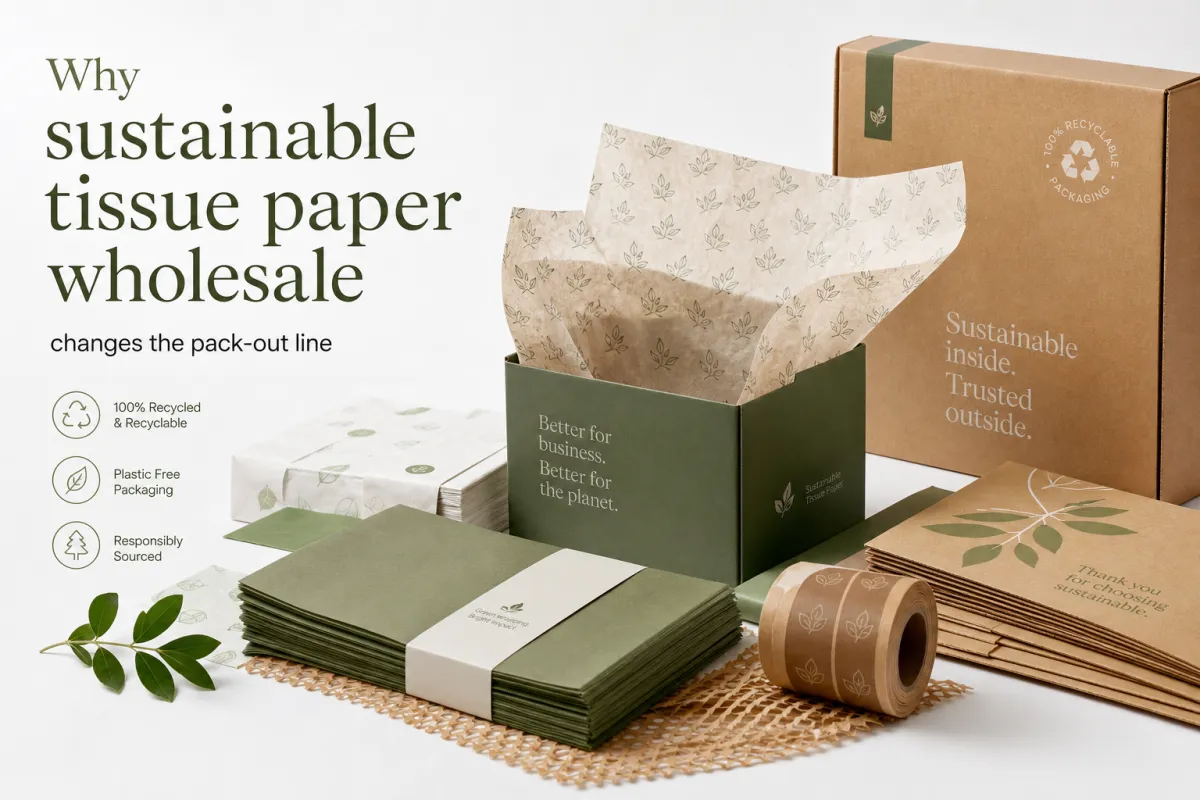
Small packaging materials carry more operational weight than most people expect. Tissue sits right at the intersection of presentation and protection. In sustainable tissue paper wholesale, one sheet can wrap apparel, cushion a bottle, separate accessories, or give a gift box a cleaner reveal. That flexibility matters on busy pack-out lines, where nobody wants to stop and think about whether the paper is gonna hold up today.
Standardization is the first win. Many teams start with three tissue specs for three different jobs, then realize they are spending half their time managing exceptions. One spec family solves a lot of that. Procurement gets fewer SKUs to track. Operations gets fewer surprises. Reordering gets less annoying, which is honestly a bigger deal than it sounds.
Repeatability is the second win. If tissue is part of the brand experience, it has to look like itself every time. Color drift, weak folds, crooked cuts, and sloppy registration do not read as "artisan." They read as sloppy. I have watched a launch get delayed because the second tissue run looked just a little off next to the first. Not dramatic. Just enough to make the box feel patched together.
The sustainability side is real too, as long as the claims are documented. Recycled fiber, responsibly sourced pulp, and lower-impact print systems can reduce dependence on heavier decorative packaging. In some programs, tissue replaces multiple materials and still makes the package feel complete. That is the sweet spot: less material, same or better presentation. For fiber verification, FSC chain-of-custody remains one of the clearer references when buyers need a paper trail behind the paper.
The best tissue spec is the one that behaves the same way on reorder day as it did on sample approval day.
Price still matters. Just not by itself. Sheet size, basis weight, print method, pack count, storage footprint, and freight efficiency all change the real cost. A cheap quote can turn expensive fast if the sheets are undersized or the cartons are awkward to store. Sustainable tissue paper wholesale works best when the buyer thinks in system terms, not line-item fantasy math.
Used well, sustainable tissue paper wholesale supports the pack-out line instead of slowing it down. That is the difference between packaging that earns its keep and packaging that just looks nice in a mockup.
Sustainable tissue paper wholesale product details that buyers compare
Buyers usually start with format. Sustainable tissue paper wholesale shows up in a few practical versions. Flat sheets are common for retail wrap and apparel presentation. Pre-cut pack tissue works better when a team wants consistent counts and faster station handling. Custom-printed tissue is the obvious pick for branded unboxing, gift packaging, and premium retail where the reveal has to feel deliberate instead of improvised.
Material choice comes right after that. Recycled fiber, fiber blends, and FSC-aligned sourcing each support different claims and different performance goals. Recycled content gives sustainability teams a cleaner story about waste reduction. FSC-aligned sourcing supports responsible fiber procurement and traceability. Some programs need both. If the outer carton already tells a strong sustainability story, the tissue should not contradict it.
Texture is one of those details people ignore until it bites them. White tissue, natural tones, kraft-inspired shades, and dyed colors all fold a little differently and present a little differently under light. Softer handfeel can make a package feel more premium. A crisper sheet can hold its fold better and stay in place inside a box. Print clarity changes too. A logo proof on a screen is not the same thing as a logo printed on a thin, absorbent sheet of tissue. The paper matters. The ink matters. The surface matters.
Decorative tissue and functional tissue are not the same thing. Decorative tissue creates the first impression. Functional tissue protects, separates, and reduces abrasion. A lot of sustainable tissue paper wholesale orders need both jobs done at once, which is why the spec should match the actual use case instead of a vague "we need tissue" request. Wrap a hard-edged product and fold retention starts to matter a lot more. Use it for reveal only and visual consistency may matter more than tear resistance.
Sample approval is not optional if the order is real. A finished sample shows how the paper behaves after cutting, folding, and packing. That is different from a swatch book, which is basically the paper version of a dating profile. Looks fine. Does not always tell the truth. Sustainable tissue paper wholesale buyers should always ask for samples before committing to volume, because opacity, color, and print registration can shift once the material runs through an actual production line.
The cleanest way to keep the brief useful is to document the product format, fiber story, print method, and intended use on the same spec sheet. That keeps sustainable tissue paper wholesale grounded in actual buying requirements instead of vague optimism.
- Flat sheets: best for retail wrap, apparel, and presentation packaging.
- Pre-cut tissue: useful for fast packing and consistent reorders.
- Custom-printed tissue: ideal for branded unboxing and gift programs.
- Recycled or FSC-aligned fiber: supports environmental claims when documented correctly.
For shipping and transit expectations, teams testing a new tissue program can also compare packaging guidance from ISTA and broader materials stewardship guidance from the EPA. Those references help when tissue sits inside a larger pack system that has to survive sorting, carton movement, and warehouse handling without turning into a crumpled problem.
Specifications: fiber, caliper, print options, and sheet sizing
Good spec work saves money later. In sustainable tissue paper wholesale buying, the core numbers are basis weight or gsm, caliper, opacity, tensile strength, sheet dimensions, and pack configuration. Each one affects handling, storage, freight cost, and the final look in the box. A 17 gsm sheet can feel light and refined. A 22 to 28 gsm sheet can feel more premium and resist tearing better. Neither is automatically right. The use case decides that.
Caliper deserves real attention because it changes bulk and fold behavior. Very thin tissue can ship efficiently, then collapse too easily during packing, especially with dense or irregular products. A slightly heavier sheet can improve opacity and block-through resistance, which matters when the print on one side should not show shadows from the other. In sustainable tissue paper wholesale orders, that tradeoff often decides whether the tissue feels refined or fragile.
Sheet sizing should follow the product, not some random standard. Apparel programs often need larger sheets that can wrap folded garments with clean overlap. Cosmetics may need smaller sheets that fit a compact box without wasting paper. Stuffing tissue wants width and cut accuracy that support easy crumpling and repeatable fill volume. Wrapping tissue needs squared edges and tight tolerance because the folds have to land where the packer expects them.
Print options need to be written down with the same level of care. Sustainable tissue paper wholesale programs can support one-color logos, repeating patterns, spot color builds, and in some cases fuller graphics. Water-based inks and soy-based inks are common because they fit sustainability goals better than heavier coating systems. Artwork matters too. A repeat logo usually costs less and prints cleaner than a full-coverage background, especially on thin tissue that lets light pass through. If the logo has to sit in a fixed position, the setup has to account for repeat length and registration tolerance.
Consistency is the quiet spec that gets forgotten too often. Tissue orders should define acceptable variation in sheet squareness, cut accuracy, and color matching across reorders. Seasonal programs need this even more because the second order often lands months after the first. If the paper changes too much, the packaging starts to look patched together. Sustainable tissue paper wholesale only works as a program if repeat quality is part of the spec, not something someone hopes will work out later.
Freight is another place where people get lazy. Bigger sheets can reduce packing efficiency. Tiny pack counts can create extra cartons and burn pallet space. A tissue program that looks cheap per sheet can become expensive once cartons, pallet density, and warehouse storage are added in. The spec should go beyond paper weight. It should tell you how the finished tissue ships, how it stores, and how many units fit in a case.
- Basis weight / gsm: drives feel, opacity, and tear resistance.
- Caliper: affects bulk, fold behavior, and shipped volume.
- Sheet size: should match the product and pack-out method.
- Print setup: determines logo repeat, bleed, and registration control.
- Pack configuration: influences storage and freight efficiency.
Once those details are written down, sustainable tissue paper wholesale gets easier to quote, easier to compare, and far less annoying to reorder.
Pricing and MOQ for sustainable tissue paper wholesale orders
Pricing in sustainable tissue paper wholesale is not driven by paper grade alone. Quantity matters. So does sheet size, print complexity, color count, packing format, and freight method. A large order of unprinted stock tissue can price very differently from a custom-branded run with two print colors and a nonstandard dimension. Clean comparisons start with a quote that separates material, printing, packing, and shipping. Anything less is fog with a number attached.
MOQ matters just as much. Standard unprinted tissue usually has a lower entry point because setup is simpler and press adjustments are minimal. Custom color or printed tissue tends to need a higher minimum because the run has to cover make-ready time, waste, and color control. Exact thresholds shift by spec, but buyers should expect custom sustainable tissue paper wholesale orders to carry larger minimums than stock paper. If a supplier claims a suspiciously low MOQ on a printed item, ask what is being absorbed and whether the price still holds at reorder volume.
The easiest way to lower unit cost is to reduce variation. Keep one repeat size if the product line allows it. Consolidate SKUs where you can. Use one branded pattern across several product families instead of inventing a new tissue for every box size. Those choices usually improve price as well as ordering efficiency. Sustainable tissue paper wholesale pays off when the order can be repeated, not just when the first quote looks pretty.
| Option | Typical spec | Best use | Planning price | MOQ tendency |
|---|---|---|---|---|
| Stock unprinted recycled tissue | 17-18 gsm, standard sheet sizes, case-packed | Retail wrap, light void fill, general packing | $0.03-$0.06 per sheet | Lowest |
| Custom one-color logo tissue | 17-21 gsm, repeat print, approved PMS match | Branded reveal, apparel, DTC inserts | $0.06-$0.12 per sheet | Moderate |
| Custom full-coverage tissue | 18-22 gsm, higher ink coverage, tighter registration | Premium gifting, seasonal launches, retail display | $0.10-$0.22 per sheet | Higher |
Those numbers are planning ranges, not a promise. Freight, carton count, print coverage, and order volume can move the final price in either direction. A lighter sheet may cost less per unit but create more cartons. A heavier sheet may cost more per sheet but reduce damage or improve the handfeel enough to justify the jump. Landed cost is the number that actually matters.
Tiered quoting helps a lot. Ask for three volume breaks so you can see the point where the unit cost improves. A lot of buyers find that a slightly larger order lowers the total enough to justify the inventory. That only works if the reorder calendar is stable, which means the tissue program needs to be forecast with the rest of the packaging stack. Sustainable tissue paper wholesale rewards planning. Surprise orders are expensive. Shocking, I know.
For internal budget approval, it helps to frame the tissue as an experience component, not just a consumable. A good sheet can make a product feel more deliberate, reduce the need for extra inserts, and support the brand story inside the box. That value shows up fast in premium retail and e-commerce programs.
Simple rule: if the quote does not separate spec, print, packing, and freight, the comparison is incomplete. Sustainable tissue paper wholesale should be judged on landed cost, serviceability, and reorder stability, not paper price alone.
Process and timeline from quote to delivery
A clean ordering process usually moves through inquiry, specification review, artwork check, sample or proof approval, production scheduling, packing, and shipping. Simple enough. The delay comes when one of those steps is vague. Sustainable tissue paper wholesale projects usually lose time at the front end, not on the press. Unclear dimensions and incomplete artwork cause more trouble than the actual run.
Once a buyer sends an inquiry, the supplier should confirm the intended use, tissue format, sheet size, color target, print method, and quantity. That is the point where the program stops being theoretical. If the buyer knows whether the tissue is for retail packaging, e-commerce inserts, or gift wrap, the supplier can recommend the right basis weight and pack style much faster. Leave the use case fuzzy and the quote usually comes back fuzzy too. Uselessly polite, but fuzzy.
Artwork review is another place where detail saves time. A repeat pattern needs a clear repeat size. A one-color logo needs vector artwork that can print cleanly at the right scale. The closer the file is to press-ready, the smoother the proofing stage. Most sustainable tissue paper wholesale orders do not stall because the idea is bad. They stall because somebody sent a JPG from a web folder and called it "final_final2." We have all seen that disaster waiting to happen.
Timing depends on the order type. Stock tissue moves faster because the material already exists. Custom-printed sustainable tissue paper wholesale orders need extra time for proofing and setup. A common planning window for custom work is around 12 to 15 business days after proof approval, though bigger orders and more complex print coverage can take longer. Shipping time is separate. Domestic freight, consolidated international freight, and full container shipments all run on different clocks, and pretending otherwise only creates problems later.
Receiving windows matter too. A production schedule can be perfect and still miss the mark if the shipment lands after the store launch or after the warehouse closes out the month. Buyers should work backward from the need date, not forward from the order date. Build in transit time, customs if needed, and a day or two for receiving and count verification. That is how a reorder stays controlled instead of turning into a scramble.
For repeat orders, a reorder calendar is one of the best tools you can have. If the next shipment starts before inventory gets thin, the supplier has room to keep the spec stable and the buyer has time to review any artwork tweaks. Sustainable tissue paper wholesale works best when the buying cycle is calm enough to protect standards.
For transport-sensitive orders, think like a packaging engineer. Carton strength, pallet layout, and stacking behavior all affect whether tissue arrives ready to use. The ISTA family of transport test methods is a useful reference for teams that want to evaluate distribution risks before committing to a program, especially when tissue is part of a larger branded packaging system.
Build the reorder before the reorder becomes urgent; that one habit prevents more packaging mistakes than any sales pitch ever will.
Why choose Custom Logo Things for wholesale supply
A decent supplier sells paper. A strong supplier talks honestly about tradeoffs, print limits, and order sizing without pushing a cookie-cutter answer. That matters in sustainable tissue paper wholesale because the best spec is not always the loudest one. Sometimes the right choice is a lighter sheet that ships better. Sometimes it is a heavier sheet that protects better. A good supplier can explain that without making it weird.
Custom Logo Things is built for buyers who want practical packaging guidance, not polished nonsense. Consistent wholesale supply depends on specification control, and specification control depends on clear communication. If the color target changes, the logo repeat changes, or the sheet size shifts, the program needs a partner who catches the ripple before production starts. That matters a lot in sustainable tissue paper wholesale, where brand presentation, sustainability claims, and budget pressure all show up at the same time.
Repeatability is another reason the supplier matters. Wholesale Tissue Paper only works if the color, cut, and print result stay stable from one restock to the next. A launch can survive one premium tissue run. A real program needs dependable reorders. That is where detailed quoting, sample approval, and consistent file handling make a difference. The buyer should not have to re-explain the spec every time.
Packaging is a system. Tissue does not live alone. It sits with mailers, cartons, inserts, labels, and sometimes outer shipping protection. If the tissue is too bulky, it can raise freight cost. If it is too thin, it can underperform. If the print is too heavy, it can bleed through or look muddy. A supplier with packaging experience helps balance those tradeoffs instead of treating tissue like an isolated commodity.
That kind of guidance reduces friction. Fewer revisions. Clearer expectations. Better reorders. Better landed cost. Better brand consistency. Those are the outcomes that matter, and they are the real reason to choose a supplier for sustainable tissue paper wholesale instead of chasing the lowest first quote.
- Clear communication: fewer surprises during proofing and production.
- Specification control: better consistency from order to order.
- Packaging knowledge: smarter advice on sheet size, finish, and freight.
- Repeatable supply: more stable reorders and cleaner forecasting.
If your packaging program needs a broader sourcing starting point, the Wholesale Programs page is the right place to line up the tissue spec with the rest of your branded materials. Sustainable tissue paper wholesale works best when the whole packaging stack is planned together, not patched together later.
Next steps to place a sustainable tissue paper wholesale order
The easiest way to move forward is to prepare a short, specific brief. Start with target sheet size, preferred color, printed or unprinted format, and estimated monthly or quarterly volume. Add the delivery destination because freight affects both timing and cost. A buyer who shares the basics gets a cleaner quote than a buyer who asks for "tissue paper pricing" and hopes for magic. Sustainable tissue paper wholesale is a specification-driven category. Better brief, better quote. Not hard.
Ask for three scenarios if possible. A smaller order shows the entry point. A mid-volume order shows the normal operating price. A larger order shows where the unit cost may improve enough to justify extra inventory. That comparison makes the MOQ conversation a lot easier because the buyer can see how the economics move as quantity changes. It also helps procurement explain why a smarter order size beats a panic reorder.
Request a sample or digital proof before final approval. Basic step. Still gets skipped. That is how teams miss feel, opacity, print clarity, and fold performance. A proof can confirm logo placement, but a sample tells the truth about handling. In sustainable tissue paper wholesale, that difference matters because thin paper behaves differently once it is wrapped, stuffed, or stacked in a carton.
Match the use case to the spec sheet. Retail packaging often needs a more polished reveal and a cleaner print. E-commerce insert use may care more about throughput, fit, and light protection. Gift wrap may prioritize color and handfeel over tear resistance. If the use case is clear, the tissue spec can support it without overbuying material nobody needs.
Compare sample, quote, and lead time together. Price alone can mislead, especially if the cheapest option takes longer or comes in a pack size that makes storage ugly. The best sustainable tissue paper wholesale order is the one that fits budget, brand presentation, and reorder stability at the same time. That is the bar.
If the team is ready to move, keep the discussion practical: confirm the sheet size, confirm the print method, confirm the MOQ, and confirm the delivery window. Then choose the option that gives you a stable, repeatable, and genuinely sustainable tissue paper wholesale program instead of a one-time purchase that has to be solved again next quarter.
Frequently asked questions
What basis weight is typical for sustainable tissue paper wholesale orders?
Most programs land in a lightweight paper range, often around 17 to 28 gsm depending on whether the tissue is used for presentation, wrapping, or light protection. A lighter sheet is easier to fold and usually ships more efficiently, while a slightly heavier sheet can improve opacity, tear resistance, and the premium feel of the package. For sustainable tissue paper wholesale, gsm is a useful starting point, but it does not tell the whole story. Ask for samples so you can see how the paper behaves in the box, not just on a spec sheet.
Can sustainable tissue paper wholesale orders be custom printed?
Yes. Most programs can support logos, repeat patterns, and one- to two-color graphics, and some can support fuller coverage if the artwork and material allow it. The important part is to confirm the ink system, repeat size, and file setup early so the proof matches the final result. Simpler artwork usually runs cleaner and costs less to produce. For sustainable tissue paper wholesale buyers who want strong brand recognition without adding production complexity, a well-placed repeat logo is often the most efficient option.
What is the usual MOQ for wholesale sustainable tissue paper?
MOQ depends on whether the tissue is stock, custom colored, or printed. Stock unprinted tissue typically has the lowest threshold because setup is easier, while custom print programs require more press time and therefore larger minimums. If you are comparing sustainable tissue paper wholesale suppliers, ask for tiered pricing so you can see how the economics change as quantity rises. That will show you whether a slightly larger order produces a better landed cost and a safer reorder rhythm.
How long does sustainable tissue paper wholesale production take?
Timing depends on proof approval, print complexity, quantity, and shipping mode. Simple stock tissue usually moves faster, while printed custom tissue needs extra time for setup and quality checks. A practical planning window is often around 12 to 15 business days after proof approval for custom work, but the exact timeline can move with order size and seasonality. Always add freight time separately so your delivery plan is realistic. In sustainable tissue paper wholesale, the production schedule is only part of the calendar.
How do I choose between recycled and FSC-aligned tissue paper wholesale options?
Choose based on the claims you need to support, the look you want in the package, and how the tissue will be used. Recycled content can support a strong waste-reduction story, while FSC-aligned sourcing supports responsible fiber procurement and documented chain-of-custody practices. If your packaging or retail team needs to back up sustainability language, ask for documentation before you approve the order. For sustainable tissue paper wholesale, the right choice is the one that fits both the brand message and the operating reality.
The short version: define the use case, lock the spec, ask for samples, and compare landed cost instead of chasing the cheapest sheet price. That is how a sustainable tissue paper wholesale program stays consistent, budgetable, and easy to reorder without drama.