Buyer Fit Snapshot
| Best fit | Tamper Evident Poly Mailers Supplier projects where brand print, material claims, artwork control, MOQ, and repeat-order consistency need to be specified before quoting. |
|---|---|
| Quote inputs | Share finished size, material target, print colors, finish, packing count, annual reorder estimate, ship-to region, and any compliance wording. |
| Proofing check | Approve dieline scale, logo placement, barcode or warning zones, color tolerance, closure strength, and carton packing before bulk production. |
| Main risk | Vague material claims, crowded artwork, missing packing details, or unclear freight terms can make a low unit price expensive after revisions. |
Fast answer: Tamper Evident Poly Mailers Supplier: Film, Print, MOQ, and Carton Packing should be specified like a repeatable production item. The safest quote records material, print method, finish, artwork proof, packing count, and reorder notes in one written spec.
Production checks before approval
Compare the actual filled-product size with the drawing, then confirm tolerance on folds, seals, hang holes, label areas, and retail display edges. Reserve space for logos, QR codes, warning copy, and material claims before decorative graphics fill the panel.
Quote comparison points
Review material grade, print process, finish, sampling route, tooling charges, carton quantity, and freight assumptions side by side. A quote is only useful when the supplier can repeat the same color, closure quality, and packing count on the next order.
If a parcel lands on the dock with the outer film intact but the flap looks lifted, wrinkled, or re-stuck, you already know why a tamper evident poly mailers supplier matters. A good mailer does not simply move product from one place to another. It gives you visible proof that the package was opened, touched, or altered along the way, which is exactly the kind of evidence that saves time when the receiving team starts asking questions.
That matters for returns, supplements, cosmetics, subscription shipments, medical accessories, and any order where a customer expects privacy and traceability in transit. The right tamper evident poly mailers supplier should offer more than a plastic pouch with a stern warning printed on it. You need a closure that behaves the same way every time, a film that holds up to ordinary handling, and printed cues that make tampering obvious instead of arguable.
Buyers get tripped up by marketing language more often than they should. “Tamper resistant” is not the same thing as tamper evident, and a “strong adhesive” is not the same thing as a seal that leaves clear damage after opening. A plain poly mailer with a warning line on the front does not become tamper evident because the words are bold. I have opened enough sample bags over the years to know that the proof lives in the closure, not in the copy.
The practical way to judge a tamper evident poly mailers supplier is simple: understand the seal, compare material and print options, pressure-test the pricing, and choose a partner that can repeat the same result when you reorder. That work is not glamorous, but it is the part that keeps complaints down and packing teams from improvising at the line.
Tamper Evident Poly Mailers Supplier Basics
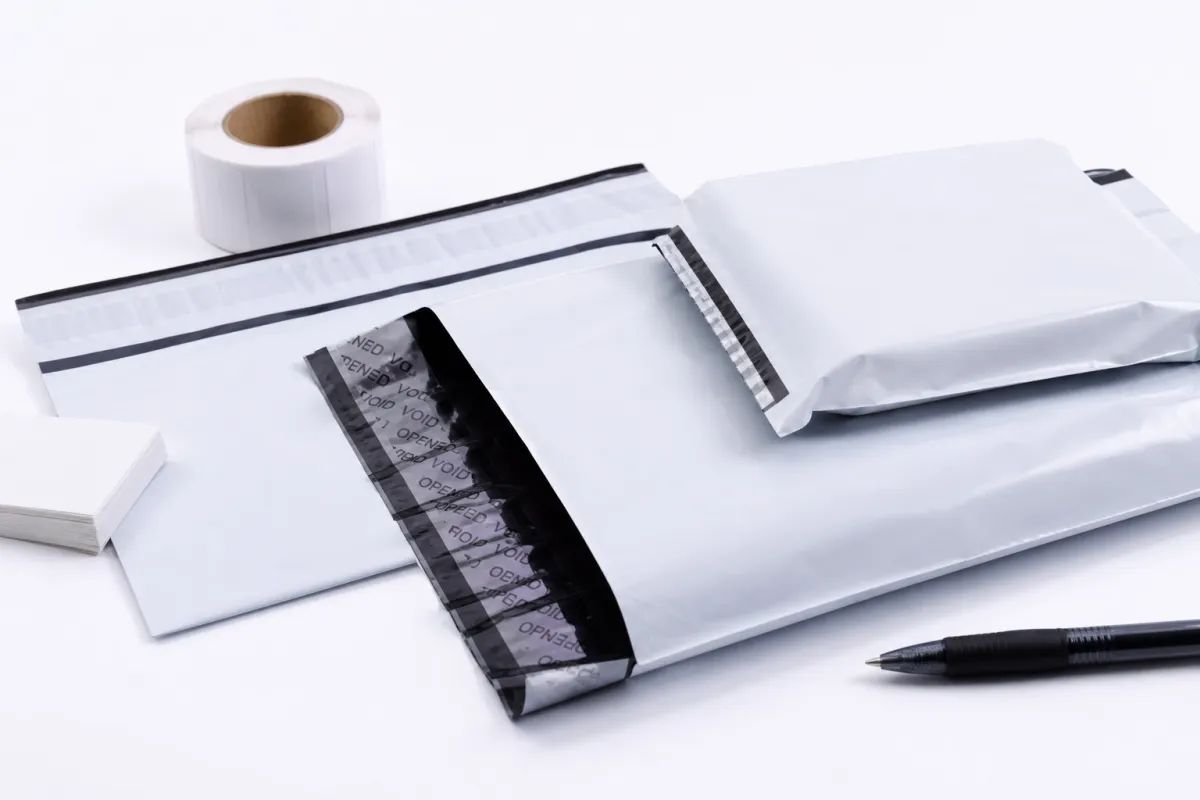
A tamper evident poly mailers supplier sells packaging that shows visible signs of opening. That is the core idea. The mailer is not meant to make tampering impossible. It is meant to make tampering obvious. In practical use, that means a customer can tell whether the closure has been opened, peeled, torn, or forced back into place without having to guess what happened.
Think of it as proof, not armor. A standard poly mailer keeps out dust and light moisture reasonably well. A tamper evident poly mailers supplier adds closure features that create a telltale sign after opening. For ecommerce brands, that visible evidence can save a lot of back-and-forth with support when a customer says the parcel looked opened on arrival, and it can also keep the warehouse from getting dragged into a long blame game.
These mailers show up often for higher-value products, controlled inventory, and shipments where chain-of-custody matters. Supplements, beauty products, medical accessories, and premium apparel all fit that pattern. In some cases, the goal is compliance support. In others, the goal is lowering dispute risk. Either way, the packaging should make the shipping story easy to explain without a lot of hand waving.
There is also a real difference between tamper evident, tamper resistant, and plain poly mailers. Tamper resistant means harder to open or reuse. Tamper evident means opening leaves clear evidence. Plain mailers do neither. Buyers mix these up constantly, usually after a sales pitch sounds reassuring but falls apart once the first sample gets peeled open on the packing table.
A careful tamper evident poly mailers supplier should help you choose based on risk, not hype. If your product is low value and the shipping lane is clean, a simpler bag may be enough. If you are shipping something that draws customer scrutiny, then the closure design matters more than another layer of glossy ink.
Bottom line: the right supplier should explain what the mailer does, what it does not do, and what you should test before placing volume. That conversation is worth more than a polished catalog page, and it usually tells you pretty fast whether the supplier understands the real job.
A mailer that opens once and shows it clearly is worth more than a prettier bag with a weak seal.
How Tamper Evidence Works in Poly Mailers
Most tamper evidence comes from the closure. A tamper evident poly mailers supplier may use a permanent adhesive strip, a second seal layer, a tear-away design, or a destructive opening feature that changes the bag in a way you cannot hide easily. Once the package is opened, the evidence should be visible without detective work. If you need a flashlight and a magnifying glass, the design is probably not doing its job.
One common setup uses a pressure-sensitive closure with a release liner. The buyer removes the liner, folds the flap, and the adhesive bonds firmly. If someone peels it open, the film stretches, wrinkles, or tears. Another setup uses a tear strip or tear line, so the opening process damages the mailer by design. That is the kind of detail a tamper evident poly mailers supplier should explain plainly, because the difference between a decent closure and a lousy one often shows up in the first few minutes of handling.
Some mailers depend on layered film construction. Coextruded layers can improve puncture resistance and make the bag less likely to split under light abuse. Edge seals matter too. If the seams fail before the closure does, the packaging loses value fast. The same goes for a closure that can be lifted and pressed back down without leaving a mark. That is not tamper evidence. That is a weak seal wearing a disguise.
Printing can reinforce the function. A strong tamper evident poly mailers supplier may add warning text, serial numbers, custom branding on the flap, or void-style messaging that makes any opening attempt easier to spot. You do not need a full security label system for every shipment, but printed cues help the customer understand what they are seeing and reduce the “was this already open?” conversation.
There are limits, and pretending otherwise is how buyers get burned. Tamper evidence is visual proof, not a replacement for inner packaging, secure fulfillment, or sensible chain-of-custody controls. If your operation is sensitive, pair the mailer with warehouse practices that match the risk. A mailer can tell you a package was opened. It cannot tell you who did it or when it happened, so you are gonna want your internal process to carry some of that load too.
For context on parcel testing and packaging performance, resources from ISTA are useful. If you also care about material sourcing and chain-of-custody claims, FSC is a solid reference point for paper-based components in broader packaging systems, though it does not replace your own verification of the poly film and adhesive system.
Key Factors to Compare Before You Buy
A tamper evident poly mailers supplier should be judged on more than price. The details that matter are often the least exciting ones, which is exactly why they get overlooked. Film thickness, closure behavior, size fit, print quality, and storage conditions all shape how the mailer performs once it is in daily use.
Film thickness is the first place to start. Thin mailers can reduce cost, but they also puncture more easily on sharp product corners or during conveyor handling. For many ecommerce shipments, 2.5 to 3.5 mil is a practical range. Heavier products or rougher logistics may push you to 4 mil or above. A good tamper evident poly mailers supplier should recommend a range instead of pushing the thickest option by default, because thicker is not automatically better if it slows pack-out or makes the bag awkward to fold.
Seal quality matters just as much. You want closure speed and bond strength that still hold up in cold, humid, or dusty environments. If your warehouse runs chilly, adhesive tack can drop. If your packers work in a dusty area, the flap may not bond cleanly. That is why sample testing should happen in your actual conditions, not in a spotless office with a single bag and a handshake.
Size and fit are not trivial. A mailer that is too tight risks seal failure and product stress. One that is too loose wastes material and looks sloppy. In practice, a proper fit means enough room for the product, a label, and a little slack for easy loading without turning the pack-out into a wrestling match. A better tamper evident poly mailers supplier will ask for product dimensions, not just a rough category, because the dimensions tell the real story.
Customization can help or hurt. You may want opaque film for privacy, a clear panel for visibility, a bold warning line on the flap, or custom printing for branding and serial control. Good branding is useful. Overprinting every available surface is not. If the mailer becomes noisy or hard to read, the tamper message gets buried under the artwork, and that defeats the point pretty quickly.
Usage environment should shape the spec sheet. Ask how the bag will be stored, whether it will be packed by hand or automation, how long it may sit before shipping, and whether it will travel through hot trailers, cold docks, or humid sorting hubs. A tamper evident poly mailers supplier that ignores that context is handing you a generic answer to a specific problem.
Here is the practical checklist I use before moving forward:
- Confirm product weight, dimensions, and sharp edges.
- Choose the closure type based on opening evidence, not just ease of use.
- Decide whether privacy, branding, or barcode control is part of the job.
- Test the mailer in cold, warm, and dusty conditions if your operation sees all three.
- Ask the tamper evident poly mailers supplier how repeat orders stay consistent.
Tamper Evident Poly Mailers Supplier Pricing: MOQ, Quote, and Unit Cost
Pricing is where a lot of buyers lose discipline. A tamper evident poly mailers supplier can quote three bags that look similar on paper, but the gap in cost can come from film grade, adhesive system, print coverage, size, and order volume. The cheapest quote is often cheap for a reason. Sometimes for several reasons, and the supplier may not volunteer the whole picture unless you ask.
MOQ changes the math quickly. Stock items may be available in small runs, while custom printed mailers often start at 5,000 or 10,000 pieces and climb from there. The Price Per Unit usually drops as volume increases, but only to a point. If you buy more than you can use before your branding changes, you have not saved money. You have stored it in a box and turned warehouse space into a savings account with terrible interest.
Watch the quote structure. A clean quote from a tamper evident poly mailers supplier should show whether the price includes setup, plates, sampling, packaging, and freight. If any of those are vague, your “good deal” may not be a good deal after all. Freight alone can swing a project enough to change the decision, especially if the bags are shipping from far enough away that transit and duties start creeping into the landed cost.
Sample packs deserve a hard look too. Some suppliers send a proof that feels close to production but is not actually production-grade. That can mislead buyers into approving a bag that performs differently once the full run starts. Ask whether the sample reflects the same film, seal, and print method you will get in bulk, because a display sample can be polite in ways the finished run is not.
For a realistic comparison, the following ranges are common for custom work, though your specs may land above or below them:
| Option | Typical MOQ | Approx. Unit Cost | Best For | Main Tradeoff |
|---|---|---|---|---|
| Stock plain tamper-evident mailer | 500-1,000 | $0.12-$0.22 | Low-volume testing and urgent replacement orders | Limited branding and fewer size choices |
| Stock size with custom print | 5,000-10,000 | $0.18-$0.35 | Brands that need logo placement and warning copy | Less flexibility on dimensions and finish |
| Fully custom size, print, and closure spec | 10,000-25,000 | $0.22-$0.48 | Higher-risk products and tighter brand control | Higher setup cost and longer lead time |
That table is not a promise. It is a working range. The real cost driver is the combination of material grade, print coverage, and how specialized the closure needs to be. A tamper evident poly mailers supplier can make the unit cost look fine while hiding the setup, or make the setup look small while padding freight. You need to compare the full landed cost, then make sure the bag still performs after the numbers look friendly.
My blunt view: if a seal failure would create support tickets, refunds, or a compliance headache, saving two cents per bag is not the victory people think it is. The right tamper evident poly mailers supplier should help you price the whole workflow, not just the plastic. That includes packing time, rejects, and the soft cost of a customer who is not convinced the order arrived untouched.
Ordering Process, Timeline, and Lead Time
The cleanest ordering process starts with a spec sheet. A tamper evident poly mailers supplier should receive product dimensions, target weight, closure type, print requirements, quantity, and any must-have handling conditions. If you send a vague request for “something secure,” you are asking for a vague result. The more exact the input, the fewer surprises later.
The usual flow looks like this: inquiry, spec confirmation, artwork review, sample approval, production, quality check, then shipping. If the order is custom, each step can add time. Stock items may move in days. Custom runs often need several weeks, depending on the factory queue and the size of the order. That part is not especially exciting, but it is the difference between a clean rollout and a last-minute scramble.
Typical lead time is driven by a few things. First, print complexity. Second, whether the supplier already has the film and closure components in stock. Third, whether you approve the proof quickly. Fourth, whether transit is domestic or international. A tamper evident poly mailers supplier should be honest about those variables instead of offering a cheerful estimate that falls apart the moment artwork changes or the art team notices one more typo.
From a buyer’s standpoint, the most common schedule delays are predictable. Artwork revisions add time. Late sample approval adds time. Holiday factory queues add time. So does a missing detail like a flap length measurement or an unreadable logo file. None of that is mysterious. It is just the usual way orders slip when nobody owns the spec clearly enough.
A workable timeline checklist is simple:
- Lock the product dimensions and film thickness first.
- Approve print copy before chasing fancy color tweaks.
- Order samples early enough to test real packing conditions.
- Build slack into your inventory plan if the mailer is custom.
- Ask the tamper evident poly mailers supplier for a written lead time with milestones.
If your volume is growing, that timeline discipline matters even more. A dependable tamper evident poly mailers supplier should give you a realistic path, not a glossy promise. The goal is not speed for its own sake. The goal is receiving the right mailer before your stock runs dry and your pack line starts improvising with whatever is left on the shelf.
If you are comparing broader formats and finishes, it can help to review Custom Packaging Products alongside Custom Poly Mailers so you can match the closure style to the actual shipping job rather than guessing from a catalog thumbnail. That sort of comparison sounds tedious, but it usually saves a round of corrections later.
Common Mistakes When Choosing a Supplier
The first mistake is buying on price alone. That sounds obvious, yet it happens constantly. A tamper evident poly mailers supplier with a low quote might be using thin film, weak adhesive, or inconsistent print. You only find out after the first batch of complaints or when a packer notices the flap lifting in transit. By then, the savings are already gone.
The second mistake is skipping sample testing. A supplier sample may look fine on a desk, but that does not tell you what happens after a drop, a squeeze, or a long ride in a hot truck. Your real test should use your actual product, your actual insertion method, and your actual shipping route. A good tamper evident poly mailers supplier will not object to that. A weak one may try to hurry you past it and hope the problem does not surface until after purchase order approval.
The third mistake is choosing the wrong size. Too tight creates stress on the seal and the seams. Too loose creates movement and sloppy presentation. Either way, the bag becomes annoying for the warehouse team. Packaging that slows the line is expensive even when the unit cost looks fine on paper, because the labor cost keeps showing up every day.
The fourth mistake is ignoring workflow. How will the bag be packed? Will labels stick cleanly? Will the closure need to be pressed by hand or by machine? Will the bag sit in storage for weeks before use? If the answer to those questions is unclear, the packaging spec is incomplete. A tamper evident poly mailers supplier should help close those gaps, not pretend they do not exist. Honestly, this is where a decent supplier earns its keep.
The fifth mistake is forgetting repeat-order consistency. One batch of mailers may look perfect and the next batch may vary in film tone, print shade, or seal strength. That is a headache for brand teams and operations teams alike. If your business depends on predictable output, ask how the supplier controls production, inspection, and reorder matching. Ask what they check, how they document it, and what happens if a later run drifts from the approved sample.
Here is a practical shortlist of red flags:
- The supplier avoids giving film thickness or adhesive details.
- The sample is clearly different from the quote.
- Lead time is offered without any production milestones.
- Print proofs do not match the actual bag layout.
- The tamper evident poly mailers supplier cannot explain how tamper evidence will show after opening.
One more thing from experience: if the sales reply is all enthusiasm and no specifics, that is usually your sign to slow down. Packaging that protects a shipment needs plain facts, not buzz. The cheap option can turn expensive fast once returns, rework, and customer complaints enter the picture.
Next Steps With a Tamper Evident Poly Mailers Supplier
The smartest move is to build a compact spec sheet before you request quotes. A tamper evident poly mailers supplier can only quote accurately if you give them real inputs: product weight, product dimensions, closure style, print needs, target volume, and the exact kind of tamper evidence you want the customer to see. If those details are fuzzy, the quote will be fuzzy too.
Then order physical samples. Not screenshots. Not a promise. Actual samples. Pack your real product, drop the bag from a reasonable height, shake it, store it in warm and cool areas if your operation sees both, and open it the way a customer or receiving team would. If the seal peels cleanly the wrong way, that is a problem. If the bag can be reclosed without obvious evidence, that is also a problem. A tamper evident poly mailers supplier should welcome those tests because they protect both sides from a bad bulk order.
Next, compare at least three quotes using the exact same spec. Same quantity. Same print. Same freight assumptions. That is the only fair way to compare a tamper evident poly mailers supplier against another one. Anything else is apples to oranges with the label peeled off, and nobody gets to call that a clean comparison.
Ask for the lead time in writing. Ask what happens if the artwork needs a revision. Ask whether the seal design is standard or custom. Ask whether reorders will match the first run in film, print, and closure behavior. Those are not picky questions. They are normal questions for a buyer who wants fewer surprises and less cleanup after the fact.
If your brand sells products where visible opening proof matters, this is not a place to cheap out. The right tamper evident poly mailers supplier protects the shipment, supports the customer experience, and cuts down on rework. That is a better use of budget than polishing a packaging spec that fails the moment someone touches it.
For brands building a wider packaging system, pairing the right mailer with the right secondary packaging is worth the effort. A solid tamper evident poly mailers supplier plus the right custom print and size strategy can reduce complaints, reduce returns, and keep your packing team from fighting the bag all day. That is not flashy, but it is what stable operations usually look like in practice.
Before you place an order, confirm three things in writing: the seal behavior after opening, the landed cost including freight and setup, and the production lead time with milestones. If those three pieces line up, you have a real basis for choosing a tamper evident poly mailers supplier instead of just a nice-looking quote.
What should I ask a tamper evident poly mailers supplier before ordering?
Ask what kind of seal or closure they use and how it shows visible opening. Confirm the exact film thickness, size options, print method, MOQ, and lead time. Request sample photos or physical samples before you approve a bulk run, and make sure the sample is the same construction you will actually receive in production.
How do I test tamper evident poly mailers before a bulk purchase?
Pack your actual product and run peel, drop, and handling tests under normal shipping conditions. Check whether the closure leaves obvious evidence after opening and whether the pouch can be resealed. Test in cold, warm, and humid conditions if your warehouse or shipping lanes vary, because adhesive behavior can change more than people expect.
What MOQ is normal for a tamper evident poly mailers supplier?
Stock items can be low MOQ, but Custom Printed Mailers usually require larger minimums. Higher MOQ often lowers unit cost, but do not buy more than you can use before artwork or specs change. Ask if the supplier offers tiered pricing so you can see the real break points and compare the actual landed cost rather than just the per-bag number.
How long does production usually take for custom tamper evident poly mailers?
Stock orders can move quickly, while custom print and special seal builds take longer. Expect samples, proof approval, production, and freight to each add time. A good supplier should give a realistic lead time instead of a vague promise, and they should be willing to spell out the steps that affect your schedule.
Are tamper evident poly mailers better than regular poly mailers?
They are better when visible opening proof matters for trust, compliance, or dispute reduction. Regular poly mailers may be enough for low-risk shipments where tamper evidence is not needed. Choose based on product risk, not because the feature sounds impressive in a sales pitch, and definitely not just because it looks nicer in a catalog mockup.


