Tea Brand Belly Bands Material Guide for Smarter Orders
The tea shelf is a hard place to hide. A band that feels flimsy, scuffs too easily, or lands off-center can make a tea line look cheaper before anyone reads the blend notes, which is exactly why the tea Brand Belly Bands material guide matters so much at first glance. The same artwork can read calm and artisanal on kraft paper, sharp and premium on smooth white stock, or oddly flat on the wrong board. The difference is small on a spec sheet and huge in the hand.
From a packaging buyer's point of view, the tea brand belly bands material guide is really about controlling three things at once: appearance, performance, and cost. The band has to wrap cleanly, print clearly, and survive shipping, storage, and retail handling without losing shape. Tea raises the stakes because shoppers often buy on trust, freshness, and restraint rather than loud graphics. A well-chosen band supports the brand identity instead of competing with it.
I have watched a polished herbal launch lose its quiet, apothecary feel because the sleeve was a shade too glossy. Nobody noticed the blend story first; they noticed the finish. That kind of miss is avoidable, but only if the material decision is made with the pack in hand, not in a vacuum.
Tea Brand Belly Bands Material Guide: What They Are and Why They Matter
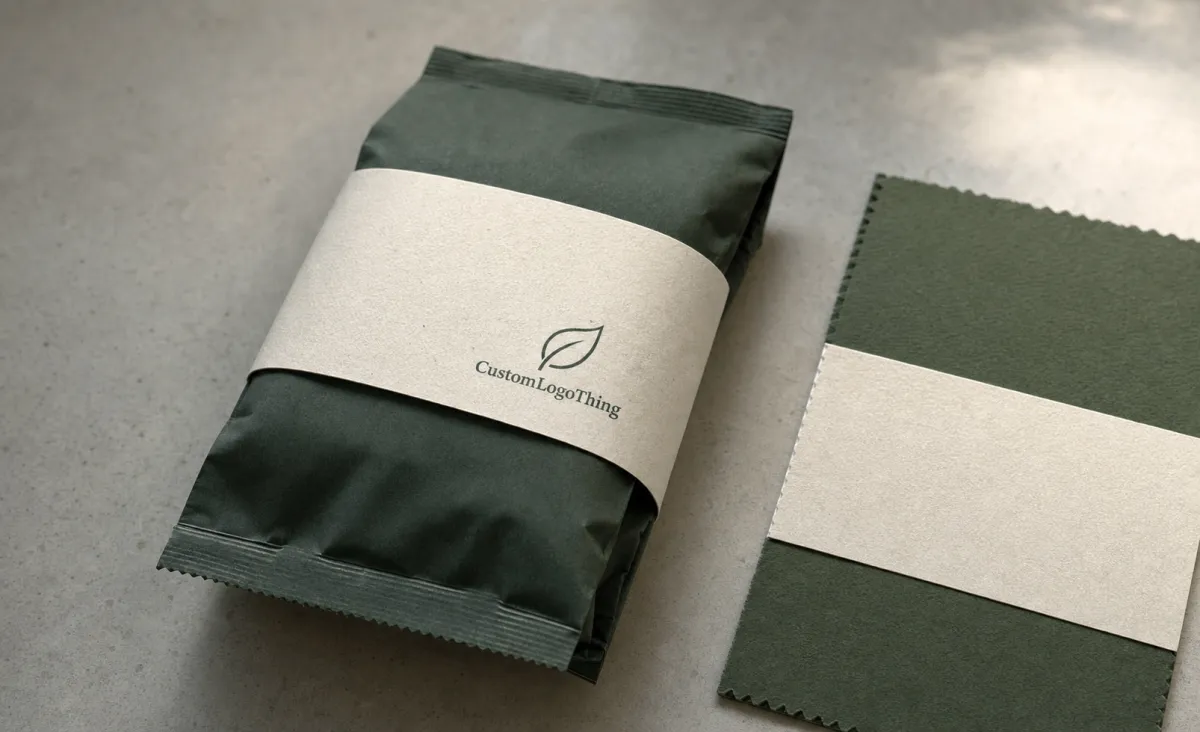
A belly band is a wraparound paper sleeve that secures and brands a carton, pouch, tin, or gift set. It is not the primary pack, yet it often becomes the first thing a shopper notices and the last thing a production team wants to rush. On a tea line, that sleeve may carry the logo, flavor name, blend story, barcode, legal copy, and certification marks in a space smaller than most people expect. The tea brand belly bands material guide is useful because material choice affects every one of those jobs.
Here is the shelf-level reality: a band can make a tea range look boutique, natural, clinical, or mass-market without changing a single word of the design. Uncoated paper pulls the eye toward warmth and restraint. Kraft paper signals an earthy, recycled materials story. A smooth coated board sharpens typography and color, especially when the brand wants a cleaner wellness cue. The tea brand belly bands material guide is really shorthand for picking the visual language that fits the price point.
Tea is a special case because the product itself is light, quiet, and often bought as a repeat purchase. Shoppers are not looking for noise. They are reading trust signals. That is why a band on a premium herbal blend often carries more visual weight than a sticker on a snack pack. It helps the pack feel finished, and it helps the buyer feel certain. The opening moment starts there, not when the lid comes off.
In packaging terms, a belly band also does practical work. It can keep a carton panel closed, hold a tea tin set together, or add a premium outer layer to a sampler bundle. It can be flat-packed to reduce freight, or pre-formed to speed packing on the line. The tea brand belly bands material guide becomes a decision tool because the format touches retail presentation, warehouse handling, and line labor all at once.
A tea band is tiny compared with the full pack, but it can change how the whole range is read in under two seconds.
That speed matters. Packaging studies repeatedly show that first impressions form fast, and in a crowded tea aisle, even a small lift in perceived quality can influence whether a consumer picks up the pack. On a packaging.org resource page, you will see how much emphasis the industry places on structure, materials, and consumer response: packaging.org. For tea brands, the lesson is plain. The tea brand belly bands material guide is not about paper shopping. It is about buying shelf confidence.
If you are comparing a premium loose-leaf launch against a value-led supermarket SKU, the same layout will not work the same way. A heavy textured stock might flatter a heritage blend but overpower a budget line. A lighter recycled board might be perfect for a subscription set but feel underbuilt on a gift box. The tea brand belly bands material guide helps teams avoid those mismatches before they turn into expensive reprints.
One more practical point: the band should never be treated as a decorative afterthought. On tea, the sleeve often carries the story that sells the pack, especially when the outer carton is plain by design. That is a big job for a small piece of paper.
How Tea Brand Belly Bands Material Choices Work on Pack Types
The pack shape changes everything. A band around a folded carton behaves differently from a band around a gusseted pouch, and both behave differently again on rigid tea tins or multi-item gift sets. That is why the tea brand belly bands material guide has to start with the pack, not the artwork. A carton gives you flat panels and clean edges. A pouch flexes. A tin is round or semi-round and punishes materials that do not have enough stiffness or memory. A gift set may need the band to hold multiple items without buckling.
For folded cartons, the band usually needs enough stiffness to stay crisp, but not so much that it lifts at the corners. On stand-up pouches, the stock has to wrap around seams and gussets with less resistance. Rigid tins are less forgiving still; if the paper is too heavy, the curve can crease or spring open. That is one reason the tea brand belly bands material guide keeps returning to caliper, grain direction, and wrap tension. A beautiful stock on a flat sample can behave very differently once folded on the actual pack.
Printing performance is tied to the substrate too. Porous papers absorb ink quickly, which can soften fine type and reduce edge sharpness. Smoother boards usually hold small legal text better, and they tend to give more consistent color across a run. If the design uses botanical illustration, subtle gradients, or tiny origin copy, the tea brand belly bands material guide should lean toward a stock that supports detail rather than one that only looks premium in hand.
Finish choice changes the sensory profile as much as the base stock. Matte can feel calm and natural. Gloss can feel bright and commercial. Soft-touch gives a velvety hand feel, but it can also show rub marks in transit, so it is kinda a tradeoff, not a free upgrade. Uncoated stock usually feels more authentic and pairs well with tea brands that want an earthy story. The tea brand belly bands material guide is useful here because the finish often does more to shape perception than a brand expects.
There is also a subtle logistics issue. The band has to stay aligned from pack-out to shelf. If the stock is too slippery, it may shift in transit. If it is too soft, it can crease at the overlap. If the closure method depends on a glue dot, a tuck, or a self-locking slit, thickness and surface texture matter even more. In short, the tea brand belly bands material guide is as much about mechanical fit as it is about design taste.
For tea brands that ship through changing climates, the issue is more than visual. Humidity can relax paper fibers, soften folds, and affect adhesive hold. A band that behaves beautifully in a dry studio can fail after a week in a warehouse with poor climate control. The tea brand belly bands material guide should always be tested on real pack types, not just in renderings.
- Folded cartons: best for crisp, flat bands with clean panel alignment.
- Stand-up pouches: need more flexibility and a careful wrap allowance.
- Tea tins: benefit from tighter fold behavior and better surface grip.
- Sampler sets: often justify stronger board so the set feels giftable.
- Subscription bundles: usually favor flat-packed bands to cut shipping volume.
The tea brand belly bands material guide also needs to account for the rest of the package system. A band on a carton printed on corrugated cardboard will feel different from one wrapped around a premium paperboard sleeve. A band around kraft paper packaging tells a different story than a band over bright white stock. Those combinations are not accidents; they are part of how the consumer reads quality, sustainability, and care.
Key Factors for Choosing the Right Belly Band Stock
The starting question is not “What looks nice?” It is “What should the pack communicate?” A botanical wellness line, a heritage black tea, a luxury gift set, and a clinical functional blend all need different material cues. The tea brand belly bands material guide works best when the brand first defines the emotional target. Is the pack meant to feel artisan, modern, natural, premium, or approachable? That answer narrows the stock choice faster than any sample deck.
Thickness matters, but only alongside fold behavior. A heavier stock can feel more substantial in the hand, yet it may crack on tight folds or create bulk where the band overlaps. Too light, and it can feel insubstantial or curl at the edges. For many tea projects, the sweet spot sits in the middle: enough rigidity to present a clean face, enough flexibility to wrap without stress. That balance is why the tea brand belly bands material guide should always include a physical mockup or at least a paper dummy.
Print goals also change the equation. Deep solids, metallic inks, foil stamping, embossing, and fine linework all respond differently to different paper families. On a rough stock, foil can look striking but lose edge sharpness. On a smooth board, typography often reads more clearly, especially at small sizes. If the band must carry a barcode, ingredient statement, or certification mark, the tea brand belly bands material guide should favor readability before novelty.
Sustainability belongs in the stock conversation, but only when the claim is real and supported. Tea brands often ask for recycled materials, FSC certified papers, or post-consumer waste content because buyers care about the environmental story. That is a good instinct. It still has to be paired with a material that performs well. An FSC certified stock can still scuff. A recycled board can still print beautifully. The tea brand belly bands material guide should make room for both ethics and execution.
From a compliance standpoint, the wording on the pack should match the material claim. If the sleeve says biodegradable packaging, the brand needs to be sure the structure, coating, inks, and adhesive all support that message. If the band is only one part of a larger pack, the claim should be precise rather than vague. Honest packaging language builds trust faster than overpromising does.
There is a practical distinction between “premium” and “expensive.” A textured sheet with subtle fiber content can feel premium without adding unnecessary cost. A heavily coated board might raise the price without improving the tea buyer's experience. The tea brand belly bands material guide is useful because it helps teams separate tactile value from flashy add-ons.
For brands still refining the brief, this is the point to compare material options side by side. Internal reference files, prior print runs, and a few examples from Case Studies can show how a stock choice changes the final impression. The tea brand belly bands material guide becomes much easier to apply once the team sees a real-world band beside the actual carton or tin.
One more detail gets overlooked often: the print environment. A band that looks refined under studio light may read dull under retail LEDs, while a warm-toned kraft paper can look richer in a physical store than it does on screen. The tea brand belly bands material guide should include live viewing whenever possible. Screens lie. Paper does not.
For design teams, this is where material and brand identity meet. The texture, sheen, and weight are not side issues. They are part of the message. A clean white band on a smooth board says something very different from a raw kraft wrap, even if the logo is identical. That is not branding theory. It is what shoppers actually see in the aisle.
Process and Timeline: From Spec Sheet to Production Run
A clean order starts with a clean spec sheet. The dimensions of the carton, pouch, tin, or gift set need to be measured precisely, and the wrap direction has to be clear before the artwork is finalized. The tea brand belly bands material guide is useful here because a small measurement mistake can create an overlap problem, a gap, or a band that slides too easily. In print production, a millimeter can be the difference between a neat fit and a rework.
The normal workflow is straightforward, but each step creates room for delay if details are missing. The sequence usually runs like this: brief, dieline, material selection, artwork, proof, approval, finishing, cutting, packing, and shipping. The tea brand belly bands material guide should help buyers understand that the most time-consuming part is often not the press run itself. It is the back-and-forth before the run begins.
Late changes are expensive. If the team changes the finish after proof approval, or adds a barcode after the file is locked, the schedule can slip fast. Missing legal copy is another common hold-up, especially on tea packs that need ingredients, net weight, origin, and compliance notes in a small area. A clear tea brand belly bands material guide reduces those delays by forcing the team to gather the right data early.
Turnaround time depends heavily on complexity. A simple one-color band on standard stock can move through production faster than a multi-finish design with foil, embossing, or Custom Die Cutting. As a rule of thumb, a straightforward run might take roughly 10-15 business days from proof approval, while a more involved job may stretch to 15-25 business days or more, depending on volume and finish setup. The tea brand belly bands material guide is useful because it keeps expectations grounded.
Sampling changes the calendar too. A digital proof is quick, but a physical sample tells the truth about fold quality, color, and texture. Many tea brands choose a press proof or sample pack for exactly that reason. It adds time, yes. It also lowers risk. For a launch tied to a fixed retail date or subscription drop, the tea brand belly bands material guide should include a buffer for at least one revision cycle.
Distribution also affects scheduling. If the bands ship flat-packed, the brand saves warehouse space and freight, but the packing team has to assemble them later. If they arrive pre-formed, they can speed line work but take up more volume in transit. The right choice depends on labor cost, storage space, and pack-out speed. The tea brand belly bands material guide should never treat these as afterthoughts.
For transport testing, some brands also ask about edge crush, scuff resistance, or drop behavior, especially when sleeves travel with heavier sets. Standards such as ISTA methods are useful references when the supply chain is rough or the packs move through multiple handoffs. That matters even more if the tea carton is paired with corrugated cardboard shipper Boxes for Retail distribution.
Approval discipline matters too. A spec sheet that lists stock, finish, cut shape, artwork version, and closure method can save days of confusion later. The tea brand belly bands material guide is not just for procurement. It is a communication tool between design, operations, and sales. A better brief usually means fewer surprises on press.
If you have ever approved a file at 4:45 p.m. and then spent the next morning fixing a tiny copy issue, you already know the pattern. The fix is boring, which is exactly why it works: lock the measurements, confirm the finish, and get the sample into a real hand before the print file is treated as final.
Tea Brand Belly Bands Material Guide: Cost, MOQ, and Quote Drivers
Pricing for a belly band is driven by more than paper grade, but the material is usually the first big lever. The tea brand belly bands material guide helps teams see that unit cost is shaped by stock, sheet size, print coverage, finishing, die complexity, and whether the bands ship flat or pre-assembled. A simple one-pass run on standard board can stay relatively efficient. Add foil, embossing, or a custom shape, and the quote climbs for ordinary reasons: setup, labor, and waste.
Minimum order quantity changes the economics quickly. On short runs, the setup cost gets spread across fewer units, so the per-piece price rises. That is not a penalty; it is how print production works. A 2,000-piece order will almost always cost more per unit than a 10,000-piece order with the same specs. The tea brand belly bands material guide is useful because it helps teams decide whether a lower MOQ is worth the tradeoff or whether a larger run makes more sense for a stable SKU.
To make the tradeoffs clearer, it helps to compare typical options side by side. A tea brand belly bands material guide should give buyers a realistic way to discuss value, not just price.
| Stock / Finish | Typical Feel | Best For | Indicative Cost at 5,000 Units | Notes |
|---|---|---|---|---|
| Uncoated FSC paper | Natural, tactile, understated | Herbal teas, wellness brands, kraft paper aesthetics | $0.05-$0.11 per band | Good for writing, less resistant to rub marks |
| Smooth coated board | Crisp, bright, clean | Retail cartons, fine typography, color-critical artwork | $0.06-$0.13 per band | Improves detail, can feel less earthy |
| Textured premium stock | Warm, elevated, giftable | Sampler sets, premium gift packs, heritage teas | $0.08-$0.16 per band | Strong tactile value, often slower to source |
| Recycled content board | Eco-forward, matte, slightly fibrous | Brands with recycled materials claims | $0.05-$0.12 per band | Check print uniformity and color drift |
| Special finish with foil or embossing | High-impact, more decorative | Limited editions and gift sets | $0.11-$0.24 per band | Higher setup cost, more waste allowance |
Those figures are broad, and they depend on quantity, size, supplier capability, and region. They are directional, not a quote. Still, they are useful because they show the pattern: a stock upgrade is not always the same as a finish upgrade. The tea brand belly bands material guide should encourage brands to test one variable at a time. A modestly better board can deliver more perceived value than a complicated finish stack that strains the budget.
That distinction matters for launch planning. If a brand is preparing a seasonal range and only needs a short production window, the safest move may be to stay on standard stock and spend the budget on layout clarity. If the pack is a gift item with higher margin, the brand can justify a more tactile paper or a decorative finish. The tea brand belly bands material guide helps buyers match spend to SKU economics instead of chasing a generic notion of premium.
Freight and warehousing can also tilt the numbers. Flat-packed bands are compact and cheaper to ship, but they ask the brand to do more assembly. Pre-formed bands save labor and reduce mistakes on the line, yet they can cost more to store and transport. The tea brand belly bands material guide should include those hidden costs because the cheapest unit price is not always the cheapest total landed cost.
If sustainability targets are part of the brief, ask for proof, not promises. FSC certification documents, recycled content statements, and substrate specifications should all line up. The tea brand belly bands material guide should not accept vague “eco” language as a substitute for actual paper data. If the brand wants to claim a post-consumer waste percentage, that percentage needs to be verifiable.
For brands comparing multiple vendors, a useful quote request asks for three scenarios: a standard stock option, an upgraded stock option, and a premium finish option. That makes the tradeoff visible. Without those scenarios, it is easy to dismiss a higher quote without seeing what is actually included. The tea brand belly bands material guide becomes a negotiation tool, not just a reference document.
It also helps to ask one plain question: what changes the price the most on this job? Good suppliers can answer that quickly. If they cannot, the quote usually hides more uncertainty than value.
Common Mistakes Tea Brands Make with Belly Band Materials
The most common mistake is choosing by appearance alone. A sample may look elegant on a desk and still fail on the line because the folds are too sharp, the paper too soft, or the overlap too narrow. The tea brand belly bands material guide exists to prevent that kind of mismatch. Beauty matters. So does behavior.
Another frequent problem is over-specifying finishes too early. Brands sometimes lock in foil, embossing, or soft-touch coating before the budget is approved. Then the project hits reality, and the team has to substitute materials late in the schedule. That creates rework, stress, and a pack that does not always match the original intent. A better tea brand belly bands material guide keeps the finish decision aligned with the actual launch economics.
Legibility is often underestimated. Tea packs usually carry small text: ingredients, origin, tea type, brewing instructions, and compliance copy. If the band is scaled down too aggressively, the legal information becomes hard to read and the design looks cramped. The tea brand belly bands material guide should always treat small type as a material issue, not just a graphic issue.
Color pairing causes trouble too. A rich cream carton under a pale belly band can look refined. The same band over a darker kraft box may disappear into the background or look muddy. A saturated botanical print on a textured sheet can lose contrast if the substrate absorbs too much ink. The tea brand belly bands material guide should include a carton-and-band test, not only a band sample on white paper.
Timing mistakes are brutally common. A launch date arrives faster than the revision cycle, and the team accepts a weaker stock simply to keep the shipment moving. That is understandable. It is also avoidable with earlier planning. If a brand knows the tea line is going to retail or subscription customers, the tea brand belly bands material guide should sit inside the project calendar, not after the deadline.
Then there is fit. If the band is not tested on the actual carton or pouch, slippage and buckling can appear only after production starts. A band that overlaps too much may feel bulky. One that overlaps too little may open in transit. The tea brand belly bands material guide should always end with a physical fit check. It is a small step that prevents waste.
- Do not approve paper from a photo alone.
- Do not assume the same stock works on every pack format.
- Do not leave barcode and compliance copy until the end.
- Do not ignore humidity, warehouse time, or transit scuffing.
- Do not skip a test fit on the real pack.
A final mistake is treating the band as a disposable add-on. In tea, the sleeve often carries the brand story, the sustainability story, and the premium cue all at once. If the material is wrong, the whole pack feels unresolved. That is why the tea brand belly bands material guide keeps coming back to one idea: the sleeve is small, but the signal is big.
Expert Tips and Next Steps for Tea Brand Belly Bands
Start with a short shortlist instead of an open-ended search. One practical option, one premium option, and one sustainability-led option are usually enough to reveal the real tradeoffs. The tea brand belly bands material guide works best when the team compares a few sharply defined paths rather than twenty nearly identical samples.
Ask for printed samples on the actual stock, not just digital mockups. Screen color can help with layout review, but it tells you very little about texture, fold behavior, or how the band will photograph under store lighting. The tea brand belly bands material guide should include a live-handling step because the hand feel is part of the product, not a nice extra.
Request a dieline check before artwork is locked. That means the band dimensions, overlap, closure method, and panel hierarchy all get checked against the pack shape early. This is the point where many tea jobs become easier or harder than they need to be. The tea brand belly bands material guide should make dimensional accuracy feel non-negotiable.
Build the launch backward from delivery. Approval date, production window, transit time, and a small buffer for reprints should all appear on the project timeline. If the band is tied to a seasonal launch, the schedule should be even tighter. The tea brand belly bands material guide is only useful if it lives inside a real calendar.
Document the final material choice for future reorders. Stock name, GSM, coating, finish, closure method, and supplier notes should all be saved in one place. That sounds mundane. It is also what makes repeat orders faster and more consistent. A strong tea brand belly bands material guide becomes a living record, not a one-time memo.
For teams that want a quick decision framework, this helps:
- Define the shelf position and price tier.
- Choose the pack type and closure method.
- Decide whether texture, smoothness, or recycled materials matter most.
- Request quotes on three material scenarios.
- Approve the physical sample before final production.
Packaging people often talk about premium as if it were a finish. It is not. Premium is usually the result of alignment: the right paper, the right layout, the right amount of white space, and the right amount of restraint. The tea brand belly bands material guide helps teams make those choices with fewer assumptions. If the material supports the promise, the pack feels credible from the first glance.
For tea brands that are still undecided, the smartest next move is simple: gather the carton or pouch dimensions, decide the budget tier, ask for two or three quotes, and compare the samples under real retail lighting. That is the practical core of the tea brand belly bands material guide, and it is often enough to keep a project on budget without flattening the unboxing experience.
One more point: if the broader pack system includes outer shipper cartons, think about how the band reads next to corrugated cardboard, recycled materials messaging, and any FSC certified claims on the box. The sleeve, the box, and the insert should feel like one story. If they do not, the customer notices. That is why the tea brand belly bands material guide is less about a tiny wrap and more about a coherent package system.
For brands that want to compare actual outcomes, reviewing a few live examples can help. The right material choice often shows up clearly in Case Studies, especially where the same layout was tested on different papers. If the project needs a sustainability edge, keep the language precise, the paper claims honest, and the finish aligned with shelf presence.
Here is the shortest honest version: choose the material that fits the pack, print it on a stock that can hold the message, and test it under the same conditions the customer will see. That sequence is not glamorous, but it is the difference between a tea sleeve that looks considered and one that looks improvised.
FAQ
Which tea brand belly bands material works best for premium retail tea boxes?
A thicker uncoated or lightly textured stock usually gives the strongest premium hand feel without looking overly polished. If the artwork depends on crisp typography or subtle color work, a smoother board may be the better choice because it holds detail more cleanly. For gift sets, scuff resistance often matters more than simply choosing the heaviest paper. The tea brand belly bands material guide should always balance hand feel with durability.
How do tea brand belly bands material choices affect unit cost?
Heavier paper, custom finishes, and complex die cutting usually raise the unit cost fastest. Short runs also cost more per piece because setup time is spread across fewer bands. The easiest way to keep cost under control is to stay on one standard stock and one print pass unless the brand story really needs something more elaborate. That is a core lesson in the tea brand belly bands material guide.
What should I check before ordering tea brand belly bands material samples?
Confirm the carton or pouch dimensions, the wrap direction, and the overlap needed for closure. Ask for samples printed on the actual stock options rather than only digital mockups, because texture and fold behavior change the result. Review the samples in natural light and on the real product so color, surface feel, and fit are all judged together. The tea brand belly bands material guide is only useful if the sample stage is treated seriously.
How long does tea brand belly bands material production usually take?
Simple standard-stock runs move faster than jobs with foil, embossing, or custom cutting. Artwork approval and proofing often take more time than the press run itself, especially if the team is still adjusting legal text or finishes. If the launch date is fixed, build in a buffer for sampling and at least one revision round before production begins. That is the safest reading of the tea brand belly bands material guide.
Can tea brand belly bands material be sustainable and still look premium?
Yes. Recycled or FSC certified stocks can look refined when the typography, color control, and layout are handled well. Premium does not require heavy coating; texture, spacing, and clean print work can do most of the visual work. The key is to match the sustainability claim to the actual stock and keep the message consistent across the full package. That is one of the clearest takeaways from the tea brand belly bands material guide.
For most tea brands, the best move is not the fanciest paper on the table. It is the one that matches the pack shape, survives the route from printer to shelf, and reads the way the brand intends. Start there, test on the real pack, and the decision usually gets simpler fast.

