Tea embroidered beanies Bulk Order Planning works best when the order is treated as a small production project, not a simple merch purchase. The biggest mistakes usually come from incomplete specs: the wrong beanie body, vague logo placement, unclear thread references, or a quote that leaves out digitizing, samples, inspection, and freight. If those items are not fixed early, the final cost and the final result can both drift.
Knit headwear is less forgiving than flat garments. Stretch changes placement, texture affects stitch clarity, and a tea-colored base can make subtle color shifts more visible. Buyers ordering for staff uniforms, retail, school programs, or seasonal promos need a plan that covers fit, decoration, cost, and replenishment before they compare suppliers. A standard bulk order often starts at 100-300 units for custom embroidery, while 500-1,000 units usually gives the best balance of price and consistency.
On knit headwear, the sample is the real test. It shows stretch, stitch density, placement, thread tension, and color contrast before the full run starts.
Why tea embroidered beanies bulk order planning pays off early
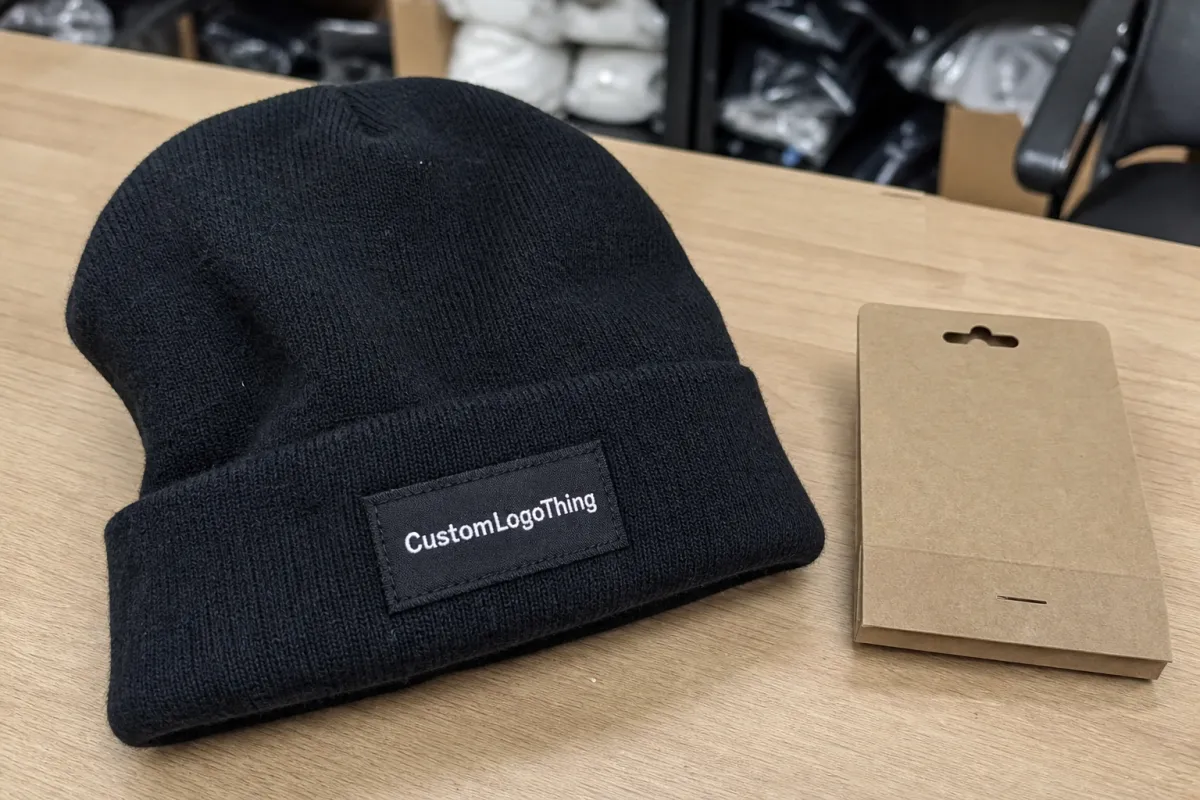
The first choices in a bulk order usually decide the final margin. Blank beanies are only one part of the cost. Digitizing, sampling, thread changes, labels, packaging, inspection, and freight can add up quickly, especially on smaller runs where setup costs are spread across fewer units. A quote that only shows the blank hat price is usually incomplete. For a simple one-color logo, digitizing often runs about $20-$45 per design, while a first sew-out or sample can add $35-$75 depending on complexity.
Planning should start with use case. A hospitality team may care most about a clean uniform look. A retail buyer may need consistent reorders and shelf appeal. A school or nonprofit may prioritize fit, speed, and replacement. Those priorities affect body style, fabric blend, color tolerance, and packaging, so the item should be defined as inventory, not just decoration. If the supplier is using a recycled yarn, ask for GRS documentation; if the beanie includes organic cotton, ask for GOTS support; for skin-contact yarns, OEKO-TEX Standard 100 is a useful benchmark.
Detailed planning also improves supplier accuracy. When the supplier knows the exact quantity range, the decoration zone, and the expected reorder path, the quote is more reliable and the production schedule is easier to hold. Clear documentation helps procurement and operations use the same spec later instead of rebuilding it from scratch. For a 500-piece reorder, many suppliers can hold production to 18-22 business days after sample approval; larger runs commonly need 22-28 business days.
Most bulk problems are practical, not creative. A beanie that stretches more than expected, a tea tone that shifts under different lighting, or a front panel that lacks enough structure can make the same logo look different across the run. Those issues need to be addressed before production, not after shipment. If the supplier is claiming social compliance, ask whether the facility has WRAP or BSCI coverage and request a current certificate or audit summary rather than a marketing statement.
Choose the right beanie body before you compare quotes
Beanie body selection changes both appearance and production behavior. Cuffed styles usually give the embroidery a more stable area and are often the safest choice for clear logos. Slouch styles feel more relaxed, but the looser drape can make placement less predictable. Rib-knit designs add texture and stretch, which can work well for simple marks but may need tighter stitch control. Standard custom runs typically use 1x1 rib or 2x2 rib knit bodies in 5-gauge to 7-gauge construction, with a double-layer cuff for better structure.
Fabric matters just as much as shape. 100% acrylic is common because it is durable, warm, and cost-effective. Acrylic-wool blends, often around 80/20 or 70/30, feel more premium but raise the price. Recycled polyester or recycled acrylic can support sustainability goals, but those yarns should be verified with GRS if recycled content is being claimed. If tea-colored samples are being compared across suppliers, swatches are more useful than photos because knit density and sheen are hard to judge on a screen.
Recovery after stretch is another factor buyers often miss. A beanie that looks fine off the table may shift once worn. That matters for mixed-size teams and retail stock. The safest option is usually the body style that fits the widest range of wearers with the least distortion, not the style that looks best in a catalog. Buyers should also confirm the finished dimensions: many adult cuffed beanies land around 20-23 cm wide and 20-24 cm tall before stretch, but the acceptable tolerance should be written into the spec.
Decoration zone should be decided before pricing. Front-panel embroidery is the most common choice because it reads clearly. Side placement works for small marks or secondary branding. The cuff can improve visibility, but it changes the available vertical space. These are not just aesthetic choices; they affect stitch count, production time, and unit cost. A 60-90 mm wide logo is usually more reliable on knit headwear than a tall, complex mark, and text under 3.5-4 mm high often closes up on textured yarn.
For quoting, define three items first: body style, yarn composition, and decoration position. That removes most pricing noise and prevents a generic knit cap quote from being compared against the wrong product. Add the intended quantity band, because 100-249 units, 250-499 units, and 500+ units can price very differently once setup is spread across the order.
Embroidery specifications that protect logo clarity at scale
Embroidery on a knit beanie needs tighter control than embroidery on a flat garment. The surface moves, the yarn is thicker, and the available area is small. A request like "put the logo on the front" is not enough. The quote should define stitch count, thread colors, width, height, and the logo's position relative to the cuff, seam, or edge of the panel. On a typical beanie, a 5,000-8,000 stitch logo is common for a clean front mark; more detailed artwork can push higher and raise the unit price.
Vector artwork is the cleanest starting point because it gives the digitizer clear paths. If only a JPEG or PNG is available, the supplier may still be able to work with it, but cleanup is often needed. Tiny text is usually the first thing to fail on knit headwear. As a practical baseline, embroidery copy should stay large enough to remain legible after the yarn texture and stitch density are applied, and fine lines should be simplified before the sew-out.
Thread colors should be named and matched before production. If the brand color has to be exact, ask for a thread chart reference and a proof that shows contrast against the actual beanie color. A pre-production sample or strike-off is worth the time because it reveals issues that a digital proof can hide, including stitch direction, density, underlay, and how the design sits on the knit surface. Many suppliers use water-soluble topping, tear-away backing, and a beanie hoop or knit fixture to keep the embroidery from sinking into the fabric.
Bulk embroidery is consistent, but not perfectly identical. There is always a tolerance range for placement and scale. Good suppliers define that range in advance so no one has to argue later about small shifts that fall inside normal production variation. A practical spec might allow a placement tolerance of plus or minus 3 mm to 5 mm on the front panel, with a color approval tied to the thread chart and physical sample rather than a screen image. The same approach is standard in packaging and transit testing, where groups such as ISTA set repeatable performance expectations.
Useful proof standards include:
- Digital mockup with placement measurements in mm
- Vector artwork file, ideally AI, EPS, or PDF
- Thread color references or Pantone-like equivalents
- Maximum logo width and approved text height
- Sample timing, approval deadline, and revision limit
- Location tolerance for the final run
That level of detail prevents the most common failure mode: a logo that looked fine on screen but loses clarity on the actual knit surface. Once the stitch file is set, changes become expensive, so the goal is to catch problems before production starts. Ask the supplier to include the digitized stitch count, underlay type, and any push or pull compensation notes in the approval sheet.
There is also a limit to design complexity. Fine gradients, tiny copy, and detailed seals often lose clarity on beanies. A simplified mark usually performs better, especially on tea-colored yarn where contrast is moderate rather than extreme. If the design contains more than two thread colors or a lot of small text, a woven label or patch may be the better decoration method.
Pricing, MOQ, and unit cost drivers to compare upfront
Pricing should be broken into parts: blank beanie cost, digitizing, embroidery stitch cost, labels or tags, packaging, inspection, and freight. Without that split, a low headline number can hide expensive add-ons later. Buyers need a like-for-like comparison, not a quote that looks good only because half the work was left out. For a standard cuffed acrylic beanie with a one-color logo, $2.50-$4.00 per unit at 500 MOQ is a realistic target range when the spec is simple and packaging is basic.
MOQ changes the math quickly. A 100-piece order usually carries more setup weight per unit than a 500-piece order. Larger orders often unlock better tiering because fixed work is spread across more items. If a reorder is likely, the first run should be treated as a spec lock, not a disposable experiment. Typical MOQ ranges are 100-300 units for straightforward acrylic beanies, 300-500 units for more custom yarn blends, and 500+ units for the most efficient pricing.
| Order band | Typical cost pattern | What to watch | Best fit |
|---|---|---|---|
| 100-249 units | $6.50-$9.50 per unit is common, depending on yarn, stitch count, and packaging | Setup, digitizing, and sample costs carry more weight | Small internal teams, pilot runs, limited drops |
| 250-499 units | $4.25-$6.75 per unit often becomes more competitive | Good balance between flexibility and value | Schools, hospitality, mid-size promos |
| 500-999 units | $2.50-$4.00 per unit is achievable for a simple cuffed beanie with basic embroidery | Ask what is included in the quote before comparing suppliers | Uniform programs, retail replenishment, seasonal campaigns |
| 1,000+ units | $2.10-$3.25 per unit can be realistic on repeat-friendly specs | Confirm color consistency, packing method, and inspection plan | National rollouts, larger retail assortments, steady reorders |
Quote drivers that most often move price are stitch count, thread changes, yarn blend, size grading, label application, and carton configuration. A two-color logo with a dense fill stitch will cost more than a one-color outline. A recycled yarn beanie may cost more than a standard acrylic body, and a private-label woven tag or printed care label can add another $0.15-$0.60 per unit depending on the run size. If the supplier is also handling polybagging, barcodes, or kitting, ask for each line item separately.
Sampling should also be priced separately. A first sew-out is often $35-$75, a physical pre-production sample may be $45-$95, and courier charges can add more if you need a fast turnaround. When comparing suppliers, ask whether the sample fee is credited back against the bulk order. Some suppliers will waive or partially credit the fee once the order is confirmed; others will not.
Freight and duty can change the landed cost more than the embroidery does. If the quote is ex-works, buyers should estimate packaging, cartons, transit insurance, and any import charges before comparing options. A low unit price is not a win if the landed cost is significantly higher than a more complete quote from another supplier.
Process and timeline: sampling, approvals, and production steps
A reliable beanie order usually follows a predictable sequence. It starts with artwork review, then digitizing, then a sew-out or strike-off, then physical sample approval, then bulk production, then final inspection and packing. The full cycle for a simple order is often 18-22 business days after sample approval, while the sample stage itself usually takes 5-7 business days depending on revision count and current workload.
The sample process should not be treated as a formality. The first step is artwork confirmation, where the supplier checks logo size, placement, and thread count. The second step is digitizing, where the art is converted into stitch instructions for the embroidery machine. The third step is a sew-out on an actual beanie body or test panel, using the same yarn color and thread colors that will be used in production. The fourth step is customer approval, ideally with a photographed close-up and a physical sample if the timeline allows.
For the bulk run, a good supplier will set a first-piece approval checkpoint, an in-line check at roughly the first 10-20% of production, and a final audit before packing. On larger orders, an AQL inspection standard such as 2.5 for major defects and 4.0 for minor defects is commonly used as a practical benchmark. The inspection should verify logo placement, thread tension, beanie dimensions, color consistency by shade lot, and carton counts.
Machine setup matters as well. Commercial 12-needle or 15-needle embroidery machines are common for this type of work, and the operator should confirm the frame size, backing, topping, and thread tension before the production run starts. If the beanie is especially stretchy, a stabilizer or support board may be needed to keep the stitches from sinking. That is why the sample needs to be approved on the same body and color, not just on a generic test fabric.
A simple approval path usually looks like this:
- Artwork receipt and spec confirmation
- Digitized proof with measurements and stitch count
- Physical sew-out on the actual beanie body
- Sample sign-off with thread and placement approval
- Bulk production with first-piece and in-line checks
- Final inspection, carton count, and packing approval
If the order has multiple colors, multiple sizes, or custom labels, the timeline should include one extra day for each added approval step. A buyer who needs the product for a fixed launch date should build in buffer time, because a second sample round can easily add 3-5 business days.
What dependable suppliers do to reduce defects and missed dates
Dependable suppliers reduce risk before the order starts, not after problems show up. They confirm the yarn shade lot, check the knit gauge, lock the stitch file, and inspect the first sewn piece before allowing the line to continue. They also separate approval points so a packaging change does not accidentally alter the embroidery spec. Those controls matter because small deviations can become visible across a 500-piece or 1,000-piece run.
A practical quality plan starts with incoming material checks. The supplier should verify yarn composition, color consistency, and fabric weight, especially if the order depends on an OEKO-TEX Standard 100, GRS, or GOTS claim. Before production, they should also verify that the artwork file matches the approved size and that the thread colors match the physical reference. During production, operators should watch for needle breaks, thread tension drift, and stitch puckering.
Packaging checks are part of quality too. A finished beanie should be counted, folded consistently, and packed with the agreed label or insert. If the order includes retail packing, the supplier should confirm barcode placement, polybag thickness, and carton count. A final inspection should catch off-color items, loose threads, skipped stitches, incorrect label placement, and quantity discrepancies before shipment leaves the factory floor.
Dependable suppliers also communicate what they cannot hold. If the design is too small, if the tea shade is likely to vary by shade lot, or if the production schedule is too tight, they should say so before the PO is issued. That transparency is more valuable than a low initial quote that turns into rework later. It is also why buyers should ask for certificate copies, inspection photos, and sample photos instead of relying on sales language alone.
When social and material compliance matters, ask for the right proof for the right claim. WRAP and BSCI relate to facility or social auditing. GOTS applies to organic textile content and processing. OEKO-TEX Standard 100 is useful for testing harmful substances in the finished textile. GRS supports recycled content claims. The best suppliers can explain exactly which certification applies to which part of the beanie, rather than using a single certificate as a catch-all answer.
Next steps to lock your tea beanie bulk order correctly
Start by locking the spec in writing: body style, yarn blend, color, logo size, stitch count, placement, label method, pack method, and target quantity. If you already know the reorder path, say so now, because a 300-piece pilot and a 3,000-piece roll-out should not be quoted the same way. The more exact the request, the easier it is to compare suppliers on the same basis.
Next, request a complete quote that separates blank cost, digitizing, sample cost, packaging, and freight. If the supplier offers a price that looks too low, ask what is excluded. The most useful comparison is landed cost per unit at your actual order size, not a headline number with missing parts.
Then ask for the sample sequence and inspection plan in writing. You want to know when the sew-out will be ready, how many revisions are included, what approval is required before bulk production starts, and what final inspection standard will be used. That way the order stays on schedule even if the sample needs one round of edits.
Finally, keep the approved sample, thread reference, and measurement sheet as the master reference for the reorder. That is the simplest way to protect consistency when the same tea embroidered beanies are ordered again later.
FAQ
What is the usual MOQ for custom embroidered beanies?
Most suppliers start around 100-300 units for standard acrylic beanies. More customized yarn blends, private labels, or recycled-content programs often work better at 300-500 units or more.
How long does production usually take?
A simple order often takes 18-22 business days after sample approval. The sample stage itself usually takes 5-7 business days, and larger or more complex orders may need extra time.
What certifications should I ask for?
Ask for OEKO-TEX Standard 100 for skin-contact textile safety, GRS for recycled content, GOTS for organic cotton content, and WRAP or BSCI for social compliance if those claims matter to your program.
What details should be in the sample request?
Include the artwork file, logo size in mm, thread colors, placement, beanie body, yarn blend, target quantity, packing method, and the inspection standard you want used for the bulk run.
What are the biggest quality checkpoints?
The most important checkpoints are incoming yarn verification, digitized sew-out approval, first-piece approval, in-line inspection, final AQL-style audit, and carton count before shipment.

