Buyer Fit Snapshot
| Best fit | Monochrome Logo on Bright Boxes That Stand Out projects where brand print, material claims, artwork control, MOQ, and repeat-order consistency need to be specified before quoting. |
|---|---|
| Quote inputs | Share finished size, material target, print colors, finish, packing count, annual reorder estimate, ship-to region, and any compliance wording. |
| Proofing check | Approve dieline scale, logo placement, barcode or warning zones, color tolerance, closure strength, and carton packing before bulk production. |
| Main risk | Vague material claims, crowded artwork, missing packing details, or unclear freight terms can make a low unit price expensive after revisions. |
Fast answer: Monochrome Logo on Bright Boxes That Stand Out: Board, Finish, Dieline, and Unit Cost should be specified like a repeatable production item. The safest quote records material, print method, finish, artwork proof, packing count, and reorder notes in one written spec.
Production checks before approval
Compare the actual filled-product size with the drawing, then confirm tolerance on folds, seals, hang holes, label areas, and retail display edges. Reserve space for logos, QR codes, warning copy, and material claims before decorative graphics fill the panel.
Quote comparison points
Review material grade, print process, finish, sampling route, tooling charges, carton quantity, and freight assumptions side by side. A quote is only useful when the supplier can repeat the same color, closure quality, and packing count on the next order.
A bright box can do half the branding before anyone reads the logo, which is why tips for monochrome logo on bright boxes matter more than many teams expect. I still remember a cosmetics client in Los Angeles who arrived with a neon coral rigid box and a three-color mark that looked elegant on a laptop but oddly fussy in the hand. We switched it to a single black pass, and the package suddenly had the kind of clarity you can feel from 18 inches away. The box stopped competing with the logo and started framing it. That was the whole trick, and it was kind of a relief for everyone in the room.
A monochrome logo uses one ink, one foil, or one finish instead of a multicolor build. On saturated packaging, that restraint can look more deliberate than a busy print stack. If the substrate is electric blue, mango orange, lime, or high-visibility yellow, a one-color mark can read with more confidence than a design that tries to explain itself too much. I have seen that in folding cartons in Chicago, rigid gift boxes in Shenzhen, and corrugated mailers in Manchester. The result is usually strongest when the artwork is simplified before production gets involved, especially on 300gsm SBS or 350gsm C1S board. That is usually where good ideas either sharpen up or get muddied beyond repair.
Packaging teams often miss the real problem. They treat tips for monochrome logo on bright boxes as a styling choice, then wonder why the logo looks soft under 4,000K retail lighting or turns muddy on the final board. The job is more practical than that: pick a box color that supports the logo, choose a finish that does not fight it, and let the substrate carry some of the visual weight. When that combination works, the package can feel premium without extra ink or extra setup headaches for the production team in Dongguan, Mexico City, or Rotterdam.
I have seen the opposite too, and it still makes me wince. In one supplier meeting in Xiamen, a brand team brought in a cobalt carton with a silver logo that looked elegant on screen but faint on the press sheet. The board had a slight gloss, the strokes were too thin at 0.25 mm, and the metallic ink sat softly instead of crisply. After we switched to a heavier one-color mark and a matte laminate, the same carton finally read the way they wanted. That is why tips for monochrome logo on bright boxes are never only about color. They are about contrast, print behavior, and how people actually see the box in the wild.
Set expectations early. The strongest results usually come from matching the logo to the box color, the finish, and the viewing conditions. A carton on a warehouse pallet in Atlanta needs different legibility than a boutique rigid box under a 50-watt spotlight in Seoul. A shipping mailer handled for five seconds needs different treatment than a premium gift box that sits on a table and gets photographed by somebody with a phone camera and a very strong opinion. Tips for monochrome logo on bright boxes work best when you design for the real use case, not the mockup alone.
Tips for Monochrome Logo on Bright Boxes: Why It Works
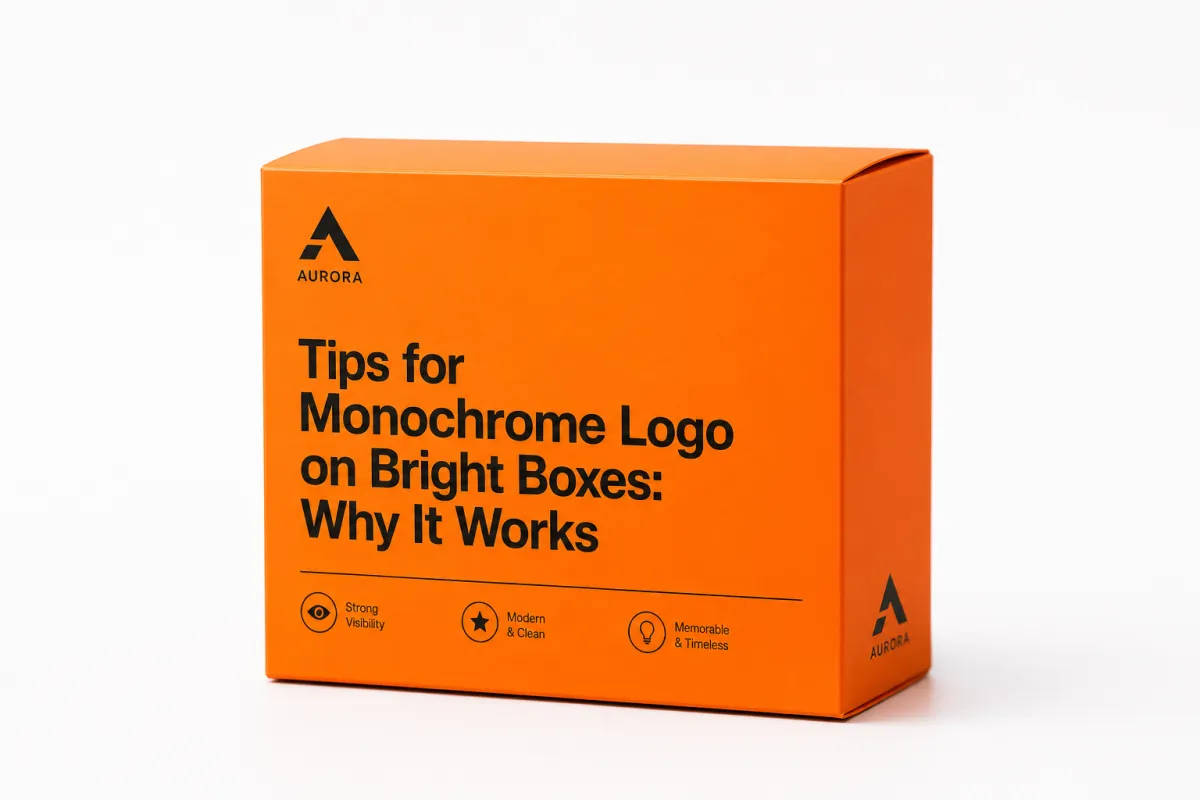
Tips for monochrome logo on bright boxes start with one basic truth: the box color can be louder than the artwork, and that is often an advantage. A vivid surface gives the brand a built-in background, which means the logo does not have to carry the entire visual story by itself. On a bright orange carton with a 350gsm C1S liner, for example, a clean black logo can look more intentional than a full-color badge because the eye reads contrast first and color second. That is one reason monochrome approaches work so well for packaging that needs to feel confident without feeling crowded.
The effect is not limited to orange. Bright blue, neon green, hot pink, and saturated red all behave differently under ink, film, and light. Tips for monochrome logo on bright boxes are useful because they push the design team to ask a better question: what does the eye need to see from two feet away, and what can the package leave out? That question changes everything, especially for brands selling in dense retail environments in New York, Toronto, or Singapore where packaging gets about one second to earn attention. Sometimes less is not a style preference. It is survival.
When I visited a converter floor in Shenzhen, the press operator showed me three versions of the same logo on a vivid teal board. The multicolor version looked busy. The white version looked clean but a bit clinical. The one-color navy version landed in the sweet spot because the strokes stayed visible and the logo held its shape even after 16-micron matte lamination. That sample settled the argument, and it proved a point I repeat to clients: tips for monochrome logo on bright boxes are not about stripping personality out of a package. They are about removing everything that gets in the way of the package doing its job.
Scale matters too. A monochrome mark usually holds better than a layered design when it is reduced to carton size, especially on 250gsm to 350gsm board or on a corrugated mailer with a rougher surface. One clean ink can survive die-line distortion, minor registration drift of 0.3 to 0.5 mm, and a little coating variation better than a stacked print build with multiple delicate colors. In practice, tips for monochrome logo on bright boxes often protect the brand from production issues that show up only after 5,000 or 10,000 pieces are already moving through the line. That is the unglamorous part, and it is also the expensive part.
There is also a psychological effect. Bright boxes already signal energy, novelty, or confidence. A monochrome logo can calm that energy just enough to make the package feel deliberate instead of noisy. I have seen DTC brands use this to good effect on subscription boxes, launch kits, and influencer mailers shipped from Dallas or Leeds. The package says, in one glance, that the brand knows what it is doing. That is a rare advantage, and tips for monochrome logo on bright boxes help you hold onto it without overcomplicating the design.
For brands that want a quick reality check, I often suggest a simple rule: if the box color is doing the excitement work, the logo should do the clarity work. That is the balance. A logo with too many colors starts competing with the board, while a monochrome logo can frame the box color and let the package feel designed rather than printed. Tips for monochrome logo on bright boxes are strongest when the box itself becomes the stage and the logo becomes the focused point of attention, especially on a 90mm-wide lid or a 140mm mailer flap.
"We thought the bright box needed more ink to feel premium," a cosmetics client told me after the sample round in Irvine. "It turned out the opposite was true. The single-color logo made the carton look more expensive the second it hit the shelf, and we approved it in 14 minutes instead of arguing for two weeks."
That reaction is common. A cleaner mark often reads as more controlled, and control is a premium signal. On a shelf crowded with gradients, repeats, and busy pattern work, a monochrome logo on a bright box can look almost editorial. Tips for monochrome logo on bright boxes tap into that effect by reducing noise and making the structure of the logo visible again. It is not a magic trick. It is just the design equivalent of turning down a blaring radio so you can hear the conversation at 6 feet away.
How a Monochrome Logo Reads on Bright Boxes
The eye does not read a bright box and a logo separately. It reads the relationship between them. That is why tips for monochrome logo on bright boxes have to account for hue, value, and surface finish at the same time. A vivid substrate can either amplify the logo or swallow it, depending on how much separation exists between the ink and the board. Black on neon yellow is obvious; white on a highly reflective silver-blue stock may be harder than it looks; and a muted metallic on a saturated surface can disappear if the gloss level is too high.
Opacity matters more than many teams expect. Standard coated boards, such as SBS and CCNB, often accept a one-color logo cleanly because the surface is smooth and the ink sits on top instead of sinking in. Kraft and uncoated specialty boards are a different story. The grain can break up edges, so small text needs more stroke weight and sometimes a heavier ink hit. Tips for monochrome logo on bright boxes are most reliable when the printer can show you how the chosen ink behaves on the actual stock, not just on a PDF. A PDF will smile and promise you everything. The board will tell you the truth in a press proof.
White ink is a special case. On dark bright colors, white can look crisp and modern, but only if coverage is strong enough and the press side is controlled. A weak white pass can look gray, chalky, or patchy, especially on textured board. Black ink, by contrast, usually gives a denser silhouette, but only if the box color is not close in value. Silver and gold inks can work well on bright boxes when the brand wants a more premium signal, yet they need careful testing because reflection can change the reading angle. Tips for monochrome logo on bright boxes are really about choosing the version that keeps the logo legible under real light in Berlin, Austin, or Singapore.
Finish changes the outcome fast. Matte and soft-touch laminations often sharpen contrast because they reduce glare, while gloss coatings can make the package feel energetic but sometimes soften the edges of a fine logo. I have seen a lime carton with a satin black logo look perfect under studio lighting in Brooklyn and then go dull on a reflective shelf because the gloss coat bounced light straight across the mark. That sort of thing makes me want to tap the sample board and say, "See? This is why we do the annoying part first." Tips for monochrome logo on bright boxes should always include a finish test on the exact laminate, not a guess based on a swatch card.
Material choice also changes the reading distance. A smooth folding carton can carry tiny typography more safely than a corrugated mailer with open flute or coarse liner. If the package will be photographed, a higher-opacity ink and cleaner line art matter more because the camera exaggerates any blur at the edges. Tips for monochrome logo on bright boxes become especially practical here: decide how the box will be seen, by whom, and from what distance. A retail carton at arm's length and a shipper viewed from a loading dock are not the same assignment, even if both cost the same to print at first glance.
For teams that need a standards check, packaging performance language often draws from transit testing like ISTA procedures, especially when the box has to survive distribution before it ever reaches a shelf. That is not the same thing as design approval, but it matters because a bright box with a fragile logo is still a weak package if the line work breaks during handling. Tips for monochrome logo on bright boxes work best when aesthetic approval and transport durability are both part of the conversation, especially for cartons shipping from Indianapolis, Shenzhen, or Tilburg.
One more nuance: the same logo can appear darker or lighter depending on the surrounding field. A monochrome mark sitting in the center of a large bright panel can feel smaller than it should, while the same mark placed near a fold, a lid edge, or a window cutout may feel more anchored. I have seen clients solve this by moving the logo just 6 to 10 mm, not by changing the artwork itself. That is a reminder that tips for monochrome logo on bright boxes are partly graphic design and partly box architecture.
When the package needs a sustainability claim, board selection matters too. If a brand wants FSC-certified material, the chain-of-custody story should be clear before artwork is finalized. You can start with the certifier at FSC, then make sure your converter can support the claim on the box copy. Tips for monochrome logo on bright boxes do not replace compliance details, but they should sit alongside them so the package feels polished and credible from every angle, whether the cartons are produced in Milwaukee, Suzhou, or Valencia.
How do tips for monochrome logo on bright boxes work best?
They work best when the design decision and the production decision happen together. Start with contrast, then test the logo on the actual board, then compare finish options under real light. That order matters because a bright carton is not a flat design canvas. It is a physical object with grain, reflection, folds, and handling wear. Tips for monochrome logo on bright boxes become most useful when the team agrees that legibility is the first goal and style is the second.
A clear value gap between the logo and the box color is usually the fastest path to success. If the surface is very vivid, choose a monochrome mark with enough weight to survive the print run. If the logo includes thin strokes or tiny details, simplify them before sampling. On a 350gsm C1S carton or a matte SBS box, that small adjustment can make the difference between a crisp read and a mark that fades into the background. Tips for monochrome logo on bright boxes are strongest when the logo can be understood from a short glance and still look polished up close.
The practical test is simple: hold the sample at arm's length, then under store lighting, then in a quick phone photo. If the logo still reads at all three moments, the system is probably sound. If it fails in one of them, something is off in the contrast, the finish, or the scale. That kind of quick check saves time later, because a package that only works in a render is not ready for production. For teams refining tips for monochrome logo on bright boxes, this sample-first habit is usually the highest-value step.
Key Factors That Shape the Final Look
Contrast is the first gate, and it is usually the least forgiving one. If the logo and the bright box are too close in value, the design fails before any style discussion begins. Tips for monochrome logo on bright boxes should start with a contrast check in daylight and under warehouse LEDs around 5,000K. I have seen beautiful brand marks fail on a neon stock because the chosen ink sat only a shade away from the board. It looked elegant in concept art, then vanished in production. That kind of failure is painful because it is so preventable.
Line weight comes next. Thin strokes, tiny counters, and decorative scripts are risky on packaging because box size forces the logo to shrink. If the logo includes a monogram or icon, simplify it before proofing. A 0.5 mm rule may hold on a premium rigid box, while a 0.25 mm line might disappear on a rougher mailer or on a coated board with heavy lamination. Tips for monochrome logo on bright boxes work better when the logo is built for print, not just for a business card or a website header.
Typography deserves its own attention. Small serif fonts can look refined, but only if the x-height and spacing survive the production method. Bold sans-serif type is usually safer for shipping cartons and retail-ready folding cartons because the letters stay open under variation in ink spread. I once advised a beverage client in Portland to widen the tracking by 10 percent and increase the stroke on a single-word mark. That minor adjustment made the bright can carrier feel far more polished. The lesson carries over directly to tips for monochrome logo on bright boxes: clarity usually beats ornament, even when ornament looks prettier on the screen.
Brand personality matters too. A playful brand can handle a chunkier logo, a taller icon, or a more literal mark because the package already carries energy. A premium skincare or jewelry brand often benefits from restraint, with more whitespace and a quieter one-color seal. Neither path is inherently better. Tips for monochrome logo on bright boxes are about alignment. If the box color is loud, the logo can be disciplined. If the logo is expressive, the box may need to stay controlled. I have argued for both approaches on the same day, which probably says more about packaging than it does about me.
Viewing distance and lighting are practical variables, not abstract ones. A box in a boutique is seen under warm spotlights and touched at close range. A mailer in a fulfillment center is seen under harsh white strips and moved quickly. A subscription carton in an influencer photo may be shot with natural light that flattens subtle contrast. I have watched a supplier spend an hour arguing about ink tone in Vancouver, only to realize the real problem was the overhead lighting in the proof room. Tips for monochrome logo on bright boxes need that kind of reality check, because lighting can make a good solution look mediocre and a mediocre one look worse.
Registration tolerance and coating compatibility also shape the final look. If a box needs multiple finishing steps, every extra pass adds risk. A one-color logo can reduce that risk, but only if the die line, fold lines, and print area are planned carefully. A logo placed too close to a seam can lose a corner. A logo that sits over a heavy fold can distort. Tips for monochrome logo on bright boxes work best when the artwork map respects the physical box, not just the artwork file. That becomes especially important on mailers that fold at 42 mm or 58 mm flaps.
Why the sample stage is where the truth shows up
Clients often ask why I push so hard for a physical sample. Because the screen lies, at least a little. Screen proofs cannot show how ink soaks into board, how a soft-touch film changes reflection, or how a bright stock looks once it is folded and glued. The sample stage is where tips for monochrome logo on bright boxes become actionable. You can see whether the logo holds at 24 inches, whether the bright box steals too much attention, and whether the finish supports the branding or dulls it on a 210 x 150 x 60 mm carton.
On a supplier negotiation for a 5,000-unit cosmetics run in Dongguan, we compared three options side by side on the same box: standard black ink, a slightly richer black with heavier coverage, and a debossed seal with no ink at all. The cost difference was not huge, but the reading difference was. The debossed version looked luxurious in hand, yet it lost impact in photos. The heavier black was the winner because it stayed legible across both use cases. That is the kind of judgment call tips for monochrome logo on bright boxes should help you make. I have learned not to trust the "it will probably be fine" crowd. They are almost never the ones reordering 5,000 boxes.
Step-by-Step Process and Production Timeline
The fastest way to keep a monochrome packaging project clean is to treat it like a sequence, not a single approval. Tips for monochrome logo on bright boxes usually work best in this order: artwork cleanup, substrate selection, proofing, sample review, production, and final shipping. If you skip a step, you usually pay for it later in reprints, delayed launches, or a box that prints correctly but does not actually read well. I have watched an otherwise smart brand lose 11 business days because they tried to approve everything from one digital mockup. The mockup looked lovely. The box looked like a very expensive compromise.
Start with the artwork audit. Strip the logo down to a true one-color master file and remove details that collapse at package size. That may mean converting gradients into solid shapes, thickening a thin stroke, or redrawing a tiny icon so it survives folding. I have had clients save an entire run by converting a fancy script into a cleaner word mark with the same proportions. Tips for monochrome logo on bright boxes often begin with this quiet, boring work, because the box cannot rescue artwork that is too fragile to print. The romance lives in the render. The reality lives in the file.
Next comes substrate selection. A 300gsm SBS carton, a 350gsm C1S artboard, a recycled CCNB board, and a kraft mailer all behave differently under the same ink. If you want the logo to pop, the board has to support the finish you want. If you want the package to feel premium, the laminate or coating needs to match the tone of the mark. Tips for monochrome logo on bright boxes are easier to execute when the production team knows whether the final look should be crisp, soft, matte, glossy, or tactile, and whether the plant is in Guangzhou, Newark, or Ho Chi Minh City.
Then move to the proof. I always recommend two checks: a digital proof for placement and a physical sample on the actual box stock. The digital proof tells you whether the logo sits correctly relative to the fold, flap, or lid edge. The physical sample tells you whether the ink density is strong enough and whether the bright color overwhelms the mark. The second step is the one that catches most problems. In my experience, tips for monochrome logo on bright boxes only become reliable when the board in your hand matches the board in the spec, right down to the 350gsm callout and the finish code.
Production timing deserves honest expectations. A simple file adjustment might take 1 to 3 business days. A physical sample can take 4 to 7 business days depending on board availability and press scheduling. Full production might run in 12 to 15 business days from proof approval for a standard quantity of 5,000 pieces, but special finishes, complex dielines, or a large order can extend the schedule. Tips for monochrome logo on bright boxes should include that timeline reality, because a bright box with a single-color logo is still a real manufacturing job, not a digital mockup.
If your pack also needs additional forms, inserts, or display-ready packaging components, it helps to keep the order under one coordinated spec. We often point teams to Custom Packaging Products when they need to compare box types, inserts, and finish combinations in one place. That makes the logo conversation easier, because the printing method, material, and box style can be judged together instead of one by one, whether the final carton ships from Nashville, Qingdao, or Barcelona.
Here is the part most teams miss: the timeline is not just about speed. It is about decision order. If you approve the logo before the board is chosen, you may have to rework it. If you choose a bright box before the finish is tested, the logo can lose contrast. If you move straight to production without a sample, you are guessing. Tips for monochrome logo on bright boxes are really about reducing guesses, which is a nicer way of saying "avoiding costly mistakes" on a $0.15-per-unit run or a $1.80-per-unit rigid carton.
For projects that involve transit testing or distribution risk, I like to ask whether the shipping profile resembles an ISTA-style route: palletized freight, parcel handling, or mixed-mode delivery. That context changes how a box should be built and how much margin the logo needs. A simple one-color design can still survive tough handling if the board, adhesive, and finish are chosen with the right load in mind. Tips for monochrome logo on bright boxes are stronger when production and logistics are planned together, especially for lanes moving through Chicago, Dubai, or Auckland.
Cost and Pricing: What Changes the Budget
One-color artwork can reduce some print complexity, but that does not automatically make the package cheap. I have seen teams assume that tips for monochrome logo on bright boxes will cut cost by half, then discover that board grade, finishing, sampling, and freight still dominate the budget. The logo may be simple. The package around it is not. Packaging has a funny way of reminding everyone that "simple" often means "well planned."
Board choice is usually the largest variable. Standard SBS or CCNB boards are often the easiest to price because they are common, predictable, and available in volume. Specialty textured stock, rigid board, or recycled materials with a rough surface can raise cost because they need different handling or extra press care. Bright boxes may also require a more opaque ink or a second pass if the first impression is too light. That is why tips for monochrome logo on bright boxes should include a cost audit, not just a design review, before anyone signs off on a 10,000-piece order.
Special finishes can change the budget fast. Soft-touch lamination, spot UV, foil, embossing, and debossing all add steps, and each step can create tooling or setup charges. Some brands add these effects because they want a premium feel; others add them because the logo needs help standing out on a vivid surface. There is nothing wrong with that. It just means the final price depends on the visual goal as much as the box material. Tips for monochrome logo on bright boxes work best when the team decides whether the finish is doing branding work or just decoration.
Here is a practical comparison I use when clients ask how different build choices affect the bill. These figures are directional for a 5,000-unit run and can move based on board, location, and shipping method, but they are useful for planning.
| Option | Visual result | Typical cost impact | Best use case |
|---|---|---|---|
| Standard one-color ink on SBS | Sharp, direct contrast | Lowest setup cost; often around $0.15 to $0.29 per unit added over plain stock for 5,000 pieces | Retail cartons, mailers, and launch boxes with clean artwork |
| High-opacity ink on bright coated board | Strong coverage, better visibility | Moderate increase; often $0.05 to $0.12 per unit more than standard one-color printing | Neon or highly reflective surfaces |
| Emboss or deboss only | Premium tactile mark, low visual noise | Tooling can add a fixed $120 to $400, plus unit cost | Luxury packs and minimal branding systems |
| Foil accent on monochrome logo | High shine, attention-grabbing finish | Usually the highest option; often $0.22 to $0.60 per unit extra | Gift boxes, limited launches, and display packaging |
Those numbers matter because they show where the money goes. A simple logo may be cheap to print, but a demanding surface can force the use of a stronger ink, a different finish, or a more careful setup. Tips for monochrome logo on bright boxes should always include a line-item quote request. Ask separately for setup fees, plate or tooling charges, sample costs, and freight. If the printer bundles everything into one number, you lose visibility on where savings actually exist. And if you cannot see the line items, you cannot tell whether you are paying for quality or just for mystery.
Minimum order quantity is another budget lever. Small runs usually carry a higher per-unit cost because setup is spread across fewer boxes. Larger runs improve unit price, but only if storage and launch timing are manageable. I have seen a brand save 14 percent by moving from a 2,000-piece run to a 5,000-piece run, then lose half the gain because they rushed the freight to make launch week. Tips for monochrome logo on bright boxes are most useful when the order size matches the sales plan and the warehouse capacity in cities like Phoenix, Leeds, or Brisbane.
If you want to compare box styles, finishes, and package structures before you commit, the category page at Custom Packaging Products is a practical starting point. You can use that conversation to test whether the logo needs a softer box color, a different board, or a simpler finishing stack. A good pricing discussion should not only ask, "How much does it cost?" It should also ask, "What exact spec makes the logo look right?" That second question saves more money than most people realize, especially on 350gsm C1S artboard sourced in East Asia.
A quick pricing reality check
In my experience, tips for monochrome logo on bright boxes save money only when the design stays simple and the stock is standard. The moment a brand asks for special foil, heavy embossing, or a rush production slot, the economics shift. That does not make the project bad. It just means the budget follows the ambition. I prefer to tell clients that up front instead of promising a neat number that will not survive sampling. Clean expectations are cheaper than rescue work. Usually a lot cheaper, especially when the freight lane runs through Shenzhen or Long Beach.
Common Mistakes That Make Monochrome Logos Disappear
The biggest mistake is assuming every bright color is automatically strong enough for contrast. It is not. Tips for monochrome logo on bright boxes fail most often when the ink value and the box color are too close or when a glossy coating reflects too much light back into the logo. A lime box with a pale silver mark may look stylish on a screen. Under retail lighting in a 3000K store, it can vanish into a shine. I have stared at samples that looked like someone forgot to print the logo at all, which is a deeply annoying experience when the press time is already booked.
Thin strokes are another trap. Delicate type, fine-line icons, and crowded emblems often break down on packaging because box size forces the logo to shrink. A monogram that looks elegant at 3 inches wide may collapse at 1.5 inches wide if the inner counters close up. I have seen this happen on shipping mailers and on small cosmetic cartons. Tips for monochrome logo on bright boxes are much stronger when the artwork is simplified before the press ever sees it. If the logo needs glasses to read, the box is already losing the fight.
Skipping a real sample is a serious risk. A digital proof cannot tell you how ink opacity will behave, how the board texture will take the mark, or how the finish will read under actual light. One client in a supplier meeting in Chicago refused a sample round to save 3 days, then had to redo the run after the logo looked muddy on the final cartons. That delay cost more than the sample would have. Tips for monochrome logo on bright boxes should always include a physical proof if the project matters at all.
Finish mismatches can also kill the design. A soft-touch box with an ultra-delicate logo may feel luxurious in hand but lose edge definition from certain angles. A gloss box with a strong monochrome logo may look loud in studio photos and weak on shelf because the reflection washes across the mark. The fix is not always to add more ink. Sometimes the better move is to adjust the coating or move to a cleaner board. I know that sounds less exciting, but packaging is full of unglamorous decisions that save the brand from looking careless.
There is also a branding mistake that shows up more than people admit: forcing a full-color logo into a monochrome role without redesigning it. A brand mark built around gradients, shadows, or multiple tones rarely translates cleanly into one ink unless someone simplifies it with care. That simplification is not a compromise. It is design discipline. Tips for monochrome logo on bright boxes work best when the logo is intentionally remade for the package, not merely copied onto it.
Another common issue is ignoring the entire box system. The logo may be fine, but if the box color varies between production lots, the same monochrome mark can look inconsistent from one run to the next. I advise clients to lock in one or two approved box colors when possible. That reduces drift and protects brand recognition. Tips for monochrome logo on bright boxes are stronger when the brand uses repeatable specs instead of one-off guesses, especially for recurring shipments from the same plant in Suzhou or Monterrey.
Finally, do not ignore how people handle the box. If a carton will be touched often, fingerprints, abrasion, and scuffing can change the way a monochrome logo reads in a week. A matte board may show less glare but more wear. A gloss board may stay cleaner but reflect too much light. No option is perfect. That is why the best tips for monochrome logo on bright boxes always depend on the route the package takes after it leaves the press, whether it moves by parcel, pallet, or store display.
Final Tips for Monochrome Logo on Bright Boxes
If I had to compress tips for monochrome logo on bright boxes into one checklist, it would be this: simplify the artwork, test the actual board, compare finishes side by side, and approve a physical sample before production. Those four steps remove most of the expensive surprises. They also force the brand to see the package the way customers will see it, which is usually the most honest test available. I wish more teams would do that before they get emotionally attached to the mockup. Mockups are charming liars, especially when they are rendered on a 27-inch monitor instead of a real 210 x 150 x 60 mm carton.
Lock in your box color early. Bright packaging is strongest when the color choice is deliberate, repeatable, and tied to the brand story. If you are moving between multiple launches, keep one or two approved shades and build the monochrome logo around them. I have seen that single decision save weeks of back-and-forth later. Tips for monochrome logo on bright boxes are easier to apply when the box palette is not constantly changing from neon coral to electric teal to acid yellow.
Ask the printer for side-by-side comparisons. Compare ink options, stock options, and finish options on the same dieline. If possible, view the samples under store lighting, office light, and daylight. You will learn more in 15 minutes of comparison than in 15 emails of theory. Tips for monochrome logo on bright boxes are practical by nature, and practical tests beat opinions every time. My strong opinion here is simple: if the vendor cannot show you comparisons, the vendor is asking you to guess.
Use your vendor conversation to get specific. Ask whether the logo needs a heavier ink hit, whether the chosen board can hold small type, whether a soft-touch laminate will mute contrast, and whether the package should move to a simpler shape. If the team also needs secondary packaging or carton variants, review the options in Custom Packaging Products before you lock the final spec. That lets you match the visual treatment to the actual item being shipped, whether the order is 1,500 gift boxes or 25,000 subscription mailers.
The strongest tips for monochrome logo on bright boxes are not flashy. They are disciplined. Test on the real substrate, simplify the mark until it reads cleanly, and launch only after the sample proves the design works in hand. That is how a bright box earns attention without losing clarity, and it is how a one-color logo can look more premium than a crowded full-color print ever could. I still get a little satisfaction out of that moment when a sample lands perfectly and everyone goes quiet for a second. That silence usually means the box finally makes sense.
What are the best tips for monochrome logo on bright boxes if I need maximum contrast?
Pick the darkest or lightest ink that creates a clear value gap against the box color, then test it on the exact board and finish you plan to print. Increase stroke weight, widen spacing where needed, and simplify tiny details so the mark stays readable at package size. Tips for monochrome logo on bright boxes work best when you prioritize legibility over decoration, even if the designer in the room has feelings about it. On a 350gsm C1S sample or a matte SBS carton, that small change can make the difference between a strong read and a nearly invisible logo.
Can tips for monochrome logo on bright boxes still apply if my brand wants a premium look?
Yes. A single-color logo often looks more intentional than a crowded multicolor print, especially on a bright carton with a clean board. Use whitespace, typography, and a high-quality substrate to make the package feel premium without adding visual noise. If needed, a subtle emboss or foil accent can help, but only if it supports the logo instead of distracting from it. On a 5,000-piece run in Shanghai or Chicago, that restraint often reads more expensive than extra decoration.
Do monochrome logos on bright boxes cost less to print?
Sometimes, but not always. One-color artwork can reduce print complexity, yet special finishes, high-opacity inks, and sampling can add cost. Ask for line-item pricing so setup, tooling, samples, and freight are visible before you compare vendors. Tips for monochrome logo on bright boxes are most useful when the quote is transparent, such as $0.15 per unit for 5,000 pieces on standard SBS versus a higher rate for foil or deboss.
How long does the process usually take for a monochrome logo on bright boxes?
Artwork cleanup and proofing can take a few days if the logo needs simplification or file correction. Physical samples usually take longer than digital proofs, so build time for one actual box sample before approval. Production timing depends on quantity and finishing, but special effects and rush orders can extend the schedule. For a standard run, 12 to 15 business days from proof approval is a realistic target, plus 4 to 7 business days for sampling if the board is not already in stock.
Which materials are easiest for a monochrome logo on bright boxes?
Smooth, coated boards usually give the sharpest lines and the most predictable color response. Rough or highly textured stocks can still work, but small text and thin icons may lose definition. Choose the material based on the final viewing distance, not just the color of the box, and keep tips for monochrome logo on bright boxes tied to the real use case. For most projects, 300gsm SBS or 350gsm C1S artboard delivers the cleanest result, especially when the boxes are produced in Dongguan, Shenzhen, or Monterrey.
The practical takeaway is simple: Choose the Box color first, test the monochrome logo on the exact board, and approve the sample only after it reads clearly in hand, under store light, and in a quick phone photo. If one of those three checks fails, fix contrast, stroke weight, or finish before you print the run. That is the cleanest way to make a bright box look intentional instead of accidental.

