Buyer Fit Snapshot
| Best fit | custom shipping cartons for brands reviewed for packaging buyers comparing material specs, print proof, MOQ, unit cost, freight, and repeat-order risk where brand print, material, artwork control, and repeat-order consistency matter. |
|---|---|
| Quote inputs | Share finished size, material target, print colors, finish, packing count, annual reorder estimate, and delivery region. |
| Proofing check | Approve dieline scale, logo placement, barcode or warning zones, color tolerance, and any recyclable or compostable wording before bulk production. |
| Main risk | Vague material claims, crowded artwork, or missing packing details can create delays even when the unit price looks attractive. |
Fast answer: Custom Shipping Cartons for Brands Reviewed: Dieline, Finish, Proof, and Buyer Review should be specified like a repeatable production item. The safest quote includes material, print method, finish, artwork proof, carton packing, and reorder notes in one written spec.
What to confirm before approving the packaging proof
Check the product dimensions against the actual filled item, not only the sales mockup. Ask for tolerance on folds, seals, hang holes, label areas, and retail display edges. If the package carries a logo, QR code, warning copy, or legal claim, reserve that space before decorative graphics fill the panel.
How to compare quotes without losing quality
Compare board or film grade, print process, finish, sampling route, tooling charges, carton quantity, and freight assumptions side by side. A lower quote is only useful if the supplier can repeat the same color, closure quality, and packing count on the next order.
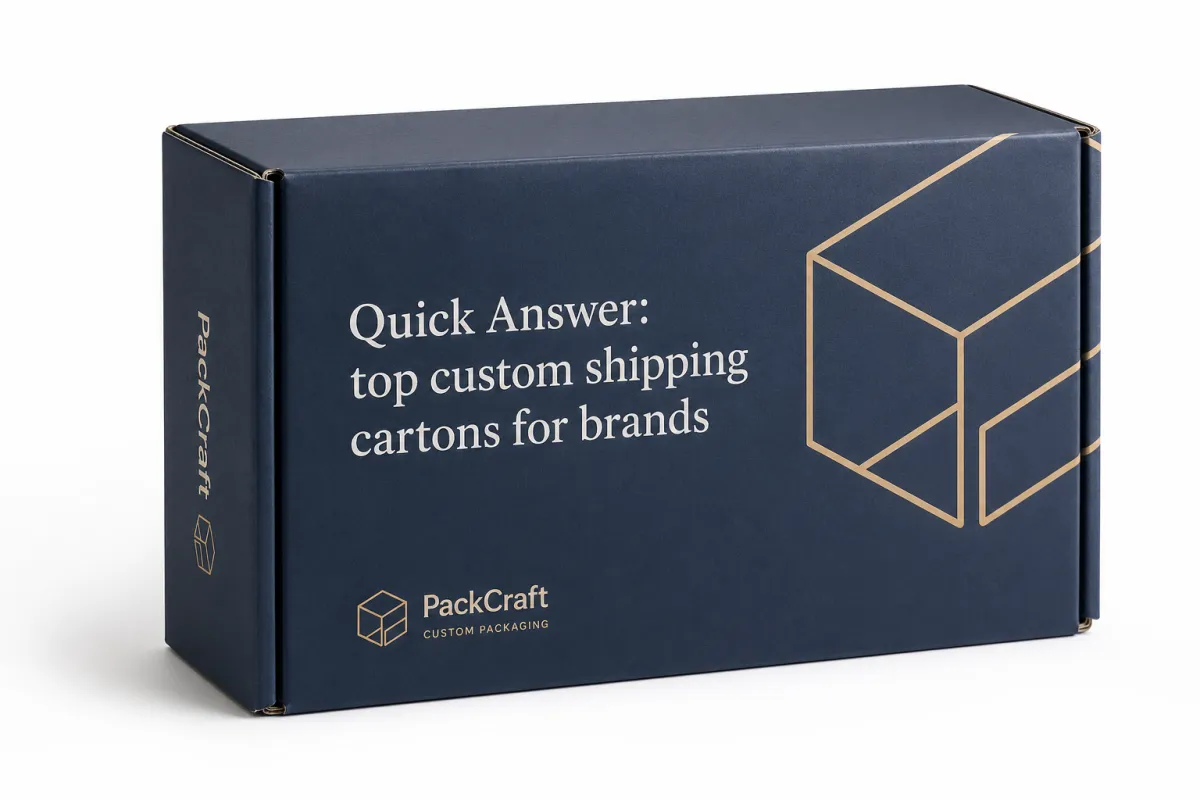
Quick Answer: top custom shipping cartons for brands
I still remember a shipment of 1,200 apparel kits that reached a Brooklyn fulfillment center with split corners and a crushed top flap on nearly every fourth carton after a 650-mile truck run from Ohio. The art looked sharp on a monitor. On the dock, though, the cartons looked tired, and a tired carton usually tells the truth faster than a sales deck does. One packaging miss turned a clean launch into a pile of damage claims, and the lesson was blunt: a 32 ECT box with a weak score line can fail long before a customer ever sees the print.
If you want the top custom shipping cartons for brands, the right answer depends on product weight, shipping abuse, and how much of the unboxing story you expect the box to carry. For most direct-to-consumer labels, a custom mailer-style corrugated carton in E-flute or B-flute sits in the sweet spot between protection, print quality, and pack speed. A 350gsm C1S artboard sleeve may photograph beautifully, but a corrugated mailer still handles the 18-inch drop onto a concrete dock better. It is not flashy. That is kind of the point.
The strongest carton is not always the prettiest one on the render board. The top custom shipping cartons for brands usually fall into five jobs: one style wins on presentation, one on speed, one on fragile-item protection, one on warehouse efficiency, and one on cost control. I judge each box against edge crush, flute profile, closure reliability, print consistency, and how it behaves after a 30-inch drop, a corner strike, and a conveyor ride that feels longer than it should, especially in the 4 p.m. outbound wave at a Chicago or Dallas facility.
My quick verdict after a sample review usually lands the same way. Best overall is a custom mailer-style carton in E-flute or B-flute, depending on whether the packed weight stays under 2 pounds or climbs closer to 5. Best premium presentation is a die-cut shipping carton with a clean tuck-lock closure and a white-top liner. Best for e-commerce efficiency is a regular slotted carton with one-color branding. Best for fragile products is a double-wall or telescoping carton with inserts. Best budget option is a plain kraft RSC with restrained print coverage and a one-color logo at roughly 20 percent ink coverage.
That judgment comes from box builds, not mood boards. I have watched 32 ECT single-wall cartons move through distribution in Shenzhen and Suzhou without much drama for light skincare, and I have also seen that same spec collapse under a 7-pound candle set once the void fill shifted just enough to crack the corners. The right choice for top custom shipping cartons for brands changes with the product, the route, and how much retail packaging theater you want the customer to feel on day one.
“We thought the glossy artwork mattered most, but customers noticed the crushed edge first. After we moved to a 44 ECT mailer and tightened the fit by 3 mm, complaints fell within the first two weeks of a 9,000-unit drop.”
Need the short answer before the longer comparison? Start with a custom mailer box for light-to-medium DTC goods, a heavy-duty RSC for practical fulfillment, and a double-wall carton for anything dense, brittle, or expensive. That shortlist covers most of the top custom shipping cartons for brands I see on factory floors in Dongguan, in buyer meetings in Los Angeles, and in the aftermath of parcel carriers doing what parcel carriers do.
Top Custom Shipping Cartons for Brands Compared
The comparison below is the one I use when a buyer wants the top custom shipping cartons for brands and wants the answer without six follow-up calls. It weighs strength, print surface, assembly time, storage footprint, and the kind of product packaging each style handles best. Warehouse managers think in cycle time and damage rate long before they think in color palettes, so that is the language I am using here, along with the actual specs: 1.5 mm to 3 mm board thickness, 1-color or 4-color print, and 5,000-piece pricing bands.
| Carton style | Strength level | Print surface | Assembly speed | Storage footprint | Best use case |
|---|---|---|---|---|---|
| Mailer-style corrugated carton | Medium to high, usually E-flute or B-flute | Excellent for full-coverage custom printed boxes | Fast, especially with self-locking flaps | Flat shipped, easy to palletize | DTC beauty, apparel, subscriptions, premium ecommerce shipping |
| Regular slotted carton (RSC) | High, especially in 32 ECT or 44 ECT | Good for one-color branding and labels | Very fast on packing lines | Compact and efficient | High-volume order fulfillment, wholesale, mixed-SKU shipping |
| Die-cut shipping carton | Medium to high, depends on board and locking tabs | Strong for premium package branding | Moderate, because folds and tabs take time | Flat and tidy, but often style-specific | Luxury goods, kits, gift sets, branded unboxing |
| Telescoping carton | High, especially for fragile or tall items | Good on both top and base panels | Slower, two-piece setup | Two nested parts require more storage | Glass, ceramics, electronics, higher-value custom shipping boxes |
| Heavy-duty double-wall carton | Very high, often 44 ECT or custom test strength | Solid for simple logos and handling marks | Fast to moderate | Bulkier than single-wall | Dense products, industrial goods, long-haul shipping |
Mailer boxes usually win in DTC beauty because they offer a clean face for print and a satisfying opening moment without forcing the packer into a 90-second fold sequence. Apparel often lands in the same bucket, though fit matters more than fashion teams want to admit; a right-sized mailer still earns a place among the top custom shipping cartons for brands if the garment is light and the box needs to look polished when the lid lifts. Glass and electronics are a different species entirely, especially if the route runs through hubs in Memphis or Louisville. For those, I reach for double-wall protection first and ask about print after the product can survive a drop.
There is a warehouse truth hiding under all the branding language. A carton that stacks neatly, closes with a single tuck, and stores flat in 2,000-piece bundles can save 12 to 18 minutes per hundred orders across a shift. That is not a rounding error. It is labor cost, line morale, and a shorter queue at the packing table. The top custom shipping cartons for brands are a systems decision, not just a design decision, and the difference shows up at 500 orders a day and again at 5,000.
Detailed Reviews of the Best Carton Styles
After a few hundred sample rounds and more than one supplier argument about board caliper, I have a firm view of the top custom shipping cartons for brands: the right style protects the product first and still feels deliberate in the customer’s hands. Beautiful cartons can fail for dull reasons. A soft-touch coating can look fantastic in a conference room and then whiten at the crease after 72 hours of humidity exposure. A folded tab can add only eight seconds per pack and still wreck throughput over a month. Good packaging design respects both the operator and the recipient, especially when a brand is paying for 4-color print, an aqueous coating, and a production slot in Ningbo.
Mailer-style corrugated cartons
Mailer boxes are usually the strongest all-around choice for the top custom shipping cartons for brands because they combine easy folding, solid branding, and respectable crush performance in one format. E-flute works well for lighter goods under 2 pounds. B-flute makes more sense once product weight climbs toward 5 pounds or the parcel route turns rough. A white-top liner gives artwork more punch, while kraft outer stock pushes the mood toward natural, earthy, and less synthetic, which suits wellness, candle, and specialty food brands better than a showroom gloss ever could.
Geometry does a lot of the work here. A self-locking mailer with tight tabs and a proper score line keeps its shape under vibration better than a loose tuck-top style. That matters when cartons slide on belt lines, stack ten high in transit cages, or ride in a van that takes corners like it has somewhere better to be. For product packaging that needs to look premium without dragging down labor, this format usually sits in the center of the map, particularly in runs of 3,000 to 10,000 units.
Most brands get the first sample slightly wrong, then get the second sample much closer. The first pass leans too shiny, too flimsy, or too ambitious. The factory team then asks for a thicker flute, a stronger glue bead, or a fold that does not split in cold weather. That back-and-forth is normal. It is also why the top custom shipping cartons for brands should always be sampled before a production run starts swallowing budget, especially if the supplier is quoting a 12-15 business day turnaround from proof approval.
Regular slotted cartons
RSC cartons are the workhorses of order fulfillment, and they deserve more credit than they usually get. They may never create the most dramatic unboxing, yet they are fast to pack, easy to stack, and excellent for standard shipping boxes in high-volume operations. When a client needs to ship 4,000 units a week and the product mix keeps changing, I usually recommend an RSC with one-color branding and smart label placement instead of an overdesigned structure that slows the line and adds $0.09 to $0.18 per unit in print complexity.
During one supplier visit outside Shenzhen, I watched a folding line reject a decorative carton because the print coverage looked fantastic but the bottom flaps took too long to close around the tape gun. The production manager did the math on the spot: 6 extra seconds per unit across 80,000 units a month became a real labor hit. That is the hidden logic behind the top custom shipping cartons for brands; a plain-looking box can be the smarter business decision if it keeps labor under control and damage claims low.
RSCs work especially well for wholesale, replenishment, and mixed-SKU goods where the outer box serves shipping protection more than storytelling. If the brand needs retail packaging theater, a branded insert, printed tape, or a one-color logo panel can still deliver some identity without turning the carton into a production bottleneck. I have seen that approach hold up for apparel programs in Atlanta and Phoenix where the fulfillment team needed 20-30 seconds per order, not 45.
Die-cut shipping cartons
Die-cut cartons are where package branding starts to feel curated instead of merely printed. They open cleanly, close neatly, and often give the product a more intentional stage than a standard slotted box. I like them for gift sets, subscription kits, and small premium goods because the customer sees alignment, fit, and structure immediately. That visual order matters in categories where the box is part of the brand promise and not just the thing that carries the thing.
The downside is time. Tabs, folds, and notches can slow the pack line if the design is not tuned carefully. I have seen a die-cut carton add 20 percent more packing time because the lead-in tab was too tight for winter conditions in a Minneapolis warehouse. That is not a failure of the style. It is a reminder that the best top custom shipping cartons for brands need real-world tolerance, not just good-looking renderings and a polished mockup deck.
Print opportunities are strong here. Full-bleed artwork works well, matte lamination looks expensive without screaming for attention, and a clean white top surface can make logos feel sharper. Die-cuts also pair well with inserts for cosmetics, tech accessories, and luxury samples. If customer experience matters almost as much as transit performance, this format belongs near the top of the stack, especially if your artwork is built for 4-color CMYK and a 350gsm C1S artboard insert card.
Telescoping cartons
Telescoping cartons are a favorite of mine for long, tall, or especially delicate items because they give you structural flexibility and extra compression resistance. The two-piece construction lets you tune the height more closely, which reduces void space and stops product movement better than a single box that is merely close enough. For fragile ceramics or premium electronics, that fit can make the difference between a clean delivery and a customer service ticket that eats half the afternoon, especially when the parcel travels from Jiangsu to the East Coast in four hub scans.
Speed is the tradeoff. Two pieces mean one extra step, one extra check, and one extra chance for mismatch if the team is moving fast. They also consume more storage space, which matters in smaller fulfillment centers where every rack has a purpose and every inch gets argued over. Still, for the right category, telescoping cartons rank among the top custom shipping cartons for brands because the fit feels controlled and the structure feels intentional in a way a loose outer box never will.
Visual tension can be excellent with this style. So can a dramatic reveal. A 9-second pack cycle tells a different story, especially at 200 orders an hour. Honest tradeoffs like that belong in the conversation before anyone orders tooling or starts promising launch dates to sales, and they are easier to resolve at sample stage than after 8,000 units are already printed in Foshan.
Heavy-duty double-wall cartons
Double-wall corrugated is the safest bet for dense, brittle, or expensive shipments. That usually means 44 ECT, BC-flute, or similar heavy-duty builds that can handle compression from stacked freight and still keep the corners sharp. For machinery parts, large candles, bottle sets, or ceramics, these cartons are often the most practical answer among the top custom shipping cartons for brands, especially if the final packed weight lands above 6 pounds.
The visual story is simpler here, and that is not a flaw. A clean logo, handling marks, and a strong kraft or white outer liner are often enough. Push too much artwork onto a heavy-duty shipping box and you may end up paying for print that does nothing to improve the shipping outcome. I have seen buyers spend an extra $0.18 per unit on rich graphics when the real need was another 10 points of board strength and better die-cut inserts. That is not branding. That is expensive decoration.
My view is plain: if the shipment weighs more than 6 pounds or the product has any breakage risk, double-wall cartons deserve a first-round sample. Long-distance ecommerce shipping only raises the stakes. A parcel may pass through three hubs, two conveyances, and one weather shift before it reaches the doorstep. Board strength feels very glamorous right about then, especially in January when humidity drops under 35 percent and boxes get less forgiving.
“We tried to make the box look as premium as the product, but the factory floor taught us otherwise. After we switched to a heavier 44 ECT board and a simpler print build, the damage rate dropped from 3.2 percent to 0.8 percent and the packing team stopped fighting the flaps.”
Brands comparing Custom Printed Boxes with plain shipping formats should ask one hard question: does the design add customer value, or does it only add cost? That single question separates useful choices from vanity choices faster than any sales deck. For more manufacturing context, our Case Studies page shows how different carton builds performed in actual launches, and our Custom Packaging Products page gives a broader view of available formats from Dongguan, Xiamen, and Jiaxing suppliers.
Price Comparison for Custom Shipping Cartons
Pricing for the top custom shipping cartons for brands is not a unit-price game. I have seen a quote that looked cheap at $0.41 a box turn into a costly project once tooling, freight, and pack labor entered the picture. Real cost is landed cost, and that includes board, print, die tooling, sample rounds, pallet freight, warehouse storage, and the time the packer spends building the carton. A carton that costs $0.15 more per unit can still win if it saves 14 seconds of labor and cuts breakage by 1 percent.
The numbers below assume a run of 5,000 pieces, standard mainland production, and normal print complexity. Smaller runs of 500 to 1,000 units can cost 30 to 70 percent more per box, which is one reason low-MOQ projects make sense for launches and seasonal tests. The economics are different, not broken, and they often make more sense for a brand testing a spring SKU in Portland or Miami than for a steady replenishment program.
| Carton style | Typical unit price at 5,000 | Tooling / setup | Typical lead time | Cost notes |
|---|---|---|---|---|
| Mailer-style corrugated carton | $0.48 to $0.92 | $0 to $180 depending on cut | 12 to 18 business days after proof approval | Strong balance of print, speed, and protection |
| Regular slotted carton (RSC) | $0.28 to $0.55 | $0 to $120 | 10 to 15 business days | Best for operational efficiency and low decoration cost |
| Die-cut shipping carton | $0.62 to $1.25 | $80 to $300 | 14 to 20 business days | More design value, more setup sensitivity |
| Telescoping carton | $0.85 to $1.60 | $120 to $350 | 15 to 22 business days | Two-piece build raises material and labor cost |
| Heavy-duty double-wall carton | $0.78 to $1.45 | $0 to $200 | 12 to 18 business days | Higher board cost, but often lower damage cost |
Brands get into trouble when they treat the cheapest quote as the lowest total cost. If a $0.37 carton creates a 2 percent damage rate and every broken unit costs $18 to replace, the “savings” vanish fast. I have watched a client save $1,400 on box spend and lose more than $4,600 in replacement product and support labor over a single 6,000-unit drop. That is why I push buyers to compare the top custom shipping cartons for brands by damage rate and labor time, not just by the inked number on the quote.
A few simple moves can cut cost without making the box worse. Tighten size ranges and standardize where possible. Simplify print to one or two colors. Skip unnecessary coatings. Use inserts only where the product actually shifts. If you already handle Custom Shipping Boxes in several dimensions, consolidating by 10 mm on one side can often trim freight and setup cost without hurting fit. In South China plants, that kind of change can shave 4 to 7 percent off material waste on a 10,000-piece run.
How do you choose the top custom shipping cartons for brands?
The easiest way to choose among the top custom shipping cartons for brands is to start with the product itself: weight, fragility, and movement inside the box. A 9-ounce serum bottle does not need the same board build as a 7-pound candle set, and a soft apparel item does not need the same insert strategy as glass or ceramic. Too many packaging decisions start with a marketing mood board instead of a product profile, and that is how brands end up overpacking light items or underpacking heavy ones by 20 to 30 percent.
My selection framework starts with a tape measure and a scale. Measure the product and the final packed kit, including tissue, insert, and void fill. Define the shipping lane, whether direct-to-consumer, wholesale, or both. Decide how much the box must contribute to package branding. If the carton must feel premium, print and opening sequence matter more. If it acts mostly as a logistics carrier, compression, closure, and order fulfillment speed take priority. A carton design built for 2-day parcel service in California should not be guessed at from a 1-inch product sketch.
Match board grade to product weight
For light goods under 1 pound, E-flute often gives a crisp feel and a good print surface. For 1 to 4 pounds, B-flute or a stronger single-wall build usually makes more sense. Above that range, I start looking at double-wall, especially if the route includes long-haul ecommerce shipping or fragile contents. That approach reduces the chance of paying for overbuilt custom printed boxes on one end and underbuilt cartons on the other, and it makes the sample stage more honest.
Judge branding by distance and lighting
Packaging that looks sharp in a studio photo can fade badly under warehouse LEDs if the contrast is weak. White-top liners help logos stay legible, while kraft stock supports a more natural, earthy look. Matte finishes tend to hide scuffs better than high gloss, though gloss can still work for certain retail packaging projects that want louder color and sharper reflections. The real goal is not “premium” in the abstract; it is clarity, consistency, and tactile fit for the category, especially at 3 feet away and again at arm’s length.
Respect the operating line
The best carton in a render can still be wrong for a packing team that has 11 seconds per order. I once sat through a client meeting where the sales team wanted a hidden magnetic closure on a shipping carton, and the fulfillment supervisor politely asked how that was supposed to work on a line moving 600 units an hour. That kind of question saves money. The top custom shipping cartons for brands have to survive both the customer moment and the packer’s hands, not just the art director’s screen.
Use sustainability criteria that can be verified
Ask for recycled content, right-sizing, and fiber sourcing details that can be documented. If claims matter to your brand, ask for FSC chain-of-custody proof at the quote stage rather than after approval. I also like to cross-check shipping and transit expectations against industry resources like ISTA testing guidance and paper sourcing details against FSC standards. Those references do not make a carton automatically better, but they help keep the project honest, especially when a vendor is quoting 4,500 units from Guangdong.
A quick decision path helps. Light and brand-forward points to a mailer-style carton. Heavy or fragile points to double-wall. High-volume and plainspoken points to RSC. Giftable or nested products point to die-cut or telescoping structures. If the choice still feels blurry, request two samples and compare them side by side with the real product inside. That hands-on test usually tells you more than ten email threads and three glossy mockups, especially if one sample uses a 1.8 mm board and the other uses 3.0 mm.
Brands that need a broader sourcing view can use our Custom Shipping Boxes page to compare structural options, while Custom Poly Mailers can be the better fit for very light apparel or accessories that do not deserve corrugated board. Not every shipment needs a carton, and good product packaging should say that out loud without pretending a 0.03 mm poly bag can replace board strength.
Process and Timeline for Custom Shipping Cartons
The production path for the top custom shipping cartons for brands usually starts with a brief, a dieline, and a blunt conversation about quantity. The brief should include product dimensions, target board grade, print count, finish preference, and the date the cartons must reach the fulfillment center. Miss the last item and the project can look perfect on paper while still failing the launch. I have seen that movie, and I do not recommend the sequel.
A clean process often looks like this: day 1 to 2 for briefing and dieline review, day 3 to 7 for sample development, day 8 to 10 for proof approval, and then 12 to 18 business days for standard production once the artwork is signed off. More complex jobs with custom inserts, laminated finishes, or heavy-duty construction can take 18 to 25 business days. Rush work exists, but not every carton should be compressed into a short timeline if the result matters. A Beijing-to-California air freight plan can shorten delivery, but it rarely saves money on a 5,000-piece run.
I learned that lesson years ago in a Guangdong converting plant where a 2 mm error in flap depth caused one hundred samples to bunch at the fold. The operators caught it early, yet the fix still cost half a day of line time and a fresh proof. That tiny measurement reminded everyone that custom shipping cartons are only “simple” until the board hits the table and the glue starts acting like it has opinions.
What slows a project down
Artwork revisions, structure changes, insert redesigns, and color corrections are the usual delays. A brand may think the only change is a logo move, while the printer sees a different ink coverage pattern, a different dry time, and a different risk of scuffing. Lead times can stretch by 5 to 7 business days when someone changes a dieline after the proof stage. That kind of slip is common, and it is avoidable if the dimensions are locked early and the carton is measured in millimeters, not guesses.
How to prepare better files
Send vector logo files, exact Pantone references if needed, and a spec sheet with product weight, dimensions, and target use. If your carton needs to hold three glass bottles, say so plainly. If it needs to tuck into a 16-inch fulfillment shelf, say that too. The cleaner the brief, the closer the first sample is to the final piece, and the less money leaks out of the custom packaging project through revisions. A complete file set can cut two proof rounds down to one.
How logistics affect the schedule
Even a perfect carton can miss a launch if freight is slow or the receiving dock is full. I always ask where the cartons are landing, whether they need palletization, and whether the fulfillment center wants a specific pallet height or label format. For a brand launch tied to a photo shoot or seasonal drop, build at least 5 extra business days into the plan. That cushion is not waste; it is insurance against carrier delays, customs checks, and receiving bottlenecks at a warehouse in New Jersey or Ontario.
From a buyer’s perspective, the best results come when the brand, the printer, and the fulfillment team all use the same numbers: exact dimensions, exact quantity, and exact delivery date. That is the only way the top custom shipping cartons for brands stop being a generic procurement line item and start behaving like a real operating tool. In practice, that usually means one spec sheet, one proof file, and one sign-off date in writing.
Our Recommendation and Next Steps
If I had to choose one answer for most brands, I would start with a custom mailer-style corrugated carton as the best overall pick among the top custom shipping cartons for brands. It gives a strong mix of transit protection, brand presentation, and packing speed, and it avoids the labor drag that some decorative structures create. For premium presentation, I would choose a die-cut carton with a white-top liner and a restrained matte finish. For cost control, a standard RSC with one-color branding is still hard to beat, especially if the target is 5,000 to 10,000 units and the line is already tuned for speed.
Before you request quotes, gather four things: accurate product dimensions, final packed weight, desired print area, and the delivery deadline. Then ask for sample lead time, tooling cost, quantity breaks, freight estimate, and whether the carton can be built in a standard board grade or requires a custom spec. Those questions separate a useful quote from a shiny number that falls apart once the project starts moving, and they are easier to answer if the supplier is quoting from Dongguan, Ningbo, or Xiamen.
- Confirm product size and weight to the millimeter and gram.
- Request two samples, one structural and one print-ready, if the product is still being finalized.
- Compare board grade, flute profile, and closure style across at least three vendors.
- Ask for a transit test note, even if it is informal, and compare it with your carrier history.
- Review how the carton will fit into order fulfillment, storage, and shipping labor before signing off.
I also recommend keeping a short vendor checklist for each quote: board strength, print method, insert options, turnaround time, communication speed, and sample accuracy. That checklist makes apples-to-apples comparison much easier, especially when one supplier emphasizes aesthetics and another emphasizes shipping performance. If you need inspiration, our Case Studies page shows how different structures performed in actual brand programs, from launch kits to high-volume replenishment.
My final view is straightforward: the top custom shipping cartons for brands are the ones that keep the product safe, fit the line, and tell the brand story without pretending the carton matters more than the product inside. Pick the structure that matches your route, your weight, and your customer promise, and you end up with the most practical carton for your brand, not just the prettiest one. A carton that saves 2 percent in damage and 8 seconds in pack time usually beats a more elaborate option with prettier renders.
What are the best custom shipping cartons for brands that sell fragile products?
For fragile products, I usually recommend double-wall corrugated or a reinforced telescoping design, often with inserts or partitions to stop movement. The carton should fit the product tightly, because a loose 1/2-inch gap can create enough momentum to crack glass or chip ceramic edges during transit. If the item is brittle, protection should win over decoration every time, especially on routes that pass through three or more hubs.
How much do top custom shipping cartons for brands usually cost?
Cost depends on size, board grade, print coverage, quantity, and whether custom tooling is required. A simple RSC might land in the $0.28 to $0.55 range at 5,000 pieces, while a premium die-cut mailer can move past $1.00 and a custom mailer can run as low as $0.15 per unit for 5,000 pieces on a simple, low-ink build. Smaller runs usually carry a higher unit price, but they reduce risk when you are testing a new product or seasonal design.
How long does it take to produce custom shipping cartons for a brand launch?
Simple cartons can be produced faster than highly customized die-cut or heavily printed formats, but the timeline depends on sampling, proof approval, and factory capacity. A standard run may take 12 to 18 business days after sign-off, with many suppliers quoting 12-15 business days from proof approval for a mailer-style carton, while more complex builds can run 18 to 25 business days. If the launch date is fixed, build extra time for freight and receiving.
Which carton style is best for branded unboxing without overpaying?
Mailer-style corrugated cartons usually give the strongest balance of presentation and efficiency. They support good print on the outer face, close quickly, and still feel substantial in the hand. If the product is light, a well-designed mailer often delivers premium package branding without the cost of a more complex structure, especially when the board spec is a 32 ECT single-wall with a white top liner.
How do I choose between plain shipping cartons and fully branded cartons?
Start with shipping risk, product value, and how visible the package is to the customer. Plain cartons work well for internal logistics, wholesale, or low-visibility routes, while fully branded cartons make more sense when the box is part of the customer experience. The right answer depends on whether your carton is mostly a carrier or also a marketing surface, and that difference can be worth $0.10 to $0.40 per unit.
If you are still narrowing the field, the safest path usually balances board strength, print clarity, and packing speed instead of chasing one feature too hard. For most brands, that means a well-built mailer or RSC will outperform a flashy but awkward carton. In my view, the top custom shipping cartons for brands are the ones that hold up on a real truck line, fit the warehouse rhythm, and make the customer feel the brand cared about the details from the first fold to the final delivery, whether the boxes were made in Dongguan, Foshan, or Jiaxing. Pick the structure that matches the product, test it with the real packout, and only then commit to a production run. That order saves money, and more often than not, it saves a launch.

