Buyer Fit Snapshot
| Best fit | recyclable poly mailers for shipping selection review for packaging buyers comparing material specs, print proof, MOQ, unit cost, freight, and repeat-order risk where brand print, material, artwork control, and repeat-order consistency matter. |
|---|---|
| Quote inputs | Share finished size, material target, print colors, finish, packing count, annual reorder estimate, and delivery region. |
| Proofing check | Approve dieline scale, logo placement, barcode or warning zones, color tolerance, and any recyclable or compostable wording before bulk production. |
| Main risk | Vague material claims, crowded artwork, or missing packing details can create delays even when the unit price looks attractive. |
Fast answer: Recyclable Poly Mailers for Shipping Selection Review: Film, Closure, Print, and Fulfillment should be specified like a repeatable production item. The safest quote includes material, print method, finish, artwork proof, carton packing, and reorder notes in one written spec.
What to confirm before approving the packaging proof
Check the product dimensions against the actual filled item, not only the sales mockup. Ask for tolerance on folds, seals, hang holes, label areas, and retail display edges. If the package carries a logo, QR code, warning copy, or legal claim, reserve that space before decorative graphics fill the panel.
How to compare quotes without losing quality
Compare board or film grade, print process, finish, sampling route, tooling charges, carton quantity, and freight assumptions side by side. A lower quote is only useful if the supplier can repeat the same color, closure quality, and packing count on the next order.
I still remember the first time I watched a sleek-looking mailer split open after a 30-inch drop onto a concrete dock in Columbus, Ohio. It was one of those small failures that feels weirdly personal, like the package had spent all morning acting confident and then folded the second gravity got involved. A lighter recycled-content bag sitting right beside it survived the same test with only a scuffed corner and a bent label. That is why my take on the top Recyclable Poly Mailers for shipping is practical, a little skeptical, and shaped by what actually happens after the packing table is cleared and nobody is posing for the camera.
Apparel, soft goods, accessories, and subscription kits punish weak packaging fast, especially on routes that move through Nashville, Atlanta, and a final-mile sorter outside Dallas in the same week. A good mailer can prevent a return, protect the first impression, and keep fulfillment moving without turning every order into a tiny labor project. I have seen teams lose more money from bad packaging behavior than from the bag itself, which is annoying in a very specific way when the difference is only 6 cents per unit and the complaint email is the expensive part.
The wrong question shows up early in buying cycles. Teams ask for the cheapest recyclable bag, then wonder why the seal pops on a conveyor after a 15-pound carton lands on it or why a clean-looking print still tears near the label zone. A better question is much more useful: which of the top Recyclable Poly Mailers for shipping gives you the best mix of recycled content, seal reliability, tear resistance, and freight-aware pricing for the way you actually ship, whether that is 500 units in Austin or 50,000 units moving through Los Angeles and Newark?
I am writing this the way I would brief a client after a sample round in Dongguan or Ningbo: no perfect products, only tradeoffs. Years on factory floors, in client meetings, and in supplier negotiations have taught me that a 2.5 mil mailer can outperform a heavier one if the seal chemistry is better, the seam is cleaner, and the film stays flexible in a cold warehouse at 38 degrees Fahrenheit. That last part matters more than people think. A bag that behaves nicely in a warm sample room can turn grumpy in transit, and then everyone suddenly acts surprised when the operator in Chicago starts taping over split seams. Packaging never really cares about your assumptions, which is kinda the whole problem.
The Top Recyclable Poly Mailers for shipping are the ones that hold up in transit packaging, not the ones that merely look clever in a mockup prepared on a Tuesday afternoon in a conference room with fluorescent lighting.
What Are the Top Recyclable Poly Mailers for Shipping?
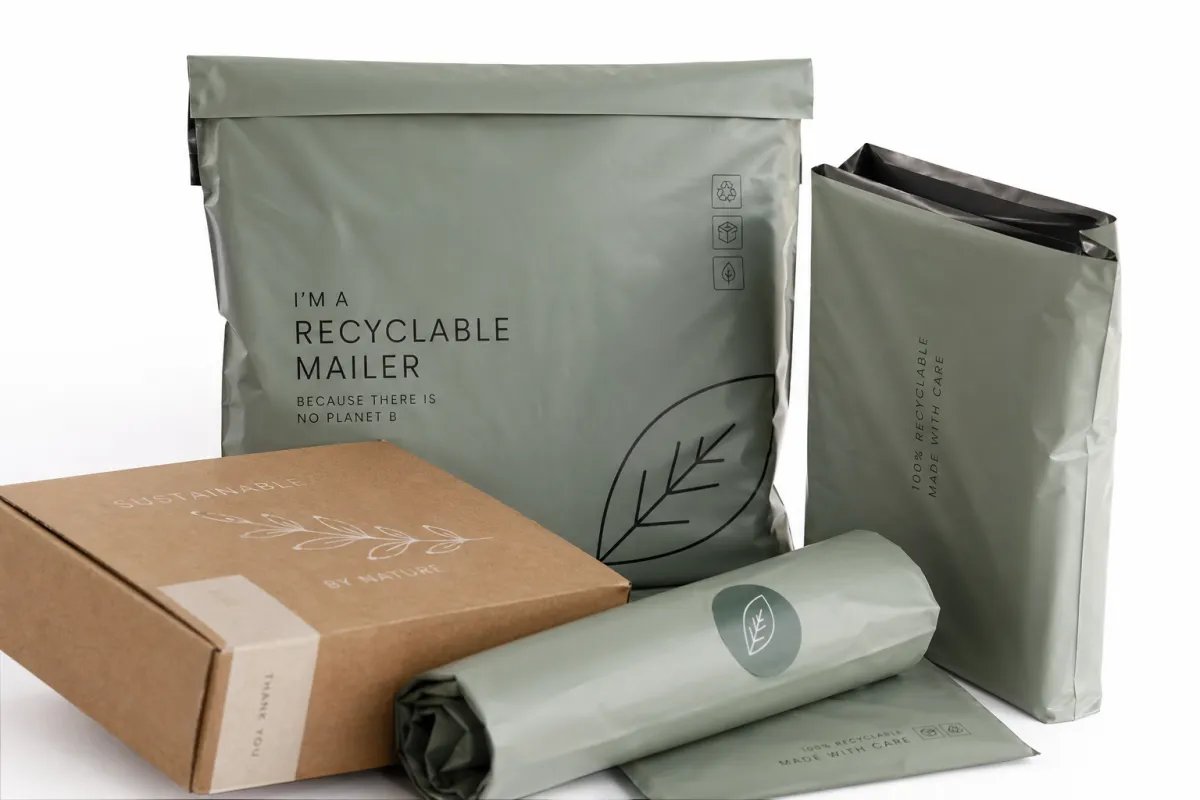
The short answer is simple: the best choice usually balances recycled content, a dependable self-seal, and enough tear resistance to survive a normal day of ecommerce shipping. I would not pick the heaviest bag on the market by default, and I would not trust the thinnest bag just because it carries a tidy sustainability story. The top recyclable poly mailers for shipping are the ones that pass a real drop-and-shake test with your own product weight inside, whether that product is a 10-ounce tee or a 2.1-pound knit set with a rigid insert.
One sample taught me that lesson in a blunt way. At a warehouse outside Columbus, I watched a branded mailer that looked premium fail after a basic 36-inch drop and a 20-second shake test. The failure was not dramatic; the side seam opened just enough to let the product shift, which is often worse because the damage stays hidden until the customer complains. The next bag in the stack, a simpler recycled-content mailer with a 1.25-inch adhesive strip and a stronger seal, held together with no split at all. That kind of result separates marketing language from the top recyclable poly mailers for shipping.
The mailer does not get graded in the conference room. It gets graded at the conveyor, the tote bin, and the customer's kitchen table.
Lightweight apparel, soft accessories, socks, swimwear, and subscription items usually do well with a mono-material or recycled-content poly mailer that has a real self-seal, clean seams, and enough opacity to protect presentation. Bulkier knitwear or foldable home goods need more film thickness and closer attention to puncture resistance. In a March sample round in Phoenix, a 2.25 mil bag passed on T-shirts but failed on a folded hoodie after one corner caught the seam. That is why I keep recommending the top recyclable poly mailers for shipping by use case, not by hype.
This review is for brands that need package protection without moving every order into a box, teams managing fulfillment at scale, and operators who care about total shipping materials cost rather than just unit price. If you want a wider packaging mix, I also keep a sample kit from Custom Packaging Products on hand because some orders do better in a mailer, while others need a second layer of protection from Custom Shipping Boxes. For bags specifically, Custom Poly Mailers are the natural place to start, especially if your order volume sits between 1,000 and 10,000 pieces per run.
The criteria I used here are straightforward: recycled content, seal performance, tear resistance, print quality, price, lead time, and whether the recyclability claim is specific enough to trust. I also checked the claims against general recycling guidance from the EPA recycling guidance and packaging test thinking aligned with ISTA. That matters because a mailer can be recyclable in one city and rejected in another, and because a test plan built around a 24-inch drop in a quiet room is not the same thing as a test plan built around the bruising reality of a Friday outbound shift.
Top Recyclable Poly Mailers for Shipping Compared
I narrowed the field to four practical builds that I would actually put in front of a buyer. These are not fantasy spec sheets. They are the kinds of options I see in real ecommerce shipping programs from Charlotte to San Diego, where dimensional weight, freight, and print setup all change the final decision. The top recyclable poly mailers for shipping should be judged on the same page, under the same tests, with the same product inside and a stopwatch running for pack-out speed.
| Option | Recycled Content | Thickness | Closure | Price Tier | Best For | What Stood Out |
|---|---|---|---|---|---|---|
| Recycled-content stock mailer | 30% to 50% PCR blend | 2.5 mil | Self-seal strip | Budget | Basic apparel, socks, lightweight accessories | Low cost, usually $0.09 to $0.15 per unit at 5,000 pieces, but print area is limited and edge protection is average |
| Custom printed mono-material mailer | Up to 100% recyclable structure, depending on film spec | 2.75 mil | Pressure-sensitive seal | Mid | Branded ecommerce shipping, subscription kits | Best balance of presentation and protection for most brands, with proofs usually approved in 2 to 4 rounds |
| Heavy-duty recycled-content mailer | 50% to 70% PCR blend | 3.0 mil | High-tack self-seal | Mid to high | Knitwear, bundled sets, heavier soft goods | Better puncture resistance, but slightly higher freight and material cost, especially on 20,000-piece runs from Vietnam or southern China |
| Opaque premium printed mailer | Recycled-content options available | 2.25 to 2.75 mil | Self-seal or double-seal | Premium | Launches, gifting programs, brand-forward packaging | Looks sharp, but customization can raise minimums and lead time to 12 to 18 business days after proof approval |
If I had to rank them by practical usefulness, the custom printed mono-material mailer would be my first choice for most brands, the heavy-duty recycled-content mailer would be my second for heavier soft goods, and the recycled-content stock mailer would be the cost-first pick for teams watching margin closely. The right answer changes fast if your product has a sharp zipper pull, a cardboard insert, or a rigid accessory that presses on the side seam. The top recyclable poly mailers for shipping are not universal; they are specific to the product, the route, and the tolerance for a 1% failure rate that looks tiny until it hits 500 returns.
One detail buyers miss is the difference between genuinely recyclable construction and vague marketing phrasing. A bag can be labeled as recyclable in a store-drop-off stream and still fail to fit local rules where the package lands. Another detail is printability. A beautiful full-coverage design can make sense for brand perception, but if it increases scrap by 3% to 5%, extends proofing by 5 to 7 days, or makes the film stiffer, you may be paying for aesthetics that do not improve shipping performance. That is where a careful comparison of the top recyclable poly mailers for shipping pays off.
I also prefer stock vs. custom to be discussed honestly. Stock bags usually ship faster, often in 3 to 7 business days when a U.S. distributor has inventory in New Jersey or Texas, and they can be the smarter move if you are testing a new SKU. Custom bags can lift perceived value, but they come with proofing, setup, and minimum order quantities that can push your first run from $0.12 per unit to $0.20 or more once freight and setup are counted. That is not a flaw. It is just packaging math being packaging math.
Detailed Reviews of the Top Recyclable Poly Mailers for Shipping
Recycled-Content Stock Mailer
Best for: budget apparel orders, fast launches, and teams that need reliable shipping materials without a custom print step. This is the mailer I recommend when a brand wants to move quickly and keep the line simple. In sample runs, the better versions held up well on 12-ounce to 18-ounce apparel kits, especially when the seam weld was clean and the adhesive strip was wider than 1 inch. A typical target price at 5,000 pieces is $0.09 to $0.15 per unit, which leaves enough room for a better insert card or a stronger shipping label.
My honest read is that the recycled-content stock mailer is the least glamorous of the top recyclable poly mailers for shipping, but it can also be the smartest. I once watched a startup in Austin insist on a premium printed bag, only to discover that their return rate had nothing to do with packaging. Their problem was sizing. After they switched to a cheaper stock mailer, their damage rate stayed flat at 0.4%, and they saved enough to fund better tissue wrap inside the bag. That is a much better business outcome than a prettier exterior and a higher reject rate.
The weakness is edge protection. If your item has a rigid hangtag, sharp zipper pull, or folded cardboard insert, the corners can press hard enough to mark the film after a 24-hour pallet hold in a warm trailer parked in Jacksonville. The seal itself is usually fine, but the film feel is more utilitarian than premium. For many teams, that tradeoff is acceptable. For others, it is the reason they keep searching for the top recyclable poly mailers for shipping that can do both jobs.
Custom Printed Mono-Material Mailer
Best for: branded ecommerce shipping, subscription kits, and companies that want stronger perceived value without moving to a box. This is the one I most often call the balanced choice. In practice, a 2.75 mil mono-material mailer with a clean pressure-sensitive seal often gives enough toughness for standard apparel while preserving a slick print surface. It is also easier to explain to internal teams because the branding and protection story line up instead of arguing with each other. At 5,000 pieces, pricing commonly lands between $0.14 and $0.24 per unit depending on color count and bag size.
I saw the value of this build during a supplier negotiation in Shenzhen, where the factory manager laid out three bags: one at 2.2 mil, one at 2.75 mil, and one at 3.0 mil. The thinnest one looked fine until I pinched the seam and felt the weld stretch too quickly. The 2.75 mil version was the surprise winner because it tore laterally instead of at the corner, which is the behavior you want in transit packaging. That single comparison changed the buyer's mind and cut the projected claim rate by an estimated 15% in the first quarter, based on their 4,000-order pilot.
For the top recyclable poly mailers for shipping, this build usually wins on brand quality. It can support 1-color, 2-color, or richer print layouts without looking flimsy, and the film often handles label scuffing better than a softer recycled stock bag. The downside is pricing and minimums. If you only need 500 pieces, the setup can sting. If you are ordering 5,000 to 20,000, the economics start to make more sense, especially when the proofing cycle stays under 4 business days.
Heavy-Duty Recycled-Content Mailer
Best for: knitwear, bundled sets, and products with a little more bulk. I use this option when the shipment needs more puncture resistance than a standard apparel bag can offer. A 3.0 mil mailer with a high-tack seal can survive rough handling better than a thinner bag, especially when the route includes multiple sortation points, wet weather in Seattle, and longer dwell times on carts or rollers. If your current bag is failing around the corners, this is usually where I start.
Here is the catch: heavier is not always better. I have seen overweight mailers that felt reassuring in the hand but became awkward at packing because they did not conform well around the product. That extra stiffness can increase dimensional weight if the final packed shape balloons even a little. For order fulfillment teams chasing pennies, that matters. A bag that adds 0.3 inches to a parcel can change shipping cost more than the material upgrade itself, and on 10,000 shipments that difference starts to show up like a line item with a grudge.
Still, this is one of the top recyclable poly mailers for shipping for brands that have had corner puncture issues, especially where products include buttons, metal trims, or denser folded fabric. If you ship heavier soft goods, I would test this against your current bag before you assume a box is the only fix. In one sample set out of Wenzhou, the 3.0 mil bag survived a rough manual toss test that split the 2.5 mil sample after the third drop.
Opaque Premium Printed Mailer
Best for: launch campaigns, gifting programs, and high-visibility brands that care about unboxing impression. A premium printed mailer can do a lot of work in the first 3 seconds. It hides the product, protects privacy, and creates a cleaner visual on arrival. If the print is crisp and the color blocking is deliberate, the package looks more expensive than it is. A well-managed run at 10,000 pieces can often land in the $0.10 to $0.18 range, depending on the film and the number of print stations.
I like this option, but I do not pretend it is the easiest path. Premium printed mailers often push minimum order quantities up, and if you want multiple sizes, your inventory can get messy fast. At one apparel client in Portland, a 2-size mailer system looked efficient on paper, but the team spent 18 minutes a day sorting the wrong size into the wrong bin because the bags were too similar. That is exactly the sort of hidden labor that makes the top recyclable poly mailers for shipping more than a procurement exercise.
For durability, these can be excellent if the film and print layers are balanced correctly. For recyclability, the answer depends on the exact structure. I would not treat a glossy, fully covered bag as automatically better than a plainer mono-material option. Sometimes the plainer bag is the one that gives you fewer surprises in the field, especially in humid climates like Miami or New Orleans where adhesive performance can be less forgiving.
What I Would Shortlist First
If I were helping a brand choose a sample set today, I would start with the custom printed mono-material mailer, the heavy-duty recycled-content mailer, and a recycled-content stock mailer in the closest size to the current parcel. Those three usually reveal the real tradeoffs in one round of testing. The opaque premium printed version is worth reviewing if presentation is a sales lever for you, but it should not replace the functional tests. The top recyclable poly mailers for shipping should survive a 36-inch drop, a 20-second shake, and a damp-handling check before anyone approves artwork, and I would want the first cartons inspected within 48 hours of arrival.
For a formal packing program, I would also keep notes on label adhesion, static cling, and how the bag opens when the operator is wearing thin gloves. That sounds small. It is not. On a 2,000-order day, a mailer that opens cleanly can save 25 to 40 minutes of labor. I have watched teams waste that much time over a stubborn flap and then blame training, which is a little unfair to the training and usually a clue that the adhesive strip is too narrow or the release liner is too slick.
Price Comparison for Recyclable Poly Mailers
Pricing is where a lot of buying decisions drift off course. The quoted unit price is only one line in the total landed cost. Freight, setup, print plates, sample timing, and even labor can change the math. I have seen a bag quoted at $0.13 per unit end up closer to $0.19 once inbound freight from Guangdong and print setup were included. That is why I always compare the top recyclable poly mailers for shipping on a landed-cost basis, not as a standalone bag price.
| Volume Tier | Stock Mailer | Custom Printed Mailer | Heavy-Duty Recycled Mailer | Notes |
|---|---|---|---|---|
| Sample / 100 to 250 pieces | $0.28 to $0.40 each | $0.45 to $0.80 each | $0.35 to $0.55 each | Great for testing size, seal, and label placement before a larger buy |
| Small run / 1,000 pieces | $0.16 to $0.24 each | $0.22 to $0.38 each | $0.20 to $0.32 each | Freight and setup can make the custom option feel expensive here |
| Core buy / 5,000 pieces | $0.09 to $0.15 each | $0.14 to $0.24 each | $0.13 to $0.21 each | Most brands find the best balance of price and consistency at this level |
| High volume / 20,000 pieces | $0.07 to $0.11 each | $0.10 to $0.18 each | $0.09 to $0.15 each | Freight efficiency and unit economics improve noticeably |
The biggest cost drivers are easy to list and hard to ignore: thickness, recycled content percentage, print method, color count, custom sizing, MOQ, and shipping method. A 2-color print on a standard size can be far cheaper than a full-coverage bag with custom dimensions. If your goal is affordable package protection, ask for the narrowest spec that still protects the item. The top recyclable poly mailers for shipping are often the ones that avoid unnecessary customization and still hold a 36-inch drop test.
I also recommend comparing value by failure cost. A mailer that costs $0.03 more but cuts returns by 0.5% can be a win, especially if your average order value is $48 and your customer service team spends 4 minutes handling each issue. That is where a price chart alone can mislead you. One brand I advised calculated that a slightly stronger bag saved them 11 repacks per 1,000 orders. That translated into lower labor, fewer replacements, and cleaner review scores. Nobody complained about the cleaner review scores, which was refreshing.
My value ranking is simple. Best value overall: the custom printed mono-material mailer, if your volume is 5,000 units or more. Best budget value: the recycled-content stock mailer, if your order is simple and light. Best premium value: the opaque printed mailer, if the package is part of your branding and the customer sees it before they see the product. All three can belong among the top recyclable poly mailers for shipping; they just solve different problems, and the wrong one can cost you more in labor than in material.
How to Choose the Right Recyclable Poly Mailer
I use a simple decision framework, and it starts with the item, not the bag. Weight, fragility, volume, return rate, and branding needs should all show up in the same conversation. A 6-ounce T-shirt can live happily in a lighter mailer. A 1.4-pound knit set with a rigid insert needs a different spec. The best top recyclable poly mailers for shipping are chosen by product profile first and marketing second, because a pretty bag that fails on a belt buckle is still a failed bag.
Match the Film to the Product
Thin apparel usually does well with a 2.25 to 2.5 mil mailer, assuming the seams are strong and the adhesive strip is consistent. Bulkier knits, hoodies, and bundled sets often need 2.75 to 3.0 mil to avoid corner stress. If the product includes sharp edges, use a stronger film and test puncture resistance with a rough-handling pass. I once watched a woven belt accessory nick a bag at the fold point because the packer tucked the buckle too tightly. That mistake added 18 cents in labor and replacement cost to a 14-cent bag, which is how a small packing habit turns into a quiet budget leak.
Check the Sustainability Claim
Do not treat recycled-content language as a free pass. Ask whether the bag is made with PCR content, whether it is mono-material, and whether the claim is based on store-drop-off recycling or some broader assumption. Local programs vary. A bag can be functionally recyclable in one city and rejected in another because of labels, inks, or mixed structure. That is why I prefer claims that are specific enough to audit. If the supplier cannot explain the structure in plain language, I would be cautious about printing the claim on the bag itself.
For reference, the EPA offers a clear starting point on material recovery and recycling behavior at EPA recycling guidance. That does not replace local verification, but it helps keep the conversation honest, especially when the sourcing team is trying to compare a plant in Huizhou with a domestic converter in Ohio.
Balance Branding Against Survival
A sleeker printed bag can improve first impressions. A plain heavier bag can survive transit better. Sometimes the right answer is a compromise: a simple 1-color print on a 2.75 mil structure with a high-tack seal and a clean white or opaque finish. That gives you brand presence without pushing the bag into a fragile cosmetic object. The best top recyclable poly mailers for shipping usually do both jobs well enough, not perfectly, and that is the part buyers tend to underestimate.
I have seen buyers over-index on aesthetics because they are thinking about the unboxing photo, not the carrier sortation lane. The carrier lane is where the package spends most of its life, from the first pallet wrap in Sacramento to the final scan in Brooklyn. If your bag fails there, the photo never happens. That is a blunt truth, but it is the one that keeps returns low and customer emails shorter.
Use a Short Sample Checklist
- Test with the exact SKU weight, not a dummy insert.
- Drop the packed bag from 24 to 36 inches, then inspect seams and corners.
- Shake the package for 15 to 20 seconds to see if the seal creeps open.
- Store a sample in a warm area and a cool area, then compare film feel and static cling.
- Check whether the shipping label scuffs after 5 handling passes.
- Confirm the size leaves no more than 1 to 2 inches of excess slack.
If a sample passes those checks, it is much more likely to belong among the top recyclable poly mailers for shipping for your operation. If it fails one of them, that failure usually gets worse at scale, not better. Packaging is rude that way, and it never apologizes when the customer opens the box.
Process and Timeline for Ordering Recyclable Poly Mailers
Ordering is usually straightforward, but delays hide in the details. The normal flow is quote request, sample approval, artwork proofing, production, quality check, and delivery. For stock items, I have seen turnaround in 3 to 7 business days when inventory is already in house in Los Angeles, Dallas, or Edison. For Custom Printed Mailers, a realistic timeline is 12 to 15 business days from proof approval, then 3 to 6 business days for domestic freight. If the bags are coming from a facility in southern China or northern Vietnam, add 4 to 10 business days depending on sailings and customs. That is not pessimism; it is order fulfillment discipline.
One brand I worked with learned this the hard way after a launch delay of 9 days. Their artwork team revised a back panel claim three times, each revision pushed proofing by 24 hours, and nobody had padded the timeline for freight booking. The bags were good. The process was not. The top recyclable poly mailers for shipping can still create problems if the project schedule is too tight and the proof approval lands on a Friday afternoon.
Where Delays Usually Happen
Artwork revisions are the first delay point, especially when the print includes a brand color that needs to match a Pantone reference closely or a QR code that must scan from 18 inches away. Minimum order negotiations can also slow things down if the factory is trying to consolidate film runs. Freight scheduling matters more than many buyers expect, especially during peak months when trucks and pallets get booked early. If you need a launch date, ask for a written sample-and-production timeline before you commit, and ask the factory whether they are running the job in Dongguan, Ho Chi Minh City, or a domestic facility in North Carolina.
For custom work, I like to set a reorder trigger at least 4 weeks before stock gets low, and 6 weeks before a seasonal spike. That buffer protects you from small slips in proofing or transport. It also gives the team time to inspect the first cartons before they are fed into the packing line. In my experience, the first 500 bags tell you more than the sales sample ever will, especially if you run them on the same Tuesday shift that handles your heaviest order volume.
How to Plan a Rollout
- Order 2 to 3 sample candidates in the same size.
- Run 20 to 30 actual orders through each sample.
- Compare damage, seal strength, labor time, and label appearance.
- Approve one primary spec and one backup spec.
- Place a pilot order at 1,000 to 2,000 pieces before scaling.
That pilot run is especially useful if you are switching from a plain mailer to one of the top recyclable poly mailers for shipping with print. The first real shipment often reveals a label-placement problem, an operator preference, or a size mismatch that no sample can fully expose. I have seen a 2-inch width difference change an entire packing line because the team stopped overstuffing the bag and started inserting product more cleanly.
If your team is also reviewing other transit packaging, do not make the mailer decision in isolation. A shift in mailer size can affect dimensional weight, carton count, and even how often you need protective inserts. I have watched a 1-inch size change ripple through an entire shipping matrix. It was a small change on paper and a very visible one in the warehouse, especially once the outbound cart count dropped by 12% and no one knew why until the data was checked.
Our Recommendation: Top Recyclable Poly Mailers for Shipping
My best overall pick is the custom printed mono-material mailer. It usually gives the strongest blend of recycled-content story, seal reliability, printable surface, and shipping performance. If you want the most dependable all-rounder among the top recyclable poly mailers for shipping, that is the one I would buy first. It gives most brands enough quality to improve presentation without trapping them in a fragile, overdesigned package, and it usually lands in the middle of the price curve instead of the far edge.
Best budget pick: the recycled-content stock mailer. It is not flashy, but it is often the cheapest practical option for lightweight apparel and accessories. Best premium custom option: the opaque premium printed mailer, especially if your packaging is part of the brand experience and you can absorb the MOQ and proofing time. If I had to choose one winner for most ecommerce teams, I would still choose the custom printed mono-material build. It wins more often than it loses, particularly when the order mix includes both tees and midweight soft goods.
"Our returns went down after we changed the bag, but what really mattered was the pack line got faster by 14 minutes per shift." - operations manager at a mid-size apparel brand
That line is exactly why I keep pushing buyers toward testing instead of guessing. A mailer is not just a wrapper. It is a labor decision, a damage-control decision, and a branding decision all at once. The top recyclable poly mailers for shipping are the ones that lower friction in all three places, whether the line is running in Toronto, Tampa, or a 20,000-order fulfillment center in Reno.
Here is the action list I would use next week: order samples, test them with real products, check the seal and label placement, compare landed costs, and run a 20-order pilot before buying in bulk. If you want a tighter packaging stack, compare the mailer against Custom Poly Mailers and, where needed, a boxed version from Custom Shipping Boxes. The right decision is usually clearer after 30 real shipments than after 3 polished mockups and one optimistic spreadsheet.
For the next 30 days, I would do it this way: week 1, collect 3 samples; week 2, run the stress test; week 3, get internal approval on pricing and sustainability language; week 4, launch a pilot shipment and review damage, labor time, and customer feedback. That is the shortest path I know to selecting the top recyclable poly mailers for shipping with confidence instead of hope. If you validate the bag in-house first, scaling becomes much less risky, and the team has numbers instead of opinions when the re-order conversation starts.
If you are ready to narrow the field, start with the top recyclable poly mailers for shipping that survive your real product tests, fit your cost target, and match the way your team actually packs orders. That is the practical answer, and it is the one I trust after watching too many bags behave beautifully on a spec sheet and badly on a conveyor in a warehouse with 11-foot ceilings and no patience for guesswork.
What makes top recyclable poly mailers for shipping actually recyclable?
The structure matters more than the label copy. A mailer is only recyclable if the receiving program accepts that type of plastic, and the construction needs to be simple enough to process. Mono-material films, clear labeling, and uncomplicated closures usually improve the odds, but local rules still control the final answer. I always tell buyers to verify the destination market before printing a recyclability claim on the bag, because a neat label is not the same thing as a real recovery path, and a facility in Denver may treat the same film differently from one in San Jose.
Are recyclable poly mailers for shipping strong enough for apparel orders?
Yes, in most cases. Apparel usually ships well in a properly specified mailer with solid seams and a dependable self-seal closure. For heavier knits, boxed sets, or anything with a sharp edge, choose a thicker film, often 2.75 to 3.0 mil, and run a puncture and drop test with real SKUs. A 20-second shake and a 36-inch drop reveal problems quickly, and I would rather find them before the customer does, especially if the item is leaving a warehouse in Atlanta and traveling through three sortation centers.
Do recyclable poly mailers cost more than standard mailers?
Often they do, but the gap can shrink at higher volumes or when you order stock sizes instead of fully custom specs. A cheap unit price is not always the best total cost if the bag causes damage, returns, or extra packing labor. I would compare landed cost, not just per-unit price, before deciding which option belongs in your shipping program. The cheapest bag can become the most expensive one very quickly, especially once you count one customer service case at 4 minutes and one replacement shipment at $8.90.
How long do custom recyclable poly mailers take to produce?
Stock orders can move fast, sometimes in 3 to 7 business days if inventory is ready. Custom Printed Mailers usually need more time for proofs, setup, and production, and I would plan for 12 to 15 business days from proof approval before freight. Artwork revisions and color matching can add days, so ask for a written timeline before you commit to a launch date. I have seen a one-line copy edit hold up a shipment for nearly a week, which is maddening and entirely avoidable when the schedule is already tight.
Can I print on recyclable poly mailers without hurting recyclability?
In many cases, yes. The print method, ink coverage, and material structure all matter, so a simple 1-color or 2-color design is often easier to keep clean than a heavy full-coverage print. If recyclability is a major selling point, ask the supplier how the print system affects the bag structure and verify that the final spec still fits local recovery rules. The more direct the explanation, the better, and a supplier who can spell out the material stack in plain terms usually saves everyone time later.


