Approve the wrong sample, and a beanie can look finished on Monday and feel wrong by Friday. That is why a material sample review matters: rib knit behaves differently from flat knit, so the sample has to prove stretch recovery, handfeel, and fit before anyone talks about bulk volume. In practical terms, a supplier should be able to show yarn spec sheets, knit gauge, and finish notes before you sign off on production.
Buyers usually notice color first, but rib construction changes how the cap hugs the head, how much it rebounds after a pull, and whether the cuff stays tidy after wear. A knit that looks soft on screen can still feel scratchy, lose shape, or sit too loosely once it is worn, packed, and handled a few times. That is why many teams request both a hand sample and a washed sample before approval.
Toy Ribbed Winter Beanies Material Sample Guide: What Buyers Miss
The most common mistake is treating a beanie sample like a color chip. A ribbed winter beanie is a system: yarn choice, stitch density, cuff depth, and finishing all interact. Change one variable, and the result can feel different even if the logo placement and Pantone match are identical. On real programs, that often means a 1x1 rib at 7GG will not behave like a 2x2 rib at 5GG, even if both look close in photos.
That is why a useful review starts with performance, not appearance. Ribbing is elastic by design, so the piece needs to show how the fabric recovers after stretching, whether it pinches at the forehead, and whether the cuff stays stable after several wear cycles. Flat knit can hide some of those issues. Ribbed knit usually does not. A solid review should include at least three stretch-and-release cycles and one 30-minute wear test on a head form or fit head.
There is also a production trap buyers run into every season. The first sample looks excellent on the table, then bulk lands slightly tighter, lighter, or harsher because the yarn lot shifted, the gauge changed, or the finishing wash was adjusted. Samples deserve more scrutiny than most teams give them. Even a small change, such as moving from 100% acrylic to an 80/20 acrylic-wool blend, can change the elastic memory and make the cuff feel less forgiving.
Sample rule of thumb: if a beanie passes the visual check but fails stretch recovery, it is not approved. It is only attractive.
Buyers who handle cold-weather accessories should look for signs of real-world readiness in the sample itself. Does it recover after being stretched over a head form? Does the cuff stay flat instead of rolling? Does the inside seam feel smooth enough for direct skin contact? Those details determine whether the final product gets worn or abandoned. If the product is meant for retail, ask for a seam allowance of 0.3-0.5 cm tolerance, a cuff height tolerance of +/- 0.5 cm, and body length tolerance of +/- 1.0 cm.
How Ribbed Knit Samples Are Built and Compared
A material sample usually starts with yarn selection, and that is where many hidden differences begin. A 1x1 rib in acrylic does not behave like a 2x2 rib in an acrylic-wool blend. Stitch structure, yarn twist, and finishing all influence the final touch. Even the cuff style changes how the piece sits and whether the edge feels structured or limp. Most factories will prototype on 3GG, 5GG, 7GG, or 12GG computerized flat knitting machines depending on the target thickness and the desired rib definition.
Buyers Should Ask whether they are reviewing a swatch, a mini prototype, or a full beanie sample. Those are not interchangeable. A swatch tells you about yarn, gauge, and color. A full beanie reveals fit, seam comfort, crown shape, and whether the cuff pulls evenly. A swatch can pass while the finished cap disappoints. For a meaningful approval, request a minimum of one swatch card, one sewn or linked proto, and one pre-production sample with final label placement.
In practice, the most useful review is comparative. Put the sample beside the reference piece, technical drawing, or a previous approved sample, and check what changed. One beanie can feel warmer simply because the rib is denser. Another can look cleaner because the yarn has less halo. Those differences are easy to miss when a sample is judged in isolation. A simple way to compare is to measure grams per piece, rib repeat count, and relaxed circumference before and after a 24-hour rest period.
- Stretch recovery: Pull the rib open, release it, and watch whether it returns quickly or stays relaxed. A healthy rib usually rebounds within 10-20 seconds and should not remain visibly bagged.
- Seam comfort: Check the inside for bulky joins, scratch points, or uneven stitching at the cuff. Linking seams and overlock joins should lie flat and not create pressure points.
- Thickness consistency: Hold the beanie up to light and compare body thickness across crown and brim. The fabric should remain even within a 5-10% visual density variation.
- Wear rebound: Leave it stretched over a form or head-shaped block and inspect recovery after several minutes. Review at 5 minutes, 30 minutes, and after overnight rest if possible.
Ribbed knit behavior also changes with yarn twist and knit direction. A soft yarn can still build a firm rib, and a tight gauge can still feel plush if finishing is right. The reverse is equally true. A sample that looks identical in photos can feel completely different in hand, which is why image approval should never be the final gate. If your program includes sustainability claims, ask for traceability documents and certificates such as GRS for recycled content, GOTS for certified organic cotton blends, or OEKO-TEX Standard 100 for chemical safety on skin-contact textiles.
If shipping is part of the approval process, ask how the sample is packed. A thoughtful supplier will keep the package simple, protect the knit from compression, and avoid excess filler that distorts shape on arrival. For transit references, the ISTA site explains how shipping stress is tested, and the FSC site outlines certified paper sourcing. For apparel sourcing compliance, many buyers also ask for WRAP or BSCI audit status before moving into bulk.
Fiber Blend, Gauge, and Trim: The Specs That Change the Handfeel
Three specs shape the buying decision more than most teams expect: fiber blend, gauge, and trim. Change one, and the handfeel changes. Change all three, and you are effectively approving a different product. In a typical quote round, a supplier may present 100% acrylic, 70/30 acrylic-wool, 80/20 acrylic-recycled polyester, or 100% wool options with different MOQ bands and price points.
Acrylic is the workhorse for early samples because it is cost-efficient, color-stable, and usually soft enough for broad use. Polyester can improve durability and print clarity, though it may feel slightly slick if the knit is too dense. Wool adds warmth and a more premium touch, but it also introduces itch risk, shrink risk, and higher cost. Recycled materials are increasingly common, especially for programs that need a sustainability story, but recycled content can shift the texture and make dye results less predictable. If the yarn is recycled, ask for GRS documentation and confirm the post-consumer or pre-consumer content percentage.
Gauge matters just as much. A looser knit often feels warmer and bulkier because it traps more air. A tighter knit can look cleaner and more retail-ready, but it may feel less plush and provide less visual give. In a ribbed beanie, that balance is everything. A 5GG body often feels heavier and more traditional, while a 7GG or 12GG version can read smoother and more refined. Many buyers ask for a target finished weight, such as 85-120 g for standard acrylic beanies and 110-160 g for wool-blend styles.
| Sample option | Typical handfeel | Common tradeoff | Indicative sample cost |
|---|---|---|---|
| 100% acrylic, medium gauge | Soft, flexible, easy to color match | Can pill sooner than premium blends | $18-$35 per sample |
| Acrylic-wool blend, tighter gauge | Warmer, more structured, slightly premium | Higher price and possible itch concerns | $28-$52 per sample |
| Recycled polyester blend | Clean surface, good consistency | Handfeel can be less lofty | $24-$48 per sample |
| Wool-rich blend with custom trim | Warm, dense, high perceived value | Greater shrink and cost variability | $35-$70 per sample |
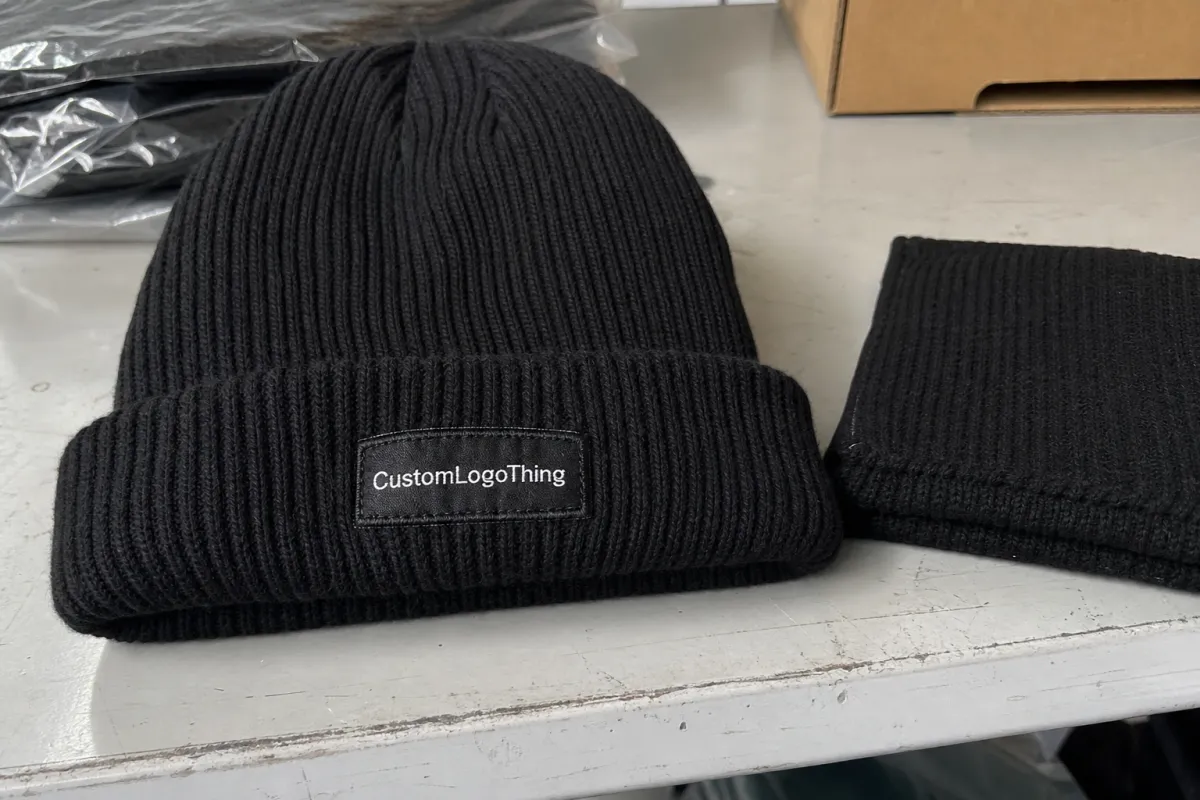
Trim changes the decision too. A woven label, PVC patch, embroidery, or sewn-on badge each affects the final look and sometimes the fit. Pom attachments matter more than buyers expect. A stitched pom can make the cap feel sturdier, while a removable attachment may suit retail assortments that need flexibility. Cuff construction also deserves attention because it changes the visible logo area and how the beanie sits on the head. For most bulk runs, buyers should confirm label size, stitch count, thread type, and patch backing before the pre-production sample is approved.
The color story can be deceptive. The same shade can feel warmer or cooler once the fiber blend, rib count, and finishing process are changed. A heather effect in acrylic will not mirror the same effect in wool. That is why buyers should review color, texture, and structure together, not as separate approvals. It also helps to request lab dip confirmation or bulk yarn strike-offs before the final sample is signed off.
Production Steps, Lead Time, and Sample Turnaround
A clean sample process usually moves in five stages: request specs, confirm yarn options, build the first sample, review revisions, then approve the pre-production version. The sequence sounds straightforward, but delays often creep in between each step. The fastest projects are the ones where the buyer gives a complete brief and one person signs off quickly. A good brief includes target dimensions, target weight, logo artwork, care label text, fiber content, and target retail or landed price.
Lead time depends on complexity. A straightforward ribbed beanie sample with standard yarn may be ready in roughly 7-12 business days, while a piece with custom trim, special dye work, or multiple revisions can stretch to 15-25 business days before approval. Shipping adds its own clock. Bulk production is often 18-22 business days after pre-production approval for standard programs, but custom yarn development, special washing, or heavy embroidery can push it longer.
Here is where sample projects tend to slow down:
- Waiting on yarn confirmation: The supplier is still checking stock, mill lot, or recycled content availability. Ask for stock yarn alternatives and lot reservations early.
- Unclear spec sheets: Nobody has agreed on finished circumference, cuff depth, or crown height. A useful tech pack should specify relaxed circumference, stretched circumference, and acceptable tolerances.
- Too many revisions at once: Buyers change color, trim, and fit in the same round. One change at a time usually gives better control and faster sampling.
- Missing approval checkpoints: Color, artwork, and fit are reviewed by different teams on different timelines. Consolidated sign-off can save 3-5 business days.
Most factories build the sample using a standard workflow: yarn winding, knitting on a flat knitting machine, linking or sewing the seam, washing or steaming to set the shape, trimming loose threads, applying labels or patches, and then final inspection. The most useful checkpoint is after finishing, because that is when dimensions and handfeel are closest to bulk reality. A factory should also verify needle alignment, stitch uniformity, and seam integrity before packing the sample.
If a supplier is credible, they will not just send a photo and call it done. They will record the yarn count, stitch density, needle setup, weight per unit, and the finish method. For compliance-heavy programs, they should also be able to support WRAP, BSCI, OEKO-TEX Standard 100, GRS, or GOTS documentation where relevant. Buyers should ask for a copy of the relevant certificate scope, not just the logo on an email signature.
Cost, Pricing, MOQ, and Quote Basics for Sample Orders
Sample pricing is usually separate from bulk pricing, and the gap can surprise first-time buyers. A standard sample may cost $18-$70 depending on yarn, trim, and revision count, while bulk pricing often lands far lower once the order reaches MOQ. For example, a simple ribbed beanie might quote at $2.50-$4.00 per unit at 500 MOQ, while premium wool-blend or heavily decorated styles can land closer to $4.50-$8.50 per unit depending on the finish.
MOQ is one of the first things a buyer should ask about. For basic acrylic ribbed beanies, MOQs often start around 300-500 pcs per colorway. For custom jacquard, special yarn blends, or branded trims, minimums can move to 800-1,000 pcs or more. If a supplier is offering low MOQ, check whether they are using stock yarn, stock color, or simplified trim, because that often explains the lower entry point.
The quote should also show what is included. Look for yarn cost, knitting, linking, washing or steaming, trim application, label stitching, polybag packing, carton packing, and any testing or certificate fee. Ask whether the price includes one revision sample or whether each revision is charged separately. It is common for second and third samples to be billed at a reduced cost, such as 50%-80% of the first sample fee.
| Order stage | Typical quantity | Expected pricing / timing | Buyer checkpoint |
|---|---|---|---|
| Proto sample | 1-3 pcs | $18-$70, 7-12 business days | Fit, handfeel, trim placement |
| Revised sample | 1-2 pcs | $10-$45, 5-10 business days | Corrected dimensions and finishing |
| Pre-production sample | 1 pc per colorway | $15-$55, 7-15 business days | Final approval for bulk |
| Bulk order | 300-1,000+ pcs MOQ | $2.50-$8.50 per unit, 18-22 business days | Final QA, carton count, packaging |
Buyers should also ask about hidden costs. Freight, duty, testing, embroidery digitizing, custom label setup, and packaging inserts can change the landed cost. A clear supplier will break out those items instead of burying them in a single line. If your company needs formal audit support, request current evidence of WRAP or BSCI status and ask whether the factory can pass chemical testing requirements such as OEKO-TEX Standard 100 for skin-contact goods.
Common Material Sample Mistakes That Skew Buying Decisions
One of the biggest mistakes is approving a sample without testing it in motion. A beanie that looks right on a table may behave differently once stretched, folded, or worn under a hood. Buyers should test fit, rebound, and seam comfort before they sign off, not after the first bulk delivery.
Another common mistake is ignoring the difference between sample yarn and bulk yarn. Some suppliers use a one-off lot for speed, which can make the handfeel look better or worse than production. Ask whether the sample came from the intended bulk yarn count and whether the same spinning mill or yarn composition will be used in production.
It is also easy to overfocus on decoration. A perfect patch does not rescue a weak fit. A clean woven label does not fix an itchy seam. The product has to work as a garment first. Trim should be the last step in approval, not the only one.
- Skipping wash and wear checks: A quick hand inspection will not reveal shrinkage, twist, or pilling risk.
- Approving from photos only: Photos hide seam bulk, recovery, and surface irregularity.
- Not measuring the sample: Relaxed circumference, cuff height, and total length should be measured before approval.
- Ignoring certification requests: If the program needs GRS, GOTS, or OEKO-TEX Standard 100, ask early so the supplier can source accordingly.
Quality checks should also include a simple set of inspection points: yarn count verification, stitch evenness, seam flatness, logo placement, weight, measurements, and packaging count. For bulk, many teams also request an AQL inspection plan, usually at AQL 2.5 for major defects and AQL 4.0 for minor defects, depending on the customer standard.
Next Steps After Reviewing Your Samples
Once the sample is in hand, mark the pass/fail points in writing and keep the notes tied to the exact sample version. If the sample passes fit and handfeel, confirm color, trim, and label placement before moving into pre-production. If it fails, isolate the problem clearly so the next round is faster. The best feedback is specific: cuff too short by 1 cm, seam too bulky at the side join, handfeel too dry, or crown too shallow by 0.5 cm.
If you need to move forward quickly, send the supplier a revised spec sheet with final measurements, fiber composition, label art, and packaging instructions. Ask for a pre-production sample, bulk lead time, and final quote broken out by unit cost, setup fee, and freight. For programs with compliance needs, include the required certificates in the same email so nothing gets missed later.
At this stage, buyers should also confirm final inspection expectations. Typical checkpoints include measurement verification, thread trimming, label alignment, color consistency under daylight and standard light box conditions, and packaging count. If the order is export-bound, ask for carton markings, country-of-origin wording, and barcode placement to be confirmed before bulk cut-and-sew starts.
FAQ
How many samples should I request? Most buyers should plan for at least one proto sample and one pre-production sample. If the design is complex, budget for 2-3 revisions.
What is a normal MOQ for ribbed winter beanies? A common range is 300-500 pcs for basic styles and 800-1,000 pcs for custom yarns, trims, or special finishes.
What certifications matter most? For textile safety and sustainability, buyers often ask for OEKO-TEX Standard 100, GRS, GOTS, WRAP, or BSCI depending on the product and sourcing policy.
How long does bulk usually take? For a standard program, 18-22 business days after approval is a common window, plus freight time.
What should I check first when the sample arrives? Start with fit, stretch recovery, seam comfort, weight, and measurement accuracy before judging decoration or packaging.
``` If you want, I can also turn this into a cleaner production-ready version with tighter copy and stronger SEO phrasing while keeping the same HTML structure.