Someone walks your aisle, gives your display about two seconds, and decides whether your product is worth touching. That tiny pause is exactly why a trade show Hang Tags Material guide matters more than most teams expect. Before anyone reads a headline, they notice stiffness in the hand, glare off the surface, and whether the tag feels thoughtful or throwaway.
I’ve watched this happen at live events more times than I can count. Two products can share similar pricing, similar claims, and similar booth traffic, yet the tag that feels better gets handled first. Human perception is fast, a little blunt, and almost unfair in a crowded hall.
What changes outcomes isn’t mysterious. Substrate family, thickness, finish, durability, print behavior, attachment method, and cost structure all shape performance. Teams also miss practical issues that don’t show up in mockups: abrasion inside shipping cartons, humidity during move-in, repetitive handling during demos, and QR scan failures under mixed lighting. Treat this as a working framework for real projects, not a search for one universal “best” stock.
If your tag program is tied to other booth collateral, align specs with your current Custom Labels & Tags standards so color, finish, and durability tell one consistent brand story.
Trade Show Hang Tags Material Guide: Why Material Choice Wins or Loses Attention Fast
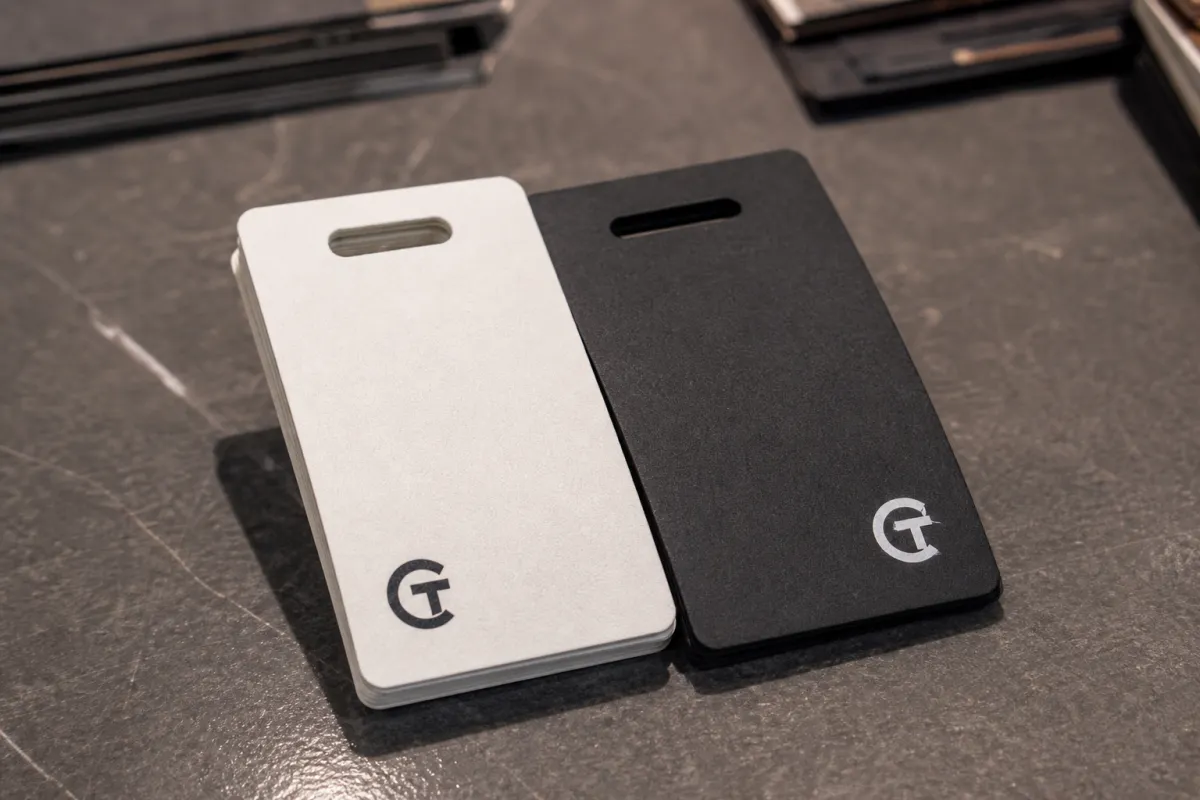
Trade show floors are unforgiving. Attendees make snap judgments with almost no context, and a tag that bends too easily, smudges after a few touches, or reflects light like a mirror can kill interaction before a conversation starts. Any reliable trade show hang tags material guide begins there.
Hang tags at events usually carry four jobs at once:
- Product identifier: SKU, model family, variant color, or compatibility note.
- Micro-sales sheet: one or two proof-backed claims plus a trust marker (certification, test metric, or specific use case).
- Brand signal: tactile quality often stands in for product quality.
- Lead-capture bridge: QR or NFC prompt linked to landing pages, spec sheets, or forms.
Retail shelf tags usually live in stable conditions. Trade show tags don’t. They get packed and repacked, handled by staff and prospects, rubbed against fixtures, and viewed under LEDs, warm spots, fluorescents, and spill light from neighboring booths.
Add rushed setup and late edits, and material selection becomes risk management, not just styling. Why leave that to guesswork?
A practical trade show hang tags material guide should cover six variables that determine field performance:
- Substrate type (coated board, kraft paper, synthetic PP/PET, textured specialty sheets)
- Caliper/thickness and stiffness profile
- Surface finish (matte, gloss, satin, soft-touch, aqueous)
- Durability under handling and moisture exposure
- Print compatibility by method (digital vs offset)
- Total landed cost, including finishing, assembly, and freight
One misconception keeps showing up: visual style should decide the entire spec. It shouldn’t. The better approach blends style, function, and schedule reality. A premium cotton sheet can look beautiful and still fail if hole pull strength is weak for a hands-on demo. A synthetic stock can survive transport and heavy use, but it may feel too plastic for a craft-driven brand unless finish choices are dialed in.
Callout: If the conversation starts and ends with aesthetics, pause and define handling stress first. For most show programs, durability and readability drive outcomes more than decorative finishing.
How a Trade Show Hang Tags Material Guide Works in Real Buying Decisions
A useful trade show hang tags material guide mirrors how decisions actually get made across marketing, sourcing, design, and operations. Teams rarely choose in a straight line; they filter options through stacked constraints:
- Brand objective (premium, technical, eco-forward, value-driven)
- Use-case stress (handling frequency, moisture risk, transport conditions)
- Print method constraints (digital variable data or offset economies)
- Material shortlist (3–4 candidates)
- Finishing and attachment specs
- Compliance and claim checks (FSC, recycled content language, relevant testing)
Core logic is simple: every material attribute maps to an observable result.
- Stiffness shapes perceived quality and handling confidence.
- Surface energy/smoothness affects ink holdout, color saturation, and tiny-text clarity.
- Fiber structure influences tear behavior around drilled holes.
- Finish reflectivity changes legibility and QR scan rates under bright lighting.
Material families that appear in most trade show hang tags material guide workflows:
- Coated paperboard (typically 300–400gsm C1S/C2S): strong print fidelity, consistent brand color, moderate durability.
- Uncoated kraft paper (around 250–350gsm): tactile natural look and lower glare, with more ink absorption that can soften very small text edges.
- Cotton or fine art papers: premium touch and elegant texture, often with higher unit cost and tighter handling limits.
- Synthetic stocks (PP/PET, often 8–14pt): moisture resistance, high tear resistance, and strong performance for repeated handling.
- Specialty textured sheets: distinctive visual identity, with trade-offs in QR reliability and fine-line sharpness.
Design intent can change your shortlist quickly. Minimal luxury often leans toward high-caliper coated stock with matte lamination and restrained foil accents. Eco-rustic programs tend to favor recycled materials with visible fiber character and higher post-consumer waste content. High-tech industrial booths usually do better with stable synthetics, high contrast, and abrasion-resistant coatings.
If you want a reusable internal tool, build a 100-point scorecard. Rate each candidate on look, touch, durability, print fidelity, sustainability fit, and budget alignment. A practical weighting model is durability 30, print fidelity 25, cost 20, sustainability 15, tactile perception 10.
If tags are part of a wider print set, align substrate and finish terms with your current Custom Labels & Tags documentation so suppliers quote against the same language.
Key Material Factors: Printability, Durability, Sustainability, and Readability Under Booth Lighting
A credible trade show hang tags material guide pressure-tests options across four performance pillars. Miss one, and a tag that looked perfect in a PDF can disappoint on-site.
Printability and color control
Digital print is excellent for shorter runs and variable content. Offset usually becomes more efficient as volume rises. Substrate behavior still changes outcomes: coated sheets generally hold cleaner 6pt text and smoother solids, while uncoated kraft paper absorbs more ink, deepening tone and softening fine detail. What good is a beautiful tag if nobody can read the QR code?
Ink laydown matters too. Heavy coverage on a porous sheet can dry unevenly, while dense blacks on a smooth stock may look richer but reveal scuffing if the finish is too light. Small type needs protection, especially when the layout carries compliance notes, pricing, or a short call to action.
For QR and barcodes, contrast beats decoration. Keep quiet zones clean. Avoid busy texture behind the code. If the code has to work after a week of tote-bag travel and booth traffic, test it on the real substrate, under real light, with a real phone.
Durability and handling
Durability starts with structure, not just surface treatment. Paperboard can feel substantial, but drilled holes can fail if the sheet is too brittle or the hang method concentrates stress. Synthetic films stretch differently, resist tearing, and handle moisture well, though they can feel less organic in the hand.
Edge performance matters on the floor. Rounded corners, reinforced holes, and lamination can reduce fray and curl. If your team expects staff to attach and remove tags repeatedly during demos, choose a stock that forgives rough handling instead of one that only survives in sample form.
Simple test, big payoff: bend it, rub it, and clip it to the display before the order is finalized.
Sustainability and compliance
Sustainability claims should be specific, not vague. Recycled content, FSC certification, and responsible sourcing language all help, but they need to match the material and the purchase record. Marketing language gets risky when it outruns procurement documentation.
Many teams want the lowest-impact option and the best-looking option at the same time. Sometimes that works. Other times it doesn’t, because a highly recycled sheet may be more porous, and a premium natural stock may come with higher freight or more waste from tighter yield constraints.
The smart path is transparency. Choose the stock that fits the brand, then document why it fits.
Readability under booth lighting
Lighting changes everything. Glossy surfaces can sparkle under LEDs and create glare that obscures type. Matte and satin finishes usually perform better for line-heavy layouts, while selective gloss or foil can still work if the rest of the composition is calm.
Color temperature matters as well. Warm light can dull cool grays. Bright white light can exaggerate contrast and make some papers appear harsher than they looked in the proof room. Test the tag in the same kind of lighting your booth will actually use.
Some designers add texture to create depth. That can be smart. It can also be a trap if the texture fights legibility, especially on small type or scanned elements.
Trade Show Hang Tags Material Guide: Cost, Pricing, MOQ, and Unit Cost Trade-Offs
Price is never just price. In a trade show hang tags material guide, the right question is how material choice affects the full landed cost, including setup, printing, finishing, packing, and freight.
Low unit cost can hide weak economics. A cheaper substrate that requires extra lamination, slower print speeds, more waste, or manual assembly can end up costing more overall. A pricier synthetic stock may save money if it reduces reprints, damage, or rush replacement orders.
MOQ changes the math. Higher minimums often favor stable, standardized specs that can be used across several shows. Smaller runs make premium experimentation easier, but setup fees and per-unit cost usually climb fast.
Three cost levers usually matter most:
- Sheet yield: how many tags fit per press sheet or production roll.
- Finishing complexity: die cutting, drilling, lamination, foil, or spot UV.
- Assembly labor: threading, kitting, nested inserts, or attachment hardware.
Here’s the practical trade-off: if the tag is part of a short, high-value campaign, premium stock may be easy to justify. If the show is large, frequent, and operationally repetitive, a durable mid-tier material can outperform a boutique option because it scales better.
Budget discipline helps. It also protects design. Teams that set a cost ceiling early can explore finishes without drifting into specs that are impossible to repeat.
Want a cleaner buying conversation? Ask for quotes on three versions only: good, better, and best. That keeps vendor comparisons focused.
Production Steps and Timeline: From Quote to Delivery Without Booth-Day Surprises
Production for event tags has a short fuse. Delays compound quickly, and one missed approval can turn into a booth-day scramble. A reliable trade show hang tags material guide should include timeline discipline, not just material theory.
The usual path looks like this:
- Define use case, quantity, and booth dates.
- Shortlist materials and finishes.
- Request quotes with exact dimensions, hole specs, and attachment method.
- Review digital proofs and physical samples if time allows.
- Approve color, copy, and compliance language.
- Produce, finish, pack, and ship with buffer days built in.
Sampling is worth it whenever the tag is highly tactile or scan-dependent. A proof file tells you almost nothing about hole strength, glare, curl, or how the stock feels after repeated handling. A real sample does.
Lead times vary by substrate and finish. Standard coated stock moves quickly. Specialty papers, lamination, foil, and custom die cuts often need extra time. If the campaign is tied to a trade show deadline, schedule backward from the show date and leave room for one correction cycle.
Don’t compress approval. Slow the signoff, speed the booth.
Packaging also deserves attention. Tags should arrive flat, clean, and counted. If they will be pre-attached to products, confirm insertion order and labeling so the crew can work without guessing on-site.
Step-by-Step Material Selection Framework for Trade Show Hang Tags
Use this framework when you need a decision, not a debate.
- Define the booth story. Is the brand premium, technical, sustainable, playful, or rugged?
- Map the touch points. Will attendees handle the tag once, or will staff and prospects handle it repeatedly?
- Set the visual bar. Do you need ultra-clean print fidelity, natural texture, or a more dramatic finish?
- Choose the performance floor. Must it resist moisture, tearing, glare, or scuffing?
- Align with budget. What is the maximum all-in cost per tag?
- Validate with samples. Print, touch, scan, bend, and compare before full production.
A simple matrix can eliminate bad options quickly. Score each stock from one to five on durability, brand fit, print clarity, and cost. Then weight the categories based on the campaign goal. This is where the argument becomes useful instead of endless.
If the brand is premium and the event is low volume, prioritize tactile quality and restrained finishing. If the show is high traffic and the tag will be handled hard, prioritize tear resistance and scan reliability. If sustainability is central to the message, document the exact material story and make sure the visual language supports it.
Sometimes the best material is not the most elegant one. Sometimes it is the one that survives the weekend and still looks intentional on Monday.
Common Mistakes, Expert Tips, and Next Steps Using This Trade Show Hang Tags Material Guide
Teams repeat the same mistakes because the sample looks good on a desk. Then the show floor exposes everything.
Common mistakes include choosing a glossy stock that fights glare, underestimating hole strength, using text that is too small for the selected paper, and treating sustainability language as a garnish instead of a specification. Another frequent miss is forgetting that the tag has to survive packing, shipping, setup, and repeated handling before anyone even sees it.
Expert tip: prototype the worst-case scenario, not the best-case photo shoot. Throw the sample in a carton, rub it a few times, clip it to a fixture, and check the code under booth lighting. If it passes there, it will usually pass on the floor.
When in doubt, simplify. Cleaner hierarchy, stronger contrast, and fewer finish effects often make the tag feel more expensive than a crowded design with too many tricks.
A good trade show hang tags material guide is not about picking one perfect stock forever. It is about choosing the right material for this show, this audience, and this handling environment.
If you are aligning a larger print system, keep your Custom Labels & Tags spec sheet, quote requests, and artwork notes in sync so every vendor is working from the same playbook.
Start with three candidates, test them under real lighting, and let the floor tell you which one survives contact with people.
FAQ
What is the best material for trade show hang tags? There is no universal best. Coated paperboard works well for crisp print and a premium feel, while synthetic PP or PET is better when the tag needs more moisture resistance and tear strength.
Are kraft hang tags a good choice for events? Yes, especially when the brand wants a natural or eco-forward look. They reduce glare and feel warm in the hand, but fine text and dense coverage need more testing because the stock absorbs ink differently.
Should I laminate trade show hang tags? Sometimes. Lamination adds durability and can improve handling, but it can also add cost, shift the tactile feel, and increase glare if you choose the wrong finish.
How do I choose between digital and offset printing? Digital is usually better for shorter runs, faster turnaround, and variable data. Offset tends to win on longer runs when consistency and unit economics matter more.


