The first number in a quote is rarely the full number. Setup, freight, packaging, duty, and rush fees can change a beanie order enough to erase an apparent bargain. For a real comparison, use landed cost, not just the blank price.
For trade show use, the beanie has to do three jobs at once: keep staff warm, carry a logo cleanly, and survive repeated wear without looking tired. If a cheaper option pills, stretches, or distorts the brand mark after a few days, it stops being cheap very quickly.
The simplest way to evaluate a run is to ask whether the total cost matches the job. A slightly higher unit price can be the better buy when the item needs to photograph well, fit consistently, and arrive without production drama.
Trade Show Ribbed Winter Beanies Unit Cost Review: What Moves the Price
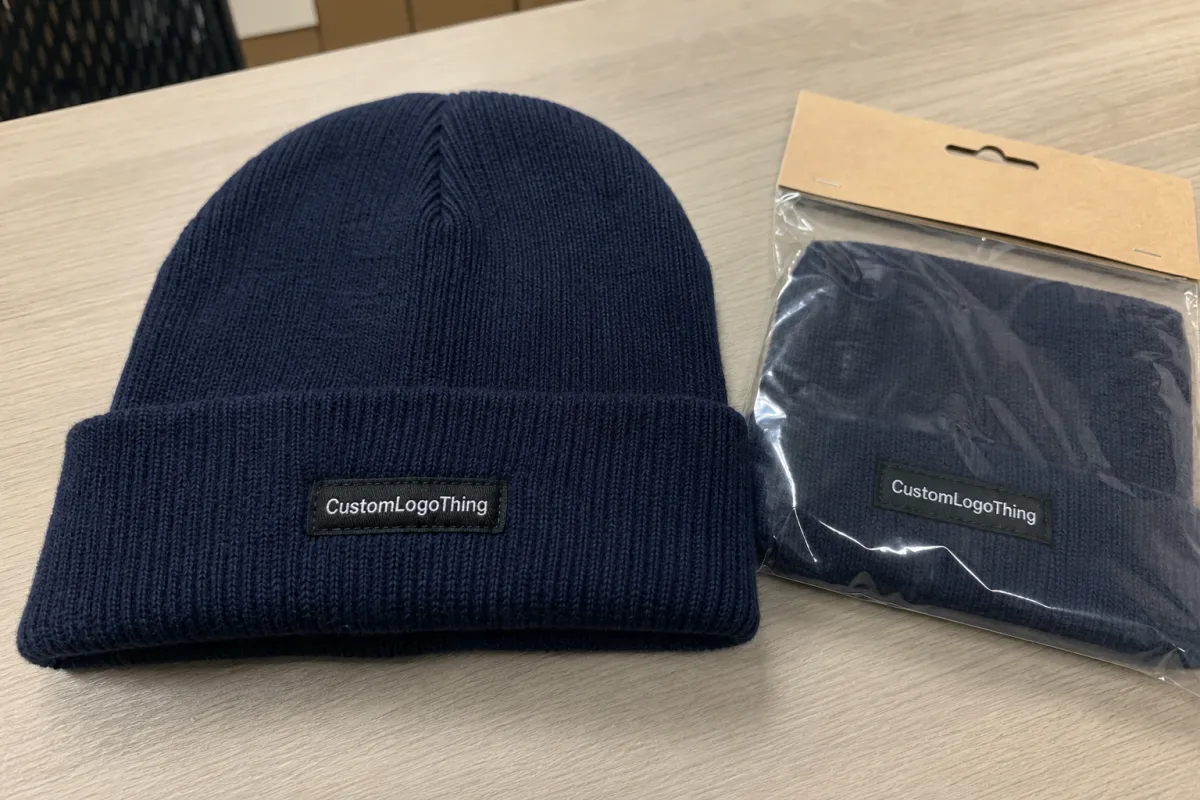
Ribbed knit is popular for event apparel because it holds its shape better than flatter constructions. The ribbing adds stretch and recovery, which helps the beanie keep its form after being packed, worn, and removed all day. In practice, most buyers are choosing between 1x1 rib and 2x2 rib on a 7-gauge to 12-gauge knit machine, with finished weights often landing around 70 to 120 grams per piece depending on yarn and cuff height.
The blank price is only one part of the budget. On smaller runs, decoration and freight can outweigh the beanie itself. On larger runs, the base material matters more, but the decoration method still drives the final number. A basic 100% acrylic ribbed beanie often sits in the most useful budget band, while an acrylic-wool blend improves hand feel and warmth at a modest premium. Recycled yarn can be a good option too, but it deserves closer sample review because consistency varies by lot. If recycled content is important, ask for GRS documentation rather than relying on a verbal claim.
Buyer goals change the economics fast:
- Booth staff usually need a clean logo, darker colors, and a fit that works with headphones and headset mics.
- Giveaways need low landed cost and simple packing so quantity can stretch farther.
- Retail-style kits can justify better yarn, better decoration, and more deliberate packaging.
That is why the first question should be about total cost for the use case, not just the cheapest blank. A beanie that lands at $2.90 and stays presentable for several events is often better value than one that saves 40 cents and looks worn after a single show.
Decoration on ribbed knit also changes pricing because the fabric itself is not flat. The knit moves, the cuff folds, and small design decisions can create rework or placement problems. Buyers save time when they treat the quote like a production plan instead of a price tag.
Practical read: if the date is fixed, the fastest savings usually come from simplifying decoration or packaging, not from chasing the lowest blank cost.
Ribbed Knit Construction, Fit, and Wearability
Most trade show ribbed winter beanies are made from 100% acrylic or an acrylic blend. Acrylic remains common because it is warm enough for event use, light, and predictable in price. Adding wool usually improves feel and warmth, but it raises cost. For many buyers, a blend with 10% to 30% wool is a reasonable middle ground. If the target is a premium feel, a common mix is 80/20 acrylic-wool or 70/30 acrylic-wool, with an upcharge of about $0.35-$0.90 per piece versus basic acrylic at the same quantity.
Ribbing matters because it stretches in a controlled way. That helps the cuff sit flatter and gives the beanie a better fit across different head sizes. Those details show up in photos and in person. A hat that rides too high or slouches too much can make a booth team look less polished, even if the decoration is correct. On the production side, ribbed beanies are usually knit on computerized flat knitting machines, then linked at the crown, steamed, and blocked to hold shape.
Fit also affects how the beanie works on event day. A low-profile style is easier with headphones and long setup shifts. A taller crown can look better as a giveaway because it reads more clearly as finished merch. One-size really means one construction that should fit most heads adequately if the proportions are right. For most adult event beanies, buyers should ask for a relaxed opening of roughly 7.5 to 9 inches, a body height around 8.5 to 10.5 inches before cuff, and a cuff that can fold 2.5 to 3.5 inches depending on the look.
Color and texture change how the item presents. Heathered yarn can hide wear and soften the look, but it may reduce logo contrast. Solid dark colors usually make embroidery easier to read. Lighter colors can look friendly, but they show dirt sooner and can feel less substantial if the knit is thin. If color consistency matters, ask for Pantone matching on yarn-dyed or piece-dyed programs and request a strike-off or lab dip reference before bulk approval.
Packaging is part of wearability too. Bulk cartons can compress cuffs, which makes the product look less tidy on arrival. If the order is being kitted or shipped to an event site, ask whether the supplier can polybag the pieces individually or pack them to preserve shape. For longer transit routes, it is reasonable to ask whether the package plan follows ISTA-style durability thinking. For direct-to-event shipments, a standard carton spec is often 24 to 36 pieces per master carton, with carton weights kept under about 15 kg to reduce handling damage.
“A beanie that fits well and photographs cleanly earns more impressions than a cheaper one that gets left in a hotel drawer.”
Decoration Options That Hold Up on the Show Floor
On ribbed beanies, the main decoration choices are embroidery, woven patches, and sewn labels. Embroidery is the most familiar and often the easiest to approve. Woven patches handle small text and fine detail better. Sewn labels are the most understated option and work well for minimal branding. When the artwork is highly detailed, buyers should also ask whether a jacquard knit-in logo is feasible, since that can avoid stitch distortion entirely.
| Decoration method | Typical setup charges | Typical decoration cost per piece | Best fit | Main tradeoff |
|---|---|---|---|---|
| Embroidery | $35-$85 | $0.90-$2.10 | Simple logos, fast turnaround, broad buyer familiarity | Small text can blur on a ribbed surface |
| Woven patch | $60-$140 | $1.20-$2.80 | Detailed marks, cleaner edges, more polished presentation | Higher setup and usually a slightly higher MOQ |
| Sewn label | $25-$65 | $0.70-$1.60 | Minimal branding, lower cost targets, subtle identity | Less visual impact from a distance |
Placement matters as much as method. A patch set too low can disappear into the cuff. Embroidery that is too wide can distort when the knit stretches. Dense stitch counts also raise cost because they take more machine time and more thread. For a standard 2 to 2.5 inch mark, a 6,000 to 10,000 stitch embroidery is often enough for a readable logo; once you move above 12,000 stitches, cost usually rises noticeably without improving show-floor visibility by much.
In practice, a readable mark around 2 to 2.5 inches wide is often more effective than a larger design with tiny type. That is especially true on dark knits, where fine letters can vanish unless the contrast is strong. Buyers often ask for more detail because the art already exists, but the beanie is what decides what is actually legible.
Repeatability is another cost factor. A decoration method that looks good once but shifts from run to run creates avoidable risk. Ask how the supplier controls placement, whether the logo is stitched from a fixed point, and how symmetry is handled on cuffed styles. A good production check is to approve a first-piece sample, then confirm stitch count, placement distance from the cuff edge, and left-right alignment before bulk sewing starts.
For some brands, a woven patch is worth the extra cost because it preserves edges better than embroidery and reads cleaner in close-up photos. For others, embroidery is the better choice because it is faster and easier to reorder. The right answer depends on the artwork and the event use, not a blanket rule.
Pricing, MOQ, and Unit Cost Breakdowns
Quantity is the biggest lever in a beanie cost review. Setup charges get spread across more units as the order grows, so the price gap between a small and medium run can be significant. A 100-piece order can look very different from a 250-piece order. By contrast, the savings from 1,000 to 2,500 pieces are often smaller because most setup overhead has already been absorbed.
For stock ribbed beanies with standard decoration, these ranges are a useful baseline:
- 100-150 units: roughly $3.50-$6.50 per piece, depending on decoration and shipping.
- 250-500 units: roughly $2.40-$4.20 per piece.
- 1,000 units: roughly $1.85-$3.20 per piece.
- 2,500+ units: roughly $1.55-$2.75 per piece for standard acrylic with straightforward decoration.
A practical target buyers often use is $2.50-$4.00 per unit at 500 MOQ for a standard acrylic ribbed beanie with a single-color logo, before expensive freight or special packaging. If the quote is well below that, check whether it includes only the blank, excludes decoration, or assumes a very thin yarn and minimal finishing.
MOQ usually depends on the construction. Stock blank beanies can be available at 100 to 300 pieces, but custom colors, custom labels, or patch programs often push the MOQ to 300 to 500 pieces. Fully custom knit programs can require 1,000 pieces or more, especially when the supplier must program the machine, source matched yarn, and run a separate sample lot.
Sample pricing also matters. A plain size or color sample may be free or credited against the order, but a decorated pre-production sample commonly costs $25-$75 plus shipping. For custom knit or custom color work, buyers should plan on one development sample and one pre-production sample if the art or fit needs validation.
Freight can change the answer. Air shipping can add $0.60-$2.50 per piece on small orders, while ocean freight is cheaper per unit but usually only makes sense when the order size is large enough to absorb the transit time. If the event date is close, a faster production program with slightly higher unit cost can still be the lower-risk option.
When reviewing a quote, ask whether the number includes carton labeling, inner polybags, hangtags, fold-and-pack, and customs paperwork. Those details are often excluded from the headline price but still affect the landed total.
Process and Lead Time: From Quote to Delivery
The cleanest orders follow a predictable sequence. First comes artwork review, then material confirmation, then sample approval, then bulk production, then inspection, then packing and shipment. That sounds simple, but each step can add days if details are missing. A buyer who sends Pantone colors, logo size, placement, and packing instructions early can often save a full week versus a back-and-forth approval cycle.
A realistic timeline for a standard custom ribbed beanie is usually 18 to 22 business days after sample approval for production, with another 3 to 8 business days depending on freight method and destination. If the order needs custom yarn, custom dyeing, or a new patch tool, development can add 7 to 14 days before production starts.
A typical sample path looks like this:
- Step 1: Artwork and spec sheet review, including placement, size, stitch count, and Pantone references.
- Step 2: Material confirmation, such as 100% acrylic, acrylic-wool blend, or recycled yarn with GRS support.
- Step 3: Sample or digital mockup approval, followed by a physical pre-production sample when needed.
- Step 4: Bulk knitting, linking, steaming, decoration, and final trim.
- Step 5: Final inspection, packing, carton labeling, and shipment booking.
Inspection should not be a vague promise. A useful checkpoint list includes yarn shade match, stitch uniformity, crown shaping, cuff height, logo placement, logo size tolerance, loose-thread removal, and carton count verification. For decorated pieces, it is also worth checking stitch density, patch edge adhesion, and whether the logo sits flat after the beanie is stretched. A common control standard is to review the first 20 to 30 pieces off the line, then inspect a statistically useful sample from the finished batch before packing release.
For orders going into retail or event kits, ask for final packout verification too. That means counting by carton, checking label accuracy, and confirming the correct assortment if multiple colors or sizes are included. If the supplier offers photo proof before shipment, that can help catch obvious errors without slowing the schedule much.
Supplier Standards Buyers Should Verify Before Ordering
Certification matters when the beanies are part of a brand program, a sustainability claim, or a corporate procurement process. For acrylic or mixed-fiber beanies, the most relevant documents are usually OEKO-TEX Standard 100 for chemical safety, GRS for recycled content, and facility-level social compliance such as WRAP or BSCI. If the product is primarily cotton or cotton blend and the claim is organic, GOTS can be relevant as well, but it is less common for winter beanies than for tees or fleece.
Buyers should separate product claims from factory claims. A factory can be WRAP- or BSCI-audited without every item being certified, and a yarn can be OEKO-TEX certified without the finished product carrying the same paperwork unless the supplier can trace the chain properly. Ask for the certificate number, scope, and expiry date rather than a logo image in an email signature.
Real production controls are just as important as certificates. Good suppliers can explain how they check yarn lot consistency, how they track color deviation, how they remove loose threads, and how they prevent mixed-carton errors. They should also be able to confirm whether the factory uses in-line inspection during knitting and a final AQL-style check before packing. For many apparel programs, a final inspection target around 2.5 AQL is a reasonable baseline unless the buyer specifies stricter terms.
It also helps to ask about compliance on the process side. If the beanie uses a woven patch or embroidered badge, ask whether adhesive backing is tested for wash durability and whether the thread is colorfast after steam finishing. If the item includes recycled yarn, ask for the recycled content percentage by weight and whether the claim is supported by transaction records.
Keep the verification list focused:
- Material proof: composition sheet, yarn spec, and recycled-content documents if applicable.
- Safety proof: OEKO-TEX Standard 100 or equivalent test support where needed.
- Social compliance: WRAP, BSCI, or a comparable factory audit.
- Process proof: sample photo, pre-production approval, and final inspection record.
If the supplier cannot explain those items clearly, the risk usually shows up later as color mismatch, delayed shipping, or a batch that looks different from the sample.
What to Confirm Before You Place the Order
Before approving the quote, confirm the exact yarn composition, the rib gauge, the cuff depth, the logo method, and the decoration size. Those are the items most likely to change how the beanie looks and how much it costs. It is also worth confirming whether the quoted price includes one logo position only; adding a second hit or back logo can add $0.40-$1.25 per piece depending on stitch count and method.
Ask the supplier to state the MOQ in writing, along with what changes might trigger a different MOQ. A stock blank may have a lower minimum than a custom color, and a simple embroidered logo may require fewer units than a woven patch or custom label. If the order is close to the supplier minimum, request a clear note on whether a short-run surcharge applies.
Sample approval should be specific. The buyer should sign off on the yarn color, the cuff shape, the crown profile, the logo position, and the thread color before bulk production starts. If there is a packing requirement, such as individual polybags or hangtags, that should be approved at the same time so the packout matches the event plan.
Lead time should also be written down with milestones. A good order confirmation will show sample approval date, bulk start date, inspection date, and ship date estimate. If the schedule is tight, ask whether partial shipment is possible for a portion of the order, though that usually adds handling cost.
One final point: the quote should say what happens if something goes wrong. If there is a color issue, a wrong logo placement, or a packing error, the buyer should know whether the remedy is rework, replacement, or credit. That clarity matters more than a small discount.
FAQ
What is a realistic budget for custom ribbed winter beanies?
For a standard acrylic beanie with a single-color logo, many buyers land around $2.50-$4.00 per unit at 500 MOQ before premium freight. Smaller runs often cost more per piece because setup charges are spread across fewer units.
How long does production usually take?
A standard program is often 18-22 business days after sample approval, plus freight time. If the order needs new yarn development, custom dye matching, or a new patch tool, plan for extra time.
Which decoration lasts best on ribbed knit?
For simple logos, embroidery is usually the fastest and most familiar. For small text or sharper edges, woven patches often read better. For minimal branding, a sewn label can be the most cost-efficient.
Which certifications should buyers ask for?
The most useful documents are usually OEKO-TEX Standard 100 for chemical safety, GRS for recycled content, and factory audits such as WRAP or BSCI. GOTS is relevant if the beanie uses organic cotton or a cotton-forward blend.
What should be checked on the pre-production sample?
Confirm the yarn color, stitch quality, crown shape, cuff height, decoration placement, thread color, and packaging format. If anything looks off at sample stage, it is much cheaper to fix there than after bulk production starts.
What causes beanie prices to change the most?
The biggest drivers are quantity, yarn composition, decoration method, packaging, and shipping method. A small change in stitch count or a second decoration location can also move the price more than buyers expect.