Buyer Fit Snapshot
| Best fit | Translucent Poly Mailers for Branding projects where brand print, material claims, artwork control, MOQ, and repeat-order consistency need to be specified before quoting. |
|---|---|
| Quote inputs | Share finished size, material target, print colors, finish, packing count, annual reorder estimate, ship-to region, and any compliance wording. |
| Proofing check | Approve dieline scale, logo placement, barcode or warning zones, color tolerance, closure strength, and carton packing before bulk production. |
| Main risk | Vague material claims, crowded artwork, missing packing details, or unclear freight terms can make a low unit price expensive after revisions. |
Fast answer: Translucent Poly Mailers for Branding: Film, Print, MOQ, and Carton Packing should be specified like a repeatable production item. The safest quote records material, print method, finish, artwork proof, packing count, and reorder notes in one written spec.
Production checks before approval
Compare the actual filled-product size with the drawing, then confirm tolerance on folds, seals, hang holes, label areas, and retail display edges. Reserve space for logos, QR codes, warning copy, and material claims before decorative graphics fill the panel.
Quote comparison points
Review material grade, print process, finish, sampling route, tooling charges, carton quantity, and freight assumptions side by side. A quote is only useful when the supplier can repeat the same color, closure quality, and packing count on the next order.
Translucent Poly Mailers for Branding: Key Design Tips start with a simple idea that gets missed a lot in packaging meetings: a mailer does not have to shout to do brand work. A well-made translucent poly mailer for branding can create a stronger first impression than a fully opaque pouch because it hints at what is inside, builds curiosity, and sets a visual tone before the seal is even opened. That little bit of reveal can feel polished, even a little premium, without getting fussy.
There is a real balancing act here. Too much clarity and the package feels exposed; too little and you lose the chance to show shape, color, or product intent. For apparel, accessories, and curated kits, translucent poly mailers for branding can support recognition while still staying lightweight, affordable, and easy for fulfillment teams to run through a busy pack station. Brands comparing packaging formats often find that the right mix of Custom Packaging Products and a purpose-built mailer works better than forcing one package style to do everything.
Used with care, translucent poly mailers for branding do more than move a parcel from point A to point B. They shape the first impression, reinforce the product story, and can influence whether the customer feels the order was packed with intent. That matters for direct-to-consumer labels, seasonal drops, boutique launches, and products where texture, silhouette, or color are part of the appeal. I have seen a simple smoked mailer make a folded tee feel considered in a way a plain white bag just never could.
What Translucent Poly Mailers for Branding Really Do
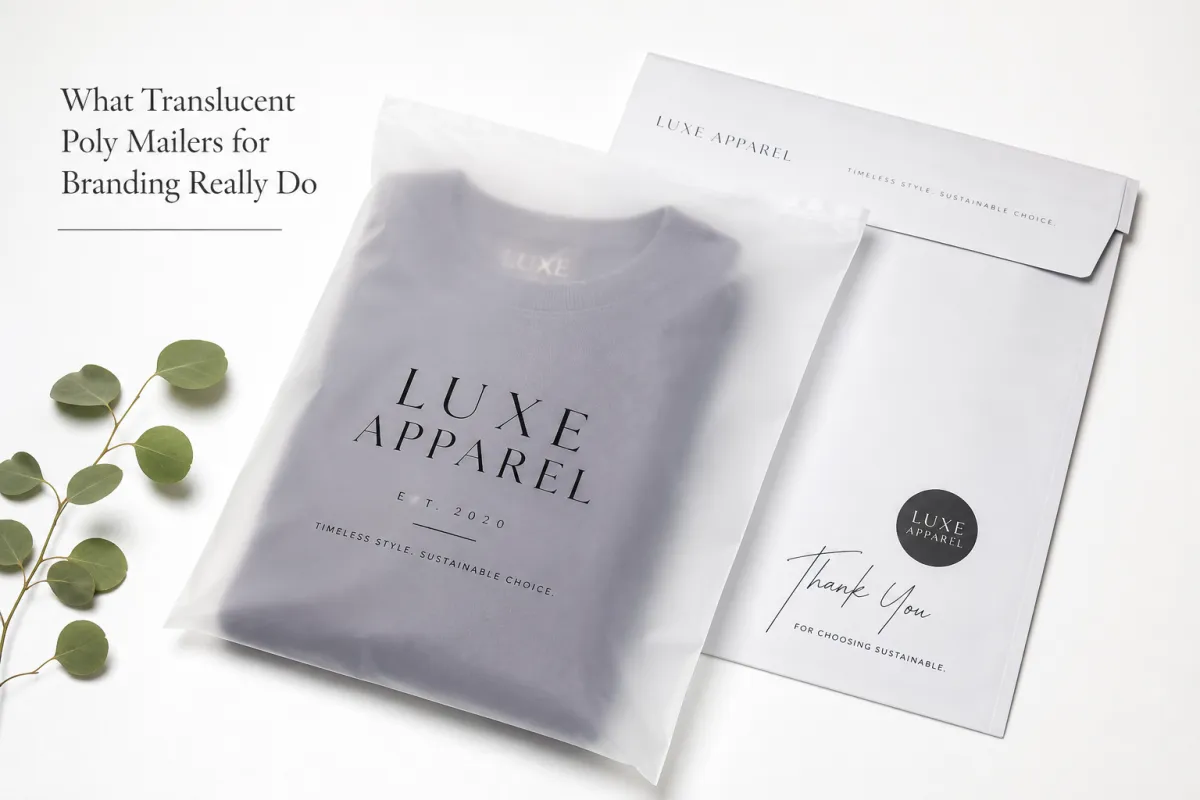
Translucent packaging works because it controls visibility instead of removing it. Translucent poly mailers for branding let light through without exposing every detail, so the customer sees a softened outline instead of a full reveal. That difference sounds small on a spec sheet, but in hand it changes the mood of the package. A shopper senses that something interesting is inside, and that bit of mystery can lift perceived value without adding much cost.
In practical terms, translucent poly mailers for branding sit between clear and opaque. A clear mailer shows nearly everything, which is great for some use cases and a bad fit for others. A frosted mailer diffuses the contents further and usually reads milky or softly clouded. An opaque mailer hides the product completely. Translucent film lands in the middle, softening edges, reducing visual clutter, and still allowing color and volume to come through.
That middle ground supports the brand story in a very real way. From the buyer’s side, the big benefit is not decoration. It is framing. The package becomes part of the presentation instead of just a barrier around the product. A folded sweatshirt can feel more premium when it shows through a muted film and sits beside a branded insert or a clean label. The same logic applies to socks, scarves, swimwear, small accessories, and subscription bundles.
Translucent poly mailers for branding work especially well when the product itself carries some of the visual message. A black hoodie in a smoked gray bag reads differently from the same hoodie hidden in a blank pouch. One feels like a plain shipment. The other feels planned. That difference shows up in product photos, social clips, and unboxing videos long before anyone starts measuring performance on a spreadsheet.
There is a practical side too. A semi-visible bag can help warehouse teams identify contents faster during sorting, cycle counts, or last-mile packing. In larger operations, a few seconds saved on each parcel adds up fast. Spread that across a few hundred or a few thousand orders and the operational case starts to look pretty solid. Translucent poly mailers for branding can support both the customer-facing presentation and the pack-station workflow.
No single answer fits every product. Items with sensitive details, premium gifts that should stay concealed, or goods that need stronger privacy may be better served by opaque construction. The right choice depends on how much visibility helps the brand and how much exposure it creates. Good packaging teams test before they commit, because guessing on a screen and shipping a real product are two very different things.
A strong mailer earns attention before the box is opened. If it does that without adding weight, clutter, or confusion, the packaging has already started doing marketing work.
How Translucent Poly Mailers for Branding Work
Translucent poly mailers for branding work because the eye reads layers. The outer film softens what sits inside, while print, labels, inserts, and folds still guide the message. That layering matters more than many teams expect. Clean packing can make the mailer feel elevated. Sloppy packing can make the same film look cheap. The material tells on you a little faster than an opaque bag does.
Light transmission drives the effect. A darker item inside a translucent mailer usually reads as a bold silhouette, while lighter products can look softer or even slightly washed out. High-saturation colors often stand out through smoked or frosted film, while pale pastels may lose contrast. So the choice is not only about appearance. It is also about how color, opacity, and package structure behave under real lighting.
That is why sample testing matters. A mockup on screen can make translucent poly mailers for branding look polished. Warehouse lighting can tell a different story. Bright overhead lights, shipping labels, fold lines, and even the way a product settles inside the bag all change the result. A package can look refined in a studio shot and busy on a packing table. The reverse happens too. Brands that test under more than one light source usually make better decisions.
The unboxing experience starts before the unboxing. A translucent bag signals product type, shape, or collection theme before the customer even cuts the adhesive strip. That early cue builds anticipation. And yes, anticipation is part of perceived value. If the customer feels the package was assembled with care, the contents often feel more valuable too.
Fulfillment teams pick up a small but real advantage as well. A semi-visible mailer makes it easier to separate sizes, styles, or order groups without opening each pouch. For brands with a lot of SKUs, that can reduce packing mistakes and speed up restocking. It will not replace a proper WMS, but it can lower friction in day-to-day operations.
Compared with opaque poly mailers, translucent poly mailers for branding offer more visual interest and less concealment. Compared with clear mailers, they usually protect the customer from a literal full view of the contents. That middle ground suits a lot of apparel and lifestyle brands. The key question is which matters more: privacy, presentation, or a careful blend of both.
If presentation comes first and privacy comes second, translucent bags deserve serious attention. If privacy comes first, they may still work, but only after testing with the actual product rather than a placeholder sample. That extra step can save money and avoid a disappointing rollout later.
Cost, Pricing, and MOQ Factors That Shape the Quote
Pricing for translucent poly mailers for branding usually comes down to a handful of variables: material thickness, bag size, translucency level, color tint, print coverage, closure type, and freight weight. Each one nudges the quote in a different direction. A move from stock sizing to a custom size can introduce setup costs. A switch from a one-color logo to a full-coverage graphic can move the order into a different print tier. Small changes add up faster than people expect.
MOQ matters just as much. Smaller runs often cost more per unit because the setup is spread across fewer pieces. That can feel frustrating, but it also lowers inventory risk. A new brand may not want 20,000 mailers sitting in storage while the product line is still changing. In that case, translucent poly mailers for branding can make sense as a smaller first order, even if the unit price is higher. The safer move is not always the cheapest one on paper.
One common mistake is comparing quotes by unit cost alone. That view is too narrow. A supplier may advertise a lower sticker price and then add separate charges for plates, proofs, freight, or rush service. Another may include more in the base quote and look expensive at first glance. The full landed cost is the number that matters, and that is the one worth putting next to your margin math.
To make the tradeoffs easier to read, many buyers use a simple comparison framework:
| Option | Typical MOQ | Typical Unit Range | Best For | Tradeoff |
|---|---|---|---|---|
| Stock translucent mailers with labels | 500-1,000 | $0.12-$0.22 | Testing demand, fast launch, limited runs | Less brand control, more dependence on labels |
| Semi-custom printed translucent mailers | 1,000-5,000 | $0.18-$0.35 | Growing DTC brands, seasonal drops, repeat SKUs | Setup fees and longer lead times |
| Fully custom translucent mailers | 5,000+ | $0.28-$0.55 | Higher-volume brands with strict brand consistency | More cash upfront, more storage needed |
These ranges are directional, not universal. Thickness, print complexity, and shipping region can move them in either direction. Even so, they help show how translucent poly mailers for branding scale with volume. A cheaper mailer is not always the better business decision if it looks off-brand or tears in transit. That kind of false economy shows up later as rework, complaints, or extra inserts to hide a weak presentation.
Print strategy is another cost lever. A single-color logo in the corner can sometimes deliver a better return than a full-bleed design. The reason is simple: translucent film already does part of the branding work. Add too much ink and the package can lose the effect you paid for in the first place. A restrained layout often looks more expensive than a crowded one, which is kind of the neat trick here.
If sustainability is part of the buying criteria, ask about recycled content, the actual recyclability of the film in your market, and any documentation tied to the material source. Be careful with broad claims. Many plastic mailers are not accepted curbside in every area, and that varies by region and waste stream. If your order includes paper inserts or kraft labels, FSC documentation may be relevant for those paper components, while recycled-content verification matters more for the plastic film itself. Buyers who want broader packaging guidance can also review the United States Environmental Protection Agency for waste reduction guidance at epa.gov.
For brands comparing packaging in parallel, reviewing Custom Poly Mailers alongside label systems can be useful, since a label-driven rollout sometimes beats a fully printed first order on cost control and speed. That path is not as flashy, but it is often the smarter move during a launch window.
Production Steps and Timeline for Translucent Poly Mailers
The production path for translucent poly mailers for branding usually follows a familiar sequence: request a quote, confirm specifications, review artwork, approve proof, run production, inspect, pack, and ship. That sequence looks straightforward on paper. In real use, it rarely feels that tidy. Most delays happen not in the machine room, but in the back-and-forth over specs and artwork.
Artwork readiness saves time. Clean vector files, Pantone references, clear bleed areas, and a simple print layout reduce confusion. If a brand keeps changing the logo placement or color matching, the timeline stretches. With translucent poly mailers for branding, that matters because the translucent base changes how ink appears. A color that reads strongly on white paper may look softer on film, so the proof stage is not a formality.
Standard sizes move faster than custom formats. Simpler print methods do too. If the goal is a logo, a short brand name, or a basic mark, production usually advances with fewer hurdles. The more complex the artwork, the more likely a proof cycle will need revisions. That is not a flaw in the process. It is the normal cost of precision.
Many buyers plan for roughly 12-15 business days after proof approval for a straightforward custom run, with added time for freight. Custom color matching, special finishes, or imported transit can stretch the calendar further. Brands that build launch dates with no buffer often find that packaging arrives last, which is exactly backward. I have seen teams cut things close, then end up rushing inserts and labels to catch up; it is avoidable, but only if the packaging schedule gets real attention early.
These are the most common delay points:
- Artwork revisions that require new proofing rounds
- Custom color requests that need adjustment
- Unexpected material availability issues
- Freight delays, especially for overseas production
- Internal approval bottlenecks on the buyer side
Good planning shortens the route. Choosing a standard size, limiting print zones, and locking the design early usually helps. So does setting a reorder trigger before the warehouse runs low. That matters more than most people think. A brand that sells through inventory and then rush-orders packaging can end up paying more and still miss the marketing window.
For teams that want proof of how packaging affects perceived value, the Case Studies page is a useful place to compare how different packaging choices shape customer response and repeat orders. The strongest examples are not always the flashiest ones; often they are the ones that match the product with discipline.
Packaging performance standards also help set expectations. Transit testing through the International Safe Transit Association is one way to evaluate how packaging handles vibration, compression, and repeated handling. That matters because a mailer that looks beautiful but splits in transit does not support brand consistency. It creates returns and complaints instead.
Step-by-Step Guide to Choosing the Right Mailer
Choosing translucent poly mailers for branding starts with the product, not the packaging catalog. Measure the item flat and folded. Check the weight. Decide whether the contents should be softly visible, partially obscured, or strongly featured. That single decision narrows the field faster than any style chart.
Thickness comes next. A lightweight garment may do fine in thinner film, while a product with sharp edges, rigid inserts, or heavier weight usually needs more material. A thicker mailer can improve durability and perceived quality, but it can also reduce the soft translucent effect. The goal is not to choose the thickest option. The goal is to Choose the Right one for the item, the route, and the customer experience.
Then match the print strategy to the brand identity. A minimal logo may be enough if the product itself is carrying most of the visual weight. A bolder mark can help if the business needs stronger shelf appeal in office pickups, event kits, or retail handoff moments. Some brands use subtle corner placement. Others use a partial color block that frames the contents without hiding them. Both approaches can work, and both can look good if the rest of the execution is disciplined.
Here is a simple checklist that keeps the decision grounded:
- Privacy - Does the customer need the contents hidden, softened, or visible?
- Protection - Will the film survive shipping distance, friction, and handling?
- Cost - Does the quote fit the margin after freight and setup?
- Sustainability - Is recycled content or a material claim relevant to the brand?
- Photos - Will the mailer look good in product images and social content?
- Reorder logic - Can the team restock before inventory drops too low?
Sampling is the smartest move before placing volume. Put the actual product inside. Seal it. Label it. Set it under bright light and dim light. Then place it next to the current packaging. That comparison shows the truth faster than renderings do. For translucent poly mailers for branding, the real-world test is the only one that really counts.
Do not overlook labels and tags. In many cases, the strongest result comes from pairing the mailer with Custom Labels & Tags so the brand mark stays legible even if the film shifts or the product color changes. That gives more control over visual identity without overprinting the entire surface.
One more practical note: if a third-party warehouse will handle the order, ask how the package scans, stacks, and seals in their workflow. A beautiful mailer that slows pack-out speed is not premium. It is friction dressed up as design, and the ops team is gonna feel that immediately.
Common Mistakes Brands Make with Translucent Mailers
The biggest mistake is choosing translucent poly mailers for branding without deciding how much privacy the product actually needs. Some items should never be visible through the package, even in softened form. Sensitive products, gift orders, or anything with personal meaning may need full opacity. The package should serve the product and the customer, not the other way around.
A second mistake is overdesigning the print. Dense graphics can lose clarity once the film, product, and light all layer together. What looked bold in a mockup can turn muddy in person. With translucent poly mailers for branding, restraint usually wins. A clean logo, a thoughtful tint, and a disciplined layout often look more expensive than a crowded design.
Sizing errors show up quickly too. A mailer that is too tight can wrinkle, stress the seal, or make the package look overstuffed. A mailer that is too large can look sloppy and waste material. Both problems hurt brand consistency. From the customer’s side, the package stops feeling curated and starts feeling improvised.
Fulfillment issues appear fast as well. If the label area is awkward, scanners may miss barcodes. If the adhesive strip fails, returns and reships rise. If the bag sticks too much during pack-out, line speed falls. Those are not abstract branding problems; they are cost problems. They happen in real warehouses, not just on design boards.
Skipping samples is another error, and it is where many brands get burned. A digital proof cannot show how a black tee, a cream sweater, or a glossy accessory will look through translucent film. A sample can. It also reveals whether the bag scratches easily, whether the seal is strong enough, and whether the contents slide around too much during handling.
For some brands, shipping standards should be part of the review. If parcels need more rigorous transit testing, ISTA methods are worth a look. A short packaging spec sheet can also reduce risk. That sheet should list bag size, material thickness, seal type, print notes, and an acceptable tolerance for color or opacity.
Here is the short version: translucent poly mailers for branding fail when they are treated as decoration only. They succeed when brands treat them as a shipping system, a presentation layer, and a cost line item at the same time.
Expert Tips and Next Steps for a Smarter Rollout
My practical advice is to test two or three versions side by side. Compare visibility, durability, shipping cost, and how each package reads on camera. That last point matters more than many teams expect. A package that photographs well can improve product pages, social posts, and paid creative without adding a separate props budget. Translucent poly mailers for branding often earn part of their keep through marketing reuse alone.
Start with one product line before rolling the format across the catalog. A controlled launch gives the team room to measure customer response and pack-out performance. If returns do not increase, if the warehouse team likes the format, and if the package lifts perceived value, then expanding makes sense. If not, refine the spec and test again. That is cheaper than guessing at scale.
Document everything in a simple spec sheet. Include size, thickness, closure type, artwork rules, color references, approval steps, reorder triggers, and the supplier contact path. That may sound unglamorous. It is. It is also what keeps translucent poly mailers for branding consistent six months from now when someone else on the team needs to reorder quickly.
There is also a budgeting habit worth using. Do not evaluate the mailer only as packaging. Evaluate it as packaging plus brand recognition plus warehouse efficiency. If the bag improves perceived quality, reduces the need for extra inserts, and speeds up packing by a few seconds per order, it may justify a slightly higher unit cost. The wrong comparison is “cheapest mailer versus most expensive mailer.” The better comparison is “total value per shipped order.”
One more point: if you want to understand how different packaging systems shape customer response, the most useful examples are often the ones that show the unglamorous details. The best Case Studies are not always dramatic. They show fit, finish, and process. That is where the learning lives.
If you are still deciding, use this rule: if the sample looks clean, the quote fits the margin, and the timeline works, move forward. If any one of those three fails, revise the spec before buying in volume. That is the disciplined way to approach translucent poly mailers for branding.
Used carefully, translucent poly mailers for branding can raise brand identity, improve the unboxing experience, and strengthen customer perception without pushing packaging spend into vanity territory. That is why they keep showing up in stronger DTC programs: they bring visual branding, practical protection, and a controlled first impression into one simple format.
FAQ
Are translucent poly mailers for branding private enough for everyday shipping?
Yes, if the product can be softly obscured by the film, an insert, or a careful fold. No, if the contents must stay fully hidden. Translucent poly mailers for branding work best for apparel, accessories, and curated kits where partial visibility supports the story instead of exposing sensitive contents. Always sample the real product inside the actual mailer under ordinary lighting before ordering in volume.
What thickness works best for translucent poly mailers for branding?
Choose thickness based on product weight, sharp edges, and shipping distance. Lighter garments often do fine with thinner film, while heavier or more rigid items usually need more material. Thicker films can improve durability and perceived quality, but they may also soften the translucent effect. With translucent poly mailers for branding, test puncture resistance, seal strength, and flex before committing.
How much do translucent poly mailers for branding usually cost?
Pricing depends on size, thickness, print coverage, order quantity, and whether the order is stock, semi-custom, or fully custom. Smaller MOQs usually carry a higher unit cost, while larger runs lower the per-mailer price but require more storage and cash upfront. Ask for quotes that separate product cost, setup fees, freight, and rush charges so you can compare suppliers accurately.
What is the usual turnaround for translucent poly mailers for branding?
Turnaround depends on artwork readiness, proof approval speed, and whether the mailers are stock or custom manufactured. Simple orders move faster when files are final and specifications are standard; custom colors or complex printing add time. Build extra buffer into the schedule for samples, revisions, and shipping so the packaging arrives before the product launch does.
What should I check before placing a first order of translucent poly mailers for branding?
Verify the fit, seal quality, and how the product appears through the film under bright and dim lighting. Confirm that labels scan properly, branding elements stay legible, and the package holds up through handling and transit. Use a short checklist covering size, thickness, MOQ, quote structure, lead time, and reorder plan before approving the run.


