Buyer Fit Snapshot
| Best fit | Wax Seal Packaging Boxes projects where brand print, material claims, artwork control, MOQ, and repeat-order consistency need to be specified before quoting. |
|---|---|
| Quote inputs | Share finished size, material target, print colors, finish, packing count, annual reorder estimate, ship-to region, and any compliance wording. |
| Proofing check | Approve dieline scale, logo placement, barcode or warning zones, color tolerance, closure strength, and carton packing before bulk production. |
| Main risk | Vague material claims, crowded artwork, missing packing details, or unclear freight terms can make a low unit price expensive after revisions. |
Fast answer: Wax Seal Packaging Boxes: Design, Cost, and Process should be specified like a repeatable production item. The safest quote records material, print method, finish, artwork proof, packing count, and reorder notes in one written spec.
Production checks before approval
Compare the actual filled-product size with the drawing, then confirm tolerance on folds, seals, hang holes, label areas, and retail display edges. Reserve space for logos, QR codes, warning copy, and material claims before decorative graphics fill the panel.
Quote comparison points
Review material grade, print process, finish, sampling route, tooling charges, carton quantity, and freight assumptions side by side. A quote is only useful when the supplier can repeat the same color, closure quality, and packing count on the next order.
I remember standing in a Shenzhen showroom in March, watching a rigid carton lose half its authority the moment the wax seal landed under bright 6,500K LED lights. On the sample table, the box looked rich and ceremonial. Under retail lighting, it suddenly read like a bargain sticker trying to impersonate luxury. That gap explains the promise and the trap of Wax Seal Packaging Boxes: the seal can carry the whole experience, or it can expose every weak decision hiding underneath, especially when the carton is built from thin 300gsm paperboard instead of a proper rigid shell with greyboard backing.
I have seen brands spend $1.80 a unit on a beautiful carton in Guangzhou, then ruin the effect with a seal that looked flat, oversized, or fake from three feet away. It was never subtle. wax seal packaging boxes are not decoration floating in space; they are a Packaging Choice That changes how a customer judges the product before they even touch the lid. In a 500-piece run, that judgment often happens in under four seconds, which is brutal, but it is real.
That is why so many premium launches now treat Wax Seal Packaging Boxes as more than a visual flourish. They are a signal. They tell the buyer the brand understands ceremony, materiality, and pacing. A good box slows the hand down. A weak one gets opened and forgotten.
Wax Seal Packaging Boxes: What They Are and Why They Matter
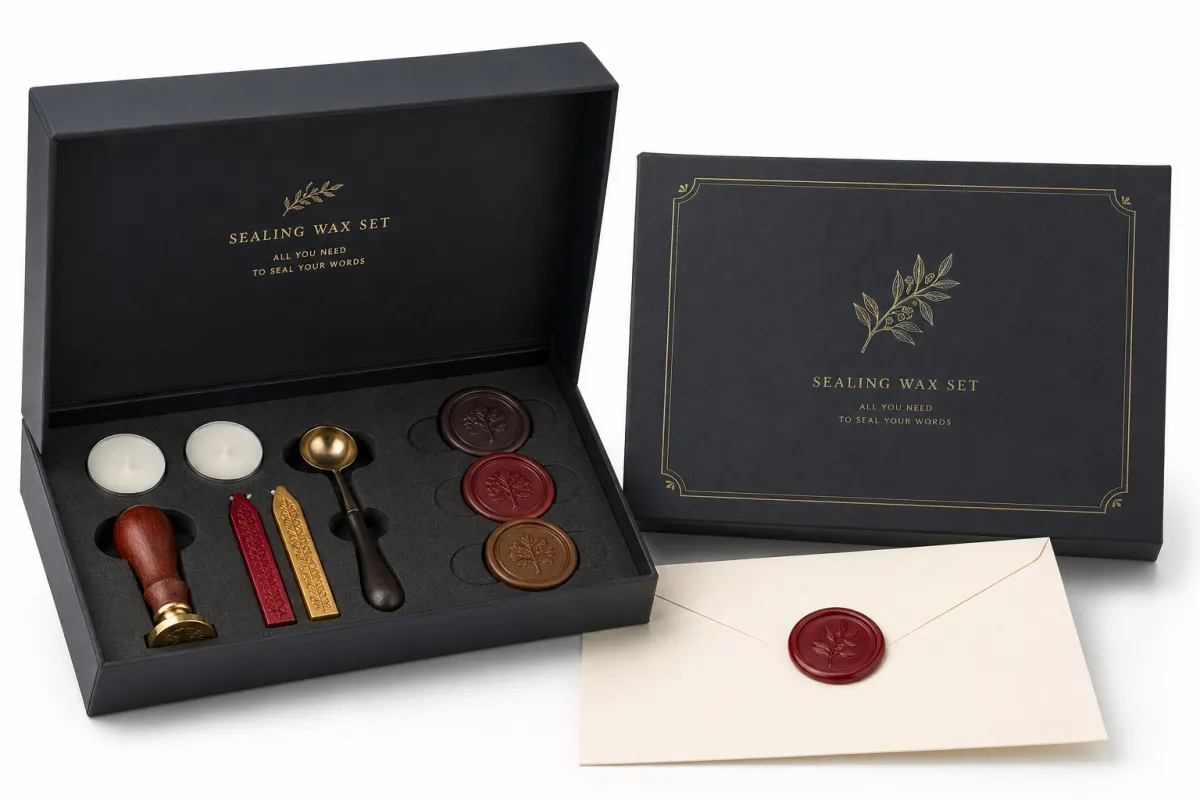
In plain terms, Wax Seal Packaging boxes are cartons, rigid boxes, sleeves, or mailers finished with a seal-style detail that creates a premium, old-world feel. Sometimes the seal is actual wax poured at about 62 to 68 C. Sometimes it is a wax-look sticker, an embossed badge, a foil mark, or a molded closure piece. The customer rarely cares whether the spec sheet says "real wax" or "PU wax badge"; they care that the package feels deliberate and expensive in the right places, often on 350gsm C1S artboard or an FSC-certified wrap sourced from Zhejiang.
That is why I keep pushing clients to think about the emotional job of wax seal packaging boxes before they obsess over coverage percentages or Pantone numbers. The seal says someone handled the package with care. It also creates a tiny ceremony at opening, which is exactly what luxury gifts, wedding products, specialty food, cosmetics, stationery, and limited-edition launches need. A package that opens like a statement tends to live longer in memory than one that merely opens, and memory is what keeps a $48 candle from being compared to a $19 one from Yiwu.
"The box should feel like a private invitation, not a shipping carton wearing a costume." I heard that from a candle client in Chicago after we tested three seal styles on 250 samples made in Dongguan, and she was not wrong.
Here is the part people often miss: they treat the seal as the hero. It is not. The hero is the whole package. If the board is flimsy, the print is muddy, or the closure fights the structure, wax seal packaging boxes start looking theatrical in the worst way. On a sturdy rigid box with clean artwork and a 157gsm C2S wrap, though, they read like brand confidence. On weak stock, they read like a shortcut. I have never once seen a weak box rescued by a fancy seal, no matter how hard the marketing deck tried to argue otherwise.
I once sat with a stationery brand in London that wanted a monogram stamped in the center of a lid, 18 mm wide, on ivory art paper. The first proof looked elegant on screen and then vanished on press because the line weight was too fine and the foil plate was only 0.25 mm deep. We fixed it by thickening the mark, switching to a 1.5 mm emboss depth, and moving the seal 12 mm off center. That small shift made the box feel editorial instead of ornamental. Small change, big result. Packaging is annoying like that, and the best fixes usually look boring on the drawing but expensive on the sample line. wax seal packaging boxes reward that kind of restraint.
For brands that care about branded packaging, these boxes do more than look fancy. They support package branding by turning the closure into a signature detail. That matters in retail packaging, where a customer in a Tokyo department store or a Dallas boutique can compare three boxes in under ten seconds and decide which one looks worth the money. In that kind of scan, seconds matter more than slogans. I have watched people choose the "expensive" box before they knew what was inside it, and the difference was often a 25 mm seal plus a cleaner lid panel.
Because wax seal packaging boxes work so well as a signal, they are also useful for launches that need a quick visual memory. A buyer may not remember the board grade, but they remember the ritual. They remember the slight resistance in the lid. They remember the seal breaking cleanly. That is the kind of detail that turns first-time buyers into repeat buyers.
- Best fit: wedding favors, premium gift sets, artisanal tea, beauty kits, and invitation boxes with a 25 mm seal.
- Less ideal: budget mailers, heavy-rotation subscription boxes, and products that need a purely minimal look or a 24-hour fulfillment line.
- Big win: products that benefit from ceremony, heritage, or a collector feel, especially in runs of 500 to 5,000 pieces.
How Do Wax Seal Packaging Boxes Work in Production?
The build for wax seal packaging boxes usually starts with a base structure: folding carton, rigid box, sleeve, or mailer. Then we layer the print wrap, choose the seal placement, and decide whether the seal is actual wax or a more stable alternative. If the design calls for foil, embossing, or ribbon, those details are added around the seal, not on top of a weak box structure pretending to be luxury. That distinction sounds obvious. In a Shanghai sample room, it is not obvious to everybody in the room, which is part of why I keep repeating it.
Real wax seals are exactly what they sound like. A supplier heats sealing wax, drops it onto the closure point, and presses a stamp into the wax while it is still soft. It looks authentic, but it is also the most sensitive option for heat, pressure, and rough transit. Wax-look alternatives solve a lot of that pain. A molded badge, sticker seal, or foil dome can mimic the same visual effect with better consistency and fewer broken pieces in shipping, especially on courier routes from Shenzhen to Los Angeles or from Ningbo to Berlin. If a product is going through carriers who seem personally offended by cardboard, I usually lean toward the stable option.
Placement matters more than people expect. On a tuck flap, the seal can hide the opening point and reinforce the closure. On a rigid box lid, it can act as a decorative brand mark on the top panel. On a sleeve, it can hold the wrap shut while also giving the customer a small break in the surface, which makes the opening feel deliberate instead of generic. That is the difference between a box and a moment. I know that sounds sentimental, but the market rewards sentiment more often than people admit, especially when the unboxing happens on a phone camera at 9 p.m.
Different formats handle the seal differently, and if you ignore that, the result gets messy fast. Folding cartons need the seal to work with a fold line that may flex 30 to 50 times before the customer opens it. Rigid boxes can support a heavier seal detail and more embellishment. Mailers need the closure to survive a courier lane that will not care about your aesthetic. Sleeves, meanwhile, live or die by friction and alignment, so a seal that is 3 mm off can look crooked on the shelf. Three millimeters is nothing on a drawing. On a package, it can look like the whole thing had a bad night.
When I visited a factory in Dongguan, the production manager showed me why a bright wax finish can fail under strong lights. He lined up six sample lids under a bank of white LEDs and measured gloss at 72 GU on one version and 28 GU on another. Three looked rich from one meter away. Two looked shiny and fake. One looked like a broken caramel candy. Same artwork, same seal size, different board coating and wax finish. That is why I tell clients to sample under the kind of light their customers actually use, not under the flattering table lamp in a design studio. Studio lighting lies. Retail lighting tells the truth, sometimes rudely. wax seal packaging boxes are unforgiving in that way, which is exactly why they can be so effective.
For wax seal packaging boxes, production planning is usually a chain of small decisions. The board choice affects the wrap. The wrap affects the seal. The seal affects the opening motion. Change one link and the whole rhythm can shift. That is the part many teams underestimate.
- Base box: folding carton, rigid setup, magnetic closure, sleeve, or mailer.
- Printed wrap: CMYK, Pantone, foil, deboss, or a simple monochrome brand field on 157gsm art paper.
- Seal method: real wax, wax-look sticker, embossed badge, or molded insert.
- Extras: ribbon, tissue, spot UV, blind emboss, or a custom inner tray.
What Changes the Look and Feel of Wax Seal Packaging Boxes
The visual outcome of wax seal packaging boxes comes down to a handful of variables: seal size, color, finish, placement, and the amount of detail packed into the brand mark. A 25 mm seal with a simple monogram reads crisp. A 40 mm seal stuffed with tiny flourishes can look busy, especially on a 90 mm lid. If the seal is centered, the effect feels formal. If it sits slightly off center, the look gets more editorial and less wedding-catalogue. I have a soft spot for the offset version, probably because perfection can feel a little stiff when the box is only 130 mm square.
Paper choice matters just as much. Soft-touch lamination gives the box a velvet-like feel, but it can make a seal look slightly muted. Uncoated stock gives you more texture and a warmer, handmade impression, though the print may absorb ink and reduce sharpness. Textured paper can be beautiful for Custom Printed Boxes, but the texture can interfere with tiny seal details. Coated stock helps color stay bright, which is useful if the seal needs to pop against a dark background. The trick is that every finish solves one problem and quietly creates another, which is why a 350gsm C1S artboard sample and a 157gsm coated wrap should both be checked before any big order.
Branding consistency is where a lot of projects fall apart. If your logo has six thin lines, a tiny crown, and a script tagline, the seal will turn into soup at small sizes. I learned that the hard way with a beauty client in Los Angeles whose original crest looked perfect in Illustrator and terrible at 22 mm. We stripped it down to one monogram and a border ring, and suddenly the whole box looked cleaner. wax seal packaging boxes reward restraint. They punish clutter. They also punish vanity, which I find oddly fair.
And here is the practical truth: a beautiful seal on a flimsy structure still looks cheap. If the lid caves in, if the sleeve slips, or if the flap opens too easily, the customer does not blame the structure. They blame the brand. That is why I pair the seal decision with the carton spec, not after it. A rigid box with proper greyboard and a controlled wrap will outperform a pretty but thin carton every time. The numbers are not glamorous, but they are usually right, and the assembly line in Dongguan will confirm that faster than a mood board ever can. wax seal packaging boxes only work if the box beneath them can hold its posture.
I usually tell clients to think like a magazine art director in New York or Milan. Does the seal need to be bold and centered? Does it need to sit low and quiet so the foil stamp can shine? Does the paper need a natural fiber look because the brand sells tea, candles, or specialty food? Answering those questions early keeps wax seal packaging boxes from drifting into awkward territory. A good packaging decision can feel invisible once it is working properly, which is the nicest kind of invisible.
If you want a useful benchmark, compare the final look against your other Custom Packaging Products instead of judging it in isolation. A seal that looks too busy on one carton might be perfect on a cleaner sleeve, and that comparison usually saves a second round of samples. I have saved more money by comparing options side by side than by arguing over a single mockup for an hour, especially when one prototype came from Yiwu and the other came from Shenzhen.
On the shelf, wax seal packaging boxes should read in one second. If the mark disappears, the paper texture overwhelms the artwork, or the finish catches light in the wrong way, the premium signal collapses. That is why shelf tests matter. A box is not a static object; it is a moving one, seen from above, at an angle, and usually for just long enough to decide whether it earns a second look.
- Seal size: 18 mm for subtle marks, 25 mm for most premium cartons, 30 mm+ for statement pieces.
- Finish: matte seal for elegance, gloss for drama, metallic for a more ceremonial feel.
- Placement: centered for formal, offset for editorial, hidden over the closure for functional drama.
Wax Seal Packaging Boxes Cost, Pricing, and Lead Times
The cost of wax seal packaging boxes depends on five main drivers: box style, print method, seal type, labor time, and how much hand assembly the job needs. A simple wax-look sticker seal on a folding carton is one thing. A rigid box with soft-touch lamination, foil, magnetic closure, and hand-applied wax is another thing entirely. The second option is prettier, but the labor line will remind you that beauty is not free. Packaging budgets have a way of becoming very honest very quickly, especially once a factory in Guangzhou adds up touch labor at 18 seconds per unit.
Here is the pricing logic I use when I quote a project, and I want to be candid that these are directional figures, not universal quotes. A wax-look sticker seal often lands around $0.15 per unit for 5,000 pieces when you include printing, die cutting, and manual placement on a simple box. A real wax seal applied by hand can add $0.12 to $0.35 per unit, depending on the complexity and the number of touch points. A molded badge or embossed seal sits somewhere in the middle, usually $0.07 to $0.18 per unit if the volume is decent. At 1,000 pieces, the setup cost can matter more than the unit rate. At 10,000 pieces, labor efficiency starts to decide the winner.
One supplier I negotiated with in Shenzhen quoted $0.14 per hand-applied seal at 3,000 pieces. I pushed back, because I had seen the same operation done for $0.10 on a cleaner line in Dongguan with better jigs and a simpler stamp. He came back at $0.11, then $0.08 after we simplified the crest and removed a tiny halo detail that was slowing the press crew down. That is a classic packaging tradeoff: every extra line in the artwork can become a labor cost in disguise. wax seal packaging boxes make that visible faster than most packaging types. I wish that were less true, but there it is.
Setup costs are easy to ignore and annoying when they show up. A dieline may be $40 to $120. Sample prototypes can run $80 to $250, especially if you want multiple finishes. Foil tooling might add $60 to $180. If you need a custom wax stamp or seal die, budget another $35 to $150 depending on size and engraving depth. On a small run, those numbers can move the total more than the per-unit quote does. On a larger run, they become background noise and the unit cost takes over, which is why a 500-piece job and a 5,000-piece job rarely live in the same pricing universe.
Lead times also stretch once the seal enters the picture. A plain printed carton might move from proof approval to production in 7 to 10 business days. wax seal packaging boxes usually take longer. Sampling can take 5 to 7 business days if the seal style is simple, then final production often runs 12 to 15 business days after proof approval for standard rigid boxes in Shenzhen or Ningbo. If the seal is hand-applied, add another 2 to 5 business days for assembly and quality control. Freight is its own beast: air can take 4 to 7 days, while sea can take 18 to 35 days depending on the route and whether the cargo leaves from Yantian, Ningbo-Zhoushan, or Qingdao.
For shipping-sensitive projects, I still ask clients to test the carton against ISTA methods and think about fiber sourcing if the box uses paperboard. The ISTA test library is useful when you need real drop and vibration logic instead of wishful thinking, and the FSC label matters when your buyer asks where the board came from. If sustainability and shipping integrity both matter, those two references save a lot of debate. They also save a lot of awkward phone calls after a launch goes sideways.
For wax seal packaging boxes, cost is usually a balance between the emotional payoff and the mechanical risk. If the seal adds theater without adding stability, the quote may look cheap while the returns process gets expensive. If the seal is engineered into the structure, the numbers make much more sense.
| Option | Typical Unit Cost | Best For | Watch-Out |
|---|---|---|---|
| Real wax seal, hand applied | $0.12-$0.35 | Limited editions, wedding kits, invitation boxes | Heat sensitivity, slower assembly, occasional cracking |
| Wax-look sticker seal | $0.03-$0.09 | E-commerce orders, medium volume launches | Less tactile than real wax, detail must print cleanly |
| Embossed or foil seal | $0.07-$0.18 | Beauty, stationery, retail packaging | Needs strong artwork and a clean stock surface |
| Molded seal badge or insert | $0.15-$0.40 | Rigid boxes and premium gift sets | Tooling and fit tolerance can add complexity |
That table is why I always ask for two quotes: one with the seal, one without it. If the premium effect only adds $0.05, great. If it adds $0.42 and pushes the box over the margin target, You Need to Know that before you approve the art. A lot of people discover this after samples, which is the expensive way to learn basic math. I have never met a finance team in Hong Kong, Chicago, or Berlin that enjoyed being surprised by packaging. wax seal packaging boxes should make the economics visible early, not after the invoices arrive.
Step-by-Step: Ordering Wax Seal Packaging Boxes
The cleanest way to order wax seal packaging boxes is to treat them like a small production system, not a single print job. Start with the product dimensions, the opening moment, and the closure you actually want customers to experience. If the box is for a 220 g candle, a 120 ml serum set, or a six-piece stationery kit, those measurements need to be locked before art begins. A 148 mm x 102 mm invite box and a 90 mm x 90 mm gift lid do not share the same seal behavior. Guessing here burns time and makes the seal look like an afterthought. I have seen that mistake more times than I want to admit.
If the structure is wrong, the seal cannot rescue it. I tell clients to start by matching the box style to the product and the shipping method. A rigid box with a lid works differently from a tuck-end carton or a sleeve over a tray. The seal can be decorative, functional, or both, but it should never be doing the job of the board. For brands comparing branded packaging options, that structure choice is usually the place where cost and presentation finally meet, whether the run is made in Dongguan, Wenzhou, or a smaller line outside Guangzhou.
I also ask teams to write the opening sequence before they approve artwork. That sounds fussy, but wax seal packaging boxes are all about sequence. First the customer sees the mark. Then they break the seal. Then the lid lifts. If one step feels out of rhythm, the box stops feeling premium and starts feeling fidgety.
- Define the goal. Decide whether the seal should signal luxury, ceremony, heritage, or collector value, then write that into the brief in one sentence.
- Choose the structure. Pick the carton, rigid box, sleeve, or mailer first, and size it to the product with at least 2 to 4 mm of clearance where needed.
- Approve the seal style. Confirm whether the seal is real wax, wax-look, foil, or molded, then lock the diameter, color, and placement before artwork moves forward.
- Test the sample. Check adhesion, crush strength, and courier vibration with the actual product inside; a 1-meter drop on one corner tells you more than a pretty render ever will.
Step three is where most delays happen. One sloppy proof can ruin the whole run, especially if the seal position does not match the closure line or the stamp is too detailed for the stock. I have seen a beautiful crest get approved in a PDF, only to fail because the emboss depth was 0.8 mm instead of 1.5 mm and the foil edge bled on a 320gsm coated stock. That difference is tiny on paper and huge on the box. The paper file looks clean. The actual carton does not care.
For testing, I ask for real-world handling: a courier shake test, a shelf rub test, and a temperature check in a truck-like environment around 30 C if the destination is warm. If the seal cracks, slips, or smears, fix it before production. wax seal packaging boxes are supposed to feel deliberate, not fragile in a way that keeps the operations team awake at night. No one wants to be the person explaining why a premium launch arrived looking tired after a five-day route from Shenzhen to Singapore.
Then, and only then, do I ask for the final quote. I want the die line, the seal sample, two material options, and one written production timeline. If a supplier cannot give those four things, the conversation is still in the "pretty mockup" stage, not the "ready to run" stage. I say that politely, but I mean it pretty firmly, especially if the job is being quoted at 8,000 pieces and the supplier expects a deposit on day one. wax seal packaging boxes deserve a real production checklist, not optimism.
For teams building a launch calendar, this process usually prevents the most common delays. A rushed seal decision can throw off the dieline, the proofs, and the shipping window all at once. Slower approval at the start is almost always cheaper than emergency fixes at the end.
Common Mistakes and Expert Tips for Wax Seal Packaging Boxes
The biggest mistake with wax seal packaging boxes is making the seal too large for the box. A 35 mm seal on a small lid can overpower the artwork and make the pack feel top-heavy. The second mistake is choosing a finish that hides detail. A heavy gloss over fine lines can flatten the mark so much that it looks like a smudge from 50 cm away. The third mistake is expecting the seal to compensate for weak construction. It cannot. Pretty glue is still glue. I know that sounds harsh. The packaging floor in Dongguan is not there to protect our feelings.
I once had a cosmetics client in Los Angeles insist on a real wax seal for a mailer that had to survive summer delivery. We sent 500 samples through a basic vibration and heat check, and 23 seals showed surface scuffing by the time they came back. The fix was not magic. We switched to a wax-look seal on a stronger board, then used a foil-embossed mark on the lid for the premium feel. The customer never knew the difference, and the box stopped failing in transit. That is the job: protect the brand, not the ego. Packaging that looks brave on a mood board and collapses in a truck is just expensive optimism.
"If the seal needs a magnifying glass, the box is already in trouble." That line came from a factory supervisor in Dongguan after he rejected a detailed crest that looked beautiful on screen and unreadable on press.
My practical tips are simple, because the best packaging systems are usually the least dramatic. Simplify the seal mark to one monogram or one clean crest. Choose materials that photograph well in daylight and store lighting. Keep application steps repeatable so the line can hit the same position 1,000 times without wandering. And always, always test the sample with the actual product weight, not the empty carton. Empty-box approvals make people feel productive, which is nice, but they are also misleading when the product is 380 grams and the wrap stock is only 157gsm.
Another common mistake is adding too many decorative elements around the seal. Ribbons, tags, foil borders, and printed patterns can all work, but not all at once. wax seal packaging boxes usually look strongest when one detail leads and the rest support it. If everything is speaking at the same volume, the box loses its focus.
- Tip: Keep the seal artwork bold enough to read at 1 meter.
- Tip: Use a 25 mm seal for most premium cartons unless the box is unusually small.
- Tip: Favor soft-touch or uncoated stocks when the brand story feels tactile or artisanal.
- Tip: Ask for two versions of the seal placement: centered and slightly offset.
- Tip: Lock a written timeline before you approve the final proof.
One more thing. Do not overcomplicate the opening sequence. If the ribbon, seal, sleeve, and inner tray all compete for attention, the customer feels friction instead of pleasure. The strongest wax seal packaging boxes usually have one primary gesture and one supporting detail. That is enough. Anything more starts to feel like the packaging is trying too hard, and packaging trying too hard is expensive theater. I have seen elegant brands in Paris accidentally make their own box look nervous by adding a second seal and a third ribbon.
When I negotiate with suppliers, I look for repeatability first and romance second. A line that can apply 5,000 seals at the same height every day is gold. A line that says "we can probably make it work" usually means I am about to buy a sample problem. For a brand that needs wax seal packaging boxes to show up on launch day, certainty is worth more than a 2% discount. The discount disappears fast if the cartons arrive crooked, cracked, or two weeks late.
If you are narrowing down the design, compare the seal version against a cleaner carton and ask whether the seal is adding value or just adding noise. Then ask for a dieline, request a seal sample, compare two material options, and get the quote in writing before you lock the artwork. That is the boring part. It is also the part that saves money. I know boring is not glamorous, but packaging budgets do not care about glamour, and a 12- to 15-business-day production plan only works when the decisions are already locked.
For brands building product packaging with a premium first impression, I would rather see a modest seal done well than a flashy one done badly. That is how you build trust. That is how you make the box worth opening. And yes, that is how you avoid the very unromantic moment where a customer peels back the seal and mutters, "Really?" wax seal packaging boxes should inspire curiosity, not confusion.
There is also a hidden strategic benefit. In competitive categories, wax seal packaging boxes can make a product feel more collectible without changing the formula inside. That is a rare kind of value-add: visual drama without operational chaos, provided the spec is handled carefully.
Frequently Asked Questions
Are wax seal packaging boxes durable enough for shipping?
Yes, if the seal is treated as decoration and the box structure does the real protecting. For mail shipping, I prefer stronger board, a secure closure, and a seal style that will not crack or smear under pressure. A rigid box with greyboard and a controlled wrap performs far better than a thin 300gsm carton with a heavy wax blob. Always test drop performance and temperature exposure before approving a large run of wax seal packaging boxes. If the pack cannot survive a courier route from Shenzhen to Dallas, the seal is just a very pretty liability.
What is the difference between real wax and wax-look seals on packaging boxes?
Real wax gives an authentic handcrafted feel, but it can be fragile under heat, pressure, and rough handling. Wax-look seals, sticker seals, or molded elements are usually more consistent and easier to mass-produce. The right choice for wax seal packaging boxes depends on your budget, shipping method, and how premium the unboxing needs to feel. I tend to favor the stable option for anything leaving the building by truck or air, especially if the route includes summer temperatures above 30 C.
How much do wax seal packaging boxes usually cost?
Cost depends on box style, seal type, print coverage, and assembly labor. A medium-run job of 5,000 pieces with a wax-look sticker seal can land around $0.15 per unit for the seal and placement alone, while hand-applied real wax can push the total premium effect into the $0.12 to $0.35 range depending on labor. Ask for pricing with and without the seal so you can see the real cost of the premium effect on wax seal packaging boxes. That comparison usually exposes where the money is hiding.
How long does it take to produce custom wax seal packaging boxes?
Typical timelines include design, sampling, approval, production, and shipping, so the process usually takes longer than plain printed cartons. A standard job in Shenzhen or Dongguan is often 12 to 15 business days from proof approval to finished production, and hand-applied seals can add 2 to 5 more days. Build in buffer time before launches, weddings, or seasonal campaigns so you are not begging a factory for miracles with wax seal packaging boxes. I have done that call, and it is not a fun role to play.
What products work best with wax seal packaging boxes?
They work especially well for luxury gifts, wedding items, specialty foods, beauty products, stationery, and limited-edition collections. Any product that benefits from ceremony, heritage, or a premium first impression is a strong fit. If the packaging needs to look casual, fast, or ultra-minimal, wax seal packaging boxes may be the wrong move. The wrong move can still be beautiful, but it will be wrong, and the customer will notice in about five seconds.
Do wax seal packaging boxes need special storage?
If the seal uses real wax, yes, a little. Keep the cartons away from direct heat, heavy pressure, and long exposure to bright sunlight. Wax-look versions are easier to store, but they still benefit from clean, dry handling. If your inventory sits in a warm warehouse or moves through summer freight lanes, wax seal packaging boxes should be tested under those conditions before you order at scale.
If you want wax seal packaging boxes That Feel Premium without becoming a production headache, start with the structure, simplify the seal, and get the sample in your hand before you approve anything. I have seen too many pretty concepts die on the factory floor because nobody asked the boring questions first. That is how you end up paying for drama instead of packaging. And honestly, packaging should impress people, not exhaust the team making it, whether the run is 500 pieces in Yiwu or 20,000 pieces in Ningbo.
The best wax seal packaging boxes are rarely the most ornate. They are the most disciplined. They choose one memorable gesture, one durable structure, and one clean finishing story, then leave enough room for the product to feel important on its own. The practical takeaway is simple: lock the box construction first, choose the seal format second, then test the result under retail lighting and transit stress before you sign off on production. That sequence protects the budget, the timeline, and the customer's first impression.