A wedding pom pom beanies Unit Cost Review should answer one question clearly: what does the order cost once production, decoration, packaging, sampling, and freight are all included? The base unit price is only one part of the picture. If the rest is vague, the quote will not hold up when the order moves into production.
Wedding orders are especially sensitive to weak specs. A color that looks fine on screen can read differently in daylight. A pom that seems elegant in one sample may look oversized in bulk. A beanie shipped loose can lose its shape before it reaches the event. A useful review has to cover the product and the process, not just the sticker price.
For bridal-party gifts, welcome-bag inserts, winter ceremony accessories, and small event merch runs, the buyer is paying for consistency as much as the item itself. That is what separates a keepable gift from a forgettable one.
Why this unit-cost review matters for wedding orders
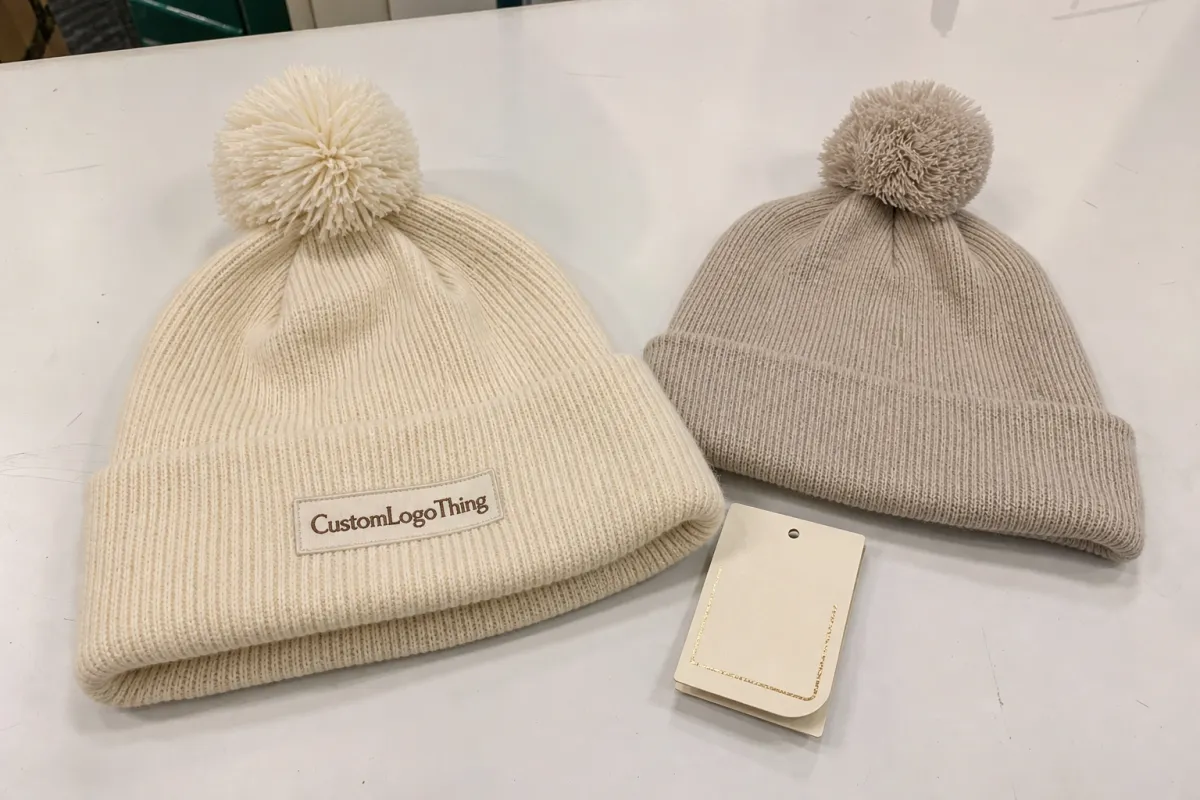
Wedding headwear sits in a narrow lane between practical and decorative, which means defects show quickly. A slightly uneven cuff might be acceptable on a casual promo hat. On a wedding table, it looks unfinished. A loose pom tie may not matter in retail, but in an event order it becomes a problem as soon as the boxes are opened and counted.
The right question is not “What is the lowest factory price?” It is “What lands on time, looks consistent, and avoids rework?” Those are not the same thing. The lowest quote can still become the most expensive option once inspection, repacking, or expedited freight enters the picture.
A landed-cost view is the only reliable way to compare suppliers. Buyers who handle event orders regularly know that a cheap unit price can disappear once packaging, approvals, or schedule recovery are added. In wedding production, hidden cost is still cost.
Wedding quantities also tend to land in the awkward middle: too small to enjoy the best factory rates, too large to treat casually. That is where a disciplined spec sheet matters. A clear brief cuts back-and-forth. A vague one burns time, and time gets expensive once the event date is fixed.
“If the date is locked, the best order is the one that can be made correctly, packed correctly, and shipped without drama.”
That is blunt, but it is the right standard. There is no benefit in a low quote if the product arrives late or needs hand sorting at the receiving end.
Product details: what these wedding beanies include
A wedding pom pom beanie is usually a knit cap with a top pom, a decoration area, and packaging that makes it feel gift-ready. The details are simple in theory and cost-sensitive in practice. Yarn choice, knit structure, pom build, and finishing all affect appearance, durability, and shipping performance.
Most buyers choose from three common material paths:
- Acrylic knit for broad color range and the lowest entry price.
- Wool blend for a warmer hand feel and a more premium finish.
- Recycled yarn for sustainability claims, with quality tied closely to the blend and supplier control.
A softer premium acrylic sometimes sits between standard promo stock and a wool blend. It usually costs more than basic acrylic, but it photographs better and feels less scratchy, which matters when the item is worn rather than displayed.
Pom-poms are another direct cost driver. A sewn-in pom is the simplest and most stable option. Removable poms can help with storage or color changes, but they add assembly work and another point of failure. Two-tone or oversized poms look custom, but they increase labor and rejection risk if the color match is tight.
Decoration should stay restrained. A woven label, a small embroidery hit, or a single patch usually does more for the product than stacking multiple methods together. Wedding buyers often prefer the beanie to support the event aesthetic instead of competing with it.
Packaging matters more than it first appears. Standard polybags protect quantity. Gift sleeves, tissue wrap, or insert cards protect presentation. If the beanies need to arrive ready for a planner, bridal party, or welcome table, packaging is part of the product spec, not an afterthought.
Neutral and soft tones usually work best: ivory, cream, blush, heather gray, soft green, and muted brown photograph well under mixed lighting. Bright colors can work for themed weddings, but they leave less room for error.
Specifications that control the final quote
Quotes get messy when specs are treated like decoration ideas instead of pricing inputs. Every meaningful change has a cost. Yarn weight changes material use. Knit gauge changes machine time. Decoration type changes labor. Packaging changes both packing time and carton size. Freight then adds its own cost based on the finished pack-out.
The main pricing drivers are predictable:
- Yarn type and blend, which control raw material cost and the hand feel of the finished piece.
- Knit gauge, because tighter knits usually take more machine time and look cleaner.
- Beanie weight, which affects both material usage and shipping weight.
- Crown shaping, since some shapes require more finishing work than others.
- Pom style, especially if the pom is custom colored, oversized, or two-tone.
- Decoration method, because embroidery stitch count and patch construction change labor.
- Packaging format, which can move cost more than buyers expect.
Fit also affects value. Most event buyers ask for “one size,” but that is not enough to protect the final look. Crown depth, stretch recovery, and cuff flexibility all influence how the beanie sits and how it photographs. A beanie that technically fits can still look sloppy if the shape is wrong.
Decoration specs are another place where quotes drift. A 4,000-stitch embroidery logo is not the same as a 10,000-stitch logo. A woven label on the side seam is not the same as a larger front-cuff patch. Small placement changes can affect setup time and inspection, so the artwork should be locked early.
Color control needs practical approval. Knit goods always carry some tolerance range, and no factory can make every piece match every screen image. PMS references help, but physical swatches are better. A digital mockup is useful for alignment, not final color certainty.
Quality checks should be practical. Inspect label alignment, pom security, stitch consistency, cuff symmetry, and carton pack-out. If the beanies are gift-bound, check how they fold and whether they recover after packing. For freight-sensitive orders, carton drop resistance and compression checks are worth requesting. Industry references like ISTA can help structure those tests, and FSC is useful if paper inserts or packaging need traceable sourcing.
One common issue is a quote built on missing information. No final artwork, no packaging dimensions, no color reference, no delivery detail. Then the supplier has to guess, the buyer has to correct, and the calendar starts slipping. That is not a production problem; it is a brief problem.
Wedding Pom Pom Beanies Unit Cost Review: MOQ and Pricing Breaks
MOQ is where the pricing logic becomes obvious. Smaller runs carry more overhead per unit because setup, knitting prep, decoration, and inspection are spread across fewer pieces. A 100-piece order does not behave like a 500-piece order. The same work gets done, but the math is harsher.
A clean quotation should separate the main cost buckets instead of hiding them inside one number. The usual pieces are:
- Base beanie cost for the knit body and pom.
- Decoration cost for embroidery, label application, or patches.
- Setup or tooling charges for artwork prep, color matching, and machine adjustment.
- Sample or proof fees when physical approval is needed.
- Packaging cost for sleeves, tissue, hangtags, or polybags.
- Freight, which can turn a decent quote into a bad one if ignored.
| Spec path | Typical MOQ | Cost per piece | Setup / tooling fees | Best use case |
|---|---|---|---|---|
| Standard acrylic, one-color embroidery, polybag | 100-200 | $6.20-$8.40 | $45-$90 | Simple favors and tighter budgets |
| Acrylic or wool blend, woven label, gift sleeve | 200-300 | $8.90-$12.50 | $60-$120 | Bridal-party gifts and welcome bags |
| Recycled yarn, custom pom, patch, premium wrap | 300-500 | $9.75-$14.20 | $75-$150 | Higher-end event merchandise and photo-forward orders |
These are working ranges, not promises. Yarn swings, decoration complexity, and transit method all move the final number. The pattern is still clear: simplifying the spec often saves more than chasing a slightly lower MOQ.
Packaging is the classic hidden cost. If the quote assumes loose packing and the buyer later wants each beanie in a sleeve with a folded insert, the unit price changes immediately. The same applies to custom pom work. A standard solid-color pom is easy. A precise two-tone pom that matches a wedding palette adds labor and rejection risk.
For wedding orders, a slightly higher unit price with consistent output is usually better than a bargain quote with weak control. The cheap order often pays for itself in extra email threads alone.
Process and timeline from proof to shipment
The production flow is straightforward enough to fit on one line, which is usually a sign that real-world revisions will try to stretch it:
- Brief and quote.
- Artwork check and digital proof.
- Sample or pre-production approval.
- Bulk knitting and pom assembly.
- Decoration and finishing.
- Final inspection and packing.
- Shipment and delivery.
Lead time depends on the spec. Standard acrylic is faster than a wool blend. One-color embroidery moves faster than a patch with extra stitching. Stock packaging is quicker than custom gift wrapping. None of that is surprising, but it still gets underestimated because a mockup makes everything look instant.
A typical custom run may take 10-18 business days after proof approval for bulk production. Add another 3-7 business days for air transit, depending on route and service level. Ocean or consolidated freight can lower cost, but the calendar gets longer. If the wedding date is fixed, plan around the event, not only the ship date on the quote.
Revisions are the quiet schedule killer. One round is manageable. Three rounds can turn a calm order into a rushed one. That is why a complete brief matters: quantity, destination, color references, decoration file, packaging preference, and deadline. If the supplier has to guess, the schedule is already slipping.
Final inspection should be functional, not decorative. Check stitch density, pom security, label placement, packaging count, and carton markings. If the order ships to multiple venues or each bridal-party member receives a separate pack, confirm carton labels and pack counts before shipment.
Why buyers choose our beanie program for wedding orders
For buyers at Custom Logo Things, the value is control. Clear specs, repeatable production, and a quote structure that is easy to compare. Wedding orders need stable color, consistent decoration, and packaging that protects the presentation. If those three hold, the rest is usually manageable.
Factory-direct quoting helps because the buyer can see where each dollar goes. Base knit cost, decoration, packaging, and freight should be separate. If a supplier bundles everything into one number, it becomes harder to compare options or spot where the quote is inflated. Clear line items make it easier to choose between a simple spec and a premium one without guessing.
That visibility matters even more on small to mid-size runs. A 150-piece order does not have much room for weak QC. There is not enough volume to absorb mistakes, and there is definitely not enough room for hidden packaging changes after approval.
What a serious supplier should be able to show:
- Clear spec confirmation before production starts.
- Tolerance notes for knit, color, and pom variation.
- Sample approval tied to the final bulk spec.
- Transparent separation of unit cost, setup charges, and freight.
- Packaging that protects the look of the product, not only the carton.
Retail-like beanies and production-managed beanies are not the same thing. A hat can look fine on a shelf and still fail a wedding order because the color lot drifted, the pom shapes vary, or the label placement wanders across the cuff. Group photos are unforgiving.
“A wedding accessory order should behave like a controlled production run, not a hopeful guess.”
That is the standard worth keeping: controlled process, clear specs, honest pricing.
Next steps: sample, quote, and place the order
Start with the basics: quantity, delivery date, destination, decoration method, color references, and whether the beanies are favors, bridal-party gifts, or resale items. That is enough to build a quote that means something. Without those details, the price is mostly a placeholder.
If you want a cleaner comparison, ask for two quote paths side by side: a standard spec and a premium spec. The gap usually shows where the real cost pressure lives. Sometimes it is the yarn. Sometimes it is packaging. Often it is decoration complexity that looked harmless in the mockup.
A sensible approval sequence looks like this:
- Review the digital proof carefully.
- Approve the sample or mockup against the final spec.
- Confirm packaging and carton details.
- Release the deposit so production can begin.
- Track shipment against the event date, not only the ship date.
If the order has multiple delivery points, add a buffer. If the beanies need gift-ready presentation, add another buffer. If the color is tightly matched to a wedding palette, add one more. That is not pessimism; it is how event production stays boring.
A solid wedding pom pom beanies Unit Cost Review is less about hunting the lowest quote and more about separating real savings from false savings. Buyers who compare landed cost, packaging quality, and schedule risk usually make the better call.
What affects wedding pom pom beanie unit cost the most?
Yarn choice, decoration method, packaging, and MOQ usually have the biggest effect. Smaller runs carry more setup cost per unit, so the price can move fast if the spec gets complicated.
Can I lower the MOQ without making the quote jump too much?
Yes, but the better move is usually to simplify the spec. Standard yarn colors, one decoration location, and basic packaging usually keep the quote steadier than quantity cuts alone.
How do I get an accurate quote for wedding pom pom beanies?
Send the exact quantity, target delivery date, destination, decoration file, color references, and packaging preference. If you want a cleaner comparison, ask for a standard version and a premium version in the same request.
What is the usual production lead time for custom beanies?
Lead time depends on proof approval, yarn availability, and decoration complexity. A realistic custom run often needs 10-18 business days for production, plus freight time. Build buffer into the wedding schedule.
Can the pom-pom and beanie colors be matched to a wedding palette?
Usually yes, but exact matching should be confirmed with PMS references or approved swatches. Knit goods allow some variance, so physical approval is more reliable than a screen image.

