Buyer Fit Snapshot
| Best fit | Packaging QR Branding projects where brand print, material claims, artwork control, MOQ, and repeat-order consistency need to be specified before quoting. |
|---|---|
| Quote inputs | Share finished size, material target, print colors, finish, packing count, annual reorder estimate, ship-to region, and any compliance wording. |
| Proofing check | Approve dieline scale, logo placement, barcode or warning zones, color tolerance, closure strength, and carton packing before bulk production. |
| Main risk | Vague material claims, crowded artwork, missing packing details, or unclear freight terms can make a low unit price expensive after revisions. |
Fast answer: Packaging QR Branding: Material, Print, Proofing, and Reorder Risk should be specified like a repeatable production item. The safest quote records material, print method, finish, artwork proof, packing count, and reorder notes in one written spec.
Production checks before approval
Compare the actual filled-product size with the drawing, then confirm tolerance on folds, seals, hang holes, label areas, and retail display edges. Reserve space for logos, QR codes, warning copy, and material claims before decorative graphics fill the panel.
Quote comparison points
Review material grade, print process, finish, sampling route, tooling charges, carton quantity, and freight assumptions side by side. A quote is only useful when the supplier can repeat the same color, closure quality, and packing count on the next order.
What is smart packaging qr branding? It is the moment a carton, label, sleeve, or insert stops behaving like static print and starts acting like a trackable channel. A shopper scans, the package responds, and the brand gets proof the interaction actually happened. That sounds simple enough. In practice, it changes how product packaging, retail packaging, and the unboxing experience work together.
At Custom Logo Things, the code itself is not the headline. The path after the scan is what matters. What is smart packaging qr branding if not a way to move someone from a printed surface to a mobile action that matters: setup help, authenticity, registration, reorder, or education. That is what separates it from decoration. It becomes packaging design with a job to do.
Brands keep asking the same practical question because the answer affects cost, layout, and content planning. What is smart packaging qr branding, and how do you build it across SKUs without wrecking the artwork or confusing shoppers? The sections that follow break it down in packaging terms that make sense at the press check, on the shelf, and in the analytics dashboard. I have watched good packaging teams overcomplicate this by trying to do six things at once. Usually, one clean path wins.
What Is Smart Packaging QR Branding?
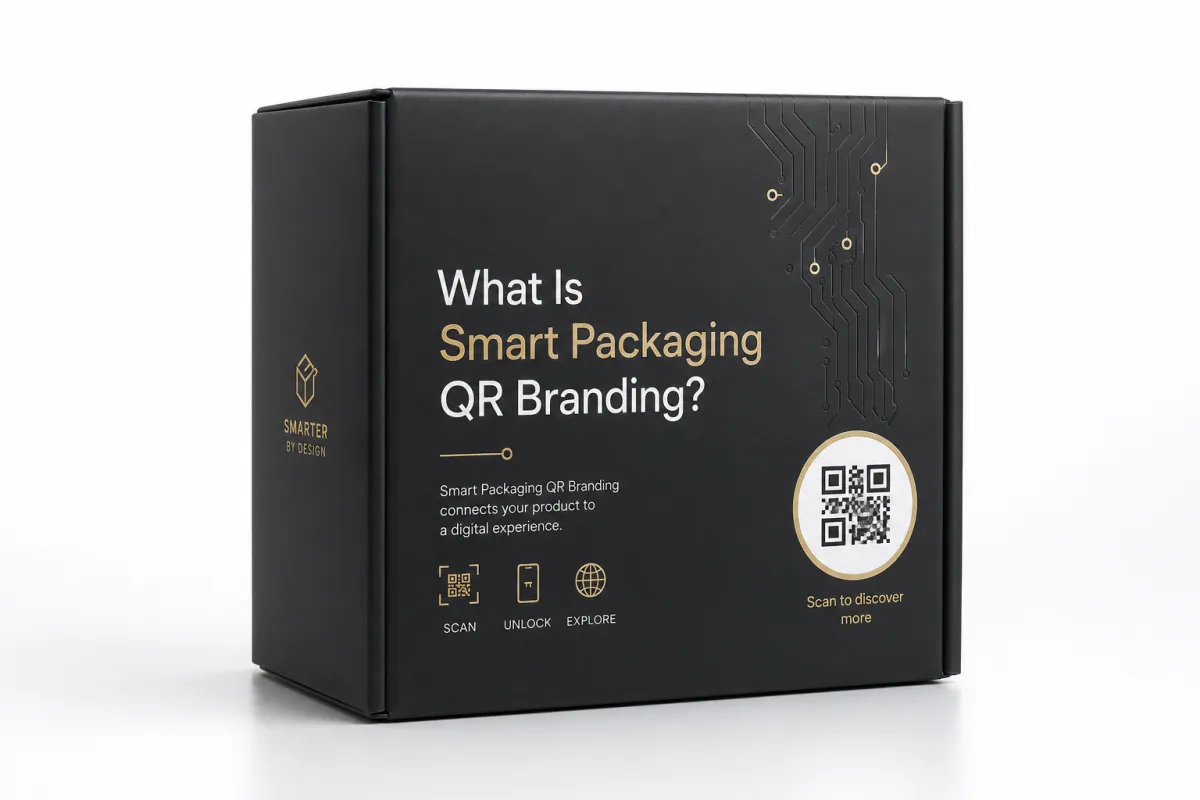
What is smart packaging qr branding in one sentence? It is packaging that combines brand design, a QR code, and a tracked digital destination so the package can trigger a useful customer action. The code acts as the bridge. The brand experience sits on the other side. The data trail is what makes it smart instead of static.
That difference matters because a random QR code is just a square of ink. Smart packaging QR branding uses the code as part of the brand identity. The printed surface still has to look strong, hold up on shelf, and fit the category. Yet it also has to do operational work: answer questions, route traffic, and show which pack produced the scan. What is smart packaging qr branding without that layer? A link printed on a box.
Why does it matter now? Buyers expect instant answers. They do not want to hunt through a homepage for usage instructions, warranty details, ingredient stories, sourcing proof, or reorder links. On a crowded shelf, that expectation gets sharper, not softer. A scan can do what a sales rep, brochure, or call center once handled, only faster and with a record attached.
From a packaging buyer's point of view, what is smart packaging qr branding also a measurement question. If the code sits on a label, sleeve, insert, or seal, the brand can see whether the package actually drove action. That turns the pack from a fixed cost line into something closer to a media asset with a conversion path. That comparison sounds a little bold, but it is not wrong.
A QR code is not the strategy. The destination is.
It helps to keep QR branding separate from other smart packaging tools. NFC tags, sensors, and app-only experiences can be powerful, but they solve different problems. NFC depends on a tap-capable phone and often a more controlled environment. Sensors add cost and complexity. App-only experiences create adoption friction. What is smart packaging qr branding in contrast? A lower-friction entry point that works with the camera most customers already have in their hand.
For teams building branded packaging, the appeal is range. The same framework can support a DTC skincare box, a coffee label, a supplement carton, or a retail pack that needs authentication. What is smart packaging qr branding if not a flexible layer you can extend across many formats without rebuilding the entire pack from scratch?
There is also a standards angle here. In regulated categories, many brands are starting to align QR systems with GS1 Digital Link thinking so the code can carry product-level context instead of a dead-end URL. That does not mean every box needs enterprise-grade traceability. It does mean the smartest teams are thinking about packaging as an information system, not just a decorated container.
How Does Smart Packaging QR Branding Work in Practice?
The workflow looks straightforward, which is exactly why so many brands miss the point. A code is generated, a destination page is built, the code is placed on the package artwork, and the package is printed. What is smart packaging qr branding doing between those steps? It is matching physical design to a mobile journey that should feel obvious the moment someone scans.
The cleanest setup starts with a single next step. That could be a how-to video, a product registration form, an authenticity page, a refill order page, or a set of care instructions. If the scan sends people to a general homepage, performance usually falls off fast. If it sends them to one relevant action, what is smart packaging qr branding starts to earn its keep.
Here is the core asset stack:
- QR generator: static or dynamic code creation.
- Branded landing page: a mobile-first page with one clear action.
- Tracking links: UTM tags, analytics events, and scan reporting.
- Print-ready artwork: a code placed with enough contrast and quiet space.
- Call to action: short copy that tells people why to scan.
Placement changes behavior more than many teams expect. On a carton, the front panel gets attention but can be crowded with brand graphics. On a label, the code may need to avoid seams, edges, and curvature. On an insert, there is more room, but less visibility. What is smart packaging qr branding if the code ends up tucked into a decorative corner nobody notices? In that case, it is a missed opportunity.
Static and dynamic codes are not the same thing. Static codes point to one fixed URL. Dynamic codes let brands change the destination after printing, which matters when campaigns shift, a page needs updates, or a product SKU gets redirected. Dynamic codes also make scan reporting easier to manage across multiple runs. For what is smart packaging qr branding, that flexibility often matters more than people expect once the first version goes live.
Take a skincare box as an example. The front panel can invite a scan for a routine video. The back panel can explain key ingredients. A second code on the insert can validate authenticity, and a third can lead to a reorder page. That is not overkill if the pack supports different moments in the customer journey. It is smart packaging QR branding built around actual use cases, not one generic code pasted everywhere.
If the pack also ships through distribution, test the same code under real handling conditions. Packaging engineers often refer to ISTA test methods to check whether print remains readable after vibration, compression, and handling. The code should still scan after the box has done its job. I have seen a beautiful launch get dinged because the code sat too close to a fold and wore down during transit. That kind of failure is boring, but expensive.
One practical detail gets overlooked constantly: a code needs room. There is no single magic size, but a roughly 0.8 to 1.0 inch square can work on a small, flat pack when the code density is light and the camera distance is short. Curved bottles, glossy sleeves, and heavily textured finishes usually need more breathing room. If the package uses gloss varnish, metallic ink, or heavy texture, print testing becomes more important. What is smart packaging qr branding without scan reliability? A pretty square that nobody can use.
Key Factors That Make QR Branding Actually Work
Scanability comes first. High contrast beats fancy treatment. A code buried in a busy pattern, reflective film, or curved surface can fail even if the art director loves the look. What is smart packaging qr branding if the code is hard to scan in store lighting or at the kitchen counter? It loses the customer before it starts.
Good placement does not mean boring placement. It means the code is integrated into the packaging design system so it feels deliberate. A small caption such as "Scan for setup" or "Scan for authenticity" can do more than a larger code with no context. The brand is telling the shopper why the code exists, and that usually lifts uptake. In one category test I reviewed, a plain code got ignored while a smaller code with clear instructions pulled much better engagement. The difference was not the technology. It was the language.
The destination matters even more. A scan should not send the customer on a detour through unrelated content. The page needs to match the promise printed on the pack. If the carton says "scan for assembly help," the page should open to assembly help immediately. What is smart packaging qr branding if not a promise kept in one tap?
Speed and trust shape the experience. Mobile pages should load fast, use clear typography, and avoid pop-ups that get in the way. Secure HTTPS links are table stakes. If the page asks for personal data, explain why. If the package is tied to an authenticity check, make the verification step obvious. People scan because they want certainty, not another obstacle. And if the product sits in a regulated category, legal and compliance should review the wording before print. That is not glamorous, but it protects the brand.
Set success metrics before launch. Otherwise, teams end up praising scan volume without knowing whether the campaign actually moved product or reduced support work. Useful measures include:
- Scan rate: scans divided by units distributed or sold.
- Conversion rate: scans that complete the next step.
- Repeat purchase lift: how often the code leads to reorder behavior.
- Support deflection: fewer repetitive questions or tickets.
- Registration or email capture: if the pack is used for retention.
For paper-based packs, sustainability claims need care. If the package uses certified fiber, a page can reinforce that with an FSC message and link. If the packaging is being redesigned for lower waste, the QR path can explain disposal instructions, refill options, or recovery steps. For sourcing and chain-of-custody references, FSC guidance is a useful benchmark. What is smart packaging qr branding in that setting? A way to turn the pack into an education tool without adding another leaflet.
Brands also need to think about the physical finish. Soft-touch lamination, matte inks, and uncoated stock usually scan more predictably than mirror gloss or metallic effects. That does not shut the door on premium finishes. It means the code zone should be protected. A reserved white box, a high-contrast label panel, or a separate insert panel often works better than forcing the code into a decorative field. Packaging can be beautiful and functional. It just has to be intentional.
There is also a brand discipline issue. What is smart packaging qr branding supposed to feel like? Not a last-minute attachment. It should look like part of the package branding system, with the same tone, typography, and visual rhythm as the rest of the pack. If the box feels luxurious but the code looks like a generic sticker, the story breaks. That disconnect is subtle, but shoppers feel it.
What Is Smart Packaging QR Branding: Costs, Pricing, and ROI
Costs split into several buckets, and that is where many estimates go sideways. Design, landing page work, print setup, tracking tools, and ongoing management each carry their own price. What is smart packaging qr branding if not a mix of print and digital work? Treat it that way, or the budget will feel mysterious later.
A basic campaign can be surprisingly affordable if the destination page is simple and the code is static. As soon as a brand wants dynamic links, multiple SKUs, or custom content, costs rise. Custom illustrations, multi-language content, and campaign analytics can push the project from a small print add-on into a more strategic rollout. That is where the budget conversation gets real, and honestly, a little messier than most kickoff decks admit.
| Rollout type | Typical setup cost | Ongoing cost | Best fit |
|---|---|---|---|
| Basic static QR on existing artwork | $300-$1,500 | Low or none | Simple instructions, one-time campaigns, low SKU count |
| Dynamic QR with branded landing page | $1,500-$7,500 | $50-$300 per month for tools and updates | Reorder flows, authenticity, product education, changing links |
| Multi-SKU smart packaging system | $5,000-$20,000+ | $200-$1,000+ per month depending on content volume | Campaign tracking, regional versions, retention programs, enterprise use |
Print costs depend on substrate and run size. For labels, the QR itself may add only a small amount, sometimes a few cents per unit or less at scale. For Custom Printed Boxes with variable data, special finishes, or short runs, the increase can be more noticeable, especially if proofing and plate changes are involved. What is smart packaging qr branding? In budget terms, it is usually cheaper than a full app strategy and more measurable than a plain printed insert.
ROI should be judged against outcomes that matter to the business. Scan count alone is not enough. A code that gets 10,000 scans but no conversions may be weaker than one that gets 1,500 scans and drives 400 repeat orders. Useful ROI inputs include:
- Scan volume: how often the package gets used.
- Conversion rate: how many scanners take the next step.
- Email or SMS signups: if the page supports retention.
- Support savings: fewer returns, fewer setup calls, fewer repeat questions.
- Repeat-order lift: especially for consumables and refillable products.
Hidden costs deserve attention too. Someone has to maintain links, update content, archive old campaigns, and approve changes. If a SKU goes through six versions in one year, the QR system should keep pace. That operational work is easy to ignore at launch. It becomes impossible to ignore once customers start scanning old codes that point to outdated pages.
If the packaging program is tied to broader sourcing goals, material selection matters as much as the code. For paper or board programs, FSC-certified options can help support the story. For transit-heavy product packaging, the pack should still pass handling tests before any QR-led campaign goes live. A beautiful scan path does not help if the box crushes before delivery.
What is smart packaging qr branding worth? That depends on whether the code changes customer behavior. For some brands, it reduces support tickets. For others, it lifts registration or repeat purchase. For others still, it improves the perceived value of the pack itself. That is why ROI should be modeled by function, not by print line alone.
If you are comparing formats, browse Custom Packaging Products for substrate and format ideas, then review Case Studies to see how different brands organize the content side. For label-heavy programs, Custom Labels & Tags are often the fastest route to a testable pilot. What is smart packaging qr branding at this stage? A budget decision with a customer-experience upside.
Step-by-Step Process and Timeline for Launch
Start by defining the business goal in one sentence. Do you want education, proof, registration, or repeat sales? That answer drives every other choice. What is smart packaging qr branding without a clear job to do? It becomes a novelty, and novelties get ignored.
Next comes a packaging audit. Check the structure, print method, coating, available panel space, and whether the code must sit near a seam or fold. A code that works on a flat label may fail on a glossy sleeve with a tight radius. If the project uses Custom Printed Boxes, the code position should be reviewed before the final dieline is locked. This is the boring part, which is exactly why it matters.
The destination experience should be built before the pack goes to print. Test it on real phones in real lighting. A team can test on an office desktop and assume the work is done. It is not. What is smart packaging qr branding if the mobile page loads slowly or the CTA drops below the fold? Not much.
A practical timeline often looks like this:
- Concept and scoping: 2-4 business days.
- Design and copy: 3-7 business days.
- Landing page build: 5-10 business days for a basic page, longer for multi-SKU logic.
- Proofing and revisions: 2-5 business days.
- Print production: often 12-20 business days depending on run size and finishing.
- Post-launch review: first scan data usually becomes useful within days, but better decisions come after a few weeks.
Proofing is where many projects quietly fail. Scan the code from the print proof, not just the digital file. Check size, placement, contrast, and whether the quiet zone has been respected. If the pack includes multiple SKUs, each code should be tested separately. One broken link in one version can distort the whole program's data.
After launch, review scan patterns by SKU, region, or version. If one label location performs better than another, move the code. If a CTA underperforms, rewrite it. If the landing page gets traffic but low completion, simplify the action. What is smart packaging qr branding if not a system that improves from real use?
For brands shipping through distribution, tie QA back to handling standards. The print may be beautiful, but if the pack is exposed to abrasion, compression, or damp storage, the code needs to survive that environment. Production and logistics need to talk to each other instead of working in separate rooms. A smart pack that fails in transit is just a pretty problem.
From a project-management standpoint, the biggest timeline risk is not the QR code. It is artwork approval. Packaging teams often spend more time aligning claims, legal copy, and branding than they do generating the code. That is normal. What matters is sequencing the work so the digital destination is ready before print deadlines lock in.
Common Mistakes in Smart Packaging QR Branding
Hiding the code is the first mistake. Low contrast, tiny scale, shiny ink, or a curved edge can make scanning frustrating. Brands sometimes assume customers will work around a weak design because the product is good. They will not. If what is smart packaging qr branding is meant to reduce friction, the code zone has to be the easiest part of the pack.
Sending people to a generic homepage is the second mistake. A homepage is a cluttered environment, not a focused destination. The scan should lead to one task. If the packaging promise is "scan for setup," then setup should be the first thing the customer sees. Otherwise, the experience feels like a detour.
Using one code for every SKU and every region is the third mistake. That choice destroys useful data. You lose the ability to see which product, panel, language, or campaign version is performing. What is smart packaging qr branding if you cannot tell which package triggered which behavior? It becomes a rough guess instead of a measurement tool.
Skipping testing on real phones is the fourth mistake. Camera apps behave differently across devices, and lighting changes everything. Gloss, glare, and small-print artwork can all interfere. Test in bright light, low light, and on the actual packaging surface. A code that scans on a computer monitor does not count. Neither does one that works only for the person who built it.
Treating the code like a gimmick is the fifth mistake. A smart packaging QR system should solve a real customer issue: setup, authenticity, education, or reorder. If the page does not reduce friction or add clarity, people will scan once and move on. The pack loses trust quickly, and trust is hard to win back once a shopper feels misled.
Poor content maintenance causes another kind of damage. Dynamic codes can solve many problems, but only if someone owns the destination pages and updates them. Old promotions, expired offers, and dead links are more damaging than having no code at all. What is smart packaging qr branding if the customer lands on a stale page? It is a broken promise.
Overcomplicating the experience is the final mistake. Three codes, six destinations, and five calls to action can make a package feel noisy. Most of the time, one strong QR path beats a cluttered system. Start with one use case that makes sense, then expand only after the data gives you a reason. Kind of boring? Maybe. Effective? Usually, yes.
Expert Tips and Next Steps for Your Next Rollout
Start with the highest-intent use case. For many brands, that is instructions, authenticity, or reorder access. Those are moments where the customer already has a reason to scan. What is smart packaging qr branding at its strongest? It is the fastest answer to the question the shopper is already asking.
Keep the design system consistent. The code badge, the CTA copy, and the landing page should feel like one brand voice. If the pack is premium, the scan page should not look like a generic template. If the pack is playful, the page should not turn stiff and corporate. That consistency matters because packaging is part of the brand identity, not just a delivery shell.
A/B test with discipline. Small changes can shift behavior more than people expect. Test code placement, CTA wording, and destination content before changing the whole pack. One label might say "Scan for setup," while another says "Scan to get started." One page might open to a video, another to a short checklist. What is smart packaging qr branding if not a chance to learn which message the customer actually responds to?
Set a maintenance routine. Review analytics weekly at first, then monthly once the program stabilizes. Retire old links. Refresh seasonal content. Archive old QR campaigns so they do not keep competing with current ones. That operating rhythm is the difference between a one-off novelty and a repeatable packaging system.
Plan the rollout in tiers. A strong first tier uses a single SKU, one landing page, and one measurable action. A second tier adds a second product line or a second region. A third tier can handle variable data, multilingual content, or retailer-specific paths. That staged approach keeps the learning curve manageable for packaging design, production, and marketing teams.
From a production standpoint, the smartest programs stay close to print reality. The code needs enough quiet zone. The artwork needs enough contrast. The line item needs enough margin in the budget. What is smart packaging qr branding if the project ignores the mechanics of printing and shipping? It is just a good idea with a weak production plan.
If you are deciding where to start, pair one packaging format with one outcome. A label can handle a support or authenticity flow. A box can support education or reorder. An insert can carry a longer explanation. That is often enough to prove the concept before expanding into broader branded packaging across the line.
For Custom Logo Things, the best way to think about what is smart packaging qr branding is this: it turns a package into a small but measurable service channel. The right code, on the right surface, with the right destination, can improve package branding, strengthen product packaging, and create a cleaner unboxing experience. Done well, what is smart packaging qr branding is not an add-on. It is a repeatable workflow that makes the next packaging run more useful than the last.
If you want one practical rule to carry into the next production cycle, use this: one pack, one promise, one scan path, one owner. That keeps the system honest. It also keeps the customer from doing unnecessary work, which is really the whole point.
FAQ
What is smart packaging QR branding in plain English?
It is packaging that uses a QR code and branded digital content to connect the physical pack to a useful online experience. The best versions do more than share information; they guide the customer to instructions, proof, support, or a reorder step. Dynamic QR codes make the system easier to update and measure than a one-time printed link. What is smart packaging qr branding, stripped down, is packaging that can take action.
How much does smart packaging QR branding cost per product?
The cost depends on design complexity, print method, landing page build, and whether you use static or dynamic codes. Simple campaigns may only add a small printing and setup cost, while custom multi-SKU systems require more planning and maintenance. The strongest way to judge cost is by expected scan rate, conversion lift, and support savings rather than print price alone. What is smart packaging qr branding worth is different for every category.
How long does a smart packaging QR branding rollout take?
A basic rollout can be built in a few weeks if the package art is simple and the destination page is already planned. More complex launches take longer because artwork proofing, variable data, and print lead times add extra coordination. The timeline is usually driven by the packaging production schedule, not the QR code itself. What is smart packaging qr branding from a timeline perspective is a packaging project first and a digital project second.
What should a QR code link to on packaging?
It should link to the most immediate next step a customer needs after scanning, such as setup help, product proof, or reorder access. The page should be mobile-first, fast, and tightly matched to the promise printed on the pack. A homepage is usually too broad unless it is highly customized for that specific product or audience. What is smart packaging qr branding works best when the link answers the printed promise.
Can small brands use smart packaging QR branding effectively?
Yes, small brands often benefit because one clear use case can create a strong customer experience without a large system. The simplest wins usually come from a hero product, a single landing page, and a code that solves one real customer problem. Even a modest rollout can generate useful data for future packaging and branding decisions. What is smart packaging qr branding can be a very practical entry point for smaller teams.


