Buyer Fit Snapshot
| Best fit | Packaging Technology projects where brand print, material claims, artwork control, MOQ, and repeat-order consistency need to be specified before quoting. |
|---|---|
| Quote inputs | Share finished size, material target, print colors, finish, packing count, annual reorder estimate, ship-to region, and any compliance wording. |
| Proofing check | Approve dieline scale, logo placement, barcode or warning zones, color tolerance, closure strength, and carton packing before bulk production. |
| Main risk | Vague material claims, crowded artwork, missing packing details, or unclear freight terms can make a low unit price expensive after revisions. |
Fast answer: Packaging Technology: Quote Scope, Sample Proof, MOQ, and Lead Time should be specified like a repeatable production item. The safest quote records material, print method, finish, artwork proof, packing count, and reorder notes in one written spec.
Production checks before approval
Compare the actual filled-product size with the drawing, then confirm tolerance on folds, seals, hang holes, label areas, and retail display edges. Reserve space for logos, QR codes, warning copy, and material claims before decorative graphics fill the panel.
Quote comparison points
Review material grade, print process, finish, sampling route, tooling charges, carton quantity, and freight assumptions side by side. A quote is only useful when the supplier can repeat the same color, closure quality, and packing count on the next order.
What is smart packaging technology? Most buyers ask that after one of three things happens: a shipment spoils, a scan fails at the worst possible moment, or a customer opens a box and realizes the packaging looked polished but did very little. The short answer is straightforward. Smart packaging technology is packaging that can sense, track, verify, communicate, or trigger an action. It is not decoration with a technical costume. It is packaging doing a job after it leaves the press.
That job can be modest or highly technical. A QR code on Custom Printed Boxes can send someone to product instructions. An NFC tag can confirm authenticity with a tap. An RFID label can help a warehouse count inventory without scanning each item by hand. Freshness indicators can show whether food, cosmetics, or pharma products are still within an acceptable window. Temperature sensors can record whether a cold-chain shipment took a bad turn somewhere between the dock and the destination.
The hard part is separating function from theater. A lot of branded packaging gets called "smart" when all it really does is open a web page. That can still be useful, but it is not the same thing as packaging that improves traceability, protects shelf life, supports compliance, or cuts counterfeit losses. What is smart packaging technology only matters when it solves a measurable problem. If the feature cannot change a metric, it is usually just expensive decoration wearing a technical costume.
That is the practical starting point. Not every brand needs it. High-value retail packaging, regulated goods, perishables, and products that attract counterfeiters are the obvious fit. Low-margin commodity items are another story. Sometimes the smartest move is a plain box with good print and no electronics at all. Margins tend to appreciate restraint. If you are weighing structure, materials, or inserts at the same time, our Custom Packaging Products page is a practical place to start.
What Is Smart Packaging Technology? A Fast Reality Check
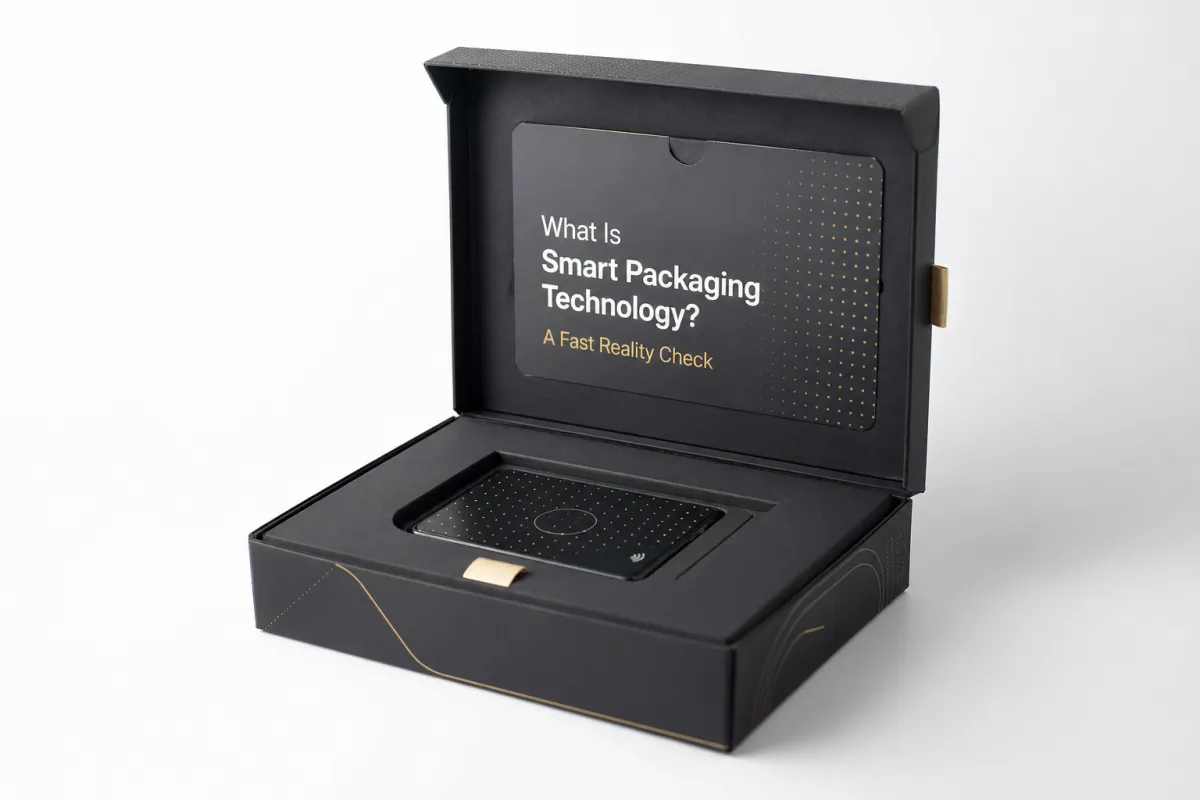
What is smart packaging technology in practice? It is packaging with a communication layer. The package might carry printed data, a scan code, an antenna, a chip, an indicator label, or a sensor that interacts with a phone, a scanner, a warehouse reader, or a software system. The point is not to make the carton look futuristic. The point is to make the packaging useful after it leaves the press.
Start with QR codes. They are the simplest entry point, and also the one most brands underestimate. A QR code can send a customer to a setup guide, a reorder page, a batch-specific certificate, or a product registry. It can also carry serialized data, which matters for traceability and anti-counterfeit work. NFC adds a tap action and feels more premium because the customer does not need to open a camera app. RFID behaves differently. It is built for fast inventory movement and supply-chain visibility, especially when a package is moving through a warehouse, a distribution center, or a receiving dock. Freshness indicators change color as time, temperature, or gas exposure changes. Printed sensors can log transit conditions for products that are unforgiving about handling.
What is smart packaging technology is also about the gap between "can" and "should." A tag can be added to almost anything. That does not mean it belongs there. I have sat in too many packaging reviews where someone wanted the feature because a competitor had it. That is how projects swell. The packaging gets more complicated, the cost climbs, and nobody can point to a business outcome that justifies the spend.
The cleaner test is blunt. If the packaging has no role beyond looking premium, keep it simple. If it has to protect shelf life, reduce returns, prove origin, or connect the buyer to instructions, then what is smart packaging technology turns into a practical tool instead of a gimmick. The best versions stay quiet until somebody needs them.
Practical rule: if the package cannot produce a measurable action, what is smart packaging technology is probably being used as a marketing label instead of a packaging solution.
Common examples include:
- QR-enabled cartons that send buyers to a landing page, certificate, or product setup video.
- NFC tags that let a phone verify authenticity with a tap.
- RFID labels that help warehouses count inventory without scanning every item one by one.
- Freshness indicators that show when food, cosmetics, or pharma products are past an acceptable condition.
- Temperature or humidity sensors that record cold-chain stress during transit.
From a buyer's point of view, what is smart packaging technology usually falls into three jobs: track the item, communicate with the user, or prove something happened. That is the cleanest way to think about it. The technology can be simple, but the business case should be specific. Vague goals drain budgets quickly and leave teams arguing over features nobody asked for.
How Smart Packaging Technology Works
What is smart packaging technology becomes easier to understand when you break it into layers. First is the package itself: a box, label, pouch, carton, sleeve, or insert. Second is the embedded tech, which might be printed ink, a code, an antenna, a chip, or an indicator material. Third is the capture point, such as a phone, scanner, warehouse reader, or inspection station. Fourth is the software or workflow behind it, because data that goes nowhere is just ink, metal, or plastic with a more expensive story attached.
QR codes are the entry-level version. They are cheap to print, easy to scan, and flexible enough for customer engagement, lot tracking, or anti-counterfeit checks. NFC works when you want a tap rather than a scan. It feels cleaner on premium packaging and package branding because the user does not need to open the camera and line up a code. RFID is different. It is designed for faster inventory movement and supply-chain visibility, especially where a scanner on every unit would slow the process to a crawl.
What is smart packaging technology gets more interesting when the package is not just pointing to a web page. Printed electronics can log simple events. Indicator labels can respond to environment changes. Sensor-based systems can track temperature, shock, or humidity. In those cases the package is reporting on itself, which is unusually valuable when the product is fragile, regulated, or expensive enough that one failure matters.
Picture a carton leaving the plant with an RFID label and a QR code. The warehouse reads the RFID tag at pack-out. The distributor reads it again at receipt. The customer scans the QR code after purchase and lands on a verification page or setup guide. If the shipment experiences a temperature excursion, the sensor log shows it. That is what smart packaging technology looks like when It Actually Works: data moves from the package to the right person at the right time, without a human rewriting the story later.
There is a distinction that deserves a clean line. Active packaging changes the product environment. It might absorb oxygen, trap moisture, or control ethylene. Intelligent packaging monitors or communicates information about the package or product. What is smart packaging technology usually sits in the intelligent category, though some projects borrow from both. A moisture absorber is not "smart" just because the sales pitch sounds technical.
The data path matters more than most packaging teams expect. A printed code can be scanned by a phone and pushed to a landing page with batch data. An RFID reader can feed an ERP or warehouse management system. A temperature sensor can log to an app or cloud dashboard. If the backend is weak, what is smart packaging technology turns into a dead feature. The package may be smart. The workflow is not.
For packaging design teams, that means the visual layout has to support the tech, not fight it. Glossy varnish can interfere with readability. Metallic films can block radio signals. Tiny codes can fail on curved surfaces. On custom printed boxes, the placement of the QR or NFC mark should be decided before final artwork locks. Fixing it later usually costs more than doing it right the first time, and the repair never looks as clean as the original plan.
If the use case is authenticity, the user journey should be simple enough to explain in one breath: scan, verify, confirm. If the use case is freshness, the indicator should be obvious at a glance and hard to fake. If the use case is logistics, the reader environment should be mapped before production starts. That is the difference between a smart feature and a smart headache.
What Drives Cost and Pricing
What is smart packaging technology costs depends on five things: the technology type, the material stack, the print complexity, the data setup, and the volume. That last part matters more than most buyers want to hear. At low volumes, setup cost can overwhelm the per-unit cost. At higher volumes, unit economics improve, but only if the system was designed properly in the first place.
QR codes are usually the cheapest way in. If the code is static and the landing page already exists, the packaging cost may be close to zero beyond layout time and proofing. Add serialized codes, variable data, or a custom backend, and the price climbs. NFC tags cost more because there is hardware in every unit. RFID often costs more again because the label, antenna, encoding, and reader environment all have to cooperate. Sensor-based smart packaging can get expensive fast because the hardware does more than identify the package; it measures conditions that somebody has to store, interpret, and act on.
What is smart packaging technology should be priced in layers, not as one mystery number. There is the one-time setup: artwork changes, integration, encoding logic, testing, and any software configuration. There is the per-unit component cost: tags, labels, indicator materials, or embedded devices. Then there may be recurring fees for dashboards, cloud storage, authentication services, or reporting. Ignore any one of those and the quote is basically fiction with a logo on it.
Here is a practical table to keep the options straight:
| Format | Typical Cost Profile | Best Use Case | Main Tradeoff |
|---|---|---|---|
| QR code | Lowest setup cost; often pennies in print impact | Engagement, setup instructions, simple verification | Needs a clear call to action and maintained links |
| NFC tag | Moderate unit cost; setup depends on data flow | Premium retail packaging, tap-to-verify, brand interaction | Higher component cost and placement sensitivity |
| RFID label | Higher unit cost plus reader infrastructure | Inventory visibility, supply-chain tracking, warehouse automation | Needs process changes and compatible readers |
| Freshness indicator | Moderate to high depending on chemistry and format | Food, pharma, and sensitive product packaging | Must be validated for the real environment |
| Temperature sensor | Highest cost in many consumer applications | Cold chain, high-value shipments, compliance-heavy goods | Requires data handling and tighter testing |
Real-world pricing is also about order size. A QR-based project on 5,000 custom printed boxes might add almost nothing to the unit cost if the artwork is already being produced. A serialized NFC program at the same quantity can add noticeable cost per box, especially if the data system is custom. RFID at scale can be economical for operations, but the readers, training, and integration are not free. What people call "expensive" is often just "mispriced for the job."
For a rough planning range, simple QR packaging may add less than a penny in print impact but still carry a few hundred dollars of setup work. NFC often lands in the tens of cents per unit at volume, depending on the inlay and encoding needs. RFID and sensor-based systems can move into the higher tens of cents or dollars per unit once the whole stack is counted. That is not a scare tactic. It is what happens when hardware, data, and packaging all insist on getting paid.
What is smart packaging technology should always be judged against return, not against sticker shock. If a higher-cost label prevents spoilage, the math can work fast. If a more expensive tag reduces counterfeiting, the avoided loss can be bigger than the packaging delta. If it only feels advanced, it is too expensive already. That is the blunt version, and it saves people money.
Brands also overspend by asking for more than the product needs. A low-margin retail item does not need a full sensor platform. A high-value item may not need a fancy animation when a secure verification page would do. If the same outcome can be reached with a QR code, start there. Nobody gets a prize for buying the priciest version of a problem.
For brands building branded packaging, the right question is not "What is the coolest tech we can add?" It is "Which format pays back fastest for this product line?" If you are comparing structures, finishes, or inserts, our Custom Packaging Products page is a better place to start than a fantasy budget spreadsheet.
Smart Packaging Technology Process and Timeline
What is smart packaging technology does not start with a supplier quote. It starts with one specific problem. Maybe the product is being counterfeited. Maybe customers need better setup instructions. Maybe cold-chain risk is eating margin. Once the goal is clear, the packaging team can Choose the Right format, define the data flow, and work backward from launch. That sequence matters. Build around a gadget first and the project turns into a workaround before production even begins.
A good process usually moves through six steps: brief, concept, prototype, testing, production, and launch support. The brief should define the business outcome in one sentence. The concept phase should choose the tech type and the pack format. The prototype phase is where artwork, placement, and scan behavior are checked. Testing verifies that the package survives transport, storage, and handling. Production sets the printing, encoding, and quality checks. Launch support keeps the backend alive after the first shipment goes out.
What is smart packaging technology often slows down at the integration stage. That is normal. If the package has to talk to a product database, authentication platform, or warehouse system, somebody has to connect the dots. If the supplier says the hardware is ready but the data work is still vague, expect delay. If they say everything is easy, ask for evidence. Easy is a word people use right before something becomes annoying.
Testing is not optional. It is the difference between a clean launch and a support nightmare. Scan reliability should be checked under actual lighting and angle conditions, not just in the sample room. Adhesion should be tested on the exact substrate, not a random substitute. If the package is going through shipping, vibration, compression, drop testing, and temperature swing matter. For transport validation, many teams use procedures aligned with ISTA testing standards, along with internal checks for the exact packaging structure.
Here are the milestones I would expect on a sane project:
- Define the goal: choose one measurable outcome, like scan rate, fewer returns, or fewer counterfeit complaints.
- Select the format: QR, NFC, RFID, indicator label, or sensor-based packaging.
- Approve artwork and placement: confirm size, contrast, varnish, and print position.
- Build the data workflow: landing page, encoded data, dashboard, or authentication path.
- Run real-condition testing: shipping, storage, handling, and scan validation.
- Launch a pilot: keep the first run small enough to learn from.
- Scale only after proof: fix weak scan rates or failure points before full rollout.
Timeline depends on complexity. A QR-based packaging update can move quickly if the artwork and landing page already exist. That can be days or a couple of weeks, depending on proof cycles and internal approvals. NFC or RFID projects often need several weeks because component sourcing, encoding, and integration take time. Sensor-based programs can take longer because you are testing the physical behavior of the package, not just the graphic design.
Here is a realistic planning range: simple scan-based projects may take 1-3 weeks from approved concept to print-ready files; NFC or RFID projects often run 3-8 weeks; sensor-heavy or compliance-heavy programs can stretch to 6-12 weeks or more. That depends on artwork revisions, supplier lead times, and how many systems need to talk to each other. What is smart packaging technology rarely collapses because of one giant failure. It usually fails because five small problems were ignored until they turned into one expensive problem.
Build in room for corrections. If the first batch of samples shows a scan issue, bad contrast, or tag interference, you want time to fix it without blowing the launch date. A smart packaging program with no slack is just a schedule waiting to get embarrassed.
Key Factors That Decide Whether It Pays Off
What is smart packaging technology pays off when the package is solving a problem that already has measurable pain. Product value is the first factor. If a unit sells for a few dollars and carries little risk, expensive tech may never earn back the cost. If the unit is high value, regulated, or easy to counterfeit, the economics shift quickly. Packaging buyers should think like operators, not decorators.
Distribution environment matters too. A shelf-stable item in a dry warehouse is one thing. A chilled product moving through a multi-stop chain is another. If the packaging needs to survive humidity, compression, vibration, or repeated handling, the tech choice has to fit the environment. A glossy label that looks fine in sample form can become unreadable after a week in transit. That is not theoretical. It happens constantly, and usually right after the launch materials are already printed.
Customer behavior is the other half of the equation. What is smart packaging technology only creates value if people actually interact with it. A QR code on retail packaging is useless if nobody knows why they should scan it. A tap feature is weak if the call to action is invisible. A verification flow fails if the page is slow, ugly, or confusing. Adoption is not a side issue. It is the whole game.
Regulatory and traceability needs can make the decision easier. Food, cosmetics, medical, and industrial goods often benefit from better lot tracking, recall support, or condition monitoring. In those cases, smart packaging technology can reduce waste, improve response time, and support compliance. If sustainability is part of the brief, the packaging structure may also need to support paper-based materials, reduced returns, or better sourcing transparency. For paper and fiber sourcing, the FSC certification framework is a useful reference point when material claims matter.
Here is a clean way to judge fit:
- High-value product: Smart packaging is easier to justify if a single loss is expensive.
- High-risk distribution: Temperature, moisture, or shock can make monitoring valuable.
- High fraud exposure: Authentication and serialization become much more attractive.
- High customer support load: Setup instructions and post-purchase content can save service costs.
- High regulatory pressure: Traceability and condition logging can reduce headaches later.
What is smart packaging technology should always be tied to one metric. Scan rate. Spoilage reduction. Counterfeit complaints. Inventory accuracy. Return rate. Support tickets. Pick one, then measure it before and after the pilot. If the metric does not move, the tech is not earning its keep, no matter how polished the packaging looks on a shelf.
Another factor people overlook is brand fit. Premium packaging can support NFC or elegant verification flows because the customer already expects a higher-touch experience. Budget retail packaging can still use QR, but the presentation needs to stay simple and clear. If the tech fights the packaging design, the result feels awkward. Nobody buys awkward on purpose.
Finally, think about internal capability. If your team cannot maintain data, links, or support content, what is smart packaging technology becomes an ongoing burden. The strongest programs have a simple backend, a clear owner, and a plan for updates. Fancy is not the same as sustainable.
Common Mistakes With Smart Packaging Technology
What is smart packaging technology gets botched in predictable ways. The biggest mistake is adding it because the competitor did. That is not strategy. That is packaging envy, and it costs money. If the product does not need tracking, authentication, or interaction, a fancy feature will not magically create a business case.
Another common error is weak execution. Tiny scan targets, poor contrast, bad placement, and dead links kill adoption fast. If the code sits across a seam or under glare, the customer will not scan it. If the NFC tag is placed where a reader struggles to reach it, the tap rate will disappoint. If the landing page takes forever to load, the user bails. The failure has nothing to do with the concept and everything to do with basic discipline.
What is smart packaging technology also fails when brands skip real-world testing. Sample-room success means very little if the package gets crushed, scuffed, chilled, warmed, or flexed in transit. Test on the exact substrate, coating, and closure style. Test under the same shipping conditions the product will actually face. It is remarkable how often "it worked on the bench" turns into "why are the scan rates awful?"
Backend support is another problem nobody wants to budget for. A code that points to a broken page is worse than no code at all. A tag that should connect to a database but instead just sits there is wasted money. A customer service team that has no idea how the smart feature works will end up improvising. That is not a system. That is a mess with a label on it.
Common mistakes include:
- Using tech without a clear objective.
- Choosing a format that is too advanced for the product value.
- Ignoring lighting, surface finish, or signal interference.
- Skipping the pilot and going straight to full volume.
- Failing to maintain links, dashboards, or scan destinations after launch.
What is smart packaging technology should solve a business problem first and look impressive second. That order matters. If the buyer can explain why the package is smart in one sentence, the project probably has a chance. If the explanation needs a slide deck, a meeting, and a miracle, the answer is probably no.
There is also a sustainability trap. Some teams add more materials, more layers, or more electronics and then call the result "modern." That is not automatically better. Smart packaging should not create waste just to prove it is smart. If the information can live in a code and the package can stay lightweight, that is often the cleaner move.
For brands building custom printed boxes or broader retail packaging lines, the cleanest projects are usually the ones that stay simple on the outside and smart where it counts. Put the effort into the workflow, not the hype.
What To Do Next Before You Place an Order
What is smart packaging technology becomes much easier to buy when you define the job first. Start with one goal. Track inventory. Verify authenticity. Reduce spoilage. Improve customer engagement. Pick one measurable outcome and write it down. If the goal sounds fuzzy, the quote will be fuzzy too. Suppliers are very good at pricing fog.
Then ask for samples and test them under real conditions. Do not stop at a pretty mockup. Ask how the code scans on the final finish. Ask whether the NFC or RFID component still performs after shipment, stacking, vibration, or temperature changes. Ask what happens if the data link breaks. Ask for lead times, setup charges, and per-unit pricing before you commit. If the supplier cannot explain the cost stack, that is a sign, and not a flattering one.
What is smart packaging technology should start with the simplest version that solves the problem. A QR-based project is often the smartest first move for engagement or basic verification. NFC is a good next step when you want a more premium interaction. RFID makes sense when operations need visibility. Sensors and indicator labels are for cases where product condition truly matters. Do not start with the most expensive option just to feel advanced.
A small pilot run is the safest way to learn. A pilot lets you test customer response, scan behavior, packaging durability, and backend support without betting the entire launch on one idea. It also gives you real data for ROI. If scans are low, you can fix the call to action. If tags fail, you can change the substrate or placement. If the workflow is clumsy, you can simplify it before scaling.
Use this checklist before ordering:
- Write the business goal in one sentence.
- Choose the tech type that matches the goal.
- Confirm unit cost, setup cost, and ongoing software cost.
- Approve samples on the final packaging material.
- Test under shipping, storage, and customer-use conditions.
- Plan who owns updates, analytics, and support after launch.
If you are already building branded packaging, this is the moment to check whether the smart feature fits the broader package branding and product packaging strategy. A good package should do more than sit in a cart or on a shelf. It should help the buyer, support the operation, or protect the product. That is the real job. Everything else is filler. If you need to compare formats or structure choices, our Custom Packaging Products page can help you narrow the starting point.
What is smart packaging technology is not a magic fix, and nobody serious would claim otherwise. It is a tool. Used well, it improves traceability, freshness monitoring, authentication, or engagement. Used badly, it adds cost and confusion. The smart part is not the chip, the code, or the label. The smart part is making the packaging earn its place.
The practical takeaway is simple: start with the business problem, choose the lightest technology that solves it, and test that choice in the real supply chain before you spend on volume. If the package cannot prove value in the pilot, it is not ready for rollout.
What is smart packaging technology in simple terms?
It is packaging with built-in features that can sense, track, verify, or communicate. Common examples include QR codes, NFC tags, RFID labels, and freshness indicators. The main goal is usually better traceability, better customer interaction, or fewer product failures.
How much does smart packaging technology cost?
QR-based packaging is usually the cheapest entry point because the code is easy to print and the setup can be minimal. NFC, RFID, and sensor-based systems cost more because the hardware, data setup, and testing are more complex. Expect separate costs for artwork, encoding, software, and any ongoing platform fees.
What type of smart packaging technology should a brand start with?
Start with the simplest tool that solves the problem, usually QR or NFC for basic engagement or verification. Use RFID when you need inventory or supply-chain visibility at scale. Use sensors or indicator labels when the product condition itself needs monitoring.
How do you measure ROI from smart packaging technology?
Track the one metric the packaging is meant to improve, such as scans, reduced spoilage, fewer returns, or fewer counterfeits. Compare the added packaging cost against savings, lift, or avoided losses. Include adoption rates too, because unused technology has a very polished way of wasting money.
What should I ask a supplier before using smart packaging technology?
Ask about unit cost, setup fees, lead time, and whether the technology works with your existing packaging structure. Ask for sample testing under real shipping and storage conditions. Ask what happens after launch if scan rates are low or tags fail, because a good supplier should already have that answer.

