Buyer Fit Snapshot
| Best fit | where to buy custom luxury packaging sleeves for brands for packaging buyers comparing material specs, print proof, MOQ, unit cost, freight, and repeat-order risk where brand print, material, artwork control, and repeat-order consistency matter. |
|---|---|
| Quote inputs | Share finished size, material target, print colors, finish, packing count, annual reorder estimate, and delivery region. |
| Proofing check | Approve dieline scale, logo placement, barcode or warning zones, color tolerance, and any recyclable or compostable wording before bulk production. |
| Main risk | Vague material claims, crowded artwork, or missing packing details can create delays even when the unit price looks attractive. |
Fast answer: Where to Buy Custom Luxury Packaging Sleeves for Brands should be specified like a repeatable production item. The safest quote includes material, print method, finish, artwork proof, carton packing, and reorder notes in one written spec.
What to confirm before approving the packaging proof
Check the product dimensions against the actual filled item, not only the sales mockup. Ask for tolerance on folds, seals, hang holes, label areas, and retail display edges. If the package carries a logo, QR code, warning copy, or legal claim, reserve that space before decorative graphics fill the panel.
How to compare quotes without losing quality
Compare board or film grade, print process, finish, sampling route, tooling charges, carton quantity, and freight assumptions side by side. A lower quote is only useful if the supplier can repeat the same color, closure quality, and packing count on the next order.
If you are trying to decide where to buy custom luxury packaging sleeves, the real issue is not who can print a strip of paperboard. It is who can turn that strip into a premium signal without inflating cost, damaging fit, or creating production headaches later. That choice affects branded packaging, packaging design, and the way buyers interpret the rest of the product packaging system.
Luxury sleeves appear simple from a distance. Up close, they are demanding. The board has to wrap cleanly, the artwork has to register properly, and the finish has to feel intentional rather than busy. For an $80 product, that first tactile layer can separate a polished retail presentation from a pack that feels one tier lower than it should.
Many buyers underestimate sleeves because they are thinner than a rigid box. That is a mistake. A sleeve is a visual frame, a touchpoint, and a very efficient test of brand discipline. If the proportion is off by a few millimeters, or if the finish is overworked, the product can lose credibility before the customer even opens it.
Why Sleeves Win When the Unboxing Has to Sell
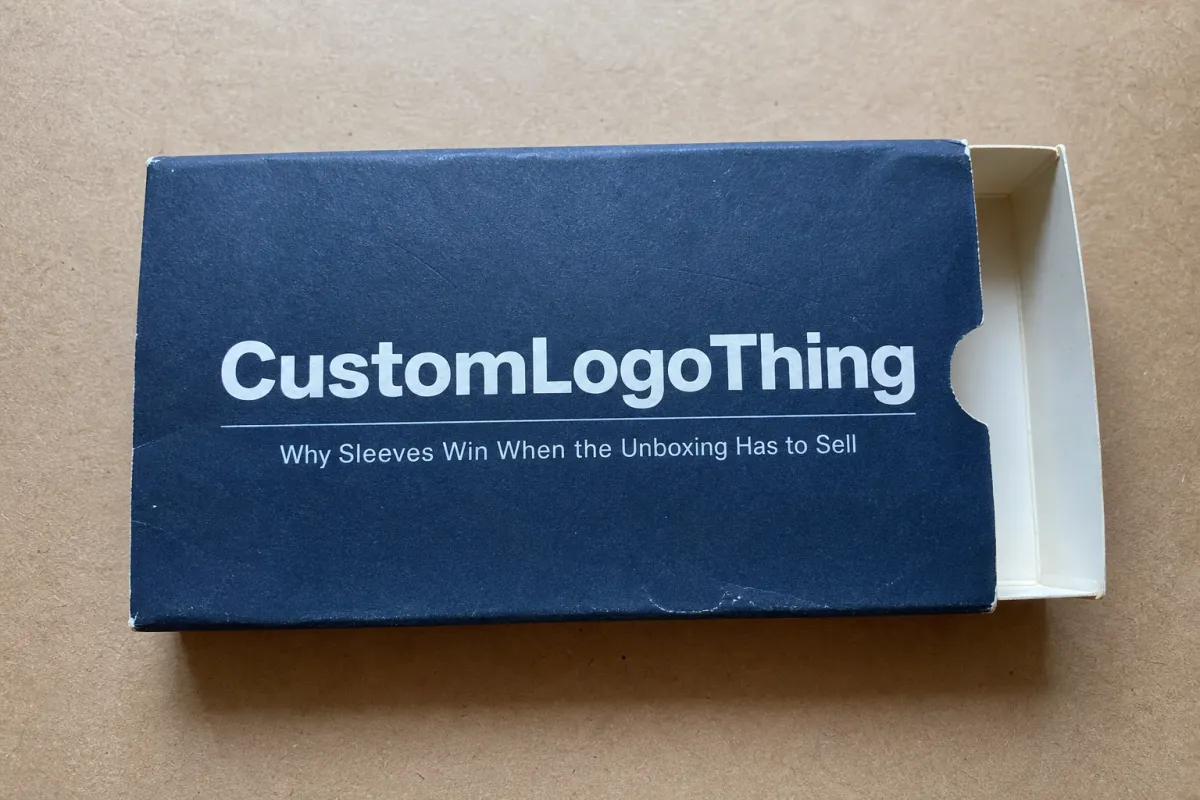
For a lot of brands, sleeves are the smartest premium move because they deliver presence without forcing a full structural redesign. Rigid boxes can be beautiful, but they also bring heavier board, more freight weight, added assembly steps, and more setup risk. A sleeve can create a similar visual hierarchy while staying lighter and easier to manage.
That matters most when the product already lives in a carton, tray, bottle, jar, or other structure that works well. In those cases, the sleeve becomes the branded layer that does the selling. It is often the fastest way to make a standard package feel special, seasonal, or editioned without rebuilding the whole system.
There is another advantage that buyers notice once the product is on shelf. A sleeve creates contrast. It gives the eye a border, separates the logo from the background, and makes restraint feel deliberate. A matte board with a well-placed foil accent can carry more perceived value than a pack crowded with effects. That is why sleeves show up so often in launch kits, influencer mailers, holiday sets, and premium gift packaging.
A sleeve that fits cleanly and uses one or two strong finishes often looks more expensive than a louder package that tries to do everything at once.
That is also why the buying decision matters. The right sleeve is not decorative filler. It is a compact piece of package branding that can improve perceived value, support shelf differentiation, and keep production repeatable across multiple SKUs.
Where to Buy Custom Luxury Packaging Sleeves: What to Compare
When buyers ask where to buy custom luxury packaging sleeves, they usually run into four supplier types: commercial printers, packaging brokers, specialty carton converters, and manufacturers that handle print plus material sourcing in one workflow. Any of them can work. Each one brings a different risk profile.
Commercial printers are often strong on color control and graphic detail, especially for shorter runs or artwork with many small elements. Packaging brokers can accelerate sourcing and quote comparison, though they add a communication layer between the buyer and production floor. Specialty carton converters usually understand die cutting, board behavior, and fit better than a general printer, which becomes more important when the sleeve needs to wrap an existing box or bottle precisely. Full-service manufacturers can reduce handoff errors because they control more of the process, which matters when repeat orders are part of the plan.
Price is only one filter. The more useful question is whether the supplier can preserve the details that make luxury packaging feel expensive rather than merely decorated. Tight registration, clean fold lines, accurate color, and finish alignment are the points where a sleeve succeeds or fails.
Use the table below as a practical screening tool before you request quotes. The ranges are planning figures, not guarantees, because board grade, finishing, and quantity can move the numbers quickly.
| Supplier Type | Best For | Typical MOQ | Indicative Unit Price | Strengths | Watch-Outs |
|---|---|---|---|---|---|
| Commercial printer | Short runs, detailed graphics, faster artwork changes | 250-1,000 units | $0.80-$2.50 | Strong print quality, flexible file handling, useful for test launches | May offer limited structural guidance or specialty finishing depth |
| Packaging broker | Comparing options quickly across multiple factories | Depends on factory network | $0.70-$2.20 | Broad sourcing range, helpful for quick market checks | Extra communication layer can slow technical problem solving |
| Specialty carton converter | Precision fit, custom die cuts, brand-specific finishes | 500-5,000 units | $0.45-$1.60 | Good control over sleeve fit and finish choices | May need clearer specs up front to avoid rework |
| Full-service manufacturer | Repeat orders, controlled quality, coordinated production | 1,000-10,000 units | $0.35-$1.40 | Better consistency, easier replenishment, fewer handoffs | Some firms prefer larger volumes or stricter file standards |
Ask every vendor the same questions. What board are they quoting? What finish is actually included? Is the quote for a prototype build, a digital short run, or a full production job? A low headline price can hide thinner stock, simpler ink coverage, or fewer finishing steps. In luxury packaging, that mismatch creates false savings.
A supplier that also handles Custom Printed Boxes will often ask better questions about fit and presentation. That matters because sleeve projects are usually linked to cartons, trays, bottles, rigid packs, or display sets. When a vendor thinks in terms of the full packaging system, the results are usually more stable.
If the sleeve is part of a wider product line, compare the vendor against other formats too. A team that can execute sleeves well may also be a good fit for related Custom Packaging Products, which can help keep your package branding consistent across launches.
One more screen separates polished suppliers from average ones: ask how they handle reorders. Can they match a previous batch closely? Do they retain dielines and material specs? Can they explain how they control color drift from one run to the next? Direct answers there usually signal a stronger long-term partner.
Material Specs, Finishes, and Print Decisions
Luxury sleeves live or die on the material spec. The board has to feel substantial without adding cost that the product cannot justify, and it has to fold without cracking or rubbing through at the edges. In many cases, 300-400gsm SBS or C1S/C2S paperboard is a sound starting point. For a more tactile premium cue, some brands move into 18-24pt stock. Kraft-style luxury stocks can work too, but only if the artwork is designed with restraint; otherwise the piece can read as rustic instead of premium.
The finish stack changes perceived value quickly. Soft-touch lamination adds a velvety feel and usually reads as higher-end immediately. Matte varnish creates a quieter and cleaner surface. Gloss can sharpen contrast, although it is not always the best choice for luxury unless the design depends on shine. Foil stamping, especially as a small logo treatment or narrow band, often carries more weight than covering the whole surface in effects. Spot UV works best in moderation. Embossing and debossing add dimensional interest, and edge discipline often matters more than buyers expect because the sleeve is handled before the product is even removed.
Print method affects both appearance and cost. Short-run digital is useful for test-market launches, SKU trials, and designs that change often. Offset printing becomes more economical as quantity rises and is usually favored for stable artwork with stronger color control. Specialty finishing adds setup time and cost, especially when foil, embossing, or layered spot effects are involved. The right choice depends on volume, art complexity, and how much color precision the brand needs to protect.
There is no reason to specify every effect just because the option exists. Practical luxury usually benefits from restraint. A sleeve with one strong tactile treatment, one controlled metallic accent, and a precise structure can outperform a concept that uses five finishes and loses focus. The buyer’s job is to protect brand perception while keeping production predictable.
Size is equally important. A sleeve that is too loose feels cheap. A sleeve that is too tight slows packing and increases the chance of damage. Good fit usually means the width, depth, and wrap allowance are calculated from the actual product or inner carton, not guessed from nominal dimensions. Request a prototype or physical sample whenever possible, especially if the sleeve has to slide over a rigid insert, jar, or molded tray. A difference of 1-2 mm can change how the pack feels in hand.
For brands that care about sustainability claims, material choice should be part of the discussion too. FSC-certified paperboard can support chain-of-custody expectations when the source matters to the brand story. If your team needs a reference point for forest-management standards, start with the Forest Stewardship Council at fsc.org. For transit performance, especially when sleeves are shipping inside master cartons or promotional kits, teams should also review ISTA transit testing standards so the packaging is not only attractive but also durable enough for distribution.
The best sleeve programs usually keep the spec disciplined: one core board, one production method, and a limited finish palette that can be repeated without surprises. That kind of control is what separates luxury packaging from expensive packaging.
Pricing, MOQ, and Quote Factors
Pricing for custom luxury packaging sleeves is shaped by several variables at once. Board grade, print coverage, finish complexity, size, die cutting, folding method, and shipping all play a part. When a quote comes back lower than the rest, the first question should be simple: what changed? Often the answer is thinner stock, fewer finishing steps, or less quality control built into the job.
MOQ matters because setup costs have to be spread across the run. A 250-piece order can be useful for a launch test, but the unit cost will usually be materially higher than a 5,000-piece run. As volume rises, per-piece price typically drops because press setup, tooling, and finishing setup are amortized across more units. That is not a trick. It is production math.
Here is a practical framework for comparing quotes fairly:
- Base material: confirm exact board type, caliper, and whether the quote includes coated or uncoated stock.
- Print coverage: check whether the quote assumes full-bleed art, spot color, or a limited ink count.
- Finishing: identify soft-touch, foil, emboss, deboss, spot UV, or any combination of effects.
- Tooling: ask whether die cutting, plates, or special setup is already included.
- Sampling: confirm whether a prototype, digital proof, or physical sample is part of the process.
- Freight: compare landed cost, not just ex-factory pricing.
That last point carries more weight than many buyers expect. Freight can move the total economics, especially for larger sleeves or heavier board. A quote that looks slightly higher on unit price can still win if shipping is lower, the pack cartons more efficiently, or the supplier nests the job better for transport.
For planning purposes, these broad ranges are common:
- Short-run digital sleeves: $0.80-$2.50 per unit for very small quantities, depending on size and finish.
- Mid-volume offset sleeves: $0.35-$1.20 per unit once quantities move into the low thousands.
- Premium finishing adds: $0.08-$0.45 per unit for foil, emboss, spot UV, or heavier tactile treatments, depending on coverage.
Those numbers are not a quote. They are a planning tool. A sleeve with heavy foil coverage, a complex fold, and a soft-touch finish will not price like a plain printed wrap. The more precise the spec, the more useful the quote becomes. If you want apples-to-apples comparisons, send the same dieline, board callout, finish references, quantity target, and delivery address to every supplier.
There are times when paying more is justified. If the sleeve is tied to a new launch, a retailer-facing presentation, a holiday gift set, or a high-margin hero SKU, a better-looking sleeve can support sell-through in a way that offsets the extra packaging cost. Buyers should think in terms of margin protection, not only packaging expense. For some products, the sleeve is not an accessory. It is part of the retail argument.
Time matters just as much as price. A cheaper quote that triggers two extra rounds of color correction, another proof cycle, and a delayed freight booking can cost more in lost launch momentum than a higher quote that moves cleanly. Packaging purchasing often punishes the buyer who only studies the invoice.
Production Process, Timeline, and Lead Time
The production flow for a sleeve looks straightforward on paper and is easy to disrupt in practice. It usually starts with a brief, then a dieline review, artwork placement, proofing, press setup, finishing, folding, packing, and dispatch. Delays tend to happen at the handoff points: artwork revisions after proof approval, unclear size data, or a finish request that was not fully specified during quoting.
Lead time should be split into two parts. First is proof approval. Second is manufacturing. Many schedules slip because the team assumes the quoted turnaround begins immediately after the order is placed. In reality, a day spent waiting on art changes is a day not spent on press. If the sleeve has to land for a launch date, that buffer belongs in the schedule from the start.
A simple timeline for a standard sleeve order often looks like this:
- Brief and quote: 1-3 business days if dimensions and finish targets are clear.
- Dieline and art check: 1-4 business days, longer if the brand is still adjusting layout.
- Proofing: 2-5 business days for digital or physical proof review.
- Production: often 10-15 business days for moderate runs, longer with specialty finishing.
- Packing and dispatch: 1-5 business days depending on destination and shipping method.
Custom foil, embossing, or multi-SKU programs can extend the schedule. Exact color matching can do the same. If the brand is strict about a specific Pantone or a particular brand red, expect at least one extra proof cycle in some cases. That is normal. It is the cost of control.
Good suppliers do not wait until the last day to explain a risk. They flag missing artwork elements, unusual fit dimensions, or finish conflicts early. That saves time and protects the launch. For a packaging buyer, the best sign is not a promise of speed. It is a supplier who can say exactly which step is likely to slow the order and why.
Transit testing can matter too if the sleeves ship as part of a larger campaign or are packed in a way that stresses carton corners. Some teams use industry testing references from the International Safe Transit Association to validate pack performance before a large release. If the sleeve is part of a premium mailer or a retail kit, that extra step can prevent returns, crushed edges, or a presentation failure at the point of unboxing.
Premium packaging deserves more schedule protection than commodity packaging. The reason is simple: there are more approvals, and more ways for a detail to go wrong. A sleeve may look thin, but the approval chain around it is rarely thin.
The most reliable schedules come from buyers who treat art approval like production control. One missing logo lockup or one unclear finish reference can move a job by days. A supplier can only move as fast as the information it receives.
Why Custom Logo Things Fits Practical Luxury Buyers
For buyers evaluating where to buy custom luxury packaging sleeves, Custom Logo Things is a practical fit when the project needs clear specs, dependable communication, and a supplier mindset that values repeatability. That matters because luxury packaging is not only about visual polish. It is also about getting the dimensions, the finish, and the reorder behavior right.
A process-driven packaging partner helps reduce the common failure points: incorrect dimensions, weak print consistency, confusing finish choices, and inconsistent communication between quote and production. Buyers do not need more adjectives. They need a vendor that can explain what the sleeve will cost, how it will be built, and what happens if the design changes before print.
That kind of support is especially useful when the sleeve sits inside a broader package branding system. One launch may need a sleeve for a carton. Another may need a label-driven format. Another may need related presentation packs. A supplier who stays organized across those variations reduces the chance that one SKU looks disconnected from the rest of the line.
Custom Logo Things is also a strong option for teams that want practical luxury rather than overbuilt packaging. There is a real difference. Practical luxury uses the minimum structure needed to create a premium impression. It respects budget, keeps production manageable, and avoids complexity that does not improve shelf performance. That approach is common in modern retail packaging because it keeps the focus on the product while still giving the pack a premium edge.
For many brands, the best supplier is the one that can handle a test run without treating it like a low-priority job, then scale with the same discipline when demand grows. That is the hard part of packaging procurement. Plenty of vendors can quote. Fewer can keep the art, board, finish, and delivery aligned across reorders.
If you are also sourcing other presentation formats, it helps to think across the whole system, not just the sleeve. A strong sleeve supplier should understand how the item relates to inserts, cartons, and display-ready secondary packaging. That broader view is what keeps the final result coherent across branded packaging, retail packaging, and the rest of the product line.
Practical buyers also care about how a vendor reacts under pressure. If a launch shifts by a week, can the supplier keep the job organized? If a retailer changes the pack hierarchy, can the dieline be updated without confusion? Those questions sound boring. They are the difference between a polished release and an expensive scramble.
What to Prepare Before You Request a Quote
The fastest way to get a useful quote is to remove guesswork. Start with the product dimensions. Then define the sleeve’s fit target, because a sleeve for a rigid box is not the same as a sleeve for a bottle, jar, or folding carton. Add quantity, shipping destination, and any deadlines tied to launch or replenishment. A supplier can only price accurately if the basics are fixed.
Next, gather artwork files and visual references. A good quote is easier to produce when the supplier can see what “luxury” means to your team. Some brands mean minimal black-and-white presentation. Others mean heavy foil, tactile coatings, and bold contrast. Those are not the same job. If you send a reference image or a previous sample, the vendor can match your target more reliably.
It also helps to decide where the sleeve sits in the hierarchy of the pack. Is it the only visible layer? Is it wrapping over a tray? Is it part of a set that also includes boxes, inserts, or product labels? That context informs the material and finish stack. In many cases, the smartest sleeve is the one that complements the other packaging elements rather than competing with them.
Before you request quotes, use this checklist:
- Exact product or carton dimensions
- Target quantity and backup quantity
- Board preference or sample stock reference
- Color count and print style
- Finish ideas, including foil, emboss, or soft-touch
- Delivery location and deadline
- Need for prototype, sample, or physical proof
Then ask one more question: who owns the dieline and art approval process? If that answer is unclear, delays usually follow. The best projects move quickly because responsibility is defined early. A good supplier should be able to advise on fit, recommend a suitable stock, and explain where the cost breaks happen without making the buyer decode the process alone.
For brands comparing suppliers side by side, the decision often comes down to three things: clarity, consistency, and fit. Clarity means the quote matches the spec. Consistency means the sample and production pieces line up. Fit means the sleeve works around the real product, not just on paper. Those three factors matter more than a vague promise of premium quality.
There is one final test worth applying. Ask for the supplier’s recommendation, then compare it to your own brief. If the answer is too generic, the project will probably stay generic. If the answer changes after the dieline review, that is useful signal. The strongest vendors push the spec harder than the buyer does.
Where can I buy custom luxury packaging sleeves with a low MOQ?
Look for a manufacturer or print partner that offers short-run digital production or flexible offset options. Ask whether the MOQ changes when you add foil, embossing, or a larger sleeve size. A lower minimum can help with launches, but compare the true unit cost against expected sell-through before you commit.
What do I need to request an accurate quote for custom luxury packaging sleeves?
Send exact dimensions, product weight, the sleeve’s fit target, quantity, artwork files, color expectations, finish references, and delivery location. If possible, include a previous sample or a reference image so the supplier can quote against a clear visual target rather than a vague luxury description.
Which materials work best for luxury packaging sleeves?
Heavier coated paperboard is a common choice when you want structure, sharp print, and a cleaner premium feel. Kraft-style stocks work well for a natural premium cue. Soft-touch coated stocks are useful when tactile feel is part of the brand message and the sleeve needs a more muted, high-end presentation.
How long does production usually take after I place an order?
Lead time depends on proof approval, finish complexity, and quantity. Simple runs can move in roughly 10-15 business days after approval, while foil, embossing, or multiple SKU changes can add more time. Build in buffer if the sleeves are tied to a launch, seasonal rollout, or retail deadline.
How do I compare suppliers when buying custom luxury packaging sleeves?
Match every quote to the same specs so you are comparing the same board, finish, quantity, and shipping assumptions. Review sample quality, communication speed, and whether the supplier can explain material and finish tradeoffs clearly. Favor vendors that show a repeatable process, not just a low headline price.
For buyers who want strong presentation without unnecessary production risk, the smartest answer to where to buy custom luxury packaging sleeves is a supplier that understands fit, finish, and repeatability as one job. That is how sleeves protect margin, improve shelf presence, and keep the packaging program coherent from one order to the next.
Use the quote stage to force clarity: lock dimensions, define the finish stack, confirm the production method, and ask how reorders are handled. If those four points are stable, the sleeve usually is too. If they are vague, the package will likely feel vague as well.
Used well, a sleeve can do something rare in packaging: it can make a restrained budget feel deliberate. That is not an accident. It is the result of clear specs, disciplined production, and a supplier that knows the difference between a wrap and a retail signal.

