A white logo paper bag can look polished on a screen and still disappoint in the hand. The surface may photograph well, the logo may sit neatly on the dieline, and the quote may look competitive, but paper weight decides whether the bag feels crisp, bends too easily, or starts to fail after a few uses. That is why the white logo paper bags paper weight guide matters: it connects the spec sheet to the actual object a customer carries out of the store.
Two bags with identical dimensions can behave very differently once the stock changes. One may hold its shape, keep the print sharp, and survive a busy counter. The other may warp at the gusset, show seam ripple, or lose its clean white appearance after a single delivery run. White stock exposes those differences faster than colored paper because scuffs, edge crush, and show-through are harder to hide.
For buyers, the right goal is not “the heaviest paper available.” It is the lightest stock that still prints cleanly, supports the load, and matches the brand experience. That sounds simple until you factor in handle type, glue strength, coating, folding behavior, and shipping. Those details are usually where a bag succeeds or fails.
Why the white logo paper bags paper weight guide matters in hand
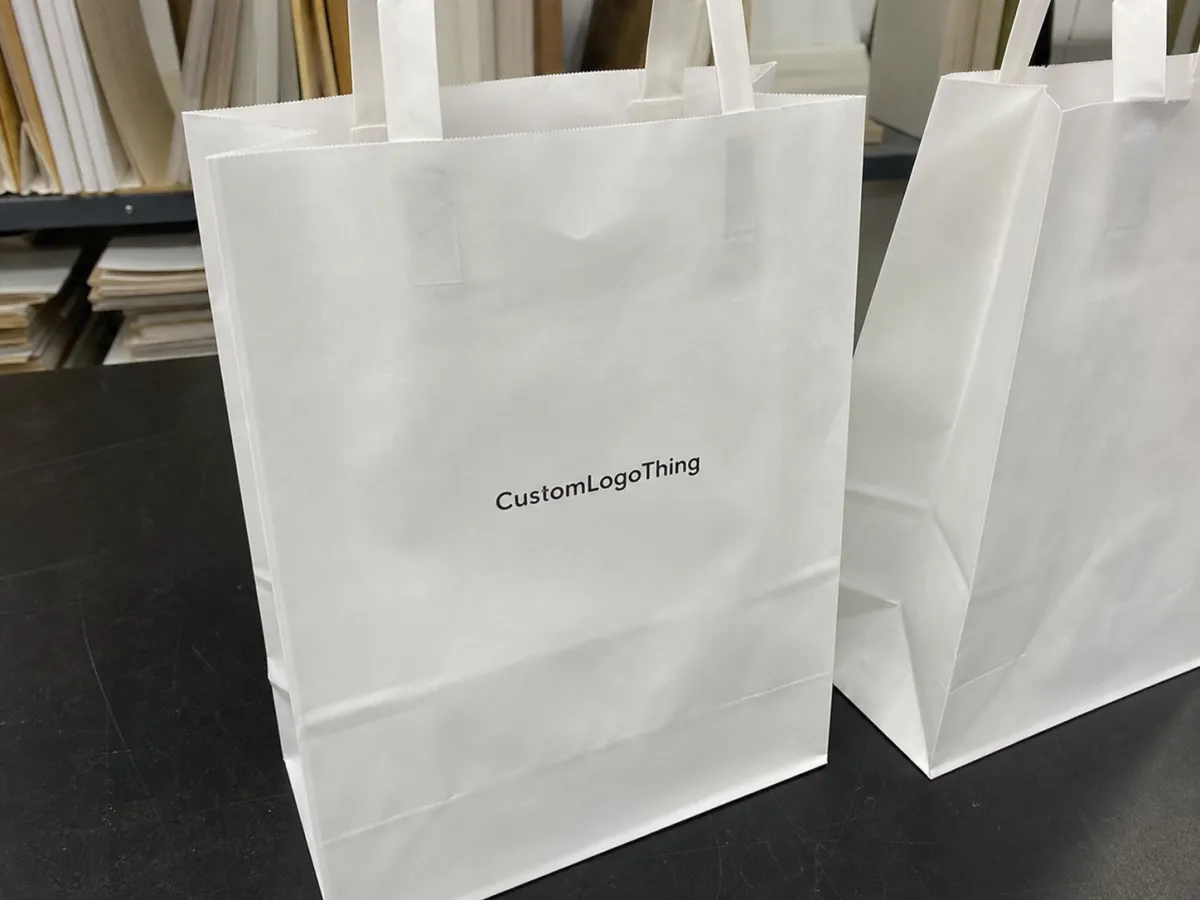
Paper weight reads like a clean number on a spec sheet, yet the finished bag tells a fuller story. In most sourcing conversations, people quote gsm, basis weight, or a supplier-specific paper description, then assume the number alone will predict performance. It rarely does. The same nominal weight can feel firmer or softer depending on fiber mix, coating, caliper, and how much the sheet has been compressed during conversion.
White paper makes that difference obvious. A light sheet can look fine flat, then reveal ripple near the fold lines, a slight bow in the panels, or faint show-through once a dark logo is printed. On a white bag, any scuff or fingerprint reads faster too. That is useful if the buyer wants a premium appearance, because it gives the team a chance to catch weak choices before the order scales.
The practical lesson is straightforward: paper weight affects perception as much as structure. A bag that feels too soft can make a boutique brand look underbuilt. A bag that is too heavy may feel over-specified, add freight cost, and still not solve a handle or glue problem. The best choice sits between those two mistakes.
A heavier bag is not automatically a better bag. The right stock is the lightest one that still carries the load, keeps the logo clear, and survives folding, stacking, and handling without tearing at the weak points.
One more point usually gets missed: regional terminology is inconsistent. Buyers often say “paper weight” when they mean gsm, but some suppliers still quote basis weight or a local grade description. Those are not always interchangeable. If the order crosses regions, ask for the actual paper construction, not just the label. A 150 gsm white bag in one market may not feel identical to a 150 gsm bag sourced elsewhere if the fiber structure differs.
How paper weight affects print, strength, and bag shape
Heavier paper usually gives ink a steadier surface. That matters on white logo paper bags because crisp type, thin rules, and small marks show flaws immediately. On a firmer sheet, the print tends to hold its edge better during impression and drying, and large solid areas often appear more even. This is especially noticeable on logos with tight letter spacing or a lot of white space inside the mark.
Structure changes in a very visible way. Heavier stock helps side panels stay square, gussets stand cleaner, and the bag keep a more deliberate silhouette on a shelf or counter. If the bag is part of the display experience, that shape matters. A bag that slumps can make the product inside look less considered than it really is.
There is a limit, though. Very stiff stock is not always the answer. Some bags need enough flex to fold sharply without cracking at the crease or putting stress on the glued seams. If the paper is too rigid for the construction, conversion can become messy, and a beautiful boardlike feel can create poor fold memory. Good bag design balances appearance, convertibility, and load-bearing behavior.
Handle style changes the equation as well. Twisted paper handles, flat tape handles, and rope handles distribute force differently. A handle that is adequate on a 130 gsm bag may feel underpowered on a 200 gsm luxury presentation bag if the attachment area is not reinforced. The paper choice should be made with the handle in view, not after the fact.
For light retail carry-out, moderate stock often gives the best mix of cost and appearance. Boutique and gift programs usually need a firmer sheet to maintain the brand look. Promotional bags that hold catalogs, boxed items, or multiple samples often justify a heavier weight and stronger conversion details. The load is the real test, not the catalog photo.
Choosing the right paper weight for white logo paper bags
The best place to start is the end use. Retail apparel, cosmetics, bakery packaging, event giveaways, and boxed gift sets all place different demands on a bag, and those demands should shape the stock choice before decoration is discussed. That is where a white logo paper bags paper weight guide earns its keep: it turns a vague feeling about “premium” into a practical decision.
For smaller light-duty bags, a moderate sheet can work if the contents are soft, the handle is simple, and the bag will not carry sharp corners. For boutique bags, buyers often want enough body that the bag stands up on its own and does not collapse when the customer picks it up. For heavier promotional packs, a more substantial sheet is usually worth the extra cost because the failure point is often not the print but the conversion itself.
Print coverage matters too. A plain one-color logo is easier on the paper than a dense full-coverage design, a large foil area, or a mark with tiny text and hard edges. Finishes also change the result. Matte stock can look refined, but it may show scuffing differently than a satin or lightly coated surface. White paper is unforgiving that way; any surface issue is easier to see than on a patterned or tinted bag.
Sample testing saves real money. Ask for two bags at adjacent paper weights and fill them with the actual product, not an abstract estimate. If the bag is designed to hold one boxed item, test one boxed item. If it will carry several pieces with hard corners, test that exact configuration. Side-by-side comparison usually settles the question faster than a long email thread filled with opinions.
If sustainability claims matter to the brand, ask whether the paper can be sourced to FSC or another recognized forestry standard. Certification does not change the handfeel by itself, but it can affect approval, retail placement, and internal procurement rules. For buyers who have to justify the spec to more than one department, that documentation can be as important as the weight number.
| Use case | Typical paper weight range | Best fit | Tradeoff | Rough unit cost at 5,000 pcs |
|---|---|---|---|---|
| Light retail carry-out | 120-140 gsm | Accessories, slim boxes, low-fill bags | Lower cost, softer feel, less structure | $0.16-$0.28 |
| Boutique or gift bag | 150-180 gsm | Cosmetics, premium retail, client gifts | Better print presence, slightly higher cost | $0.24-$0.42 |
| Heavier promotional bag | 190-230 gsm | Kits, boxed sets, event materials | Strong feel, higher freight and conversion cost | $0.34-$0.60 |
Those price ranges are directional, not fixed. Quantity breaks, paper source, finish, handle style, and freight lane all move the number. A standard white bag with a simple one-color logo may sit near the low end, while a heavy bag with a coated surface, custom handle, and complex print can move well beyond the table. The point is not to memorize a perfect price. It is to understand where the cost pressure usually starts.
Cost, pricing, and what changes your unit cost
Paper weight is the most obvious driver of raw material cost. Heavier stock uses more fiber, so the unit price rises even before decoration is added. But the quote rarely moves for one reason alone. Print coverage, finishing, handle choice, quantity, and packaging all affect the final number. A dense logo and a specialty finish can cost more than a small jump in paper weight.
The cleanest way to control cost is to decide which variable actually matters. If the bag exists mainly to carry a light item, pushing from midweight to very heavy stock may deliver little real value. If the bag is meant to sit on a counter and represent the brand, then the extra stiffness may be justified. Buyers get the best result by spending where the customer will notice the difference and trimming where they will not.
Freight can quietly change the economics too. A heavier bag increases carton weight, and that can alter shipping charges, pallet counts, and warehouse handling. On large orders, the landed cost may be more sensitive to freight than to the print itself. That is why the bag should be priced as a system, not as paper alone.
There are other small cost traps. Full bleed coverage may require more press time and tighter quality checks. Specialty handles add assembly steps. Extra reinforcement at the top edge can improve durability, but it also adds material and labor. None of these are bad choices. They just need to be justified by the actual use case.
Quality control has cost implications too. A supplier that checks fold alignment, handle pull strength, print registration, and scuff resistance before packing may quote slightly more than a vendor that skips those steps. The difference often pays for itself in fewer rejects. Buyers should ask what checks are done at the end of the run, not just what paper is being used.
For teams that still need a common vocabulary, a general packaging reference such as Packaging School/Packaging Alliance can help align terms across procurement, design, and production. Misunderstood specs are expensive because they usually surface after the proof stage, when changes are slower and more costly.
Production process and lead time from proof to delivery
The path from artwork to finished bag usually follows a predictable sequence: artwork review, digital proof, sample or preproduction approval, printing, converting, packing, and freight booking. The delays usually happen before printing starts. Missing dielines, low-resolution logos, unclear placement notes, or late changes to handle style can add more time than the press run itself.
Paper weight can affect the schedule in practical ways. Thicker stock may need different setup on the converting line, and some coated papers require extra drying time so the surface does not mark in the stack. That does not mean heavy stock is slow by default. It does mean the plant needs enough room in the schedule to handle it correctly.
For a standard custom run, a realistic planning window is often 12 to 15 business days after proof approval. If physical samples are needed first, add several days more. Seasonal launches, retail openings, and event dates should carry extra padding because one revision can shift the whole timeline. Buyers who lock in artwork early usually get the cleanest schedule.
Shipping deserves its own check. If the bags are moving through a long carrier chain or being distributed to multiple sites, ask how the cartons are packed and protected. Carton strength, inner packing, and pallet stability matter more than many teams realize. A bag that leaves the plant in good condition can still arrive marked or crushed if the packing spec is too loose for the route.
Pay attention to the approval loop. The simplest jobs often move fastest because the brief is complete from the start. The more complete the artwork, size, paper, handle, and shipping information, the less room there is for guesswork. That is the difference between a tidy production schedule and one that keeps slipping by a day or two every time someone asks for “just one more change.”
Step-by-step guide to building a quote-ready spec sheet
A good spec sheet does two things at once: it speeds up quoting and it reduces the chance of receiving a bag that feels right only in theory. If the brief is incomplete, suppliers have to guess at load, finish, or structure, and guesses usually cost time. The more exact the input, the cleaner the quote.
- List the bag dimensions. Include width, gusset, and height. Add any need for board inserts, top reinforcement, or special folding.
- Give a target paper weight range. A range such as 150-170 gsm is often more useful than a single number if you are open to alternatives.
- Describe the load. State the product weight, shape, and whether the contents have sharp edges, rigid corners, or uneven distribution.
- Define the print. Name logo colors, coverage area, and whether the design uses fine type, foil, full blocks, or a simple one-color mark.
- Specify the handle. Rope, flat tape, and twisted paper handles affect structure, cost, and assembly time in different ways.
- Add delivery details. Quantity, destination, in-hand date, and any split shipment requirements help the supplier quote freight correctly.
A single sentence about the use case often improves the quote more than another page of technical notes. “This bag will carry a boxed skincare set and should feel premium at checkout” tells the supplier how the bag needs to perform in the hand. That context can change the paper recommendation even when the dimensions stay the same.
Artwork files matter just as much as the bag spec. Vector logos are easier to reproduce cleanly, especially on white stock where edges and spacing are easy to judge. If there are placement concerns, send a marked-up reference image. If the logo has thin strokes or small type, say so early. Those details affect print feasibility and may push the spec toward a heavier or more stable sheet.
When the choice still feels unclear, request two adjacent sample weights with the same design. A side-by-side comparison usually shows which bag keeps its body, which one wrinkles at the fold, and which one feels too fragile once it is filled. That is the kind of test that prevents a weak spec from going into production.
Common mistakes that make white logo paper bags underperform
The first mistake is choosing by touch alone. An empty bag can feel elegant in the hand and still fail once it is loaded, stacked, or carried for ten minutes. Real performance comes from the filled product weight, the handle attachment, the crease behavior, and the way the bag survives ordinary handling. Empty-sample bias causes more problems than people like to admit.
The second mistake is using a light sheet for an overbuilt design. Dense coverage, heavy ink, or large solid logo areas can warp lighter paper, make the surface look dull, or show seam distortion after converting. White bags reveal that weakness quickly because the eye has no pattern to distract it.
Storage and shipping conditions can damage a good spec. Paper that is packed too tightly, stored in humidity, or shipped through rough handling may arrive with curl, edge crush, or surface scuffing. If the bags will sit in a stockroom, move through a warm warehouse, or travel long distance, ask how the cartons are protected.
Another common miss is matching the bag to the brand image but not to the physical load. A luxury-looking bag that cannot carry the product cleanly still feels wrong. A practical bag that is overspecified for a light item wastes money. The strongest result comes from aligning image, load, and production reality instead of treating them as separate decisions.
Most failures start before the logo is printed. The paper choice was wrong, the handle was underbuilt, or the bag was never tested against the real load and the real route.
Quality checks help catch those issues early. A good preproduction routine should include fold-line inspection, handle pull testing, print registration review, rub resistance checking, and a quick fill test with the intended product. None of those checks are glamorous, but they are faster than fixing a batch that looks fine in the box and wrong on the shelf.
Expert tips and next steps before you request samples
Start with one real product and one realistic load. Test the bag against that load before ordering volume. That one step clears out a lot of guesswork because it forces the paper choice to answer a physical question instead of a theoretical one.
Compare at least two adjacent paper weights using the same logo artwork. The easiest differences to spot are stiffness, edge sharpness, panel memory, and the way the bag sits after filling. If the size, handle, and print all change at once, the comparison becomes too muddy to trust.
Ask for a quote that shows the effect of each change separately. It is useful to see how the price moves if paper weight changes, or if the handle switches, or if the finish is simplified. That kind of breakdown helps identify the one upgrade that adds real value and the one that merely adds cost.
Before sending the brief, write down four items: use case, quantity, delivery window, and the quality points that cannot be compromised. That small amount of preparation usually leads to fewer revisions and a better final bag. The process becomes easier to judge when the supplier is reacting to a complete spec instead of trying to reconstruct one from fragments.
What to verify before sample approval
- Does the bag hold its shape when filled with the actual product?
- Do the handles stay secure under normal lifting and short-distance carrying?
- Does the logo stay crisp on the white surface without bleed, warp, or dulling?
- Do the folds, gussets, and glued seams remain neat after conversion and packing?
- Does the price still make sense once freight and packing are included?
What paper weight is best for white logo paper bags?
The best paper weight depends on the load, the desired feel, and how much structure the bag needs to hold its shape. Light retail carry-out can work on moderate stock, while boutique and gift bags usually benefit from a firmer sheet. If the use case is uncertain, compare two sample weights with the actual product inside and judge the result in the hand, not on the table.
How does paper weight affect printing on white logo paper bags?
Heavier paper usually gives the ink a steadier surface, which helps fine text, thin lines, and solid logos print more cleanly. Lighter paper can show warp, show-through, or soft edges more easily, especially when the artwork has heavy coverage. Finish matters too, so paper weight should be selected alongside the print method and the logo complexity.
Are heavier white logo paper bags always stronger?
No. Strength depends on the full construction, including fiber quality, fold design, glue, handle attachment, and how the bag is packed. A well-made midweight bag can outperform a poorly converted heavy bag if the seams or handles are weak. The filled product and the handling route are the best tests.
How long does production usually take for custom white logo paper bags?
Many standard custom runs take about 12 to 15 business days after proof approval, though sampling and complex finishing can add time. The schedule may stretch if the artwork is incomplete, the handle style is unusual, or the paper needs special handling. Build in extra time for seasonal jobs and anything that must ship to more than one location.
How can I lower unit cost without making the bag look cheap?
Keep the bag dimensions standard, simplify the artwork, and avoid special finishes unless they are doing real work for the brand. Choose the lightest paper weight that still passes a real fill test and prints cleanly. Ask for alternate quotes so you can see exactly which changes move the price the most.
For most buyers, the cleanest path is to anchor the spec to the actual product, the actual load, and the actual handling environment. That is where the white logo paper bags paper weight guide becomes useful in practice: it helps balance appearance, strength, and cost without relying on guesswork or overshooting the spec.

