Buyer Fit Snapshot
| Best fit | Wholesale Custom Neon Hang Tags for Bold Brand Impact projects where brand print, material claims, artwork control, MOQ, and repeat-order consistency need to be specified before quoting. |
|---|---|
| Quote inputs | Share finished size, material target, print colors, finish, packing count, annual reorder estimate, ship-to region, and any compliance wording. |
| Proofing check | Approve dieline scale, logo placement, barcode or warning zones, color tolerance, closure strength, and carton packing before bulk production. |
| Main risk | Vague material claims, crowded artwork, missing packing details, or unclear freight terms can make a low unit price expensive after revisions. |
Fast answer: Wholesale Custom Neon Hang Tags for Bold Brand Impact should be specified like a repeatable production item. The safest quote records material, print method, finish, artwork proof, packing count, and reorder notes in one written spec.
Production checks before approval
Compare the actual filled-product size with the drawing, then confirm tolerance on folds, seals, hang holes, label areas, and retail display edges. Reserve space for logos, QR codes, warning copy, and material claims before decorative graphics fill the panel.
Quote comparison points
Review material grade, print process, finish, sampling route, tooling charges, carton quantity, and freight assumptions side by side. A quote is only useful when the supplier can repeat the same color, closure quality, and packing count on the next order.
Wholesale custom neon hang tags do something most packaging elements only hope to do: they grab attention before the shopper has finished the first scan. I remember standing on a packing floor in Dongguan and watching a standard white tag sit beside a fluorescent pink one under 4,000K warehouse LEDs. The neon version won the first glance every time. That was not subtle, and retail rarely rewards subtlety. First glance matters because a tag starts working before anyone reads the logo, and on a crowded rack that can matter as much as a 10% price gap.
At Custom Logo Things, I have seen wholesale custom neon hang tags do double duty for brands that need sharper retail packaging, faster SKU recognition, and a cleaner visual system across repeat orders. Brightness is only part of the story. These tags help merchandisers sort product faster, help buyers spot color families from 6 to 8 feet away, and help a brand keep its packaging language steady when seasonal drops keep changing the clothes. That steadiness is underrated. A lot of teams chase novelty so hard that they miss the fact that consistency is often what makes a line feel expensive, especially across 5,000-piece or 10,000-piece reorders.
I do not think most teams realize how much a tag can influence the whole package. In one meeting with a fashion buyer in Los Angeles, we lined up six tag versions beside a stack of sample tees, and the neon hang tag was the only one that held attention from across a 12-foot showroom under mixed LED and daylight bulbs. The buyer was not chasing flash. She wanted less hesitation on the sales floor, and wholesale custom neon hang tags gave her a simple way to get it. That kind of visibility matters in pop-up retail, warehouse-to-store programs, and seasonal displays where the product has to do more selling on its own. A tag can behave like a traffic signal: not shy, not decorative, and sometimes exactly what the room needs when a buyer has 30 seconds and three samples in hand.
"We do not need a louder design; we need a tag that gets read in two seconds." I have heard that exact line from buyers in New York, Chicago, and Austin, and it is usually the moment they stop thinking about decoration and start thinking about sales floor behavior. A tag that can be read in 2 seconds at 5 feet is doing real work, not just looking bright.
For Brands That Scale through repeat runs, wholesale custom neon hang tags are especially practical because wholesale pricing rewards consistency. Once the size, finish, hole placement, and ink build are locked, the next order is easier to quote, easier to produce, and easier to match. Apparel lines, beauty launches, and promotional goods all benefit from that kind of stability. A tag that matches the last run down to the millimeter saves more time than a fresh design ever will, and it can shave 1 to 2 proof cycles off a reorder if the artwork remains unchanged.
Why do wholesale custom neon hang tags get noticed so fast?
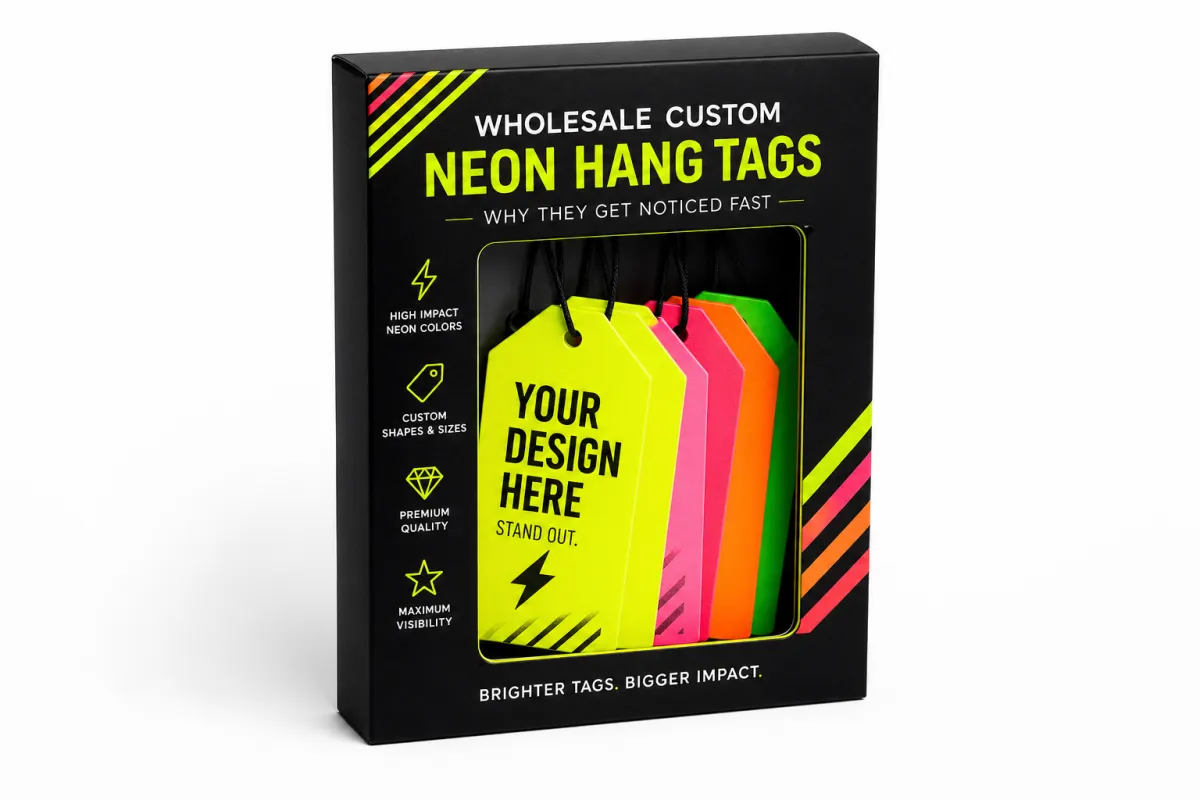
The simplest way to describe wholesale custom neon hang tags is this: they turn the tag into a signal instead of a footnote. In a retail setting where a buyer may scan 20 similar products in one aisle, fluorescent colors like neon pink, lime, orange, and yellow create immediate contrast against denim, cotton fleece, kraft cartons, and neutral fixtures. The eye reads color blocks before it reads copy. Shopper research often shows that visual attention locks in within 2 to 3 seconds, and neon tags exploit that split-second filter with almost unfair efficiency. That speed matters whether the tag is sitting on a $28 basic tee or a $140 outerwear piece.
I saw that play out in a knitwear factory near Guangzhou where a buyer had standard cream tags and a neon yellow revision on the table. The garments were nearly identical in construction, but the neon hang tags made the second line feel more current and easier to merchandise by size and color. The buyer was not chasing flash. She wanted less hesitation on the sales floor, and wholesale custom neon hang tags gave her a simple way to get it. I still remember her tapping the bright sample with a pen and saying, "That one reads from across the room." She was right, and the test table was about 14 feet from the doorway.
There is a practical side that gets overlooked. Bright tags are easier to sort in a warehouse. On a crowded packing table in Shenzhen or Yiwu, they are easier to count, easier to bundle, and easier to pull for reorders. On a multi-SKU program, they make color blocking cleaner because the tags can act as a coded system for style, fit, or season. I have seen teams shave 15 to 20 minutes off a 3,000-unit packing shift simply because the tag color told everyone where the product belonged. That sounds small until you are staring at 3,000 units and a clock that is absolutely not your friend.
Repeat orders make the case even stronger. Wholesale custom neon hang tags work better than one-off print solutions because the wholesale setup supports consistent neon stock, predictable unit pricing, and stable color management from batch to batch. If a brand launches a streetwear capsule in March and restocks it in June, the tag should look like the same program, not like a different supplier borrowed the idea. I think brand memory depends on these tiny consistencies more than executives like to admit, especially when the line is sold through 12 stores or more.
One detail gets missed all the time: the tag is often the first visible piece of package branding in the room. On a rack, in a carton, in a pop-up bin, or in a folded stack, wholesale custom neon hang tags can create instant recognition before the shopper ever reads the brand name. That first recognition is not cosmetic. It is a sales tool. I have watched a neon tag pull attention to a $32 mid-priced item that would have been ignored in a sea of beige and black. Color does not magically fix weak product, but it absolutely changes the odds.
If you are building a broader system, the tag should fit with the rest of the line. I often pair Custom Labels & Tags with matching inserts and compare it against our Wholesale Programs so the spec stays uniform across the season. Brands that also need cartons, sleeves, or mailers can use Custom Packaging Products to keep the visual language aligned from shipper to shelf. That alignment sounds glamorous in a pitch deck, but in practice it usually looks like fewer mismatched shipments, fewer late-night emails, and fewer returns caused by packaging that does not match the rest of the line.
Wholesale Custom Neon Hang Tags Product Details: Materials, Shapes, and Finishes
When I spec wholesale custom neon hang tags, I start with the substrate because material controls both the look and the behavior of the tag. Bright fluorescent paper stock gives the strongest neon effect right away, especially for lime and pink, but heavy tag stock or coated card can hold the color more cleanly when the tag has to survive freight lanes, carton compression, and repeated handling by store staff. For a premium apparel line, I usually look at 350gsm C1S artboard or a 16pt coated board with a neon face print. If the wrong stock is chosen, the tag can look flat, and then everyone suddenly wants a more vibrant redo 48 hours before launch.
Shape matters more than most people expect. A simple rectangle with rounded corners still does the heavy lifting, especially for wholesale custom neon hang tags on basics and private-label apparel. Custom die-cuts can reinforce brand identity if the silhouette echoes a logo, a product line, or a seasonal theme. I have seen tag shapes that mimic a lightning bolt, a bottle outline, or a sneaker tab become the thing buyers talk about at the merch table without adding much to print cost. A custom die might add $40 to $120 in setup, but it can change the way a line is remembered.
Finishes and handling
Finishing changes how the tag feels in the hand and how it survives packing. Matte lamination keeps glare down under retail lights; gloss coating makes the neon color hit harder; soft-touch coating gives a more premium feel but can mute some fluorescent pop if the base stock is not chosen carefully. Spot UV works when a logo needs a small reflective hit, and foil accents can fit if you want the tag to stay bold without drifting into overdesigned territory. I have a personal bias here: if the neon is already doing the visual heavy lifting, I prefer the rest of the finish to behave like a supporting actor, not the loud cousin at a family dinner.
On the line, I pay close attention to edges and hole prep. A clean edge trim reduces paper dust, and a reinforced eyelet can prevent tearing on heavier products. If the tag is going through speed packing in a warehouse in Dongguan or Shenzhen, an elastic loop fastener is usually faster than string, while a safety pin can be the right call for fashion goods that are attached after folding. Wholesale custom neon hang tags should support the packaging line, not slow it down by ten seconds per unit. Ten seconds sounds harmless until you multiply it by 8,000 units and realize the floor manager has started developing a twitch.
Print elements that add real value
Good tag design is not just color and logo placement. Barcodes, QR codes, SKU numbers, size marks, care icons, and country-of-origin text all matter in real production, especially for apparel, gifts, and beauty items. A QR code can drive traffic to product detail pages or care instructions, but it needs enough quiet space around it to scan properly. That is why I always ask for the exact data list before a proof is built for wholesale custom neon hang tags. A missing digit or a crowded code turns a clean job into a very avoidable mess, and one bad code on a 10,000-unit run can stop receiving teams for hours.
For brands that are serious about branded packaging, the hang tag should match the rest of the package branding language. If the line uses Custom Printed Boxes with a matte black exterior, a neon tag can create a deliberate contrast. If the line uses lighter product packaging, a neon tag may need a more restrained type hierarchy so the whole set still feels balanced. I think contrast works best when it feels intentional rather than accidental, like someone actually had a point of view instead of just a stack of color swatches and a deadline.
There is also a sourcing angle worth mentioning. If a buyer wants recycled content or chain-of-custody support, I will often point them toward FSC material guidance for paper sourcing. For transit and handling questions that affect cartons and kitting, the standards discussed by ISTA are helpful when shipments move through parcel networks or mixed freight lanes. Those references matter because tags do not live in a vacuum; they live in cartons, warehouses, and trucks that rarely treat paper with the tenderness it deserves.
One beauty client in Queens wanted wholesale custom neon hang tags with a punched hole, a small barcode, and a soft-touch finish on 18pt stock. We tested two versions, and the glossy version looked louder but picked up scuffs faster during bagging. The soft-touch option kept the color strong enough while hiding minor rub marks better, which mattered because the launch had 12,000 units and each carton was opened and reclosed multiple times on the receiving side. I remember thinking the glossy sample looked beautiful for about five minutes, and then reality walked in carrying a stack of cartons.
Specifications for Wholesale Custom Neon Hang Tags
Before I quote wholesale custom neon hang tags, I want the buyer to lock down the basics: finished size, stock weight, print sides, color build, hole diameter, and the exact finish. That sounds simple, but a lot of delays begin when a team says "whatever fits" and then tries to approve a proof without a dieline. A 2 x 3.5 inch tag behaves very differently from a 3 x 5 inch tag, especially if the product is lightweight or the copy block is dense. Small differences create big visual consequences; that is one of those annoying little truths packaging people learn the hard way.
Neon color behaves differently from standard CMYK. A digital mockup can show the general direction, but the actual fluorescence depends on the paper stock, ink system, and coating. Some buyers want neon that reads almost electric under store lighting; others want a softer fluorescent tone that supports premium branding without overpowering the garment. With wholesale custom neon hang tags, the exact material choice matters as much as the color name. I have seen two "neon orange" tags from different setups look like they came from different planets, even though both were approved from a PDF.
Here is a spec list I like to confirm before a job starts:
- Finished size: 2 x 3.5 inches, 2.5 x 4 inches, or a custom die-cut silhouette.
- Stock: 350gsm C1S artboard, 16pt coated card, or fluorescent paper on a heavier base.
- Print sides: one side for a simple brand hit, two sides for SKU, barcode, and care data.
- Hole: 1/8 inch or 3mm punched hole, with eyelet if the product is heavy.
- Finish: matte, gloss, soft-touch, spot UV, or foil accent.
- Readability: logo, copy, and barcode must stay legible under retail lighting.
Durability is the other issue. A tag may look perfect on the approval sheet and still fail in the real world if the corners dent during carton compression or the ink rubs against folded garments. I have seen this happen on a shipment that moved from our Shenzhen facility to a distribution center in the Midwest; the tags were stacked too tightly, the outer cartons flexed in transit, and the cleanest fix was to move from a lighter card to a stiffer board with slightly rounded corners. Wholesale custom neon hang tags need to survive the route, not just the sample table. A beautiful sample that collapses in shipping is just expensive confetti.
Product category should also influence the spec. Apparel usually tolerates a standard hole and string loop. Streetwear may want a heavier tag with a stronger visual block. Beauty items often need a smaller format with refined type and a more polished coating. Gifts and promotional goods may use brighter ink density and a simple one-sided print. Wholesale custom neon hang tags are flexible enough to serve all of those categories, but the build should match the use case. I think that is where a lot of otherwise good programs get sloppy: they choose one spec and hope it behaves well across every product type. It usually does not.
I always recommend requesting a physical sample or at least a proof that shows actual stock color, hole placement, and print density. A PDF helps with text review, but it will not tell you how the fluorescent stock behaves in the hand. For wholesale custom neon hang tags, a sample can save a buyer from approving the wrong shade of neon orange or discovering too late that the barcode sits too close to the edge. I have had clients thank me for being fussy at this stage, which is a nice change from being thanked after the deadline is already breathing down everyone’s neck.
One more detail matters: if the tag will be attached after folding and bagging, the attachment hardware must be fast enough for the packing line. A 3mm eyelet with elastic cord can save labor on a 5,000-unit run, while a string tie may be the better aesthetic choice for premium retail packaging. There is no universal answer; the right spec depends on the product, the budget, and how the cartons will be opened on arrival. This is where experience beats guessing, every time.
Wholesale Custom Neon Hang Tags Pricing, MOQ, and Order Breakpoints
Pricing for wholesale custom neon hang tags comes down to five big drivers: size, stock, print complexity, finishing, and volume. If the tag is small, one-sided, and printed on standard fluorescent paper, the unit price can stay low. If you add a custom die-cut, lamination, foil, or a reinforced eyelet, the cost rises because each of those steps adds setup time, material handling, or waste. The math is not mysterious, just inconvenient, and the gap between a $0.15 unit and a $0.48 unit can come down to finish choices alone.
I like to explain MOQ in plain language. Minimums usually reflect the amount of setup work needed to make the first sheet or press run economical, not an arbitrary policy designed to frustrate a buyer. A die has to be made, plates have to be checked, colors have to be balanced, and the press needs enough quantity to justify the finishing line. That is why wholesale custom neon hang tags get more efficient as volume increases. There is a reason factories keep talking about setup, and it is not because they enjoy hearing themselves speak.
| Quantity | Sample Spec | Typical Unit Price | Setup / Notes |
|---|---|---|---|
| 1,000 pieces | 2 x 3.5 inch, one-sided print, neon card, punched hole | $0.42/unit | Higher setup share; good for pilots and seasonal tests |
| 5,000 pieces | Same spec, light coating, no special die-cut | $0.15/unit | Often the first practical wholesale breakpoint for repeat brands |
| 10,000 pieces | Two-sided print, barcode, matte coat | $0.12/unit | Better efficiency on repeat artwork and stable color |
| 25,000 pieces | Custom shape, eyelet, premium finish | $0.08/unit | Best cost spread for national rollouts and multi-store programs |
Those numbers are practical examples, not a promise on every job, because a 4 x 6 inch custom die-cut with foil and a soft-touch finish will cost more than a 2 x 3.5 inch tag with one-color print. Still, they give buyers a solid frame for budgeting wholesale custom neon hang tags and comparing quotes on an apples-to-apples basis. I always say a quote only becomes useful when everyone is measuring the same thing; otherwise you are just comparing postcards and calling it strategy.
Watch for extra charges that can appear if they are not discussed early. Plate fees, die charges, proof fees, rush production, custom kitting, and freight surcharges all affect the landed cost. I have seen a buyer celebrate a low print quote and then lose the margin in packaging, repacking, and expedited shipping. For wholesale custom neon hang tags, the smart comparison is total landed cost per tag, not just the press line number. The cheapest quote can become the most expensive decision if nobody looked past the first line item.
Here is a simple rule I use with clients: if a brand launches new collections every eight to ten weeks, the tag spec should be set up for repeatability first and novelty second. A steady spec means fewer changes, fewer proof cycles, and less risk of paying setup costs again and again. Wholesale custom neon hang tags are a strong fit for that kind of program because once the approval is locked, reorders move much faster. Repeatability is where the real savings hide, especially once a brand is ordering 3 to 4 runs per year.
I also tell buyers to think about the whole packaging system. If the neon tag sits beside custom printed boxes, tissue, and inserts, the tag cost should be viewed as part of the total product packaging budget. That wider view helps a brand keep packaging design consistent while still protecting margin on the shelf. A tag that looks cheap inside an elegant box system can drag down the whole perception, which is annoying because one small part can ruin a perfectly good presentation.
Production Process and Timeline for Wholesale Custom Neon Hang Tags
The production flow for wholesale custom neon hang tags is straightforward, but each step needs clean input. We start with artwork review, move into proof generation, confirm stock and finish, then go to printing, cutting, hole punching, finishing, quality control, packing, and shipment. The fastest jobs are the ones where the buyer sends a clean file, a clear size, and one approved contact for signoff. That last part matters more than people think. Three people "final approving" the same tag is a classic recipe for delay and mild office drama.
Most delays come from a short list of problems: missing dielines, low-resolution logos, unclear copy, unapproved color, or a quantity change after the proof has already been built. I have watched a 2-day approval stretch into 8 days because a team could not agree on whether the barcode should sit on the front or the back. With wholesale custom neon hang tags, a little clarity up front saves a lot of time later. Clarity is boring, yes, but boring is cheaper than reworking a whole run.
For a simple repeat order, I usually expect a faster timeline than for a new custom shape or a specialty finish. A standard run can often move in 7 to 10 business days after proof approval, while a new die-cut with foil or soft-touch coating may need 12 to 15 business days from approval, depending on material availability and the press schedule in Shenzhen or Dongguan. Shipping time is separate, and that matters if the launch date is fixed. I always tell clients to back-plan from the ship date, not the meeting date where everyone nodded enthusiastically and then went home.
In one supplier negotiation I handled, the buyer wanted wholesale custom neon hang tags attached to folded garments before a store reset that had already been booked on the calendar in Chicago. We spent more time talking about carton counts, pack sequence, and receiving windows than we did about the art itself, because the tags were only valuable if they arrived kitted by style and size. That is the kind of detail that separates a good quote from a useful delivery plan. Anyone can sell a tag; fewer people can get it where it needs to be in the right order.
Quality control should be more than a quick visual check. I like to confirm print density, hole placement, corner finish, and barcode readability before cartons are sealed. If the tags are going out with finished goods, I also want to know how they will be nested, how many per bundle, and whether the outer cartons need a label that identifies style and color. Wholesale custom neon hang tags can create speed only if the final pack-out is organized. Disorder is how a bright, simple product becomes a warehouse puzzle.
Because transit can be rough, especially on mixed freight or parcel routes, it helps to align the packaging plan with the shipment method. If cartons are going to be handled several times, I want a sturdier master carton and a bundle count that prevents edge crush. I have seen perfectly printed wholesale custom neon hang tags arrive with bent corners simply because the inner packs were too loose and the outer cartons flexed under weight on a route from Ningbo to a Midwest distribution center. Packaging people do not get enough credit for preventing chaos, or enough blame when the cartons lose a fight with gravity.
Why Choose Custom Logo Things for Wholesale Custom Neon Hang Tags
Factory-level control matters. A lot of vendors can sell a bright tag; fewer can explain how the stock will behave in a humid warehouse, how the edge trim will hold under bundling pressure, or how the tag will look after it has been packed, stacked, and shipped across multiple distribution nodes. At Custom Logo Things, I would rather give a buyer a correct spec than a polished promise, and that is especially true for wholesale custom neon hang tags. Polished promises are easy. Correct specs are what keep a project from wobbling later.
When I worked with a streetwear brand that had six colorways and one launch date, the biggest issue was not the logo. It was the hole placement, because the tag kept rotating on the cord and covering the size mark. We solved it by moving the hole 1/8 inch higher and switching to a heavier board. That small change made the tag behave better on the rack and in the carton, which is exactly the kind of practical adjustment that matters in wholesale custom neon hang tags. I love that kind of fix because it is not flashy, but it works.
Another thing buyers appreciate is honest quoting. If the run needs a die, a special coating, or a faster turnaround, the quote should say so clearly. A transparent quote helps the buyer compare pricing, MOQ, and Lead time without guessing where the cost sits. That is especially useful for wholesale custom neon hang tags because the same design can be produced in multiple ways, and the cheapest version is not always the best value. I have seen "cheap" become expensive after three rounds of revisions and one frantic courier fee.
I also value support that looks at the full package branding system. A hang tag should not fight the rest of the line. If the brand already has a distinct palette on the inserts, the tags should complement it. If the packaging design uses restrained typography, the neon stock should carry the energy without forcing a loud visual clash. That is how wholesale custom neon hang tags fit into branded packaging that still feels deliberate. My opinion: a great tag should feel inevitable, like it obviously belongs there and nobody had to apologize for it.
For larger programs, repeatability is everything. A buyer may not need a brand-new concept every quarter; sometimes they need a reliable partner who can rebuild the same tag with the same shade, same hole size, and same finish every time. I have seen too many programs drift because each reorder came from a different source. When wholesale custom neon hang tags stay consistent, inventory planning gets easier, customer service gets easier, and the whole product packaging program feels tighter. That consistency has a strange way of making a brand look more expensive without actually changing the product.
We also try to think like the packing team. If a tag is too stiff, it may crack on a fold line. If it is too thin, it may curl during storage. If the coating is too slick, string ties slide around on the garment. Those details sound small until you are on a production floor trying to get 8,000 units out the door before a cutoff at 5:00 p.m. Good wholesale custom neon hang tags reduce friction on the line, and that saves real time. I have yet to meet a production supervisor who enjoys wrestling with curled tags at 6:30 p.m.
When clients ask how we compare to broad-market suppliers, I point to the combination of practical spec guidance, wholesale pricing, and a broader catalog of supporting items. A tag order might begin with wholesale custom neon hang tags, then move into labels, inserts, or matching cartons as the program grows. That is where our Wholesale Programs and Custom Packaging Products help keep the whole run organized. It is less dramatic than reinventing packaging, but much more useful when the first shipment needs to land in one piece.
Next Steps for Ordering Wholesale Custom Neon Hang Tags
If you are ready to quote wholesale custom neon hang tags, start with the basics: logo files, finished size, quantity range, print sides, finish, hole size, and delivery address. I would also recommend choosing whether the tags need barcodes, QR codes, care copy, or a custom shape before you ask for a proof. That single step cuts revisions because the spec is already complete when the artwork review begins. The less everyone has to guess, the faster the whole thing moves.
It helps to send one reference point, even if it is only a competitor tag or a sample from another brand. I have found that a visual reference saves time because it communicates the level of brightness, thickness, and finish better than a vague description ever can. For wholesale custom neon hang tags, a reference sample is often the difference between close enough and exactly what we wanted. I have seen close enough turn into a 9-email revision thread, and nobody enjoys that thread.
Before the quote goes out, confirm these details:
- Finished size and shape.
- Stock choice and coating.
- One-sided or two-sided print.
- Hole size, eyelet, or fastener type.
- Barcode, QR code, or care text requirements.
- Quantity, deadline, and shipping location.
Ask for a proof only after the spec is settled. That keeps the revision cycle short and protects the schedule. It also helps the team compare actual output against the brand's package branding standards instead of debating details that should have been set before production started. For wholesale custom neon hang tags, that discipline saves money and keeps the launch on track. I know discipline sounds unglamorous, but it is usually the reason the nice thing actually arrives looking nice.
If your program spans apparel, accessories, or gift items, think beyond the tag itself. Pairing the order with Custom Labels & Tags and the right outer cartons can make the entire package branding system feel finished. If the tag is part of a larger retail packaging rollout, it should work with the rest of the visual language, not sit off by itself as an afterthought. I have seen beautifully designed tags look stranded because the rest of the packaging had a completely different personality. That disconnect is more noticeable than most brands expect, especially when the box arrives from a different factory than the tag.
My practical takeaway is simple: lock the size, stock, finish, and attachment method before approval, then order one physical sample if the launch matters. Wholesale custom neon hang tags earn their keep when the spec is clear, the color is tested on the actual substrate, and the packing line can move without hesitation. That is how the first order sets up the next three reorders, and it is how a bright tag stops being a gimmick and starts acting like part of the sales system.
What is the minimum order for wholesale custom neon hang tags?
MOQ usually depends on stock, print method, and finishing steps rather than a single universal number. Higher quantities lower the unit cost because setup and die-cutting are spread across more tags. If you need a smaller pilot run, ask whether the shop can quote a test quantity with the same materials and finish. I always tell buyers not to assume one supplier’s minimum tells the whole story, because the real driver is often setup complexity. A 1,000-piece pilot and a 10,000-piece reorder can use the same artwork but produce very different unit economics.
Which materials work best for wholesale custom neon hang tags on apparel?
Fluorescent paper stock is the most direct choice when you want strong neon visibility. Heavier card or coated board works better when the tag needs to stay flat during shipping and display. The best option depends on garment weight, attachment style, and whether the tag must feel premium in hand. If the piece needs to survive repeated handling, I lean toward a sturdier board even if the first sample of lighter stock looks a touch brighter. For many apparel programs, 350gsm C1S artboard is a reliable starting point.
Can wholesale custom neon hang tags include barcodes or QR codes?
Yes, barcodes and QR codes are common on Custom Hang Tags for retail tracking and product information. The code should be placed with enough quiet space around it so scanners can read it reliably. If the tag is very bright, the supplier should verify contrast so the code stays sharp in print. I have seen a great tag fail because someone tucked the code too close to the edge. That is the sort of tiny mistake that causes entirely too much drama at receiving, especially when the carton count is over 2,000 units.
How long does production usually take for wholesale custom neon hang tags?
Simple repeat orders usually move faster than new custom shapes or specialty finishes. Artwork approval is often the biggest factor, so clean files and fast proof signoff help shorten lead time. Shipping time should be added separately if the tags need to arrive before a launch or seasonal reset. If the schedule is tight, I recommend building in a cushion, because freight has a habit of behaving like it has never once seen a calendar. A 12 to 15 business day window from proof approval is common for more complex runs.
What files do I need to request an accurate quote for wholesale custom neon hang tags?
Send your logo or artwork file, preferred size, quantity, and any die-cut or finish notes you already know. If you have a sample tag or reference image, include that so the quote matches the look you want. The more specific the spec sheet, the faster the pricing and proofing process will move. Clear inputs save everyone from the very human habit of interpreting the same word three different ways. If you can include the shipping city, such as Los Angeles, Chicago, or Dallas, that also helps with landed-cost estimates.


