Buyer Fit Snapshot
| Best fit | Custom Bamboo Fiber Packaging projects where brand print, material claims, artwork control, MOQ, and repeat-order consistency need to be specified before quoting. |
|---|---|
| Quote inputs | Share finished size, material target, print colors, finish, packing count, annual reorder estimate, ship-to region, and any compliance wording. |
| Proofing check | Approve dieline scale, logo placement, barcode or warning zones, color tolerance, closure strength, and carton packing before bulk production. |
| Main risk | Vague material claims, crowded artwork, missing packing details, or unclear freight terms can make a low unit price expensive after revisions. |
Fast answer: Custom Bamboo Fiber Packaging: Costs, Process, Uses should be specified like a repeatable production item. The safest quote records material, print method, finish, artwork proof, packing count, and reorder notes in one written spec.
Production checks before approval
Compare the actual filled-product size with the drawing, then confirm tolerance on folds, seals, hang holes, label areas, and retail display edges. Reserve space for logos, QR codes, warning copy, and material claims before decorative graphics fill the panel.
Quote comparison points
Review material grade, print process, finish, sampling route, tooling charges, carton quantity, and freight assumptions side by side. A quote is only useful when the supplier can repeat the same color, closure quality, and packing count on the next order.
Custom Bamboo Fiber Packaging: Costs, Process, Uses
I first noticed custom bamboo fiber packaging on a factory floor in Dongguan, Guangdong, where a tray came out of a 120-ton press looking almost like dark slate and then, after drying for 18 minutes at 160 C, weighed so little I could lift it with two fingers. The sample was for a 48 mm serum bottle, and the fit was tight enough to stop movement without foam tape. That contrast explains the appeal. Buyers want packaging that looks substantial, feels cleaner than cheap plastic, and gives the product more presence than a plain carton insert ever could. For many teams, custom bamboo fiber packaging is also a quicker way to signal premium intent than repainting the whole brand story.
There is a catch, and it is not a small one. A sample that looks elegant on a stainless-steel bench in Shenzhen can become a headache if the product is 420 grams, the route runs through Singapore in August, or the shipment spends 31 days on a vessel to Los Angeles. Custom bamboo fiber packaging is a material choice, not a spell. A 0.8 mm wall, a 1.2 mm wall, and a 1.6 mm wall all behave differently in humidity tests, and the invoice arrives whether the tray looks beautiful or not. Honestly, that is the part of sourcing nobody prints on the mood board. Physics does not care about the presentation deck.
If you need other formats too, our Custom Packaging Products page covers more options, from inserts to retail-ready structures. For anyone comparing custom bamboo fiber packaging against molded pulp, PET, or a folded carton with a 350gsm C1S artboard sleeve, the real question is simple: does it improve protection, presentation, and landed cost enough to justify the mold fee, the extra tooling, and the longer sampling cycle? That comparison gets sharper when you put bamboo pulp packaging beside molded fiber packaging and look at weight, fit, and shelf presence side by side.
Here is the short version. Custom bamboo fiber packaging works best for cosmetics, electronics, wellness items, gifts, and Retail Packaging That needs a natural, premium inner structure. It works poorly as a bargain-bin protective insert, in high-moisture conditions above 70 percent relative humidity, or when the sustainability story matters more than the actual supply chain paperwork. Brands love the narrative. Finance looks at freight from Shenzhen to Chicago and asks for the cube rate. Both sides are right to care, which is annoying only because they are usually saying the same thing from different spreadsheets. That is also why sustainable packaging claims need to survive transit math, not just a marketing review.
"I do not mind paying for packaging that earns the product a better first impression," one skincare client told me during a sampling meeting in Shenzhen, "but I am not paying extra just to feel good in a sales deck." That was for a 6,000-piece launch, and the quote he was reacting to was $0.24 per unit with a $420 mold fee. That is the right attitude. Also, a refreshingly sane one.
What Is Custom Bamboo Fiber Packaging?
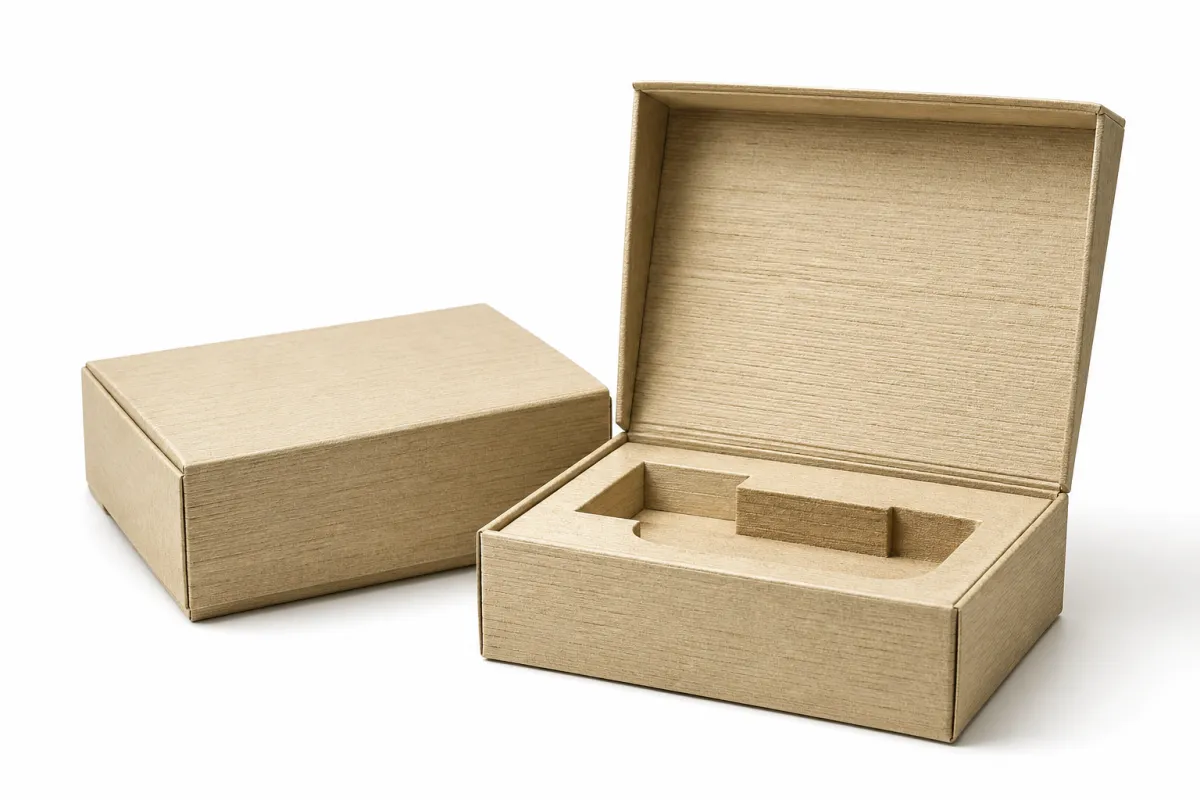
Custom bamboo fiber packaging is molded packaging made from bamboo pulp or bamboo-heavy fiber blends, usually shaped into trays, inserts, clamshells, and protective inner packs. Heat, vacuum, and pressure give the material its form, and once it dries, the part keeps that shape. The result can cradle a product, protect vulnerable edges, and present the item with more intent than a generic insert. It is the packaging equivalent of a tailored jacket instead of something grabbed off a clearance rack in Yiwu for $3.90. In practice, custom bamboo fiber packaging is often used as a premium inner component inside branded packaging systems rather than as a standalone showpiece.
Buyers often underestimate the material because the raw slurry or wet part looks rough. Then the dried piece lands on the table and reads as premium. One of my favorite factory-floor moments happened in Xiamen, Fujian: a molded tray looked almost stone-like as it came off the press, then turned out to be feather-light when I picked it up and checked it against a 112-gram glass bottle. I laughed, because I had mentally filed it under "probably okay," and it immediately proved me wrong. That is the point. Custom bamboo fiber packaging can look dense without adding much weight, which is one reason it works so well for fiber trays and compact retail inserts.
Its strengths are easy to see. It gives the unboxing moment a cleaner feel, it can improve shelf presentation for certain product packaging formats, and it brings a more natural finish than glossy plastic. For branded packaging, especially in skincare, candles, earbuds, and gift sets, that matte fiber texture does a lot of work. In one Ningbo project, a bamboo fiber insert replaced a PET tray and a printed spacer card at the same time, cutting two components and 11 grams of plastic from the pack. Less clutter, better feel, fewer pieces to argue about in a meeting. That is especially true when the line between product packaging and display packaging is already thin.
The limits matter just as much. Custom bamboo fiber packaging is not a good fit for products that sit in wet environments, freeze, or collect condensation on a 14-hour air route. Heavy items and sharp corners also need careful geometry. A 280-gram glass jar and a 40-gram sachet should not share the same insert shape, and a 60 mm corner radius is not the same as a 6 mm shoulder. That sounds obvious, yet I still see requests for a universal tray every few months. Every time, I feel the same small sigh start in my chest. Material honesty matters more than wishful packaging design.
Most buyers choose custom bamboo fiber packaging because they want the package design to signal something specific: natural, premium, restrained, clean, or thoughtfully made. That signal can help. It can also become expensive theater if the rest of the pack is sloppy. If the carton rattles, the lid bulges, or the insert arrives warped after a 3,000-kilometer truck leg from Guangzhou to Chengdu, the story falls apart quickly. Packaging has a brutal honesty to it. It tells on everybody.
One more point. Suppliers do not all use the same fiber blend. Some rely mostly on bamboo, while others mix in bagasse, wood pulp, or recycled paper pulp to reach a target texture, density, or price. So when someone says they offer custom bamboo fiber packaging, I ask for the material spec, the mold photos, and the test samples. Words are cheap. Samples are where the truth shows up. I would trust a 30-second sample check over a 30-slide pitch deck any day, especially if the supplier is quoting from Dongguan or Quanzhou and promising a 10-day turnaround.
How Custom Bamboo Fiber Packaging Is Made
The manufacturing path for custom bamboo fiber packaging is straightforward on paper and full of traps in real life. Fiber prep comes first. Bamboo pulp or a bamboo blend gets mixed with water and turned into a slurry at roughly 3 to 5 percent solids. The slurry is then pulled into a mold with vacuum or pressure, dried under controlled heat, trimmed, sometimes pressed again for a smoother face, and finally checked for size, surface quality, and fit. If it sounds simple, that is because the hard parts hide in the details. This is where molded fiber packaging earns its keep: the process is familiar, but the precision is not.
The mold controls most of the result. Wall thickness, corner strength, insert fit, logo embossing, and surface texture all start there. I learned that the hard way during a supplier negotiation in Shenzhen, when a client wanted a very shallow 0.9 mm wall and a crisp embossed logo for a 24 ml eye cream jar. The first sample looked fine from three feet away and failed the product fit test by 2 mm at the neck ring. We adjusted the mold, added a little depth, and saved the project. Vague briefs are cheap for suppliers and expensive for buyers. Sometimes painfully so, especially when custom bamboo fiber packaging is meant to hold a high-value SKU.
Most custom bamboo fiber packaging projects move through a sequence like this:
- Brief and dimensional input
- Quote review
- Drawing or 3D layout
- Prototype or soft sample
- Revisions
- Production mold
- Pilot run
- Full production
- Final inspection and packing
A few finishing choices change the feel a lot. Smooth pressing reduces some of the raw fiber texture. Light polishing tightens the surface and makes it cleaner for retail packaging. Embossing or debossing adds logo detail without ink. Some suppliers also apply selective coatings when extra moisture resistance is needed, though coating should not be treated like a cure-all. A water-based dispersion can lift the humidity tolerance a bit, but it does not turn the part into a waterproof shell. I say this because people keep hoping for magic, and packaging refuses to cooperate with wishful thinking. If you need biodegradable packaging claims, the finishing stack becomes even more important.
For brands building package branding around a natural material story, the approval path matters more than they expect. I usually recommend a brief, a line drawing with exact dimensions, a prototype, one revision round, and a pilot run before full production. If a vendor wants to jump straight into mass production after a 15-minute call, that is not speed. That is someone avoiding responsibility while trying to sound efficient. In Foshan, where I once reviewed a 4-cavity tool on a Thursday afternoon, the cleanest launches all had one thing in common: no one skipped the prototype.
In real packaging design work, tiny decisions change the result. A corner radius that looks harmless on a CAD file can create stress marks on the mold. A 1.5 mm tolerance may be acceptable for one product and a disaster for another. If you want custom bamboo fiber packaging to perform, the item, the route, and the carton all need to be part of the design, not just the mood board. A lot of brands build a beautiful idea and forget they still have to ship the thing 8,000 miles and stack it 6 high on a pallet. I have seen more than one good concept unravel because the outer box was sized for the render, not the freight lane.
How Much Does Custom Bamboo Fiber Packaging Cost?
Pricing for custom bamboo fiber packaging starts with tooling. A basic custom mold may begin around $300 to $1,500, depending on size, detail, and how many cavities the supplier builds into the tool. A single-cavity insert for a 50 ml bottle is usually cheaper than a 4-cavity tray for a skincare set with a lid recess and finger notch. Intricate geometry, deeper logos, and tighter fit requirements push the mold cost higher. That is normal. Good tooling is not cheap, and cheap tooling is only cheap once. After that, it starts collecting interest like a bad credit card.
Unit price depends on a blunt set of factors: size, wall thickness, quantity, finish quality, print complexity, and whether the part needs a product-specific fit. A simple insert at 10,000 pieces might land around $0.18 to $0.35 per unit. A more finished tray with embossing, tighter tolerances, or a smoother face could sit around $0.32 to $0.68. At 5,000 pieces, I have seen a clean, single-color insert quoted at $0.15 per unit and a more refined piece with a tighter neck pocket closer to $0.29. Small runs do not use the same math. Setup costs spread across fewer units, and the price per piece climbs fast. That is not supplier greed; it is just arithmetic wearing a hard hat. For custom bamboo fiber packaging, the sweet spot often depends as much on quantity as on design complexity.
At one client meeting, I watched a buyer ask for a super-premium feel on a 2,000-piece order and then react as if the quote had appeared out of nowhere. I gave him the same answer I give everyone: custom bamboo fiber packaging can be worth the spend, but it is not automatically the cheapest path. It wins on presentation, feel, and certain branding goals. It loses when the only target is the lowest possible landed cost. Trying to force both outcomes usually ends with someone rubbing their temples in a conference room in Guangzhou at 7:15 p.m.
Freight matters more than most people expect. A bulky part can look inexpensive per unit and still become irritating once carton count and shipping volume show up. If the design nests poorly, carton efficiency collapses. If the insert is tall, you are paying for air. I have seen a project with a reasonable $0.27 unit price turn messy because the cartons used 38 percent more cubic volume than the original foam insert, and the ocean freight from Shenzhen to Long Beach jumped by $620 on a 12-carton shipment. The unit price held. The freight bill did not. That is the sort of surprise nobody frames and hangs on the wall.
| Option | Typical Tooling | Unit Price at Mid Volume | Best For | Main Tradeoff |
|---|---|---|---|---|
| Custom bamboo fiber packaging | $300 to $1,500+ | $0.18 to $0.68 | Premium inserts, retail packaging, branded packaging | Higher setup and freight sensitivity |
| Molded paper pulp | $250 to $1,200+ | $0.12 to $0.55 | Cost-focused product packaging | Less refined surface and feel |
| Plastic tray | $800 to $3,000+ | $0.10 to $0.40 | High-volume protection, moisture resistance | Weaker sustainability story and weaker package branding |
When you read a quote for custom bamboo fiber packaging, look for separate lines for tooling, samples, production, QC, packaging, freight, duties, and any testing fees. A supplier who gives you one total number with no breakdown is not handing over a quote. That is a guess with a logo on it. I prefer vendors who show the math because the numbers reveal where the money is actually going. They also reveal who is hoping you will not ask follow-up questions, which is useful information if your production is in Dongguan and your buyer is sitting in London.
If you are comparing against Custom Printed Boxes or another structure, ask for landed cost, not just ex-factory price. A tray that looks cheaper on paper can become more expensive once it needs larger cartons, a 350gsm C1S artboard outer sleeve, extra wrap, or a pricier freight lane. That is especially true for custom bamboo fiber packaging, where the shape of the part affects how efficiently the units stack. Packaging math is boring right up until it eats the margin. The difference between a tidy carton and a wasteful carton is often the difference between a viable SKU and a product that quietly drains profit.
Custom Bamboo Fiber Packaging Process and Timeline
A realistic timeline for custom bamboo fiber packaging is usually longer than a buyer hopes and shorter than a panic email suggests. For a simple part, brief and quote review may take 2 to 5 days. Sample development often takes 10 to 14 business days. Production after proof approval commonly lands in the 12 to 15 business day range for a straightforward order of 5,000 to 8,000 pieces, and 18 to 35 business days for larger or more complex jobs. Then shipping starts, and the clock stops being polite. There is always a moment where everyone acts surprised by time, as if time has not been doing this the entire century. That is the part of custom bamboo fiber packaging that most launch calendars underestimate.
Delay points are predictable. Artwork approval drags. Sample revisions multiply. Tooling changes add a week here and another week there. Coating tests fail because someone wanted a glossy face on a naturally fibrous material. Holiday shutdowns hit, especially in southern China around Lunar New Year, and optimism does not reopen a closed line in Dongguan or Huizhou. That is not a bamboo problem. That is a planning problem. I wish I had a more glamorous explanation, but honestly, bad timing is just bad timing. The schedule usually breaks where the specs were vague.
I remember one negotiation in Guangzhou where a client wanted final approval on Friday and delivery the following Monday for 12,000 pieces of custom bamboo fiber packaging. I asked, very calmly, what shipping lane they had invented that could solve production, QC, and export paperwork in 72 hours. They did not love the question. They did, though, avoid a fantasy schedule and a promise they could not keep. Sometimes the best service is telling someone their calendar is fictional and their export form still needs a signature.
Here is the flow I recommend for most projects:
- Send exact dimensions, product weight, and photos of the item.
- Confirm whether the part needs to work with one SKU or a family of SKUs.
- Ask for a drawing and a prototype before you approve tooling.
- Test fit, drop behavior, and carton loading.
- Approve a pilot run before the full order.
Shipping changes the math. Sea freight from Shenzhen to Los Angeles or Rotterdam can add 18 to 32 days depending on the route and port congestion. Air freight is faster, but the unit economics can get ugly fast if the order is small. I have seen people save three weeks and spend three times the margin they wanted to protect. That trade rarely makes sense, especially for custom bamboo fiber packaging that already sits in a mid-tier cost band. Fast is nice. Financially chaotic is not.
For performance validation, I like to reference the ISTA testing framework for distribution risks and transit shock, especially if the packaging will travel by parcel or mixed freight. The standard does not make the package good on its own. It just keeps you honest about what happens between the warehouse in Dongguan and the customer’s hands in Berlin or Boston. Packaging has a habit of looking impressive right up until a truck hits a pothole or a sorter drops a carton from 1.2 meters.
One more practical point: timeline risk usually shrinks when specs are locked early. If the dimensions, finish, quantity, and shipping method are clear, custom bamboo fiber packaging moves smoothly. If those details keep changing, the project becomes a moving target. Suppliers hate moving targets. Warehouses hate them more. Buyers, understandably, hate being told their "quick update" just added ten days and a second proof round.
Key Specs to Lock Before You Order
If you want custom bamboo fiber packaging to work, lock the product dimensions first. Not approximate dimensions. Exact dimensions with a tolerance range. A tray that fits loosely is still a bad tray, no matter how polished the surface looks. I usually ask for width, depth, height, corner radius, and weight to the gram. That is not overkill. That is how a 1 mm mistake stops becoming a reorder. And yes, a 1 mm mistake can ruin a whole day, which is always more irritating than the number suggests. With custom bamboo fiber packaging, the margin for guesswork is thinner than the material itself.
Performance requirements come next. Does the part need drop protection from 80 cm? Does it need stack strength for 24 units per carton? Will it face humidity above 70 percent in a warehouse in Jakarta or humid summer conditions in Miami? Will it sit near heat during transport or storage? Does it touch food, cosmetics, or another regulated product? Ignore those questions, and custom bamboo fiber packaging gets judged on appearance alone, which is a poor way to spec anything that has to ship. A pretty tray that fails shipping is just expensive scenery.
I also want the finish level decided early. A raw-fiber surface feels honest and natural, but it may not suit every brand. A smoother press can elevate the look for premium product packaging. Embossing can support package branding without adding ink. If the marketing team wants a bright white face, I usually remind them that material honesty and a fake-perfect surface are not the same thing. That usually earns me one of those polite smiles that means "we will circle back," which in a meeting in Shanghai often means "we are not ready to decide yet."
Sustainability claims need discipline too. If you plan to talk about recycled content, compostability, or certified sourcing, ask the supplier for documentation. I like seeing FSC paperwork or chain-of-custody information when the claim matters. The FSC system is not a magic stamp, but it gives you a real paper trail instead of a sales pitch. I have also seen brands try to market a fuzzy environmental story with zero backup. That never ends well. Regulators, unlike marketers, do not appreciate creative writing, especially on cross-border shipments into the EU or California. If your plan is to describe the pack as biodegradable packaging, make sure the proof exists first.
Before you approve custom bamboo fiber packaging, make sure you have these items nailed down:
- Exact product dimensions and weight
- Target quantity and repeat-order expectation
- Finish level and color preference
- Need for logo embossing, debossing, or printing
- Transit conditions and freight method
- Compliance needs for food, cosmetics, or electronics
- Any drop, compression, or stack test requirement
One of the smartest buyers I worked with sent a one-page spec sheet listing every dimension, the carton size, the target MOQ, and the shipping route from Shenzhen to Vancouver. The quote came back fast, and the sample matched on the first pass. That is not luck. That is packaging discipline. The faster you make the job understandable, the cheaper the mistakes become. The boring prep work pays for the exciting part, which in this case is usually the finished tray and the product sitting exactly where it should. In other words, custom bamboo fiber packaging gets better when the brief stops being vague.
Do not forget the surrounding system. Custom bamboo fiber packaging does not live alone. It sits inside a master carton, inside a pallet, inside a freight route, inside a budget. If one of those layers is loose, the whole package starts costing more than it should. A 30-piece tray order can look elegant in the sample room and still fail if the master carton adds 11 kilograms to a pallet or if the outer sleeve uses the wrong board stock. The product is rarely just the product.
Common Mistakes With Custom Bamboo Fiber Packaging
The biggest mistake I see with custom bamboo fiber packaging is overclaiming what it can do. A buyer hears "bamboo" and immediately wants to describe it as compostable, recyclable, and eco-friendly in every jurisdiction without checking local rules or supplier documents. That is how brands get themselves into compliance trouble. Sustainability claims should be specific, supportable, and boring enough to survive legal review. If a claim sounds too shiny, it probably needs paperwork from the plant in Dongguan or the third-party lab in Shenzhen. The same caution applies to any sustainable packaging claim that moves across borders.
Another mistake is designing for looks only. A beautiful tray that fails a 1-meter drop test is not useful. A clean-looking insert that swells at 75 percent humidity is not useful either. I have watched teams approve something because it looked elegant on a render, then scramble after the first transit sample came back cracked in one corner after a 900-kilometer truck move. A 15-minute sample review would have saved them two weeks and a lot of embarrassment. It also would have saved a few defensive emails, which are never a joy to read at 9:40 p.m.
Skipping samples is where low-volume buyers get burned. They see a quote, approve the mold, and jump straight to mass production because they want to move fast. Then the fit is off by 3 mm, the emboss depth is too shallow, or the tray marks the product surface. Custom bamboo fiber packaging is still a molded part. It deserves sampling. That is not optional. The urge to skip it usually comes from optimism, and optimism is a lovely quality until it reaches tooling and a $780 mold invoice. I would rather lose a day to a prototype than lose a production run to a bad assumption.
Freight dimensions are another silent killer. A design that nests badly can wreck margin faster than a weak unit quote. I once reviewed a project where the part price looked decent, but the carton count jumped from 14 to 22 because the tray profile was too tall. The buyer thought the supplier had inflated the freight. No. The design had inflated the box. Same pain, different cause. Packaging can be very dramatic in the most expensive way possible, especially on a 20-foot container leaving Ningbo. That is why custom bamboo fiber packaging must be judged as a system, not a sample.
You also cannot assume every supplier works to the same blend, mold tolerance, or finish standard. One plant may dry the part to a tighter moisture spec. Another may rely on a looser process and leave more surface variation. That matters for custom bamboo fiber packaging, especially if you are pairing it with premium retail packaging or a lid that needs a consistent fit. Two trays can look related and still behave like distant cousins at inspection, one from Foshan and one from Xiamen, both insisting they are "within normal range."
Here are the most common traps I warn clients about:
- Claiming compostability without the right paperwork
- Choosing a finish that looks good but fails in transit
- Skipping prototype approval to save one week
- Ignoring carton size and freight volume
- Assuming all suppliers use the same blend or press method
Most failures with custom bamboo fiber packaging come from bad process, not bad material. The material has limits. Fine. Every material does. The real problem is usually a fuzzy brief, a rushed approval, or a buyer who wanted the green story without the ugly details that make the story real. Sourcing has a way of punishing shortcuts with interest, and the interest rate is usually paid in time, freight, and rework. That is the hidden cost behind many packaging mistakes.
Expert Tips and Next Steps for Custom Bamboo Fiber Packaging
If I were starting a new custom bamboo fiber packaging project today, I would begin with one hero SKU and one shared insert platform. That keeps the mold count under control and gives you a cleaner cost structure. Brands often want an entire family of shapes on day one. I understand the impulse. It feels organized. It also multiplies tooling and testing before you know whether the first structure works. I have seen that movie, and the sequel usually involves spreadsheets, extra samples, and a second payment to the mold shop in Jiangsu. A simple starting point is often the best way to keep custom bamboo fiber packaging from becoming a budget sink.
I also recommend getting samples from at least two suppliers. Not just for price. For discipline. Compare fit, finish, speed, quote detail, and how each vendor handles questions. One supplier may be strong at selling. Another may be stronger at manufacturing. You want the second one. The first can cost you months. A charming sales pitch is nice; a part that actually fits on the first try is nicer, especially when you are trying to launch 8,000 units in under three weeks. That kind of comparison is especially useful when you are choosing between custom bamboo fiber packaging and molded paper pulp.
Ask direct questions about mold ownership and retooling policy. If you pay for the mold, who owns it? If the shape needs a tweak later, what does that cost? Can the supplier keep repeat orders consistent, or do they drift shape after three runs? Those are boring questions. Boring questions save money. That is why I like them. I also like them because they keep everyone a little more honest, which matters when the quote includes a $560 tooling line and a promise of 12-day sampling.
I spent one afternoon at a supplier’s table in Shenzhen with a buyer who wanted a clean answer on repeatability for custom bamboo fiber packaging. The supplier admitted that the second run would probably differ a little unless we locked the drying time and the trim spec to within 5 minutes and 0.2 mm. That honesty mattered more than a polished pitch. I would rather hear a risk early than find it after 50,000 units are sitting in a warehouse in Savannah or Hamburg. Nothing makes people inventive like a warehouse full of problems they did not budget for.
Build a one-page spec sheet and send it to suppliers. Keep it plain. Include dimensions, target quantity, finish expectations, shipping method, and compliance needs. If you want to compare against other Custom Packaging Products, put those notes on the same sheet so you can judge landed cost and fit side by side. Clear inputs get clearer quotes. Clear quotes lead to better decisions. It is almost boring how often that works, especially when the spec includes the exact product weight, the carton count, and the target release date.
For buyers who want a better sourcing conversation, these questions help:
- What exact fiber blend are you using?
- What is the mold fee, and who owns the tool?
- What is the sample timeline after drawing approval?
- What tests have you run on similar products?
- How will you pack the units to protect the finish?
If you are building branded Packaging for Cosmetics, gifts, electronics, or premium retail packaging, custom bamboo fiber packaging can be a smart move. If your product is heavy, wet, or highly price-sensitive, it may not be the right answer. That is fine. I would rather tell you no than help you buy a beautiful problem. There are enough beautiful problems already in the world, and most of them already have a freight quote attached. Sometimes the smartest packaging decision is to choose a simpler structure and keep the budget where it matters.
The next step is simple and practical: send a clean spec sheet, request a sample, compare at least two quotes, and check whether the landed cost fits the budget before you approve tooling. If the numbers work, custom bamboo fiber packaging can do serious work for product presentation and package branding. If they do not, you have saved yourself from a fancy mistake. That is the real win, and it usually shows up later as fewer revisions, cleaner freight math, and a launch that does not wobble the week before it ships.
FAQ
How much does custom bamboo fiber packaging usually cost?
Expect a one-time mold or tooling fee, often starting around $300 and rising into the low thousands depending on complexity and cavity count. For custom bamboo fiber packaging, unit price depends on size, thickness, finish, and order volume; a 5,000-piece run might land near $0.15 per unit for a simple insert, while a more detailed tray can move closer to $0.29. Do not forget freight, cartons, testing, and samples, because those extras can change the real landed cost fast. The quote on the screen is rarely the whole story.
How long does custom bamboo fiber packaging take to produce?
A typical sample-and-tooling phase can take 10 to 14 business days if the design is simple and revisions stay limited. Production after proof approval often lands around 12 to 15 business days for a straightforward order, though larger or more complex jobs can stretch to 18 to 35 business days. Shipping can add several more weeks depending on the route from Shenzhen, Ningbo, or Xiamen. Timeline slips usually come from design changes, not the material itself, so lock specs early when you order custom bamboo fiber packaging. The more you wobble, the slower it gets.
Can custom bamboo fiber packaging be printed or embossed?
Yes, though the level of detail depends on the mold quality and surface finish you choose. Embossing and debossing are usually more reliable than tiny full-color graphics on rough surfaces, and a 350gsm C1S artboard sleeve can carry color if you need a stronger retail-facing panel. If branding is critical, ask for a sample before committing, because decorative ideas can look very different once molded into custom bamboo fiber packaging. I have seen elegant logos turn into mildly confused shapes, which is not ideal for a premium launch.
Is custom bamboo fiber packaging food safe?
It can be, but only if the supplier provides the right material and compliance documentation for the specific use case. Ask about coatings, additives, and food-contact testing before you assume a tray is safe for direct contact. Never rely on a generic sustainability claim when your product will touch food, cosmetics, or anything regulated, even if the part is made as custom bamboo fiber packaging. Paperwork first, vibes second, especially if the shipment is crossing from Guangdong to California.
Is custom bamboo fiber packaging better than molded paper pulp?
Bamboo fiber often feels denser, finer, and more premium, which can matter a lot for brand perception. Molded paper pulp may be cheaper or easier to source in some cases, so the better choice depends on budget, MOQ, and finish goals. Compare both on protection, appearance, and landed cost before you assume custom bamboo fiber packaging is automatically the winner. The right answer depends on what you are trying to protect and what story you want the box to tell, whether the order is 3,000 pieces or 30,000.

