Buyer Fit Snapshot
| Best fit | wholesale custom packaging for crafts faster for packaging buyers comparing material specs, print proof, MOQ, unit cost, freight, and repeat-order risk where brand print, material, artwork control, and repeat-order consistency matter. |
|---|---|
| Quote inputs | Share finished size, material target, print colors, finish, packing count, annual reorder estimate, and delivery region. |
| Proofing check | Approve dieline scale, logo placement, barcode or warning zones, color tolerance, and any recyclable or compostable wording before bulk production. |
| Main risk | Vague material claims, crowded artwork, or missing packing details can create delays even when the unit price looks attractive. |
Fast answer: Wholesale Custom Packaging for Crafts Faster: MOQ, Samples, Lead Time, and Quote Checks should be specified like a repeatable production item. The safest quote includes material, print method, finish, artwork proof, carton packing, and reorder notes in one written spec.
What to confirm before approving the packaging proof
Check the product dimensions against the actual filled item, not only the sales mockup. Ask for tolerance on folds, seals, hang holes, label areas, and retail display edges. If the package carries a logo, QR code, warning copy, or legal claim, reserve that space before decorative graphics fill the panel.
How to compare quotes without losing quality
Compare board or film grade, print process, finish, sampling route, tooling charges, carton quantity, and freight assumptions side by side. A lower quote is only useful if the supplier can repeat the same color, closure quality, and packing count on the next order.
Wholesale Custom Packaging for Crafts That Sells Faster
Wholesale Custom Packaging for crafts sounds tidy until a candle, soap bar, resin ornament, stitched bookmark, or small ceramic trinket has to survive a 24-inch drop, sit on a boutique shelf for six weeks, and still look like it belongs to a brand with momentum. I remember a maker in Asheville, North Carolina, telling me with complete confidence that the product was "basically indestructible." The first shipment arrived with two cracked lids, one dented corner, and a mailer that looked like it had been sat on by a very tired forklift in a warehouse outside Dallas. I have watched makers spend $18 on the product and only $0.12 on the package, then wonder why the first impression feels thin. The box is the handshake, the shipping buffer, and the opening argument all at once. Buy the right package and you get fewer transit losses, a cleaner unboxing, and a presentation system that makes a small craft line feel established without pretending to be something it is not.
The strongest orders usually start with practical questions, not mood boards, though I do enjoy a good one when someone has taped in six different fonts and insists they are all equally calm. How heavy is the item? How fragile are the corners? Does the customer open it as a gift, or receive it as a parcel in 2 to 5 business days? Those details matter more than a glossy render because Wholesale Custom Packaging for crafts has to work in a studio in Portland, Oregon, in a fulfillment room in Charlotte, North Carolina, and on a store fixture with a 10-inch shelf depth in Chicago, Illinois. I still remember a soap maker in Lancaster, Pennsylvania, whose bars were wrapped beautifully in paper, yet the shipping carton was a plain mailer with a crooked label. Once we moved her into a printed folding carton with a snug insert, the line looked finished, and the product started selling that way. That is not magic. That is packaging doing its job.
Too many brands treat packaging as decoration. That mistake costs money, often in two places at once: damaged goods and slower packing. Wholesale custom Packaging for Crafts should protect the item, speed up packing at the bench, and keep the brand story consistent across pop-ups, Etsy orders, and wholesale accounts. Whether you are ordering 500, 5,000, or 25,000 units, the box, sleeve, or mailer needs to earn its place by reducing damage, reducing labor, or lifting perceived value in a way customers can actually feel. A simple one-color kraft sleeve can land near $0.15 per unit at 5,000 pieces, while a rigid gift box with an insert can sit closer to $1.40 per unit at 3,000 pieces. That is the business case, and it is the one worth using when you are deciding between Custom Printed Boxes, mailers, and gift-ready rigid packaging. I see a lot of craft brands get tripped up here: they buy for the photo, then live with the package for every single order after that.
When the package is right, the item inside feels more giftable and more trustworthy before the customer even touches it. Wholesale custom packaging for crafts can do that without turning the job into a pile of unnecessary add-ons. I prefer simple systems: one structure, one print system, one clear insert strategy, and one repeatable reorder path. Craft brands that restock every 30 or 45 days usually benefit more from that kind of discipline than from overbuilt branding that has to be relearned every season. In Dongguan and Shenzhen, Guangdong, I have seen production lines keep the same dieline for 9 to 12 months, then swap only the artwork for holiday, spring, and summer runs. That keeps cost down and color consistent. I have also seen a beautifully "creative" packaging setup that required three kinds of tape, a paper belly band, a sticker, and a tiny prayer. It was charming for exactly one afternoon.
Think of wholesale custom packaging for crafts as a match between product, route, and price point. A soy candle sold at $24 needs a different box than a resin coaster set sold at $68, and a soap gift trio needs a different structure than a single bar shipped in a padded mailer. I have seen a lot of waste come from forcing one oversized carton across three distinct products. The smarter move is usually a small family of sizes, each one tailored to the item instead of asking the item to compensate for the box. A packaging strategy that ignores fit tends to charge you twice: once at purchase and again in damaged goods. In practical terms, a box that is 8 mm too wide can raise void-fill use by 15% to 20%, which is a strange way to save nothing.
"We thought the product was doing all the selling," one client told me after a busy holiday market in Atlanta, Georgia, "but the package was what got people to pick it up." That line stayed with me because it was true in the aisle, true in the shipping room, and true again when the same brand landed in three boutiques with 18-inch shelves and bright LED lighting.
Wholesale Custom Packaging for Crafts: Why the Box Sells the Craft
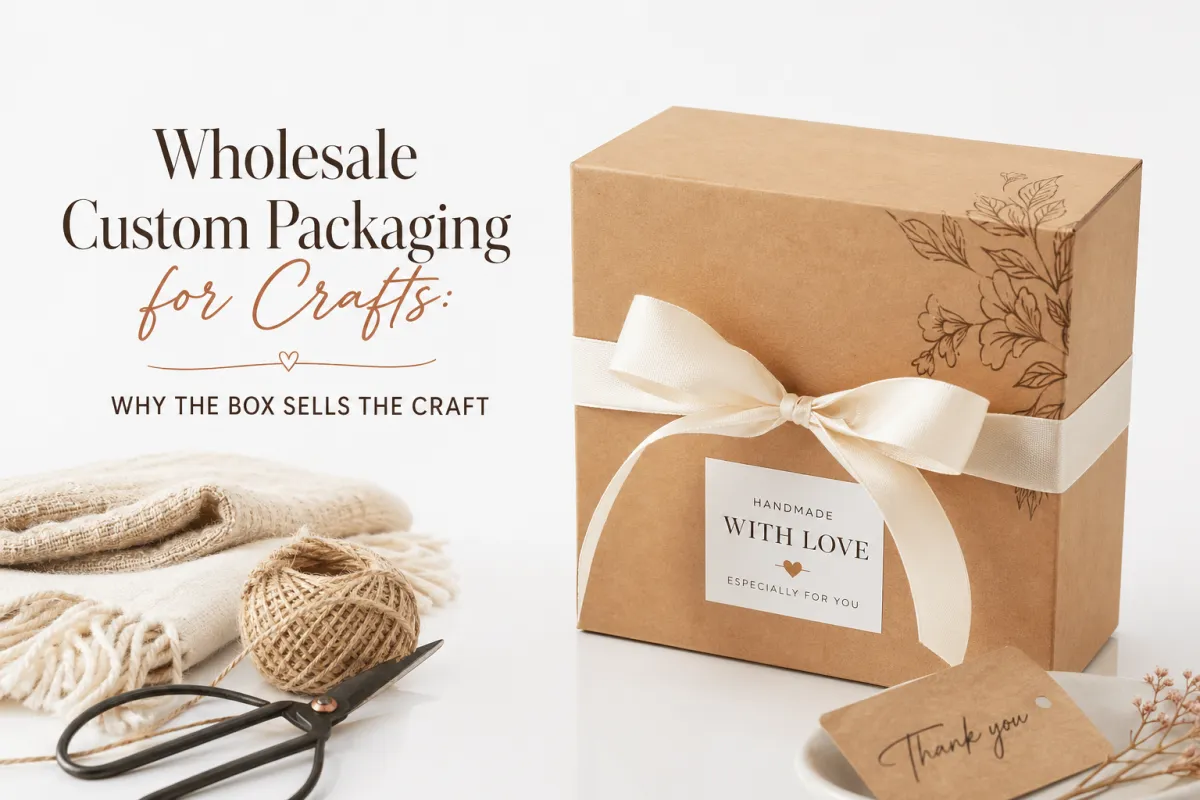
At a folding-carton plant in Pennsylvania, I watched a candle maker compare two samples that were identical in size. One had a crisp printed sleeve, the other a plain kraft shipper with a sticker. The candle inside was the same 8-ounce tin, yet the better package made the line feel more established because the print, fit, and closure worked together instead of fighting each other. That is the reason wholesale custom packaging for crafts matters. Buyers decide on shelf readiness in about three seconds, and the box is usually the first thing they see, touch, and remember. Three seconds is not much time, which is exactly why the first visual impression has to be doing heavy lifting.
Wholesale custom packaging for crafts also helps a small product line look giftable without creating more work on the packing bench. A soap trio, a set of watercolor pencils, or a handmade ornament should feel intentional, not improvised. In practical terms, that means clean edges, consistent logo placement, and a structure that opens without requiring effort from the customer. I have watched a 2 mm shift in logo position make a carton feel sharper simply because the front panel finally looked balanced at arm's length. That tiny adjustment changed the whole read. Packaging is weird like that: sometimes a millimeter matters more than a slogan, especially on a 120 mm x 80 mm face.
Protection is part of the equation too. A well-built box keeps loose pieces from rattling, protects sharp corners, and lowers the odds of returns from crushed lids or cracked jars. Once a craft order starts moving through parcel sorting in Louisville, Kentucky, or a regional hub near Columbus, Ohio, the package has to absorb vibration, compression, and stacking pressure. That is not branding language; it is physics. Wholesale custom packaging for crafts should therefore be judged by the transit path first and the shelf photo second, especially if the product includes glass, plaster, ceramic, or layered components. If the package fails in transit, the customer never reaches the pretty part.
Brand consistency is easy to underestimate. Wholesale custom packaging for crafts allows a maker to carry the same visual language from a weekend market table to a wholesale account with 40 units on the shelf. That consistency can come from a 1-color kraft print, a two-color SBS carton, or a matte-laminated sleeve with a foil accent, but it should be deliberate. I have seen brands raise their perceived polish simply by keeping the same typeface, logo lockup, and board color across three product families. It is not glamorous work, but neither is repacking 300 units because the first run looked like three different companies had argued over the art file. A consistent 350gsm C1S artboard across the line can solve more of that than a new slogan ever will.
The strongest packaging usually does its job without making a speech. Wholesale custom packaging for crafts should feel obvious in the hand, with a closure that stays shut, a print finish that resists scuffing, and an opening experience that does not force the customer to hunt for a box cutter. If a package saves 20 seconds during packing and arrives with fewer dents, it is performing real work, not vanity work. That is the standard I trust, and it is the standard most craft brands can afford if they build the structure around the product instead of forcing the product around the structure. In a run of 5,000 units, even a 12-second packing gain per box can free up more than 16 labor hours.
How do you choose wholesale custom packaging for crafts?
Start with the item, then work outward. For wholesale custom packaging for crafts, the first questions are always dimensions, weight, fragility, and sales channel. A candle going direct to a customer needs different protection than the same candle sitting in a boutique display, and a soap set that ships in bulk does not need the same structure as a gift-ready trio on a holiday endcap. I like to think of the decision as a triangle: protection, presentation, and production speed. If one side is too weak, the whole package starts wobbling.
The fastest way to narrow the choice is to sort by use case. If the product ships often, a mailer or corrugated shipper usually wins. If the product sits on a shelf, a folding carton or sleeve may be better. If the product is premium, fragile, or meant to feel collectible, rigid gift boxes can make sense even at a higher unit cost. Wholesale custom packaging for crafts works best when the format follows the product, not the other way around. The box should fit the object, the route, and the budget in the same conversation.
I also tell buyers to think about packing labor. A package that takes an extra 30 seconds to assemble can erase the savings from a cheaper print run. Wholesale custom packaging for crafts should be simple enough that a small team can repeat the process without mistakes, especially during peak season. One insert, one closure style, one label location, and one clear reorder path are usually enough to keep the whole system honest. If the package needs a training manual, it is probably doing too much.
There is a practical way to pressure-test choices before you commit. Put the product in the box, close it, shake it gently, and imagine the carton riding through a conveyor lane, then a delivery van, then a front porch in bad weather. That sounds a little plain, but it saves money. The right packaging is rarely the fanciest-looking sample on the table; it is the one that survives the trip and still looks like your brand when the customer lifts the lid.
Packaging Formats That Fit Craft Products
The right format depends on the item, the weight, and how much movement happens inside the carton. Wholesale custom packaging for crafts usually starts with a short list of structures that already solve a lot of problems: mailer Boxes for Shipping, tuck-end cartons for retail display, sleeves for flexible branding, rigid gift boxes for premium presentation, inserts for movement control, wraps for simple outer branding, and corrugated shippers for the final mile. Seven formats can cover a surprising number of craft categories if the dimensions are chosen with care. I like that because it keeps the workflow sane. Craft businesses do not need twenty packaging types. Most need four or five good ones and a supplier who can keep them consistent from a factory floor in Guangzhou to a reorder six months later.
- Mailer boxes for candles, bath bombs, kits, and subscription sets that need a shipping-first structure.
- Tuck-end cartons for soap bars, stationery, small home-decor items, and retail-ready products with a defined front panel.
- Sleeve packs for bundles, seasonal sets, and reusable inner trays that need flexible branding.
- Rigid gift boxes for jewelry, ornaments, and high-value crafts that should feel premium from the first glance.
- Corrugated cartons for heavier or more fragile items that need stacking strength and transit protection.
For candles, I usually compare a folding carton with a mailer that includes a paperboard insert, then choose based on whether the order is retail or ship-direct. Soap tends to work well in a tuck-end carton with a coated or uncoated finish that keeps unit cost under control. Resin pieces, ceramics, and glass jars need more attention. If the product can move more than 3 mm inside the box, the fit is too loose. Wholesale custom packaging for crafts should not rely on the customer to tolerate movement after the fact. Loose fit is one of those little sins that turns into expensive bad reviews later, and a 4-star review with "box was too big" can follow the product for months.
Jewelry and ornaments often perform better in rigid boxes or small folding cartons with a fitted cavity because presentation matters as much as protection. Stationery kits, punch needle bundles, and paint sets usually fit neatly into a sleeve-over-tray format, where the outer layer carries the package branding and the inner tray keeps the contents organized. I have seen one craft studio sell the same $14 notebook set in three different structures, and the rigid box version consistently won because it felt like a gift instead of a supply item. People really do judge the experience before they judge the product, and in retail that is not shallow; it is normal. A 90 mm square ornament box can feel luxurious if the lid lift is crisp and the board is 2 mm rigid, not 1.2 mm flimsy chipboard.
A practical strategy is to keep one print system across several SKUs while changing only the size. That makes wholesale custom packaging for crafts easier to reorder and lowers art changes when a seasonal collection or colorway update rolls out. A family of 3 or 4 carton sizes can share the same logo placement, the same 4-color art file, and the same coating choice, which helps the line feel unified on a shelf. It is a simpler way to scale than redesigning the entire package for every item. Simpler is usually better. "Creative chaos" sounds cute until someone has to produce the thing on a deadline in Yiwu, Zhejiang, or manage freight for a holiday launch in November.
If you want a quick way to compare structures by product type, our Custom Packaging Products page is a useful place to review box styles before requesting a quote. The key is matching the structure to the item, not forcing a visually attractive box onto a product that needs compression resistance or a deeper cavity. Wholesale custom packaging for crafts works best when the format is chosen for shipping behavior, shelf behavior, and packing speed all at once. A beautiful box that slows packing is not a win. It is just an expensive delay, especially when a team is packing 250 units before a Saturday market.
Materials, Print Specs, and Structural Details
Material choice drives both the look and the performance of wholesale custom packaging for crafts. SBS paperboard gives you sharp print and smooth color coverage, kraft board gives you a natural and earthy feel, corrugated board adds shipping strength, and rigid board creates a premium gift experience with more body in the hand. I have quoted jobs on 18pt SBS, 24pt SBS, 350gsm C1S artboard, E-flute corrugated, and 2 mm rigid board, and the board often tells me more about final cost than the artwork does. Weight, stiffness, and finish matter more than most first-time buyers expect. A box is not just a surface. It is a structure with opinions.
Print decisions carry just as much weight. CMYK handles full-color artwork, spot colors help when a brand must keep a very specific PMS tone, and foil adds a clear accent without covering the entire panel. Matte lamination gives a softer boutique feel, while gloss can help darker art pop under retail lighting. For wholesale custom packaging for crafts, I usually recommend a protective coating or lamination whenever the box will be handled often, because hand oils and scuff marks show up quickly on unprotected surfaces. I have seen a gorgeous dark navy carton look tired after one trade show day in Philadelphia. It was heartbreaking, and slightly annoying, which is probably the most honest way to describe it.
Structural details are where many projects succeed or fail. Board caliper, glue flap width, tuck depth, insert fit, and die-cut tolerance all affect whether the box feels tight or sloppy. A product weighing 10 ounces should not use the same carton spec as a 2-ounce item, and if a jar has a glass lid, the insert should capture the shoulder, not just the base. Wholesale custom packaging for crafts has to respect weight, fragility, and movement, or the print work never gets a fair chance to perform. You can spend a fortune on artwork, but if the structure is wrong, the package still feels wrong. A 1.5 mm shift in an insert can change how a lid closes, and that is enough to matter.
Artwork readiness
Before production starts, I like to see the artwork file, the dieline, the bleed, and the safe zone all locked down. A clean setup usually means 0.125 inch bleed, a safe margin of at least 0.125 inch, and vector logo files whenever possible so the edges stay crisp at print scale. A low-resolution PNG can still work sometimes, but the result may not match the clarity that wholesale custom packaging for crafts deserves. Tiny type and delicate line art are especially unforgiving. The press remembers everything, especially a 6-point ingredient note that was exported at 72 dpi.
I also check the measurements against the actual sample or prototype, because a 1.5 mm discrepancy can make a tuck flap feel too loose or a sleeve too tight. That is not theory. I watched it happen on a bracelet box run where the designer measured the product after padding was added, and the inner tray ended up binding on the corners. The correction was simple, but it cost two days and a second proof, which is why I treat measurement accuracy as part of the artwork process. I have a very low tolerance for avoidable rework. Probably because packaging errors always seem to appear at the exact moment everyone is already busy and the freight deadline is 48 hours away.
For sustainability claims, precision matters more than vague language. If you want recycled or responsibly sourced board, ask for the documentation and check the supply chain rather than trusting a broad label. The Forest Stewardship Council explains chain-of-custody requirements clearly at fsc.org, and that matters if your brand wants its material claims to hold up under scrutiny. Wholesale custom packaging for crafts can be eco-aware and still look polished, but the paperwork should match the printed message. Customers notice when a brand says "sustainable" but cannot explain what that means beyond a leafy icon and a hopeful caption. A 100% recycled liner is useful only if the spec sheet proves it.
Transit testing matters too. For parcel shipments, I often point clients to the standards and testing ideas described by the International Safe Transit Association, because a drop sequence or vibration test tells you more about real-world performance than a render ever will. Wholesale custom packaging for crafts that passes a basic transit-style sample is usually a better long-term purchase than a prettier package that collapses during the first week. A good spec is not just a drawing; it is a set of choices that survive handling. That is the part people skip, then regret when the first pallet arrives with corner crush or one side panel bowed by 3 mm.
Pricing, MOQ, and Wholesale Custom Packaging for Crafts
Pricing for wholesale custom packaging for crafts depends on quantity, board type, print coverage, finishing steps, and whether the job uses a standard dieline or a fully custom structure. A simple 1-color kraft mailer at 5,000 units may come in near $0.18 to $0.30 per unit, while a 4-color folding carton with matte lamination can land around $0.32 to $0.65 per unit, depending on size. Move into a rigid gift box with an insert and the number can climb to $1.25 to $2.80 per unit quickly. That spread surprises people the first time they see it. It should not, but it does. A 280 mm x 180 mm x 90 mm mailer costs a very different amount to print and ship than a 70 mm cube.
MOQ is not a punishment; it is a production reality. Tooling, setup, proofing, and material waste all get spread across the run, so a 500-piece job almost always carries a higher unit cost than a 5,000-piece job. For wholesale custom packaging for crafts, I tell buyers to think in bands: pilot runs for a new product, standard runs for an established SKU, and larger runs for seasonal volume or retail expansion. That approach is usually safer than chasing the lowest sticker price on a structure that does not fit the product. A cheaper box that damages product is not cheap. It is just delayed expense, plus the cost of replacement units and extra customer service time.
Here is a simple comparison I use with buyers who want a practical starting point.
| Packaging Option | Typical Craft Use | Estimated Unit Price | Best Advantage |
|---|---|---|---|
| Budget folding carton | Soap bars, stationery, small kits | $0.15-$0.32 at 5,000 pcs | Low cost with sharp print |
| Mid-range mailer box | Candles, bundles, subscription orders | $0.38-$0.75 at 5,000 pcs | Shipping strength and branding space |
| Premium rigid gift box | Jewelry, ornaments, premium sets | $1.25-$2.80 at 3,000 pcs | High-end presentation and structure |
| Corrugated shipper with insert | Fragile glass, ceramics, mixed kits | $0.55-$1.10 at 5,000 pcs | Transit protection and load strength |
Those numbers are working ranges, not promises, because size, print coverage, and freight can move the final quote by a meaningful amount. I have seen a simple artwork change add $0.07 per unit because the client wanted a foil stamp, a spot UV patch, and a thicker board all in the same build. Wholesale custom packaging for crafts becomes much more efficient when the same artwork is reused across three product sizes or across a spring launch and a holiday launch, because the setup cost gets spread out and the brand looks consistent at the same time. If you are running a business on narrow margins, those little efficiencies are not little. They are oxygen, especially when a 5,000-piece reorder arrives just before peak season.
If you are comparing wholesale options, our Wholesale Programs page is useful for understanding how repeat ordering can reduce rework and simplify replenishment. I have negotiated with suppliers who could shave pennies off a carton by changing glue pattern or board grade, and those pennies mattered once the order hit 10,000 units. In one client meeting, we dropped the board from 24pt to 18pt on a lightweight soap line and saved enough to pay for matte coating, which gave the package a better hand feel without pushing the total budget higher. That was a very good day, mostly because nobody had to hear the phrase "we need to start over." It also showed how a 350gsm C1S artboard spec can outperform a heavier board when the product itself weighs only 4 ounces.
From Dieline to Delivery: Process and Timeline
The cleanest way to buy wholesale custom packaging for crafts is to follow a predictable sequence: quote request, product measurement, dieline selection, artwork setup, proof review, sample approval, production, and freight coordination. That sequence sounds basic, but it prevents the worst surprises. If the product dimensions are incomplete, the insert fit gets guessed; if the logo file is not clean, prepress spends extra time; and if the structure changes after proofing, your delivery date can move by a week or more. I wish I could say the mistakes are always dramatic. Most are not. Most are small and annoying, which is somehow worse when the order is already in motion.
A realistic timeline helps craft brands plan launches and seasonal restocks. A simple print-and-cut carton might move from proof approval to production in 12 to 15 business days, while a job with inserts, special finishes, or a custom die can run 18 to 28 business days before freight. Sampling usually adds 3 to 7 business days, depending on whether the sample is structural only or fully printed. Wholesale custom packaging for crafts should be scheduled with room for one revision cycle, because a last-minute artwork fix usually takes longer than the team expects. And if someone says, "we only need one tiny change," my experience says there are probably three more hiding nearby. Freight from South China to the U.S. West Coast can add 12 to 18 days by sea, which is why launch calendars need buffer time.
Delays usually show up in the same three places: measurements, artwork cleanup, and sample approval. I once had a resin kit order stall because the client measured the outer box with a filler sheet included, which made the carton 4 mm too short once the real insert was built. Another time, a jewelry brand sent raster logos at 150 dpi, and the tiny type softened just enough to bother them on the proof. These are small issues, but on wholesale custom packaging for crafts, small issues become schedule issues fast. Small mistakes are very efficient at becoming expensive, especially when the fix requires a second sample couriered from Shenzhen or Xiamen.
Shipping and receiving deserve attention too. A carton that arrives in a crushed master case is not ready for a launch photo, even if the box itself is perfect. I like to see cases labeled by SKU, packed with clear counts, and stored in a dry room away from high humidity, because board warp can turn a tight insert into a loose fit. Wholesale custom packaging for crafts should reach your studio ready to assemble, not ready for another round of sorting. I have opened boxes that looked like they had been through weather, a forklift, and a minor disagreement. Nobody wants that, especially when the first order is only 1,200 units and every carton has to count.
Why Custom Logo Things Is Built for Craft Brands
Custom Logo Things fits makers who need packaging to behave like a production tool, not a decorative accessory. The value sits in the details: custom sizing, guidance on board choice, repeat ordering that keeps color and structure stable, and practical recommendations for inserts or closures that match the product. Wholesale custom packaging for crafts should come from a partner who understands the difference between a pretty sample and a carton that can survive a market day in Nashville, a parcel sort in Indianapolis, and a store shelf in the same week. That difference matters more than people think, especially when the product line is small and every unit has to carry more weight.
That factory-side mindset matters because it prevents waste. I have seen brands spend money on a rigid box because it looked premium, only to find that a well-specified folding carton with an inner tray would have delivered the same visual effect at half the cost and one-third the weight. Wholesale custom packaging for crafts works best when someone asks the uncomfortable but useful questions: Does the product need a box, a sleeve, or a shipper? Does the insert stop movement? Can the same art serve two sizes? Those questions save real money. They also spare everyone the joyless experience of explaining why a "luxury" box costs more to ship than the item inside it. A 200-gram product should not be wrapped in 600 grams of unnecessary board if a lighter spec works.
We also keep quoting and file checks straightforward, which matters more than most people think. A clear quote should tell you board type, print method, finish, quantity, lead time, and any tooling cost in plain language. If a proof needs a logo vector, a tighter bleed, or a product weight update, that should be explained without guesswork. Wholesale custom packaging for crafts should not feel mysterious, because the buyer needs enough confidence to commit to 1,000 or 10,000 units without worrying about hidden corrections later. Hidden costs are a trust problem as much as a budget problem, and a $125 die charge is easier to accept when it appears before production instead of after the invoice.
In one Shenzhen facility visit, I watched a team adjust a paperboard insert by less than 2 mm because a set of handmade ceramic trinket dishes was rattling during a shake test. That tiny change stopped the movement, lowered the risk of chip damage, and kept the customer from adding foam. That is the kind of detail I want behind Wholesale Custom Packaging for Crafts: quiet, practical problem-solving that improves the result without inflating the design. The best packaging teams do not brag much. They just keep your product from becoming a cautionary tale, which is a better metric than an Instagram photo ever will be.
If your brand is still choosing between product families, start with a packaging structure your team can pack quickly, then refine the graphics. Wholesale custom packaging for crafts is strongest when the job is built around operational needs, not just the nicest mockup on the screen. That is how a candle line, a soap line, or a gift set line earns consistency, and consistency is what makes reordering easier for everyone involved. I am biased toward boring reliability here, and I do not think that is a flaw. A repeatable 15-second pack-out is better than a flashy box that takes 45 seconds to assemble.
Next Steps for Wholesale Custom Packaging for Crafts
The fastest way to move forward is to gather the facts before you ask for a quote: product dimensions, product weight, quantity, shipping method, and a few reference photos of the item in use. I always ask buyers to add one note about the goal, whether that is retail display, transit protection, or premium gifting, because wholesale custom packaging for crafts changes depending on which goal matters most. A box that works for a holiday market may not be the right one for parcel shipping, and a shipper that saves breakage may not be the one you want on a boutique shelf. The goal should drive the structure, not the other way around. If the item is 6 inches tall and 9 ounces, that fact should lead the spec.
Choose the packaging job by job. Sometimes the right answer is one structure for shipping and another for retail display; sometimes one unified system can serve both if the insert and print layout are planned properly. I have seen makers save money by using the same exterior print on a mailer and a retail sleeve, then changing only the internal fit. Wholesale custom packaging for crafts rewards that kind of modular thinking because it keeps the line flexible without making the brand feel patched together. It also keeps your sanity intact, which is underrated in production planning. A three-part system with two shared panels is often easier to reorder than a new structure for every SKU.
A sample or prototype is worth the time, especially if the product is fragile, irregularly shaped, or sold as a gift set. I would rather catch a 3 mm fit issue in a sample than hear about a cracked lid after 800 units are already packed. That is not caution for its own sake; it is cheaper to correct a carton before production. Wholesale custom packaging for crafts should always include one honest test, even if the final design looks finished on the screen. I have yet to meet a customer who enjoys paying for avoidable mistakes twice, and I have yet to meet a warehouse manager who enjoys discovering them at 7:00 a.m.
Before you place the order, confirm the first proof, compare the specs, and make sure the price aligns with the material and finish you actually want. If you need a starting point, review the dimensions, ask for a sample, and compare options side by side until the structure feels right in the hand. Wholesale custom packaging for crafts works best when you buy with the product in front of you and the transit path in mind, not just a mood board. That is the approach I trust, and it is the one that keeps orders moving without avoidable surprises. It also keeps me from getting a late-night message that starts with, "quick question..." which is rarely quick and almost never about something small.
What is the best wholesale custom packaging for crafts with fragile items?
For fragile items, I usually start with a corrugated mailer, a rigid box, or a carton with a fitted insert that holds the product at two points instead of one. Board strength should be chosen around the product weight, brittleness, and shipping method, not just appearance, and a basic drop-style sample is worth the extra day because a 30-inch corner drop can reveal a weak closure fast. Wholesale custom packaging for crafts should protect corners first and look good second. If the item can chip, crack, or spill, protection is not optional. A ceramic ornament in a 2 mm rigid box needs a very different insert from a pressed soap bar in a 350gsm C1S carton.
How low can the MOQ be for wholesale custom packaging for crafts?
MOQ depends on the packaging style, the board material, the print method, and whether the design uses a standard dieline or a custom tool. Smaller runs are often possible for simple folding cartons or sleeves, while rigid packaging and specialty finishing usually need higher quantities to stay economical. If you are testing a new line, a pilot order of 500 to 1,000 units is often the smarter first move for wholesale custom packaging for crafts. I usually prefer a smaller run with better fit over a giant order of regret, especially when the first customer review can shape the next 200 sales.
How long does wholesale custom packaging for crafts usually take to produce?
Simple jobs can move from proof approval to production in about 12 to 15 business days, while projects with inserts, custom tooling, or special finishes can take 18 to 28 business days before freight. Sampling usually adds 3 to 7 business days, and shipping time can add another week depending on route and destination. I tell clients to build a cushion into the calendar because wholesale custom packaging for crafts should not be rushed against a craft fair date if the launch matters. Deadlines have a habit of becoming much stricter once the first pallet is late, and freight from South China to the U.S. can vary by 5 to 10 days.
Can I use one packaging system for several craft products?
Yes, if the products share similar dimensions or can be supported with interchangeable inserts. A family of sizes with the same print style reduces art costs and makes the product line look more consistent on a shelf, especially for candles, soaps, kits, and gift bundles. I have seen a three-SKU line use one outer graphic system and two insert sizes very effectively, and wholesale custom packaging for crafts is often better that way than with three unrelated box styles. Consistency is underrated until you need to reorder, then it suddenly looks brilliant. The same dieline across a soap bar, a lotion bar, and a mini candle can save both setup time and budget.
What details do you need to quote wholesale custom packaging for crafts?
Provide product dimensions, weight, quantity, shipping destination, and the level of protection or display you need. Share logo files, finish preferences, and a few reference images so the quote reflects the actual packaging goal instead of a guess. The more accurate the measurements are, the faster the structural recommendation and pricing come back, and wholesale custom packaging for crafts gets much easier to buy when the first request is complete. A clean brief saves everyone from endless back-and-forth and, frankly, from developing email fatigue at a worrying speed. I also recommend including your target launch date, because a date like May 12 or November 1 can change the production plan immediately.
Takeaway: Start with one craft product, measure it with its insert or wrap, test the package through a real shipping path, and then standardize the best-fitting structure across the rest of the line. That one discipline does more for wholesale custom packaging for crafts than a dozen prettier mockups ever will. It protects the product, speeds packing, and gives customers a cleaner first impression, which is exactly the kind of quiet advantage That Sells Faster.

